Journal of Applied Linguistics and Language Research Volume 3, Issue 7, 2016, pp. 114-122
Available online at www.jallr.com ISSN: 2376-760X
* Correspondence: Mehrosadat Tabibian, Email: mehrnaz_tabibian yahoo.com © 2016 Journal of Applied Linguistics and Language Research
Gender Differences in Using Complex Structures in Group
Discussions and Learners’ Attitudes towards Group
Discussion Assessment
Sajad Shafiee
Department of English, Shahrekord Branch, Islamic Azad University, Shahrekord, Iran
Mehrosadat Tabibian *
Department of English, Shahreza Branch, Islamic Azad University, Shahreza, Iran
Abstract
The objectives of the present study were twofold. First, this study investigated gender differences regarding complex structure use in group discussions. Participants included 15 females and 15 males, aged from 18 to 35, who studied the same book with the same teacher in a language institute in Shahreza, Iran. These learners, who had been screened by the Oxford Quick Placement Test and found to be upper-intermediate, took part in a group discussion for their final oral exam. Using a scoring rubric, the researchers and their co-rater examined the oral productions of both male and female learners. Frequency counts and percentages of the different types of complex structures used by the learners were tabulated, and the chi-square test was conducted to analyze obtained data. The findings revealed that there were no significant differences between female and male learners in using complex structures containing noun clauses, relative clauses, and adverbial clauses. The second objective of the study was to find out the learners’ attitudes towards group discussion assessment; a researcher-made Likert-scale questionnaire was handed out to the participants, and the results revealed that the majority of the learners, both female and male, felt less stress in group discussion assessment, and that it was believed that this type of assessment was very fair. The only attitudinal difference between male and female learners was germane to peer pressure: 73% of male learners in comparison to 40% of female ones thought peer pressure stopped them from expressing their ideas in groups. The results bear implications for both language teaching and assessment.
Keywords: Gender Differences; Complex Structures; Group Discussion; Assessment; Attitude
INTRODUCTION
progress made and the work to be done. We also recognize the importance of backwash, i.e. the effect of the tests on teaching and learning during the course (Hughes, 1989). But the problems of testing oral ability make teachers reluctant to perform it; they find the whole process problematic, and feel the validity of their assessments is under question. The conceived problems include a) the practical problem of finding the time, the facilities, and the personnel for testing oral ability, b) the problem of designing productive and relevant speaking tasks, and c) the problem of being consistent (on different occasions, with different tastes, and between different assessors.
There is a large body of research which suggests that male and female speakers have distinctive communicative styles. It is possible that gender of the rater or candidate may significantly influence assessment of the oral interview. As a case in point, one study was based on interviews with 16 candidates (8 male and 8 female) by male and female interviewers with a total of 32 interviews. The review indicated that different interviewers presented different hurdles for candidates, and that there were particular interviewing styles which characterized easy and difficult interviewers. (Malvern, & Richards, 2002). Additionally, Brown and Hill (1996) in a study found that easier interviewers tended to shift topics more frequently and asked simpler questions. The more difficult interviewers tended to use a wide range of interactional behaviors, such as interruption and disagreement as well as asking more challenging questions. What was evident was that candidates’ output might have varied according to their gender. What is more, the quality and quantity of their output might be affected positively or negatively by the gender of their interviewer. They concluded that it is possible that in oral interviews male and female raters assess differently. Also, their assessments are likely to be influenced by the sex of their candidates.
Finally, the whole discussion on gender and assessment brings us to the conclusion that there might be gender differences with respect to a wide range of issues pertinent to language instruction and assessment. That is why the present study aimed to compare male and female learners with respect to using complex structures in discussion groups, and to seek their attitudes towards group discussion assessment. Hence, the current study was guided by the following research questions.
RESEARCH QUESTIONS
The research questions formulated for the purpose of the present study were:
1. Are there any significant differences between male and female learners in the use of complex structures in group discussions?
2. How do male and female learners feel about group discussion assessment? METHODOLOGY
Information regarding the methodology used to collect data in order to answer the research questions of the study is presented in what follows.
Participants
This study was conducted on 30 nonnative English learners including 15 males and 15 females. They were studying a 22-session course of American English File 4. The students were screened by a placement test, through which it was affirmed that they were at the upper-intermediate level of proficiency. All of the participants were being taught by the same teacher in the same language institute, and they studied the same complementary materials. It is also worth noting that these learners were conveniently accessed at the institute, and thus were not randomly selected.
Instruments
Oxford Placement Test
The first instrument used in the study was the Oxford Quick Placement Test (OQPT). This test consists of 60 multiple-choice items. The questions measure the test-takers’ English language knowledge in relation to reading, usage, prepositions, and vocabulary in the form of cloze passages and fill-in-the-blank questions. The learners in this study were found to be upper-intermediate based on the scoring rubrics of the OQPT.
Interview
adverbial clauses. A researcher-made questionnaire was also used to elicit the participants’ attitudes towards group discussion assessment. The questionnaire contained five Likert-scale items with options ranging from agree through no idea to disagree. Prior to use, the questionnaire was examined by three ELT experts who approved of its validity.
Data collection procedure
Male learners (and females as well) were divided into five groups of three learners each. They were given a topic and two minutes to think about it. Then they discussed the topic, in presence of three English teachers, in 10 minutes. If one of them did not take part in discussion, he/she was triggered by the teachers to speak. While the learners were discussing, they were being recorded without their noticing it. After that each recorded voice was listened and transcribed carefully to identify complex structures, i.e. those containing noun clauses, adjective clauses, and/or adverbial clauses.
RESULTS
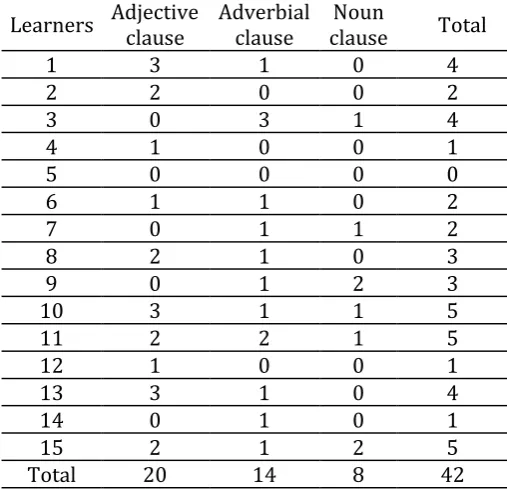
As it was mentioned above, while the learners were discussing, they were being surreptitiously recorded. Afterwards, each recorded voice was examined carefully in order to identify and categorize complex structure used by the learners. The following tables illustrate the number of complex structure males and females used in group discussion.
Table 1. Frequency of Males’ Complex Structures
Total Noun clause Adverbial clause Adjective clause Learners 4 0 1 3 1 2 0 0 2 2 4 1 3 0 3 1 0 0 1 4 0 0 0 0 5 2 0 1 1 6 2 1 1 0 7 3 0 1 2 8 3 2 1 0 9 5 1 1 3 10 5 1 2 2 11 1 0 0 1 12 4 0 1 3 13 1 0 1 0 14 5 2 1 2 15 42 8 14 20 Total
was one student who did not use any kind of complex structures, there were some students with more than three complex structures in their speaking.
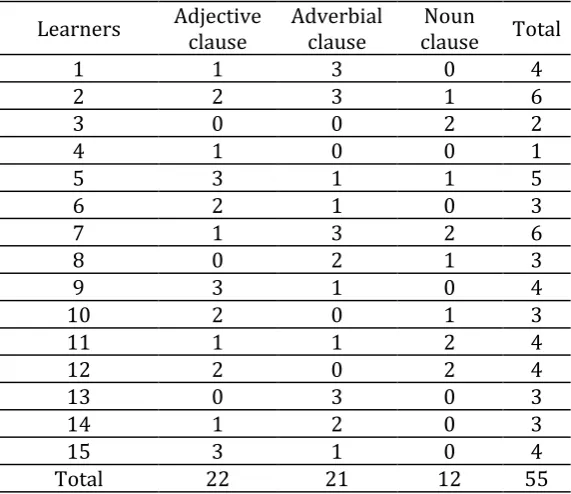
Table 2. Frequency of Females’ Complex Structures
Total Noun clause Adverbial clause Adjective clause Learners 4 0 3 1 1 6 1 3 2 2 2 2 0 0 3 1 0 0 1 4 5 1 1 3 5 3 0 1 2 6 6 2 3 1 7 3 1 2 0 8 4 0 1 3 9 3 1 0 2 10 4 2 1 1 11 4 2 0 2 12 3 0 3 0 13 3 0 2 1 14 4 0 1 3 15 55 12 21 22 Total
Table 2 illustrates complex structures, including noun clauses, adverbial clauses, and adjective clauses, used by female learners. Totally, females used more adjective clauses, while the number of noun clauses made by female students was not noticeable. All the female learners used at least one complex construction in speaking, and there were learners who used even more than three complex structures. Comparing Table 1 and Table 2, one can construe that approximately the same number of complex structures were used by learners of both genders. More specifically, adjective clause was the most common complex structure among learners, either males or females. Although there was a male student with no complex structure in his speaking, for the rest of male students, there was no striking difference with female ones. To prove this, chi-square was run and the results can be seen in the following tables.
Table 3. Frequency of Use of Different Types of Complex Structures by Male and Female Learners
Structure
Total Adjective clause Adverb clause Noun clause
Gender Male 20 14 8 42
Female 22 21 12 55
Total 42 35 20 97
Table 4. Chi-Square Results Comparing Male and Females Learners Regarding Complex Structure Use
Value df Asymp. Sig. (2-sided) Pearson Chi-Square
Likelihood Ratio Linear-by-Linear Association
N of Valid Cases
.56 .56 .43 97
2 2 1
.75 .75 .51
Since the p value under the Asymp. Sig. (2-sided) column was greater than the significance level, (.75 > .05), it could be claimed that the difference between male and female learners in the use of different complex constructions failed to reach statistical significance.
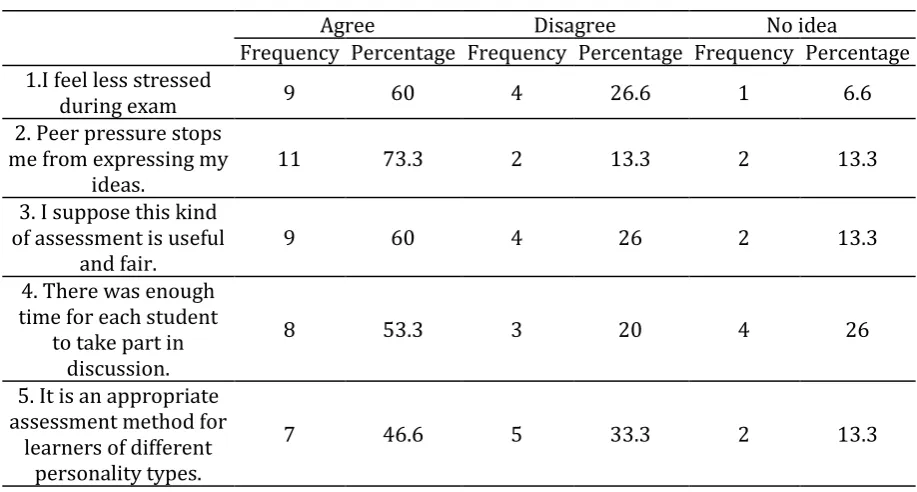
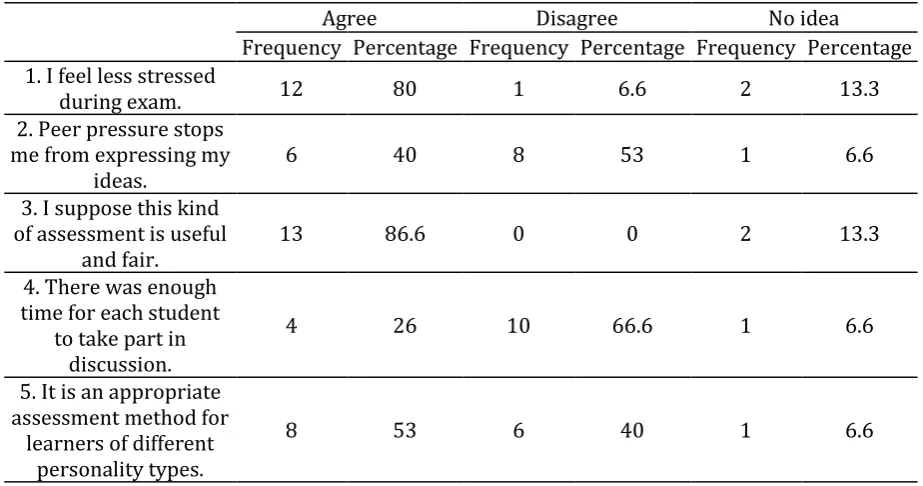
In order to answer the second question of this study, a questionnaire of 5 questions was given to the learners after they took part in the group discussion. The goal was to understand how students felt about group discussion assessment and whether they found it more or less useful in comparison to other kind of speaking assessment. Male and female learners’ responses to the questionnaire are presented in Tables 5 and 6 below.
Table 5. Males’ Responses to the Attitude Questionnaire
No idea Disagree
Agree
Percentage Frequency
Percentage Frequency
Percentage Frequency
6.6 1
26.6 4
60 9
1.I feel less stressed during exam
13.3 2
13.3 2
73.3 11
2. Peer pressure stops me from expressing my
ideas.
13.3 2
26 4
60 9
3. I suppose this kind of assessment is useful
and fair.
26 4
20 3
53.3 8
4. There was enough time for each student
to take part in discussion.
13.3 2
33.3 5
46.6 7
5. It is an appropriate assessment method for
Table 6. Female' Responses to Questionnaire
No idea Disagree
Agree
Percentage Frequency
Percentage Frequency
Percentage Frequency
13.3 2
6.6 1
80 12
1. I feel less stressed during exam.
6.6 1
53 8
40 6
2. Peer pressure stops me from expressing my
ideas.
13.3 2
0 0
86.6 13
3. I suppose this kind of assessment is useful
and fair.
6.6 1
66.6 10
26 4
4. There was enough time for each student
to take part in discussion.
6.6 1
40 6
53 8
5. It is an appropriate assessment method for
learners of different personality types.
As it was mentioned above, for having better understanding of the learners’ feelings and attitudes toward group discussion assessment, a questionnaire of 5 items was given to each and every of the 30 learners who took part in this study. Casting a quick look at Tables 5 and 6 reveals that the majority of the learners (60% males and 80% females) found this kind of assessment less stressful. In terms of peer pressure, males found it a barrier to expressing themselves nearly twice more than females (73% males and 40% females). Additionally, female students felt more positive about the fairness and usefulness of group discussion assessment (males 60% and females 86.6%).
When it comes to the allocated time to the assessment, females (26%) believed they needed more time to talk and most of them were stopped in middle of their talking whereas a lot of males (53%) thought the time was enough. On average, females spoke more about the raised topics and were more willing to express their opinions. The questionnaire also revealed that more than half of all the learners with different kinds of personality types found group discussion assessment appropriate for their given personality type; on the contrary, half others did not think it was suitable for their personality type. Overall, the most conspicuous differences between male and female learners’ opinions pertained to peer pressure and allocated time in group discussion assessment.
DISCUSSION
Table 2 shows almost the same number of complex structures were used by learners of both genders examined in the present study. Adjective clause was the most common complex structure among students, both male and female. Although there was a male student with no complex structure in his speaking, for the rest of male students, there was no significant difference with female ones. This result was confirmed by conducting a chi-square test which compared the frequencies of different complex structures produced by male and female learners. L2 learners often worry that they need to use "complex structures" in the speaking test. Using correct complex structure is important, but risky. Therefore, learners might tend to avoid making complex structure in their speaking assessment. This study showed that, given all the aforementioned variables at work, both genders tended to make use of the investigated complex structures to a rather similar extent.
Speaking is an essential skill in English language. Pupils will not be able to convey a message accurately without this skill. Most learners believe that speaking assessment is rather stressful and too subjective in scoring. By conducting the questionnaire used in this study, it was found that the majority of learners found group discussion assessment less stressful. In term of peer pressure, males found it an interruption from expressing themselves nearly twice more than females. This was so probably because classroom peers can serve as powerful sources of reinforcement in increasing or maintaining both the positive and negative behaviors of their classmates. In group discussion, peer pressure seemed to be negative for males, but not so for females.
Female learners felt more positive regarding fairness and usefulness of group discussion assessment. They spoke more about raised topics and were more willing to express their opinions. This was consistent with the results of Baker and MacIntyre (2000), where they found female learners enjoyed higher levels of willingness to communicate. The significant difference among male and female learners was related to peer pressures and allocated time, which males thought was enough but females did not think so. These results can simply be justified by the globally-renowned presumption that females tend to talk more and would like to do so.
CONCLUSION
REFERENCES
Afghari, A & Sadeghi, E. (2012). The effect of EFL learners’ gender and second language proficiency on willingness to communicate. Sheikhbahaee University EFL Journal, 1(1), 49-66.
Baker, S. & McIntyre, P.D. (2000). The role of gender and immersion in communication and second language orientations. Language Learning, 50(2), 311-341.
Brown, A. & Hill, K. (1996). Interviewer style and candidate performance in the IELTS oral interview. Report submitted to IELTS Australia.
Charlesworth, W. R., & Dzur, C. (1987). Gender comparisons of preschoolers’ behavior and resource utilization in group problem solving. Child Development, 58, 191– 200.
Gascoigne, C. (2003). The role of gender in L2 interaction: Socialization via L2 materials. Encuentro Revista de Investigacion en la Clase de Idiomas, 13, 81-89.
Hughes, A. (1989). Testing for language teachers. Cambridge: Cambridge University Press.
Lazarton, A. (1996). Interlocutor support in oral proficiency interviews: The case of CASE. Language Testing, 13(2), 151–172.
Luoma, S. (2004). Assessing speaking. Cambridge: Cambridge University Press.
Malvern, D. & Richards, B. (2002). Investigating accommodation in language proficiency interviews using a new measure of lexical diversity. Language Testing, 19(1), 85– 104.
McNamara, T. & Lumley, T. (1997). The effect of interlocutor and assessment mode variables in overseas assessment of speaking skills in occupational settings. Language Testing, 14(2), 140–156.
Mohammadzadeh, A. & Jafarigohar, M. (2012). The relationship between willingness to communicate and multiple intelligences among learners of English as a foreign language. English Language Teaching, 5(7), 25-32.
Morton, J. Wigglesworth, G. & Wiliams, D. (1997). Approaches to the evaluation of the interviewer performance in oral interaction tests. In G. Brindley & G. Wiggleworth (Eds.). Access: Issues in English language test design and delivery (pp. 175-196). Sidney: National Centre for English Language Teaching and Research.
Powell, R. (1986). Boys, girls and languages at school. London, England: Centre for Information on Language Teaching and Research.
Ross, S. & Berwick, R. (1992). The discourse of accommodation in oral proficiency interviews. Studies in Second Language Acquisition, 14(2): 159–176.
Tannen, D. (1990). You just don’t understand: Women and men in conversation. New York: Ballantine.