R E V I E W
Open Access
THOC5, a member of the mRNA export complex:
a novel link between mRNA export machinery
and signal transduction pathways in cell
proliferation and differentiation
Doan D H Tran, Alexandra Koch and Teruko Tamura
*Abstract
Cell growth, differentiation, and commitment to a restricted lineage are guided by a timely expressed set of growth factor/cytokine receptors and their down-stream transcription factor genes. Transcriptional control mechanisms of gene expression during differentiation have been mainly studied by focusing on thecis- andtrans-elements in promoters however, the role of mRNA export machinery during differentiation has not been adequately examined. THO (Suppressors of thetranscriptional defects ofhpr1 delta byoverexpression)complex 5 (THOC5) is a member of THO complex which is a subcomplex of thetranscription/export complex (TREX). THOC5 is evolutionarily conserved in higher eukaryotes, however the exact roles of THOC5 in transcription and mRNA export are still unclear. In this review, we focus on recently uncovered aspects of the role of THOC5 in signal transduction induced by extracellular stimuli. THOC5 is phosphorylated by several protein kinases at multiple residues upon extracellular stimuli. These include stimulation with growth factors/cytokines/chemokines, or DNA damage reagents. Furthermore, THOC5 is a substrate for several oncogenic tyrosine kinases, suggesting that THOC5 may be involved in cancer development. Recent THOC5 knockout mouse data reveal that THOC5 is an essential element in the maintenance of stem cells and growth factor/cytokine-mediated differentiation/proliferation. Furthermore, depletion of THOC5 influences less than 1% of total mRNA export in the steady state, however it influences more than 90% of growth factor/cytokine induced genes. THOC5, thereby contributes to the 3′processing and/or export of immediate-early genes induced by extracellular stimuli. These studies bring new insight into the link between the mRNA export complex and immediate-early gene response. The data from these studies also suggest that THOC5 may be a useful tool for studying stem cell biology, for modifying the differentiation processes and for cancer therapy.
Keywords:mRNA export protein THOC5, Immediate-early gene response, Signal transduction, Cell differentiation
Introduction
Cell lineage commitment and subsequent differentiation are tightly regulated by timely expressed cytokines/growth factors and their receptors. The binding of growth factors/ cytokines to the corresponding receptor causes receptor activation and triggers the expression of different sets of immediate-early response genes, such as v-ets erythro-blastosis virus E26 oncogene homolog (Ets) family genes, Myc, Fos, early growth response 1 (Egr1) or JunB. Tran-scriptional control mechanisms of the expression of these
genes during differentiation were mainly studied by focu-sing on the cis- and trans-elements in promoters. How-ever, recent findings reveal that the immediate-early gene response is also regulated by RNA processing machinery.
The THO complex, a sub-member of TREX (trans-cription/export), was originally identified in Saccharomy-ces cerevisiae as a five protein complex (Tho2p, Hpr1p, Mft1p, Thp2p, and Tex1) [1-6] that plays a role in tran-scriptional elongation, nuclear RNA export and genome stability. In higher eukaryotes such asDrosophila melano-gaster[7] or humans [8], three proteins, (THOC1/hHpr1/ p84, THOC2/hRlr1, and THOC3) and three additional unique proteins were identified, namely THOC5/Fms
* Correspondence:[email protected]
Institut fuer Biochemie, OE4310, Medizinische Hochschule Hannover, Carl-Neuberg-Str. 1, D-30623 Hannover, Germany
interacting protein (FMIP) [9], THOC6 and THOC7, as members of the THO complex. In this review we will focus on the role of THOC5 in extracellular stimuli mediated signal transduction.
THOC5 is conserved fromDrosophila
melanogastertohuman
Mouse and human THOC5 are 683 amino acids long. Amino acid identity of whole protein between human (NP_001002878.1) and mouse (NP_766026.1) is more
than 96%, between mouse and Xenopus tropicalis
(NP_001016827.1: 678 amino acids long) is 78%, bet-ween mouse and Danio rerio (AAH66736.1: 684 amino
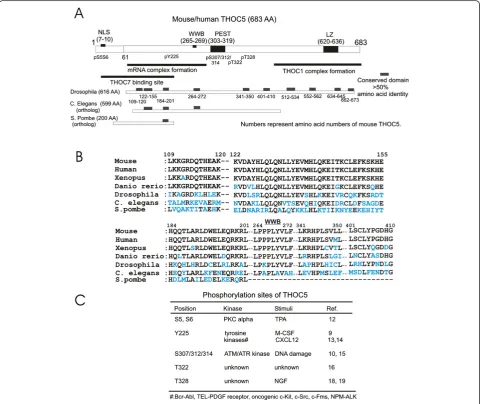
acids long) is 68%, and between mouse and Drosophila melanogaster (AAF47114.2: 616 amino acids long) is only 30%. However Drosophila THOC5 contains mul-tiple short conserved sequences all over the molecule (Figure 1A,B). These include a potential WW domain binding site that may be engaged in protein/protein inter-action (Figure 1A,B, WWB). Furthermore, THOC5 ortho-logs from Caenorhabditis elegans(C. elegans, CCD73969. 1: 599 amino acids long) andSchizosaccharomyces pombe (S. pombe, CAB54812.1: 200 amino acids long) also contain three and one conserved sequences at the N-terminal domain, respectively (Figure 1A,B). Mouse, human and Xenopus,but notDrosophilaorC. elegansTHOC5 contains
a PEST like domain, i.e. target sequence for proteo-lytic degradation. Furthermore, the human and mouse N-terminal domain (60–289 amino acid number) parti-cipates in forming a complex with mRNA [10] and also binds to THOC7, another member of the THO complex [11]. The C-terminal domain (500–683) is involved in the association with THOC1 [11] (Figure 1A).
THOC5 is phosphorylated by extracellular stimuli THOC5 is phosphorylated at multiple positions by extra-cellular stimuli, such as stimulation with growth factors/ cytokines/chemokines, or DNA damage. The phosphory-lation sites of THOC5 are summarized as following (see also Figure 1C).
Serine 5/6: Protein kinase C phosphorylates and in-hibits nuclear import of THOC5 [12].
Tyrosine 225: It has been shown that THOC5 is a sub-strate for several tyrosine kinases such as macrophage-colony stimulating factor (M-CSF, or CSF-1) receptor, Fms [9], and various leukemogenic tyrosine kinases, such as Bcr-Abl (breakpoint cluster region-Abl tyrosine kinase fusion protein), translocation-ets-leukemia (TEL)-platelet derived growth factor (PDGF) receptor, oncogenic c-Kit (receptor for stem cell factor) or nucleophosmin (NPM)-anaplastic lymphoma kinase (ALK) [13,14]. Recent data showed that upon stimulation with chemokine (C-X-C motif ) ligand 12 (CXCL12), tyrosine 225 is also phospho-rylated via c-Src [13]. Notably, it has been clearly demon-strated that THOC5 is highly phosphorylated in CD34 positive chronic myeloid leukemia cells. Thus, tyrosine phosphorylation of THOC5 may be involved in leukemic cell behavior [13], however the biological consequence of tyrosine phosphorylation of THOC5 during leukemia de-velopment remains to be studied.
Serine 307/312/314: Three serine residues (S307/312/ 314) in the PEST domain of THOC5 have been shown to be directly phosphorylated by Ataxia-telangiectasia-mutated (ATM) kinase [15] followed by loss of the RNA binding potential of THOC5 [10], suggesting a novel connection between DNA damage and RNA export ma-chinery. Notably, these serines are highly phosphorylated in testis [16] where ATM kinase plays a key role in spermatogenesis [17].
Threonine 322: this residue is phosphorylated in kidney, liver, spleen and testis by an unknown kinase [16].
Threonine 328: This phosphorylation was first re-ported using Akt kinase substrate antibody [18,19]. Upon stimulation with nerve growth factor (NGF), but not with insulin [18,19], threonine 328 is phosphory-lated. Although ribosomal S6 kinase (RSK) and proto-oncogene kinase Pim1 phosphorylate at this residue in vitro (Koch and Tamura, unpublished data), it is not clear which protein kinase directly phosphorylates this residuein vivo.
Notably, all phosphorylation sites listed above are con-served among vertebrates, such as mouse, human,Danio rerio,Latimeria chalumnae(XP_006008521),Geospiza for-tis(XP_005427642), andXenopus tropicalisTHOC5, but a corresponding amino acid was not found in Drosophila melanogaster, C. elegansorS. pombeTHOC5.
Subcellular localization of THOC5
THOC5 is ubiquitously expressed in all organs [9]. It is located mainly in the nuclear speckles in bone marrow derived immature macrophages [20] or human mesen-chymal stem cells (Figure 2A). In the terminal differen-tiated macrophages, however THOC5 is detected mainly in the cytoplasm [20], while in differentiated gut epithe-lial cells THOC5 is still in the nucleus [21]. This diffe-rence may be due to the quick turnover of gut epithelial cells.
Although THOC5 is detected mainly in the nucleus in NIH3T3 and Hela cells, heterokaryon assay experiment reveals that THOC5 is able to shuttle from human Hela cells to mouse NIH3T3 cells (Figure 2B), indicating that THOC5 is nuclear/cytoplasmic shuttling protein. It re-mains unknown whether THOC5 plays any role in the cytoplasm.
THOC5 contributes to the differentiation process in vivoandin vitro
regenerative organs. On the other hand, depletion of THOC5 in terminally differentiated organs such as liver or kidney did not result in any pathological alterations [21]. Although hepatocytes express THOC5 at a high level [9], the mice in which THOC5 is depleted only in the liver survived for more than 3 months without any symptoms [26]. It has been shown that the conventional THOC1 (another member of THO complex) knockout mice are embryonic lethal [27]. However, using the tamoxi-fen inducible knockout mice system, knockout phenotype is quite different between THOC5 [21] and THOC1 [28]. Upon depletion of THOC1, pathological alteration was ob-served exclusively in stem cells from the small intestine, not in stem cells from colon, mammary gland or hematopoietic cells [28]. It is not clear whether the function of THOC1 and/or the efficiency of the tamoxifen inducible system are different than those of THOC5. Since THOC1 is also expressed ubiquitously the molecular mechanism which leads to alteration exclusively in small intestinal stem cells upon depletion of THOC1 remains to be studied.
THOC5 dependent mRNAs
As described above, the depletion of THOC5 in liver does not result in a pathological phenotype. Further-more,albuminortransferrinmRNAs were exported into the cytoplasm in the THOC5 depleted liver [21], indica-ting that THOC5 does not play a role in export of a bulk polyA + RNA. In agreement with these data, Katahira et al. [29] and Chi et al. [30] showed that the depletion of THOC5 in Hela cells did not cause the accumulation of polyA + RNA in the nucleus. Similar data was also
obtained using the HEK293 system [31]. Depletion of THOC5 however, causes severely altered phenotypes in mice, indicating that THOC5 is involved in indispensable functions for the differentiation process. These facts raise the question as to which mRNAs are THOC5 dependent.
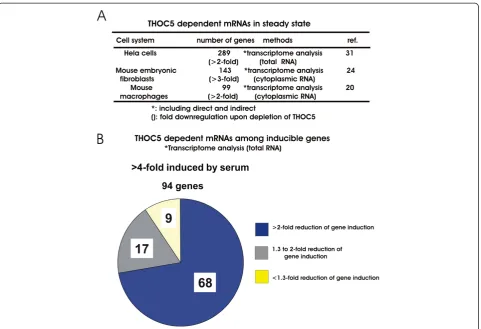
THOC5 dependent mRNAs were studied by trans-criptome analysis before or after depletion of THOC5 in three systems, namely human Hela cells, mouse em-bryonic fibroblasts, and mouse bone marrow derived mac-rophages (Figure 3A). In Hela cells the knockdown of THOC5 leads to down-regulation of 289 genes (>2-fold) [32]. In the mouse embryonic fibroblast system [25] and in the macrophage system [20] depletion of THOC5 caused the downregulation of 143 (>3-fold) and 99 (>2-fold) genes, respectively. The Ingenuity Pathway Analysis (IPA) of these genes reveals that over 60% of the genes were involved in differentiation/proliferation/motility. These included SRY-box containing gene (Sox) family genes, inhibitor of DNA binding (ID) family genes, Homeobox (Hox)A1 or HoxB3, and polycomb gene CBX2 [20,25] that are required for the maintenance of primitive cells.
Extracellular stimuli induced mRNAs and THOC5 In the yeast system, it has been demonstrated that the THO complex plays a crucial role in processing of heat shock induced mRNA [33-35]. Recently, Mouaikel et al. [34] demonstrated that a high-frequency promoter asso-ciated with the THO complex function in the yeast sys-tem. Does THO complex in mammalian system also plays a role in highly inducible genes, such as immediate-early response genes?
When macrophages were stimulated with M-CSF, the expression of different sets of immediate-early response genes, such as Ets family genes, Myc, Fos, early growth response 1 (Egr1), or JunB are induced [36]. Indeed, Ets family genes failed to be upregulated upon stimulation with M-CSF in the absence of THOC5 [20]. Furthermore, Wnt (wingless/integrated) signal target genes, achaete-scute complex homolog 2 (Ascl2), Sox9, or snail family zinc finger (Snai)1, which play a key role in maintenance of intestinal stem cells and epithelial cell differentiation [37-42], are THOC5 dependent [21], indicating that the observed pathological alterations resulting from the deple-tion of THOC5 in intestinal epithelial cells are due to the lack of Wnt target gene expression.
Which population of inducible genes is indeed THOC5 dependent? Our recent data obtained from transcriptome analysis using serum induced mRNAs in mouse embryonic fibroblasts reveal that upon stimula-tion with serum, 94 genes were upregulated more than
4-fold within 1 h in the presence of THOC5. In THOC5 depleted cells, however only 9 genes were upregulated to a similar extent (Figure 3B), indicating that redun-dant backup pathways only partially rescue mRNA pro-cessing in the absence of THOC5 under serum induced conditions. These genes can be divided into two cate-gories: One set of genes (e. g.etsfamily genes) [20] were not induced in the absence of THOC5. Another set of genes were induced in delayed manner, and spliced, but not exported (e. g.Smadfamily genes,Snai1) [20,21]. In agreement with these data, Grb10 interacting GYF pro-tein 2(Gigyf2or Tnrc15),and protein kinase C binding protein 1(Prkcbp1)that were identified as THOC5 tar-get genes using the fibroblast system were spliced but not exported in the absence of THOC5 [25]. These data imply that THOC5 plays a role in mRNA processing and export, however a redundant backup pathway may rescue the mRNA processing of a subset of genes, but not the export.
Figure 3Identification of THOC5 dependent genes in steady state and under serum stimulation conditions. A:Summary table of transcriptome analyses in THOC5 depleted Hela cells [32], mouse embryonic fibroblasts [25], and bone marrow derived macrophages [20].
Potential molecular function of THOC5 in immediate-early gene processing
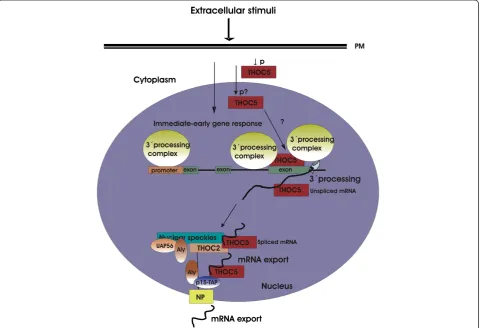
Lipopolysaccharide induced full-length nascent RNAs that contain introns accumulated on chromatin prior to release of functional mRNA for export [43]. These RNAs are post-transcriptionally spliced. Our preliminary data reveal that in the absence of THOC5 chromatin asso-ciatedEts1mRNA accumulated to a greater extent than in the presence of THOC5 after M-CSF stimulation. These data suggest that THOC5 may play a role in re-lease of its target immediate-early gene transcripts from chromatin. In agreement with these data, Katahira et al. recently showed that THOC5 plays a role in 3′ proces-sing of THOC5 target genes in Hela cells [32]. The same authors show that THOC5 interacts with polyadenyla-tion specific factor 6, (CPSF6, or CFIm68). Moreover, CFIm68 is not properly recruited to the 5′end of certain genes in THOC5 depleted cells and that in these genes 3′end cleavage is altered. CPSF6 is recruited to the
promoter region of THOC5 target genes, however it is not clear to where THOC5 is recruited in this system [32]. We recently showed that THOC5 is recruited to the last exon, but not the promoter region ofEts1gene upon stimulation with M-CSF [20] (Figure 4). Thus, it could be that in a subset of genes, THOC5 dictates the 3′ cleavage site by directly recruiting the CPSF machi-nery, while in other transcripts, such asEts1, it does not. The mechanism by which THOC5 is recruited to its tar-get genes and how the depletion of THOC5 reduces the recruitment of the 3′processing complex still remains to be studied. It has been shown that unspliced and spliced Ets1 mRNA bind to THOC5 [20], and THOC5 is mainly detected in nuclear speckles where post-transcriptional splicing occurs [44-46], suggesting that THOC5 may be involved in mRNA localization in nuclear speckles. In addition, it has been documented that for the export of spliced mRNAs from nuclear speckles, other members of TREX, Aly, UAP56 and THOC2 are required [30,44]. It
has been suggested that THOC5 and the adapter protein Aly concomitantly bind the mRNA receptor Tap-p15 and play a role in Tap-p15 mediated nuclear export ofHsp70 mRNA under heat shock conditions [29] (Figure 4). How-ever, the exact role of THOC5 in 3′ processing, and export of growth factor/cytokine inducible genes still re-mains to be studied.
Target selectivity of THOC5
How does THOC5 select its target mRNAs? Interestingly, all rapidly-inducible genes, such asFos, Egr1, immediate-early response 2 (Ier2), or JunB which are identified in macrophages stimulated by lipopolysaccharides [43] are induced and exported without alteration in THOC5 depleted cells [20]. These are intron-less (Jun, Ier2) or co-transcriptionally spliced (Fos, Egr1) genes. THOC5 de-pendent immediate-early genes which have so far been indentified are spliced post-transcriptionally. Recently, Katahira et al. [32] proposed that THOC5 controls an al-ternative polyadenylation site choice by recruiting cleavage factor CPSF6 on target genes. However, 70-75% of human mRNAs contain a potential alternative polyadenylation site [47], suggesting that THOC5 dependency may also be associated with different RNA element(s). It has been pre-viously shown in the yeast system that the yeast homolog of THOC1, Hpr1 is required for transcription of either long or GC rich DNA sequences [2]. Interestingly, the coding regions (not in the 3′-UTR) ofSox9, Ascl2,Snai1, and Wnt11(THOC5 dependent genes) contain high per-centages of GC degree (61-67%), while THOC5 independ-ent genes contain 54-55% GC [21]. However, GC-contindepend-ent is known to vary even within most genes [48]. Fur-thermore, the target selectivity of THOC5 is highly com-plex, because redundant backup pathways partially rescue mRNA 3′ processing and export to a different degree in the absence of THOC5. Identifying the binding partners of THOC5 for the 3′processing or the export of its target mRNAs, and further identification of THOC5 target genes may provide more insight into its target selectivity.
Potential applications
The findings described above suggest that the level of THOC5 in cells is one of key factors for controlling the immediate-early gene response. We have previously shown that a 50% reduction of endogenous THOC5 in C2C12 cells causes adipocyte differentiation under muscle differentiation conditions, while a 2-fold over-expression of THOC5 causes muscle differentiation under adipocyte differentiation conditions [22]. In agreement with these conditions for generating phenotypes, CCAAT/enhancer-binding protein (C/EBP) family genes (no intron) that play a key role in adipocyte differentiation are THOC5 inde-pendent (GEO series accession number GSE41170), while Soxfamily genes,CBX2, ID2orHOXB3that participate in
muscle differentiation are THOC5 dependent [20,25]. This mechanism may also served as a useful tool to manipulate lineage commitments from mesenchymal stem cells by down- or upregulation of THOC5 expression at different levels.
Furthermore, the knockdown of THOC1 or THOC5 did not cause apoptosis in normal cells, but it causes apoptosis in cancer cells [25,27,49]. In addition, recent data imply the involvement of THOC5 in leukemia development [13]. These data suggest that members of THO complex could be a target molecule for cancer therapy.
Conclusions
THOC5 that couples transcription and mRNA processing with mRNA export is a key molecule for maintenance of stem cells and for differentiation/proliferation in multiple organs. THOC5 is required for the 3′processing and/or export of most cytokine/growth factor induced genes. Thus, THOC5 is one of key factors to commit cell lineage and to mediate fine tuning during cell differentiation. Presently, however understanding of the molecular func-tion of THOC5 in immediate-early gene response is still in its infancy. Does phosphorylation influence its function and cancer development? How is THOC5 recruited to active immediate-early genes? How does THOC5 select its target genes? Does THOC5 participate in post-transcrip-tional splicing? These questions remain to be answered.
Competing interests
The authors declare that they have no competing interests.
Authors’contributions
DDHT, AK and TT drafted and wrote the manuscript. All authors participated in the discussion and approved the final manuscript.
Acknowledgments
We apologize to all colleagues whose important works could not be cited here due to space restrictions. We thank C. Bruce Boschek and Shashank Saran for critically reading the manuscript. The publication of this article was funded by the program“Open Access Publizieren”of Deutsche
Forschungsgemeinschaft. The work was supported by DFG Ta 111/13-1.
Received: 3 December 2013 Accepted: 6 January 2014 Published: 10 January 2014
References
1. Chavez S, Aguilera A:The yeast HPR1 gene has a functional role in transcriptional elongation that uncovers a novel source of genome instability.Genes Dev1997,11(24):3459–3470.
2. Chavez S, Garcia-Rubio M, Prado F, Aguilera A:Hpr1 is preferentially required for transcription of either long or G+C-rich DNA sequences in Saccharomyces cerevisiae.Mol Cell Biol2001,21(20):7054–7064. 3. Jimeno S, Rondon AG, Luna R, Aguilera A:The yeast THO complex and
mRNA export factors link RNA metabolism with transcription and genome instability.EMBO J2002,21(13):3526–3535.
4. Piruat JI, Aguilera A:A novel yeast gene, THO2, is involved in RNA pol II transcription and provides new evidence for transcriptional elongation-associated recombination.EMBO J1998,17(16):4859–4872.
6. Reed R, Cheng H:TREX, SR proteins and export of mRNA.Cur Opin Cell Biol2005,17(3):269–273.
7. Rehwinkel J, Herold A, Gari K, Kocher T, Rode M, Ciccarelli FL, Wilm M, Izaurralde E:Genome-wide analysis of mRNAs regulated by the THO complex in Drosophila melanogaster.Nat Struct Mol Biol2004, 11(6):558–566.
8. Masuda S, Das R, Cheng H, Hurt E, Dorman N, Reed R:Recruitment of the human TREX complex to mRNA during splicing.Genes Dev2005, 19(13):1512–1517.
9. Tamura T, Mancini A, Joos H, Koch A, Hakim C, Dumanski J, Weidner KM, Niemann H:FMIP, a novel Fms-interacting protein, affects granulocyte/ macrophage differentiation.Oncogene1999,18(47):6488–6495. 10. Ramachandran S, Tran DD, Klebba-Faerber S, Kardinal C, Whetton AD,
Tamura T:An ataxia-telangiectasia-mutated (ATM) kinase mediated response to DNA damage down-regulates the mRNA-binding potential of THOC5.RNA (New York, NY2011,17(11):1957–1966.
11. El Bounkari O, Guria A, Klebba-Faerber S, Claussen M, Pieler T, Griffiths JR, Whetton AD, Koch A, Tamura T:Nuclear localization of the pre-mRNA associating protein THOC7 depends upon its direct interaction with Fms tyrosine kinase interacting protein (FMIP).FEBS letters2009,583(1):13–18. 12. Mancini A, Koch A, Whetton AD, Tamura T:The M-CSF receptor substrate and interacting protein FMIP is governed in its subcellular localization by protein kinase C-mediated phosphorylation, and thereby potentiates M-CSF-mediated differentiation.Oncogene2004,23(39):6581–6589. 13. Griaud F, Pierce A, Gonzalez Sanchez MB, Scott M, Abraham SA, Holyoake
TL, Tran DD, Tamura T, Whetton AD:A pathway from leukemogenic oncogenes and stem cell chemokines to RNA processing via THOC5. Leukemia2013,27(4):932–940.
14. Pierce A, Carney L, Hamza HG, Griffiths JR, Zhang L, Whetton BA, Gonzalez Sanchez MB, Tamura T, Sternberg D, Whetton AD:THOC5 spliceosome protein: a target for leukaemogenic tyrosine kinases that affects inositol lipid turnover.Br J Haematol2008,141(5):641–650. 15. Matsuoka S, Ballif BA, Smogorzewska A, McDonald ER 3rd, Hurov KE, Luo J,
Bakalarski CE, Zhao Z, Solimini N, Lerenthal Y,et al:ATM and ATR substrate analysis reveals extensive protein networks responsive to DNA damage. Science (New York, NY2007,316(5828):1160–1166.
16. Beausoleil SA, Villen J, Gerber SA, Rush J, Gygi SP:A probability-based approach for high-throughput protein phosphorylation analysis and site localization.Nat Biotechnol2006,24(10):1285–1292.
17. Takubo K, Ohmura M, Azuma M, Nagamatsu G, Yamada W, Arai F, Hirao A, Suda T:Stem cell defects in ATM-deficient undifferentiated spermatogonia through DNA damage-induced cell-cycle arrest.Cell stem cell2008, 2(2):170–182.
18. Gridley S, Lane WS, Garner CW, Lienhard GE:Novel insulin-elicited phosphoproteins in adipocytes.Cell Signal2005,17(1):59–66. 19. Kane S, Sano H, Liu SC, Asara JM, Lane WS, Garner CC, Lienhard GE:A
method to identify serine kinase substrates. Akt phosphorylates a novel adipocyte protein with a Rab GTPase-activating protein (GAP) domain. J Biol Chem2002,277(25):22115–22118.
20. Tran DD, Saran S, Dittrich-Breiholz O, Williamson AJ, Klebba-Farber S, Koch A, Kracht M, Whetton AD, Tamura T:Transcriptional regulation of immediate-early gene response by THOC5, a member of mRNA export complex, contributes to the M-CSF-induced macrophage differentiation. Cell Death Dis2013,4:e879.
21. Saran S, Tran DD, Klebba-Farber S, Moran-Losada P, Wiehlmann L, Koch A, Chopra H, Pabst O, Hoffmann A, Klopfleisch R,et al:THOC5, a member of the mRNA export complex, contributes to processing of a subset of wingless/integrated (Wnt) target mRNAs and integrity of the gut epithelial barrier.BMC Cell Biol2013,14(1):51.
22. Mancini A, El Bounkari O, Norrenbrock AF, Scherr M, Schaefer D, Eder M, Banham AH, Pulford K, Lyne L, Whetton AD,et al:FMIP controls the adipocyte lineage commitment of C2C12 cells by downmodulation of C/EBP alpha.Oncogene2007,26(7):1020–1027.
23. Kamath RV, Leary DJ, Huang S:Nucleocytoplasmic shuttling of polypyrimidine tract-binding protein is uncoupled from RNA export. Mol Biol Cell2001,12(12):3808–3820.
24. Carney L, Pierce A, Rijnen M, Gonzalez Sanchez MB, Hamzah HG, Zhang L, Tamura T, Whetton AD:THOC5 couples M-CSF receptor signaling to transcription factor expression.Cell Signal2009,21(2):309–316. 25. Guria A, Tran DD, Ramachandran S, Koch A, El Bounkari O, Dutta P, Hauser H,
Tamura T:Identification of mRNAs that are spliced but not exported to the
cytoplasm in the absence of THOC5 in mouse embryo fibroblasts. RNA (New York, NY2011,17:1048–1056.
26. Mancini A, Niemann-Seyde SC, Pankow R, El Bounkari O, Klebba-Farber S, Koch A, Jaworska E, Spooncer E, Gruber AD, Whetton AD,et al:THOC5/ FMIP, an mRNA export TREX complex protein, is essential for hematopoietic primitive cell survival in vivo.BMC Biol2010,8:1. 27. Li Y, Wang X, Zhang X, Goodrich DW:Human hHpr1/p84/Thoc1 regulates
transcriptional elongation and physically links RNA polymerase II and RNA processing factors.Mol Cell Biol2005,25(10):4023–4033. 28. Pitzonka L, Wang X, Ullas S, Wolff DW, Wang Y, Goodrich DW:The THO
ribonucleoprotein complex is required for stem cell homeostasis in the adult mouse small intestine.Mol Cell Biol2013. E-pub.
29. Katahira J, Inoue H, Hurt E, Yoneda Y:Adaptor Aly and co-adaptor Thoc5 function in the Tap-p15-mediated nuclear export of HSP70 mRNA. EMBO J2009,28(5):556–567.
30. Chi B, Wang Q, Wu G, Tan M, Wang L, Shi M, Chang X, Cheng H:Aly and THO are required for assembly of the human TREX complex and association of TREX components with the spliced mRNA.Nuc Acids Res
2013,41(2):1294–1306.
31. Viphakone N, Hautbergue GM, Walsh M, Chang CT, Holland A, Folco EG, Reed R, Wilson SA:TREX exposes the RNA-binding domain of Nxf1 to enable mRNA export.Nat Commun2012,3:1006.
32. Katahira J, Okuzaki D, Inoue H, Yoneda Y, Maehara K, Ohkawa Y:Human TREX component Thoc5 affects alternative polyadenylation site choice by recruiting mammalian cleavage factor I.Nuc Acids Res2013, 41(14):7060–7072.
33. Jensen TH, Patricio K, McCarthy T, Rosbash M:A block to mRNA nuclear export in S. cerevisiae leads to hyperadenylation of transcripts that accumulate at the site of transcription.Mol Cell2001,7(4):887–898. 34. Mouaikel J, Causse SZ, Rougemaille M, Daubenton-Carafa Y, Blugeon C,
Lemoine S, Devaux F, Darzacq X, Libri D:High-frequency promoter firing links THO complex function to heavy chromatin formation.Cell Reports
2013,5(4):1082–1094.
35. Rougemaille M, Gudipati RK, Olesen JR, Thomsen R, Seraphin B, Libri D, Jensen TH:Dissecting mechanisms of nuclear mRNA surveillance in THO/sub2 complex mutants.EMBO J2007,26(9):2317–2326.
36. Sherr CJ:Mitogenic response to colony-stimulating factor 1.Trends Genet
1991,7(11–12):398–402.
37. Blache P, van de Wetering M, Duluc I, Domon C, Berta P, Freund JN, Clevers H, Jay P:SOX9 is an intestine crypt transcription factor, is regulated by the Wnt pathway, and represses the CDX2 and MUC2 genes.J Cell Biol2004, 166(1):37–47.
38. Fevr T, Robine S, Louvard D, Huelsken J:Wnt/beta-catenin is essential for intestinal homeostasis and maintenance of intestinal stem cells.Mol Cell Biol2007,27(21):7551–7559.
39. Horvay K, Casagranda F, Gany A, Hime GR, Abud HE:Wnt signaling regulates snai1 expression and cellular localization in the mouse intestinal epithelial stem cell niche.Stem Cells Dev2011,20(4):737–745. 40. Lickert H, Kispert A, Kutsch S, Kemler R:Expression patterns of Wnt genes
in mouse gut development.Mech Dev2001,105(1–2):181–184. 41. Planutiene M, Planutis K, Holcombe RF:Lymphoid enhancer-binding
factor 1, a representative of vertebrate-specific Lef1/Tcf1 sub-family, is a Wnt-beta-catenin pathway target gene in human endothelial cells which regulates matrix metalloproteinase-2 expression and promotes endothelial cell invasion.Vascl Cell2011,3:28.
42. von Toerne C, Schmidt C, Adams J, Kiss E, Bedke J, Porubsky S, Gretz N, Lindenmeyer MT, Cohen CD, Grone HJ,et al:Wnt pathway regulation in chronic renal allograft damage.Am J Transplant2009,9(10):2223–2239. 43. Bhatt DM, Pandya-Jones A, Tong AJ, Barozzi I, Lissner MM, Natoli G, Black
DL, Smale ST:Transcript dynamics of proinflammatory genes revealed by sequence analysis of subcellular RNA fractions.Cell2012,150(2):279–290. 44. Dias AP, Dufu K, Lei H, Reed R:A role for TREX components in the
release of spliced mRNA from nuclear speckle domains.Nat Commun
2010,1:97.
45. Vargas DY, Shah K, Batish M, Levandoski M, Sinha S, Marras SA, Schedl P, Tyagi S:Single-molecule imaging of transcriptionally coupled and uncoupled splicing.Cell2011,147(5):1054–1065.
46. Girard C, Will CL, Peng J, Makarov EM, Kastner B, Lemm I, Urlaub H, Hartmuth K, Luhrmann R:Post-transcriptional spliceosomes are retained in nuclear speckles until splicing completion.Nat Commun
47. Elkon R, Ugalde AP, Agami R:Alternative cleavage and polyadenylation: extent, regulation and function.Nat Rev Genet2013,14(7):496–506. 48. Palazzo AF, Akef A:Nuclear export as a key arbiter of“mRNA identity”in
eukaryotes.Biochimica et biophysica acta2012,1819(6):566–577. 49. Li Y, Lin AW, Zhang X, Wang Y, Wang X, Goodrich DW:Cancer cells and
normal cells differ in their requirements for Thoc1.Cancer Res2007, 67(14):6657–6664.
doi:10.1186/1478-811X-12-3
Cite this article as:Tranet al.:THOC5, a member of the mRNA export complex: a novel link between mRNA export machinery and signal transduction pathways in cell proliferation and differentiation.Cell Communication and Signaling201412:3.
Submit your next manuscript to BioMed Central and take full advantage of:
• Convenient online submission
• Thorough peer review
• No space constraints or color figure charges
• Immediate publication on acceptance
• Inclusion in PubMed, CAS, Scopus and Google Scholar
• Research which is freely available for redistribution
![Figure 2 Subcellular localization of THOC5. ATHOC5. In immature macrophages, THOC5 is located mainly in the nucleus (nuclear speckle-like domains), while in mature macrophages THOC5is also found in the cytoplasm [20]](https://thumb-us.123doks.com/thumbv2/123dok_us/411131.2038523/4.595.59.541.89.272/figure-subcellular-localization-immature-macrophages-domains-macrophages-cytoplasm.webp)