- 523 -
Structuring requirements as necessary premise for
customer-oriented development of complex products: A
generic approach
Sandra Klute
1, Robert Refflinghaus
21
Dortmund University of Technology (Germany)
2 RIF e.V.(Germany)
Received June 2010
Accepted September 2011
Abstract:
- 524 -
hundreds of data records, structuring requirements is mandatory to achieve
accuracy, clarity and consequently satisfactory results when transforming
requirements into product characteristics
which fit customer needs. In the paper an
excerpt of this model is presented.
Design/methodology/approach: In literature a multitude of methods which
deal with the topic of structuring exist. The methods have been analysed regarding
their purpose and their level of specification, i.e. the number of differentiated
categories, to check if they could be applied in the regarded area of intra-logistics.
Also potential stakeholders have been identified to ensure that the surveying of
requirements is not incomplete. Based on these analyses an own model has been
developed which combines, adepts and enlarges the existing methods.
Findings: A 10-dimensional model has been developed for structuring
requirements on intra-logistical facilities. This model is holistic, because
additionally it allows capturing the stakeholders’ feedback to the requirements’
fulfilment. The dimensions of the model can be divided into four groups. The first
one serves to structure the requirements regarding their content. These are the
dimensions obligations, surroundings, information, qualification,
technical-functional requirements and qualification. The second group serves to structure the
reference object to which the requirements refer and includes the dimension
product. Weighted level of performance and customer satisfaction are part of the
third group, which encompasses the evaluation of the requirements’ fulfilment.
The fourth group is for the temporal structuring of requirements and includes the
dimension time. For applying the model it has been implemented for data
processing as component of a large data processing system. The developed model
is presented in this paper.
- 525 -
requirements on maintenance have to be observed. Using the model, working with
lots of requirements should be facilitated. Thereby, clustering and weighting of
requirement should be advanced.
Practical implications: For applying the model and handling the great amount of
requirements, the model has been implemented for data processing. This allows
the stakeholder to easily sort the requirements into the model. Thereby, the system
offers many assistance functions which should facilitate the matching for example
matching of the same requirement by other stakeholders can be shown or
matching of similar requirements.
Originality/value: In contrast to the existing structuring methods the developed
model is holistic and generic. It allows to capture the stakeholders’ feedback to the
requirements fulfilment and hence a comparison between nominal and actual
condition. Moreover, it can be applied not only the area of intra-logistics, for which
it has been originally developed, but to complex products in general. Even if an
adaption of the dimensions’ categories might be necessary.
Keywords: requirements, structuring, product development
1 Introduction
When planning and developing complex products customer orientation has become of foremost importance for the companies. Individual products that meet the customer needs replace standardized products. Therefore, it is essential for companies to identify the customer requirements and transform them into adequate product characteristics. In this context, sustainability has become an important aspect in the last years. Thereby, ecological, economic and social sustainability can be differentiated (Stead & Stead, 2004). They determine buying decisions to an increasing degree. Hence, companies have to cope with demands regarding theses aspects by adapting their aims, strategies, products and processes and their outward communication.
- 526 -
management is necessary. Apart from the systematic gathering of requirements this should include a requirements’ structuring. Thereby, it should be considered that the requirements refer to different aspects of the product and that they have a different level of specification. For this purpose, a generic multi-dimensional model had been created within the German Collaborative Research Centre 696, Logistics on Demand. This model allows structuring requirements on the one hand and giving feedback of the extent of requirements’ fulfilment by measuring the weighted level of performance and the customer satisfaction on the other hand. This paper gives an overview of the developed model and its dimensions. Moreover, the dimensions economy, technical-functional aspects and the dimensions that serve to give feedback will be presented in more detail.
2 10-dimensional structuring model
For structuring requirements, a generic, 10-dimensional model has been created based on the analysis of a variety of methods which deal with the topic of structuring and on the identification of potential stakeholders. This analysis has shown that the existing methods differ regarding the number of distinguished categories and their purpose but none of them could be transferred to the area of intra-logistical facilities because of its complexity. Moreover it has been necessary to combine, adept and extent the existing methods (Crostack, Klute & Refflinghaus, 2010). Thereby, the developed model’s basic idea is that it is not sufficient to consider merely requirements. In fact, a holistic approach is necessary which should include the stakeholders’ evaluation of the requirements’ fulfilment as well as the customer satisfaction which results from this in addition to the regarded product respectively the requirements made on it. By this a feedback between requirements and their fulfilment and the consideration of latent requirements is enabled. Moreover, it is not sufficient to consider solely the “product core”. In fact, additional services and the delivery have to be taken into account, too.
Figure 1. Basic idea of the model
The model encompasses the dimensions obligations, surroundings, information,
- 527 -
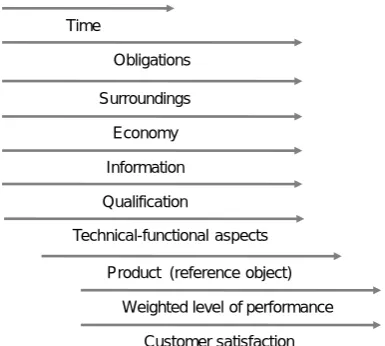
economy, qualification, technical-functional aspects, product, weighted level of performance and customer satisfaction. The dimensions fulfil different purposes and therefore are different from each other regarding their content and meaning. Whereas the first six mentioned dimensions serve to structure the stakeholder requirements and hence capture the nominal condition, the dimension weighted level of performance measures the reaction of the stakeholders regarding the fulfilment of their requirements by comparing nominal and actual condition and the dimension customer satisfaction the therefrom resulting satisfaction. That means, the reaction of the customer to existing attributes of the (real) product or within the framework of tests, like for instance three-dimensional simulations has to be surveyed. By comparing nominal condition and actual condition it is shown whether and how far the stakeholder requirements are fulfilled. Consequently, the dimensions “weighted level of performance” and “customer satisfaction” capture the actual condition. Hence, they are temporally behind the other ones. In contrast, the dimension product does not contain requirements in their classical meaning. In fact, it serves to structure the reference object to which the requirements refer, i.e. a product or a process.
In addition to the requirements’ structuring from the stakeholders’ point of view, also time aspects have been taken into account. In this context, it has been considered that requirements are of different importance in different stages of the life cycle and that they are dynamical. That means they change over time regarding their meaning and their level of specification. For instance, stakeholders may not be able to articulate all of their requirements at the beginning of the planning process and may not be precise in their requirements (Gautum & Singh, 2008). Hence, time has been considered as separate dimension.
Figure 2. 10-dimensional model
Time
Obligations
Surroundings
Economy
Information
Qualification
Product (reference object)
Weighted level of performance
- 528 -
Originally, this model has been developed for the fields of intra-logistics and thus the development of complex facilities. However, it can also be applied and extended to other fields by adapting the dimensions and their categories if necessary. Each dimension which serves to structure requirements can be divided into several categories and sub-categories so that requirements can be adequately matched according to their level of specification. Thereby, laminations should be avoided to allow valid interpretation by comparing these categories. That means categories of different dimensions should not be too similar (Crostack, Klute & Refflinghaus, 2010). Nevertheless, it could not be avoided that they deal with the same topic but from a different point of view and with different focus. For example, the aspect of environment is treated within the dimensions obligations and surroundings. The dimension “obligations” thereby deals with requirements regarding environmental protection by observing laws and provisions concerning this matter. In contrast, the dimension “surroundings” deals with aspects which are not necessarily dealt with by law like, for example, stakeholder requirements concerning radiation and sonic which go beyond legal requirements.
Furthermore, it should be considered that requirements could not be sorted into only one dimension. They should rather be classified in the 10-dimensional space of the model although they should not necessarily been sorted into all of them. The dimensions allow to determine and to structure all requirements on intra-logistical facilities in the case at hand and complex products or processes in general. Therefore, a further detailing and categorizing of the dimensions is requisite to ensure a topical classification of the requirements which takes their level of specification into account.
Following, the dimensions economy and technical-functional aspects to which requirements concerning sustainable aspects often refer are presented in more detail. Also the dimensions product, weighted level of performance and customer satisfaction are described in more detail because they give feedback to the gathered requirements.
2.1 Economy
For buying decisions economic aspects are an important factor. Especially in the context of economic sustainability cost-effectiveness and acting according to financial means have become focal points for companies and their decisions. For
this reason, requirements which are dealing with this issue have to be regarded in
- 529 -
Thereby, the customers are interested in “costs” on the one hand and in “benefits” on the other hand. For economic considerations both have to be taken into account, because concentrating only on the costs would not lead to adequate decisions. In fact, a comparison of costs and benefits has to be preferred. Thereby, the cost-efficiency of the regarded product and/or individual parts of it can be assessed. Moreover, the aspect of long-term consideration has become an important aspect. This is reflected in the requirements dealing with economic aspects. So requirements do not only concern acquisition costs but also operating costs. Hereby, energy costs are increasingly essential for customers and determine their buying decision.
Moreover, it has to be estimated whether the economic requirements fit with the requirements that belong to the dimension “obligations”, “surroundings”, “information”, “qualification” and “technical-functional aspects” so that these requirements can be transformed into adequate product characteristics by meeting financial restrictions.
The category “costs” can be divided into the sub-categories “cost accounting” and “controlling”. Thereby, requirements which concern different stages of the life cycle, for instance the acquisition and the operation of a complex product like an intra-logistical facility, have to be taken into account. Additionally, requirements which result from cost accounting systems of the buyer respectively the user of the product including data processing, information needs and requirements of decision makers are important.
Requirements regarding acquisition costs and operating costs are part of the category “cost accounting systems”. They can be further differentiated by the types of costs, for example material costs and personnel costs. Thereby, material costs can be further differentiated into costs for raw materials and supplies. Hereby, in addition the above mentioned energy costs, costs for service and maintenance which can include material as well as personnel cost elements are especially interesting. The costs can be essential for the buying decision. On the other hand, the sub-category controlling includes ratios and cost objectives as well as requirements concerning the method of payment and the quote.
- 530 -
necessary. This may be reached during later stages of the planning process or by interviewing the stakeholder and asking them to quantify these requirements to avoid misinterpretation.
The following figure shows the dimension “economy” and its categories.
Figure 3. Structuring in line with the dimension “economy”
2.2 Technical-functional aspects
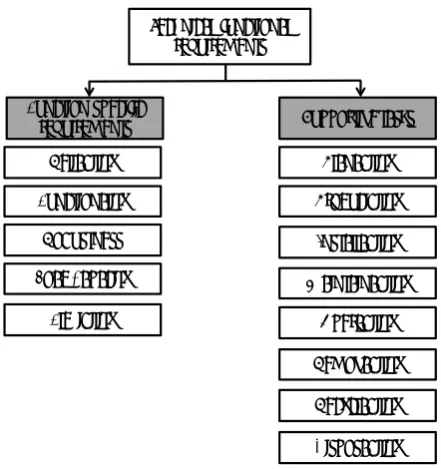
Requirements might also be more general. That means they do not refer directly to individual parts of the regarded product. In fact, they refer to the whole product and/or its function capability and performance like, for example, low energy consumption. Consequently, for taking them into account another dimension of the model for structuring requirements is the dimension “technical-functional aspects”. It can be further differentiated into the categories “function-specific” and “supportive requirements”. Within the category, “function-specific requirements” the sub-categories reliability, functionality, robustness, load capacity and flexibility can be differentiated. Thereby, reliability is an important aspect. It is defined as ability of a reference object to perform its functions during a period of time (Smith, 2005). It can be measured for instance by using “mean time to failure”,” mean time between failure” and “failure rate” to reach a higher level of specification (Blischke & Murthy, 2000).
The category “supportive requirements” comprises requirements that deal with aspects that are not part of the core functions of the facility. It can be sub-divided into the sub-categories for planning ability, producibility, installability, maintainability, operability, removability, recyclability and disposability. Requirements which have to be sorted into this category are for example “The product should be able to be disposed eco-friendly” or “The parts of the parts should be removable easily.”. Thereby, the first named requirement has to be
Economy
Costs Benefit
Cost Accounting
Controlling
quantitative
- 531 -
sorted into the sub-category “disposability” and the latter one into the category “removability” (Figure 4). In this context, requirements dealing with aspects of ecological and economical sustainability like requirements dealing with eco-friendly disposal and the avoiding waste of resources are increasingly mentioned by the stakeholders in the process of surveying requirements. Therefore, their implementation in adequate product characteristics should be attached great importance.
Figure 4. Structuring in line with the dimension “technical-functional aspects”
2.3 Product
Products, like for example intra-logistical facilities, can be structured into the categories product core, formal product and extended product according to the onion-layer-model (Hohn, 2008). Additionally, requirements resulting from the collaboration between the facility’s components have to be taken into account. This category is necessary for considering interdependency and compatibility between the facility’s different components. Consequently, the onion-layer-model had to be extended regarding this aspect.
Requirements concerning the product’s material, processing and functioning belong to the category “product core”. This category includes requirements dealing with single assembly groups of the facility in the case at hand respectively single parts of the reference object and with the documentation. The subcategory assembly group encompasses requirements regarding “mechatronical”, “mechanical”, “electrical” and “software” components for example when regarding intra-logistical
Technical- functional requirements
Function-specific requirements
Reliability
Functionality
Supportivetasks
Robustness
LoadCapacity
Planability
Producibility
Installability
Maintainability
Operability
Removability
Recyclability
- 532 -
facilities otherwise it can be adapted to the reference object. Regarding an intra-logistical facility requirements concerning for example length, diameter or even material of the used conveyors have to be sorted in the category “mechanical”, while requirements concerning drive train and switches have to be sorted in the category “mechatronical”. Requirements regarding controlling-software have to be sorted in the category software, while requirements regarding cables and sensors belong to the category “electrical”.
Requirements which exceed the product core have to be sorted into the category “formal product”. This category can be further differentiated into the subcategories “design”, “packaging”, “ergonomics” and “brand name”. Exemplarily for the category “formal product” can be named the product’s colour, the brand name of its producer (or of the producers of its components) or the ergonomic design of single workstations.
Requirements which concern service or delivery belong to the subcategory “extended product”. Thereby, especially the service respectively requirements referring to this are important. Customers often demand serve feature in addition to the product like, for example, maintenance or service hotline for upcoming problems or taking back packaging materials.
The following figure gives an overview of the dimension “product”.
Figure 5. Structuring in line with the dimension “product”
2.4 Weighted level of performance
This dimension is set temporarily after the surveying and structuring of requirements. In contrast to the dimensions which serves to structure requirements respectively the reference object, this dimension shows the actual
Product
Product core Extended
product Formal product
Assembl y
Documentation Col l aboration
between Components
Service
Del ivery Design
Brand name
Packaging
Ergonomics
Inter-dependencies
Compatibil ity
- 533 -
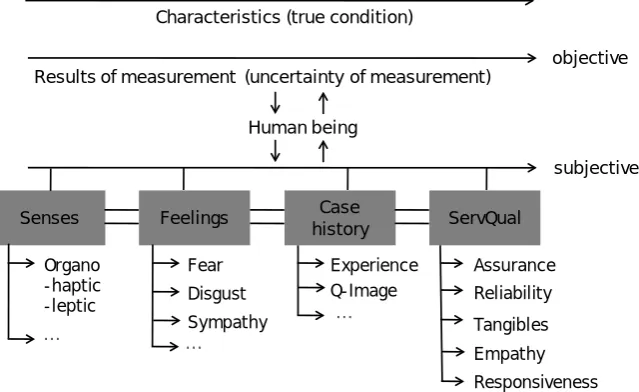
condition. That means that in this dimension the requirements’ satisfaction, i.e. their weighted level of performance is checked. Hence, it serves to check whether and to which extent the stakeholder requirements have been fulfilled. Persons as well as suited measurement devices may check the level of requirements’ fulfilment. Thereby, it has to be considered that a property’s “true condition” can hardly be measured. Consequently, a differentiation between the objective and the subjective evaluation is necessary. Requirements like, for example, “The floor
spaces required for the facility must not exceed 250m2.” can be measured
objectively with measurement devices. However, the results which are reached respectively reachable vary due to an uncertainty of measurement so that the “true” value is only determinable with a certain probability. Requirements like “The facility should be as flexible as possible.” cannot be measured objectively. Those requirements respectively their fulfilments can only be assessed by persons. However, these requirements and their fulfilment are of great importance for the stakeholders and their satisfaction (Chen & Chuang, 2008). Thereby, senses, feelings and their case history are relevant aspect for their evaluation.
Figure 6. Structuring in line with the dimension “weighted level of performance”
The case history is determined by the experience the stakeholder may have with the producer and by the quality image the company has. Negative experiences which a stakeholder may have had in the past himself or which he may have heard of by media for example could lead to further requirements or more specified requirements. The established method ServQual can be applied for evaluating services. This method evaluates based on the aspects “assurance”, “reliability”, “tangibles”, “empathy” and “responsiveness” (Hentschel, 1990). Beyond that, the requirement’s weighting for a stakeholder may be important and therefore should
object ive
subject ive Result s of measurement (uncert aint y of measurement )
Human being
Senses Feelings Case
hist ory
Experience Q- Image
…
Fear
Disgust
…
Organo - hapt ic - lept ic
… Sympat hy
ServQual
Assurance
Reliabilit y
Tangibles
Empat hy
Responsiveness
- 534 -
not be neglected. It is also crucial for the customer satisfaction resulting from the evaluation. This is because the fulfilment of those requirements is a significantly determining factor for the degree of customer satisfaction. (Figure 6).
2.5 Customer satisfaction
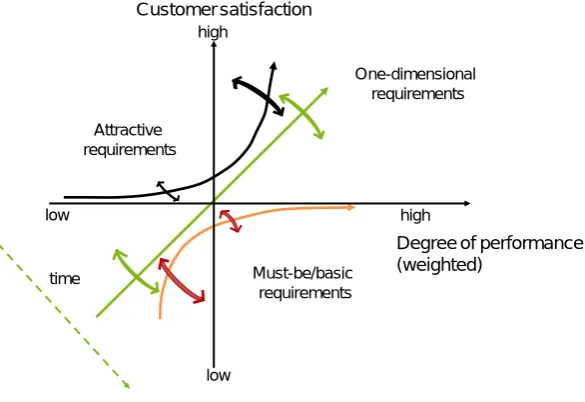
This dimension also gives feedback to the other dimension’s surveyed and structured information by depicting whether the customers are satisfied. Therefore, information needed for this dimension derives from the stakeholder’s evaluation whether and how their requirements were fulfilled. Customer satisfaction is the result from the perceived difference between expectation and performance respectively between performance-standards and the perceived quality or performance of the product (Sauerwein, 2000), (Tse & Wilton, 1988). In this context, the requirements’ importance for the stakeholders respectively their weighting of the requirements is essential. For this purpose, the KANO-model can be used but it has to be for considering the weighted requirements and the weighted degree of satisfaction. In line with the original model, attractive, one-dimensional and must-be-requirements can be distinguished. Also, it is assumed that there is not necessarily a linear correlation between meeting requirements and satisfaction (Sauerwein, 2000; Hölzing, 2008). Integrating a weighting-factor although results in the inability to depict graphs of requirements exactly. In fact, the graphs may have a flatter or steeper progress. That means that the weighting-factor causes a weaker or more intense impact of the meeting of requirements on customer satisfaction. This effect is shown by arrows in the following figure.
Figure 7. Modified KANO-model
low high
low high
time
Degree of performance (weighted)
Must-be/basic requirements Attractive
requirements
One-dimensional requirements
- 535 -
Fulfilling must-be-rated requirement is essentially. Though it does not increase the customer satisfaction, not fulfilling this requirement will lead to dissatisfaction. In contrast, attractive requirements possess the highest influence on customer satisfaction.
The modification’s effects on the KANO-model as well as the exact determination of the graphs are part of current research.
3 Advantages and Benefit of the developed Model
The developed generic structuring model fulfils several purposes. It allows surveying and structuring the requirements made on the reference object for further use, which is necessary to transform them into adequate product features, because of the multitude of the requirements which have to be considered and which (may) exist in different degrees of specification. Therefore, it is possible to consider for example single groups of requirements which are single dimensions respectively categories of a dimension which show a similar or same degree of specification. Hence, requirements management has become an essential part of quality management and the developed model assures an adequate and comprehensive requirements management and therefore customer-oriented products in this context by structuring requirements regarding according to their content, temporal element and level of specification. Thereby, requirements dealing with aspects of economic and ecological aspects are increasingly important and therefore have to be identified, managed and implemented into appropriate product features. Beyond that, the evaluation of requirements’ fulfilment is taken into account by the model. Hence, the model represents a holistic approach for requirements management.
- 536 -
that a topical search is possible which allows searching for certain terms respectively requirements dealing with them like, for example, “energy costs” or “eco-friendly disposal”.
Moreover, the system offers assistance for matching “new” requirements to adequate dimensions and categories. Therefore, several search options allow looking for requirements that have been matched before by searching for example for similar terms to facilitate and optimise the structuring process
Thereby, the model is just a component of the data processing system which has also been developed within the collaborative research center. The system also includes a linguistic analysis, a template for storing a single requirement and an ontology for machine interpretable knowledge. These components are linked to each other so that the requirements can be handled adequately during the planning process.
Acknowledgments
The authors wish to thank the Deutsche Forschungsgemeinschaft (DFG) for supporting their work within the framework of the Collaborative Research Centre 696.
References
Blischke, W., & Murthy, D. (2000). Reliability: modeling, prediction, and
optimization. New Jersey: Wiley.
Chen, C., & Chuang, M.C. (2008). Integrating the Kano model into a robust design approach to enhance customer satisfaction with product design. Journal of
Production Economics, 114(2), 667-681.
Crostack, H.A., Klute, S., & Refflinghaus, R. (2010). A multi-dimensional model for structuring stakeholder requirements. 20th CIRP Design Conference,
Nantes/Frankreich.
- 537 -
Hentschel, B. (1990). Die Messung wahrgenommener Dienstleistungsqualität mit SERVQUAL – eine kritische Auseinandersetzung. Diskussionsbeiträge der Wirtschaftswissenschaftlichen Fakultät Ingolstadt.
Hohn, S. (2008). Public Marketing, Marketing-Management für den öffentlichen Sektor, 2. Aufl. Wiesbaden: Gabler-Verlag.
Hölzing, J. (2008). Die KANO-Theorie der Kundenzufriedenheitsmessung. Eine theoretische und empirische Überprüfung. Wiesbaden: Gabler-Verlag.
Sauerwein, E. (2000). Das KANO-Modell der Kundenzufriedenheit. Reliabilität und Validität einer Methode zur Klassifizierung von Produkteigenschaften. Wiesbaden: Gabler-Verlag.
Smith, D.J. (2005). Reliability, maintainability and risk: practical methods for engineers. Oxford: Butterworth-Heinemann.
Stead, W.E., & Stead, J.G. (2004). Sustainable strategic management. Armonk, NY: Sharpe.
Tse, D., & Wilton, P. (1988). Models of Consumer Satisfaction Formation: An
Extension. Journal of Marketing Research, 25, 204-212.
Journal of Industrial Engineering and Management, 2011
Article's contents are provided on a Attribution-Non Commercial 3.0 Creative commons license. Readers are allowed to copy, distribute and communicate article's contents, provided the author's and Journal of Industrial Engineering and Management's names are included. It must not be used for commercial purposes. To see the complete