47
Constructivist Strategy,
Microcomputer-Based Laboratory, and Students’
Alternative Conceptions of Force and
Motion
Gil Nicetas B. Villarinoa
Corresponding author: Gil Nicetas B. Villarino ([email protected]) aScience Department, Leyte Normal University, Tacloban City, Leyte, Philippines 6500.
Keywords: constructivist strategy, microcomputer-based laboratory, alternative conceptions, force, motion
International Journal of Innovation in Science and Mathematics Education, 27(1), 47–60, 2019.
Abstract
This study investigated junior high school students’ alternative conceptions of force and motion and the effectiveness of the microcomputer-based laboratory (MBL) and the constructivist strategy (CS) on the students’ understanding of force and motion. Using a quasi-experimental non-equivalent control group design, four treatments, including the combination of MBL and CS, the combination of MBL and traditional strategy (TS), the combination of traditional laboratory (TL) and CS, and the traditional approach (control) were tried out in two schools, a public school and a private school, in a three-month period during the school year 2015–2016. A 40-item physics conceptual test was used to assess students’ alternative conceptions of force and motion. The results of the pretest showed that junior high school students have already formed their conceptions of force and motion even before physics instruction. Some of these alternative conceptions, specifically of speed, are similar to the views of children whose ages range from 5 to 8 years old. Although students’ conceptions generally improve after physics instruction, many students’ alternative conceptions remain unchanged even after physics instruction. Examples include: the greater the distance traveled, the higher the speed; being ahead implies faster speed; and if there is motion, there is a force(an object is in motion, when there is an applied force). Controlling the effect of the IQ, Mathematics II, and III grades, and the physical pretest scores, the study showed that students who were exposed to MBL activities performed significantly higher in the physics post-test than those who were exposed to the traditional activities. Students were exposed to the combination of MBL and the constructivist strategy also performed significantly higher in the physics posttest than those subjected to the traditional approach. On the other hand, the constructivist strategy as implemented in this study did not produce a significant effect on the students’ performance in the physics test. The graphs, elimination of drudgery of some of the laboratory tests, and the immediate feedback provided by the MBL instruction may have contributed to the students’ better understanding of force and motion concepts. The non-positive effect of the constructivist strategy on students’ conceptual understanding of force and motion may be due to the use of large class size instead of small groups. It may also be due to the inadequate training of the teachers on the constructivist strategy.
Introduction
48
In recent years, several science teachers have been trying out various teaching strategies that would improve students’ conceptual understanding (Posner, Strike, Hewson, & Gertzog, 1982; Hewson & Hewson, 1988; Duit, Treagust, & Widodo, 2008; Halim, Yong, & Meerah, 2014). Most of those strategies are based on the constructivist perspective of learning which views learners as active participants in the learning process (Driver, 1986). Those strategies take into account the students’ prior ideas, and the goal of instruction is to modify or build on these ideas. In this approach, students are given the opportunities to express their ideas explicitly, clarify them, and then change their ideas to scientific ones. They are also provided experiences to use correct concepts in a range of situation (Driver, 1986).
On the other hand, laboratory activities are believed to improve students’ understanding and learning of concepts (Hall & Valder-Ulu, 2013). They provide the student's opportunities to experience directly what they learn and verify their predictions. However, studies showed the appalling lack of effectiveness of laboratory instruction (Elliot, Stewart, & Lagowski, 2008). In traditional laboratory activities, students sometimes do not observe what is expected because of the inaccuracy or limitations of the measuring instruments. Thus, the results of the activities cannot be convincing enough to enable students to replace their prior views with the correct or scientific views. Also, working on the hands-on traditional laboratory activities can be tedious and time consuming in preparing the laboratory equipment. As a result, most of the students’ time is spent on the routine aspects of laboratory such as recording, computing and graphing data while little time is spent on the scientific ideas they are investigating.
One approach, which is believed to improve instruction and conceptual understanding, is the computer-assisted laboratory or MBL (Mokros & Tinker, 1987; Thornton, 1987; Layman, 1990; Voogt, 1992; Steinberg, 2003). This approach combines the application of computer technology and hands-on laboratory instruction. Studies reviewed suggest that MBL can improve students’ conceptual understanding because:
1. It can engage students more actively in their learning (Brassel, 1987; Stein, 1986; Stein, 1987; Liu & Johnson, 2003);
2. It allows students to build on experiences like those in their everyday interaction with the physical world (Thornton, 1987);
3. It provides immediate feedback of data in usable forms, to move away from misconceptions towards a deeper scientific understanding (Thornton, 1987); and 4. It allows students to extend their investigations because of the ease and immediate
feedback of the instruments, thus giving the students the opportunity to investigate their intuitions and to modify their alternative conceptions.
This paper presents the results of the study which assessed junior high school students’ conceptions of force and motion before and after physics instruction and explore the effectiveness of the MBL instruction and the constructivist teaching strategy in improving the students’ understanding of force and motion. Specifically, this study was conducted to answer the following questions:
1. What are junior high school students’ alternative conceptions of force and motion before and after physics instruction?
By controlling the students’ intelligent quotient, mathematics grades and physics pre-test scores,
49
3 Did students expose to the CS perform better in the conceptual physics test than those exposed to the TS?
4 Did students expose to both MBL activities and the CS perform better in the conceptual physics test than those than who were exposed to the TA?
The strategy used in this paper is similar to Driver’s constructivist strategy (Driver, 1986). In this approach, the role of the teacher is that of a facilitator of learning. It starts with probing the students’ existing ideas by showing some demonstration situations. The students write their views individually on their notebooks. This is then followed by discussion. The students lead the discussion while the teacher provides guiding questions. Sometimes the teacher poses some questions or situations to challenge students’ views or beliefs. It is also during this phase that experiments or demonstrations are done. The discussion phase is followed by clarification of ideas. In this phase, the teacher presents the scientific conception(s). The last phase is the application wherein the students are given both practical and textbook exercise where they can apply the concepts and principles learned.
Research methodology
Research design
Since the participants are not randomly assigned to classes by the researcher, a quasi-experimental non-equivalent control group design was employed in this study. The design is shown below.
Schools
A (Public School, N = 127)
Group Pre-test Treatment Post-test
C O1 O2 X0 O3
T1 O1 O2 X1 O3
T2 O1 O2 X2 O3
T3 O1 O2 X3 O3
B (Private School, N = 104)
Group Pre-test Treatment Post-test
C O1 O2 X0 O3
T1 O1 O2 X1 O3
T2 O1 O2 X2 O3
C refers to the control groups. The O’s to the tests administration to the different groups before and the after the treatment while the X’s refer to the different treatments to which the different groups were exposed.
The participants
50
Similarly, the treatment classes in school B were by the MBL-trained teacher, and the control class was taught by the untrained teacher. In this study, the researcher are not randomly assigned the teacher participants. Therefore, teacher factor was not controlled in this study because the researcher had no control over the teaching load of the experimental teachers. The MBL-trained teacher in school A was teaching only three classes while the MBL-trained teacher in school B was teaching only two classes.
The instruments
1. Physical Conceptual Test (PTC)
The instrument was developed by Talisayon, (1999) and was adapted by the researcher. The adaption was in terms of wording of the items of the instrument. This is a paper-and-pencil test consisting of 40-multiple-choice items that assess conceptions of force and motion. The distractors represent common alternative conceptions. The test requires explanations for every answer selected. The explanations given by the students reveal or confirm their alternative conceptions. The reliability of the test based on the Kuder-Richarson Formula 20 is 0.78. Hence, the questions in a test all have approximately the same difficulty (i.e. the mean score of each question is approximately equal to the mean score of all the questions).
2. IPAT Culture Fair Scale 2 (Form B)
This test, which was used to measure the Intelligence Quotient (IQ) of the students, consist of a 46-item nonverbal test including items on seriation, classification, and matrices.
3. Laboratory Activities
The research suggests that laboratory experiences will be more likely to achieve the conceptual understanding of the students. The activities labelled as the traditional activities included in the study were taken from their textbooks. Ten MBL activities on force and motion which were parallel to the traditional activities were used. Using MBL, students utilize a microcomputer and accompanying probes to collect, record, and graph data to support the construction of their science concepts. The term probeware has been applied to describe the probes, interfacing boxes and software needed to use the microcomputer as a laboratory tool. Examples of probes used to collect laboratory data include motion and force.
The titles of the activities are the following: a. Determining Reaction Time
b. Timing Devices
c. How Fast Do You Walk d. Uniform Horizontal Motion e. Motion Along an Inclined Plane f. Acceleration of Falling Objects g. Effect of Force on Acceleration h. Effect of Mass on Acceleration i. Sliding Friction
j. Range of a Projectile
Treatments
51
discussion or lecture part, the teacher employed the constructivist strategy. The control consisted of the usual laboratory instruction and the traditional or non-constructivist teaching strategy (TL-TS).
Data collection procedure
The Department of Education (DepEd) Schools Division of Tacloban City on the official opening of classes is June for the first semester and November in the second semester in all public schools. The study was conducted from August to October 2016 in school A and from July to September 2016 in school B. Two test -the Physics Conceptual test and the IPAT intelligence Quotient (IQ) Test– were administered to the treatment and control classes in school. Two weeks before the start of the treatment. Only the Physics conceptual test was administered to the treatment and control classes in school B because IQ data of the students were already available in the school’s guidance office. The standardized IQ test was purchased by the school and administered to the students before the start of the classes.
Two weeks before the start of the try-out, the teachers were briefed and oriented by the researcher about the teaching strategies and the MBL activities. Teaching guides for each main lesson for each treatment class were provided. The teaching guides were developed by the science teachers in Leyte Normal University, Tacloban City, Leyte, Philippines. The control teachers were instructed to use the traditional laboratory activities and the traditional strategy.
One week before the start of the first lesson, the MBL classes in each school performed two MBL activities which were not part of the required activities of the first lesson. These activities involved measuring time using a pushbutton and determining reaction time. The main aim of these activities was to orient students on the MBL experiments and the computers. On the other hand, microcomputers were not new to the school B students because they had a separate computer class. The researcher observed the classes daily except when there were other classes or school activities which were not part of the study or when there were overlapping schedules in two schools. The PTC was again administered after the last lesson was done. The Mathematics 2 and 3 grades of the students were obtained from the students’ school permanent record.
Data analysis procedure
Each correct choice to the physics test was given one point and another point for the correct explanation. The explanation was considered correct when it coincided with the scientific view. For each question, the percentages of students in each school choosing each alternative conception and the corresponding common explanations were tabulated. The choices and explanations were analysed qualitatively by the researcher as to what alternative conceptions or misconceptions they represent.
Using physical pre-test scores, IQ score and the average grades in Mathematics 2 and 3 as covariates, multiple regression was done to determine significance in differences among adjusted, means in the physical post-test scores of the treatment and control classes per school.
Discussion of results
Conceptions of speed, force and motion
52
B
1. Speed
a) Shorter elapsed time implies greater speed
Before instruction, 21% and 46% of the students from school A and B respectively, considered the runner who finished in the shortest time regardless of the distance covered as the fastest. One common explanation is shown below:
“Because C ran for the shortest time.”
After instruction, the number of students who had the above conceptions decreased by about 15%. However, 31% of the students from A and 6% of the students from B still held on to this initial belief.
b) Greater distance traveled implies higher speed
Before instruction, 23.5% and 7.4% of the students in schools A and B, respectively, arranged the runners according to the distance they covered. The runner who covered the greatest distance regardless of the time of travel was the fastest. After instruction, the percentage of the students who had the above conception decreased by about 8% and 4% in schools A and B, respectively. However, 15.5% and 3.7% of the students, in school A and B, respectively, still had the above conception.
c) Shorter route implies greater speed
This alternative conception is similar to the second alternative conception in that speed is associated with distance only. But it is reverse in that the cyclist that took the shortest routes is believed to have traveled at the greater speed. The given condition was two cyclists who travelled on two separate routes forming a right triangle (Fig.1). Michael followed the shorter route which is the hypotenuse while Martin passed through the longer route which are the legs of the triangle route. Both started and stopped at the same position and time. The students were asked to compare the speeds of two cyclists. Before instruction, 15% and 17% answered by the students from school A and B, respectively, that Michael traveled faster than Martin. One conventional explanation is shown below:
“Michael's route is shorter while Martin’s route is longer. This belief persisted after instruction.
Michael’s route
Martin’s route A
Figure 1: Two cyclists who travelled on two separate routes
d) Same position at the same time implies same speed (space-time coincidence)
In the same question shown in Figure 1, several students (13% and 2% from schools A and B, respectively) answered that the two cyclists had the same speed. Some explanation is the following:
“Michael and Martin arrived at the same time. Thus they have the same speed.” “They both started at the same position.”
A similar response was also observed about the following question two trains, A and B, are moving uniformly toward each other on different tracks (Fig. 2). Train A leaves Station 1
C
53
at the same time train B leaves Station 3. If two trains meet at Station 2 which is midway between Stations 1 and 3, the question posed was: Did the two trains ever have the same speed?
Station 1 Station 2 Station 3
A
B
Figure 2: Two trains, A and B, are moving uniformly toward each
Before instruction, about 21% and 15% of the students from schools A and B, respectively, believed that the trains had the same speed all the time. The common explanations of those who believed so are the following:
“Because the two trains started at the same time.”
“Because it said that both trains move uniformly, so if they pass each other at the same time, then they have the same speed.”
From the above explanation, it can be inferred that the students consider two objects to have the same speed if they start at the same position at the same time or arrive at the same position at the same time. It is not necessary that the bodies both start and arrive at the same position and at the same time. What seems to be crucial is that the motion of the two objects is simultaneous either at the starting or the finishing point.
After instruction, fewer (by about 6%) of the experimental and control students had the above conception.
e) Being ahead implies faster speed.
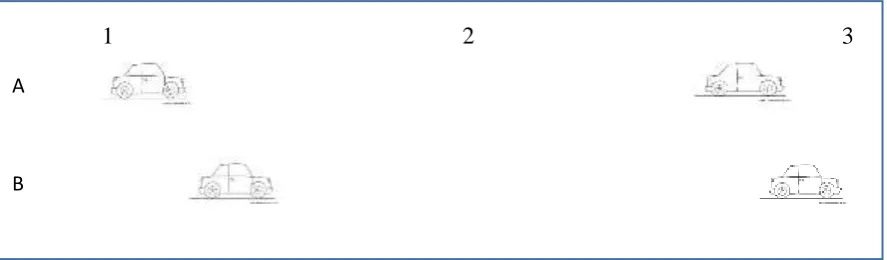
In another test item, the two cars are both traveling in uniform motion, but car B is always ahead of a car A (Fig. 3). When the two cars stop, are B is still ahead of car A but the distance between the two cars is shorter than when they started. The question posed was: compare speeds of car A and B.
1 2 3
Figure 3: Two are both traveling in uniform motion
A
54
A significant number of students (47.7% and 16.75%, in schools A and B, respectively) answered that car B is faster than car A. Below are some of the typical explanations:
“Because car B is ahead of car A.”
“Car B arrived earlier at post 3 than car A. This shows that car B is faster than car A.”
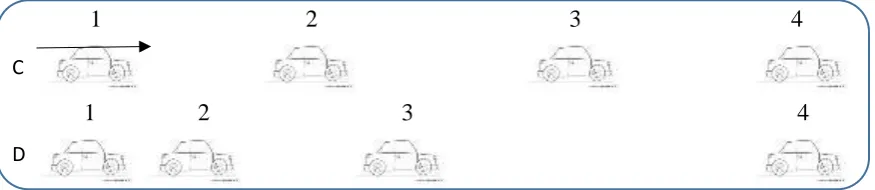
In a related question, car A is initially ahead of a car B but car B passes car A at post 2 (Fig. 4).
1 2 3 4
1 2 3 4
Figure 4: Car A is initially ahead of a car B but car B passes car A at post 2
When asked to compare the speeds of the two cars before car B passes car A, some students (22.7% and 11.1% in schools A and B, respectively) answered that car A is faster than car B. The students’ explanations:
“Because car A is ahead of car B.”
“Car B is still behind car A, and it has to catch up with car A. If car B’s speed were greater, it would already overtake car A.”
2. Acceleration
a) Same position at the time implies same acceleration.
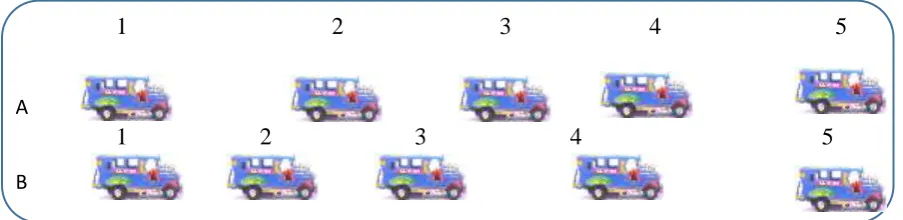
In Fig. 5, jeepneys A and B are side by side at position 1 but jeepney B is increasing in speed at a faster rate than jeepney A. More than one-third of the students answered that the two jeepneys have the same acceleration at certain position only. Some reasoned:
“Yes, because at some points they are beside each other which denotes that they have the same speed at the time.”
Others were more specific in their explanation regarding the position at which the jeepneys have the same accelerations:
“They only had the same acceleration at position 1 and 5 because they traveled side by side”, or
“Because at points 1 and 5 they are side by side.”
1 2 3 4 5
1 2 3 4 5
Figure 5: Jeepneys A and B are side by side at position 1
A A
A
B
A
55
b) Being ahead implies greater acceleration.
In one test item, two buses, C, and D are moving at uniformly increasing speeds. However, bus D is always ahead of bus C (Fig. 6). A 5% of the students who answered that buses never had same acceleration reasoned:
“Acceleration of bus D was greater than bus C because bus D was ahead of bus C.”
1 2 3 4 5
1 2 3 4 5
Figure 6: Two buses, C, and D are moving at uniformly increasing speeds
In Fig. 7, car C which is moving uniformly when it passes car D at position 1, is ahead. But car D is accelerating. Both cars reach position four at the same time. The students were asked to compare the acceleration of the two cars.
1 2 3 4
1 2 3 4
Figure 7: Car C which is moving uniformly when it passes car D at position
More than 20% of the students responded that car C’s acceleration is greater than car D’s. Most reasoned that
“Car C was ahead of car D at certain points.” A few explained that “Car C faster than car D.”
The reasons given by the students indicate their alternative conception that when the car is ahead of another car, then it has greater acceleration than the other car.
The misconception of acceleration is similar to their misconception of speed that “the same position at the same time implies same speed” or “being ahead means greater speed.” This means that many students are unable to distinguish the physical concepts of speed from acceleration.
3. Force
The misconceptions of force such as motion implies force, the impetus view of motion and that force is an innate property found in this study are similar misconceptions to the findings of previous studies (Talisayon, 1990; APPTEA, 1987; Brookes & Etkina, 2009). From the responses of the students, it seems that they tend to deal with one variable at time and hold the other variable(s) constant. Speed is a ratio of two independent variables –distance and time. In
C
D
C
56
dealing with this ratio, most students tend to focus on one independent variable and hold the other variable constant. For example in the misconception greater distance implies greater speed, the students considered only the distance variable and held the time constant. In another misconception, shorter time implies greater speed; the student focused only on the time variable while assuming the distance variable to be constant. Another general finding from the student's alternative conceptions that they seem unable to distinguish between force, speed and acceleration.
Computer-assisted laboratory versus traditional laboratory
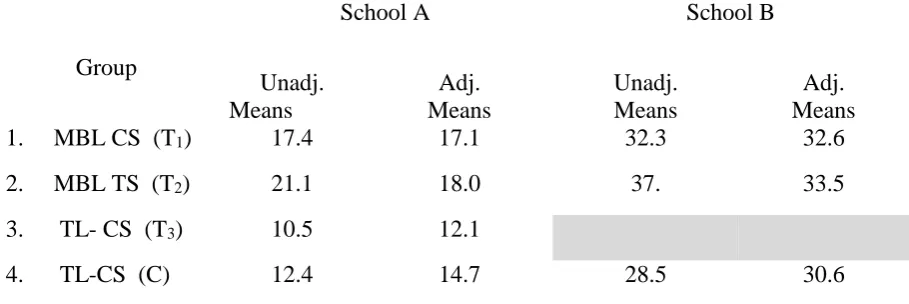
The focus of the discussion in this section is on the question: Do students exposed to MBL perform better in the conceptual physics test than those exposed to the traditional laboratory (TL). Table 1 shows the unadjusted and adjusted physics post-test mean scores of the experimental and control groups in the two schools. From the table, it can be seen that the MBL groups (T1 and T2) have higher adjusted means than the TL groups (T3 and C).
Table 1: Unadjusted and adjusted group means scores in the Physics Conceptual post-test in schools A and B.
Group
School A
School B
Unadj. Means
Adj. Means
Unadj. Means
Adj. Means
1. MBL CS (T1) 17.4 17.1 32.3 32.6
2. MBL TS (T2) 21.1 18.0 37. 33.5
3. TL- CS (T3) 10.5 12.1
4. TL-CS (C) 12.4 14.7 28.5 30.6
To determine whether the difference between the MBL and the TL groups is significant, multiple comparisons using the regression coefficients (b’s) was made (see Table 2). Five comparisons between groups were made school A while three comparisons were made in school B.
57
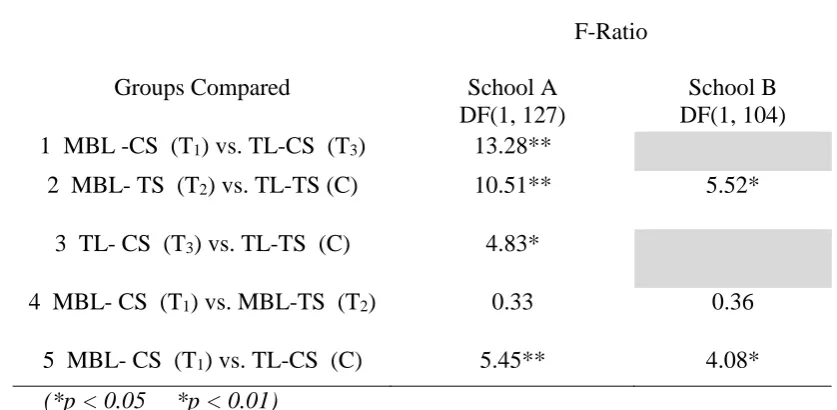
Table 2: F-rations for comparison of the adjusted means on the physics conceptual post-test between the treatment groups in school A and B.
F-Ratio
Groups Compared School A
DF(1, 127)
School B DF(1, 104) 1 MBL -CS (T1) vs. TL-CS (T3) 13.28**
2 MBL- TS (T2) vs. TL-TS (C) 10.51** 5.52*
3 TL- CS (T3) vs. TL-TS (C) 4.83*
4 MBL- CS (T1) vs. MBL-TS (T2) 0.33 0.36
5 MBL- CS (T1) vs. TL-CS (C) 5.45** 4.08*
(*p < 0.05 *p < 0.01)
In school B, the F-ratio (5.52) for the comparison of the groups means school of the MBL-TS (T2) and the TL-TS (C) groups was also significant at the 0.05 level. From Table 2, the adjustment posttest means of the MBL-TL (T2) group higher than adjusted posttest means scores of the TL-TS (C) group. This show that the group which has exposed to the MBL activities did better in the physics posttest than the group which was exposed to the traditional laboratory activities. The study results are similar to the findings of a previous study (Stien, 1987).
Several possible reasons can be cited why the groups exposed to MBL performed significantly better in the conceptual physics test than those exposed to the TL in improving high school students’ understanding of force and motion. First, the graphs provided in MBL might have helped students visualize and understand abstract concepts in physics. Second, MBL provides immediate feedback which gives students the opportunity to check their intuitions. Finally, MBL eliminates some task such as computing and plotting of data which distract students’ attention from the conceptual goals of the activity. Because some tasks are eliminated, the memory load of the students is also reduced thereby allowing them to concentrate on the understanding of concepts.
a) Constructivist strategy versus traditional strategy
The discussion of results in this section is focused on answering the question: Do students exposed to the constructivist approach (CS) perform better in the conceptual physics test than those students exposed to the traditional teaching strategy (TS)?
58
These results suggest that the CS failed to improve students’ performance in the conceptual physics test. Under the traditional laboratory instruction, school A students who were taught under the TS performed even better in the physics conceptual post-test than those who were taught under the CS. This contradicts the result of some studies that the constructivist approach can bring about conceptual change. A plausible explanation is that the constructivist strategy was conducted in one class which was too big for all students participated in the discussion. It was observe that not all students participated in the discussion. Based on the daily observation by the researcher, most likely, the students who just kept quiet were the ones who might have retained their misconceptions. Studies which were successful in using the constructivist teaching strategy in promoting conceptual change dealt with small groups and instructional materials which focused on the students misconceptions (Hewson & Hewson, 1983; APPTEA Report, 1993; Bishaw & Egiziabher, 2013). Neither of these was present in this study. Another possible reason is that the teacher did not implement the CS properly because they were not sufficiently trained. Perhaps, teaching guides were inadequate to enable teachers to implement the constructivist strategy effectively.
b) Combination of MBL and constructivist strategy versus traditional strategy
The focus in this section is on the question: Do students exposed to both MBL activities and constructivist approach (CS) perform better in the conceptual physics test than those exposed to the traditional laboratory activities and strategy?
The F-ratio between the MBL-CS and the TL-TS (control) groups in school A (F = 5.45, p<0.05) indicates that there is a significant difference between the means scores in the physics conceptual posttest of the two groups. The group taught by the combined MBL and the CS performed significantly higher in the physics conceptual posttest than the control group that was taught using the traditional approach.
In School B, the comparison of the means of the combined MBL-CS group and the TL-TS (control) group also yielded a significant F-ratio (F =4.08, p.<0.05). There is a significant difference between the adjusted mean scores of the MBL-CS and the TL-TS groups in favor of the group taught under the combined MBL and CS.
The above result indicates that MBL combined with CS was more effective than the TA in improving student’ understanding of force and motion concepts in the two school where this study was conducted. Although the combined MBL and CS groups did it better than the control groups, Table 1 shows that the MBL-TS groups performed better in the physics post-test than the MBL-CS groups. Perhaps it was due to the improper implementation of the CS which negated the effect of MBL.
Conclusions
59
not significant more effective than traditional laboratory combined with traditional strategy (TL-TS) in improving students’ conceptual understanding of force and motion concepts.
References
APPTEA-ASPEN (1991). Research for Students’ Conceptual Structures and Changes in
Learning Physics, ASPEN-UP Institute for Science and Mathematics Education Development. Bishaw, A., & Egiziabher, Y.G. (2013). Comparison of traditional and constructivist
teaching approaches in using English language learning strategies (Grade Eleven Students of Bahir Dar Preparatory School). Ethiopian Journal of Education and Sciences, 9, 1-13.
Brassel, H. (1987). The effect of real-time laboratory graphing on learning graphic
representations of distance and velocity. Journal of Research in Science Teaching, 24, 385-395. Brookes, D.T., & Etkina, E. (2009). ‘Force,’ ontology, and language. Physics Education
Research, 5, 1-13.
Champage, A.B., Klopfer, L.E., & Anderson, J.H. (1985). Factors influencing the learning of classical mechanics. American Journal of Physics, 48, 1074-1079.
Demirci, N. (2001). The effects of a web-based physics software program on students’
achievement and misconceptions in force and motion concepts. Doctoral Dissertation. Florida Institute of Technology, Melbourne, Florida
Driver, R. (1986). Cognitive psychology and pupils’ frameworks in mechanics. The Many
Faces of Teaching and Learning Mechanics in Secondary and Early Tertiary Education, Ed. P.L. Lijnse, W.C.C. – Utretch.
Driver, R. (1986a). Restructuring the physics curriculum: Some implications of studies on
learning for curriculum development. International Conference on Trends in Physics Education Proceedings, Sophia University, Tokyo.
Duit, R., Treagust, D., & Widodo, A. (2008). Teaching science for conceptual change:
Theory and practice. In S. Vosniadou (Ed.), International Handbook of Research on Conceptual Change (pp.629–646). New York: Routledge.
Elliot, M. J., Stewart, K. K., & Lagowski, J. J. (2008). The role of laboratory in chemistry instruction. Journal of Chemical Education, 85(1), 145–149.
Gunstone, R., & White, R. (1981). Understanding gravity. Science Education, 65, 291-299.
Halim, L., Yong, T., & Meerah, T. (2014). Overcoming students’ misconceptions on forces in equilibrium: An action research study. Creative Education, 5(11), 1032–1042.
Halim, L., Yong, T. K., & Meerah, T. S. M. (2014). Overcoming students’ misconceptions on forces in equilibrium: An action research study. Creative Education, 5, 1032-1042. Hall, M.L., & Vardar-Ulu, D. (2013). An inquiry-based biochemistry laboratory structure
emphasizing competency in the scientific process: A guided approach with an electronic notebook format, Biochemistry and Molecular Biology Education, 42(1), 58-67.
Hewson, M.G., & Hewson, P.W. (1983). Effect of instruction using students’ prior
knowledge and conceptual change strategies on science learning. Journal of Research in Science Teaching, 20, 731-743.
Jimoyiannis, A., & Komis, V. (2003). Investigating Greek students’ ideas about forces and motion. Research in Science Education, 33, 375–392.
Layman, J. (1990). The microcomputers in the laboratory: Contributions to conceptual
development. Paper presented at the Microcomputer-Based Laboratory Workshop UP Institute for Science and Mathematics Development, Quezon City.
Liu, L., & Johnson, L. (2003). A new approach of design: Technology integration as
information system development Technology and Teacher Education International Conference, 2003 1, 1010- 1016.
Mokros, J.R., & Tinker, R.F. (1987). The impact of microcomputer-based labs on
children’s ability to interpret graphs. Journal of Research in Science Teaching, 24, 369-383. Posner, J.G., Strike, K.A., Hewson, P.W., & Gertzog, W.A. (1982). Accommodation of a
scientific conception: Towards a theory of conceptual change. Science Education, 66, 211-227. Stein, J.S. (1987). Raising laboratory learning to a conceptual level: Does MBL help?
Proceedings of the Second International Seminar Misconceptions and Educational Strategies in Science and Mathematics, 3, 471-479.
60
understanding of the nature of science. Journal of Computers in Mathematics and Science Teaching,
22(3), 185-205.
Talisayon, V.M. (1990). A preliminary investigation of university students’ understanding of force and energy. Diwa Pisika. 10, 4–8.
Thornton, R.K. (1987). Tools for scientific thinking microcomputer-based laboratories for physics teaching. Physics Education. 22, 231–238.
Trowbrige, D.E., & McDermott, L.C. (1981). Investigation of student understanding of the concept of acceleration in one dimension. American Journal of Physics, 49, 212- 253.
Voogt, J.M. (1992). Microcomputer based laboratories in inquiry-based science education
– an implementation perspective. Paper presented at the NATO Advanced Workshop Microcomputer