20
Effects of the 5E Teaching Model Using
Interactive Simulation on Achievement and
Attitude in Physics Education
Uğur Sarıa, Abdillahi Hajiomer Hassanb, Kutalmış Güvena & Ömer Faruk Şena
Corresponding author: Uğur Sarı ([email protected])
aKırıkkale University, Turkey bAmoud University, Somalia
Keywords: physics teaching, interactive computer simulations, constructivist approach, 5E teaching model, attitude
International Journal of Innovation in Science and Mathematics Education, 25(3), 20–35, 2017.
Abstract
In this study, the effects of 5E teaching model with interactive simulations on students’ academic achievements and attitudes were investigated and their opinions about using simulations in physics teaching were also determined. Two 11th grade science stream classes with 80 students participated in the research and a quasi-experimental design with
pre- and post-test control groups was used. While a traditional method was used to teach the control group, the 5E teaching model with interactive simulations was used to teach the experimental group by the same teacher. The quantitative data were collected by using an achievement test and attitude scale and the qualitative data were collected via semi-structured interview form. For the analysis of the quantitative data, independent samples t-tests were used and for qualitative data, content analysis was conducted. The findings revealed that interactive simulations integrated 5E teaching model caused significantly better acquisition of scientific concepts related to content taught and relatively higher positive attitudes towards physics than traditionally based instruction. The results have also been supported by the thoughts collected from the students in the experimental group at the end of the study. As a result the 5E teaching model integrated with simulations had potential to help eleventh graders improve their physics academic achievement and attitude.
Introduction
21
Interactive Physics, Crocodile Physics, Algodoo , PhET simulations, etc), have led the integration of simulations into the teaching–learning environment in science classes (Rutten, et al., 2012). As soon as computer simulations appear in the field of science education, researchers and educators raise the question of how interactive simulations are best used in teaching science so as to improve the learning outcomes in science classroom (de Jong & van Joolingen, 1998). Many researchers and science teachers tried to answer such a question through studies that focus on the impacts of computer simulations on students’ understanding of scientific concepts as well as motivation. Such researchers investigated the effectiveness of simulations from different points of view. Some researchers used simulations to enhance the effectiveness of traditional methods (Jimoyiannis & Komis, 2001) and some studied the effectiveness of computer simulations compared to the traditional method (Bayrak, 2008; Chen & Howard 2010; Sarı & Güven 2013). Other researchers used simulations as pre-laboratory activities to enhance the effectiveness of laboratory equipment (Martinez-Jimenez, Pontes-Pedrajas, Polo, & Climent-Bellido, 2003; Zacharia, 2007; Ulukök, Çelik, & Sarı, 2013), while some investigated whether computer simulations can replace real equipments (Finkelstein, et al., 2004; Ünlü & Dökme, 2011). Early studies soon realized that computer simulations showed great potential to enhance students’ academic achievements if they are used as a part of an appropriate educational approach (Bransford, Brown, & Cocking, 2000). Gilakjani, Leong and Ismail (2013) explained that technology by itself cannot make education more effective but it needs an appropriate instructional method so that teachers provide opportunities for students to construct their own knowledge. Thus, with simulation integrated 5E which provides opportunities for students to construct their own knowledge, students’ achievement can be increased.
Theoretical Framework
Interactive Computer Simulations
22
decades, have documented the potentially positive impact of simulations on instructional approaches, instructional capabilities, the development of skills, the development of cognitive and meta cognitive skills, the development of attitudes, and the development of conceptual understanding (Shin, Jonassen, & McGee, 2003; Zacharias, 2005; Rutten, et al., 2012; Sokolowski, 2013).
5E Instructional Model
The 5E instructional model based on the constructivist learning approach states that students learn best by trying to make sense of something on their own with the teacher as a guide to help them along the way The 5E learning model encourages students’ active participation in the teaching-learning process and consists of five distinct phases; engagement, exploration, explanation, elaboration and evaluation. The curriculum guides the teacher through this process, prompting them with facilitation questions and supplying background information. The approach is very much student-centred and is more about discovery and deeper understanding than direct instruction. At the engagement phase of the model, students’ attentions are attracted and their preconceptions are uncovered. The activities of this phase make connections to past experiences and expose students’ misconceptions; they should serve to mitigate cognitive disequilibrium. In the following phase, exploration, students are given time to think, plan, investigate, and organize collected information. This phase should be concrete and hands on. The teacher initiates the activity and allows the students time and opportunity to investigate knowledge. In the explanation phase, the teacher helps students focus their attention on their previous engagement and exploration experiences and provides opportunities to explain their understanding. In the fourth phase, elaboration, students are given the opportunity to expand and solidify their understanding of the concept and apply it to a real world situation. This phase facilitates the transfer of concepts to closely related new situations. Finally, for the evaluation phase, the learners are encouraged to assess their own understanding and teachers evaluate their development in achieving the educational objectives (Bybee et al., 2006; Taşlıdere, 2015).
23
this study will make important contributions to the literature in terms of effective use of simulation in order to improve learning processes and outcomes.
Research Question
On the basis of the aim of the study, the following research questions were determined:
1. Is there a significant difference between the effects of computer simulations integrated into the 5E teaching model, and traditionally designed physics instruction on students’ academic achievements towards light concepts?
2. Is there a significant post test score mean difference between students taught through computer simulations integrated into the 5E teaching model and those taught through traditionally designed physics instruction, with respect to their attitudes towards physics as a school subject?
3. What do students in the experimental group think of using computer simulations with the 5E model to learn physics?
Methodology of the Research
General Background of the Research
In this quasi-experimental design study, the mixed method research design was used. In the studies including both qualitative and quantitative research designs, researchers first gathered quantitative data, analysed them and then gathered qualitative data in order to complete and refine them (Creswell & Plano-Clark, 2007). For the quantitative analysis part of the study, pre-test/post-test control group design, which is among the experimental designs, was used. The characteristic feature of this design is that the study is done with experimental and control groups and the measurements of the groups are taken both before and after the method is applied (Fraenkel, & Wallen, 2000). For the qualitative part of the study, semi-structured interviews were carried out in order to reveal the opinions of experimental group students about the application.
Sample of Research
The sample of the study was composed of 80 students in 11thgrade (male: 57 and female: 23) who were in two different science stream classes in a school in Borama Province during the fall semester of 2014-2015 education year. The two different instructional methods used in the study, were randomly assigned to the two classes, as experimental and control groups. In both groups, the same physics teacher, who has ten years’ experience, instructed lessons. Interactive simulations integrated into the 5E teaching model were administered to the experimental group (N=40) whereas traditionally designed physics instruction was administered to the control group (N=40). The sub-topics of light (introduction to light, reflection of light and mirrors, refraction of light and lenses, and colours of light) were taught using different instructional methods to both groups by the same teacher.
Data Collection Tools
Light Concepts Achievement Test (LCAT)
24
evaluated an academic achievement of a particular learning outcome. During the development of test items care was taken to eliminate any irrelevant factor or any ambiguity that might prevent students from understanding what the question was supposed to ask. After expert opinion and the necessary changes were made, the achievement test was piloted with 92 students to examine reliability of test items. Item difficulty and discrimination indices of test items were determined and internal consistency of the test items was found to be 0.8521 by using Kuder & Richardson formula-20. After removing questions with very high or very low difficult indices and those with a very low discrimination index from the test, the remaining 27 questions with difficult indices between 0.2–0.8 and discrimination indices above 0.2 were used. The reliability of the final test was calculated as 0.76. The test items were applied to both groups before and after the implementation of the study.
Attitude Scale towards Physics (ASTP)
Effect of the instructional method on students’ attitudes towards learning physics was evaluated with the Attitude Scale towards Physics (ASTP). The scale, including 20 items developed by Barmby, Kind, Jones and Bush (2005) which was adapted into Turkish by Kaya and Böyük (2011), has a reliability coefficient of 0.73. The students participating in the study were asked to mark their level of agreement for any given statement which has five degrees of options. Some of the items were aimed to measure students’ positive attitudes towards physics or physical experiments (e.g.
we learn interesting things in physics lessons; I like physics more than other subjects; I get good
marks from physics examinations; etc). For each such question, students’ levels of participation
were taken as [(1) strongly disagree, (2) disagree, (3) neither agree nor disagree, (4) agree, (5) strongly agree], whereas negative statements such as physics lessons are boring; physics lessons
are difficult; I only fail physics lesson; etc students’ levels of participation were taken as [(5)
strongly disagree, (4) disagree, (3) neither agree nor disagree, (2) agree, (1) strongly agree]. Therefore, the maximum students’ attitude score is 100 points where as the minimum score is 20 points. The attitude scale was applied to students in experimental and control groups at the beginning and end of the study.
Effectiveness of Computer Simulations Evaluation Form (ECSEF)
The Effectiveness of Computer Simulations Evaluation Form (ECSEF) contains six items that
survey students’ views and thoughts towards the use of simulation in teaching physics. The questions on the form were developed by reviewing the literature. The views of two experts were taken to assess content validity and then the number of questions was reduced to four items. ECSEF was applied to the experimental group at the end of the study.
Material Development and Implementation
25
In contrast, the experimental group used the 5E teaching model supported by interactive computer simulations. The 5E were arranged such that students were active in the learning process through interactive simulations. The five phases are summarized as follows: capturing students’ attention and curiosity; allowing them to construct the knowledge in the topic; letting them explain what they have discovered; applying what they have learned in different but similar situations; and observing students conceptual understanding of the content. The implementation of the study lasted for 24 periods over six weeks. The main target was to reach the learning outcomes prescribed in the instructional objectives for both groups.
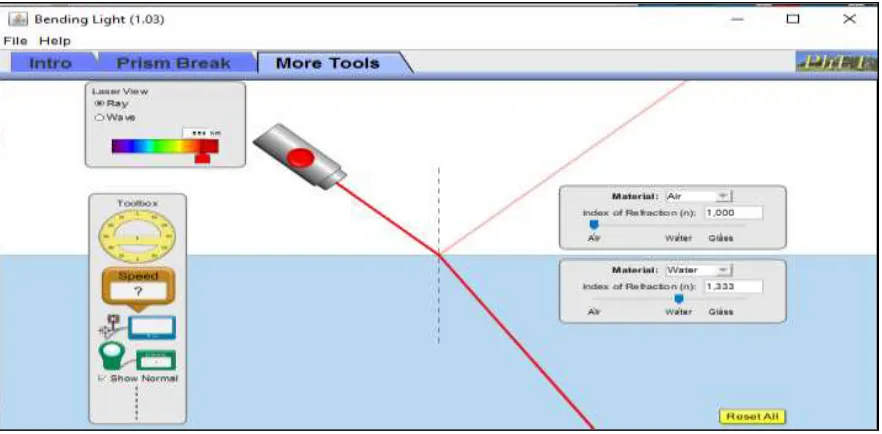
For the experimental group, “Color Vision”, “Bending Light”, and “Geometric Optics” simulations (http://phet.colarodo.edu/en/simulations), developed for Colorado University’s Physics Education Technology (PhET) Project and “Crocodile Physics” Software (http://crocodile-clips.com/en/Crocodile-Physics) were used. With Phet simulations, students can do the experiments easily by themselves in a virtual environment. Several tools in the simulations provided an interactive experience. As users interact with these tools, they get immediate feedback about the effect of the changes they made. This allowed them to investigate cause-and-effect relationships and answer scientific questions through exploration of the simulation (https://phet.colorado.edu/en/about). The necessary materials and tools for the experiment were chosen from the tools menu and any desired experimental setup could be formed in the display screen. Moreover, necessary measurement values are given by measurement tools; graphics can be drawn by graphic tools when needed, so that the data can be evaluated (Figure 1).
Figure 1: Phet simulation used to teach students the concepts of refraction of light in different media
26
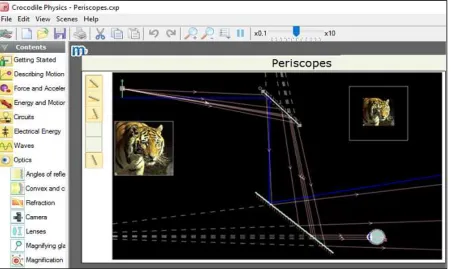
the tools and materials and options, such as graphics, they will use in the program by themselves and they can use these in a picture and in symbol form. On the upper part of the screen, there are shortcut keys that allow users to make changes on the mechanism of the experiment.
Figure 2:Crocodile simulation used to demonstrate applications of plane mirrors as periscope
Data Analysis
The quantitative data was analysed by using SPSS 17. To analyse the achievement test and the attitude scale to physics, independent samples t-test was used. For qualitative data analysis, the content analysis technique was used in order to do an in-depth analysis of the collected data. The data and certain concepts that are similar to each other were gathered together and arranged and interpreted in a way in order to construct a theme representing all of the data acquired. Thus, with content analysis, the codes were firstly formed from the collected data and then themes and sub-themes of these codes are determined. Later, the frequencies of these codes are shown on a chart in order to provide easiness for the reader and to visualize the study. The identities of the students interviewed were not revealed and numbers were assigned to each student such as S1, S2….
Results of Research
Results and Interpretations about LCAT
27
which represents the proportion of variance in scale scores accounted for by the students was 0.0011. The eta-squared index indicated that their prior knowledge had a very small to moderate effect size on the LCAT pre-test scores, although there was no significant difference.
Table 1: The results of independent samples t-test with respect to pre-test scores on LCAT
Group N SD t p
Experimental group 40 8.700 3.451
– 0.289 0.773 0.0011
Control group 40 8.925 3.511
After the learning activities of experimental and control groups with different instructional methods, the two groups of students took the post-test. Table 2 shows the analysis of independent samples t-test result of the post-test scores of the two groups. It is seen that there is a statistically significant difference between the post-test scores of the groups in favour of the experimental group with t = 3.22 (p <.05). Consequently, integrating the 5E instruction model with interactive simulations was helpful to the students in terms of improving their learning achievement in the physics course. The partial eta square statistic was 0.11, indicating that interactive simulations integrated 5E teaching model had a small to moderate effect size on the LCAT post-test scores.
Table 2: The results of independent samples t-test with respect to post-test scores on LCAT
Group N SD t p
Experimental group 40 15.975 4.747
3.222 0.002 0.11
Control group 40 12.725 4.261
Results and Interpretations about ASTP
Before participating in the physics courses, students from both the experimental and control groups completed the ASTP to understand whether the two groups of learners had homogeneous attitudes toward the physics. As seen in Table 3, the t-test result showed no significant difference between the pre-test scores of the two groups with t = 0.525 (p > .05), showing that the two groups of students had statistically equivalent attitude test scores before participating in the physics courses. The eta-squared index indicated that their prior attitude had a very small to moderate effect size on the ASTP pre-test scores, although there was no significant difference between groups.
Table 3: The results of independent samples t-test with respect to pre-test scores on ASTP
Group N SD t p
Experimental group 40 64.075 11.834
0.525 0.601 0.0035
28
After the implementation of the study, to understand the differences between the outcomes achieved by applying different teaching models, the two groups of students completed the learning attitudes post-questionnaire. Table 4 shows the independent samples t-test result of the post-test scores of the two groups. It was found that there was a statistically significant difference between the post-test scores of the groups in favour of the experimental group with t = 2.536(p <.05). Also, the value of eta squared (0.076) indicated that interactive simulations integrated 5E teaching model had a small to moderate effect size on the ASTP post-test scores.
Table 4: The results of independent samples t-test with respect to post test scores on ASTP
Group N SD t p
Experimental group 40 72.975 11.247
2.536 0.013 0.076
Control group 40 66.175 12.693
Qualitative Data Results
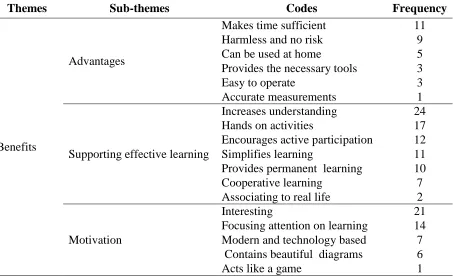
Forty volunteer students who participated in the experimental group gave their opinions about the application. The data obtained by ECSEF related with the opinions of the students about computer simulations in teaching physics was analysed. Common themes were determined and coded by referring directly to the opinions of students and these codes subsequently interpreted. Table 5 summarizes the themes, sub-themes, codes and frequencies collected from students’ opinions in the survey form.
29
Table 5: Student opinions about using computer simulations in teaching physics: Themes, sub-themes, codes and frequencies
Themes Sub-themes Codes Frequency
Benefits
Advantages
Makes time sufficient 11
Harmless and no risk 9
Can be used at home 5
Provides the necessary tools 3
Easy to operate 3
Accurate measurements 1
Supporting effective learning Increases understanding 24
Hands on activities 17
Encourages active participation 12
Simplifies learning 11
Provides permanent learning 10
Cooperative learning 7
Associating to real life 2
Motivation Interesting 21
Focusing attention on learning 14
Modern and technology based 7
Contains beautiful diagrams 6
Acts like a game 1
Among the answers to the question What can you say about the advantages of computer
simulation? the code, “Makes time sufficient”, (f=11) was the most frequent answer in the sub
theme. Simulations reduced the time needed to complete experiments. With the help of simulation students had the chance to do a lot of activities in a short time. The following students’ statements are relevant to this finding:
…the instruction supported by computer simulation has many advantages and some of
them are: it takes less time to cover huge concepts’, among others (S5);
Yes I recommend simulations because it is easy for the teacher. Experiments can be
done in less time (S20);
Computer simulation saves time (S34).
Another point revealed here is that the simulations are harmless and no risk (f=9) and they can be used at home (f=5). For example, the students commented that:
Simulation does not have any dangerous things so that students did not afraid computer
simulation experiments(S3);
…there is no risk like a real lab (S13);
…can be alternative if we do not have real lab, more safer than real lab, no more health
problem in computer based simulation” (S40);
We can also do experiments at home (S20).
30
misuses of equipment in real laboratories and also there are no dangerous and poisonous chemicals. Since simulation is free from these risks, it encourages students to do activities by trial and error. Other views in the advantage category also include that simulation programs provide students an opportunity to use the program not only in the class but also when they are at home; provides equipment needed for experiments; can be used easily; and that the program gives accurate measurements.
The students’ answers to the question Is there a difference between instruction with computer
simulation and traditional instructions? If your answer is yes, explain revealed that all of the
students considered simulations to be effective for learning. The points that students focus on most are that simulations increase the understanding of concepts (f=24). Students claimed that, since computer simulations provide hands on activities and students can do these activities by themselves repeatedly, this will increase the level of understanding. Example opinions of the students relevant to this point are:
Computer simulations are good because students can do the work, when the teacher gives
one example, repeatedly and understand (S29);
Yes there is a difference, because computer simulation is more effective than traditional. It facilitates the understanding of students and gives students mental image of the lesson
(S8);
Yes of course, computer simulation is like an experiment and experiments have more
understanding effect than traditional instruction (S14).
The second most frequently expressed (f=17) view was that simulations are like practical experiments and that when students do these hands on activities they understand the lesson well. They explained that simulation was a practical activity and that what they did with their hands was more effective than what they were told orally. Some of their opinions were as follows:
Yes, because computer simulation is practical while traditional instruction is lecture
only and as we are aware practical method is more effective than lecture (S3);
Yes, because traditional instruction is like history and there is no practical but computer
simulation is real like practice (S23);
Yes, computer simulation is like a practical. It has virtual experiments and students do
the practical together (S16).
Other opinions of students towards the sub-theme ‘Supporting Effective Learning’ included that
computer simulations increased the active participation of students and made them more involved in the learning environment, simplified learning, provided permanent learning, provided cooperative learning by letting students do activities in groups, and that it provided real life activities.
Among the answers to the question How computer simulation used instruction affects the
motivation of students? interesting (f=21) was the most important matter for the students. Some
31
others said that because it included attractive diagrams; while others justified that it on the basis of being technology based instruction. Example opinions of the students relevant to this point are:
Simulation increases the circle of interest for learners (S24);
Students always interest using technology so that they become happy with their lessons
(S13);
Computer simulation is more interesting than traditional method. The participation of
students is high because they can do everything with their hands (S34).
The next most frequently held view (f=14) in this category was that simulations focus students’ attention on learning. That is, simulation helps the teacher to capture students’ attention when explaining something and when giving instructions. Students also focus their attention when doing activities. Learners explained that they do not lose their interest and awareness for a long time while doing simulations. For example, they commented:
Simulation always keeps the attention span for hours (S6);
It makes students active participants and aware physically and mentally when they are
doing simulations (S29);
When the teacher shows students computer simulations all of them are listening (S7).
Other opinions of students towards the sub-theme ‘Motivation’ included that simulations increase
the motivation of students because it is a technology based method; included beautiful diagrams; and acts like a game. All these factors affect the motivation of students towards simulation and as a result towards learning.
The analysis of the question Would you recommend your physics teacher use computer based
simulations while teaching physics lessons? If your answer is yes, explain is distributed among all
the three sub-themes because some students recommend the use of simulations from the point of view of advantages; others from their supporting effective learning; while others look from their motivational increases. While the vast fast majority of students (36) recommended the use of simulations without hesitation, four students stated that simulations cannot replace the role of real laboratory activities and that simulations are needed only when there is no real equipment. Some of their opinions included:
Yes there is great difference between them. The differences are: you do not see real things in simulation based on computer; the effectiveness of simulation is less than real lab
(S40);
…if students can get ‘lab’, the lab is better than computer simulation (S25).
Discussion and Conclusion
32
academic achievement and attitudes. The appreciable academic achievement gain in the experimental group is thought to be due to: students’ greater engagement in the lessons as compared with the traditional classes; their active participation in the class activities by constructing their own understandings of knowledge; conducting real-like experiments and proving physical laws and facts by themselves through virtual experiments; and their interest and willingness in doing activities on computers which develops positive attitudes towards learning physics. The difference between the attitudes of the experimental and control groups is thought to be: experimental students’ greater engagement in the lessons as compared with the traditional classes; learning by doing through practical activities increased students’ understanding and the more students understand the topic the more they develop positive attitudes; and students like using computers. Furthermore, the significantly higher academic achievement of the experimental group is thought to be the consequence of motivational increase due to the interactive simulations supporting the 5E teaching model used.
Computer simulations provide a suitable technology that supports the level of interaction needed for 5E learning. The integration of simulations with the 5E teaching model which encourages students to be actively engaged, explore knowledge through thinking, explain the observed concepts, extend their findings to the real world under guidance and evaluation of the teacher, also contributes a lot to the achievements of the experimental group. The learning principles of constructivism claimed that the more opportunity for active learning for the students, the more the fruit of the efforts they gained (Yuan & Sheng Heh, 2007; Kırbulut & Gökalp, 2014). Our findings are broadly in line with previous studies showing that computer simulations positively affect academic achievement. Sarı and Güven (2013) used inquiry learning with computer simulations in learning environments similar to the 5E learning with simulation. They showed that the interactive simulation supported inquiry-based learning approach is more effective on students’ academic achievement and motivation compared to traditional methods. White and Bodner (1999) found that students enjoy using simulations and that this enables them to perform the application and learn easily. Moreover, they state that simulations are more effective in students’ learning new concepts and methods. Rutten, van Joolingen and Van der Veen (2012) analysed a total of 510 articles published between 2001 and 2010 that had investigated the effect of simulations on science teaching. It was found that all of the analysed articles reported that the use of simulations has positive effects.
33
that simulation makes lessons interesting, focuses their attention on learning, provides beautiful diagrams and they enjoy when doing simulations on computers. Students also suggested that simulations are more effective in some topics than others even though they were different in their selections. These opinions show that computer simulations have positive effects on students’ beliefs and perceptions towards learning physics. Students have a more positive attitude to teaching with computer simulations in terms of contributions to their motivation and insight when the teaching approach has an inquiry-based character such as the 5E teaching model (Rutten, Van der Veen & Van Jooligen, 2015). Researchers also argued that computer simulations have positive effects on students’ attitude (Chen & Howard, 2010; Sarı & Güven, 2013, Ulukök & Sarı, 2015). Sarı, Ulukök and Özdemir (2013) indicated that simulation applications have more positive effects on students’ attitudes towards science lessons compared to traditional instructions. However, another study indicated that computer-assisted instructions have no effect on students’ attitudes (Çepni, Taş & Köse, 2006; Güven & Sülün, 2012). Çepni et al (2006) suggest that applications performed over a short period do not affect students’ attitudes.
Teaching physics requires teaching resources such as a well-equipped laboratory, real objects, models, audio visuals, well trained teachers etc. In developing countries, in which Somalia is a part, these resources are either very limited or not available. For example, schools in big cities may have very small laboratories with insufficient equipment, but most of schools in the small towns and villages do not have laboratories at all. According to the results of this study, we can propose the 5E teaching model integrated with simulations as an alternative way of teaching physics classes in Somali secondary schools, where there is a lack of real science laboratories.
Limitations of the Research and Future Directions
This study investigates the effects of interactive simulations integrated in the 5E teaching model on academic achievements and attitudes towards physics. However, there are several limitations to this study, which suggest future research directions. First, this study was limited to the data collected from 80 students and to the topic ‘light’. Similar studies can be carried out for different grade levels and for different topics with large samples, so that the results of this study can be generalized. Second, this study was restricted to simulations integrated with the 5E teaching model. Further research might well consider the effects of simulations integrated with other student-centered teaching approaches.
Acknowledgement
The current study was produced from a master thesis written by Abdillahi Hajiomer Hassan under the supervision of Professor Dr. Uğur Sarı.
References
Bajzek, D., Burnette, J., & Brown, W. (2005). Building cognitively informed simulators utilizing multiple, linked representations which explain core concepts in modern biology. In Proceedings of World Conference on Educational Multimedia, Hypermedia and Telecommunications 2005 (pp. 3773-3778). Norfolk, VA: AACE. Barmby, P., Kind. P. M., Jones, K. & Bush, N. (2005). Evaluation of Lab in a Lorry, Final Report Durham
University, CEM Centre of School and Education.
Bayrak, C. (2008). Effects of computer simulations programs on university students’ achievement in physics.
Turkish Online Journal of Distance Education, 9(4).
34
simulations and Internet conferencing. International Journal of Innovation in Science and Mathematics Education (formerly CAL-laborate International), 6(1).
Bransford J. D., Brown A. L., & Cocking R. R.(Eds.) (2000). How people learn: Brain, mind, experience, and school. Washington DC: National Academy Press. https://doi.org/10.17226/9853.
Bybee, R. W., Taylor, J. A., Gardner, A., Van Scotter, P., Powell, J. C., Westbrook, A., & Lands, N. (2006). The BSCS 5E instructional model: Origins, effectiveness, and applications. Colorado Springs: BSCS.
Çelik, H., Sarı, U., & Harwanto, U. N. (2015). Developing and evaluating physics teaching material with Algodoo (Phun) in virtual environment: Archimedes’ Principle. International Journal of Innovation in Science and Mathematics Education (formerly CAL-laborate International), 23(4), 40–50.
Çepni, S., Taş, E., & Köse, S. (2006). The effects of computer-assisted material on students’ cognitive levels, misconceptions and attitudes towards science. Computers & Education, 46(2), 192–205.
Chen, C. H., & Howard, B. (2010). Effect of live simulation on middle school students' attitudes and learning toward science. Educational Technology & Society, 13(1), 133–139.
Creswell, J. W., & Plano-Clark, V. L. (2007). Designing and conducting mixed methods research. CA: Sage Publications, Thousand Oaks.
De Jong, T., & Van Joolingen, W. R. (1998). Scientific discovery learning with computer simulations of conceptual domains. Review of Educational research, 68(2), 179–201.
Duran, E., Duran, L., Haney, J., & Scheuermann, A. (2011). A learning cycle for all students: Modifying the 5E instructional model to address the needs of all learners. The Science Teacher,78, 56–60.
Duschl, R.A., Schweingruber, H.A., & Shouse, A.W. (Eds.), (2007). Taking science to school: Learning and teaching science in grades K-8. Washington, DC: National Academies Press.
Finkelstein, N. D., Perkins, K. K., Adams, W., Kohl, P., & Podolefsky, N. (2004). Can computer simulations replace real equipment in undergraduate laboratories? Department of Physics: University of Colorado, Boulder. Fraenkel, J. R., & Wallen, N. E. (2000). How to design and evaluate research in education (4th ed.). Boston:
McGraw-Hill.
Gilakjani, A. P., Leong, L., & Ismail, H. N. (2013). Teachers’ use of technology and constructivism. I. J. Modern Education and Computer Science, 4, 49–63.
Güven, G., & Sülün, Y. (2012). The effect of computer assisted instruction on 8th grade students’ achievement levels in science course and on their attitudes towards the course. Journal of Turkish Science Education, 9(1), 68–79.
Jaakkola, T., & Nurmi, S. (2008). Fostering elementary school students’ understanding of simple electricity by combining simulation and laboratory activities. Journal of Computer Assisted Learning, 24(4), 271–283. Jaakkola, T., Nurmi, S., & Veermans, K. (2011). A comparison of students’ conceptual understanding of electric
circuits in simulation only and simulation-laboratory contexts. Journal of Research in Science Teaching, 48(1), 71–93.
Jimoyiannis, A., & Komis, V. (2001). Computer simulations in physics teaching and learning: A case study on students’ understanding of trajectory motion. Computers and Education, 36(2), 183–204.
Kaya, H., & Böyük, U. (2011). Attitude towards physics lessons and physical experiments of high school students.
European Journal of Physics Education, 2(1), 38–49.
Kırbulut, Z. D., & Gökalp, M. S. (2014). The relationship between pre-service elementary school teachers’ metacognitive science learning orientations and their use of constructivist learning environment. International Journal of Innovation in Science and Mathematics Education (formerly CAL-laborate International), 22(6), 1– 10.
Martinez- Jimenez, P., Pontes-Pedrajas, A., Polo, J., & Climent-Bellido, M. S. (2003). Learning a chemistry with virtual laboratories. Journal of Chemical Education, 80(3), 364–352.
Richards, J., Browy, W., & Levin, D. (1992). Computer simulations in science classroom. Journal of Science Education and Technology, 1(1), 67–79.
Ronen, M., & Eliahu, M. (2000). Simulation - A bridge between theory and reality: The case of electric circuits.
Journal of Computer Assisted Learning,16, 14–26.
Rutten, N., Van Joolingen, W. R., & Van der Veen, J. T. (2012). The learning effects of computer simulations in science education. Computers and Education, 58, 136–153.
35
Sarı, U., & Güven, G. B. (2013). The effect of interactive whiteboard supported inquiry- based learning on achievement and motivation in physics and views of prospective teachers towards the instruction. Necatibey Faculty of Education Electronic Journal of Science and Mathematics Education, 7(2), 93–125.
Sarı, U., Ulukök, Ş., & Özdemir, F.Z. (2013).The effect of virtual laboratory applications for “Electricity in our life” unit on science process skills and attitudes. Mediterranean Journal of Educational Research, 14(a), 650–655. Shin, N., Jonassen, D. H., & McGee, S. (2003). Predictors of well-structured and ill-structured problem solving in an
astronomy simulation. Journal of Research in Science Teaching,40(1), 6–33.
Singer, S. R., Hilton, M. L., & Schweingruber, H. A. (2006). America’s lab report: Investigations in high school
science. Washington, DC: National Academies Press.
Sokolowski, A. (2013). Teaching the photoelectric effect inductively. Physics Education, 48(1), 35–41.
Taşlıdere, E. (2015). A study investigating the effect of treatment developed by integrating the 5E and simulation on pre-service science teachers’ achievement in photoelectric effect. Eurasia Journal of Mathematics, Science & Technology Education, 1–16.
Ulukök, Ş., & Sarı, U. (2016).The effect of simulation-assisted laboratory applications on pre-service teachers’ attitudes towards science teaching, Universal Journal of Educational Research,4(3), 465–474.
Ulukök, Ş., Çelik, H., & Sarı, U. (2013). The effects of computer-assisted instruction of simple circuits on experimental process skills. Journal of Theoretical Education Science, 6(1), 77–101.
Ünlü, Z. K., & Dökme, İ. (2011). The effect of combining analogy-based simulation and laboratory activities on Turkish elementary school students’ understanding of simple electric circuits. Turkish Online Journal of Educational Technology, 10(4), 320–329.
Van Berkum, J. J. A., & de Jong, T. (1991), Instructional environments for simulations. Education & Computing, 6, 305–358.
White, S. R., & Bodner, M. G. (1999). Evaluation of computer simulation experiments in a senior level capstone chemical engineering course. Chemical Engineering Education, 33(1), 34–39.
Yuan Y., & Sheng H. (2007). The impact of internet virtual physics laboratory instruction on the achievement in physics, science process skills and computer attitudes of l0th grade students. Journal of Science Education and
Technology, 16(5), 451–461.
Zacharia, Z. C. (2007). Comparing and combining real and virtual experimentation: An effort to enhance student’s conceptual understanding of electric circuits. Journal of Computer Assisted Learning. 23(2), 120–132. Zacharia, Z. C. (2003). Beliefs, attitudes, and intentions of science teachers regarding the educational use of
computer simulations and inquiry-based experiments in physics. Journal of Research in Science Teaching, 40(8) 792–823.