ISSN 2324-805X E-ISSN 2324-8068 Published by Redfame Publishing URL: http://jets.redfame.com
Perceptions of the Prospective Teachers Regarding the Opinion
Development Technique
Burcu Duman
Correspondence: Burcu Duman, Assist. Prof. Dr., Faculty of Education, Department of Educational Sciences, Bartın University, Turkey.
Received: January 30, 2019 Accepted: February 26, 2019 Online Published: February 26, 2019
doi:10.11114/jets.v7i3.4011 URL: https://doi.org/10.11114/jets.v7i3.4011
Abstract
The opinion development technique is one of the learner centered teaching methods. In the study, it has been aimed at identifying the metaphorical perceptions of the prospective teachers about the opinion development technique. The case study design has been used in the study. 77 prospective teachers have taken place in the study group. The metaphors of the prospective teachers about the opinion development technique have been identified by a semi-structured questionnaire. The data has been analyzed through content analysis. 65 valid metaphors have been produced by the prospective teachers. Chameleon is the most repeated metaphor. Tree, sea, fingers of one hand, democracy, plane and war has followed it. Metaphors have been classed in 8 categories. These categories are dissimilarity (f: 26), change (f: 19), variety (f: 11), interaction (f: 6), integrity and comprehensiveness (f: 5), eternity (f: 4), freedom (f: 4) and sharing (f: 2). According to the results of the study, perceptions of the prospective teachers about the opinion development technique are positive. The study results suggest that opinion development technique can be effective to develop 21st century skills such as invention, flexibility and adaptation and critical thinking. Opinion development technique can be used at the teacher training institutions more widely because it contributes various skills to develop especially the 21st century skills. Studies can be carried out to identify the metaphorical perceptions of the prospective teachers about various methods and techniques.
Keywords: prospective teacher, metaphor, opinion development, teaching technique
1. Introduction
Teaching methods and techniques have a significant effect on achievement of an education program to reach its objectives, and the learning-teaching process to be effective is related to the selection of the suitable teaching methods and techniques (Demirel, 2012; Ocak, Ocak, Yılmaz & Mergen; 2012). It is known that teaching which is done by techniques and method that puts students on center and adds them into learning process has effects to realize effective learning (Duman, 2018). One of the techniques that can be assumed among the student centered methods and techniques is the opinion development technique. The opinion development technique is a discussion technique that can be used to develop the opinions of the students about teaching the subjects including specific contradictions and manners (Gözütok, 2007; Saracaloğlu & Küçükoğlu, 2015).
In life, particularly in social fields and even in physical sciences, there are subjects including oppositions and contradictions. Sometimes, the subject itself and sometimes the suggested ways for solving the problem can contradict with themselves. The ones defending the different opinions have causes on this issue. The ones defending the same opinion may have different causes to defend this opinion. In this case, it is essential to be a democratic society that everybody defend his/her opinion, respect different opinions and change the opinions if it is wished (Gözütok, 2007). Opinion development technique can be an important tool in achieving these values and manners. Nevertheless, it is aimed at creating positive changes in the values and manners of the learners with the opinion development technique (Erginer, 2015; Ocak, 2012). It maintains the students to develop, change their current opinions or to have a new opinion (Taşpınar, 2012). The subjects to be dealt with must include the opposite view-points to be considered valid (Saracaloğlu & Küçükoğlu, 2015). The most important characteristic of the technique is the necessity not to go up against the ones bringing forward an idea, but only to go up against their ideas during the discussion of the opinions. Adequate evidence and justification is asked for defending the opinions (Erginer, 2015).
development, there are different points between two opposite ends like a fan. While discussion is lasted with only a certain group of students, the whole class can actively join into the opinion development. While the participants defend the same opinion up to the end, opinions may be changed in opinion development. There are “winner” and “loser” groups in discussion while there is no “winner”, “loser”, “correct defender” or “wrong defender” in opinion development (Gözütok, 2007; Sönmez, 2007; Taşpınar, 2012). Application steps of the Opinion Development Technique can shortly be summarized as follows (Erginer, 2015; Gözütok, 2007; Saracaloğlu & Küçükoğlu, 2015; Taşpınar, 2012): - On five different cartoons, it is written “absolutely agree”, “agree”, “indecisive”, “don’t agree” and “absolutely don’t agree”.
- These cartoons are stuck on the walls of the classroom from the most positive one to the most negative one at certain intervals.
- Suggestion is written on the board (it should be noticed that the suggestion include contradiction).
- Students are asked to what extent they agree on this suggestion. Students pass to sections where the cartoons determine their agreement degrees.
- Students are asked one by one why they are at the place where they are. Adequate evidence and justification is asked for defending the opinions.
- It is said that the student may go to somewhere else during the discussion by changing his/her opinion if he/she wants.
- The student changing his/her opinion is asked why he/she changed and to explain with the justifications.
- When it is decided that the subject has been discussed in detail, the discussion is terminated.
The Opinion Development Technique may have some explicit sides. Technique may take a long time. If the media is not managed effectively, the discussion may turn into a fight. It may be hard to apply in crowded groups (Taşpınar, 2012). Beside all its objections, the opinion development technique maintains students to respect various opinions and to have a democratic attitude. It helps to have different view-points and to look critically on the issues. It teaches that opinions may change by development of the critical approach. The interest onto the lesson increases thanks to discussion environment. The tolerance, bearing each other, speaking, persuasion and being open to change skills develop (Ocak, 2012; Saracaloğlu & Küçükoğlu, 2015; Taşpınar, 2012).
In spite of its so many positive sides, the studies carried out directly on the opinion development technique are limited. In Akkaya Yılmaz & Karakuş’s (2018) study titled as “The Impact of Place Based Education Approach on Student Achievement in Social Studies”, opinion development technique is given a place within the scope of the social sciences lesson. In Özdemir’s (2018) study titled as “The Use of Idea Development and Speaking Circle Techniques in Teaching Turkish to Foreigners”, it is dwelled on opinion development technique in the foreign language teaching. In Ocak & Yurtseven’s (2017) study, opinion development technique has been applied in the Turkish Lesson at the primary school fourth-grade and then, the opinions of the primary school students devoted to this technique have been received. Even if it does not form the focal point of the researches, opinion development technique is told about in some studies dealing with the student centered methods and techniques. For instance, in Aykaç (2011) and Aykaç & Adıgüzel’s (2011) studies, it is seen that the teachers haven’t give place to opinion development technique in education process not all that. In Kubat’s study (2016), it has been identified that the prospective teachers have never allowed the active teaching methods and techniques such as discussion method, problem solving method and opinion development technique happen during the teaching-learning process. In Uysal’s PhD dissertation (2010), most of the teachers have found themselves adequate in applying the opinion development technique. Moreover, the better part of the teachers have expressed that they often used the opinion development. Yet, the mind-bender is that no class at which the opinion development technique has been applied according to the observation results of the researcher has been run across. In fact, these results show that the opinion development technique is not known and used enough at the educational environments. Whereas, Demirel (2012) says that the teachers’ being selective about the methods and techniques can be possible only with their knowing and using various methods and techniques. So, it is important that the prospective teachers qualify about the methods and techniques at the teacher training and education institutions. For this reason, it is aimed to identify the metaphorical perceptions of prospective teachers about the opinion development technique. In this context, the following questions were asked:
1. What are the metaphors produced by the prospective teachers about the opinion development technique?
2. Under what conceptual categories are the produced metaphors gathered in terms of metaphorical aspects? 2. Method
processes can be subjected to the case studies (Merriam, 2013). Also in this study, the opinion development technique has been applied and then, the perceptions about it have been tried to be described through metaphors. When metaphors are used with the purpose of description, a case, event or phenomenon is depicted as it is. Metaphors present a very firm and rich description about the studied case and give a visual image (Yıldırım & Şimşek, 2006).
2.1 Study Group
85 prospective teachers getting education at the 2nd grade of the Primary School Teaching and Elementary Mathematics Teaching programs, Faculty of Education at a state university in Turkey in the 2018-2019 academic year are at the study group of the research. But, 8 of the prospective teachers who have joined in the study group have been qualified out of the group at the data analysis stage because they could not justify their metaphors understandably. Finally, 77 prospective teachers have formed the study group of the research. 40 of the 77 prospective teachers are at the Primary School Teaching program and 37 at the Elementary Mathematics Teaching program.
The prospective teachers have been selected through the criterion sampling which is one of the purposive samplings. In the criterion sampling, the criterion identified by the researcher or prepared before is based on, and the study group is determined due to the meeting this criteria (Yıldırım & Şimşek, 2006). The basic criterion in this study is that the persons in the study group have studied the opinion development technique at the 2nd grade of the so-called programs and applied it at the Teaching Principles and Methods class. The purpose of selecting this criterion is to be able to achieve more qualitative data by benefitting from the knowledge and experience of the participants.
2.2 Data Collection Tool
In the study, a semi-structured questionnaire has been used as the data collection tool. In this questionnaire form, a question in the type of infill statement like “the opinion development technique is like ….. because ……..” is available. With the word “like” in this statement, it has been tried to identify by which metaphor the perceptions of the prospective teachers about the opinion development technique are expressed. In the part continuing with “because”, the justifications of the mentioned metaphors have tried to be learned.
2.3 Data Collection and Analysis
The research data have been collected just after the application of the opinion development technique at the Teaching Principles and Methods class. This period of time has been preferred in order to obtain more creative and fresh opinions in the realest and safest way from the prospective teachers. The prospective teachers have been informed about the questionnaire form, and sample metaphor statements have been presented by explaining particularly what the metaphor concept is and for what purpose it is used. The data has been analyzed by content analysis. The content analysis is to bring together the like data within the scope of specific concepts and categories and to interpret them for the reader to understand clearly by putting them in order (Ekici, 2016; Yıldırım & Şimşek, 2006).
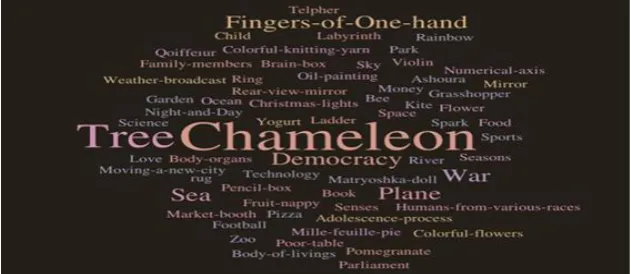
At the data analysis stage, the questionnaire forms have firstly been controlled and eight of them have not been written understandably and whose justifications have not been presented have been excluded from the analysis. The rest of the questionnaire forms have been divided into two as the prospective primary school teachers and the prospective elementary mathematics teachers. By identifying PPST code for the prospective primary school teachers and PEMT code for the prospective elementary mathematics teachers, each group within itself has been assigned a number starting from 1. Thus, the forms of the prospective primary school teachers have respectively been named as PPST-1, PPST-2…PPST-40, and those of the prospective elementary mathematics teachers as PEMT-1, PEMT-2…PEMT-37. The metaphors at the numerated forms have been examined, and cognitive categories have been developed. The metaphors have been distributed according to the categories. The word cloud program (https://worditout.com) has been used for showing the metaphors with the word cloud. Some points have been noticed in order to increase the validity and reliability of the study. 1) The steps at the process of codifying and analyzing the data are explained in detail. 2) For each category, samples selected from the explanations of the prospective teachers have been presented at the findings. In other words, direct quotations are given. 3) The codes of the two researchers and the categories related to the codes have been compared with the aim of confirming whether metaphors which are given under the conceptual category represent the so-called conceptual categories. For this, it has been benefitted from Miles & Huberman’s (1994) formula. [Consensus / (Consensus + Dissensus) x 100] and codifying reliability has been found as 0.91 [70 / (70 + 77) x 100]. 4) The data’s being interpreted fair-and-square by being supported with literature has been taken into consideration. 3. Results
dissimilarity (f:26), change (f:19), variety (f:11), interaction (f:6), integrity and comprehensiveness (f:5), eternity (f:4), freedom (f:4) and sharing (f:2). At Table 1, all metaphors formed about the opinion development technique are given.
Table 1. Metaphors about the opinion development technique
Metaphors f Metaphors f Metaphors f
Chameleon 5 Christmas lights 1 Ladder 1
Tree 4 Ocean 1 Mirror 1
Sea 2 Mille-feuille pie 1 Kite 1
Fingers of One hand 2 Technology 1 River 1
Democracy 2 Spark 1 Science 1
Plane 2 Labyrinth 1 Park 1
War 2 Flower 1 Food 1
Rainbow 1 Ashura 1 Seasons 1
Night and Day 1 Moving a new city 1 Colorful knitting yarn 1
Bee 1 Ring 1 Parliament 1
Sports 1 Book 1 Oil painting 1
Love 1 Senses 1 Humans from various races 1
Matryoshka doll 1 Telpher 1 Violin 1
Colorful flowers 1 Pencil box 1 Football 1
Market booth 1 Pomegranate 1 Space 1
Body organs 1 Child 1 Adolescence process 1
Zoo 1 Garden 1 Numerical axis 1
Family members 1 Yogurt 1 Grasshopper 1
Sky 1 Money 1 Fruit nappy 1
Body of livings 1 Pizza 1 Coiffeur 1
Brain box 1 Weather broadcast 1 Poor table 1
rug 1 Rear-view mirror 1
65 valid metaphors have been created by the prospective teachers. Chameleon has been the most repeated metaphor.
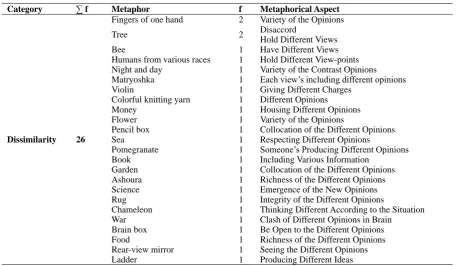
Tree, sea, fingers of one hand, democracy, plane, and war are the metaphors repeated more than once. Some these repeated metaphors are placed in different categories because the evaluation has been done according to the metaphorical aspects. The metaphors which are formed by the prospective teachers about opinion development technique and having a part in the category “Dissimilarity” are given at Table 2.
Table 2. Metaphors Taking Part at the Category Dissimilarity
Category ∑ f Metaphor f Metaphorical Aspect
Dissimilarity 26
Fingers of one hand 2 Variety of the Opinions
Tree 2 Disaccord
Hold Different Views
Bee 1 Have Different Views
Humans from various races 1 Hold Different View-points Night and day 1 Variety of the Contrast Opinions Matryoshka 1 Each view’s including different opinions
Violin 1 Giving Different Charges
Colorful knitting yarn 1 Different Opinions
Money 1 Housing Different Opinions
Flower 1 Variety of the Opinions
Pencil box 1 Collocation of the Different Opinions
Sea 1 Respecting Different Opinions
Pomegranate 1 Someone’s Producing Different Opinions
Book 1 Including Various Information
Garden 1 Collocation of the Different Opinions Ashoura 1 Richness of the Different Opinions
Science 1 Emergence of the New Opinions
Rug 1 Integrity of the Different Opinions
Chameleon 1 Thinking Different According to the Situation
War 1 Clash of Different Opinions in Brain
Brain box 1 Be Open to the Different Opinions
Food 1 Richness of the Different Opinions
Rear-view mirror 1 Seeing the Different Opinions
Ladder 1 Producing Different Ideas
particular importance is given to the concept “difference of opinions” which is the common trait of all metaphors. If it is studied more in detail; the emphasis is laid on respecting different opinions at the sea metaphor while collocation, richness and integrity of the different opinions are emphasized at the money, pencil box, garden, ashoura and food metaphors. Innovations are mentioned at the science metaphor. Some of the answers of the prospective teachers about the dissimilarity category are as; The opinion development technique is like the fingers of one hand because each opinion is different from others (PPST-10). The opinion development technique is like chameleon because there are different opinions in opinion development. Chameleon can also relapse into various colors in various situations. Persons may relapse into various opinions according to the situation, too (PPST-14). The opinion development technique is like bee because the opinion development technique receives different opinions from everybody as well as the bee takes honey from every flower (PPST-16). The opinion development technique is like colorful knitting yarn
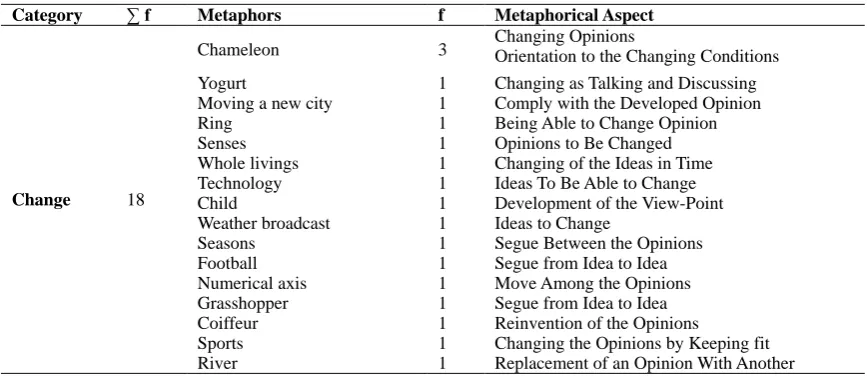
because different yarns express different opinions (PEMT-12). The opinion development technique is like a rug because it forms a whole with different designs (PPST-19). The opinion development technique is like a flower because each opinion is different from the other and important just as each flower is different from the other and valuable. (PEMT-21). The opinion development technique is like war because it includes the fights of the different opinions in our brain (PPST-33). The opinion development technique is like food. The vegetables having their own taste may exclude very different tastes all together (PEMT-25). The opinion development technique is like sea because various creatures are together within the sea. This reminds us of being with different ideas in the same atmosphere and of living together by respecting various opinions (PEMT-30). The metaphors formed by the prospective teachers about the opinion development technique and being under the “Change” category are given at Table 3.
Table 3. The metaphors Taking Part at the Change Category
Category ∑ f Metaphors f Metaphorical Aspect
Change 18
Chameleon 3 Changing Opinions Orientation to the Changing Conditions Yogurt 1 Changing as Talking and Discussing Moving a new city 1 Comply with the Developed Opinion
Ring 1 Being Able to Change Opinion
Senses 1 Opinions to Be Changed
Whole livings 1 Changing of the Ideas in Time Technology 1 Ideas To Be Able to Change
Child 1 Development of the View-Point
Weather broadcast 1 Ideas to Change
Seasons 1 Segue Between the Opinions
Football 1 Segue from Idea to Idea
Numerical axis 1 Move Among the Opinions Grasshopper 1 Segue from Idea to Idea
Coiffeur 1 Reinvention of the Opinions
Sports 1 Changing the Opinions by Keeping fit
River 1 Replacement of an Opinion With Another
Change category is the second one after the variety category, at which the most metaphors have been produced. 16 different metaphors have been produced by 18 prospective teachers. These metaphors are chameleon, yogurt, moving a new city, senses, whole livings, technology, child, weather broadcast, seasons, football, numerical axis, grasshopper, coiffeur, sports and river. At this category, emphasis has generally been put on changing the opinions. For example; while it is mentioned about passing from one idea to another in the seasons, football and grasshopper metaphors, the changing conditions and opinions is predicated upon chameleon and moving a new city metaphors. Keeping fit is emphasized at the sports metaphor, but reinvention of the opinions is done so at the coiffeur metaphor. Some of the answers of prospective teachers about change category are as; the opinion development technique is like technology
because technology continuously develops and changes. Also in this technique, ideas may change and various ideas come to light and develop as long as it is talked about the subject (PPST-5). The opinion development technique is like
grasshopper because we can jump from one idea to another (PEMT-10).The opinion development technique is like
river because one opinion is replaced with another while one drop is replaced with another (PEMT-20). The opinion development technique is like sports because sports keep humans fit and the opinion development technique develops the opinions of people, too. (PPST-32). The opinion development technique is like coiffeur because opinion development technique may shape our opinions in many ways (PPST-40). The opinion development technique is like
Table 4. The metaphors Taking Part at the Variety Category
Category ∑ f Metaphors f Metaphorical Aspect
Variety 11
Tree 2 Existence of Various Opinions
Variety of the Increasing Ideas Fruit Nappy 1 Existence of Various Opinions
Pizza 1 Addition of the Various Ideas
Rainbow 1 Housing Various Ideas
Colorful Flowers 1 Including Various Ideas Market Booth 1 Existence of Various Ideas
Zoo 1 Existence of Every Type of Idea
Family Members 1 Housing Many View-points Christmas Lights 1 Live and Colorful Ideas Oil Painting 1 Colorful Ideas
In variety category, 10 different metaphors have been produced by 11 prospective teachers. These metaphors are tree, fruit nappy, pizza, rainbow, colorful flowers, market booth, zoo, family members, Christmas lights and oil painting. In this category, statements about the existence of various opinions in opinion development technique have been used. For instance; it is mentioned that opinions are increasingly varied at tree metaphor and many view-points are together at the family members metaphor. But, the variety of the opinions is stated with the word multicolored at the Christmas lights and oil painting metaphors. Some of the answers of the prospective teachers about the variety category are as; the opinion development technique is like fruit nappy because every opinion leaves a different taste on the palate (PPST-7). The opinion development technique is like tree because ideas are different from each other just as there are different kinds of trees (PEMT-37). The opinion development technique is like rainbow because it houses various ideas (PPST-22). The opinion development technique is like tree because ideas branch out as it is in the opinion development technique, that is, they increase and variety increases (PPST-26). The opinion development technique is like Christmas lights because Christmas lights are lively and multicolored. Each idea presented with the opinion development technique is also lively and multicolored (PPST-33). The opinion development technique is like oil painting because it houses multicolored ideas in harmony (PPST-39). The metaphors formed by the prospective teachers about the opinion development technique and being under the “Interaction” category are given at Table 5.
Table 5. The metaphors Taking Part at the Interaction Category
Category ∑ f Metaphor f Metaphorical Aspect
Interaction 6
Adolescence Period 1 Formation of the Thought via Interaction
Chameleon 1 Being Affected from the Opinions of Various persons Mille-feuille pie 1 Lamination of the Opinions via Interaction
Kite 1 Being Affected from Various Ideas War 1 Interaction of the Opposing Views Labyrinth 1 Being Affected from Other Ideas
At interaction category, six different metaphors have been produced by six prospective teachers. These metaphors are adolescence period, chameleon, mille-feuille pie, kite, war and labyrinth. At this category, statements about the interaction of the opinions from each other have generally taken place. For example, it has been stated that the opinions interact in order to refute each other at war metaphor, and that the opinions laminate with the interaction as the opinion development period progresses at the mille-feuille pie metaphor. However, in kite metaphor, the statement being affected from the ideas of others and passively being dispersed around these ideas has been used. Some of the answers of prospective teachers about the interaction category are as; the opinion development technique is like kite because we are dispersed around the opinion which is defended (PPST-8). The opinion development technique is like war because rivals bomb each other with their ideas in order to refute their opinions. They develop opposite opinions like a weapon (PPST-17). The metaphors formed by the prospective teachers about the opinion development technique and being under “Integrity and Comprehensiveness” category are given at Table 6.
Table 6. The metaphors Taking Part at the Integrity and Comprehensiveness Category Category ∑ f Metaphor f Metaphorical Aspect
Integrity and
Comprehensiveness 5
Spark 1 Discussion’s including everybody quickly Plane 1 Dominating all opinions
Telpher 1 Expansion of the view point
Body Organs 1 Completion of the mentality with various opinions Mirror 1 Reflecting all ideas
opinions in mirror metaphor. Some of the answers of prospective teachers about Integrity and Comprehensiveness Category are as; the opinion development technique is like a spark because discussion may grow and inflame with a small introduction. It embodies, includes and affects everybody (PPST-2). The opinion development technique is like a telpher because the view point expands as it goes up. As the discussion process progresses and you learn various ideas, your point of view widens (PEMT-6). The opinion development technique is like body organs because various opinions complete and develop our mentality while organs of our body complete us (PPST-9). The opinion development technique is like mirror because it shows and reflects all ideas (PEMT-18). The metaphors formed by the prospective teachers about the opinion development technique and being under the “Freedom” category are given at Table 7.
Table 7. The metaphors Taking Part at the Freedom Category
Category ∑ f Metaphor f Metaphorical Aspect
Freedom 5
Democracy 2 Everbody’s saying his idea freely Plane 1 Switching to the wished opinion
Park 1 Changing opinion whenever wanted
Parliament 1 Expression of the opinions
In freedom category, four different metaphors have been developed by five prospective teachers. These metaphors are democracy, plane, park and parliament. In this category, it has been mentioned about expressing the opinions and changing them freely. Some of the answers of prospective teachers about Freedom Category are as; opinion development technique is like democracy because each individual can tell his idea freely without feeling under any pressure (PPST-3). The opinion development technique is like park because you can ride on every toy you wanted and replace whenever you want. You can also change your opinion at the opinion development technique whenever you want (PEMT-2). The opinion development technique is like democracy because there is every type of opinion. Everybody tells his/her idea (PPST-6). The metaphors formed by the prospective teachers about the opinion development technique and being under the “Eternity” category are given at Table 8.
Table 8. The metaphors Taking Part at the Eternity Category
Category ∑ f Metaphor f Metaphorical Aspect
Eternity 4 A vast sea 1 Zero ending opinions
Ocean 1 Appearance of Endless Opinions
Sky 1 Endless opinions
Space 1 Zero ending ideas
In eternity category, four different metaphors have been developed by four prospective teachers. These metaphors are a vast sea, ocean, sky and space. In this category, metaphors about the opinions’ not coming through and infinitely many opinions’ being produced have been used. Some of the answers of prospective teachers about the Eternity Category are as; the opinion development technique is like a vast sea because there is no end of the opinions and no end can be achieved (PPST-1). The opinion development technique is like sky because our opinions are endless and vast as well as the sky (PPST-29). The opinion development technique is like space because ideas are endless (PPST-35). The metaphors formed by the prospective teachers about the opinion development technique and being under the “Sharing” category are given at Table 9.
Table 9. The metaphors Taking Part at the Sharing Category
Category ∑ f Metaphor f Metaphorical Aspect
Sharing 2 Poor Table 1 Sharing ideas
Love 1 Increase of the opinions as shared
In sharing category, two different metaphors have been developed by two prospective teachers. These metaphors are poor table and love. In this category, sharing the ideas and the increase of the opinion as shared are mentioned about. Some of the answers of prospective teachers about the Sharing Category are as; the opinion development technique is like poor table. Everybody is in on sharing something (PPST-21). The opinion development technique is like love
because it increases as shared (PPST-38).
4. Discussion
are dissimilarity, change, variety, interaction, integrity and comprehensiveness, eternity, freedom and sharing. Dissimilarity is the category at which the most metaphors exist. Metaphors have been put forth about the diversity of opinions at the dissimilarity category, about the change of the opinions at the change category, about the existence of the various opinions at the variety category, about the interaction of the opinions at the interaction category, about the expansion of the view-point at the integrity and comprehensiveness category, about the production of many opinions at the eternity category, about the expression of the opinions freely at the freedom category and about the sharing of the opinions at the sharing category. These results are similar to the results of Ocak &Yurtseven’s (2017) research results. The participants of Ocak &Yurtseven’s (2017) study have stated that the opinion development technique has so many benefits as producing many ideas about an issue, expressing the ideas freely, and respecting the opinions of others.
Figure 1. Metaphors about the opinion development technique (word cloud)
Research results support the current literature. The prospective teachers have pointed out having various view-points, being open to different opinions, the richness and integrity of various opinions. Saracaloğlu & Küçükoğlu (2015), Taşpınar (2012) and Ocak (2012) have also stated that opinion development technique maintains students to achieve different view-points, to be open to change, to respect various opinions and to acquire a democratic manner. In this respect, research results reflect the useful aspects of the opinion development technique. The metaphors produced with a similar expression show that the prospective teachers have positive perceptions about the opinion development technique. Also in Ocak &Yurtseven’s (2017) study, students have stated positive opinions about the opinion development technique.
Research results suggest that opinion development technique can be effective to develop 21st century skills. 21st century skills have three basic skill areas as “Learning and Innovation skills”, “Information, Media & Technology Skills” and “Life and Career Skills” (OECD, 2008; Lamb, Maire & Doecke, 2017). It is necessary for the students having the flexibility-adaptability skill from “life and career skills” to comply with the change, to understand various ideas and opinions and to have the balancing characteristics (Kylonen, 2012; Partnership for 21st Century Learning, 2007; Trilling & Fadel, 2009). From this point of view, the emphasis of complying with the changing conditions and thoughts at the change category coincides with the Flexibility & Adaptability skill. The Creativity skill which is of the “Learning and Innovation” skills requires the use of forming an idea technique (like brainstorm), the creation of new and valuable ideas, the development of creative ideas, and the examination, analysis and evaluation of his/her own ideas in detail (OECD, 2008; Partnership for 21st Century Learning, 2015; Trilling & Fadel, 2009). Therefore, it can be said that the usage of opinion development technique develops the Creativity skills of individuals. Particularly, the emphasis of the metaphors (tree, pomegranate, science, ladder and sea metaphors) at dissimilarity category about the innovation with the production of new opinions points out the creativity skill. Moreover, opinion development technique teaches that the opinions may change by development of critical approach (Ocak, 2012; Saracaloğlu & Küçükoğlu, 2015; Taşpınar, 2012). This knowledge can be interpreted as the opinion development technique is going to contribute the learners at the critical thinking point which is another Learning and Innovation skill.
The following suggestions can be submitted with reference research results opinion development technique can be applied more wide spread at the teacher training institutions because it contributes to the development of various skills, firstly for 21st century skills. The studies carried out on opinion development technique are too limited. Therefore, more comprehensive studies can be done about the applicability and effects of the opinion development technique with various qualitative and quantitative studies discussing it. The studies related to the identification of the metaphorical perceptions of the prospective teachers about various methods and techniques can be carried out.
Notes
Note 1. This study is presented as a verbal presentation in the III. International Research Congress on Social Sciences
References
Social Studies, Review of International Geographical Education Online (RIGEO), 8(3), 500-516. Retrieved from http://www.rigeo.org/vol8no3/Number3winter/RIGEO-V8-N3-5.pdf
Aykaç, M., & Adıgüzel, Ö. (2011). The Effect of Using Creative Drama as a Method in Social Studies Class on Students’ Achievement. Kastamonu Education Journal, 19(1), 297-314.
Aykaç, N. (2011). Evaluation of The Methods and Techniques Used in Knowledge of Life Course Teaching Pro(Sinop Case Study) Gram According to Teacher Opinions. Kastamonu Education Journal, 9(1), 113-126.
Demirel, Ö. (2012). Öğretme Sanatı. Ankara: Pegem Akademi.
Duman, B. (2018). Metaphorical Perceptions of Prospective Teachers on Station Technique and Teacher - Student Concepts in the Scope of Station Technique. Turkish Studies - International Periodical for the Languages, Literature and History of Turkish or Turkic. 13(4), 499-518.
Ekici, G. (2016). Student-Teachers’ Metaphoric Perceptions towards the Concept of “Computer”. Gaziantep University Journal of Social Sciences, 15(3), 755-781. https://doi.org/10.21547/jss.256704
Erginer, E. (2015). Teaching principles and methods. Ankara: Pegem Akademi. Gözütok, D. (2007). Teaching principles and methods. Ankara: Ekinoks Yayınları.
Kubat, U. (2016). Determination of the Techniques and Methods Used by Pre-Service Science Teachers in Learning-Teaching Process and Their Aims. Qualitative Studies, 11(4), 39-47.
Kylonen, P. C. (2012). Measurement of 21st century skills within the common core state standards. Paper presented at the Invitational Research Symposium on Technology Enhanced Assessments, May 7-8.
Lamb, S., Maire, Q., & Doecke, E. (2017). Key Skills for the 21st Century: An Evidence-Based Review. Education: Future Frontiers. Retrieved from
https://education.nsw.gov.au/our-priorities/innovate-for-the-future/education-for-a-changing-world/research-findings/f uture-frontiers-analytical-report-key-skills-for-the21st-century/Key-Skills-for-the-21st-Century-Analytical-Report.pdf Merriam, S. B. (2013). Qualitative Research: A Guide to Design and Implementation. San Francisco: John Wiley&Sons,
Inc.
Miles, M. B., & Huberman, A. M. (1994). Qualitative data analysis. Thousand Oaks, CA: Sage. Ocak, G. (2012). Teaching principles and methods. Ankara: Pegem Akademi.
Ocak, G., & Yurtseven, R. (2017). Views on Opinion Development Technique of Primary School Students. International Social Research Congress 20 – 22 April 2017 / İstanbul ISBN: 978-605-82729-0-3
Ocak, G., Ocak, I., Yılmaz, M., & Mergen, H. H. (2012). Attitudes of Primary School Teachers towards Teaching Methods and Techniques (Sample of Afyonkarahisar). Elementary Education Online, 11(2), 504 -519.
OECD. (2008). 21st Century Skills: How Can You Prepare Students for the New Global Economy? Retrieved from https://www.oecd.org/site/educeri21st/40756908.pdf
Özdemir, B. (2018). The Use of Idea Development and Speaking Circle Techniques in Teaching Turkish to Foreigners. International Congress on Afro - Eurasian Research IV Abstract Book- April 27-29, 2018 / Budapest. p.94.
Partnership for 21st Century Learning (2015). P21 Framework Definitions. Retrieved from http://www.p21.org/our-work/p21-framework
Partnership for 21st Century Learning (P21). (2007). Framework for 21st Century Learning. Retrieved from http://www.p21.org/our-work/p21-framework
Saracaloğlu, A. S., & Küçükoğlu, A. (2015). Teaching principles and methods. Ankara: Pegem Akademi. Sönmez, V. (2007). Teaching principles and methods. Ankara: Anı Yayıncılık.
Taşpınar, M. (2012). Teaching principles and methods. Ankara: Elhan Kitap.
Trilling, B., & Fadel, C. (2009). 21st Century Skills: Learning for Life in Our Times. Francisco: Jossey-Bass.
Uysal, A. (2010). Determining The Level of Elementary School Teachers’ Sufficiencies on İmplementation of Strategies, Methods and Technics That Are Stated in Life Studies Curriculum in 2009 Academic Year. Ankara University Graduate School of Educational Sciences, Unpublished Master’s Thesis, Ankara.
Yıldırım, A., & Şimşek, H. (2006). Qualitative research methods in the social sciences. Ankara: Seçkin Yayıncılık. Copyrights
Copyright for this article is retained by the author(s), with first publication rights granted to the journal.