Determining optimal amplification
parameters and assessing specificity of
developed primers
Juliya Golubtsova
Department of Biotechnology, The State Educational Institution of Higher Education, “The Kemerovo Technological Institute (University) of Food Industry,” 650056, Kemerovo, Stroiteley Boulevard, 47, Russia
Abstract
Objective: The aim of the study is to determine optimal amplification parameters and assess specificity of developed primers. Methods: Algorithmic analysis of sequences has been performed, and optimal locations for primers have been searched for the use of the PrimerQuest application with indication of the maximum size of the amplicon read by a couple of primers in the settings. Among the variants of primers proposed by the application, optimal pairs have been chosen for each type of fruit-and-berry raw materials, with regard to such parameters as length of the primer, annealing temperature, and amplicon location. Results: The optimal parameters of the amplification process have been defined volume of primers and amplification mode. The chosen mode of amplification was confirmed by the results of the polymerase chain reactions with all the samples of the fruit-and-berry raw materials with visualization in the form of the electrophoretogram. Additional check of primers specificity has been performed with the use of the BLAST algorithm. Conclusion: It has been determined that all sequened fragments that can be read by each of the pairs of the developed primers coincided with those deposited in the GeneBank by sequences of the studied raw materials.
Key words: Amplification, electrophoretogram, fruit-and-berry raw materials, primers
Address for correspondence:
Juliya Golubtsova, The State Educational Institution of Higher Education, “The Kemerovo Technological Institute (University) of Food Industry,” 650056, Kemerovo, Stroiteley Boulevard, 47, Russia Received: 08-06-2017
Revised: 28-09-2017 Accepted: 11-11-2017
INTRODUCTION
T
he use of short oligonucleotide primers allows to differentiate various samples of fruit-and-berry raw materials.[1,2] Thedifficulty lies in the fact that the primers are to be universal - they should equally well amplify DNA fragments from both raw materials, for example, fresh fruits and heat-treated products, e.g., jam.[3,4] However, it is known now that
the expected size of the amplicon of heat-treated material will not be >270–300 pairs of nucleotides. Therefore, it is necessary to develop primers that reliably amplify fragments with the length of 300 bps.[5,6] The amplified
fragment also has to contain a certain amount of single nucleotide polymorphism, i.e., to be fully conservative - this will make it more likely to correctly define the object. At the same time, availability of conservative DNA sections is required for planting the primers.[7,8] In works
of this kind, more often than the other ones, rDNA (RNA) genes are used - 18S, 5.8S, and 26S, separated by internal transcribed spacers ITS1 and ITS2.[9-14] This is due to the functional
importance of this part of the genome and
presence of evolutionary labile and conservative regions in it, within the same recurring area, to the widespread presence in all known organisms of sequences used for comparison, expanding the number of the ones deposited in the Gene Bank.[15]
For further work, a decision was made to use a portion of the small ribosome subunit - 18S rRNA, since it is the most commonly used marker for taxonomic research, and a lot of information is available about it.
It is known that polymerase chain reactions (PCR) are influenced by such parameters as concentration of primers, temperature of annealing, temperature of denaturation, and the number of amplification cycles.[16,17]
RESEARCH AR
METHODS
Table 1 presents the number of NCBI sequences of the studied species of fruit-and-berry raw materials.
All primers were developed with the use of the PrimerQuest application (http://eu.idtdna.com/Primerquest/Home/Index). To simplify the further work, the installation settings of the application were made so that primers are created with the same annealing temperature, as in.[18]
However, it was also necessary to identify the optimal parameters of amplification to be used in the future. Since we already know the temperature of primers annealing (62°C), the question remains about the number of cycles and the time of PCR elongation.
The size of amplicons obtained with the primers developed by us is in the range between 230 and 300 nucleotides. Based on the above, the recommended elongation time during PCR is 30 s.
DNA purification was performed with a commercially available set of reactants “Sorb-GMO” from ZAO “Syntol.”
During the experiment, such parameters as the number of PCR reaction cycles and the time of elongation were changed.
DISCUSSION AND RESULTS
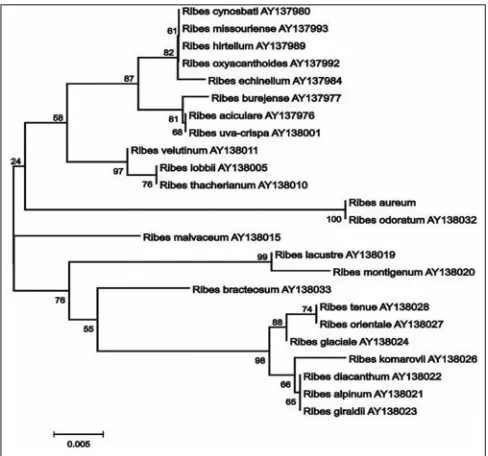
Phylogenetic analysis allows identifying interspecies relationships within the same genus of plants. Figures 1-7 show phylogenetic trees made on the basis of nucleotide sequences of rDNA 18S of genera Rubus, Fragaria, Ribes, Rósa, Prunus, Músa, and Actinidia used in our work.
Phylogenetic analysis of the nucleotide sequences of various types of raspberry shows that there are two clusters with good phylogenetic support, one type being significantly remote - Rubus odoratus (KM037685) [Figure 1].
In genus Fragaria, one large cluster is identified that incorporates the number of analyzed species, and the species of Fragaria linumae is separately remote (163512 AF and AF 163481). In genus Ribes, two large clusters are formed, which are divided into smaller clades.
In genera Prunus and Rosa, two clusters are also formed, but remote species is clearly distinguished [Figures 4 and 5], Table 1: Numbers of NCBIs of studied objects used in the work
Genus that the studied fruits and berries
belong to The studied gene The number of NCBIs of nucleotide sequences of studied species of the fruit‑and‑berry raw materials
Rubus 18SrRNA KT634247; KM037686; KM037685; KM037677;
KM037673; KM037672; KM037670; KM037669; KM037665; KM037662; KM037661; KM037411
Fragaria GQ476745; AF163481; AF163499; AF163486;
AF163494; AF163521; AF163520; AF163519; AF163518; AF163517; AF163516; AF163513; AF163507
Ribes AY138019; AY138010; AY138005; AY137993;
AY137980; AY137992; AY137977; AY138015; AY138020; AY138028; AY138030; AY138032; AY138033; AY138027; AY138026; AY138024; AY138023; AY138022; AY138021; AY138011; AY137989; AY137976; AY138010
Rósa U90801; DQ242529; DQ242528; DQ242526;
DQ242523; KP093154; KP093153; HM593928; HM593927; HM593926; HM593925; HM593924; HM593911; FM164424
Prunus HQ332167; AF318729; KT887519; AF318717;
AF318738; AF318721; AF318724; JQ926626
Músa KT696458; KT257613; FJ428097; KU215117;
FJ626378; FJ428069; FJ428093; FJ428080; FJ428081; FJ428086; KT257620; KT257621; KT257625; KU512933; KU512934; KU512938; KU512942; KT257603
Actinidia KC832314; KR819508; KR819507; KR819515;
so genus Prunus has closely grouped species Prunus avium and Prunus cerasus in the same clade. In genera Músa and Actinidia, two clusters are identified in each, one of
which being more numerous. In genus Actinidia, a clade is separately identified with high affinity, which includes 2 species - Aciotis rubricaulis (KR8195112) and Fusinus rudis (KR819512) [Figure 7].
Figure 1: The phylogenetic tree made on the basis of nucleotide sequences of raspberry rRNA 18S used in the work. The numbers of the sequences deposited in Gene Bank are shown (Method: ML, bootstrap 10000)
Figure 2: The phylogenetic tree made on the basis of nucleotide sequences of strawberry rRNA 18S used in the work. The numbers of the sequences deposited in Gene Bank are shown. (Method: ML, bootstrap 10000)
Figure 3: The phylogenetic tree made on the basis of nucleotide sequences of gooseberry rRNA 18S used in the work. The numbers of the sequences deposited in Gene Bank are shown. (Method: ML, bootstrap 10000)
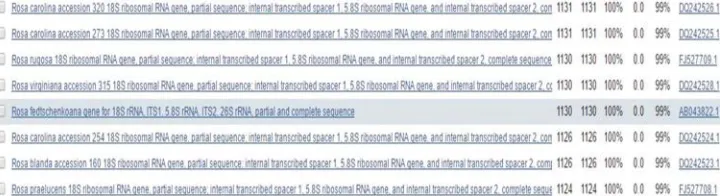
Figure 4: The phylogenetic tree made on the basis of nucleotide sequences of briar rRNA 18S used in the work. The numbers of the sequences deposited in Gene Bank are shown. (Method: ML, bootstrap 10000)
Figure 5: The phylogenetic tree made on the basis of nucleotide sequences of cherry rRNA 18S used in the work. The numbers of the sequences deposited in Gene Bank are shown (Method: ML, bootstrap 10000)
Phylogenetic analysis based on nucleotide sequences rRNA 18S of the studied fruit-and-berry raw materials shows kinship of fruit plants species within the same genus. For example, genus Prunus includes a variety of fruit-and-berry raw materials - cherry, plum, peach, apricot, and bird cherry; therefore, this fact should be considered in experimental studies and in practical work for identifying species of raw materials. On the one hand, the developed primers based on the chosen nucleotide sequences may be used for identifying all species within the genera, whereas on the other hand, one should remember that in case of mutual presence of fruit-and-berry raw materials that belong to the same genus they cannot be identified.
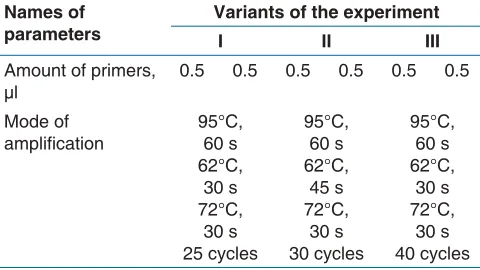
To select the optimal number of cycles of amplification, an experiment was made according to the scheme as summarized in Table 2.
Analysis has shown that the optimal parameters of amplification are the values of the II variant [Table 2]. The limiting factor in working with these primers is the number of reaction cycles. Changing the time of elongation does not result in any changes, changing the temperature of annealing is not recommended: At low temperatures, the reaction will result in a variety of non-specific amplification products, while in case of increasing the temperature, the required fragments will not be amplified.
After PCR with all primers and types of raw materials, the obtained products were visualized with the use of electrophoresis in 1% agarose gel. Analysis showed that the reaction had been successful in all studied samples of fruit-and-berry raw materials [Figure 8].
For additional verification of specificity of primers, fragments read by each pair of the developed primers were sequenced. For this purpose, eight PCR reactions were made, one with each pair of primers that corresponded to one type of raw material. The obtained PCR products were reprecipitated with ethanol in the presence of ammonium acetate, then dried, after which they were sequenced according to the Sanger method with the use of device ABI Prism 3500×L. The data at the output
of the sequenator - chromatograms [Figure 9] - had been converted into nucleotide sequences, after which they were compared to the NCBI sequences available in GeneBank using the BLAST algorithm [Figure 9].
All sequences coincided with the sequences deposited in the GeneBank for their raw material [Figures 10-17].
Thus, specificity of the developed primers with the use of the BLAST algorithm has been additionally verified. It has been found that all sequeneed sequences coincided with the sequences deposited in the GeneBank for their raw material.
Table 2: The scheme of the study for determining the optimal parameters of amplification
Names of
parameters Variants of the experimentI II III Amount of primers,
µl 0.5 0.5 0.5 0.5 0.5 0.5
Mode of
amplification 95°C, 60 s 62°C, 30 s 72°C, 30 s 25 cycles 95°C, 60 s 62°C, 45 s 72°C, 30 s 30 cycles 95°C, 60 s 62°C, 30 s 72°C, 30 s 40 cycles
Figure 7: The phylogenetic tree made on the basis of nucleotide sequences of kiwi rRNA 18S used in the work. The numbers of the sequences deposited in Gene Bank are shown (method: ML, bootstrap 10000)
Figure 8: An electrophoretogram with the results of PCR reaction. 1 - strawberry, 2 gooseberry, 3 - cherry, 4 - raspberry, 5 - banana, 6 - briar, 7 - kiwi, 8 - negative test, and 9 - DNA marker (50–1,000 bps). Each type of raw material corresponds to one of the previously developed pairs of primers
CONCLUSION
Using various software packages and databases of NCBI GeneBank, for each of the studied objects of fruit-and-berry raw materials, we have managed to find a suitable DNA portion at the level of generic differentiation for further
development of universal primers on their basis. It is the rDNA 18S portion.
All found sequences have both the conservative part for planting a pair of primers, and the variable one for reliable identification of species, or performing phylogenetic analysis.
Algorithmic analysis of sequences has been performed, and optimal locations for primers have been searched for with the use of the PrimerQuest application with indication of the maximum size of the amplicon, not exceeding 300 bps, read by a couple of primers in the settings.
Among the variants of primers proposed by the application, optimal pairs have been chosen for each type of fruit-and-berry raw materials, with regard to such parameters as length of the primer, annealing temperature, and amplicon location.
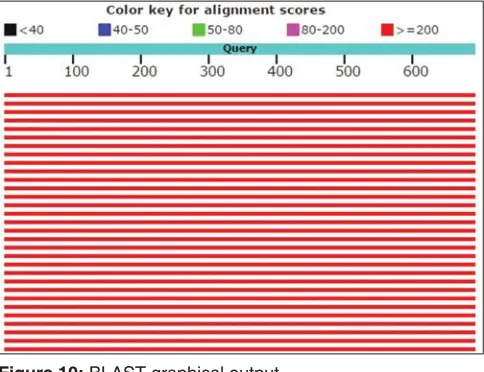
The optimal parameters of the amplification process have been defined: The amount of primers is 0.5 µl, amplification mode: 95°C, 60 s; 62°C, 45 s; 72°C, Figure 10: BLAST graphical output
Figure 11: The result of comparing the sequeneed sequence of raspberry to the sequences from NCBI database of Gene Bank using BLAST
Figure 12: The result of comparing the sequeneed sequence of strawberry to the sequences from NCBI database of GeneBank using BLAST
30 s; 30 cycles. The chosen mode of amplification was confirmed by the results of PCR with all samples of fruit-and-berry raw materials visualized as an electrophoretogram in 1% agarose gel.
An additional check of primers specificity has been performed with the use of the BLAST algorithm. It has been determined that all sequened fragments that can be read by each of pairs of developed primers coincided with those deposited in the General Bank by sequences of the studied raw material.
REFERENCES
1. Ророv A. Systemic regularities in the study and design of technological complexes for the prodaction of instant beverages. Foods Raw Mater 2014;2:156-60.
2. Porebski S. Modification of a CTAB DNA extraction protocol for plants containing high polysaccharide and polyphenol components. Plant Mol Biol Rep 1997;15:8-15.
3. Porteous LA, Armstrong JL. A simple mini-method to Figure 14: The result of comparing the sequeneed sequence of briar to the sequences from NCBI database of GeneBank using BLAST
Figure 15: The result of comparing the sequeneed sequence of cherry to the sequences from NCBI database of GeneBank using BLAST
Figure 16: The result of comparing the sequeneed sequence of banana to the sequences from NCBI database of GeneBank using BLAST
extract DNA directly from soil for use with polymerase chain reaction amplification. Curr Microbiol 1993;27:115-8.
4. Porter BW, Paidi M, Ming R, Alam M, Nishijima WT, Zhu YJ, et al. Genome-wide analysis of Carica papaya reveals a small NBS resistance gene family. Mol Genet Genomics 2009;281:609-26.
5. FaberJ. Rapid detection of common pathogenic Aspergillus species by a novel real-time PCR approach. Mycoses 2009;52:228-33.
6. Okeke CN. Ribosomal genes of Histoplasma capsulatum var. Duboisii and var. Farciminosum. Mycoses 1998;41:355-62.
7. Rogstad SH. Saturated NaCl-CTAB solution as a means of field preservation of leaves for DNA analysis. Taxon 1992;41:701-8.
8. Yu SP, Georgiyants VA, Gubar SN, Kovpak LA. Identification of Celandine alkaloidsin the Soft Medicinal Form. Vísnikfarmatsíí̈ 2009;1:15-8.
9. Olonova MV, Khrabrova NV. Research of genetic similarity of Poanemoralis L. and Рoapalustris L. (Роасеае), based on ETS of 18S-26S NR DNA sequence data. Tomsk State Univ J Biol 2011;4:55-65.
10. Badaeva ED, Salina EA. Structure of the genomand chromosome analysis of plants. Vavilov J Gen Breed 2013;17:1017-43.
11. Winnepenninckx B, Backeljau T. 18S rRNA alignments
derived from different secondary structure models produce alternative phylogenies. J Zoolog Syst Evol Res 1996;34:135-43.
12. Subacius SM. Dating the emergence of the Deuterostomes during the proterozoic eon based on 5S rRNA. An Acad Bras Ciênc 1998;70:491-500.
13. Wakefield A. The changing ‘shape’ of the nursing station. Contemp Nurse 2002;13:148-57.
14. Khot PD, Ko DL, Fredricks DN. Sequencing and analysis of fungal rRNA operons for development of broad-range fungal PCR assays. Appl Environ Microbiol 2009;75:1559-65.
15. Pantyukhina MI, Shchelkanova MS, Plaksin SV. Ionic conductivity of Li 8-2x Sr x ZrO 6. Inorg Mater 2012;48:382.
16. Schlink K. Preparing high-quality DNA from moss (Physcomitrella patens). Plant Mol Biol Rep 2002;20:423.
17. Schmutz J, Cannon SB, Schlueter J, Ma J, Mitros T, Nelson W, et al. Genome sequence of the palaeopolyploid soybean. Nature 2010;463:178-83.
18. Schreier P, Drawert F,Winkler F. Composition of neutral volatile constituents in grape brandies. J. Agric Food Chem 1979;27:365-72.