ISSN 2324-805X E-ISSN 2324-8068 Published by Redfame Publishing
A Practical Guide to Early Numeracy Instruction for General and
Special Educators
Alida Anderson1 1
School of Education, Teaching, and Health, American University, Washington D.C., USA
Correspondence: Alida Anderson, School of Education, Teaching, and Health, American University, 4400 Massachusetts Ave. NW, Washington DC 20016. E-mail: [email protected]
Received: November 13, 2012 Accepted: November 22, 2012 Available online: January 6, 2013
doi:10.11114/jets.v1i1.18 URL: http://dx.doi.org/10.11114/jets.v1i1.18
Abstract
This report summarizes recommendations from NCTM, NRC, CCSSM, NMAP, and IES to guide early numeracy instruction for elementary age students in general and special education classroom settings. We highlight common threads among general and special education research recommendations and provide a numeracy intervention curriculum model connecting intervention and instructional principles.
Keywords: mathematics, special education, elementary, curriculum, intervention
1. Introduction
This article focuses on research and recommendations from prominent organizations for curriculum and instruction in whole number numeracy, a critical foundation for all mathematics learning. As the Common Core State Standards in Mathematics (CCSSM) issue a new vision of mathematics education for all students, early numeracy warrants our increased attention. The purpose of this paper is to synthesize research and recommendations from the National Council of Teachers of Mathematics (NCTM), National Research Council (NRC), National Math Advisory Panel (NMAP), and the CCSSM initiative for application to inclusive classrooms and intervention settings with elementary school age children.
2. Numeracy Standards for All
Since 1989, when NCTM initiated the standards movement with their landmark publication, Curriculum Standards for School Mathematics, the United States has been moving steadily toward a common core of standards in mathematics, a movement that has been accelerated by the consistently poor record of mathematics achievement shown by American students on large-scale national and international tests (NCES, 2007). Due to the serious consequences of a growing population poorly prepared in the disciplines requiring a strong mathematics background (e.g., STEM fields), NCTM (1989; 1991; 1995; 2000; 2006), NMAP (2008), and the NRC (2001; 2006) have recommended content, instruction, and assessment to put students on the path to improved mathematics achievement. The CCSSM (2010) initiative led by the National Governors Association and the Council of Chief State School Officers replaces the patchwork of state-based standards contributing to uneven mathematics achievement across the country. These standards are intended to guide curriculum and professional development over the years ahead.
3. Broad Learning Outcomes in Early Numeracy
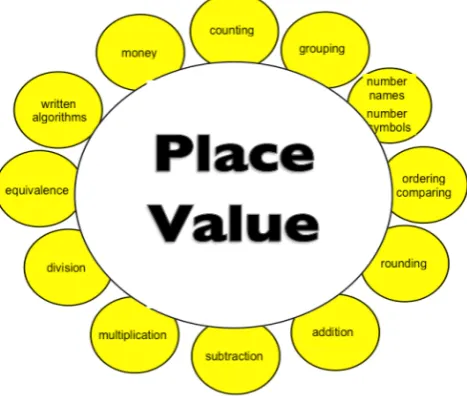
Recommendations from the CCSSM, NCTM, NRC, and NMAP collectively inform our thinking about how to redesign mathematics curriculum and instruction. Notable is their consensus on the broad learning outcomes of K-12 mathematics education: conceptual understanding, computational fluency, and problem solving skill. The recommendations for early numeracy content that support broad outcomes in conceptual understanding, computational fluency, and problem solving have two central emphases: place value and basic arithmetic operations.
with addition, subtraction, multiplication, and division, as well as reasoning skills underlying mathematical thinking and successful problem solving.
Figure 1. Place value as the organizing principle for curriculum and instruction
With place value and basic operations as the core of early numeracy content (Cooper & Tomayko, 2011), recommendations from NCTM, NMAP, NRC, and CCSSM provide guidance for instruction with curricular emphasis on:
•Explicit instruction (clear, systematic, interactive, and carefully scaffolded)
•Physical models (base-ten manipulatives to aid conceptual understanding)
•Frequent practice (following substantial experiences that stress thinking strategies)
4. Guiding Intervention Principles
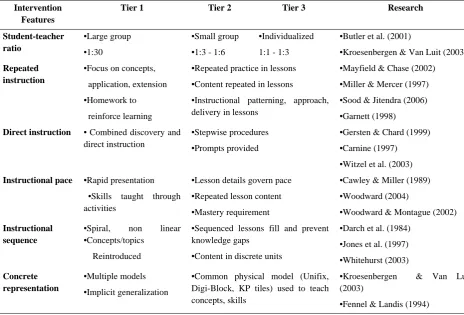
Arguably the most compelling aspect of a strong early numeracy curriculum is its capacity to teach for understanding at all levels of instruction (i.e., general and special education). In the past decade, both general and special education researchers and practitioners have identified the value of response-to-intervention (RtI) systems to address the diverse learning needs of students struggling in mathematics (Fuchs & Fuchs, 2006; 2007). This claim is supported by the research on tiered instructional interventions, which are designed to improve instruction for all students. While RtI addresses the learning needs of all students, it identifies struggling students, including those with and those without disabilities, for intervention earlier and more reliably than conventional “wait and see” approaches (Bradley & Danielson, 2004; Gartland & Strosnider, 2005; Simeonsson, 1994).
Response-to-intervention embeds universal design for learning (UDL) principles, in which curriculum and intervention approaches are intended to meet the needs of all children in Tier 1 inclusive classroom settings (Fuchs & Fuchs, 2001). In incorporating UDL principles in RtI mathematics instruction, the hope is for early prevention of mathematics difficulties (Lee, Grigg, & Dion, 2007; NCTM, 2007). A tiered approach to intervention, such as RtI, is prevention directed at both students unresponsive due to their learning disabilities and students struggling in mathematics for other reasons (i.e., failure due to instructional gaps, environmental factors, and language-learning difficulties). In this way, RtI holds promise similar to the promise implied of recommending organizations ––– that early numeracy understanding and skills prevent mathematics failure.
Table 1. Mathematics RtI features
Intervention Features
Tier 1 Tier 2 Tier 3 Research
Student-teacher ratio
•Large group •1:30
•Small group •1:3 - 1:6
•Individualized 1:1 - 1:3
•Butler et al. (2001)
•Kroesenbergen & Van Luit (2003) Repeated
instruction
•Focus on concepts, application, extension •Homework to reinforce learning
•Repeated practice in lessons •Content repeated in lessons
•Instructional patterning, approach, delivery in lessons
•Mayfield & Chase (2002) •Miller & Mercer (1997) •Sood & Jitendra (2006) •Garnett (1998) Direct instruction • Combined discovery and
direct instruction
•Stepwise procedures •Prompts provided
•Gersten & Chard (1999) •Carnine (1997) •Witzel et al. (2003) Instructional pace •Rapid presentation
•Skills taught through activities
•Lesson details govern pace •Repeated lesson content •Mastery requirement
•Cawley & Miller (1989) •Woodward (2004)
•Woodward & Montague (2002) Instructional
sequence
•Spiral, non linear •Concepts/topics
Reintroduced
•Sequenced lessons fill and prevent knowledge gaps
•Content in discrete units
•Darch et al. (1984) •Jones et al. (1997) •Whitehurst (2003) Concrete
representation
•Multiple models •Implicit generalization
•Common physical model (Unifix, Digi-Block, KP tiles) used to teach concepts, skills
•Kroesenbergen & Van Luit (2003)
•Fennel & Landis (1994)
5. Piloting a Numeracy Intervention Curriculum: Lesson from the Field
In the following example of a place value lesson in an inclusive first grade classroom, we demonstrate how instruction in grouping by tenscan be adapted tomeet the instructional needs of students in Tiers 1-3 (see Figure 2).
Objectives
• Draw the tile representation of a three-digit number (Tier 1 students).
• Draw the tile representation of a two-digit number (Tier 2 students).
• Use tiles to show that ten ones and one ten have the same value (Tier 3 students).
Activities
First grade students in Tiers 1-3 participate in the number-building lesson, each student engaging in the activities at their appropriate level of complexity and challenge.
(a) Students count 1-tiles onto a small ten-frame platform to discover the unique appearance of quantities 1 to 10.
(b) They make tiles-of-10 by grouping each full ten-frame (ten 1-tiles) with a yellow grouping tile, demonstrating that ten ones and one ten are equivalent.
(d) They make a tile-of-100 by grouping the full ten-frame (ten tiles-of-10) with a blue grouping tile, demonstrating that one tile-of-100, ten tiles-of-10, and 100 1-tiles are equivalent.
(e) Students use drawings and numerals to demonstrate their understanding.
a. b.
b. 1 .
. c. d.
Tier 1 students use the sequence (a-d above) to build two-and three-digit numbers, drawing the tiles onto printed ten-frames and labeling their drawings with numerals. They indicate equivalences under each ten-frame (e, below).
e.
Tier 2 students need additional time, experience, and practice to build instant recognition of different quantities of 1-tiles on the ten-frame (a prerequisite for recognizing similar formations among the places) and to demonstrate the understanding that ten ones and one ten have the same value.
e.
Figure 2. Grouping by tens: The foundation of place value
6. Components of an ‘Ideal’ Numeracy Intervention Curriculum
From the collective recommendations of CCSSM, NCTM, NRC, and NMAP discussed previously, and resulting from our pilot research with elementary age students, we have derived the strands of an ideal early numeracy curriculum as follows:
• Broad learning outcomes for all mathematics students (conceptual understanding, procedural fluency, and problem solving skills);
• Early numeracy content (place value and basic operations) and instructional approaches (explicit instruction, physical models, articulation of principles, frequent thought-based practice) that reflect UDL principles in both scope and depth of focus; and
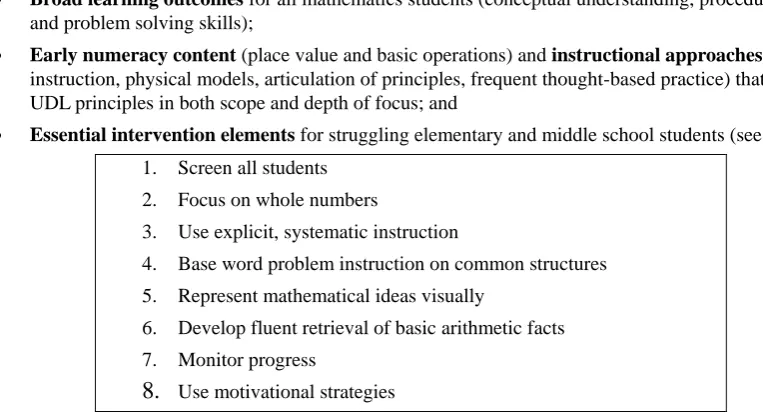
• Essential intervention elements for struggling elementary and middle school students (see Figure 3). 1. Screen all students
2. Focus on whole numbers
3. Use explicit, systematic instruction
4. Base word problem instruction on common structures
5. Represent mathematical ideas visually
6. Develop fluent retrieval of basic arithmetic facts
7. Monitor progress
8.
Use motivational strategiesFigure 3. Institute of Educational Sciences (IES) recommendations for working withstudentsstruggling with elementary and middle school mathematics (Gersten et al., 2009)
These features, taken together, constitute a numeracy curriculum that weaves together the broad learning outcomes, early numeracy content and instruction, and essential intervention elements. We can have confidence in its effectiveness both as an early numeracy curriculum for all students and as an intervention to prevent likely mathematics failure. The features of this curriculum are listed in Table 2 below.
Table 2. Curriculum Model Integrating Early Numeracy Instruction and Intervention Elements
Curriculum Model
Early Numeracy Instruction
(NCTM, NRC, NMAP, CCSSM) Essential
Intervention Elements
(IES) Broad math
instructional outcomes
Early
numeracy
content
1. Diagnostic assessment to identify knowledge and skill gaps
√
2. Coherent, sequenced instruction √ √
grades
4. Concrete, pictorial, and abstract representations of mathematical ideas
√ √ √
5. Use of manipulatives √ √
6. Development of reasoning skills √ √
7. Opportunities for students to communicate their mathematical understanding
√ √
8. Targeted progress monitoring √
9. Application of mathematical concepts to contextual problems
√ √ √
10. Frequent practice √ √ √
7. Conclusion
A critical aspect of an ideal early numeracy curriculum is its ability to teach for deep understanding at all levels of instruction and intervention (i.e., general and special education). This ideal meets the demands of an inclusive environment in which all students have access to challenging standards and, at the same time, targets weakness in the existing curriculum structure. Such weakness was noted when American College Testing (ACT), Inc. studied the ACT scores of students in the “college ready” range on items correlated to the CCSSM, they determined that the weakest math area was number and quantity, where only 34% of students showed proficiency in skills considered foundational to later math study (Gewertz, 2011). Clearly, the implications of this stunning fact demand our serious attention.
References
Bradley, R., & Danielson, L. (2004). The Office of Special Education Program's LD initiative: A context for inquiry and consensus. Learning Disability Quarterly,27 (4), 186-88. Butler, F. M., Miller, S. P., Lee, K., & Pierce, T. (2001). Teaching mathematics to students with mild-to-moderate
mental retardation: A review of the literature. Mental Retardation, 39 (1), 20-31.
Carnine, D. (1997). Instructional design in mathematics for students with learning disabilities. Journal of Learning Disabilities,30 (3), 130-41.
Cawley, J., & Miller, J. H. (1989). Cross-sectional comparisons of the mathematical performance of children with learning disabilities: Are we on the right track toward comprehensive programming? Journal of Learning Disabilities,22 (4), 250-54.
Center for Applied Special Technology (CAST). (2008). Universal design for learning guidelines version 1.0, Wakefield, MA.
Cooper, L. L., & Tomayko, M. C. (2011). Understanding place value: Exploring ancient numbers helps students focus on the structure and properties of our Hindu-Arabic system. Teaching Children Mathematics, 17 (9), 558-68.
Darch, C., Carnine, D., & Gersten, R. (1984). Explicit instruction in mathematics problem solving. Journal of Educational Research, 77 (6),351-59.
Fennel, F. S., & Landis, T. D. (1994). Number and operation sense. In C.A. Thornton and N. S. Bley (Eds.).
Windows of opportunity: Mathematics for students with special needs (pp. 187-203). Reston, VA: NCTM. Fuchs, D., & Fuchs, L. (2006.) A framework for building capacity for responsiveness to intervention. School
Psychology Review, 35 (4), 621-26.
Fuchs, L., & Fuchs, D. (2007). A model for implementing responsiveness to intervention. Teaching Exceptional Children, 39 (5), 14-20.
Fuchs, L., & Fuchs, D. (2001). Principles for the prevention and intervention of mathematics difficulties.
Learning Disabilities Research & Practice, 16 (2), 85-95. Garnett, K. (1998). Math learning disabilities. Reprinted from the Division of Learning Disabilities Journal of
Gartland, D., & Strosnider, R. (2005). NJCLD position paper: Responsiveness to intervention and learning disabilities. Learning Disability Quarterly, 28 (4), 249-60.
Gersten, R., & Chard, D. (1999). Number sense: Rethinking arithmetic instruction for students with mathematical disabilities. Journal of Special Education, 33 (1), 18-28.
Gersten, R., Beckmann, S., Clarke, B., Foegen, A., Marsh, L., Star, J. R., & Witzel, B. (2009). V Assisting students struggling with mathematics: Response to intervention (RtI) for elementary and middle schools
(NCEE). Washington, DC: National Center for Education Evaluation and Regional Assistance, Institute of Education Sciences, U.S. Department of Education.
Gewertz, C. (2011). Most students failing to reach common-standards bar. Education Week, 30 (15), 10-11. Jones, E. D., Wilson, R., & Bhojwani, S. (1997). Mathematics instruction for secondary students with learning
disabilities. Journal of Learning Disabilities, 30 (2), 151-63.
Kroesbergen, E. H., & Van Luit, J. E.H. (2003). Mathematics interventions for children with special needs: A meta-analysis. Remedial and Special Education, 24 (2), 97-114.
Lee, J., Grigg, W. S., & Dion, G. S. (2007). The nation’s report card: Mathematics 2007 (NCES). National Center for Education Statistics, Institute of Education Sciences, U.S. Department of Education, Washington, D.C.
Mathematics Learning Study Committee, National Research Council. (2001). Adding it up: Helping children learn mathematics. Washington, DC: National Academy Press.
Mathematics Learning Study Committee, National Research Council. (2006). Adding it up: Helping children learn mathematics (6th Ed.). Washington, DC: National Academy Press.
Mayfield, K. H., & Chase, P. N. (2002). The effects of cumulative practice on mathematics problem solving.
Journal of Applied Behavior Analysis,35 (2), 105-23
Miller, S. P., & Mercer, C. D. (1997). Educational aspects of mathematics disabilities. Journal of Learning
Disabilities, 30 (1), 47-56.
Montague, M. (1991). The effects of cognitive and metacognitive strategy instruction on the mathematical problem-solving of middle school students with learning disabilities. Journal of Learning Disabilities, 25
(4), 230-48.
National Center for Educational Statistics (NCES). (2006). Issue brief: Instructional focus in first grade. Jessup, MD.
National Council of Teachers of Mathematics. (1989). Curriculum and evaluation standards for school mathematics. Reston, VA.
National Council of Teachers of Mathematics. (1991). Professional standards for teaching mathematics. Reston, VA.
National Council of Teachers of Mathematics. (1995). Assessment standards for school mathematics. Reston, VA.
National Council of Teachers of Mathematics. (2000). Principles and standards for schoolmathematics. Reston, VA.
National Council of Teachers of Mathematics. (2006). Curriculum focal points for prekindergarten through grade 8 mathematics: A quest forcoherence. Reston, VA.
National Governors Association and the Council of Chief State School Officers. (2010). Common core state standards for mathematics. Washington, DC: Author. Available at: www.corestandards.org/the-standards/mathematics
National Math Advisory Panel (NMAP). (2008). Foundations for success: The final report of the National Mathematics Advisory Panel. Washington, DC: U.S. Department of Education.
MD: Brookes.
Sood, S., & Jitendra, A. K. (2007). A comparative analysis of number sense instruction in reform-based and traditional mathematics textbooks. Journal of Special Education, 41 (3), 145-57.
Whitehurst, G. (2003). Papers, presentations, mathematics and science initiative. Washington, DC: U.S. Government Printing Office. Available at:
Witzel, B., Mercer, C. D., & Miller, D. M. (2003). Teaching algebra to students with learning difficulties: An investigation of an explicit instructional model. Learning Disabilities Research and Practice, 18 (2), 121-31.
Woodward, J. (2004). Mathematics education in the United States: Past to present. Journal of Learning
Disabilities, 37 (1),16-31.
Woodward, J. & Montague, M. (2002). Meeting the challenge of mathematics reform for students with LD.
Journal of Special Education,36 (2), 89-101.