Extraction and purification of antibiotic
principles from the culture medium of
selected microbial isolates from sea
cucumber
S. Hari Hara Sudhan
1, K. Gnanaprakash
2, K. B. Chandrasekar
31Department of Pharmaceutics, Creative Educational Society’s College of Pharmacy, Chinnatekur, Kurnool, Andhra Pradesh, India, 2Department of Pharmaceutics, Saastra College of Pharmaceutical Education and Research, Kakupalli, Nellore, Andhra Pradesh, India, 3Director of Foreign Affairs Alumni Matters, Jawaharlal Nehru Technological University, Anantapur, Ananthapuramu, Andhra Pradesh, India
Abstract
Introduction: Three broad-spectrum antibiotic-producing microbes (named IF32, IF52, and CF42) were identified and isolated from intestinal region and coelomic fluids of sea cucumber species collected from Kanyakumari district, Tamil Nadu. Biochemical characterization of the isolated microbes and optimization of culture characteristic (for maximum antibiotic productivity) were performed. The present study focuses on extraction and purification of antibiotic principles from the culture medium of the selected isolates. Methodology: The
antibiotic fermentation was carried out in the optimized fermentation medium under optimum conditions separately for the isolated species. After separation of the cells by filtration, the fermented culture media were subjected to solvent extraction using 1-butanol, chloroform, ethyl acetate, and hexane. Obtained residues were subjected to antibiotic screening against Staphylococcus aureus (MTCC 1430) by disc plate method. Purification of the selected residues which showed antibiotic activity was done by column chromatography using silica gel as packing material. Collected fractions of the three antibiotic residues were subjected to bioautography to
ensure the purification of the antibiotics. Results: The results show that chloroform, 1-butanol, and ethyl acetate are found to be suitable solvents for the extraction of antibiotics from the fermented cultures of IF32, IF52, and
CF42, respectively. Bioautography performed using fractions obtained from column chromatographic separation ensured the purification of the antibiotic principles.
Key words: Bioautography of residue, extraction of antibiotic, purification of antibiotic
Address for correspondence:
S. Hari Hara Sudhan, Department of Pharmaceutics, Creative Educational Society’s College of Pharmacy, Kurnool - 518 218, Andhra Pradesh, India.
Phone: +91-9177370338.
E-mail: [email protected]
Received: 20-09-2019
Revised: 17-11-2019
Accepted: 27-11-2019
INTRODUCTION
S
earch for newer antibiotic is an ever-ending process due to the development of resistance in the microbial species. Isolation of antibiotics from the natural sources and synthesis of antibiotic process are paralleling going on to come out with better antibiotics. As antibiotic isolation from soil microbes came to end due to repetitive occurrence of existing molecules rather than newer ones, other natural sources such as marine and plant microbes become prime choice.Reports show that sea cucumber is rich in microbial flora and several molecules including antibiotic were isolated from them. As several reports show fishermen used sea cucumber to treat minor wounds during
fishing, attempt has been made to explore the antibiotic potential of the microbial flora of sea cucumber of Indian region.[1-5]
Sea cucumbers were collected from Kanyakumari District, Tamil Nadu, and three microbial isolates (named IF32, IF52, and
CF42) were found to produce a broad spectrum of antibiotics among the microbial flora collected from intestinal and
ORIGINAL
AR
coelomic fluids. After performing the susceptibility studies, biochemical characterization of the isolates and optimization of cultural parameters (for maximum productivity) were performed. The isolated microorganisms were used for the production of antibiotics. This article focuses on the extraction and purification of antibiotics from the culture medium of the isolates (IF32, IF52, and CF42).
METHODOLOGY
Fermentation of Antibiotic Principles
About 1% of 24 hours old cultures (IF32, IF52 and CF42), having optical density (OD) of 1 at 600 nm, were separately inoculated in Erlenmeyer flasks containing 400 ml of designed media. To carry out extraction of antibiotic principles using four different solvents, four set of Erlenmeyer flasks were used for fermentation for each isolated culture (IF32, IF52 and CF42). Evaluated fermentative condition profiles were followed for fermentative production of antibiotic principles during incubation. In this study, the fermented cultures were subjected to the extraction process to purify the antibiotic principles.[6]
Extraction of Antibiotic Residues
The fermented culture broths (IF32, IF52, and CF42) were subjected to centrifugation at 4000 RPM for 20 min. Supernatant fluid was collected separately. Liquid-liquid extraction method was performed separately for each fermented culture using 1-butanol, chloroform, ethyl acetate, and hexane. Equal volume of solvent was mixed with fermented medium and vigorously shaken for 1 h. Organic layer was separated and evaporated to dryness by heating under reduced pressure using rotary evaporator. The obtained residues were named [Table 1], weighed, and checked for antibiotic activity against Staphylococcus aureus (MTCC 1430) by disc diffusion method.[6,7]
Evaluation of Antibiotic Activity
The obtained residues were reconstituted in sterilized water. Six-millimeter diameter of sterile discs were prepared and impregnated in the reconstituted residue solutions for overnight and dried aseptically in room temperature. Twenty-four hours old cultures of S. aureus (MTCC 1430) were prepared and OD of the organism was checked and adjusted to 1 at 600 nm. After adjusting the absorbance, the organism was inoculated on Mueller-Hinton agar media by spread plate method. Residue loaded dried 6-mm disc was placed over the inoculated Petri plates along with penicillin standard disc and incubated at 37°C for 24 h in inverted position. Zone of inhibition (ZOI) surrounding the discs was noted in millimeters. The residues which showed antibiotic activities were considered for purification process.[8,9]
Purification of Antibiotic Principles
The residues which showed antibiotic activity were loaded in silica gel column using chloroform, 1-butanol, and ethyl acetate, respectively, for CIF32, BIF52, and EACF42 and eluted
with the solvent systems separately [Table 2] for different antibiotic residues.
The obtained fractions were evaporated to dryness using rotary evaporator. The residues were reconstituted in dimethyl sulfoxide and tested for the presence of purified antibiotic principle by bioautography.[10]
Bioautography
Contact bioautography was performed to ensure
the purification of antibiotic principle.
Thin-layer chromatography (TLC) plates were run using
methanol:acetone (9:1) solvent system for fractional residues obtained from CIF32. Fractional residues of BIF52 were run on the TLC plates using the solvent system of acetone:water (8:2) and for EACF42 fractional residue, methanol:water (5:5) was used. The developed TLC plates were dried
Table 1: Naming of extracted residues of isolates
Solvent used Name of residue from IF32 Name of residue from IF52 Name of residue from CF42
1-Butanol BIF32 BIF52 BCF42
Chloroform CIF32 CIF52 CCF42
Ethyl acetate EAIF32 EAIF52 EACF42
Hexane HIF32 HIF52 HCF42
Table 2: Solvent system used for elution
Name of the residue Solvent system
CIF32 Chloroform:methanol (95:5, 90:10, 85:15, and so on up to 0.00:100 ratio)
BIF52 Acetone:1-butanol (5:95, 10:90, 15:85, and so on up to 100:0.0 ratio)
Table 3: Zone of inhibition produced by obtained extracts
Name of residue ZOI in mm
BIF32 0
CIF32 31
EAIF32 0
HIF32 0
BIF52 20
CIF52 0
EAIF52 0
HIF52 0
BCF42 0
CCF42 0
EACF42 27
HCF42 0
ZOI: Zone of inhibition, mm: Millimeter
Figure 1: Zone of inhibition of penicillin, CIF32, BIF52, and EACF42. (1) Penicillin. (2) CIF32. (3) BIF52. (4) EACF42
Figure 2: Bioautography of chloroform:methanol fraction of CIF32 in 60:40 ratio
Figure 3: Thin-layer chromatography of chloroform:methanol fraction of CIF32 in 60:40 ratio
and observed under ultraviolet at 366 nm. Mueller-Hinton agar Petri plates were prepared and inoculated with 24 h
old culture of S. aureus (MTCC 1430), having OD of 1 at 600 nm, by spread plate method. Then, the developed TLC plates were placed over the Mueller-Hinton agar Petri plates so that the developed chromatogram would be in contact with inoculated media. After 15 min, the TLC plates were removed and Petri plates were incubated at 37°C for 24 h in an upright position.[11]
RESULTS
Antibiotic Activity of Obtained Extracts
The following Table 3 shows the ZOI produced by the residues obtained from the solvent extraction of fermented culture mediums.
Figure 4: Bioautography of acetone:1-butanol fraction of BIF52 in 85:15 ratio
Purification of Antibiotic Principles
Twenty fractional residues were obtained for each of CIF32,
BIF52, and EACF42 residues out of column chromatographic
separation. They were all separately subjected to
bioautography. The antibiotic principle presents in the 60:40 ratio fraction of chloroform:methanol from CIF32 found to be
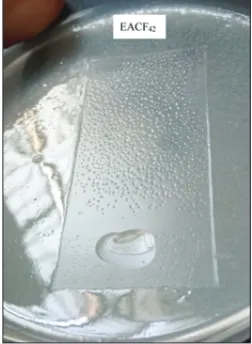
separated at TLC plate and produced ZOI surrounding the replica plated region of the spot (Rf = −0.87) in the inoculated plate [Figures 2 and 3]. The acetone:1-butanol fraction with the ratio of 85:15 found to contain the antibiotic principle from IF52 but not separated in the TLC plate as ZOI was observed at the reciprocated region of starting point of the TLC itself [Figures 4 and 5]. Though the antibiotic principle of EACF42 was present in the methanol:ethyl acetate eluted fraction with the ratio of 35:65, but not separated in TLC plate [Figure 6]. This is evident that the ZOI was observed only at starting point of the Bioautography [Figure 7].
DISCUSSION
The results of this study reveal that chloroform, 1-butanol, and ethyl acetate are found to be suitable solvents for the extraction of antibiotic principle from fermented media of IF32, IF52, and CF42, respectively. Purification of antibiotic principle from IF32 could be achieved out of this work. For rest of the two isolates, it was only partially successful.
CONCLUSION
The present work successfully isolated the antibiotic principle from isolate IF32. As antibiotic principles were present in the extracted residues of IF52 and CF42 fermented medium,
further attempt will be made to purify the antibiotic principles using different elutants or using different chromatographic
methods.
ACKNOWLEDGMENT
The authors are thankful to Creative Educational Society’s College of Pharmacy, Chinnatekur, Kurnool - 518 218, Andhra Pradesh, India, for providing facilities and support to complete this work.
REFERENCES
1. Alipiah NM, Ramli NH, Low CF, Shamsudin MN, Yusoff FM. Protective effects of sea cucumber surface-associated bacteria against Vibrio harveyi in brown-marbled grouper fingerlings. Aquacu Environ Interact 2016;8:147-55.
2. Sha Y, Liu M, Wang B, Jiang K, Sun G. Gut bacterial Figure 6: Thin-layer chromatography of methanol:ethyl
acetate fraction of EACF42 in 35:65 ratio
Figure 5: Thin-layer chromatography of acetone:1-butanol fraction of BIF52 in 85:15 ratio
Figure 7: Bioautography of methanol:ethyl acetate fraction of
EACF42 in 35:65 ratio
diversity of farmed sea cucumbers Apostichopus japonicus with different growth rates. Microbiology 2016;85:109-15.
3. Bogatyrenko E, Buzoleva L. Characterization of the gut bacterial community of the Japanese sea cucumber Apostichopus japonicus. Microbiology 2016;85:116-23. 4. Gao ML, Hou HM, Zhang GL, Liu Y, Sun LM. Bacterial
diversity in the intestine of sea cucumber Stichopus japonicas. Iran J Fish Sci 2016;16:318-25.
5. Pringgenies D, Yudiati E, Djunaedi A, Santosa GW, Koesoemadji, Explorations of symbiotic microbe from sea cucumber gut as an anti-multi-drug resistant microbe agent for utilization in hand sanitizer products. AACL Bioflux 2019;12:737-47.
6. El-Naggar N, El-Bindary A, Abdel-Mogib M, Salah N. In vitro activity, extraction, separation and structure elucidation of antibiotic produced by Streptomyces anulatus NEAE-94 active against multidrug-resistant Staphylococcus aureus. Biotechnol Biotechnol Equip 2017;31:1-13.
7. Singh V, Haque S, Khare S, Tiwari AK, Katiyar D, Banerjee B, et al. Isolation and purification of antibacterial compound from Streptomyces levis collected from soil sample of North India. PLoS One 2018;13:e0200500. 8. Pudi N, Varikuti GD, Badana AK, Gavara MM,
Singh SK, Malla R. Studies on optimization of growth parameters for enhanced production of antibiotic alkaloids by isolated marine actinomycetes. J Appl Pharm Sci 2016;6:181-8.
9. Al-Ghazali LH, Omran R. Optimization production conditions of antibacterial metabolite from Streptomyces sp. Asian J Pharm Clin Res 2017;10:386-91.
10. Kumar PS, Duraipandiyan V, Ignacimuthu S. Isolation, screening and partial purification of antimicrobial antibiotics from soil Streptomyces sp. SCA 7. Kaohsiung J Med Sci 2014;30:435-46.
11. Mounyr B, Sadiki M, Saad I. Methods for in vitro evaluating antimicrobial activity: A review. J Pharm Anal 2015;6:71-9.