Testing Conceptual Understanding in Physics Using a
Browser-based Computer Managed System
Alexander Mazzolini
School of Biophysical Sciences and Electrical Engineering, Swinburne University of Technology, Australia
Abstract
Testing Conceptual Understanding in Physics (TCUP) is a CUTSD-funded project which aims to monitor the conceptual understanding of first-year university Physics students. It is designed not as an educational research tool but rather to provide timely feedback on student conceptual understanding. This feedback is available both to students and their instructors. The TCUP tests will help promote more effective teaching, and also help to evaluate the effectiveness of physics courses in teaching basic physics concepts. To promote effective learning, individual students will receive formative feedback regarding their level of conceptual understanding in each key area of their introductory physics course.
Each test (which is not intended to count towards summative assessment) is administered via an easy to operate browser-based computer managed testing system. The system, which is fully automated, also provides statistical information to the instructor regarding the performance of the class.
The TCUP project team
Project leaders: Dr. Alex Mazzolini, Dr. Margaret Mazzolini (Swinburne University of Technology) and Dr. John Humble (University of Tasmania).
Question Bank developer: Prof. Bill Rachinger (Monash University and Swinburne University of Technology).
Web delivery: Dr. Barbara Moss (Swinburne University of Technology).
Introduction
Many university physics teaching staff are often dismayed at how little their students have learned after their first year of physics instruction. A number of physics education researchers, including Redish and Steinberg1, have suggested that many traditional teaching methods do little to improve students' conceptual understanding. Even worse, tertiary teaching staff are often unaware that a problem exists with their teaching methods. Many concerned and dedicated teachers listen to students but fail to recognise their real difficulties. Here is an example taken from Redish's recent paper: "...in a junior level electronics class, a student asked a question about a comparison of currents at two points on a single branch of a relatively complicated
namely, that somehow the current was 'used up' en route [according to the student]. The student politely nodded, no better off than before, and the teacher moved on.". The above experience is not an isolated case but rather an example of what is probably a common occurrence in many university courses throughout Australia.
Thornton and Sokoloff2 have quantitatively shown that traditional teaching methods do little to improve the conceptual understanding of students undertaking introductory physics units, and that more student-centred methods of teaching need to be considered. In their study, "fewer than 10% of the students seemed to change their (incorrect) views of dynamics after traditional instruction".
Many tertiary physics academics may not be aware of the extent of the problem for the following reasons:
(i) During a physics course, students are typically given a great deal of practice in problem-solving skills via problem sheets and tutorial exercises. Students concentrate on developing these skills rather than developing conceptual understanding, since problem solving skills are the ones most likely to be tested in the final examination.
(ii) Often there is subtle pressure on academics to set predictable examinations. Unconventional questions invariably lead to poor examination results and pass rate problems that require
justification to Heads of Department or Deans. As a consequence, students learn how to answer the predictable question styles and can often pass examinations without a good understanding of the material presented in the course.
The development of the TCUP project, which tried to address the above problems, was based on three assumptions:
(i) that assessing students' conceptual knowledge and preconceptions would be a significant aid to effective teaching;
(ii) that concept development is a crucial learning outcome not sufficiently catered for in standard physics courses; and
(iii) that physics departments need tools to evaluate the success of their courses, if they are to be persuaded to trial alternative methods of instruction.
The TCUP project
TCUP is a CUTSD (Committee for University Teaching and Staff Development) funded project that has assembled an extensive set of question banks designed to test for conceptual
TCUP has several strengths:
Course coordinators will be able to provide regular diagnostic feedback to encourage students to improve their understanding of fundamental concepts in their physics courses.
The process of "working through" the TCUP question banks will in itself signal to students that a deeper approach to learning is a requirement for conceptual understanding, and will show that conceptual understanding as well as problem solving skills are
necessary outcomes of an introductory physics course.
Teaching staff will also receive immediate, automatically generated diagnostic feedback on how well each student group (as a whole) mastered key concepts. This will allow the staff the option of undertaking remedial action and adjusting their teaching emphasis accordingly.
The TCUP question banks will allow teaching staff to do pre- and post- course concept-mastery testing. This will aid individual staff in judging the degree by which their existing courses are successful in transferring basic physics concepts. It will also be an invaluable tool in the trialling of new courses and alternative techniques of course delivery.
TCUP also has several limitations:
Ideally TCUP questions and choice of multiple choice distractors would be based on open-ended questions, preferably in the context of student interviews. However this is a time-consuming process, and diagnostic testing as a feedback tool will only be effective if it covers most of the "standard" syllabus. As TCUP aims to provide a mechanism for useful feedback rather than to be an educational research tool, it was decided instead to rely on individual expertise, plus pre-existing diagnostic tests where available, (in particular, the expertise of Prof. Bill Rachinger, who has developed diagnostic tests in physics over many years, and his surveys of the literature reporting student interviews).
The TCUP tests are purely multiple choice format. The WWWAssign computer testing system used to deliver the tests can also use numeric and other formats. However, given that the TCUP project required automatic marking of student answers (which ruled out extended answer format) and that TCUP is testing conceptual understanding rather than problem solving techniques (which reduces the need for numeric answer format), it was decided that TCUP questions would be restricted to multiple choice format. Multiple choice, a much-discussed and often maligned testing format, does have the advantage that feedback can be directed specifically at "distractors" which match common student misconceptions.
TCUP question banks
undertook an extensive survey of these and other question banks that could be used to test conceptual understanding in physics. The TCUP question banks used existing question sets as much as possible, modifying and supplementing them where necessary to cover a typical Australian introductory syllabus.
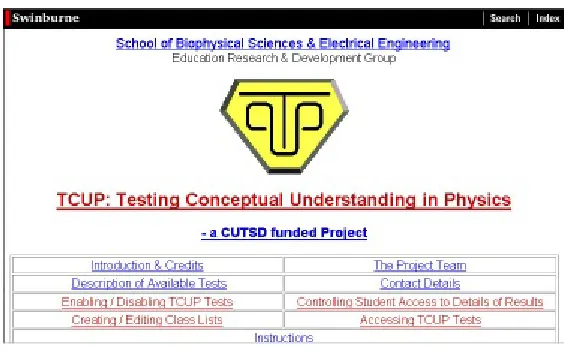
Currently, 45 TCUP tests covering electricity, magnetism, electronics, linear mechanics, rotational mechanics, waves, optics, thermal, and nuclear physics have been developed. This extensive list is shown in Table 1. The TCUP Home page is:
http://www.swin.edu.au/bsee/mazzo/tcup/
It should be emphasised that the TCUP tests are not intended to form part of a graded student assessment - rather, they are a tool to aid concept development in Physics. Students will evaluate their individual progress via electronic feedback from the tests. The feedback will help them identify which particular key physics concepts require more attention in order for them to master the course material.
Table 1. Description of TCUP tests that are currently available
Test Name Description
Sample Test
Sample Test Contains examples of EM questions from TCUP
tests.
EM1 Introductory Electrostatics
Forces between electric charges.
EM2 Electric Field The concept of electric field as force per unit charge; field due to charge distributions.
EM3 Electric Potential The concept of electric potential as potential energy per unit charge; potential due to charge distributions; equipotential lines.
EM4 Electric Flux Introduction to the concept of flux; flux through open and closed surfaces in various situations.
EM5 Gauss's Law I Gauss's Law applied to simple charge distributions.
EM6 Gauss's Law II Further applications and consequences of Gauss's Law.
EM7 Field and Potential revisited
Situations interlinking the concepts of electric field and potential.
EM8 Conductors and
Insulators
EM9 Magnetic Fields I Introduction to magnetism; forces on moving charges; superposition of fields.
EM10 Magnetic Fields II Motion of charges in electric and magnetic fields.
EM11 Magnetic Fields III Forces on current-carrying conductors in uniform magnetic fields.
EM12 Ampère and Biot-Savart Laws
Magnetic fields due to electric current
distributions; laws of Ampère and Biot-Savart.
EM13 Induced EMF Varying magnetic fields and induced EMF; Lenz's and Faraday's Laws.
EM14 Circuits I Circuits with batteries and bulbs.
EM15 Circuits II Ohm's Law; current and potential in single loop circuits.
EM16 Circuits III Energetics of circuits; multiloop circuits.
EM17 LCR Transients Switching transients in circuits containing resistors, capacitors and inductors.
EM18 AC Circuits AC circuits with LCR elements; time variation of current and voltage; phasor diagrams.
W1 Basics of 1-D Waves Reflection and superposition of waves and pulses in strings.
W2 Sinusoidal Waves Mathematical representation of a travelling sinusoidal wave and its interpretation.
W3 Superposition of
Waves
Superposition of travelling waves; standing waves.
MECH1 Introductory Mechanics
Mechanics revision.
MECH2 One Dimensional
Kinematics
Displacement-time and velocity-time graphs and their interpretation.
MECH3 Two Dimensional
Kinematics
Vector displacement, velocity and acceleration; parabolic and circular motion.
MECH4 Forces Resolution and addition of forces; pulley and inclined plane situations; Newton's Third Law.
friction and tension. Forces in free flight and in accelerating elevators.
MECH6 Mechanical Energy Work, kinetic energy and potential energy. Conservation of Energy.
MECH7 Linear Momentum Momentum conservation. Systems of particles. Centre of Mass. Collisions.
MECH8 Dynamics Revision An integrated look-back at various aspects of dynamics.
MECH9 Rotational Kinematics
Angular velocity, angular acceleration and their vector representation.
MECH10 Rotational Dynamics I
Torque, angular momentum, rotational kinetic energy, rotational inertia.
MECH11 Rotational Dynamics II
Rotational equivalent of Newton's Second Law.
MECH12 Oscillations Dynamics of the simple harmonic oscillator. Effect of damping.
MECH13 Gravitation and Orbits
Newton's Law of Gravitation. Gravitational potential. Orbital motion.
OPT1 Images and Mirrors Real and virtual images. Images formed by plane and spherical mirrors using ray tracing methods.
OPT2 Refraction and
Lenses
Refraction at interfaces. Total internal reflection. Images formed by converging and diverging lenses using ray tracing methods.
OPT3 Interference and
Diffraction
Two source interference. Edge and single slit diffraction.
HEAT1 Heat Fundamentals The nature of heat and microscopic interpretations of thermal phenomena.
HEAT2 Specific and Latent Heats
Understanding and using specific and latent heats.
HEAT3 Heat Transfer
Processes
The microscopics of heat conduction.
HEAT4 Heat Conduction Heat conduction in solids.
HEAT6 Elementary Thermodynamics
Elementary Thermodynamics, P-V diagrams.
NUC1 Nuclear Physics I Introductory nuclear physics.
NUC2 Nuclear Physics II Advanced nuclear physics.
Electronic delivery of TCUP tests
TCUP tests are accessed from the World Wide Web via any standard web browser. Students will find the electronic delivery system easy to use, and academic staff will find it easy to administer. Figure 1 shows the operational procedure used to enable and run the TCUP tests. The browser-based, computer managed testing system being used is called WWWAssign and is written in the Perl programming language. WWWAssign was originally written by Prof. Larry Martin from North Park University and modified by Prof. Aaron Titus from North Carolina State University.
TCUP has been given permission to use the shareware version of WWWAssign free of charge. It should be pointed out that a full commercial version with a robust database structure and a more sophisticated instructor interface (WebAssign) is also available for academics interested in other computer managed testing applications.
Sample Test (Instructors or students)
Standard TCUP Test (Students)
To maintain test bank security, all TCUP tests must be supervised. Teaching staff wishing to use
TCUP tests for their students will need to electronically import their class list and enable student access to individual tests. To do this academics must obtain an access password from the TCUP
administrator. All results are recorded and processed automatically and immediately to minimise the amount of test administration for staff. The TCUP Instructors' site, which is used to enable tests, create class lists etc., is shown in Figure 2.
Figure 2. Instructors' TCUP administration page
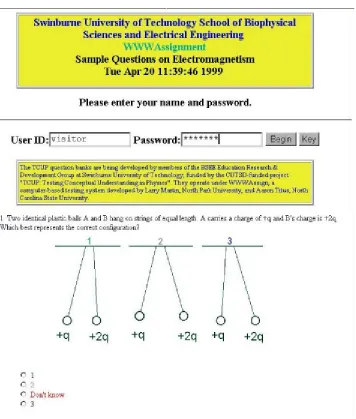
Figure 3. Typical question from one of the "sample test" TCUP question banks
Conclusion
Over the past decades in Australia there have been considerable changes both in senior high school physics curricula and in the proportion of secondary students continuing to tertiary education, and consequential changes in the skills and deficiencies of students going on to study physics at the tertiary level. Many university physics teaching approaches have not adapted to accommodate these fundamental changes. It is hoped that the TCUP project will be widely used in Australian universities to provide instructors with feedback on student's levels of conceptual understanding, and to provide students with timely feedback on their level of mastery of key concepts. It is also hoped that TCUP will provide statistical data that will assist instructors to trial new teaching methods to enhance their students' conceptual understanding in physics.
1. Redish, E. F. and Steinberg, R. N. (1999) Teaching Physics: Figuring Out What Works,
Physics Today, January, 24-30.
2. Thornton, R. K. and Sokoloff, D. R. (1998) Assessing student learning of Newton's laws: The Force and Motion Conceptual Evaluation and the Evaluation of Active Learning Laboratory and Lecture Curricula, Am. J. Phys., 66, 338-352.
3. Hestenes, D., Wells, M. and Swackhamer, G. (1992) Force Concept Inventory, The Physics Teacher, 30, March, 141.
4. Hestenes, D. and Wells, M. (1992) A Mechanics Baseline Test, The Physics Teacher, 30, March, 159.
5. Mazur, E. http://galileo.harvard.edu/home.html
Alexander Mazzolini
School of Biophysical Sciences and Electrical Engineering Swinburne University of Technology
PO Box 218 Hawthorn Victoria 3122 Australia