THE PATTERNS OF LANGUAGE CHOICE AT THE BORDER OF
MALAYSIA-THAILAND
Mohammad Fadzeli Jaafar
Norsimah Mat Awal
Mohammed Azlan Mis
Norhayati Lateh
Universiti Kebangsaan MalaysiaArticle received: 3 March 2015 Final proof received: 21 January 2016
Abstract
Any activities conducted at the boundary area between countries will only be successful if the community of speakers has mutual understanding in terms of language, especially those involving business. This study focuses on a community in the northern part of Malaysia near the Thailand border where majority of people are bilingual in Malay and Thai. This study aims to investigate the patterns of language used by speakers in the Malaysia-Thailand border, in the context of language maintenance and language shift. Both countries use different languages; with Malaysians use Malay and the Thais use Thai language. In this cross-border context, activities pertaining to business, visit or personal matters will have an impact on the development of the two languages. This study presents the findings on the language choice from a survey involving 202 respondents that was conducted in two border towns at the Malaysia-Thailand border, namely Rantau Panjang (Malaysian side) and Golok (Thailand side). By utilizing the domain concept that was introduced by Fishman (1972), this study focuses on two domains namely, business and family. In addition to the questionnaire, participant observations and interviews were also conducted as supplements. The data on the patterns of language choice were analyzed statistically. The findings show that although Malaysians and Thais speak two different languages, Kelantanese dialect, which is a variety of the standard Malay, was the most dominant language at the border. This study also found that age was a significant factor in determining the patterns of language use. The younger generations were using Kelantanese dialect and Thai language in domains where older people would only use Kelantanese dialect. This points to the occurrence of language shift at the border. However, the community at the Thai side of the border tends to choose Kelantanese dialect in their daily activities, which seems to indicate language maintenance in this area. These findings suggest that language can serve as a marker of identity, especially for those communities in Golok as most of them are originally from Malaysia. Finally, this study has contributed empirical data on language usage at the Malaysia-Thailand border.
Keywords: Language choice, language maintenance, language shift, identity markers
Border issues can be discussed from various perspectives such as geographical, political, language or identity perspectives. Geographical perspective is related to politics because the border of a country is determined by political boundaries. Language border, however, is wider because it transcends political and geographical boundaries. For example, the Malay language is also widely used in the southern part of Thailand that borders Malaysia. This then raises the issue of identity because language does not fully reflect the identity of its speakers. For example, speakers of the Malay language at Malaysia-Thailand border do not necessarily mean that they are of Malay ethnicity. The Malay language is chosen could be because of its dominance at the Malaysia-Thailand border. The wide usage of a dominant language can also have an impact on minority language spoken by a particular language community. If this occurs, then the
language shift phenomenon takes place among the speakers of minority languages. Conversely, speakers of a minority language would also insist in maintaining and defending the existence of their language amid pressure from the dominant language. Such a case is termed as language maintenance. This paper will specifically discuss the languages used at the Malaysia-Thailand border which, subsequently, will be linked with the concept of language shift and language maintenance.
Languages Used at the Border
emerge as in the case of Limburgish which is spoken at the Dutch-Belgium-German borders. This language shares certain features with German and Dutch and functions as the colloquil language at the border.
Patterns of language use and choice in Europe are not the same, depending on the particular country's borders. For example, Gal (1979, see also Holmes 2001) reported cases of language shift that is influenced by age. Gal's study focused on language used at the border of Austria-Hungary, where the speakers used Hungarian and German. Based on direct observation and supported by interviews, Gal found that patterns of language choice of younger speakers are different from the older speakers. Young people in Austria-Hungary border tend to use German language, while the elderly only use Hungarian. This finding indicates that language shift is taking place at the countrys’ borders.
Thus far, we have shown two cases of language used at the border that are different namely (i) the existence of a new language at national borders, and (ii) language shift among the younger generation that affects the native language. Cases where a new language is formed are considered rather unusual because it rarely happens, while the shift to a more dominant language is a rather common phenomenon in terms of language used at the border. However, the language choice at the border can also revert to the language originally used. For example, English gradually replaced the Spanish language at the United States-Mexico border. At the end of the 20th century, the reverse happened because Spanish once again became the dominant language at the border especially among the Mexicans. Fishman labeled occurances such as these as reversing language shift (in Omar, 2006). These cases on language used at the border present its own issue for speakers at the border because they are faced with several options of language choice. It is undeniable that the strength and “durability” of a language would also depend on the strength or stability of a community. The more stable the community in socially, economically and politically, the more stable the language is. This study then is our effort to explore the patterns of language choice in Southeast Asia, particularly at the Malaysia-Thailand border. The existence of two languages (Malay-Thai) at the Malaysia-Thailand border will see resistance or melting of one language prompted by certain factors.
METHOD
Malaysia and Thailand are separated politically by an international border. The boundary is formed following the Anglo-Siamese treaty in 1909. On the Malaysian side, the demarcation line runs through four states from west to east namely, Perlis, Kedah,
Perak and Kelantan. On the Thailand side, the demarcation line runs through four provinces, namely Satun, Songkhla, Yala and Narathiwat. This study focuses Rantau Panjang in the state of Kelantan on the Malaysian side and Golok (Sungai Kolok), in the province of Narathiwat on the Thailand side. Both of these towns are separated by Sungai Golok which is about 100 meters wide. Rantau Panjang is a shopping destination for Malaysians because of its duty free status. Rantau Panjang is a unique duty free area as it is different from other duty free areas in Malaysia as it resembles a typical kampong (village) area and equipped with various facilities such schools, mosques and clinics (Hussin et al, 2012).
This study has managed to gather data from 202 respondents representing the speaking communities from two border towns at the Malaysia-Thailand border. Respondents were from the speaker communities in Rantau Panjang and Golok. In other words, tourists who came to the Malaysia-Thailand border were not included in the list of respondents. The method used to obtain information on language use was questionnaires. This study also used two other methods, namely direct observations and interviews to complement the data from questionnaires. The patterns of language choice were then analyzed statistically.
Sociolinguistic Profile
The questionnaire prepared consists of two parts: information on respondent and information on language choice. Section A solicits information for the respondent’s profile with information on age, race, gender, occupation, education and first language. Section B seeks information on language choice of the respondents in family and business domains.
In this study, the age categories were divided into 4 groups: (i) under 20 years old, (ii) 21 to 40 years old, (iii) 41 to 55 years old, (iv) 55 years or older. The below 20 years old group focused on teenagers who were still in schools. The 21-40 age group was targeted at adults who have entered the workforce and were married. The next group, 41-55 years old were the more matured group and the above 55 years old age group was dedicated to older senior citizens.
The race category was slightly different for those from Malaysia and Thailand side of the border. As Malaysia is made up of different races it is therefore expected that there are various racial groups at the border such as Malay, Chinese, Thailand, India and others. On the Thailand side, on the other hand, there were only two dominant races, namely the Malays and the Thais. The Malays in Thailand refer to themselves as Pattani Malays. Information on gender was also solicited for the respondent profile.
groups, namely those who work in the government sector, private sector, self-employed or unemployed. Information on education was divided into several categories: primary/secondary, college/university or not schooling.
Finally, the first language category refers to ethnic groups in the study area, for example in Rantau Panjang, the first languages given are Kelantanese dialect, standard Malay, Thai language, Chinese language and Tamil while in Golok the first languages are Thai language and Pattani Malay dialect.
The sociolinguistic profile distribution was rather balanced in both areas of study. For example, the majority of respondents were from the 21-40 years age group (63%), followed by 41-55 age group (25-30%), under 20 years group (5-7%), and only 5 persons from the above 56 age group. There were no representatives in the 56 and above age group from the Thailand side.
The Malays dominated both areas of study at 97:94% and the rest are Chinese, Thais and others. In terms of gender, majority of the respondents were female with 85:16% at the Malaysian side of the border and 55:46% on the Thai side of the border. The dominace of women was not surprising because the business in Rantau Panjang and Golok were dominated by females. The information on occupation too, supports the importance of business activities in these two areas with 66.71% of the respondents were self-employed. The rest of the respondents worked in the private sector (such as shop assistants) at 23.18% and a few respondents worked in the government sector or were unemployed.
Next we looked at the level of education of the respondents. The majority of the respondents (78.48%) had secondary school education. Next was diploma/university education at 17.28%. The least number of respondents were those with primary school level education. This information showed that the levels of education of the respondents were at varying levels.
In terms of first language, it seemed that each study area was represented by its own main language. In Rantau Panjang, the first language most chosen was Kelantanese dialect while Pattani Malay dominates in Golok at 96.04%. The dominance of Pattani Malay dialect as opposed to Thai language at the Thailand border was because the community shared the same culture and religion with the Malays in Malaysia (Omar 1992). Only 4 respodents in Golok listed Thai language as their first language. On the other hand, in Rantau Panjang there was diversity in language choice such as 3 respondents listed standard Malay as their first language and one respondent stated that his first language was Chinese.
Domain Building
Constructing questionnaires based on the domain concept was proposed by Fishman (1972). Fishman contends that the concept of domain can be explained through context which will enable us to observe that one language variety is more appropriate to use in a particular context compared to other varieties. Domain is determined by several factors such as setting, topic and participants. Setting refers to place or area of the study. Topic is the aspects or issues discussed, and participants are individuals involved. For example, if a mother (participant) is talking to her children at home (setting) about something that involves the family (topic) then the domain involved would be family domain.
Fishman (1972) lists several significant domains that are applicable in studies on language use such as family, friendship, religion, education and work domains. Based on the different factors that make up a domain, the total number of domains in each community would therefore vary. For example, Schmidt-Rohr (in Gumperz and Hymes 1972) who studied German speakers before World War II identified nine domains which are family, playing field, school, church, arts, newspapers, military, court and government administration. Fasold (1984) on the other hand, identified eight domains that include family, friendship, neighborhood, business, school, occupation, government and religion. It seems that family domain is a typical domain. This study concentrates on business and family domains. Family domain was chosen because this domain is the typical domain chosen in studies on language choice as it reflects the reality of an individual language used. Meanwhile, business domain was chosen because the research area (Malaysia-Thailand border) was a popular shopping destination.
For every domain, there are 3 questions. For example, in business domain respondents are required to state the language that they use when they shop, when they are at restaurants and when they are at the immigration office. In family domain, respondents are required to give answers on language that they use at home with family members, when they go out with friends and when they are with relatives. This study has prepared two sets of questionnaires; one for respondents in Rantau Panjang (Malaysia-Thailand border) and another set for respondents in Golok (Thailand-Malaysia border).
objectives of the research. For subsequent respondents, the researchers enlisted the help of the first respondent to find other respondents (friend of a friend). This approach in getting respondents has enabled the researchers to build a social network in the area. The research was also conducted in Thai language as one the researchers comes from Pattani province in Southern Thai and is able to speak in standard Thai.
Direct Observations
The direct observation method serves as a support for the respondents’ answers in the questionnaires. This method was conducted concurrently with the questionnaires that were distributed. Direct observations served well in this study as it also helped the researcher understand the respondent’s responses when answering the questions.
Interview
It should be clarified here that the interview took place simultaneously while answering the questionnaires. That is, the researchers asked directly about the respondent’s profile and the language(s) used by the respondents based on domains that have been determined. In other words, the researcher marked the answers given by the respondents through interviews. Each set of questionnaire took between 10-15 minutes, depending on the respondents' responses to the questions posed. Through this interview method, the researcher has managed to uncover the reasons for the selection of language(s) used in business and family domains.
Language Choice
There are several languages spoken at the Rantau Panjang-Golok border region such as standard Malay, Kelantanese dialect, Pattani Malay dialect, Thai language, English, Chinese language and
bahasa rojak. The Malay language stems from the Austronesian language family and it is recognized as the national and official language in Malaysia. The Malay language has several varieties or sub-dialects such as the Kelantanese dialect, Negeri Sembilan dialect and Kedah dialect. When one talks about ‘standard language’ or ‘standard Malay’, the focus is usually on the standard pronunciation (Omar, 1987). The reference for the pronunciation of standard Malay is the Johor-Riau Malay. Therefore, the standard Malay refered to in this study was the standard Malay that was widely used in Malaysian radios and televisions. Kelantanese dialect meanwhile is a Malay subdialect which is the first language for the Kelantanese. Kelantanese dialect is also widely used at the Rantau Panjang-Golok border especially by the Kelantanese Malays and the Pattani Malays. The Pattani Malay dialect refers to a Malay subdialect that is grouped in the Malay North East dialect group. The Pattani Malay dialect has
become the main language in the Pattani, Yala, Narathiwat and part of Songkla and with about 80-85 of the population (Uthai, 2011).
Next, Thai language refers to standard Thai that is based in Bangkok. It is the variety that is used as the medium of instruction in public and private schools across the country (Lekawatana, 1994). In addition, there are three other varieties of the Thai language and they are southern Thai, northeastern Thai and northern Thai. Meanwhile, English is one of the languages that is widely used globally that is often used in multilingual societies, while the Chinese language is the language spoken by ethnic Chinese who lived in the researched area. Normally the Chinese communities who live in Rantau Panjang-Golok area speak the Hokkien dialect. Finally rojak language refers to the combination of two or more languages. An example of a popular variety of rojak language in Malaysia is Manglish
(Malay-English) that mixes words or phrases from Malay, Hokkien or Cantonese together with English (Bakar, 2009). In the context of this study, rojak
language refers to the combination of standard Malay-Thai language or Kelantanese dialect-Thai language. The explanation on concepts and functions shows that the communities at the Malaysia-Thailand border are multilingual. This study aims to to show the diverse patterns of language used based on various domains. The findings of the study will show that the dominant language in the area of study will also function as the lingua franca.
FINDINGS AND DISCUSSION
This study aims to find out the patterns of language use of two border towns at the Malaysia-Thailand border. When there is Malay and Thai, do speakers choose one of the languages or one of its varities for example Kelantanese dialect or Pattani Malay dialect? If this happens, what are the significant reasons that could explain the phenomenon? This would also lead to certain implications such as the attitude of the speaker towards the language chosen and the identity of the speaker at the Malaysia-Thailand border. These are all interesting questions to be discussed and its relation to language shift and language maintenance. The findings of the study are discussed based on the overall pattern of language use and the domain that determines the language choice. The following are discussions of the results.
Patterns of language use based on domains
The following table shows the overall pattern of language choice at the Malaysia-Thailand border for the seven languages/dialects studied.
both varieties are the first language of the community in Rantau Panjang. The highest usage is recorded by Kelantanese dialect at 579 (33.20%)
while Pattani Malay recorded usage of 544 (31.19%).
Table 1: Overall pattern of language choice based on domains
Border Area
Language Choice Malay
language
Thai language
English language
Chinese language
Rojak language
Kelantanese dialect
Pattani Malay dialect
Overall Total
Rantau Panjang
93 36 12 3 30 579 0 753
(%) 12.35 4.78 1.59 0.40 3.98 76.90 0 100
Golok 43 295 14 2 93 0 544 991
(%) 4.34 29.78 1.41 0.20 9.38 0 54.89 100
Total 136 331 26 5 123 579 544 1744
(%) 7.80 18.98 1.49 0.29 7.05 33.20 31.19 100
Standard Thai recorded the third-highest total, with 331 (18.98%), followed by standard Malay with 136 (7.8%), rojak language at 123 (7.05%), English at 26 (1.49%) and Chinese at 5 (0.29 %).
Family Domain
In this study family domain refers to three sub-domains - the language used at home, language used outside the house (among friends) and language used with relatives.
Table 2: Comparison of language used at home
Border Area
Language Choice Malay
language
Thai language
English language
Chinese language
Rojak language
Kelantanese dialect
Pattani Malay dialect
Overall Total
Rantau Panjang
6 2 0 1 1 95 0 105
(%) 5.71 1.90 0 0.95 0.95 90.49 0 100
Golok 3 43 1 0 20 0 82 149
(%) 2.01 28.86 0.67 0 13.42 0 55.04 100
Total 9 45 1 1 21 95 82 254
(%) 3.54 17.72 0.39 0.39 8.27 37.40 32.29 100
The patterns of language used at home show the dominance of Kelantanese dialect (90.49%) and Pattani Malay dialect (55.04%). The obvious pattern discovered in this study is whenever Kelantanese dialect is used in Rantau Panjang, the Pattani Malay dialect is not used at all and same pattern appears in Golok. This pattern exists in all the domains studied. This happens because the respondents in Golok
assumed that Kelantanese dialect and Pattani Malay were the same. An additional interesting pattern from the respondents in Golok is 28.86% of the respondents chose standard Thai and 13.42% chose
rojak language (rojak language is the mixture of Pattani Malay and Thai language). This shows that Thai language is an important language in home setting.
Table 3: Comparison of language used among friends
Border Area
Language Choice Malay
Language
Thai Language
English language
Chinese Language
Rojak Language
Kelantanese Dialect
Pattani Malay Dialect
Overall Total
Rantau Panjang
11 8 0 1 7 98 0 125
(%) 8.80 6.40 0 0.80 5.60 78.40 0 100
Golok 5 57 3 0 17 0 94 176
(%) 2.84 32.39 1.70 0 9.66 0 53.41 100
Total 16 65 3 1 24 98 94 301
(%) 5.32 21.59 1.0 0.33 7.97 32.56 31.23 100
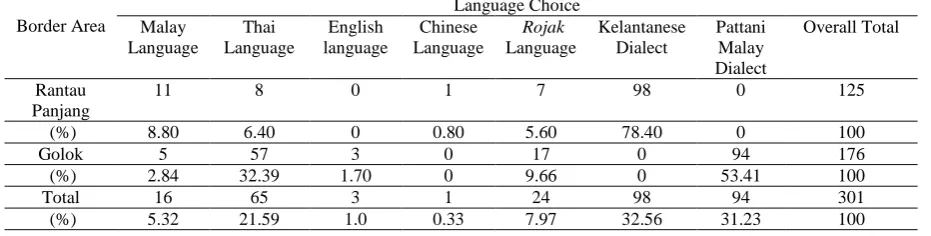
In the outside the home setting and when they are having conversations with friends, the dominant language used is Kelantanese dialect (78.40%) and followed by Pattani Malay (53.41%). There is little
Thai language (32.39%) and rojak language (9.66%) recorded impressive figures in terms of its usage.
Next in situations where relatives come to pay
a visit or visiting relatives, Kelantanese dialect (89.08%) and Pattani Malay (61.74%) recorded high usage.
Table 4: Language used among relatives
Border Area
Language Choice Malay
language
Thai language
English language
Chinese language
Rojak language
Kelantanese dialect
Pattani Malay dialect
Overall Total
Rantau Panjang
5 4 0 0 3 98 0 110
(%) 4.55 3.64 0 0 2.73 89.08 0 100
Golok 5 35 1 0 16 0 92 149
(%) 3.36 23.49 0.67 0 10.74 0 61.74 100
Total 10 39 1 0 19 98 92 259
(%) 3.86 15.06 0.39 0 7.34 37.84 35.51 100
Other languages recorded low usage in Rantau Panjang. In Golok however, Thai language and
rojak language recorded high percentages at 23,49% and 10.74% respectively. This could be the result of mixed-marriages between the Thais and the Malays. Each, therefore, tries to continue using their first language in their conversations with relatives. In certain situations, rojak language is used.
Business Domain
In this study, business domain covers three other subdomains, namely shopping, restaurants, and immigration settings. The questions posed to the respondents were intended to get information on language used during business transactions (i.e for clothing, food) and the entry-exit process at the Malaysia-Thailand border (for business purposes).
Table 5: Language choice in shop
Border Area
Language Choice Malay
language
Thai language
English language
Chinese language
Rojak language
Kelantanese Dialect
Pattani Malay dialect
Overall Total
Rantau Panjang
43 15 11 1 18 96 0 184
(%) 23.37 8.15 5.98 0.54 9.78 52.18 0 100
Golok 19 55 7 2 17 0 97 197
(%) 9.64 27.92 3.55 1.02 8.63 0 49.24 100
Total 62 70 18 3 35 96 97 381
(%) 16.27 18.37 4.72 0.79 9.19 25.20 25.46 100
Table 5 shows that majority of the respondents prefer Kelantanese dialect (52.18%) and Pattani Malay (49.24%). These results are slightly different from the findings in the family domain. Kelantanese dialect recorded the highest usage with more than 78% and 53% for Pattani Malay. In view of the fact that both Rantau Panjang and Golok are popular shopping destinations, it is not surprising that various patterns of language choice were discovered. Malay language and Thai language both recorded rather high percentages of language use
with 23.37% and 8.15% respectively in Rantau Panjang; and 9.64% and 27.92% respectively in Golok. Rojak language too, recorded a high percentage of usage with 9.78% at Rantau Panjang and 8.63% in Golok. The various patterns of language use in the shopping setting indicate that the community of speakers or language users in these areas are multilingual. This is in line with the business strategies used by the traders, which is to use the language used by the buyers for mutual understanding in their business dealings.
Table 6: Language choice in restaurants
Border Area
Language Choice Malay
language
Thai language
English language
Chinese language
Rojak language
Kelantanese dialect
Pattani Malay dialect
Overall Total
Rantau Panjang
9 3 0 0 1 97 0 110
(%) 8.18 2.73 0 0 0.91 88.18 0 100
Golok 4 44 1 0 14 0 91 154
(%) 2.60 28.57 0.65 0 9.09 0 59.09 100
Total 13 47 1 0 15 97 91 264
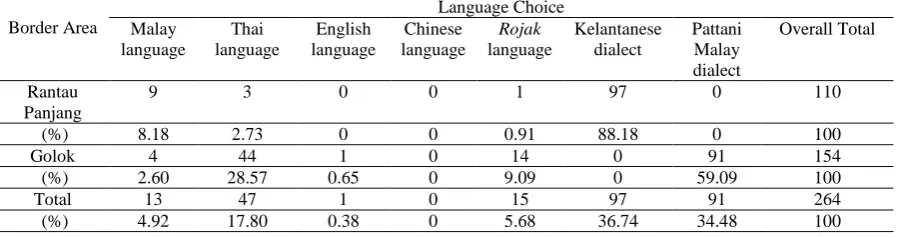
In the restaurant setting, the dominant language is Kelantanese dialect (88.18%), and slight usage of Malay language (8.18%) in Rantau Panjang. Pattani Malay dialect (59.09%), Thai language (28.57%) and rojak language (9.09%) are some of the languages used in Golok. Based on these observations, the food business in the two study areas is dominated by the Malays. Thus, the
selection of Kelantanese dialect and Pattani Malay as the most used languages has been predicted. A relatively high percentage of Thai language is consistent with the findings in other subdomains, which shows the neutral status of Thai language among the Thai population who use languages other than Thai.
Table 7: Language used at the immigration setting
Border Area Language Choice
Malay language
Thai language
English language
Chinese language
Rojak language
Kelantanese dialect
Pattani Malay dialect
Overall Total
Rantau Panjang
19 4 1 0 0 95 0 119
(%) 15.97 3.36 0.84 0 0 79.83 0 100
Golok 7 61 1 0 9 0 88 166
(%) 4.22 36.75 0.60 0 5.42 0 53.01 100
Total 26 65 2 0 9 95 88 285
(%) 9.12 22.81 0.70 0 3.16 33.33 30.88 100
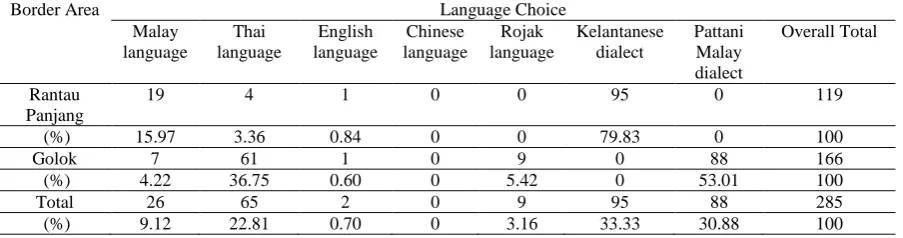
The immigration setting is significant to this study as this study involves border areas of two countries. Every day, people from Malaysia or Thailand will cross the border separating the two countries for business reasons or to visit relatives. The results showed that the community in Golok display more variety in their language choice such as Pattani Malay (53.01), the Thai language (36.75%), rojak language (5.42%), Malay (22.4%) and English (0.60%). The community in Rantau Panjang only displays 4 language choice namely, Kelantanese dialect (79.83%), Malay (15.97%), Thai language (3.36%) and English (0.84%).
Social Variables
As explained in the sociolinguistic profile section above, this study is built around six social variables, ie age, race, sex, occupation, level of education and first language. Based on the findings in Tables 1 and 2, it was found that only levels of education and age variables are significant for discussion. The diversity in age groups and levels of education show that there are various patterns of language use among the respondents. The other social variables such as race and gender are not discussed as the majority of the respondents are Malay and women. Similarly, the type of employment is dominated by those who are self-employed (business) and their first language is either Kelantanese dialect or Pattani Malay dialect. Accordingly, the discussion in this section only focuses on age and gender variables to determine the influence of these two variables on the patterns of language choice.
Language choice and age
As explained above, the distribution of age of the respondents for both areas is quite balanced, with
the majority of them aged between 21-40 years old (63%) and 41-55 years old (25-30%).
The findings showed that in the family domain, Kelantanese dialect recorded the highest percentage at 83-100% for all age group. Pattani Malay dialect that is used in Golok recorded a 57-60% usage. However, there is a strong challenge from Thai language which recorded a usage of 25-28% and
rojak language between 8-14%.
In business domain, Kelantanese dialect in Rantau Panjang is in competition with standard Malay which recorded a 20-29% use compared to 56-65% for Kelantanese dialect. With regards to language choice in Golok, it is discovered that there is a balance between business and family domains with 20-31% chose Thai language and 52-60% chose Pattani Malay dialect.
The overall findings of this study show that the 21-40 age group and the 41-55 age group are multilingual because they are able to speak 4 to 5 language varieties in both domains. Based on the observations and interviews conducted, those in the 21-40 age group are in constant contact with their peers in the same age group from Malaysia or Thailand. Therefore it is not surprising that they use various language varieties. In addition, mixed marriages also contributed to the fact that these respondents are able to communicate in more than one language. Those in the above-56 age category, however, indicate the opposite. For example, in Rantau Panjang this group do no know how to speak Thai language because of their limited contact with those who live in Golok.
Language choice and education levels
Table 8: Comparison based on age
Domain
Border area Age (years)
Language Choice
M
alay
lan
g
u
ag
e
Th
ai
lan
g
u
ag
e
En
g
li
sh
lan
g
u
ag
e
Ch
in
ese
lan
g
u
ag
e
Ro
jak
lan
g
u
ag
e
Ke
lan
tan
ese
d
iale
ct
P
att
an
i
M
alay
d
iale
ct
Ov
era
ll
To
tal
Family
Rantau Panjang
Below 20 0 0 0 0 0 100 0 100
21-40 6.94 4.63 0 0.93 4.17 83.33 0 100
41-55 8.14 4.65 0 0 2.33 84.88 0 100
56 and above
0 0 0 0 0 100 0 100
Total (%) 6.45 4.11 0 0.59 3.23 85.62 0 100
Golok
Below 20 0 25 0 0 14.29 0 60.71 100
21-40 2 26.33 1.67 0 12.67 0 57.33 100
41-55 5.15 28.68 0 0 8.09 0 58.08 100
Total (%) 2.80 26.94 1.08 0 11.42 0 57.76 100
Business
Rantau Panjang
Below 20 29.27 2.44 2.44 0 7.32 58.53 0 100
21-40 20.15 5.49 5.86 0.37 2.93 65.20 0 100
41-55 29.92 4.72 2.36 0 6.30 56.70 0 100
56 and above
0 0 0 0 0 100 0 100
Total (%) 23.03 4.82 4.39 0.22 4.17 63.37 0 100
Golok
Below 20 6.67 30 0 0 3.33 0 60 100
21-40 5.07 31.64 2.39 0 8.36 0 52.54 100
41-55 7.84 29.41 0.65 1.31 7.19 0 53.60 100
Total (%) 5.98 30.89 1.74 0.39 7.72 0 53.28 100
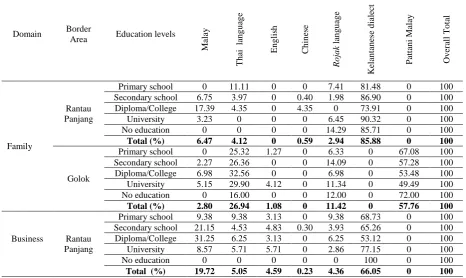
Family domain still recorded the highest percentage for all levels of education for respondents in Rantau Panjang at about 73-90%.
Thai language is still seen as a rival to Pattani Malay dialect as reflected in Table 9:
Table 9: A comparison on levels of education
Domain Border
Area Education levels
Language Choice
M
alay
Th
ai
lan
g
u
ag
e
En
g
li
sh
Ch
in
ese
Ro
ja
k
la
n
g
u
ag
e
Ke
lan
tan
ese
d
iale
ct
P
att
an
i
M
alay
Ov
era
ll
To
tal
Family
Rantau Panjang
Primary school 0 11.11 0 0 7.41 81.48 0 100
Secondary school 6.75 3.97 0 0.40 1.98 86.90 0 100
Diploma/College 17.39 4.35 0 4.35 0 73.91 0 100
University 3.23 0 0 0 6.45 90.32 0 100
No education 0 0 0 0 14.29 85.71 0 100
Total (%) 6.47 4.12 0 0.59 2.94 85.88 0 100
Golok
Primary school 0 25.32 1.27 0 6.33 0 67.08 100
Secondary school 2.27 26.36 0 0 14.09 0 57.28 100
Diploma/College 6.98 32.56 0 0 6.98 0 53.48 100
University 5.15 29.90 4.12 0 11.34 0 49.49 100
No education 0 16.00 0 0 12.00 0 72.00 100
Total (%) 2.80 26.94 1.08 0 11.42 0 57.76 100
Business Rantau Panjang
Primary school 9.38 9.38 3.13 0 9.38 68.73 0 100
Secondary school 21.15 4.53 4.83 0.30 3.93 65.26 0 100 Diploma/College 31.25 6.25 3.13 0 6.25 53.12 0 100
University 8.57 5.71 5.71 0 2.86 77.15 0 100
No education 0 0 0 0 0 100 0 100
Business Golok
Primary school 4.04 34.34 0 0 6.06 0 55.56 100
Secondary school 6.20 30.58 0.83 0.41 8.68 0 53.30 100 Diploma/College 11.54 28.85 1.92 1.92 11.54 0 44.23 100
University 3.92 34.31 5.88 0 5.88 0 50.01 100
No education 4.55 9.09 0 0 4.55 0 81.81 100
Total (%) 5.80 30.95 1.74 0.39 7.74 0 53.38 100
In business domain, the patterns of respondents’ language choice are almost similar with the ones on language choice and age. Malay language recorded between 8-31% usage while Thai language recorded a 9-34% usage. Kelantanese dialect recorded a 53-100% usage and Pattani Malay dialect recorded a 44-81% usage. These findings suggest that there is a balance for both variables in the context of language choice at the Malaysia-Thailand border.
Comparison made among various groups based on their levels of education show that those who have high school education have the most number of language choices – of about 3-6 languages. This group clearly dominates the business activities in both areas (Rantau Panjang & Golok) and in tandem with those in the 21-40 and 41-55 age groups. In other words, the pattern of language choice at the Malaysia-Thai border is determined by these two groups who mostly have high school education. The situation in Golok is slightly different; the groups with college/university education are the ones with various language choices. Some of the respondents remarked that the higher one’s level of education is, the more choices (language choices) that one has at his/her own disposal. For example, respondents who received his education in Thailand or in Malaysia, will automatically be able to speak standard Thai or Malay language, besides English and rojak language that is widely spoken. These findings show that although the education system in Thailand is based on the monolingual concept, the community in Golok in particular is bilingual.
Factors Determining Language Choice
The study on language choice would typically show three situations, namely (i) language maintenance (ii) language shift, and (iii) the existence of language maintenance and language shift simultaneously (Yeh, Chan & Cheng, 2004). Language maintenance is when the community decides to continue using the existing language while language shift occurs when a community chooses another language over the local language. The third situation where the community decides on both language shift and language maintenance is a situation where the community decides to continue using the existing language but at the same time replaces the existing language with new language. Based on these three situations, it appears that language maintenance is taking place at the Malaysia-Thailand border, particularly in Golok
when the majority of respondents choose Pattani Malay instead of the Thai language.
Based on observations and interviews conducted with the community at the Malaysia-Thailand border, it was found that the motivation that supports the communities in Golok to maintain Pattani Malay dialect was determined by cultural, political and language factors. The situation in Golok is different from the situation in Rantau Panjang because the official religion in Thailand is Buddhism. However, the majority of the populations in Southern Thailand are Muslims, hence, the culture of the community would be different. This community has been able to protect their identity as Malays and observed Malay culture. In other words, the maintenance of Malay language in this community is anchored by cultural practices and the teachings of the Islamic religion.
Politically, Golok is an area in the Thai side of the border and the language used would be Thai language. However, a variety of the Malay language, Pattani Malay dialect has been able to cross political boundary because it is widely used at the Thai border. Through the usage of Malay language, the Pattani Malay community has been able to survive as a Malay community.
From language perspective, Pattani Malay is a minority language in Thailand. However, in a broader context, Pattani Malay is actually located in the Malay world and has become the language of the majority in southern Thailand, and Malaysia. With this then, the use of the Malay language in Southern Thai has functioned as a symbol of identity for the Malay community. When the respondents were asked “What language do you use?”, the response was “Of course Malay because we are Malays”. This response confirms that the Malay language in Golok is still preserved in that community. And this is the most precious gift for the community at the Malaysia-Thailand border because they are still able to retain or preserve their mother tongue despite pressure from the Thai language.
Language maintenance among language users in Golok also serves as a marker that the Malays are prouder of their first language than any other language, such as the Thai language. This is confirmed by Lekawatana, (1994) who stated that the speakers of minority language in Thailand “... were prouder of their language than speakers of standard".
language for socializing but is also the language for business (trade). Historically, the Malay language was once the language used for trading that also served as the lingua franca in Malacca in the 15th century. This apparently is still maintained at the Malaysia-Thailand border where the Malay language serves as the primary language in home and business domains. English, which is known as an international language is not able to compete with the local language at the Malaysia-Thailand border.
CONCLUSION
The language situation in Thailand, in principle, adopts the concept of one language which is the Thai language. This is different from Malaysia which is considered as a multilingual country with its own diglossic situation (Nair-Venugopal, 2000, see also Omar, 1982). Conflict on language use appears, specifically in Southern Thailand where majority of its speakers use Malay and they are of Malay descent. The present study shows that the Malay language (Pattani Malay) is still widely used and surviving in Golok and Kelantanese dialect in Rantau Panjang in both domains studied. Therefore both Malay dialects are the lingua franca at the Malaysia-Thailand border for formal settings (e.g. at the immigrasion office) and informal settings (e.g. at home or at a restaurant). It is recommended that further studies on language choice at Malaysia-Thailand border in other states in Malaysia such as Perlis, Kedah and Perak be explored. Omar (1992) reported that as a result of of colonization by Thailand over Kedah and Perlis in the late 19th century has led certain language communities in Perlis and Kedah (including Malays) to speak Thai as their first language. This means that language shift has occurred at the Kedah-Thailand border. However, at the Kelantan-Thailand border, Malay remains as the dominant language. There are several different language situations along the Malaysia-Thailand border and this shows that studies on language use at the border area is significant. Studies such as this is able to offer the government and language planners an understanding on various language issues that exist at the border.
Akcnowledgement
This study was funded by Malaysian government through Exploratory Research Grant Scheme (ERGS)
REFERENCES
Bakar, H.A. (2009). Code-switching in Kuala Lumpur Malay: The “Rojak” phenomenon.
Explorations a Graduate Student Journal of Southeast Asian Studies, 9, Spring, pp. 99-107. Fasold, R. (1984). The sociolinguistics of society.
Oxford : Basil Blackwell.
Fishman, J. A. (1972). The relationship between micro- and macro-sociolinguistics in the study of who speaks what language to whom and when. InJohn B. Pride & Janet Holmes (eds.).
Sociolinguistics. Harmondsworth: Penguin. Gal, S. (1979). Language shift: Social determinants
of linguistics change in bilingual Austria. New York: Academic Press.
Gumperz, J. & D. Hymes (eds.). (1972). Directions in sociolinguistics. New York: Holt, Rinehart & Winston.
Holmes, J. (2001). An introduction to
sociolinguistics (2nd ed.). England: Pearson Education Limited.
Hussin, F., Norehan, A., Selamah, M., & Hussin, A. (2012). Border economy: issues and problems faced by traders in the Rantau Panjang Duty-free Zone. Journal of Sociological Research. 3(2), pp 46-56.
Lekawatana, P. (1994). The Role of Language in National Unity and Individual Identity. In Hassan, A. (Eds.). Language Planning in Southeast Asia. Kuala Lumpur: Dewan Bahasa dan Pustaka, Ministry of Education, Malaysia. pp. 268-242.
Milroy, L. (1980). Language and social networks. Baltimore, MD: University Park Press. Nair-Venugopal, S. (2000). Language choice and
communication in Malaysia business. Bangi: Universiti Kebangsaan Malaysia.
Omar, A.H. (1982). Language and society in Malaysia. KualaLumpur: Dewan Bahasa dan Pustaka.
Omar, A.H. (1987). Malay in its sociocultural context. KualaLumpur: Dewan Bahasa dan Pustaka.
Omar, A.H. (1992). The linguistic scenery in Malaysia. Kuala Lumpur: Dewan Bahasa dan Pustaka.
Omar, A.H. (2006). Bahasa Melayu Samudera. Kuala Lumpur: Dewan Bahasa dan Pustaka. Uthai, R. (2011). Keistimewaan dialek Melayu
Pattani. Bangi: Penerbit Universiti Kebangsaan Malaysia.
Yeh, H., Chan, H. & Cheng, Y. (2004). Language use in Taiwan: Language proficiency and domain analysis. Journal of Taiwan Normal University: Humanities and Social Sciences.