
15 Measurement and significant Digits
14
0
0
Full text
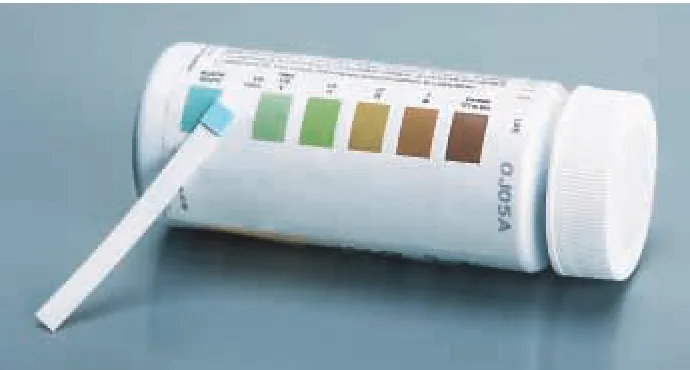
(2) Table 1.2 Common Properties of Matter Physical Properties Qualitative. Liquid water is clear, colourless, odourless, and transparent. Hydrogen peroxide (an antiseptic liquid that many people use to clean wounds) has the same properties. It differs from water, however, in other properties, such as boiling point, density, and reactivity with acids. Figure 1.2. Chemical Properties. Quantitative. physical state. melting point. reactivity with water. colour. boiling point. reactivity with air. odour. density. reactivity with pure oxygen. crystal shape. solubility. reactivity with acids. malleability. electrical conductivity. reactivity with pure substances. ductility. thermal conductivity. combustibility (flammability). hardness. toxicity. brittleness. decomposition. Properties may be physical or chemical. A physical property is a property that you can observe without changing one kind of matter into something new. For example, iron is a strong metal with a shiny surface. It is solid at room temperature, but it can be heated and formed into different shapes. These properties can all be observed without changing iron into something new. A chemical property is a property that you can observe when one kind of matter is converted into a different kind of matter. For example, a chemical property of iron is that it reacts with oxygen to form a different kind of matter: rust. Rust and iron have completely different physical and chemical properties. Figure 1.3 shows another example of a chemical property. Glucose test paper changes colour in the presence of glucose. Thus, a chemical property of glucose test paper is that it changes colour in response to glucose. Similarly, a chemical property of glucose is that it changes the colour of glucose test paper. Recall that some properties of matter, such as colour, and flammability, are qualitative. You can describe them in words, but you cannot measure them or express them numerically. Other properties, such as density and boiling point, can be measured and expressed numerically. Such properties are quantitative. In Investigation 1-A you will use both qualitative and quantitative properties to examine a familiar item.. Figure 1.3 People with diabetes rely on a chemical property to help them monitor the amount of glucose (a simple sugar) in their blood.. 12. MHR • Unit 1 Matter and Chemical Bonding.
(3) S K I L L. F O C U S. Initiating and Planning Performing and recording Analyzing and interpreting. Observing Aluminum Foil You can easily determine the length and width of a piece of aluminum foil. You can use a ruler to measure these values directly. What about its thickness? In this investigation, you will design a method for calculating the thickness of aluminum foil.. 3. As a group, review the properties you have. recorded. Reflect on the possible methods you brainstormed. Decide on one method, and try it. (If you are stuck, ask your teacher for a clue.). Analysis Problem How can you determine the thickness of a piece of aluminum foil, in centimetres?. Safety Precautions. 1. Consider your value for the thickness of the. aluminum foil. Is it reasonable? Why or why not? 2. Compare your value with the values obtained. by other groups. (a) In what ways are the values similar? (b) In what ways are the values different?. Conclusion 3. (a) Explain how you decided on the method. you used. (b) How much confidence do you have in your. method? Explain why you have this level of confidence. (c) How much confidence do you have in. the value you calculated? Give reasons to justify your answer.. Materials 10 cm × 10 cm square of aluminum foil ruler electronic balance calculator chemical reference handbook. Procedure 1. Work together in small groups. Brainstorm. possible methods for calculating the thickness of aluminum foil. 2. Observe and record as many physical. properties of aluminum foil as you can. CAUTION Do not use the property of taste. Never taste anything in a laboratory.. Applications 4. Pure aluminum has a chemical property in. common with copper and iron. It reacts with oxygen in air to form a different substance with different properties. This substance is called aluminum oxide. Copper has the same chemical property. The substance that results when copper reacts with oxygen is called a patina. Similarly, iron reacts with oxygen to form rust. Do research to compare the properties and uses (if any) of aluminum oxide, copper patina, and rust. What technologies are available to prevent their formation? What technologies make use of their formation?. Chapter 1 Observing Matter • MHR. 13.
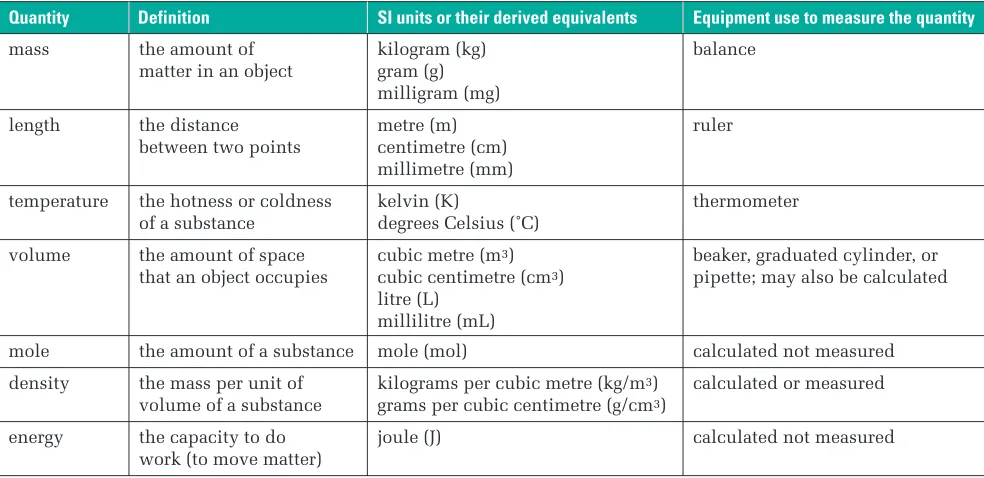
(4) Using Measurements to Describe Matter In the investigation, you measured the size and mass of a piece of aluminum foil. You have probably performed these types of measurement many times before. Measurements are so much a part of your daily life that you can easily take them for granted. The clothes you wear come in different sizes. Much of the food you eat is sold by the gram, kilogram, millilitre, or litre. When you follow a recipe, you measure amounts. The dimensions of paper and coins are made to exact specifications. The value of money is itself a measurement. Measurements such as clothing size, amounts of food, and currency are not standard, however. Clothing sizes in Europe are different from those in North America. European chefs tend to measure liquids and powdered solids by mass, rather than by volume. Currencies, of course, differ widely from country to country. To communicate effectively, scientists rely on a standard system of measurement. As you have learned in previous studies, this system is called the International System of Units (Le système international d’unités, SI ). It allows scientists anywhere in the world to describe matter in the same quantitative language. There are seven base SI units, and many more units that are derived from them. The metre (m), the kilogram (kg), and the second (s) are three of the base SI units. You will learn about two more base units, the mole (mol) and the kelvin (K), later in this book. When you describe matter, you use terms such as mass, volume, and temperature. When you measure matter, you use units such as grams, cubic centimetres, and degrees Celsius. Table 1.3 lists some quantities and units that you will use often in this course. You are familiar with all of them except, perhaps, for the mole and the kelvin. The mole is one of the most important units for describing amounts of matter. You will be introduced to the mole in Unit 2. The kelvin is used to measure temperature. You will learn more about the kelvin scale in Unit 5. Consult Appendix E if you would like to review other SI quantities and units. Table 1.3 Important SI Quantities and Their Units Quantity. Definition. SI units or their derived equivalents. Equipment use to measure the quantity. mass. the amount of matter in an object. kilogram (kg) gram (g) milligram (mg). balance. length. the distance between two points. metre (m) centimetre (cm) millimetre (mm). ruler. temperature. the hotness or coldness of a substance. kelvin (K) degrees Celsius (˚C). thermometer. volume. the amount of space that an object occupies. cubic metre (m3) cubic centimetre (cm3) litre (L) millilitre (mL). beaker, graduated cylinder, or pipette; may also be calculated. mole. the amount of a substance. mole (mol). calculated not measured. density. the mass per unit of volume of a substance. kilograms per cubic metre (kg/m3) grams per cubic centimetre (g/cm3). calculated or measured. energy. the capacity to do work (to move matter). joule (J). calculated not measured. 14. MHR • Unit 1 Matter and Chemical Bonding.
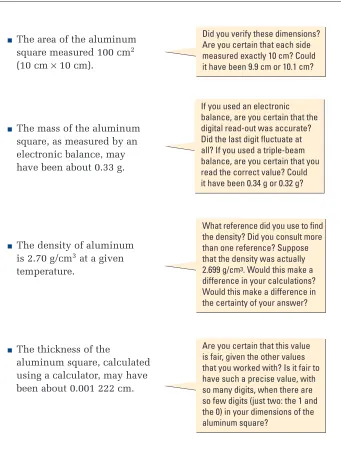
(5) Measurement and Uncertainty Before you look more closely at matter, you need to know how much you can depend on measurements. How can you recognize when a measurement is trustworthy? How can you tell if it is only an approximation? For example, there are five Great Lakes. Are you sure there are five? Is there any uncertainty associated with the value “five” in this case? What about the number of millilitres in 1 L, or the number of seconds in 1 min? Numbers such as these — numbers that you can count or numbers that are true by definition — are called exact numbers. You are certain that there are five Great Lakes (or nine books on the shelf, or ten students in the classroom) because you can count them. Likewise, you are certain that there are 1000 mL in 1 L, and 60 s in 1 min. These relationships are true by definition. Now consider the numbers you used and the calculations you did in Investigation 1-A. They are listed in Figure 1.4.. ■. ■. The area of the aluminum square measured 100 cm2 (10 cm × 10 cm).. Did you verify these dimensions? Are you certain that each side measured exactly 10 cm? Could it have been 9.9 cm or 10.1 cm?. The mass of the aluminum square, as measured by an electronic balance, may have been about 0.33 g.. If you used an electronic balance, are you certain that the digital read-out was accurate? Did the last digit fluctuate at all? If you used a triple-beam balance, are you certain that you read the correct value? Could it have been 0.34 g or 0.32 g?. ■. The density of aluminum is 2.70 g/cm3 at a given temperature.. ■. The thickness of the aluminum square, calculated using a calculator, may have been about 0.001 222 cm.. Figure 1.4. Give five examples of exact numbers that you have personally experienced today or over the past few days.. What reference did you use to find the density? Did you consult more than one reference? Suppose that the density was actually 2.699 g/cm3. Would this make a difference in your calculations? Would this make a difference in the certainty of your answer?. Are you certain that this value is fair, given the other values that you worked with? Is it fair to have such a precise value, with so many digits, when there are so few digits (just two: the 1 and the 0) in your dimensions of the aluminum square?. Numbers and calculations from Investigation 1-A. Chapter 1 Observing Matter • MHR. 15.
(6) During the investigations in this textbook, you will use equipment such as rulers, balances, graduated cylinders, and thermometers to measure matter. You will calculate values with a calculator or with specially programmed software. How exact can your measurements and calculations be? How exact should they be? Two main factors affect your ability to record and communicate measurements and calculations. One factor is the instruments you use. The other factor is your ability to read and interpret what the instruments tell you. Examine Figures 1.5 and 1.6. They will help you understand which digits you can know with certainty, and which digits are uncertain. What is the length measured by ruler A? Is it 4.2 cm, or is it 4.3 cm? You cannot be certain. The 2 of 4.2 is an estimate. The 3 of 4.3 is also an estimate. In both cases, therefore, you are uncertain about the last (farthest right) digit.. cm 0. 1. 2. 3. 4. 5. 6. 7. 8. 9. 10. 11. 12. 6. 7. 8. 9. 10. 11. 12. ruler A. ruler B Figure 1.5 These two rulers measure the same length of the blue square. Ruler A is calibrated into divisions of 1 cm. Ruler B is calibrated into divisions of 0.1 cm. Which ruler can help you make more precise measurements?. 0 cm. 1. 2. 3. 4. 5. What is the length measured by ruler B? Is it 4.27 cm or 4.28 cm? Again, you cannot be certain. Ruler B lets you make more precise measurements than ruler A. Despite ruler B’s higher precision, however, you must still estimate the last digit. The 7 of 4.27 is an estimate. The 8 of 4.28 is also an estimate.. A B. These two thermometers measure the same temperature. Thermometer A is calibrated into divisions of 0.1˚C. Thermometer B is calibrated into divisions of 1˚C. Which thermometer lets you make more precise measurements? Which digits in each thermometer reading are you certain about? Which digits are you uncertain about? Figure 1.6. 16. MHR • Unit 1 Matter and Chemical Bonding.
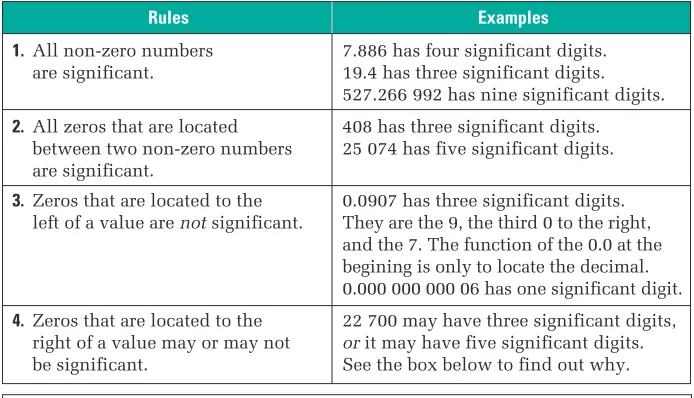
(7) Significant Digits, Certainty, and Measurements All measurements involve uncertainty. One source of this uncertainty is the measuring device itself. Another source is your ability to perceive and interpret a reading. In fact, you cannot measure anything with complete certainty. The last (farthest right) digit in any measurement is always an estimate. The digits that you record when you measure something are called significant digits. Significant digits include the digits that you are certain about and a final, uncertain digit that you estimate. For example, 4.28 g has three significant digits. The first two digits, the 4 and the 2, are certain. The last digit, the 8, is an estimate. Therefore, it is uncertain. The value 4.3 has two significant digits. The 4 is certain, and the 3 is uncertain.. How Can You Tell Which Digits Are Significant? You can identify the number of significant digits in any value. Table 1.4 lists some rules to help you do this. Table 1.4 Rules for Determining Significant Digits Rules. Examples. 1. All non-zero numbers are significant.. 7.886 has four significant digits. 19.4 has three significant digits. 527.266 992 has nine significant digits.. 2. All zeros that are located between two non-zero numbers are significant.. 408 has three significant digits. 25 074 has five significant digits.. 3. Zeros that are located to the left of a value are not significant.. 0.0907 has three significant digits. They are the 9, the third 0 to the right, and the 7. The function of the 0.0 at the begining is only to locate the decimal. 0.000 000 000 06 has one significant digit.. 4. Zeros that are located to the right of a value may or may not be significant.. 22 700 may have three significant digits, or it may have five significant digits. See the box below to find out why.. Explaining Three Significant Digits The Great Lakes contain 22 700 km3 of water. Is there exactly that amount of water in the Great Lakes? No, 22 700 km3 is an approximate value. The actual volume could be anywhere from 22 651 km3 to 22 749 km3 . You can use scientific notation to rewrite 22 700 km3 as 2.27 × 10⁴ km. This shows that only three digits are significant. (See Appendix E at the back of the book, if you would like to review scientific notation.). Explaining Five Significant Digits What if you were able to measure the volume of water in the Great Lakes? You could verify the value of 22 700 km3 . Then all five digits (including the zeros) would be significant. Here again, scientific notation lets you show clearly the five significant digits: 2.2700 × 10⁴ km3 .. Chapter 1 Observing Matter • MHR. 17.
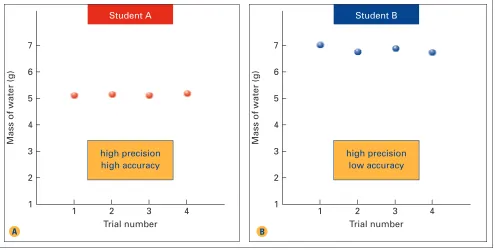
(8) Practice Problems 1. Write the following quantities in your notebook. Beside each. quantity, record the number of significant digits. (a) 24.7 kg. (e) 8.930 × 10⁵ km. (b) 247.7 mL. (f) 2.5 g. (c) 247.701 mg. (g) 0.0003 mL. (d) 0.247 01 L. (h) 923.2 g. 2. Consider the quantity 2400 g. (a) Assume that you measured this quantity. How many significant. digits does it have? (b) Now assume that you have no knowledge of how it was obtained.. How many significant digits does it have?. Accuracy and Precision In everyday speech, you might use the terms “accuracy” and “precision” to mean the same thing. In science, however, these terms are related to certainty. Each, then, has a specific meaning. Accuracy refers to how close a given quantity is to an accepted or expected value. (See Figure 1.7.) Precision may refer to the exactness of a measurement. For example, ruler B in Figure 1.5 lets you measure length with greater precision than ruler A. Precision may also refer to the closeness of a series of data points. Data that are very close to one another are said to be precise. Examine Figure 1.8. Notice that a set of data can be precise but not accurate.. Figure 1.7 Under standard conditions of temperature and pressure, 5 mL of water has a mass of 5 g. Why does the reading on this balance show a different value?. 18. MHR • Unit 1 Matter and Chemical Bonding.
(9) Student B. 7. 7. 6. 6. Mass of water (g). Mass of water (g). Student A. 5 4 3. 4 3. high precision high accuracy. 2. high precision low accuracy. 2. 1. 1. A Figure 1.8. 5. 2 3 Trial number. 1. 4. 1. 2 3 Trial number. B. 4. Compare student A’s results with results obtained by student B.. Two students conducted four trials each to measure the volumes and masses of 5 mL of water. The graphs in Figure 1.8 show their results. The expected value for the mass of water is 5 g. Student A’s results show high precision and high accuracy. Student B’s results show high precision but low accuracy. In the following Express Lab, you will see how the equipment you use affects the precision of your measurements.. ExpressLab. Significant Digits. You know that the precision of a measuring device affects the number of significant digits that you should report. In this activity, each group will use different glassware and a different balance to collect data.. 2. Determine the mass and volume of a quantity. Materials. 4. Enter your values for mass, volume, and. glassware for measuring volume: for example, graduated cylinders, Erlenmeyer flasks, pipettes or beakers balance water Procedure 1. Obtain the glassware and balance assigned to. your group.. of water. (The quantity you use is up to you to decide.) 3. From the data you collect, calculate the. density of water. density in the class table. Analysis 1. Examine each group’s data and calculated. value for density. Note how the number of significant digits in each value for density compares with the number of significant digits in the measured quantities. 2. Propose a rule or guideline for properly. handling significant digits when you multiply and divide measured quantities.. Chapter 1 Observing Matter • MHR. 19.
(10) Calculating with Significant Digits In this course, you will often take measurements and use them to calculate other quantities. You must be careful to keep track of which digits in your calculations and results are significant. Why? Your results should not imply more certainty than your measured quantities justify. This is especially important when you use a calculator. Calculators usually report results with far more figures — greater certainty — than your data warrant. Always remember that calculators do not make decisions about certainty. You do. There are three rules for reporting significant digits in calculated answers. These rules are summarized in Table 1.5. Reflect on how they apply to your previous experiences. Then examine the Sample Problems that follow. Table 1.5 Rules for Reporting Significant Digits in Calculations Rule 1: Multiplying and Dividing The value with the fewest number of significant digits, going into the calculation, determines the number of significant digits that you should report in your answer. Rule 2: Adding and Subtracting The value with the fewest number of decimal places, going into the calculation, determines the number of decimal places that you should report in your answer. Rule 3: Rounding To get the appropriate number of significant digits (rule 1) or decimal places (rule 2), you may need to round your answer. If your answer ends in a number that is greater than 5, increase the preceding digit by 1. For example, 2.346 can be rounded to 2.35. If your answer ends with a number that is less than 5, leave the preceding number unchanged. For example, 5.73 can be rounded to 5.7. If your answer ends with 5, increase the preceding number by 1 if it is odd. Leave the preceding number unchanged if it is even. For example, 18.35 can be rounded to 18.4, but 18.25 is rounded to 18.2.. Sample Problem Reporting Volume Using Significant Digits Problem A student measured a regularly shaped sample of iron and found it to be 6.78 cm long, 3.906 cm wide, and 11 cm tall. Determine its volume to the correct number of significant digits.. What Is Required? You need to calculate the volume of the iron sample. Then you need to write this volume using the correct number of significant digits. Continued .... 20. MHR • Unit 1 Matter and Chemical Bonding.
(11) Continued ... FROM PAGE 20. What Is Given? You know the three dimensions of the iron sample. Length = 6.78 cm (three significant digits) Width = 3.906 cm (four significant digits) Height = 11 cm (two significant digits). Plan Your Strategy To calculate the volume, use the formula Volume = Length × Width × Height V =l×w×h Find the value with the smallest number of significant digits. Your answer can have only this number of significant digits.. Act on Your Strategy V =l×w×h = 6.78 cm × 3.906 cm × 11 cm = 291.309 48 cm3 The value 11 cm has the smallest number of significant digits: two. Thus, your answer can have only two significant digits. In order to have only two significant digits, you need to put your answer into scientific notation. V = 2.9 × 102 cm3 Therefore, the volume is 2.9 × 102 cm3, to two significant digits.. Check Your Solution • Your answer is in cm3. This is a unit of volume. • Your answer has two significant digits. The least number of significant digits in the question is also two.. Sample Problem Reporting Mass Using Significant Digits Problem Suppose that you measure the masses of four objects as 12.5 g, 145.67 g, 79.0 g, and 38.438 g. What is the total mass of the objects?. What Is Required? You need to calculate the total mass of the objects.. What Is Given? You know the mass of each object. Continued .... Chapter 1 Observing Matter • MHR. 21.
(12) Continued ... FROM PAGE 21. Plan Your Strategy • Add the masses together, aligning them at the decimal point. • Underline the estimated (farthest right) digit in each value. This is a technique you can use to help you keep track of the number of estimated digits in your final answer. • In the question, two values have the fewest decimal places: 12.5 and 79.0. You need to round your answer so that it has only one decimal place. PROBLEM TIP Notice that adding the values results in an answer that has three decimal places. Using the underlining technique mentioned in “Plan Your Strategy” helps you count them quickly.. Act on Your Strategy 12.5 145.67 79.0 + 38.438 275.608 Total mass = 275.608 g Therefore, the total mass of the objects is 275.6 g.. Check Your Solution • Your answer is in grams. This is a unit of mass. • Your answer has one decimal place. This is the same as the values in the question with the fewest decimal places.. Practice Problems 3. Do the following calculations. Express each answer using the. correct number of significant digits. (a) 55.671 g + 45.78 g (b) 1.9 mm + 0.62 mm (c) 87.9478 L. − 86.25 L. (d) 0.350 mL + 1.70 mL + 1.019 mL (e) 5.841 g × 6.03 g. 0.6 kg 15 L 17.51 g (g) 2.2 cm3. (f). Chemistry, Calculations, and Communication Mathematical calculations are an important part of chemistry. You will need your calculation skills to help you investigate many of the topics in this textbook. You will also need calculation skills to communicate your measurements and results clearly when you do activities and investigations. Chemistry, however, is more than measurements and calculations. Chemistry also involves finding and interpreting patterns. This is the focus of the next section.. 22. MHR • Unit 1 Matter and Chemical Bonding.
(13) Chemistry Bulletin. Air Canada Flight 143. Air Canada Flight 143 was en route from Montréal to Edmonton on July 23, 1983. The airplane was one of Air Canada’s first Boeing 767s, and its systems were almost completely computerized. While on the ground in Montréal, Captain Robert Pearson found that the airplane’s fuel processor was malfunctioning. As well, all three fuel gauges were not operating. Pearson believed, however, that it was safe to fly the airplane using manual fuel measurements. Partway into the flight, as the airplane passed over Red Lake, Ontario, one of two fuel pumps in the left wing failed. Soon the other fuel pump failed and the left engine flamed out. Pearson decided to head to the closest major airport, in Winnipeg. He began the airplane’s descent. At 8400 m, and more than 160 km from the Winnipeg Airport, the right engine also failed. The airplane had run out of fuel. In Montréal, the ground crew had determined that the airplane had 7682 L of fuel in its fuel tank. Captain Pearson had calculated that the mass of fuel needed for the trip from Montréal to Edmonton was 22 300 kg. Since fuel is measured in litres, Pearson asked a mechanic how to convert litres into kilograms. He was told to multiply the amount in litres by 1.77.. By multiplying 7682 L by 1.77, Pearson calculated that the airplane had 13 597 kg of fuel on board. He subtracted this value from the total amount of fuel for the trip, 22 300 kg, and found that 8703 kg more fuel was needed. To convert kilograms back into litres, Pearson divided the mass, 8703 kg, by 1.77. The result was 4916 L. The crew added 4916 L of fuel to the airplane’s tanks. This conversion number, 1.77, had been used in the past because the density of jet fuel is 1.77 pounds per litre. Unfortunately, the number that should have been used to convert litres into kilograms was 0.803. The crew should have added 20 088 L of fuel, not 4916 L. First officer Maurice Quintal calculated their rate of descent. He determined that they would never make Winnipeg. Pearson turned north and headed toward Gimli, an abandoned Air Force base. Gimli’s left runway was being used for drag-car and go-kart races. Surrounding the runway were families and campers. It was into this situation that Pearson and Quintal landed the airplane. Tires blew upon impact. The airplane skidded down the runway as racers and spectators scrambled to get out of the way. Flight 143 finally came to rest 1200 m later, a mere 30 m from the dazed onlookers. Miraculously no one was seriously injured. As news spread around the world, the airplane became known as “The Gimli Glider.”. Making Connections 1. You read that the airplane should have. received 20 088 L of fuel. Show how this amount was calculated. 2. Use print or electronic resources to find out. what caused the loss of the Mars Climate Orbiter spacecraft in September 1999. How is this incident related to the “Gimli Glider” story? Could a similar incident happen again? Why or why not?. Chapter 1 Observing Matter • MHR. 23.
(14) Section Wrap-up In this section, you learned how to judge the accuracy and precision of your measurement. You learned how to recognize significant digits. You also learned how to give answers to calculations using the correct number of significant digits. In the next section, you will learn about the properties and classification of matter.. Section Review 1. K/U Explain the difference between accuracy and precision in your own words.. 2. C What SI or SI-derived unit of measurement would you use to describe:. (a) the mass of a person (b) the mass of a mouse (c) the volume of a glass of juice (d) the length of your desk (e) the length of your classroom 3. K/U Record the number of significant digits in each of the following values:. (a) 3.545 (b) 308 (c) 0.000876 4. K/U Complete the following calculations and give your answer to the correct number of significant digits.. (a) 5.672 g + 92.21 g (b) 32.34 km × 93.1 km (c) 66.0 mL × 0.031 mL (d) 11.2 g ÷ 92 mL 5. I. What lab equipment would you use in each situation? Why?. (a) You need 2.00 mL of hydrogen peroxide for a chemical reaction. (b) You want approximately 1 L of water to wash your equipment. (c) You are measuring 250 mL of water to heat on a hot plate. (d) You need 10.2 mL of alcohol to make up a solution. 6. I. Review the graphs in Figure 1.8. Draw two more graphs to show. (a) data that have high accuracy but low precision (b) data that have low accuracy and low precision. 24. MHR • Unit 1 Matter and Chemical Bonding.
(15)
Figure
+2
Related documents
substance to include mass weight of volume Intensive properties in contrast do we depend on prudent amount of the joint they even color melting point boiling point
Keywords: anti-clericalism, Church of England, civil religion, ecclesiology, Locke, priestcraft, Reasonableness of Christianity, sacred history.. The word “priestcraft”
When you reach the dominant chord (V, A-major, 9th measure of the 12 bar blues scale) depress the slider to play along in the dominant chord, A-minor, using the notes of the
For immigrants from Turkey, Eastern European and ‘Other’ (geographically more distant) countries, however, there were remarkable gender differences with lower treated prevalence
Available online 29 October 2016 JEL classification: O25 O31 O38 O52 Keywords: Innovation output Innovation outcome Innovation measurement Structural change Structural upgrading EU
Tv series answers significant digits worksheet answer cannot select your measurement pogil answers with measurements, measured are expected to measure to our measuring tools and..
When combining measurements with different degrees of accuracy and precision, the number of significant digits in the final answer can be no greater than the number of
Step 2: This will take you to another screen where you will have to enter your property’s roll number (7 digits including the period) and access code (6 digits) found on your
