
Open Access
Software
A user-friendly Matlab program and GUI for the pseudorotation
analysis of saturated five-membered ring systems based on scalar
coupling constants
Pieter MS Hendrickx* and José C Martins*
Address: NMR and Structure Analysis Unit, Ghent University, Krijgslaan 281 S4, B-9000 Ghent, Belgium
Email: Pieter MS Hendrickx* - [email protected]; José C Martins* - [email protected] * Corresponding authors
Abstract
Background: The advent of combinatorial chemistry has revived the interest in five-membered heterocyclic rings as scaffolds in pharmaceutical research. They are also the target of modifications in nucleic acid chemistry. Hence, the characterization of their conformational features is of considerable interest. This can be accomplished from the analysis of the 3J
HH scalar coupling
constants.
Results: A freely available program including an easy-to-use graphical user interface (GUI) has been developed for the calculation of five-membered ring conformations from scalar coupling constant data. A variety of operational modes and parameterizations can be selected by the user, and the coupling constants and electronegativity parameters can be defined interactively. Furthermore, the possibility of generating high-quality graphical output of the conformational space accessible to the molecule under study facilitates the interpretation of the results. These features are illustrated via the conformational analysis of two 4'-thio-2'-deoxynucleoside analogs. Results are discussed and compared with those obtained using the original PSEUROT program.
Conclusion: A user-friendly Matlab interface has been developed and tested. This should considerably improve the accessibility of this kind of calculations to the chemical community.
Background
Five-membered heterocyclic ring systems constitute an important part of many biologically relevant molecules. They occur in carbohydrates (furanoses), nucleosides and nucleotides, the amino acid proline and their many deriv-atives. In addition, they often occur as a moiety in com-plex natural products. Chemical modifications of nucleic acids, often driven by the needs of antisense research, tar-get in part the five-membered cycle or its analogues in order to tailor their conformation towards the desired needs [1,2].
The advent of combinatorial chemistry has also revived the interest in heterocyclic rings and their conformation [3]. As a result, scaffolds containing five-membered hete-rocycles have received much attention for the rapid gener-ation of potential lead compounds in pharmaceutical research [4-11].
Typically, the chemical and conformational space is explored by introducing a diversity of substituents at var-ying positions around the cycle. Depending on the posi-tion and nature of these substituents, the cycle either
Published: 24 October 2008
Chemistry Central Journal 2008, 2:20 doi:10.1186/1752-153X-2-20
Received: 9 July 2008 Accepted: 24 October 2008
This article is available from: http://journal.chemistrycentral.com/content/2/1/20
© 2008 Hendrickx et al
adopts a single conformation or may be in equilibrium between two conformations. These conformations will in turn impact on the conformational space that will be cov-ered by the substituents, making the determination of the cycle's conformation an issue of considerable interest.
Over the years, NMR has become a well-established tech-nique for this purpose. In particular, 3J
HH scalar coupling
constants are well-suited as they are mainly determined by the torsion angle over which they are measured. In the case of ring systems, the vicinal 3J
HH scalar coupling
con-stants are directly correlated to their corresponding exocy-clic torsion angles (exo). These are related to the corresponding endocyclic torsion angles (endo) by a sim-ple equation (1) where A and B are constants determined by the geometry of the atoms linked to the common cen-tral bond.
exo = A endo + B
As the set of all five endocyclic torsion angles in a five-membered ring fully determines its conformation, 3J
HH
scalar coupling constants provide a direct measure of the ring's conformation. The Haasnoot-Altona equation (3) [12] and the Diez-Donders equation (4) [13,14], both based on the well known Karplus equation (2), describe the relation between a 3J
HH coupling and the
correspond-ing exocyclic torsion angle (exo) to a high level of accu-racy. In both equations this is mainly achieved by including a set of four parameters i (i = 1, ..., 4) that account for the influence of electronic effects contributed by the substituents [15,16]. In some studies, the set of experimental 3J
HH scalar coupling constants is further
extended by 3J
HF scalar coupling constants [17-19] or
interproton distances obtained by nOe NMR experiments. Here however, we assume that only 3J
HH scalar couplings
are available for conformational analysis.
3J
HH = P1 cos2() + P2 cos() + P3
Altona and Sundaralingam showed that the description of a five-membered ring conformation can be reduced to a two-parameter pseudorotation model [20,21] that fully describes its conformation. The first parameter, the pucker phase P, represents the phase of the conformation and indicates which ring atoms are positioned out of the ring plane. The second parameter, the pucker amplitude max,
corresponds to the amplitude of the conformation and describes the extent to which the atoms determined by P
are out of the plane. The relationship with the endocyclic torsion angles endo, i is shown in (5).
This well-known pseudorotation description, originally described for the furanose ring in nucleosides and nucle-otides [20,21], was further generalized to any five-mem-bered heterocycle by Diez et al. [22-24] who introduced two additional parameters i and i for each endocyclic bond to cope with differences in bond lengths in various types of five-membered rings (Equation 6). As the phase of the conformation P is a periodic variable, polar plots called pseudorotation wheels are mostly used to depict ring conformations.
Using the above equations, 3J
HH couplings can be used to
derive the pseudorotation parameters of the five-mem-bered cycle. As mentioned previously, the cycle may be in equilibrium between two conformations. Thus, most gen-erally two sets of pseudorotation parameters (P and max) and the relative population (%1, i.e. the percentage of the first conformation present with %2 = 1 - %1) need to be fit-ted to the experimental NMR data. In order to avoid an under-determined model, experimental data measured at different temperatures is generally used. In such cases, the model assumes that only the relative population of the two conformations varies when changing the tempera-ture. Thus n + 4 (n being the number of temperatures used) variables will be optimized to fit the experimental data in such cases. To the best of our knowledge, the pro-gram PSEUROT [25], originally developed by Altona et al., is still the only generally available program to perform this type of analysis. Written in FORTRAN, its interface as well as its output is purely text-based. In order to facilitate the analysis of the PSEUROT results, a post-processing fea-ture has been included in the independently developed MULDER package [26] to generate a graphical output of the PSEUROT results. In this communication, we propose an integrated, user-friendly Matlab program, including a self-explanatory graphical user interface (GUI), to facili-tate the set-up, execution and subsequent analysis of pseu-dorotation calculations for five-membered ring systems decorated with a variety of substituents. The use of Matlab as high-level programming language enables to create, within a limited time frame, high-quality plots that pro-vide a graphical impression of the conformational space accessible. Furthermore, due to the open-source GNU
3
1 2 2 3
1 4
4 5 2 1 6
J P cos P cos P
P P cos P
HH i i i i i = + + + + − + =
∑
( ) ( ) (( ) {
))}
3 0 3 1 4 1 3 1 4JHH Ci cos i S sin i
i i i = + = … = …
∑
( ) ( )∑
( ) ( )endo i, =maxcos P( + 4i) 5
GPL license, users have the opportunity to adapt the pro-gram to their specific needs.
Implementation
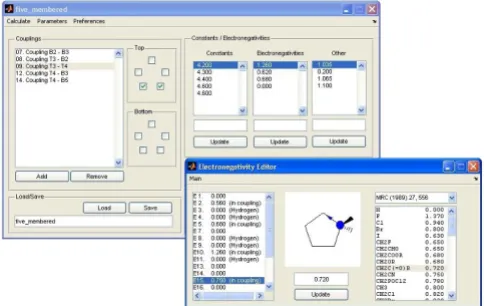
The program consists of a computational core that is accessed and controlled through a GUI (Figure 1), both written in Matlab. Its goal is to search pseudorotation parameters {P, max} for at most two conformations as well as their relative population (%1, n) at n temperatures that fit a series of experimental NMR scalar coupling con-stants. The initial pseudorotation parameters are set by the user at the start of the computational procedure. The user is also given the choice to define a subset of pseudor-otation parameters that have to be optimized. Using equa-tions 1, 4 and 6, the scalar coupling constants relating to conformation defined by the initial pseudorotation val-ues are calculated and a root-mean-square-deviation (RMSD) is determined with respect to the experimental coupling data. Next, the pseudorotation parameters are adapted so as to minimize this RMSD. The Matlab fmincon
function from the Optimization Toolbox, which is based on a Sequential Quadratic Programming (SQP) algorithm [27], was used for this purpose. To restrict the optimiza-tion to physically sensible soluoptimiza-tions, values of partioptimiza-tion coefficients were restrained to the [0, 1] interval. Further-more, puckering amplitudes (max) were restricted to the physically relevant [0, /3] interval.
A choice is provided between two operational modes. In the first mode, an optimization of the chosen parameters is performed as is, yielding the pseudorotation parameters that best fit the experimental data. The output generated in this operation mode is purely text-based and contains the optimized variables, their corresponding endocyclic torsion angles and a tabular comparison between experi-mental and fitted scalar coupling data (See accompanying manual). In the second mode of the program, the com-plete pseudorotation space of the cycle of interest is explored via 3600 combinations of pseudorotation parameters {P, max} as described hereafter. The pseudor-otation space of the cycle is covered by sampling 120 val-ues of P in the [0, 2] interval and 30 values of max in the [0, /3] interval. For each {P, max} thus sampled, the minimized RMSD between the experimental and calcu-lated scalar couplings is determined. As for the output, a pseudoratation wheel is plotted and the RMSD is repre-sented through 20 contour lines in the [min, 2min + 0.1]
interval where min is the lowest RMSD obtained over the 3600 fittings.
Whether the parameters of a second conformation and the relative populations at each temperature are opti-mized during each of the 3600 runs is again determined by the user's choice. This results in two possible outputs for this operating mode. For the case where the user chooses not to optimize any parameters of the second
conformation, one can easily assess from the pseudorata-tional wheel if the experimental data can be fitted by a sin-gle five-membered ring conformation. For the case where the second conformation's parameters (and the relative population of both conformations) are also to be opti-mized, the pseudorotation wheel represents the confor-mational space accessible to the cycle when two five-membered ring conformations are fit to the experimental data. In this latter case, one additional pseudorotation wheel is created for each temperature depicting the rela-tive population of the two fitted conformations for each set of {P, max} using contour levels.
This second mode of calculation has some interesting advantages over the first mode. First, a better appreciation of the conformational space of the cycle that is in agree-ment with the experiagree-mental data is obtained. Further-more, the extent of the contour levels in the pseudorotation plot allow to establish whether the model is under-determined or not. Even when under-deter-mined, such calculation can already indicate those confor-mations that can be excluded from further investigation.
Results
Program features
Only the main features of the program, fully described in the manual available together with the program, are dis-cussed. The GUI is easy to use and handles the input as well as the various operational modes and data output (Figure 1). Two modes of calculation for fitting five-mem-bered ring conformations to 3J
HH scalar coupling data
Layout of the Matlab GUI
Figure 1
Layout of the Matlab GUI. In the main window of the GUI (upper panel), both the coupling data and additional parame-ters required by equations 1 and 6 can be interactively defined, using a simplified representation of the cycle. Both the atom types in the cycle and the substituents can be defined interactively. The 'electronegativity editor' (bottom panel) provides a convenient graphical aid to set up the group-electronegativities (i) for many common substituents
obtained at up to five temperatures can be selected. Both the coupling data and additional parameters required by equations 1 and 6 are defined interactively, using a simpli-fied representation of the cycle (Figure 1, upper panel). Both the atom types in the cycle and the substituents can be defined interactively. The GUI includes an 'electroneg-ativity editor' (Figure 1, bottom panel) which provides a convenient graphical aid to set up the group-electronega-tivities (i) for many common substituents as required by equation 4.
Also, the program is tolerant for sparse input data. When only a sum of two or more 3J
HH scalar couplings can be
measured, e.g. due to overlap, this sum can be included in the model instead of the individual couplings. Contrary to the PSEUROT program, a coupling does not necessarily have to be measured at each temperature to be included in the calculation.
Four different parameterizations of equation 4 are imple-mented in the program. These include the 20-parameter and 12-parameter parameterization by Donders [14] and two slightly different 9-parameter parameterizations [28,29] one of which is used in PSEUROT 6.2. The use of Diez-parameters into the calculations is fully imple-mented by using equation 6 for the calculation of exocy-clic torsion angles out of the puckering parameters. The current version does not include the use of the Barfield-correction [30,31] used in some studies.
Depending on the calculation mode selected, textual or graphical output is provided. As the program is written in Matlab, the latter plots can be easily post-processed to comply with the user's needs. In addition, several param-eters involving the construction of the plots can be set manually. These parameters include the resolution of the search grid used for the pseudorotation scan (i.e. the increment in P and max) and the minimal and maximal contour levels used in the plots. Furthermore, interpola-tion of these contour plots using cubic spline funcinterpola-tions can be selected for obtaining smoothed graphs.
Standard data sets for -D-ribose and -D-deoxyribose as well as input data of 1 and 2 are available with the distri-bution of the software.
Comparison to PSEUROT
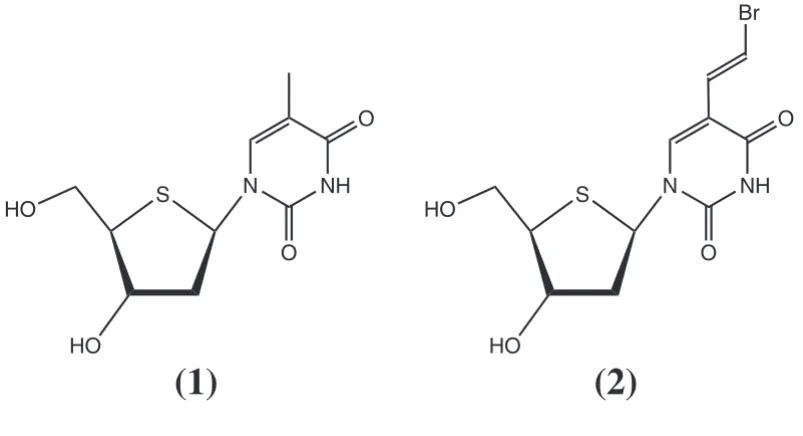
To test the performance of the computational core and the input/output handling using the GUI and compare the results with respect to PSEUROT (version 6.2), a set of two 4'-thio-2'-deoxynucleoside analogs [32] was used. For both molecules, depicted in Figure 2, literature [32] pro-vides a full set of five coupling constants measured at five different temperatures as well as Diez-parameters for each endocyclic bond. For both compounds, two conforma-tions were fit to the experimental data using our Matlab GUI and PSEUROT 6.2. The most recent parameterization of equation 4 was used. Details of these optimal fittings, as well as a third fit, taken from literature [32] and referred to as LHK, using the Haasnoot equation 3 [12] are pre-sented in Table 1. This table includes the optimized
pseu-Covalent structure of compounds 1 and 2 Figure 2
Covalent structure of compounds 1 and 2. S HO
HO
N NH
O
O
(1)
S HO
HO
N NH
O
O
(2)
dorotation parameters for the North and South conformations (PN, N, PS, S) in degrees and the popula-tion of the North-conformer at each temperature for which couplings were provided. Finally, the maximal deviation and RMSD between the fitted couplings and the experimental ones is indicated.
Quasi identical results are obtained when comparing the Matlab GUI (ML) to PSEUROT (PS). Differences between
the two programs are most likely introduced by the differ-ence in optimization method and convergdiffer-ence criteria. Looking at the residual deviations with respect to the experimental data, the Matlab GUI finds a slightly better fit. When comparing to the literature data (LHK), one can appreciate the influence of different Karplus equations on the fitting. Differences of 10 and 3 degrees are found for
PN and N respectively. Also slight differences in popula-tions are observed.
In order to get a better appreciation of the precision of these optimal values, the full pseudorotation wheel of 1
and 2 has been scanned by the Matlab program resulting in Figures 3 and 4. In Figure 3, contour plots indicate the root-mean-square-deviation between the fitted and the experimental scalar coupling couplings for 1 (left) and 2
(right). Looking at the extent of the contour lines, it is clear that the South-conformation is better defined than the North-conformation. Taking into account errors orig-inating from measuring scalar couplings, deficiencies of the model and the Karplus equation, the optimal fit does not necessarily correspond to the real situation. Therefore, interpreting the regions that have a RMSD lower than a certain threshold (e.g. 0.2 Hz), as representative of the cycle's conformation seems more reasonable than taking the optimal fit for granted, especially when comparing different compounds. In addition to Figure 3, Figure 4 can Table 1: Optimal puckering coordinates, partition coefficients
and residual errors found for compounds 1 and 2 using this Matlab GUI (ML), PSEUROT (PS) and literature data (LHK) [32].
1 2
ML PS LHK ML PS LHK
PN 3.9 3.6 13 1.8 0.1 9
N 41.7 42.6 45 42.3 44.0 45
PS 184.3 182.5 177 184.2 182.5 177
S 41.9 41.0 43 42.4 40.9 44
%N285K 29 29 25 36 36 33
%N300K 31 31 - 37 37
-%N313K 32 32 - 38 38
-%N333K 35 35 - 39 39
-%N353K 37 37 33 40 40 37 Jmax 0.14 0.18 0.21 0.18 0.21 0.29 Jrms 0.055 0.060 0.14 0.075 0.083 0.12
Numbers are indicated in degrees, percentages and Hz.
Pseudorotation wheel for compounds 1 and 2 Figure 3
be used to interpret the allowed population-range for each conformation. These graphs represent the population of both conformations of 1 at 285K (left) and 353K (right). The thick black contour is the highest contour level of Fig-ure 3. Within this black contour, a variety of populations can be found, ranging from 27 to 40 percent of the North-conformation at 285K and from 35 to 49 percent at 353K. Again, this gives a more realistic view of the conforma-tional behavior of compound 1.
Conclusion
A matlab program with easy to use graphical user interface for the calculation of five-membered ring conformations has been presented. This program has been made freely available online under a GNU GPL license. The perform-ance of the program was tested on a set of two 4'-thio-2'-deoxynucleoside analogs. It has been shown that identical results can be obtained as in PSEUROT. Furthermore, high-quality graphical output can be generated, facilitat-ing the interpretation of the calculations.
Availability and requirements
Project name: Matlab Pseudorotation GUIProject home page: http://sourceforge.net/projects/mat labpseudorot
Operating system(s): Platform independent (tested in WinXP)
Programming language: Matlab (tested in release R2007a)
Other requirements: Matlab Optimization Toolbox
License: GNU GPL
Authors' contributions
PMSH is the main author of this manuscript. His contri-butions to this article include the programming of the Matlab program and GUI, performing extensive tests to ensure its stability and functionality. Furthermore, the comparison of the obtained results between the GUI, PSEUROT and literature data were contributions from this author. JCM has provided intellectual, technical and financial support for the development of the Matlab GUI. Also, he contributed in testing phase of the GUI.
Acknowledgements
The IWT Flanders is thanked for a PhD SBO-grant to P.M.S.H.. J.C.M. thanks the FWO for financial support and several NMR equipment grants (G.0036.00N, G.0365.03). P.M.S.H. acknowledges Duane Hanselman for the 'Fully Customizable Polar Plot' (mmpolar) Matlab script used in the GUI. This article is dedicated to Prof. P. De Clercq at the occasion of his 60th birthday.
References
1. Cobb AJA: Recent Highlights In Modified Oligonucleotide Chemistry. Org Biomol Chem 2007, 5:3260-3275.
2. Leumann CJ: DNA Analogs: From Supramolecular Principles To Biological Properties. Bioorg Med Chem 2002, 10:841-854. Pseudorotation wheel of partition coefficients of compound 1 for the two extreme temperatures (285K and 353K)
Figure 4
Open access provides opportunities to our colleagues in other parts of the globe, by allowing
anyone to view the content free of charge.
Publish with
Chemistry
Central and every
scientist can read your work free of charge
W. Jeffery Hurst, The Hershey Company.
available free of charge to the entire scientific community peer reviewed and published immediately upon acceptance cited in PubMed and archived on PubMed Central yours you keep the copyright
Submit your manuscript here:
http://www.chemistrycentral.com/manuscript/ 3. Geysen HM, Schoenen F, Wagner D, Wagner R: Combinatorial
Compound Libraries For Drug Discovery: An Ongoing Chal-lenge. Nat Rev Drug Discov 2003, 2(3):222-230.
4. Saotome C, Wong CH, Kanie O: Combinatorial Library Of Five-Membered Iminocyclitol And The Inhibitory Activities Against Glyco-Enzymes. Chem Biol 2001, 8(11):1061-1070. 5. Steger M, Hubschwerlen C, Schmid G: Solid- And Solution-Phase
Synthesis Of Highly-Substituted-Pyrrolidine Libraries. Bioorg Med Chem Lett 2001, 11(18):2537-2540.
6. Boldi AM, Dener JM, Hopkins TP: Solid-Phase Library Synthesis Of Alkoxyprolines. J Comb Chem 2001, 3(4):367-373.
7. Jackson RW, Tabone JC, Howbert JJ: Identification Of TNF- Inhibitors From A Split-Pool Library Based On A Tyrosine-Proline Peptidomimetic Scaffold. Bioorg Med Chem Lett 2003, 13(2):205-208.
8. Ohtake N, Imamura H, Jona H, Kiyonaga H, Shimizu A, Moriya M, Sato H, Nakano M, Ushijima R, Nakagawa S: Novel Dithiocarbamate Carbapenems With Anti-MRSA Activity. Bioorg Med Chem 1998, 6(7):1089-1101.
9. Bray AM, Chiefari DS, Valerio RM, Maeji NJ: Rapid Optimization Of Organic Reactions On Solid Phase Using The Multipin Approach: Synthesis Of 4-Aminoproline Analogues By Reductive Amination. Tetrahedron Lett 1995, 36:5081-5084. 10. Curran TP, Chandler NM, Kennedy RJ, Keaney MT: N-
-benzoyl-cis-4-amino-L-proline: -turn Mimetic. Tetrahedron Lett 1996, 37:1933-1936.
11. Klein SI, Dener JM, Molino BF, Gardner CJ, D'Alisa R, Dunwiddie CT, Kasiewski C, Leadley RJ: O-Benzyl Hydroxyproline As A Bioi-sostere For Phe-Pro: Novel Dipeptide Thrombin Inhibitors. Bioorg Med Chem Lett 1996, 6:2225-2230.
12. Haasnoot CAG, Deleeuw FAAM, Deleeuw HPM, Altona C: The Relationship Between Proton-Proton NMR Coupling Con-stants And Substituent Electronegativities .2. Conforma-tional-Analysis Of The Sugar Ring In Nucleosides And Nucleotides In Solution Using A Generalized Karplus Equa-tion. Org Magn Reson 1981, 15:43-52.
13. Diez E, San-Fabian J, Guilleme J: Vicinal Proton-Proton Coupling Constants I. Formulation Of An Equation Including Interac-tions Between Substituents. Molecular Physics 1989, 68:49-63. 14. Donders LA, Deleeuw FAAM, Altona C: The Relationship
Between Proton-Proton NMR Coupling Constants And Sub-stituent Electronegativities .4. An Extended Karplus Equa-tion Accounting For InteracEqua-tions Between Substituents And Its Application To Coupling-Constant Data Calculated By The Extended Huckel-Method. Magn Reson Chem 1989, 27(6):556-563.
15. Altona C, Ippel JH, Hoekzema AJAWs, Erkelens C, Groesbeek M, Donders LA: The Relationship Between Proton-Proton NMR Coupling Constants And Substituent Electronegativities .5. Empirical Substituent Constants Deduced From Ethanes And Propanes. Magn Reson Chem 1989, 27(6):564-576.
16. Altona C, Francke R, Dehaan R, Ippel JH, Daalmans GJ, Hoekzema AJAW, van Wijk J: Empirical Group Electronegativities For Vicinal NMR Proton-Proton Couplings Along A C-C Bond: Solvent Effects And Reparameterization Of The Haasnoot Equation. Magn Reson Chem 1994, 32(11):670-678.
17. San Fabian J, Guilleme J: Vicinal Fluorine-Proton Coupling Con-stants. Ab Initio Calculations Of Angular Dependence And Substituent Effects. Chem Phys 1996, 206(3):325-337.
18. San Fabian J, Guilleme J, Diez E: Vicinal Fluorine-Proton Coupling Constants II. Individual Substituent Effects. J Magn Reson 1998, 133(2):255-265.
19. Thibaudeau C, Plavec J, Chattopadhyaya J: A New Generalized Karplus-Type Equation Relating Vicinal Proton-Fluorine Coupling Constants to H-C-C-F Torsion Angles. J Org Chem 1998, 63:4967-4984.
20. Altona C, Sundaralingam M: Conformational Analysis Of The Sugar Ring In Nucleosides And Nucleotides. A New Descrip-tion Using The Concept Of PseudorotaDescrip-tion. J Am Chem Soc 1972, 94:8205.
21. Altona C, Sundaralingam M: Conformational Analysis Of The Sugar Ring In Nucleosides And Nucleotides. An Improved Method For The Interpretation Of Protonproton Magnetic Resonance Coupling Constants. J Am Chem Soc 1973, 95:2233.
22. Diez E, Esteban A, Guilleme J, Bermejo F: Relationships Between Torsional Angles And Ring Puckering Coordinates. J Mol Struct 1981, 70:61.
23. Diez E, Esteban A, Bermejo F, Altona C, de Leeuw F: Relationships Between Torsional Angles And Ring Puckering Coordinates. Part II. J Mol Struct 1984, 125:49.
24. de Leeuw F, van Kampen P, Altona C, Diez E, Esteban A: Relation-ships Between Torsional Angles And Ring Puckering Coordi-nates. Part III. Application To Heterocyclic Puckered Fivemembered Rings. J Mol Struct 1984, 125:67.
25. de Leeuw F, Altona C: Computer Assisted Pseudorotation Analysis Of 5-Membered Rings By Means Of 3JHH Coupling Constants. Program PSEUROT. J Comput Chem 1983, 4:428. 26. Padrta P, Sklenar V: Program MULDER – A Tool For Extracting
Torsion Angles From NMR Data. J Biomol NMR 2002, 24(4):339-349.
27. Hock W, Schittkowski K: A Comparative Performance Evalua-tion Of 27 Nonlinear Programming Codes. Computing 1983, 30:335.
28. Donders LA: PhD thesis Universiteit Leiden; 1989.
29. van Wijk J, Huckriede BD, Ippel JH, Altona C: Furanose Sugar Conformations In DNA From NMR Coupling-Constants. Methods Enzymol 1992, 211:286-306.
30. Marshall J, Walter S, Barfield M, Marchand A, Segre A: Reasons For The Inequivalence Of The Exo-Exo And Endo-Endo Vicinal NMR Coupling Constants In Norbornanes. Tetrahedron 1976, 32:537.
31. de Leeuw F, van Beuzekom A, Altona C: Through Space Effects On Vicinal Proton Spin Spin Coupling Constants Mediated Via Hetero Atoms. J Comput Chem 1983, 4:438.
![Table 1: Optimal puckering coordinates, partition coefficients and residual errors found for compounds 1 and 2 using this Matlab GUI (ML), PSEUROT (PS) and literature data (LHK) [32].](https://thumb-us.123doks.com/thumbv2/123dok_us/391247.2036439/5.612.70.543.448.652/puckering-coordinates-partition-coefficients-residual-compounds-pseurot-literature.webp)

