ISSN 2324-805X E-ISSN 2324-8068 Published by Redfame Publishing URL: http://jets.redfame.com
The Relationship Between Performance Management Practices and
Organizational Deviations in Schools
Esef Hakan Toytok1, Merve Yavuz2 1
Siirt University, Faculty of Education, Education Sciences Department, Turkey 2
Siirt University, Institute of Social Sciences Education Management US Graduate Student, Turkey
Correspondence: Esef Hakan Toytok, Siirt University, Faculty of Education, Education Sciences Department, Turkey.
Received: October 2, 2018 Accepted: November 1, 2018 Online Published: November 29, 2018 doi:10.11114/jets.v6i11a.3807 URL: https://doi.org/10.11114/jets.v6i11a.3807
Abstract
The purpose of this research is to describe how and in which way teachers' behaviors are affected in the organisational context with performance management practices. The sample of the research consists of 350 administrators and teachers working in the schools located in the city of Siirt in 2017-2018 academic year. The study is an example of the descriptive relational screening model. The data of the research were obtained by using "Teacher / Manager Performance Management Rating Scale and "Organizational Deviation Scale" in Public and Private Primary Education Schools" . The obtained data were converted into data sets with statistical program and appropriate analysis procedures were applied and interpreted after being tabulated. According to the results obtained from the research, it was found that there is a significant difference in the overall dimension and organizational dimension of the performance management practices, and in the overall dimension of the performance management practices according to the independent variable of school type. It can also be stated that there is a negative and moderately significant relationship between the performance management practices and the organizational deviation in the schools and that as the performances of the administrators and teachers in the schools increase, the level of organizational deviation behavior may decrease. Keywords: organization, performance, management, deviation
1. Introduction
All organizations want to survive, grow, and be strong like a living organism. In order to ensure this, they frequently check and revise their organizational goals and use their resources effectively. The most important of these sources in the hands of organizations is the qualified human labor. In order for this resource to be used effectively, the performance and motivation of the transactors must be high. Because the higher the performance and motivation of the transactors, the easier it is for the organization to reach its goals. For this reason, organizations often monitor and manage the performances of the transactors. In order for the performance management to be done effectively, it is necessary for transactors to avoid the behavior of organizational deviation. For this reason, concepts of performance management and organizational deviation are also very important in terms of education. Performance management is an intermediary in providing quality communication environment among transactors in educational organizations (Helvacı, 2002). Transactors contribute to the culture of their organisation with their knowledge and skills. This resulting culture can lead to the behavior of deviation in the organisation, and can lead to the interruption in achieving the organizational goals. For this reason, for the organisation to achieve its goals, the transactors should have the necessary competences. Performance management in educational organizations is a process that is constantly changing and affected by the behavior of the transactors (Bae, 2006). This process consists of three stages as planning, evaluation and development of the teachers' performance (Torrington and Hall, 1995, citation: Boyaci, 2006). As a process, performance management can improve as long as it is at the center of the education system. For this reason, performance management practices should be actively included at all stages of the education and built on sustainable policies in order for the organisation to achieve its goals (Anvari, Soltani and Rafiee, 2016).
improve the potential of the performance of teachers, and to develop and manage performance in line with the overall objectives of the organisations (Lidl, 2010, citation: Çorbacı, 2010) If we look from this perspective, in order to increase the performance of educational organizations, school directors should determine their expectations from teachers clearly and precisely, plan the educational process together with teachers, to provide feedback to teachers in a timely manner, and to ensure that intra-organizational relationships are healthy and effective (Helvacı, 2002). When the relevant literature is examined, it is seen that one of the most effective ways to improve teacher performance is to give feedback to teachers in time (Bae, 2006, Demir and Tütüncü, 2014).
It can be said that the adaptation of our educational organizations to changing and developing world is based on the performance management. A well-planned performance management process will play an integrative role at the point of reviewing the performance of teachers, providing feedback and setting goals (Armstrong, 1996). When all these are examined, it is seen that the performance management is a process in which school administrators and teachers come together to plan and evaluate the academic year and in addition, the communication forms a large part of the performance management (Cansever, 2000). Communication between teachers is characterized by undesirable behaviors such as expected positive behaviors or deviation behaviors. In this case, it is necessary that the deviation behaviors observed in intra-organizational communication should be managed by keeping them in a controllable level.Organizational deviation behavior is defined as negative behaviors that decrease the performance of the members of the organization. According to Robinson and Bennett (1995), organizational deviation behavior is any kind of intentional act that threatens the productivity and continuation of the organisation that violates the organisational norms and members of the organization. Deviation behaviors develop based on the attitudes and behaviors of the transactors in the face of events (Chib, 2018). The conflicts between the individuals living in all the organizations and the negative events oriented towards the organisation can also be encountered in the educational organizations. Such unfavorable situations can disrupt the integrity of the organization and reduce the quality of education. In this context, it is thought that it is important to study the deviation behavior intentionally carried out in educational organizations and considered to affect organizational performance (Türkkaş and Duman, 2016). We can say that the individuals who get a qualified education at school has a great influence in shaping the society. The training of individuals who change society and move the society one step further may be associated with an increase in the quality of education. When it comes to the quality of education, it is more important to control deviation behavior in educational organizations where individuals from different cultures coexist (Fagbohungbe, Akinbode and Ayodeji, 2012).
It can be said that the deviation behaviors, which are more noticeable within the organization today than the past, lead to conversions on the general structure and working conditions of the organisation. Examples of organizational deviation behaviors include the following: employees fail to comply with the rules to harm the organisation and act towards decelerating the work being done. (Hollinger and Clark, 1982). Griffen and Lopez (2005) expressed organizational deviation behaviors as anti-social behavior, moral corruption of workers, bad behavior, aggressiveness at work (Griffin and Lopez, 2005). According to Marcus and Schuler (2004), organizational deviation behaviors can be internal or external. However, organizational deviation behaviors, whether internal or external, should be considered as a whole. It is usually necessary to determine what organizational deviation behaviors are, which are usually expressed by negative concepts. Organizations should then identify the factors that cause these behaviors and take the necessary precautions to avoid these behaviors. All of these are vital to the organization's existence. Organizational deviation behaviors in schools have an impact on school order and are directed towards teachers themselves or colleagues. These negative experiences are negatively affecting the attitudes of the teachers which necessitate coexistence of teamwork. For this reason, the factors affecting organizational deviation behaviors need to be evaluated under two separate headings as individual and organizational (Marcus and Schuler, 2004). According to Demir and Tütüncü (2014), who emphasized that deviation behaviors are mostly seen between administrators and transactors or among transactors themselves, organizational factors are more effective than individual factors in the emergence of deviation behaviors. Organizational deviation and performance management can be considered as practices that directly or indirectly affect the insurance of a specific working order within the school.
The following questions were answered in the research. According to the opinions of the directors and the teachers; 1. What are the performance management practices and level of organizational deviation in schools?
2. Do the performance management practices and organizational deviation perceptions differ significantly according to the independent variables of gender, branch, seniority, task, age, union and school type?
3. What kind of a relationship exists between performance management practices and organizational deviation in schools?
2. Method Research Method
In this research, descriptive relational scanning model is used as a quantitative research method. Researches in the screening models is a research approach that depicts a situation in past or at present time as it is (Karasar, 2007). Universe and Sampling
The population of the research consists a total of 2045 teachers working in public schools in Siirt city center. The sample of the research constitutes the views of 341 teachers'. According to Can (2017), even if there is no homogeneous distribution in an environment of 2,500 people, it has been emphasized that a view by 333 people has the necessary power of reflection.
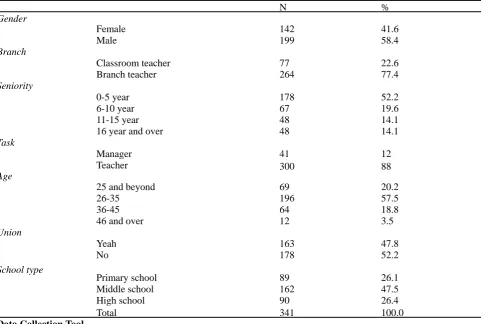
In the study, 470 rating scales were distributed and 360 rating scales were returned. As 19 of them were not filled in accordance with the instructions, they were excluded from the research and only 341 opinions were included in the research. Data regarding the sample group included in the application is presented in Table 1.
Table 1. Information Regarding the Sample Group of the Study
N %
Gender
Female 142 41.6
Male 199 58.4
Branch
Classroom teacher 77 22.6
Branch teacher 264 77.4
Seniority
0-5 year 178 52.2
6-10 year 67 19.6
11-15 year 48 14.1
16 year and over 48 14.1
Task
Age
Manager 41 12
Teacher 300 88
25 and beyond 69 20.2
26-35 196 57.5
Union
36-45 64 18.8
46 and over 12 3.5
Yeah 163 47.8
No 178 52.2
School type
Primary school 89 26.1
Middle school 162 47.5
High school 90 26.4
Total 341 100.0
Data Collection Tool
Table 2.The calculated reliability analysis values for rating scales
Number of Articles Cronbach Alpha Value(α)
Organizational deviation general 20 .853
Individual dimension 3 .787
Organizational dimension 9 .751
Ethical dimension 8 .834
Performance management in general 47 .971
Data Collection and Analysis
Percentage (%), arithmetic mean (X), frequency (f) and standard deviation values of the data obtained in the study were examined. Significance was sought according to the value P <0.05. The confidence interval is the tolerance interval against the possibility of rejecting the hypothesis and is counterproductive to the probability of making a type I error in the study. This value is determined by the value of alpha (α) (1 - <= Confidence Interval). The confidence interval P <0,05 in the study represents the range of values, in which the average value is to be found with 95% probability within the population (Altunışık, Coşkun, Yıldırım and Bayraktaroğlu, 2002). The homogeneity of variance test values were examined in determining the distributions of gender, professional seniority, occupation, branch, age, union and school type independent variables. T-test and ANNOVA were used for homogeneous distributions and Mann-Whitney U and Kruskal Wallis analysis procedure were applied for non-homogeneous distributions. Correlation (r) analysis was performed for relationship between performance management and organizational deviation and sub-dimensions.
3. Findings
Findings obtained as a result of the research are and titled and tabulated according to the purposes of the research and explained in this section.
1. According to the opinions of the adminstrators and the teachers, the performance management practices and the level of organizational deviation in the schools
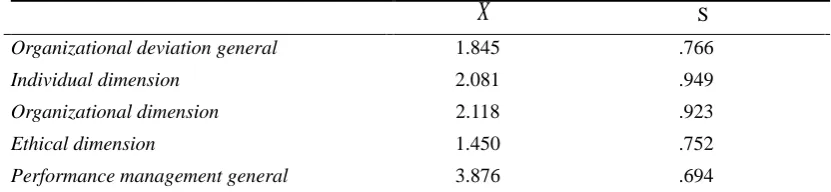
Findings related to performance management practices and level of organizational deviation according to the findings obtained in the research are presented in Table 3.
Table 3. Overall performance management and overall organizational deviation and arithmetic means of the sub dimensions and standard deviation values
X
SOrganizational deviation general 1.845 .766
Individual dimension 2.081 .949
Organizational dimension 2.118 .923
Ethical dimension 1.450 .752
Performance management general 3.876 .694
According to the findings in Table 3, we can say that the perception levels of the teachers of the performance management practices applied in the schools is high and the perception levels of organizational deviation is low. We can say that the teachers' level of perception of organizational deviation ( = 1,845) corresponds to the perception of 'I do not agree' and therefore it is evaluated as low. According to the descriptive statistical results made to determine the organizational deviation behavior levels of the teachers; we can say that organizational deviation behavior levels are not sufficient in all sub-dimensions and in total.
2. Examination of performance management practices and organizational deviation perceptions according to independent variables of gender, branch, seniority, duty, age, union and school type according to manager and teacher opinions
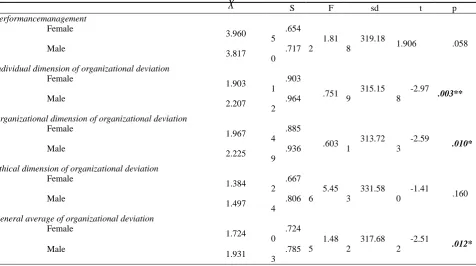
Table 4. Arithmetic mean and t-test scores for performance management dimension and organizational deviation sub-dimensions according togender independent variable
X
S F sd t pPerformancemanagement
Female
3.960 .654
5 1.81
2
319.18
8 1.906 .058
Male
3.817 .717
0 Individual dimension of organizational deviation
Female
1.903 .903
1
.751 315.15 9
-2.97
8 .003** Male
2.207 .964
2 Organizational dimension of organizational deviation
Female
1.967 .885
4
.603 313.72 1
-2.59
3 .010* Male
2.225 .936
9 Ethical dimension of organizational deviation
Female
1.384 .667
2 5.45
6
331.58 3
-1.41
0 .160
Male
1.497 .806
4 General average of organizational deviation
Female
1.724 .724
0 1.48
5
317.68 2
-2.51
2 .012* Male
1.931 .785
3 N(female)=142 N(male)=199 p<.050* p<10** p<000***
When the data in Table 4 were examined, it was found that there was a meaningful difference between the overall dimension of the organizational deviation and the organizational and individual sub-dimensions among the teachers included in the research according to the gender variable. It is seen that male teachers are more likely to deviate from their organizational sub-dimensions than female teachers. This situation can be explained with the role of the personality traits of the male and female teachers in their working environment in the school and private life. It can be said that women have less organizational deviation behaviors than males because they behave more sensitively when approaching the negative situations they encounter.
Table 5.Arithmetic mean and ANOVA test results related to the organizational deviation dimensions according to school type independent variable.
X S F sd p Explanation
Individual dimension of organizational deviation
primary school 1.977 1.00353
2.093 2
.125 middle school 2.191 .98561 338
high school 1.985 .80713 340
Organizational dimension of organizational deviation
primary school 1.938 1.00112
4.531 2
.011* between primary and
middle school middle school 2.271 .91415 338
high school 2.018 .81824 340
Ethical dimension of organizational deviation
primary school 1.373 .68010
1.942
2.189 .145 middle school 1.534 .86907 190.430 high school 1.375 .56215 192.618
N(Primary school)=89 NMiddle school)=162 NHigh school)=90 p<.050* p<.010** p<.000***
When the data in Table 5 were examined, it was seen that there was a significant difference in organizational sub-dimension(p = .011, p <0.05). Post Hoc made to determine the source of this meaningful difference. Statistically significant differences as the results of Bonferroni statistics were found between the views of primary and secondary school administrators and teachers. Since the teachers who work in the secondary schools are in the process of separated into branches, the problems experienced in sharing the course can lead to organizational deviation behaviors.
Table 6. Arithmetic Mean and Kruskal Wallis Test Scores on Performance Management by School Type Independent Variable.
Rank average sd X2 p
Performance management
primaryschool 171.14
2 6.062 .048*
middle school 159.56
high school 191.46
N(Primary school)=89 N(Middle school)=162 N(High school)=90 p<.050* p<.010** p<.000***
When the findings in Table 6 were examined, it was seen that there was a meaningful difference (performancegenX2 = 6.062, p <.050) in the Kruskal-Wallis test according to the school typeindependent variable. The results of Mann-Whitney U Test for finding the source of the significant difference are presented in Table 7.
Table 7. Mann-Whitney U Test Scores on Performance Management by School Type Independent Variable
Rankaverage Rank
sum Z U p
Performance management
middle school 118.34 19.171
-2.385 5.968 .017*
high school 141.19 12.707
N(Primary school)=89 N(Middle school)=162 N(High school)=90p<.050* p<.010** p<.000***
According to the findings in Table 7, a significant difference in performance management was found between the elementary and high school types (p = .017, p <.050)independent variable. Since high schools are institutions that prepare the student for higher education, it can be said that the average of high schools is higher than that of primary schools as the branch teachers have different performance monitoring policies.
According to the branch, seniority, duty, age and trade union variables, it is seen that there is no meaningful difference.
3. The relationship between performance management practices and organizational deviationin schools according to manager's and teacher's views
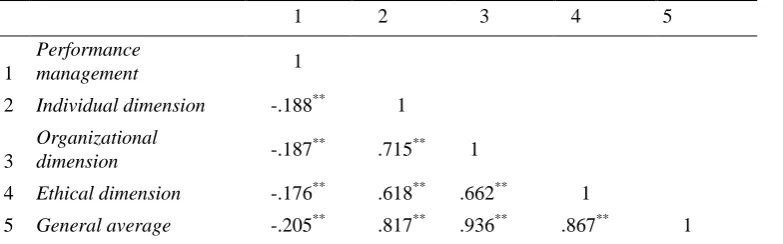
Findings related to the relationship between performance management practices and organizational deviation are presented in Table 8.
Table 8. Table of Correlation Analysis to Determine the Relationship Between Performance Management Applications Applied in Schools and Organizational Deviations
1 2 3 4 5
1
Performance
management 1
2 Individual dimension -.188** 1
3
Organizational
dimension -.187
**
.715** 1
4 Ethical dimension -.176** .618** .662** 1
5 General average -.205** .817** .936** .867** 1
When the findings in Table 8 are examined, it is seen that there is a statistically significant relationship (r=-.205; p<.010) between the performance management practices applied in the schools and the organizational deviation at the level of p<.010. Accordingly, it can be said that as the level of performance management practices applied in schools increases, the organizational deviation behaviors seen within the organization will increase.
4. Results, Conclusions and Recommendations
4.1 Discussion
different terms are often described as behaviors that harm the goal of the organization (Judge, Scott and Ilies, 2006). These behaviors are now regarded as a negative situation in many commercial sectors such as different hospitality, retail and healthcare (Bolin and Heatherly, 2001). For example, the effect of organizational justice perceptions of the employees on organizational deviation behaviors was examined in a study conducted in the textile industry by Yalap (2016) . In the study, it was determined that there was a inverse and significant relationship between the perceptions of organizational justice and the level of organizational deviation behaviors. It has been found that increase in the level of employees on the perception of organizational justice reduce the organizational deviation behavior. As a result of the findings of research done by İyigün (2011) in the pharmaceutical sector, psychological contracts and sub-dimensions were found to be positively and meaningfully related to organizational deviation for colleagues as well as organizational deviation for employees themselves. Apart from these, there are also studies showing that personal and organizational factors have an influence on deviation behaviors. For example; Demir (2011), Argon and Ekinci (2016) and Fox, Spector and Miles (2001) reported that organizational factors affected their deviation behaviors in their work. Dunlop and Lee (2004) investigated the relationship between organizational deviant behavior, organizational citizenship behavior, and work performance in a study they conducted. They have reached the conclusion that the increase in job performance reduces the organizational deviation behavior. In this sense, the results of the research that is made with organizational deviation and with different independent variables were found to be in parallel with the results obtained in the research. According to the gender independent variable in the research, it is seen that there is a meaningful difference in organizational deviation and according to school type independent variable both in organizational deviation and performance management. In the study of İyigün (2011), organizational deviation behaviors were found to be significantly different according to sex and school type, whereas no significant difference was found in the study of Köse (2013). Hystad, Mearns and Eid (2014) tried to explain the effect of moral insignificance on the perceptions of organizational injustice and organizational deviation behavior in a Norwegian survey made with 340 crew members. The findings of the research revealed that organizational justice is positively related to organizational deviation behavior. Moreover, it was seen that one's feelings of self-worthlessness in the moral direction increased the perceptions of organizational injustice in the person, and these two variables predicted the organizational deviation behaviors. The results of our research overlap with the results of this research in terms of the finding that there is a relationship between performance management practices and organizational deviation behaviors. In another study on organizational deviation, it was researched by Yeşiltaş, Çeken and Sormaz (2012) whether ethical leadership and organizational justice have an effect on organizational deviation behavior. As a result of the analyses conducted by the researchers, it is seen that there is no positive relationship between the types of ethical leadership and types of organizational justice, while there were hypotheses supporting the negative relationship between organizational justice types and deviation behavior.
4.2 Conclusion
quality of education can be said to have led school administrators to assess and continually improve the performance of teachers. Educational managers should inform the teachers about the goals they want to reach, the work to be done, and provide teachers with opportunities to present their performance. In the next step, the school managers should observe, evaluate and give feedback to the teachers during the educational period. In this way, teachers can work more efficiently in a regular, explicit, comprehensible, motivating performance management process. Thus, other figures in the education system (students, parents ...) may experience positive changes.
An increase in the level of performance in a school can be said to depend on the school administrator being clear, understandable, noticing the ideas of the people involved in the performance system, bearing the abilities of people in mind, giving the feedback on time and right place, and knowing and applying the factors which can motivate the employees. When we look at literature, we can see that all these factors play a role in improving teacher's performance. In schools, which are the most important pillars of educational organizations, performance management practices show themselves as an ongoing process. In this process, teachers exhibit undesirable behaviors such as deviation behaviors or expected positive behaviors. It is observed that deviation behaviors in education organizations cause high amounts of material and moral damages.
The negative relationship between performance management and organizational deviation behavior in the research indicates that the quality of performance management practices will reduce the deviation behavior within the organization. According to the obtained research results, improvement of the performance management practices in the schools can lead to a certain reduction in the deviation behavior. According to the results obtained in the research, it is seen that performance management practices in an educational organization may affect the deviation behaviors seen in the organization.
5. Recommendations
According to the results of the research, a clear and understandable performance evaluation process should be carried out while teacher performance is being assessed by the school administrators in order to decrease the deviation behaviors within the organization.
Effective performance management practices make it easier for teachers to achieve their educational goals by contributing to an efficient working environment for teachers. If these information are taken into consideration, it would be useful for researchers to give more importance to studies related to this subject in elementary schools, junior high schools and high schools.
Deviation behavior is one of the obstacles to the realization of organizational goals. For this reason, it is important for the school teachers to reduce the deviation behavior. The number of studies about organizational deviation in the literature is not adequate. Researchers should be encouraged and supported to work on organizational deviation. It would be beneficial and contribute to the literature to obtain different results by examining organizational deviation behaviors on different sample groups.
References
Akar, B. (2014). The effects of reference points on fairness judgements.Yayımlanmamış YüksekLisansTezi. İhsan
Doğramacı Bilkent Üniversitesi Ekonomi ve Sosyal Bilimler Enstitüsü, Ankara.
Aksu, A., & Girgin, S. (2013). Okullarda örgütsel sapma ölçeği. Education Sciences, 8 (3), 375-389.
Anvari, A. F., Soltani, I., & Rafiee, M. (2016). Providing the applicable model of performance management with competencies oriented. Procedia-Socialand Behavioral Sciences, 230, 190-197.
https://doi.org/10.1016/j.sbspro.2016.09.024
Argon, T., & Ekinci, S. (2016). Teachers' views on organizational deviance, psychological ownership and social innovation. Universal Journal of Educational Research, 4(n12A), 133-139.
https://doi.org/10.13189/ujer.2016.041317
Armstrong (1996). Employeereward, London: Institute of Personnel and Development (IPD) House.
Bae, E. K. (2006). Major elements and issues in performance management system: a literature review. Online Submission. https://files.eric.ed.gov/fulltext/ED492860.pdf (20.06.2018)
Balcı, A. (1995). Sosyal bilimlerde araştırma, 72 TDFO Bilgisayar Yayın Ltd,1. Baskı: Ankara.
Bennett, R. J., & Robinson, S. L. (2003). The past, present, and future of workplace deviance research. (Greenberg J.S. ed.). Organizational behavior: the state of the science. USA: Lawrence Erlbaum Associate.
Bozkurt, B. A. (2004). Türkiye’deki resmi ve özel ilköğretim okullarında öğretmen performans yönetimi. Yayımlanmamış Doktora Tezi. Ankara Üniversitesi Eğitim Bilimleri Enstitüsü, Ankara.
Büyüköztürk, Ş. (2009). Sosyal bilimler için veri analizi el kitabı. Pegem AkademiYayınları, Ankara. Can, A.(2016). SPSS ile bilimsel araştırma sürecinde nicel veri analizi. Ankara: Pegem Akademi Yayınları.
Cemaloğlu, N. (2002). Öğretmen performansının artırılmasında okul yöneticisinin rolü, Milli Eğitim Dergisi, 153(154). 153-154
Chib, S. (2018). An analytical study on factor affecting employee deviance behavior at workplace. Journal of Emerging Technologies and Innovative Research,5(6), 575-580.
Çorbacı, S. (2010). Okullarda öğretmenlere yönelik performans yönetimi uygulamaları ile öğretmenlerin örgütsel bağlılık düzeyleri arasındaki ilişki. Sakarya Üniversitesi Sosyal Bilimler Enstitüsü, Sakarya.
Demir, M., & Tütüncü, Ö. (2014). Ağırlama işletmelerinde örgütsel sapma ile işten ayrılma eğilimi arasındaki ilişki.
Anatolia: Turizm Araştırmaları Dergisi, 21(1), 64-74.
Dişkaya, A. M. (2006). Performans yönetimi sistemi ve bir finans şirketinin performans değerlendirme sisteminin incelenmesi. Yayımlanmamış Yüksek Lisans Tezi. Kadir Has Üniversitesi Sosyal Bilimler Enstitüsü, İstanbul.
Dunlop, D. P., & Lee, K. (2004). Workplace deviance, organizational citizenship behavior, and business unit performance: the bad apples do spoil the whole barrel. Journal of Organizational Behavior, 25(1), 67-80. https://doi.org/10.1002/job.243
Fagbohungbe, B. O., Akinbode, G. A., & Ayodeji, F. (2012). Organizational determinants of workplace deviant behaviours: an empirical analysis in Nigeria. International Journal of Business and Management. 7 (5), 207-216. https://doi.org/10.5539/ijbm.v7n5p207
Griffin, R. F., & Lopez, Y. P. (2005). Bad behavior in organizations: a review and typology for future research. Journal of Management, 31 (6), 988- 1005. https://doi.org/10.1177/0149206305279942
Helvacı, M. A. (2002). Performans yönetimi sürecinde performans değerlendirmenin önemi, Ankara Üniversitesi Eğitim Bilimleri FakültesiDergisi, 35(1-2), 155-169.
Hollinger, R., & Clark, J. (1982). Employe edeviance: A response to the perceived quality of work experience. Work and Occupations. 9(1), 97-114. https://doi.org/10.1177/0730888482009001006
Hystad, S. W., Mearns, K. J., & Eid, J. (2014) Moral disengagement as a mechanism between perceptions of organizational in just ice and deviant work behaviors. Safety Science, 68, 138–145. https://doi.org/10.1016/j.ssci.2014.03.012
İyigün, N. Ö. (2011). Psikolojik kontratın örgütsel sapma üzerindeki etkisinde kişilik özelliklerinin rolü ve bir araştırma.
Yayımlanmamış Doktora Tezi. Marmara Üniversitesi, Sosyal Bilimler Enstitüsü, İstanbul. Karasar, N. (2008). Bilimsel araştırma yöntemleri. Ankara: Nobel Yayıncılık
Köse, S. G. (2013). Ortaokul öğretmenlerinin örgütsel sapma ve stratejik liderlik arasındaki ilişki üzerine algıları:
İzmir ili örneği. Yayımlanmamış Yüksek Lisans Tezi. Dokuz Eylül Üniversitesi, Eğitim Bilimleri Enstitüsü, İzmir. Marcus, B., & Schuler, H. (2004). Antecedents of counter productive behaviour at work: A general perspective. Journal
of Applied Psychology, 89 (4), 647– 660. https://doi.org/10.1037/0021-9010.89.4.647
Nao (İngiltere Sayıştayı), (1998). Performance Measurement: What Do Look For In VFM Students, Çev. C. Suat Aral, Londra.
Özkan, C. (2017). İşin anlamlılığının iş performansı ve sapma davranışına etkisi: Mersin ilinde yapılan bir araştırma. Yayımlanmamış Doktora Tezi. Mersin Üniversitesi Sosyal Bilimler Enstitüsü, Mersin.
Robbinson, S. L., & Bennet, R. J. (1995). A typology of deviant workplace behaviors: a multi dimensional scaling study.
Academy of Management Journal, 38(2), 555-572.
Şimşek, M. Ş. (2006). İşletme bilimlerine giriş. Yelken BasımYayın, Konya.
Suliman, M. T. A. (2002). Is it really a mediating construct? The mediating role of organizational commintment in workclimate-performance relationship. Journal of Management Development, 21(3), 170-183. https://doi.org/10.1108/02621710210420255
Titrek, O., Bayrakçı, M., & Zafer, D. (2009). Öğretmenlerinin örgütsel vatandaşlık davranışlarına ilişkin görüşleri.
Torrington, D., & Hall, L. (1995). Personnel management: Hrm in action. Prentice Hall, New Jersey.
Türkkaş, A. B., & Duman, A. (2016). Öğretim üyelerinin örgütsel sapma davranışlarının incelenmesi (Muğla Sıtkı Koçman Üniversitesi Eğitim Fakültesi Örneği). INTE 2016
Yalap, O. (2016). Çalışanların örgütsel adalet algılamalarının örgütsel sapma davranışları üzerinde etkisi: Tekstil
sektöründe bir araştırma. Yayımlanmamış Yüksek Lisans Tezi. Gaziosmanpaşa Üniversitesi Sosyal Bilimler Enstitüsü, Tokat.
Yeşiltaş, M., Çeken, H., & Sormaz, Ü. (2012). Etik liderlik ve örgütsel adaletin örgütsel sapma davranışları üzerindeki etkisi. Muğla Üniversitesi Sosyal Bilimler Enstitüsü Dergisi, 28, 18-39.
Copyrights
Copyright for this article is retained by the author(s), with first publication rights granted to the journal.