RESEARCH
Flow-cytometry-based physiological
characterisation and transcriptome analyses
reveal a mechanism for reduced cell viability
in yeast engineered for increased lipid content
Huadong Peng
1,2, Lizhong He
1and Victoria S. Haritos
1*Abstract
Background: Yeast has been the focus of development of cell biofactories for the production of lipids and interest in the field has been driven by the need for sustainably sourced lipids for use in a broad range of industrial applications. Previously, we reported a metabolic engineering strategy for enhanced lipid production in yeast which delivered high per-cell lipid but with low cell growth and compromised physiology. To investigate the relationship between lipid engineering and cellular physiological responses and to identify further metabolic engineering targets, we analysed transcriptomes and measured cell physiology parameters in engineered strains.
Results: In the engineering strategy, the central carbon pathway was reprogrammed to provide more precursors for lipid production and lipid accumulation and sequestration steps were enhanced through the expression of heter-ologous genes. Genes coding for enzymes within the pentose phosphate, beta-oxidation pathways, ATP and NADPH biosynthesis had lower transcript levels in engineered cells. Meanwhile, flow-cytometry analysis of fluorescent-dye stained cells showed the highest reactive oxygen species (ROS) levels and mitochondrial membrane potential (Δψm) in cells with the highest lipid content, supporting the known relationship between mitochondrial activity and ROS generation. High intracellular ROS and low membrane integrity were not ameliorated by application of antioxidants.
Conclusions: The limited intracellular energy supplies and the unbalanced redox environment could be regarded as targets for further lipid engineering, similarly for native lipid accumulation genes that were upregulated. Thus, lipid pathway engineering has an important effect on the central carbon pathway, directing these towards lipid produc-tion and sacrificing the precursors, energy and cofactor supply to satisfy homeostatic metabolic requirements.
Keywords: Metabolic engineering, Triacylglycerol, Reactive oxygen species, Mitochondrial membrane potential, Transcriptome analysis
© The Author(s) 2019. This article is distributed under the terms of the Creative Commons Attribution 4.0 International License (http://creat iveco mmons .org/licen ses/by/4.0/), which permits unrestricted use, distribution, and reproduction in any medium, provided you give appropriate credit to the original author(s) and the source, provide a link to the Creative Commons license, and indicate if changes were made. The Creative Commons Public Domain Dedication waiver (http://creat iveco mmons .org/ publi cdoma in/zero/1.0/) applies to the data made available in this article, unless otherwise stated.
Background
Increasing market demand and broad applications of oleochemicals have made novel and sustainable routes to their production a target for research over the last decade [1]. Compared with the traditional production of plant oils and animal fats, the approach of using a microbial chassis for lipid production has the advantages of broad
feedstock flexibility and availability [2]. Much progress in improving microbial lipid production has been made, bringing them closer to commercialization [3, 4]. Yeast, Saccharomyces cerevisiae, as a popular model and indus-trial microbe, has been widely investigated for lipid pro-duction and more broadly as a model for lipid engineering of oleaginous yeasts. Yeast engineered for enhanced standard and unusual lipids production have been con-structed by a selective combination of genes support-ing the steps of fatty acid biosynthesis and modification, lipid accumulation, and sequestration [5–7]. In our prior
Open Access
*Correspondence: [email protected]
1 Department of Chemical Engineering, Monash University, Clayton, VIC 3800, Australia
Page 2 of 13 Peng et al. Biotechnol Biofuels (2019) 12:98
research, we observed that lipid pathway modification markedly increased the intracellular lipid content, but also led to reduced cell growth and membrane integrity which negatively affected the volumetric lipid yield [6].
Investigation of the basis of productivity loss and physiological impacts to cells subject to lipid path-way engineering may reveal mechanisms that could be addressed through further genetic modification or cul-ture conditions, as examples. Two powerful approaches for revealing the responses of cells to metabolic engi-neering include transcriptome and physiological param-eter analysis. While there have been few prior reports of transcriptomic analyses of yeast engineered for enhanced lipid production [8, 9], analysis to date has revealed likely oxidative stress impacts on cell growth and additional demand for NADPH in yeast engineered for high pro-duction of fatty acid esters. Technologies that have been used for transcriptome analysis include Sanger, micro-array and RNA-seq, the latter shows advantages such as higher resolution, identification of novel transcripts and avoids background noise associated with fluorescence quantification and has become the dominant technol-ogy in research [10]. Regardless of the technoltechnol-ogy used, transcriptomics has been broadly applied to great effect in the study of cell metabolism [10].
Cell physiological measurements such as cell growth, soluble metabolite production, and lipid yields are com-monly reported in yeast metabolic engineering research. However, these measures are limited by two aspects: they report an averaged response of the culture, and physiological states are inferred from metabolite pro-files. Flow cytometry, when coupled with validated fluorescent dyes, can address these deficiencies as the technique measures cells individually and suitable dyes can be selected to measure intracellular functions. Flow cytometry has been widely used for the measurement of cell-membrane integrity (CMI) of cells treated with the fluorescent-dye propidium iodide, as a key measure of general cell health, and detection of reactive oxygen species (ROS) is often used to evaluate the cellular redox environment and oxidative stress. ROS is harmful to cells as it could damage DNA or RNA, oxidize polyunsatu-rated fatty acids, amino acids, and co-factors. Mitochon-dria are critical organelles implicated in the production of ROS in the cell as a normal consequence of aerobic metabolism [11] and their function can also be probed using flow cytometry with the addition of appropriate dyes. Mitochondrial membrane potential (Δψm) gener-ated by proton pumps (Complexes I, III, and IV) is an important index for functional mitochondria [12].
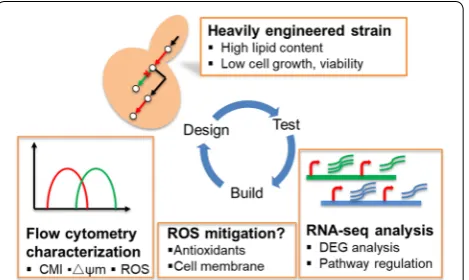
Here, we employed complementary technologies of RNA-seq transcriptomic analysis and flow-cytometry-based physiological characterisation to investigate the
performance and viability of yeast at different stages of lipid pathway engineering (Fig. 1). In this study, engineered strains of S. cerevisiae were compared by genome-wide transcription analysis and functional assessment of cell-membrane integrity and mitochon-dria and these were supported by selected metabolite analyses. The purpose of the study was to identify the impacts of lipid pathway engineering on cell physiology and potential further engineering targets for enhanced lipid production and improved cell health, towards the ultimate goal of improving production to economically competitive levels.
Results and discussion
Global transcriptional profiling emphasising central metabolic and lipid‑related pathways
Whole transcriptome view of gene expression
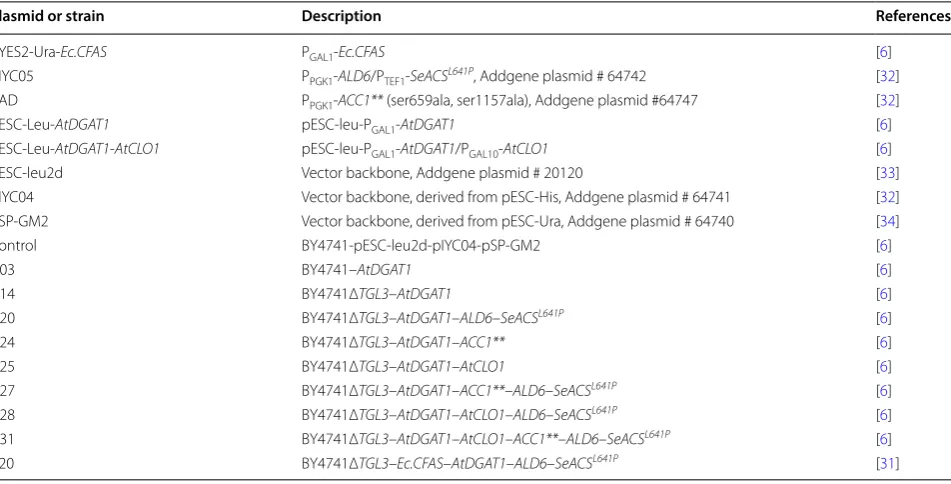
Lipid pathway modification in yeast incorporated three steps including FA biosynthesis, lipid accumulation, and sequestration. H-series yeast strains including H03, 14, 20, 24, 25, 27, 28, and 31 were built as per the gene com-binations, as shown in Table 1. Specifically, strains H03 and H14 were constructed by enhancing lipid accumu-lation and sequestration through heterologous expres-sion of the diacylglycerol acyltransferase gene from Arabidopsis thaliana (AtDGAT1) on the parent strains BY4741 and BY4741 TGL3Δ, respectively. Strains H20, 24, and 25 were built on H14 by adding genes for FA biosynthesis ALD6 (a native aldehyde dehydroge-nase gene) and an acetyl-CoA synthetase variant from
Salmonella enterica (SeACSL641P), or by increasing mal-onyl-CoA supply through the expression of ACC1** (a native acetyl-CoA carboxylase gene carrying two muta-tions ser659ala, and ser1157ala), or by the addition of caleosin, a lipid droplet-stabilising protein from Arabi-dopsis thaliana (AtCLO1). Strains H27, 28, and 31 were built on H20, by expressing ACC1**, or by expressing AtCLO1, or by co-expressing ACC1** and AtCLO1, respectively. All heterologous gene expressions were plasmid-based.
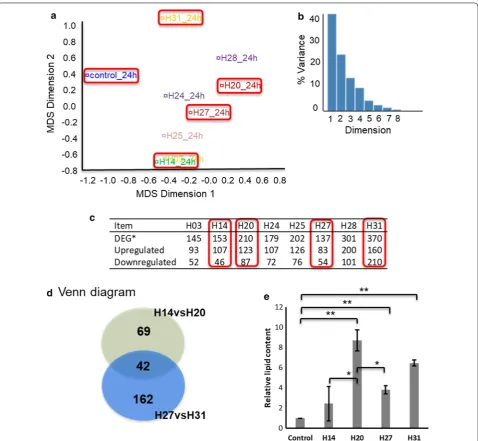
The transcriptome-wide view of gene expression from RNA-seq analysis of engineered strains at 24 h post-induction in galactose media was analysed using the interactive web-tool Degust (http://degus t.erc.monas h.edu/) which has an element of principal component-like analysis developed specifically for transcriptom-ics data [13]. As shown in Fig. 2a, the multidimensional scaling (MDS) plot was generated by Degust, which is a means of visualizing the similar gene expression level of individual strains in the RNA-seq data set. The MDS algorithm placed each RNA-seq data set in N -dimen-sional space to preserve the between-strain distance, and each strain was then assigned a coordinate in each of the N dimensions. The between-strain distance in the MDS plot determines the similarity of overall gene expression between two H-series strains. The sum percentage of Dimensions 1 and 2 was > 60% (Fig. 2b), which indicated that these were the major components representing gene expression in the strains.
The numbers of differentially expressed genes (DEG) in the engineered strains versus control were compared and the data summarized in Fig. 2c, including the num-ber of total DEG, upregulated genes and downregulated genes. Based on the number of total DEG, the 8 strains could be divided into three groups, one group with total DEG ~ 150 including strain H03, 14, and 27, one group with total DEG ~ 200 including strain H20, 24, and 25, another group with total DEG ~ 300 including strain H28 and 31. Taken together, the distance in the MDS plot and the DEG numbers resulted in four representative engi-neered strains H14, 20, 27, and 31 selected for detailed transcriptome analysis to explore relationships between DEG and lipid pathway modification. The Venn diagram (Fig. 2d) illustrates that there were 42 DEG among the four-engineered strains H14, 20, 27 and 31, and 111 DEG between H14 and H20, 204 DEG between H27 and H31. Of interest was that the heterologous expression of ALD6, SeACSL641P, and/or AtCLO1 caused more DEG in strains H20, 28, and 31. As sequences for plasmid-expressed ALD6 and minor mutant ACC1** were indistinguishable from the native counterparts in the RNA-seq analysis, their expression level was the sum of the overexpressed and native genes in the engineered strains but just native ALD6 and ACC1 transcripts in control yeast.
Expressions of target genes of interest support lipid‑engineering strategy
Regarding the expression levels of introduced genes (Additional file 1: Fig. S1), ALD6 was generally higher
Table 1 Details of plasmids and strains used in this study
Plasmid or strain Description References
pYES2-Ura-Ec.CFAS PGAL1-Ec.CFAS [6]
pIYC05 PPGK1-ALD6/PTEF1-SeACSL641P, Addgene plasmid # 64742 [32]
pAD PPGK1-ACC1** (ser659ala, ser1157ala), Addgene plasmid #64747 [32]
pESC-Leu-AtDGAT1 pESC-leu-PGAL1-AtDGAT1 [6]
pESC-Leu-AtDGAT1-AtCLO1 pESC-leu-PGAL1-AtDGAT1/PGAL10-AtCLO1 [6]
pESC-leu2d Vector backbone, Addgene plasmid # 20120 [33]
pIYC04 Vector backbone, derived from pESC-His, Addgene plasmid # 64741 [32]
pSP-GM2 Vector backbone, derived from pESC-Ura, Addgene plasmid # 64740 [34]
Control BY4741-pESC-leu2d-pIYC04-pSP-GM2 [6]
H03 BY4741–AtDGAT1 [6]
H14 BY4741ΔTGL3–AtDGAT1 [6]
H20 BY4741ΔTGL3–AtDGAT1–ALD6–SeACSL641P [6]
H24 BY4741ΔTGL3–AtDGAT1–ACC1** [6]
H25 BY4741ΔTGL3–AtDGAT1–AtCLO1 [6]
H27 BY4741ΔTGL3–AtDGAT1–ACC1**–ALD6–SeACSL641P [6]
H28 BY4741ΔTGL3–AtDGAT1–AtCLO1–ALD6–SeACSL641P [6]
H31 BY4741ΔTGL3–AtDGAT1–AtCLO1–ACC1**–ALD6–SeACSL641P [6]
Page 4 of 13 Peng et al. Biotechnol Biofuels (2019) 12:98
and ACC1** lower than other target genes compared to the control. Of further note, the ACC1** expression level was almost fivefold higher in H27 than other strains. H20 displayed higher ALD6, AtDGAT1 expression lev-els than control and H14. Moreover, AtDGAT1, AtCLO1 in H31 showed almost ninefold higher expression levels than other strains. Among the four-engineered strains, H20 and H31 showed higher lipid content at 24 h post-induction, followed by H27 and H14 and there was no
lipid levels of these strains supported the effectiveness of the engineering strategy.
The two engineered strains H20, 31 with higher lipid content at 24 h post-induction showed significantly reduced cell-membrane integrity (CMI), but strains H14 and 27 did not (described further below). This phenom-enon suggested that further investigation of the relation-ship between reduced CMI, central metabolic pathway regulation and lipid production pathway modification was required.
Regulation of central carbon pathway and lipid production pathway
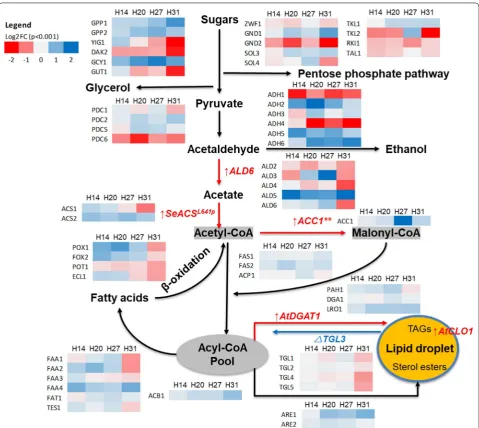
The genes responsible for generating central metabolism precursors for fatty acid biosynthesis such as acetyl-CoA, malonyl-CoA, and acyl-CoA were upregulated in the tar-get strains similar to the pattern of transcriptional rewir-ing within the central carbon pathway seen in Y. lipolytica engineered for enhanced lipid production via a differ-ent approach [14]. Expression profiles of orthologues of the introduced genes for FA biosynthesis such as ALD5, ACS2, and ACC1 were upregulated (Fig. 3) which likely contributed to overall fatty acid synthesis. Furthermore, genes coding for fatty acid biosynthesis pathway-related enzymes were also upregulated including fatty acid syn-thetases (Fas1p, Fas2p) and acyl-CoA-binding protein (Acb1p). In strains H14, 20, and 27, acetyl-CoA syn-thetase (Acs1p) and fatty acyl-CoA synsyn-thetases (Faa1-4p, Fat1p) were upregulated to enhance fatty acid biosynthe-sis and activation to form fatty acyl-CoA, while the fatty acid consumption process via β-oxidation (TES1, POX1, FOX2) was also upregulated. Differing from the other three strains, H31 showed lower expression of several genes for FA biosynthesis (ACS1, FAA1-3, TES1) and β-oxidation (POX1, FOX2, POT1, ECL1). In its response to pathway engineering, H31 showed greater similarity to the transcriptome responses of a yeast strain expressing similar FA biosynthesis genes in an earlier report [8] than to H14, 20, and 27.
In the lipid accumulation and sequestration pathways, heterologous expression of AtDGAT1 did not change the transcription level of the endogenous DGA1, except a slight upregulation in H27 (Fig. 3); similarly, the knock-out of TGL3 did not obviously change the expression of other TAG lipase genes TGL1-2 and TGL4-5 in the engi-neered strains except for the downregulation of these in H31 (Fig. 3). Interestingly, PAH1, LRO1, and ARE1,2, genes responsible for diacylglycerol/lipid droplet, triglyc-eride, and sterol synthesis, respectively, were upregulated in the four target strains, which suggests that our current lipid accumulation and sequestration strategy was insuffi-cient for demand and additional FA sequestration, as lipid or sterol sterols was required. Thus, PAH1, LRO1, and
ARE1,2 are interesting targets for future lipid engineer-ing research. ARE1 and LRO1 were more highly upregu-lated in H31 and TAG lipases were more downreguupregu-lated compared with strain H27; these two strains differ only by the addition of AtCLO1, a lipid droplet associated pro-tein from A. thaliana [15]. The pattern of upregulation suggested that there was a higher demand in H31 for FA accumulation enzymes. Caleosin was proposed to modify lipid droplet membrane function and increase the size of droplets by impairing lipase accessibility to lipid bod-ies, slowing storage lipid degradation [15]. This function is due to the special non-canonical structure of caleosin, with a long central hydrophobic region surrounded by two hydrophilic C- and N-terminal regions [16].
Regulation of redox pathway and cellular physiological characterisation
Effect of lipid pathway engineering on redox pathways
The pentose phosphate pathway (PPP) is considered to be the primary source of NADPH supply in yeast [17] which is highly consumed during the reduction steps of fatty acid synthesis. The engineered strains showed that overall downregulation of key genes involved in the PPP including ZWF1, GND2, and RKI1 which suggests that NADPH supply was impaired in these strains (Fig. 3). GND2 expression responses were also strongly downreg-ulated in yeast cells engineered for fatty ester production [8]. Interesting, gene TKL2, encoding transketolase (a key enzyme in the PPP pathway), was upregulated in strain H27 while downregulated in H14, 20, and 31. This could be explained by the fact that much higher expression lev-els of ALD6 and ACC1 in H27 were supported by a better NADPH supply in H27 than other target strains.
Page 6 of 13 Peng et al. Biotechnol Biofuels (2019) 12:98
strain H27 would generate higher NADPH production to support ethanol production (Fig. 3).
Overall, lipid pathway engineering impaired redox pathways and redirected carbon flux from ethanol bio-synthesis to lipid and glycerol production. This was similar to the effect of MHY1 gene inactivation in Y. lipolytica, a crucial gene in lipid production regulation, which increased carbon flux to lipogenesis from amino acid biosynthesis [19]. As lipid biosynthesis and derived products require a large quantity of NADPH (synthesis of one palmitate requires 14 NADPH), increasing NADPH supply has been the focus of several studies to improve the production of ethanol and fatty esters [20, 21]. Thus,
downregulation of the PPP and β-oxidation may explain the slow growth of the more engineered strains H20 and H31 and reinforce the importance of balancing cofactor supply in lipid pathway engineering research.
Effect of lipid pathway engineering on ROS production and mitochondrial function
Cell growth and CMI were much lower for strains H20 and 31, accompanied by higher intracellular ROS com-pared with the other strains (Fig. 4a) and with com-parable lipid content at 24 h. We speculated that lower CMI may be due to high ROS level in the cell [22] and that this could arise from mitochondrial respiration or Fig. 3 Overview of transcriptional reprogramming of the H-series strains H14, 20, 27, and 31 at 24 h post-induction of gene expression. The
β-oxidation, or from impaired antioxidant defense sys-tems. Since β-oxidation (POX1, FOX2, and TES1) was downregulated in strain H31 (Fig. 3), we reasoned that the other two sources were more likely to explain the high intracellular ROS value in this strain. However, while there was higher mitochondrial membrane poten-tial (Δφm) measured in the H20 and 31 cells (Fig. 4a), more genes coding for mitochondrial enzymes and mitochondrial membrane synthesis were downregulated in these strains compared with control and H14 and 27 (Fig. 4b). The apparent contradiction between physi-ological and transcriptomic results may reflect dynamic changes occurring at the specific timepoint of sampling (24 h) and warrants further investigation over a broader timeframe. Meanwhile, the ROS level in strains H20 and 31 may be also a factor in the upregulation of the small G-protein Rho1p, which controls the cell-wall integrity pathway in response to oxidative stress [23].
ROS species including hydrogen peroxide (H2O2),
superoxide radical (O2−), and hydroxyl radical (OH·)
cause damage to cells and are metabolised via multiple pathways (indicated in Fig. 4c). In H20 and 31, genes including TDH1 and ENO1 involved in the respiratory chain and ATP synthesis were downregulated and in the conversion of H2O2 from O−2 may have been affected by
SOD2 (encoding superoxide dismutase) downregula-tion. Furthermore, genes coding for catalase (CTT1), glutathione-dependent enzymes (GPX1, GRX1), and glutathione transferases (GSH1) which protect the cell from ROS damage were all downregulated in H20 and 31, but expression was either unchanged in H14 and 27 or showed the opposite. This loss of protection may explain the higher ROS level measured in H20 and 31 compared with control (Fig. 4a); however, the reason for downregu-lation of these genes is not clear.
Most genes responsible for ATP and NADPH synthe-sis were downregulated in the respiratory chain of strain H31 which indicated that the energy storage forms were unbalanced and reducing agent or cofactor were limited in these cells. As examples, Ndi1p, the internal mito-chondrial NADH dehydrogenase that transfers elec-trons to complex III of the respiratory chain; Shh3p, a putative mitochondrial inner membrane protein; and two aldehyde dehydrogenases (ALD4, 6) that contrib-ute to NADPH synthesis, were downregulated. Besides,
the autophagy-related genes including KCS1, ATG8, and ATG18 were only mildly downregulated and the apoptosis-inducing factor gene (AIF1) was only mildly upregulated indicated that the slow cell growth of highly engineered strain H31 was not caused by large-scale upregulation of autophagy or apoptosis process. There-fore, unbalanced energy and reducing equivalents supply in strain H31 and by extension to strain H20, could lower cell growth and reduce CMI.
Potential for oxidative stress generation in lipid pathway engineering
Effect of antioxidants
Engineering oxidative stress defense pathways in yeast alleviated ROS and improved standard lipid and PUFA production in the previous studies [3, 4, 24]. In addi-tion, Ma et al. 2019 succeeded in combining the engi-neering of lipid and lycopene (antioxidant) synthesis pathways to markedly increase production of both products using a two-stage bioprocess [25]. In our experiments, strain H31 consistently showed elevated intracellular ROS levels (Fig. 4a); thus, we proposed to ameliorate this by the addition of antioxidants to the culture medium. Two well-studied antioxidants, vita-min C and resveratrol, had previously demonstrated the ability to moderate intracellular ROS level in yeast [26, 27], and these were applied, separately, to yeast expression induction medium of control and strain H31 and the effects were monitored for 24 h. Contrary to our expectations, the antioxidants vitamin C and resveratrol did not have a significant effect on any of the physiological parameters measured in the control or H31 strains. That is, neither growth, CMI or intra-cellular content of ROS significantly improved in strain H31 by application of antioxidants (Fig. 5); mitochon-drial membrane potential was similarly unaffected. This result showed that while strain H31 has relatively high ROS levels and low CMI, these cannot be amelio-rated by the addition of classical antioxidants.
Cell‑membrane modification by cyclopropane fatty acid biosynthesis
Cyclopropane fatty acid (CFA) incorporation into cel-lular phospholipid membranes has been reported to increase tolerance in microorganisms such as E.
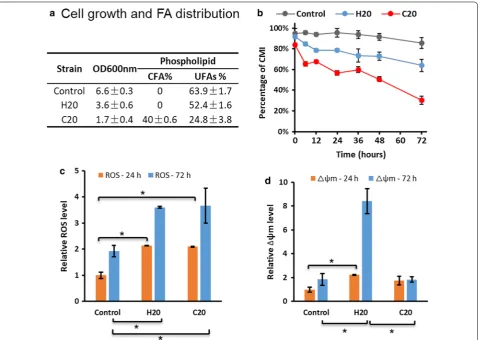
coli in response to an acidic environment [28] and to more generalized stresses. The higher oxidative stabil-ity of CFA compared with unsaturated fatty acids may also be an advantage in the protection of membranes from ROS attack which targets (poly)unsaturated fatty acids in the first instance. We hypothesised that CFA in membranes might improve membrane integrity and hence cell growth in compromised engineered yeast strains. To test this hypothesis, two strains were directly compared: H20 expressing AtDGAT1, ALD6 -SeACSL641P, ΔTGL3, and C20 which contained the same heterologous genes plus an additional cyclopropyl fatty acid synthesis gene from E. coli (Ec.CFAS). CFA con-centration in the phospholipid fraction of C20 was measured at ~ 40% and unsaturated FA percentage was
reduced from 64 to 25% (Fig. 6a). This result verified the inclusion of CFA into phospholipid membranes in the C20 strain.
Cell growth of C20 was lower (Fig. 6b), and ROS levels were unchanged from that for H20 (Fig. 6c), whereas mitochondrial membrane potential (Δψm) was similar between C20 and control and did not show the large increase that H20 exhibited at 72 h (Fig. 6d). These outcomes could be explained by the requirement for unsaturated FAs in maintaining membrane fluidity and cell growth in S. cerevisiae which is not satisfied by incorporation of CFA [29, 30] and that ROS generated internally may not be targeting membrane phospholip-ids and thus not damaging membrane integrity.
Page 10 of 13 Peng et al. Biotechnol Biofuels (2019) 12:98
Conclusions
This study investigated the relationships between tran-scriptomic profile and cellular physiological responses of yeast engineered for increased lipid production. The transcriptomic analysis showed that the lipid engineering strategy redirected the global metabolic pathway towards lipid production, such as upregulated pathways for the production of precursors including acetyl-CoA, malonyl-CoA, and acyl-CoA. Glycerol biosynthesis pathway was also upregulated and ethanol biosynthesis and the PPP were downregulated. ROS levels were consistently high in engineered strains but so was mitochondrial membrane potential; as mitochondria are the main source of ROS in the cell, high ROS is likely a result of the high mitochon-drial activity. The high ROS and low membrane integrity of the engineered strain H31 were not reversed by the addition of antioxidants to the culture media or by alter-ing the membrane lipids to include high concentrations
of saturated CFA. These results suggest that current anti-oxidants treatment and membrane modifications are not efficient enough to mitigate elevated ROS levels or ben-efit membrane integrity and low cell growth. Moreover, the downregulated ATP and NADPH synthesis pathways suggested that the intracellular energy supply was limited and redox levels were unbalanced in the engineered cells where lipid accumulation pathway genes were upregu-lated. These are all promising targets for further lipid pathway engineering. Finally, the study shows the power of transcriptome and cell physiological analyses to exam-ine cellular performance and direct future engexam-ineering efforts.
Methods Strains
In this study, strains from previous research [6, 31] that were engineered for enhanced standard lipids and
cyclopropane fatty acid production were selected for analysis. All the engineered strains were constructed based on the parent strain BY4741 (MATa his3Δ1 leu2Δ0 met15Δ0 ura3Δ0), and the details of plasmids and strains are listed in Table 1.
Cell culture
Detailed culture conditions have been described earlier [6] and given briefly below. The engineered yeast strains were maintained based on their auxotrophy using yeast synthetic complete (SC) minimal medium, which con-tains 6.7 g/L of yeast nitrogen base, 20 g/L glucose plus a mixture containing appropriate nucleotide bases and amino acids for the various dropout options (SC-Leu, SC-His-Leu, and SC-His-Leu-Ura). For the induction medium, glucose was replaced with 2% (w/v) galactose and 1% (w/v) raffinose. The seed culture was prepared by inoculating a single transformed colony into 5 mL yeast SC minimal medium and incubating at 30 °C, 250 rpm, overnight. The culture was diluted using SC induction medium to an initial OD600 nm value of approximately
0.4 and then incubated at 30 °C and 250 rpm.
Antioxidant addition to cell culture
Two antioxidants (vitamin C and resveratrol) were selected to assess their effects on the cell physiology of strain H31 during culturing. Cell growth was evaluated in the absence and the presence of vitamin C or resvera-trol (0.5 μM and 2.5 mM, respectively) added to media in 48-well plates. The selected concentrations of vitamin C and resveratrol were based on our preliminary screen-ing experiments and other previous reports [26, 35]. Seed cultures of control and H31 cells were dispensed into each well and diluted to an initial OD600 nm of 0.2. The
microplates were incubated at 30 °C, and growth (OD600
nm) was measured every 30 min using the Tecan micro-plate reader [36]. Cell samples were taken at 24 h for flow-cytometry analysis.
RNA‑seq analysis
Samples for transcriptome analysis were taken at 24 h post-induction during late exponential phase growth. Approximately 20 mL cell culture for each strain was cooled directly to 4 °C and centrifuged to obtain the cell pellets, which were washed quickly with 0.2 μm filtered PBS buffer once and then centrifuged again. The cell pel-lets were directly frozen in liquid nitrogen and stored at
− 80 °C before shipping for RNA-Seq analysis stored on dry ice. The RNA extraction, library preparation (250– 300 bp insert cDNA library), RNA sequence analysis, and assembly were conducted by Novogene, Hong Kong. The detailed method is provided in Additional File 1.
Cell physiology measurement
Cell growth was monitored by optical density (OD) at 600 nm using DR 5000™ UV–Vis spectrophotometer. Harvested cells were adjusted into 106/mL (OD ~ 0.2),
washed twice using fresh PBS buffer (pH 7.4), and resus-pended in 1 mL PBS buffer for flow-cytometry analysis for neutral lipid content, cell-membrane integrity (CMI), reactive oxygen species (ROS) level, and mitochondrial membrane potential (Δψm). In the following analyses, stained cells were kept in the dark to avoid photobleach-ing. Individual cell fluorescence was measured using the violet laser (488 nm) on a CytoFlex (Beckman Coulter, USA) under PE or FITC filter. More than 10,000 cells were measured for each sample and the data acquired were analysed further by the software CytExpert Ver.2.0.
For lipid content analysis, Nile red was used to stain the cells at a final conc. of 5 μg/mL, and incubated at room temperature for 5 min before reading under PE filter. For CMI and ROS analyses, the cell samples were first stained with CM-H2DCFDA (Thermo Fisher Scientific, USA) at
a final conc. of 5 μM and incubated at 30 °C, 250 rpm for 30 min, then stained with propidium iodine (PI) (Ther-moFisher, USA) at a final conc. of 5 μg/mL, and analysed immediately by flow cytometry under both FITC and PE filter, for ROS level and CMI, respectively. TMRE (tetra-methylrhodamine, ethyl ester) (Abcam, UK) was used to analyse the mitochondrial membrane potential (Δψm). Freshly washed cells were treated with TMRE at a final conc. of 100 nM, and incubated at 30 °C, 250 rpm for 20 min before flow-cytometry analysis using the PE fil-ter. The depolarization (negative) control was prepared by treating the cells with 20 μM FCCP (carbonyl cyanide 4-(trifluoromethoxy) phenylhydrazone) 10 min before adding TMRE.
Additional file
Additional file 1. Flow-cytometry-based physiological characterisation and transcriptome analyses reveal a mechanism for reduced cell viability in yeast engineered for increased lipid content.
Abbreviations
PL: phospholipid; DCW: dry cell weight; TAG : triacylglycerol; CFA: cyclopropane fatty acid; FA: fatty acid; ALD6: overexpression of native aldehyde dehydro-genase isoform 6; SeACSL641P: acetyl-CoA synthetase with an L641P mutation
from S. enterica; AtDGAT1: diacylglycerol acyltransferase from A. thaliana; Ec. CFAS: cyclopropane fatty acid synthase from E. coli; ΔTGL3: knock-out gene tri-glyceride lipase isoform 3; CMI: cell-membrane integrity; ROS: reactive oxygen species; Δψm: mitochondrial membrane potential.
Authors’ contributions
Page 12 of 13 Peng et al. Biotechnol Biofuels (2019) 12:98
Author details
1 Department of Chemical Engineering, Monash University, Clayton, VIC 3800, Australia. 2 Present Address: Department of Bioengineering, Imperial College London, London SW7 2AZ, UK.
Acknowledgements
The authors thank Mr. Benny Nguyen for developing aspects of the flow-cytometry analysis and Dr. Sonika Tyagi for the help in bioinformatics analysis.
Competing interests
The authors declare that they have no competing interests.
Availability of data and materials
The data sets used and/or analysed during the current study are available from the corresponding author on reasonable request.
Consent for publication
Not applicable.
Ethics approval and consent to participate
Not applicable.
Funding
We acknowledge the financial support from the ARC linkage project (LE160100185) and Monash University for the graduate and international postgraduate research scholarships awarded to HP.
Publisher’s Note
Springer Nature remains neutral with regard to jurisdictional claims in pub-lished maps and institutional affiliations.
Received: 2 February 2019 Accepted: 12 April 2019
References
1. Pfleger BF, Gossing M, Nielsen J. Metabolic engineering strategies for microbial synthesis of oleochemicals. Metab Eng. 2015;29:1–11. 2. Marella ER, Holkenbrink C, Siewers V, Borodina I. Engineering microbial
fatty acid metabolism for biofuels and biochemicals. Curr Opin Biotech-nol. 2018;50:39–46.
3. Xu P, Qiao K, Stephanopoulos G. Engineering oxidative stress defense pathways to build a robust lipid production platform in Yarrowia lipol-ytica. Biotechnol Bioeng. 2017;114(7):1521–30.
4. Qiao K, Wasylenko TM, Zhou K, Xu P, Stephanopoulos G. Lipid produc-tion in Yarrowia lipolytica is maximized by engineering cytosolic redox metabolism. Nat Biotechnol. 2017;35(2):173–7.
5. Markham KA, Alper HS. Engineering Yarrowia lipolytica for the pro-duction of cyclopropanated fatty acids. J Ind Microbiol Biotechnol. 2018;45(10):881–8.
6. Peng H, He L, Haritos VS. Metabolic engineering of lipid pathways in Saccharomyces cerevisiae and staged bioprocess for enhanced lipid production and cellular physiology. J Ind Microbiol Biotechnol. 2018;45(8):707–17.
7. Béopoulos A, Verbeke J, Bordes F, Guicherd M, Bressy M, Marty A, Nicaud J-M. Metabolic engineering for ricinoleic acid production in the oleaginous yeast Yarrowia lipolytica. Appl Microbiol Biotechnol. 2014;98(1):251–62.
8. de Jong BW, Siewers V, Nielsen J. Physiological and transcriptional charac-terization of Saccharomyces cerevisiae engineered for production of fatty acid ethyl esters. FEMS Yeast Res. 2016;16(1):1–9.
9. Gossing M, Smialowska A, Nielsen J. Impact of forced fatty acid synthesis on metabolism and physiology of Saccharomyces cerevisiae. FEMS Yeast Res. 2018;18:foy096.
10. Nookaew I, Papini M, Pornputtapong N, Scalcinati G, Fagerberg L, Uhlen M, Nielsen J. A comprehensive comparison of RNA-Seq-based transcrip-tome analysis from reads to differential gene expression and cross-comparison with microarrays: a case study in Saccharomyces cerevisiae. Nucleic Acids Res. 2012;40(20):10084–97.
11. Cadenas E, Boveris A, Ragan CI, Stoppani AO. Production of superoxide radicals and hydrogen peroxide by NADH-ubiquinone reductase and ubiquinol-cytochrome c reductase from beef-heart mitochondria. Arch Biochem Biophys. 1977;180(2):248–57.
12. Zorova LD, Popkov VA, Plotnikov EY, Silachev DN, Pevzner IB, Jankauskas SS, Babenko VA, Zorov SD, Balakireva AV, Juhaszova M, et al. Mitochondrial membrane potential. Anal Biochem. 2018;552:50–9.
13. Powell D. Degust an interactive web-tool for RNA-seq analysis. 2015.
http://degus t.erc.monas h.edu/. Accessed 17 Apr 2019.
14. Liu LQ, Markham K, Blazeck J, Zhou NJ, Leon D, Otoupal P, Alper HS. Surveying the lipogenesis landscape in Yarrowia lipolytica through under-standing the function of a Mga2p regulatory protein mutant. Metab Eng. 2015;31:102–11.
15. Froissard M, D’Andrea S, Boulard C, Chardot T. Heterologous expression of AtClo1, a plant oil body protein, induces lipid accumulation in yeast. FEMS Yeast Res. 2009;9(3):428–38.
16. Chen JC, Tzen JT. An in vitro system to examine the effective phospholip-ids and structural domain for protein targeting to seed oil bodies. Plant Cell Physiol. 2001;42(11):1245–52.
17. Wasylenko TM, Ahn WS, Stephanopoulos G. The oxidative pentose phos-phate pathway is the primary source of NADPH for lipid overproduction from glucose in Yarrowia lipolytica. Metab Eng. 2015;30:27–39. 18. Modig T, Granath K, Adler L, Liden G. Anaerobic glycerol production by
Saccharomyces cerevisiae strains under hyperosmotic stress. Appl Micro-biol Biotechnol. 2007;75(2):289–96.
19. Wang GY, Li DL, Miao ZG, Zhang SS, Liang WX, Liu L. Comparative transcriptome analysis reveals multiple functions for Mhy1p in lipid bio-synthesis in the oleaginous yeast Yarrowia lipolytica. Biochim Et Biophys Acta. 2018;1863(1):81–90.
20. Bro C, Regenberg B, Förster J, Nielsen J. In silico aided metabolic engi-neering of Saccharomyces cerevisiae for improved bioethanol production. Metab Eng. 2006;8(2):102–11.
21. Shi S, Valle-Rodríguez JO, Siewers V, Nielsen J. Engineering of chromo-somal wax ester synthase integrated Saccharomyces cerevisiae mutants for improved biosynthesis of fatty acid ethyl esters. Biotechnol Bioeng. 2014;111(9):1740–7.
22. Trancikova A, Weisova P, Kissova I, Zeman I, Kolarov J. Production of reac-tive oxygen species and loss of viability in yeast mitochondrial mutants: protective effect of Bcl-xL. FEMS Yeast Res. 2004;5(2):149–56.
23. Levin DE. Cell wall integrity signaling in Saccharomyces cerevisiae. Micro-biol Mol Biol Rev. 2005;69(2):262–91.
24. Zhang S, He Y, Sen B, Chen X, Xie Y, Keasling JD, Wang G. Alleviation of reactive oxygen species enhances PUFA accumulation in Schizochytrium
sp. through regulating genes involved in lipid metabolism. Metab Eng Commun. 2018;6:39–48.
25. Ma T, Shi B, Ye Z, Li X, Liu M, Chen Y, Xia J, Nielsen J, Deng Z, Liu T. Lipid engineering combined with systematic metabolic engineering of Sac-charomyces cerevisiae for high-yield production of lycopene. Metab Eng. 2019;52:134–42.
26. Dani C, Bonatto D, Salvador M, Pereira MD, Henriques JAP, Eleutherio E. Antioxidant protection of resveratrol and catechin in Saccharomyces cerevisiae. J Agr Food Chem. 2008;56(11):4268–72.
27. Nikolić B, Stanojević J, Vuković-Gačić B, Simić D, Knežević-Vukčević J. The effects of vitamin C on oxidative DNA damage and mutagenesis. Food Technol Biotechnol. 2006;44(4):449–56.
28. Chang YY, Cronan JE. Membrane cyclopropane fatty acid content is a major factor in acid resistance of Escherichia coli. Mol Microbiol. 1999;33(2):249–59.
29. Henderson CM, Block DE. Examining the role of membrane lipid compo-sition in determining the ethanol tolerance of Saccharomyces cerevisiae. Appl Environ Microbiol. 2014;80(10):2966–72.
30. Doi O, Doi F, Schroeder F, Alberts AW, Vagelos PR. Manipulation of fatty acid composition of membrane phospholipid and its effects on cell growth in mouse LM cells. Biochim Biophys Acta. 1978;509(2):239–50. 31. Peng H, He L, Haritos VS. Enhanced production of high-value
cyclopro-pane fatty acid in yeast engineered for increased lipid synthesis and accumulation. Biotechnol J. 2018. https ://doi.org/10.1002/biot.20180 0487.
•fast, convenient online submission
•
thorough peer review by experienced researchers in your field
• rapid publication on acceptance
• support for research data, including large and complex data types
•
gold Open Access which fosters wider collaboration and increased citations maximum visibility for your research: over 100M website views per year
•
At BMC, research is always in progress.
Learn more biomedcentral.com/submissions
Ready to submit your research? Choose BMC and benefit from:
33. Ro D-K, Paradise EM, Ouellet M, Fisher KJ, Newman KL, Ndungu JM, Ho KA, Eachus RA, Ham TS, Kirby J, et al. Production of the antima-larial drug precursor artemisinic acid in engineered yeast. Nature. 2006;440(7086):940–3.
34. Chen Y, Partow S, Scalcinati G, Siewers V, Nielsen J. Enhancing the copy number of episomal plasmids in Saccharomyces cerevisiae for improved protein production. FEMS Yeast Res. 2012;12(5):598–607.
35. Branduardi P, Fossati T, Sauer M, Pagani R, Mattanovich D, Porro D. Bio-synthesis of vitamin C by yeast leads to increased stress resistance. PLoS ONE. 2007;2(10):e1092.