[Belmimoun et. al., Vol.4 (Iss.5): May, 2017] ISSN: 2454-1907 DOI: https://doi.org/10.29121/ijetmr.v4.i5.2017.73
Http://www.ijetmr.com©International Journal of Engineering Technologies and Management Research [1-10] IJETMR
PHYTOCHEMICAL STUDY OF
ZYGOPHYLLUM ALBUM
EXTRACT
Belmimoun,A.*1, Meddah,B.1, Side Larbi K1, Sonnet,P.2
*1
Department of Biology, University of M. Stambouli, Mascara, Algeria
2
Faculty of Pharmacy, University of Picardie, Amiens, France
DOI: 10.5281/zenodo.805965 Abstract:
The aerial parts of Zygophyllum album L. are used in folk medicine as an anti-diabetic agent and as a drug active against several pathologies. In this work we present the chemical composition of Algerian phenolic extracts obtained by different solvents and extraction methods
The phytochemical study was based on a colometer method, Phenolic compound content and LC/ESI-MS analyses
The methanolic extract of zygophyllum album was at least the best extract studied for its quantitative and qualitative richness in phenolic compounds
All Z.album extracts and specially the methanolic one are a promising source of health products for functional food or nutraceutical industries.
Keywords:
Zygophyllum Album; Folk Medicine; Anti-Diabetic Agent.
Cite This Article: Belmimoun,A., Meddah,B., Side Larbi K, and Sonnet,P.,
“PHYTOCHEMICAL STUDY OF ZYGOPHYLLUM ALBUM EXTRACT” International
Journal of Engineering Technologies and Management Research, Vol. 4, No. 5(2017), 1-10. DOI: https://doi.org/10.29121/ijetmr.v4.i5.2017.73.
1. INTRODUCTION
They are some works done which aimed at knowing the different antimicrobial and phytochemical constituents of medicinal plants. Zygophyllum album L. is one of the large world of beneficts plants belongs to Zygophyllaceae family, genus Zygophyllum. Four species of Zygophyllum are recorded in Algeria [1].
Http://www.ijetmr.com©International Journal of Engineering Technologies and Management Research [1-10] fresh Z. album L.
2. MATERIALS AND METHODS
2.1. PLANT MATERIAL
Fresh upper parts from Zygophyllum album (leaves, flowers and stems) were collected in April during the flowering stage 2014 from SidiKhouiled region, Sahara of Ouargla, Algeria.
The sampling was done by a randomized collection of 15–20 sub-shrubs in an area of about 200 m2 each areal parts of Z. album were isolated manually in our laboratory to obtain a weight of 500–700 g of each part. Botanical identification of this species was carried out according to Africain flowering plants database and by local experts.
2.2. CHEMICAL AND REAGENTS
Folin–Ciocalteu reagent, anhydrous sodium carbonate (Na2CO3), gallic acid, sodium
nitrite,(NaNO2) solution, aluminium chloride hexahydrate solution (AlCl3, 6H2O), and vanillin
were purchased from Fluka (Buchs, Switzerland). Sulphuric acid (H2SO4) was obtained from
Merck (Darmstadt, Germany).
The solvents were purchased from Sigma–Aldrich (Oakville, ON). All other chemical reagents were purchased from Sigma–Aldrich (Oakville, ON) or AlfaAesar Co. (Ward Hill, MA) and were used as received.
2.3. POLYPHENOLS EXTRACTION
The plant materials was dried at ambient temperature and stored in a dry place prior to use. The plant was washed well with water, dried at room temperature in the dark, and then ground in an electric grinder to give a coarse powder. In this study, samples were extracted by decoction (10%), maceration with ethanol (8%) and by extraction with solvents of increasing polarity (Dichloromethan and methanol/soxhlet) methods.[5,6].
2.4. PHYTOCHEMICAL SCRENNING BY COLOMETER METHOD
All plant extract were tested for the presence of different families of compounds according to methods reviously described [7,8].
2.5. POLYPHENOLS ANALYSIS
[Belmimoun et. al., Vol.4 (Iss.5): May, 2017] ISSN: 2454-1907 Impact Factor: 1.745 (I2OR)
Http://www.ijetmr.com©International Journal of Engineering Technologies and Management Research [1-10] 2.6. CONDENSED TANNIN CONTENT
Condensed tannins were transformed by the reaction with vanillin to anthocyanidols. Condensed tannin contents of each organ (three replicates per treatment) were expressed as mg catechin equivalents per gram (mg CE/g) through the calibration curve with catechin.
2.7. TOTAL FLAVONOID CONTENT
Total flavonoid content was measured according to [10]. Total flavonoid contents were expressed as mg catechin equivalents per gram (mg CE/g).
2.8. TOTAL ANTHOCYANS CONTENT
Total anthocyans content was evaluated by colorimetry using a UV-visible spectrophotometer The concentration of anthocyanin pigment in the extract is expressed in mg equivalentcyanidin-3 glucose per liter of solution or mg of cyanidin-3 equivalent glucose / g dry matter(Cg / g dM) [11].
2.9. LC/ESI-MS ANALYSES
The LC analyses were conducted using a Prominence Liquid Chromatograph (Shimadzu, Kyoto, Japan) equipped with an SLC- 10A controller, LC-20AD pump, SIL-10AF auto sampler, and SPDM10A PDA detector. A Phenomenex Luna C-18(2) column (250 x 4.6 mm, 5 mm) was used. The mobile phase consisted of methanol (A) and acetonitrile (B) at a flow rate of 0.8 mL min-1 using the following gradients: 0.1–23 min, 10–40% of solvent B in A; 23.01–40 min, 10% solvent B and 90% solvent A.
The detection was done on a DAD detector set at 340 nm. The mobile phase was prepared daily, filtered through a 0.45 mm membrane filter (Millipore), and sonicated before use[12].The system was optimized in the positive mode for anthocyanins and in negative for the other phenolic compounds.
Impact Factor: 1.745 (I2OR)
Http://www.ijetmr.com©International Journal of Engineering Technologies and Management Research [1-10]
3. RESULTS AND DISCUSSION
3.1. EXTRACTION YIELDS
Figure 1: The yield of phenolic extracts of Z.album
According to the results we were able to observe more or less considerable yields were observed in the aqueous, dichloromethane and methanolic extracts of Z. album which are of the order of 15, 14.6 and 14.5%, respectively[14,9]. In contrast, the yield of ethanol extract was the lowest other recorded returns.
Generally, plant diversity is responsible for the wide variability of physico-chemical properties influencing the extraction of polyphenols [15]. Among other things, the solubility of phenolic compounds is affected by the polarity of the solvent used.
Consequently, it is very difficult to develop an extraction process suitable for the extraction of all phenolic compounds from the plant [16,17].
3.2. RESULTS OF PHYTOCHEMICAL SCREENING
Table 1: Results of phytochemical screening Zygophyllum album
Aq.E EtOH.E DCM.E MtOH.E
Alcaloids - - - ++
Free anthraceniq derived - - + -
Anthraquinon - - - -
C-hétérosides + + - ++
Anthocyans - - + +
Saponins +++ + + ++
Tannins + + + +
Flavonoids + - + ++
Aq.E: aqueous extract; EtOH.E: ethanolic extract; DCM.E: dichloromethanic extract; MeOH.E: methanolic extract
13 13.5 14 14.5 15
Aq.E MeOH.E EtOH.E DCM.E
Z.album extractsYields
[Belmimoun et. al., Vol.4 (Iss.5): May, 2017] ISSN: 2454-1907 Impact Factor: 1.745 (I2OR)
Http://www.ijetmr.com©International Journal of Engineering Technologies and Management Research [1-10] These tests are related to the intensity of the precipitate and turbidity or the color is proportional to the amount of the desired substance. So:
A positive reaction is represented by: +++
A moderately positive reaction is represented by: ++ A weakly positive reaction is represented by: + The absence of the substance is represented by: -.
Preliminary evaluation of the phytochemical composition of the extracts from the aerial part of Z. album gave results summarized in Table 01 where several families of phenolic compounds are present. In fact, these results show that the methanolic extract of the plant is very rich in saponins, heteroside, anthocyanins and flavonoids. There is also a small amount of tannins and alkaloids. Similar results were found in the studies of [18] on secondary metabolites of the methanol extract of Zygophyllum cornutum coss.
The work of [13] demonstrated the absence of free anthracene derivatives and anthraquinones in the Z. album species, which is consistent with our results. On the other hand, the presence of flavonoids in the tested plants is lower compared to that found in the studies of [19] on the same species from Egypt.
In general, extraction is a very important step before the quantitative and qualitative analysis itself. It is influenced by the extraction method chosen according to the phytochemicals to be studied. Other factors, such as pH, temperature, material volume to solvent volume ratio, time intervals, number and individual extraction steps, also play an important role in the quantification variation of the compounds.
3.3. PHENOLIC COMPOUND CONTENT
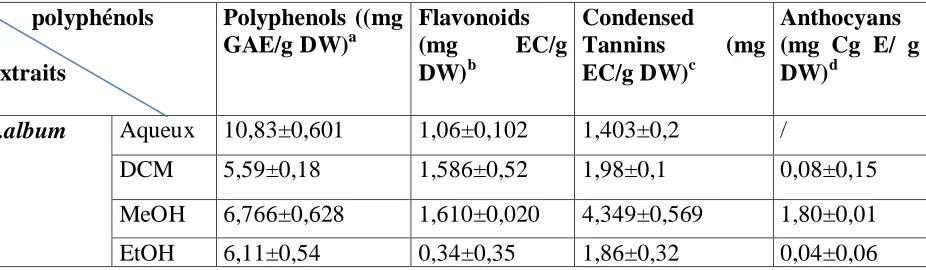
Table 2: Phenolic compound content
a: mg acid galic equivalent/g dry weight. b, c: mg catech in equivalent/g dry weight, d :e cyanidin-3 glucose/ g dry weight (All values are the average of three repeats ± standard deviation)
polyphénols
Extraits
Polyphenols ((mg GAE/g DW)a
Flavonoids
(mg EC/g
DW)b
Condensed
Tannins (mg
EC/g DW)c
Anthocyans (mg Cg E/ g DW)d
Z.album Aqueux 10,83±0,601 1,06±0,102 1,403±0,2 /
DCM 5,59±0,18 1,586±0,52 1,98±0,1 0,08±0,15
MeOH 6,766±0,628 1,610±0,020 4,349±0,569 1,80±0,01
Impact Factor: 1.745 (I2OR)
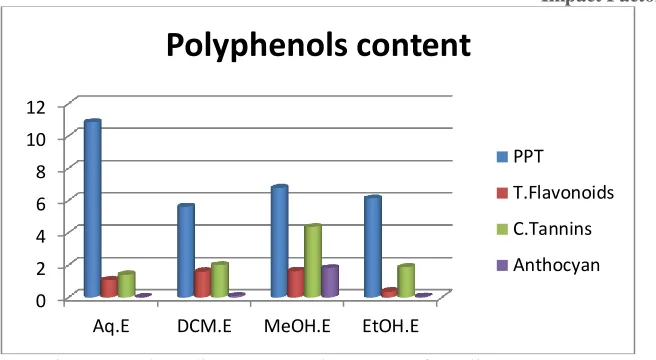
Http://www.ijetmr.com©International Journal of Engineering Technologies and Management Research [1-10] Figure 2: Phenolic compound content of Z.album extracts
Based on the results obtained in Table 02 and figure 02, there was a marked difference in the polyphenol content, but this does not preclude the highest polyphenol content recorded in The aqueous and methanolic extract (10.83 ± 0.601, 6.766 ± 0.628 mg GAE / g), these results are comparable to those found by [9] for aqueous extract and[13] for methanolic extract, but both remain significantly higher than the results found by[20] on the same species from the same region which is Sahara de Ouergla.
For flavonoids, tannins and anthocyanins, the values obtained are generally low, but compared with other studies, we find that our results are higher than those recorded by [20] and more or less close to the values recorded by [21] on ethanolic and methanolic extracts of Z. hamiense from the Sahara of Muhaisnah in Dubai. However, it is difficult to compare our results with those of the bibliography, as several factors may influence the qualitative and quantitative distribution of phenolic compounds in our extracts, mainly climatic and environmental factors: geographical area, drought, soil. [22] and the harvesting period, stage of development and part of the plant used[23], and the method of extraction and quantification. The selectivity of the solvent used can also influence the total polyphenol and flavonoid content [24].
Identification of Phenolic Compounds of Zygophyllum album 0
2 4 6 8 10 12
Aq.E DCM.E MeOH.E EtOH.E
Polyphenols content
PPT
T.Flavonoids
C.Tannins
[Belmimoun et. al., Vol.4 (Iss.5): May, 2017] ISSN: 2454-1907 Impact Factor: 1.745 (I2OR)
Http://www.ijetmr.com©International Journal of Engineering Technologies and Management Research [1-10]
Figure 3: Chromatogram of the relative content of phenolic compounds in Zygophyllum album
plant (A: ESI+ ;B :ESI-)
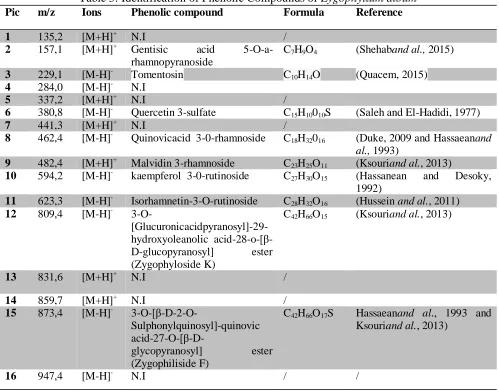
Table 3: Identification of Phenolic Compounds of Zygophyllum album Pic m/z Ions Phenolic compound Formula Reference
1 135,2 [M+H]+ N.I /
2 157,1 [M+H]+ Gentisic acid
5-O-a-rhamnopyranoside
C7H9O4 (Shehaband al., 2015)
3 229,1 [M-H]- Tomentosin C10H14O (Quacem, 2015)
4 284,0 [M-H]- N.I
5 337,2 [M+H]+ N.I /
6 380,8 [M-H]- Quercetin 3-sulfate C15H10010S (Saleh and El-Hadidi, 1977)
7 441,3 [M+H]+ N.I /
8 462,4 [M-H]- Quinovicacid 3-0-rhamnoside C18H32016 (Duke, 2009 and Hassaeanand al., 1993)
9 482,4 [M+H]+ Malvidin 3-rhamnoside C23H25O11 (Ksouriand al., 2013)
10 594,2 [M-H]- kaempferol 3-0-rutinoside C27H30O15 (Hassanean and Desoky,
1992)
11 623,3 [M-H]- Isorhamnetin-3-O-rutinoside C28H32O16 (Hussein and al., 2011)
12 809,4 [M-H]-
3-O- [Glucuronicacidpyranosyl]-29-hydroxyoleanolic acid-28-o-[β-D-glucopyranosyl] ester (Zygophyloside K)
C42H66O15 (Ksouriand al., 2013)
13 831,6 [M+H]+ N.I /
14 859,7 [M+H]+ N.I /
15 873,4 [M-H]-
3-O-[β-D-2-O-Sulphonylquinosyl]-quinovic
acid-27-O-[β-D-glycopyranosyl] ester (Zygophiliside F)
C42H66O17S Hassaeanand al., 1993 and
Ksouriand al., 2013)
Impact Factor: 1.745 (I2OR)
Http://www.ijetmr.com©International Journal of Engineering Technologies and Management Research [1-10] The content of phenolic compounds obtained by LC/MS is shown in Figure 2 and table 3. nine compounds were identified under the analytical conditions used, of which three constitute the major proportion:
Isorhamnetin-3-O-rutinoside (11), Malvidin 3-rhamnoside( 9), Quercitin-3-sulphate (6) and kaempferol 3-0-rutinoside (10) (table 3).
The negative ion mass spectrum exhibited [M-H]- at m/z 623.3, which makes it possible
to propose the chemical formula C28H32O16. Isorhamnetin-3-O-rutinoside is one of the
main phenolic compounds in this species; it corresponds to that previously isolated from the Egyptian species of Z. album. This compound appears to be a chemo-taxonomic marker in the genus Zygophyllum[13].
The flavonoic compounds (9) (m / z 482.4 C23H25O11) are temporarily determined in this
species for the second time after the study of [25]. The remaining two (6) and (10) ), They were already identified and described several times by[19,25].Furthermore, two compounded triterpenoidsaponins (12 and 15) with ions [MH]- at m/z 809.4 (C42H66O15), 873.4 (C42H66O17S) were respectively identified in this species, Zygophyloside K (12) Previously isolated and described from Z. album and decumbens[13,25]. Zygophyloside F (15) was previously described by [26,25,27].
4. CONCLUSION
In conclusion, these results have established that Z. album is a true source of phenolic compounds which disperse according to the mode and the extraction solvent. These data suggest this medicinal halophyte might be avaluable source of bioactive secondary metabolites such as triterpenoidsaponins, sterol andflavonoids with beneficial proprieties, and a promising source of health products forfunctional food or nutraceutical industries.
5. ACKNOWLEDGMENTS
The authors would like to thank the Algerian Ministry of Higher Education and Scientific Research for financial support.
6. REFERENCES
[1] Pereira H.M, Navarro L.M, Martins I. S, Scholes R.J. Curr. Opin. Environ. Sustain., 2012, 4, 139.
[2] Grim F, Bounaga N. 1996. Flavonic polymorphism and chemosystematics of the genus Zygophyllum studied in the Algerian Sahara. Acta Pharm 46: 187–194.
[3] Tigrine-Kordjani N.,B.Y. Meklati and ChematF., 2010.Analysis by gas chromatography– mass spectrometry of the essential oil of Zygophyllum album L., an aromatic and medicinal plant growing in Algeria,The International Journal of Aromatherapy,16, 187– 191.
[4] Hussein, S.R., Marzouk, M.M., Ibrahim, L.F., Kawashty, S.A. &Saleh, N.A.M., 2011.Flavonoids of Zygophyllum album L.f. and Zygophyllum simplex L. (Zygophyllaceae).Biochemical Systematics and Ecology, 39, 778-780.
[Belmimoun et. al., Vol.4 (Iss.5): May, 2017] ISSN: 2454-1907 Impact Factor: 1.745 (I2OR)
Http://www.ijetmr.com©International Journal of Engineering Technologies and Management Research [1-10] [6] AidiWannes W, Mhamdi B, Sriti J, Ben Jemia M, Ouchikh O, Hamdaoui G, Mohamed
Kchouk E, Marzouk B.,2010. Food and ChemicalToxicology., , 48, 1362-1370.
[7] Raffauf R.F.,1996. Plant Alkaloids: A Guide to their Discovery and Ditribution; Ed: FOOD Products Press., 189-190.
[8] Dohou N, Yamni, K., Tahrouch, S, IdrissiHassani, L.M, Badoc, A, Gmira, N, 2003.Soc.Pharm. Bordeaux., 142, 61-78.
[9] Benhamou N. 2011. Antioxidant activity of extracts of the phenolic compounds of ten medicinal plants in the West and Southwest of Algeria, PhD thesis in biology,Tlemcen, Algérie, P54.
[10] Dewanto V., Wu X., Adom K.K., Liu R.H., 2002.J. Agric. Food Chem. 50 :3010–3014. [11] Laouini S.E.,2014. Etude phytochimique et activité biologique d'extrait des feuilles de
Phoenixdactylifera dans la région du Sud d'Algérie (la région d'Oued Souf), PhDthesis in chemistry, Univsity of Biskra, Algeria.
[12] Da Silveira L, Farias S. L. 2014. LC/ESI-MS method applied to characterization of flavonoids glycosides in B. forficata subsp. Vol. 37, No. 3, 483-486.
[13] Ksouri W, Medini F, Mkadmini K, Legault J, Magné C, Abdelly C, Ksouri R. 2013. LC– ESI-TOF–MS identification of bioactive secondary metabolites involved in the antioxidant, anti-inflammatory and anticancer activities of the edible halophyte Zygophyllum album Desf., Food Chemistry 139:1073–1080.
[14] Ghoul JEl, Ben-Attia M., 2014. Vasorelaxant Effects of Aqueous Extract of Zygophyllum Album and Antihyperglycemic Activities in Streptozotocin-Induced Diabetic Mice. J Diabetes Metab 5: 426 doi:10.4172/2155-6156.1000426
[15] Mahmoudi S., Khali M. et Mahmoudi N., 2013. Etude de l’extraction des composés phénoliques de différentes parties de la fleur d’artichaut (Cynarascolymus L.),Journal of Nature and Technologie
[16] Jokić S., D. Velić, M. Bilić, A. Bucić-Kojić, M. Plan inić and Tomas S., 2010. Modelling of the Process of Solid-Liquid Extraction of Total Polyphenols from Soybeans. J. Food Sci. vol. 28. (). pp. 206- 212.
[17] Garcia-Salas P., Morales-Soto A., Segura-Carretero A. and Fernández-Gutiérrez A.,2010.Phenolic-Compound-Extraction Systems for Fruit and Vegetable Samples. Molecules. Vol. 15. pp. 8813- 8826
[18] Boumaza A., 2009. Effet de l’extrait méthanolique de Zygophyllum cornutumcoss contre le stress oxydant associé au diabète sucré et les organes en relation,phDthesis in molecularPhD,University of Constantine,Algeria.
[19] Hussein S, Marzouk M, Ibrahim F, Kawashty S, Saleh N. 2011. Flavonoids of Zygophyllum album L.f. and Zygophyllum simplex L. (Zygophyllaceae),Biochemical Systematics and Ecology 39:778–780.
[20] Belguidoum M., DendouguiH.,andKendourZ., 2012.In vitro antioxidant properties and phenolic contents of Zygophyllum album L. from Algeria. Journal of Chemical and Pharmaceutical Research, 7(1):510-514.
[21] Shehab N.G., Gharbieh E., Bayoumi F., 2015.Impact of phenolic composition on hepatoprotective and antioxidant effects of four desert medicinal plants, BMC Complementary and Alternative Medicine ,15:401
Impact Factor: 1.745 (I2OR)
Http://www.ijetmr.com©International Journal of Engineering Technologies and Management Research [1-10] [23] Miliauskas G., Venskutonis P.R., et Van Beek T.A., 2004. Screening of radical scavenging activity of some medicinal and aromatic plant extract. Food chemistry. 85:231-237.
[24] Lee K.W., Kim Y.J., Lee H.J., et Lee C.Y., 2003. Cocao has more phenolic phytochemicals and a higher antioxidant capacity than teas and red wine. Food chemistry, 51: 7292-7295.
[25] Hassanean HA, Desoky EK. 1992. An acylatedisorhamnetineglucoside from Zygophyllum Simplex. Phytochemistry, 31: 3293-3294.
[26] Elgamal M. H. A., Shaker K. H., Pöllman K., &Seifer K., 1995. Triterpenoidsaponins from Zygophyllum species. Phytochemistry, 40(4), 1233–1236.