
https://doi.org/10.5194/gmd-12-2837-2019 © Author(s) 2019. This work is distributed under the Creative Commons Attribution 4.0 License.
r.sim.terrain 1.0: a landscape evolution model
with dynamic hydrology
Brendan Alexander Harmon1, Helena Mitasova2,3, Anna Petrasova2,3, and Vaclav Petras2,3
1Robert Reich School of Landscape Architecture, Louisiana State University, Baton Rouge, LA, USA 2Center for Geospatial Analytics, North Carolina State University, Raleigh, NC, USA
3Department of Marine, Earth, and Atmospheric Sciences, North Carolina State University, Raleigh, NC, USA
Correspondence:Brendan Alexander Harmon ([email protected]) Received: 20 January 2019 – Discussion started: 25 February 2019
Revised: 12 June 2019 – Accepted: 17 June 2019 – Published: 11 July 2019
Abstract. While there are numerical landscape evolution models that simulate how steady-state flows of water and sediment reshape topography over long periods of time, r.sim.terrain is the first to simulate short-term topographic change for both steady-state and dynamic flow regimes across a range of spatial scales. This free and open-source Geographic Information Systems (GIS)-based topographic evolution model uses empirical models for soil erosion and a physics-based model for shallow overland water flow and soil erosion to compute short-term topographic change. This model uses either a steady-state or unsteady representation of overland flow to simulate how overland sediment mass flows reshape topography for a range of hydrologic soil ero-sion regimes based on topographic, land cover, soil, and rainfall parameters. As demonstrated by a case study for the Patterson Branch subwatershed on the Fort Bragg mili-tary installation in North Carolina, r.sim.terrain simulates the development of fine-scale morphological features including ephemeral gullies, rills, and hillslopes. Applications include land management, erosion control, landscape planning, and landscape restoration.
1 Introduction
Landscape evolution models represent how the surface of the Earth changes over time in response to physical processes. Most studies of landscape evolution have been descriptive, but a number of numerical landscape evolution models have been developed that simulate elevational change over time (Tucker and Hancock, 2010; Temme et al., 2013).
evolu-tion modeling and monitoring, there are still major research questions to address in the theoretical foundations of erosion modeling such as how erosional processes scale over time and space, and how sediment detachment and transport inter-act (Mitasova et al., 2013). While most numerical landscape evolution models simulate erosion processes at steady-state peak flows, short-term erosional processes like gully forma-tion can be driven by unsteady, dynamic flow with significant morphological changes happening before flows reach steady state. A landscape evolution model with dynamic water and sediment flow is needed to study fine-scale spatial and short-term erosional processes such as gully formation and the de-velopment of microtopography.
At the beginning of a rainfall event, overland water flow is unsteady – its depth changes at a variable rate over time and space. If the intensity of rainfall continues to change through-out the event, then the flow regime will remain dynamic. If, however, overland flow reaches a peak rate, then the hydro-logic regime is considered to be at steady state. At steady state,
∂h(x, y, t )
∂t =0, (1)
where (x, y) is the position [m], t is the time [s], and h(x, y, t )is the depth of overland flow [m].
Gullies are eroded, steep-banked channels formed by ephemeral, concentrated flows of water. A gully forms when overland water flow converges in a knickzone – a concave space with steeper slopes than its surroundings (Zahra et al., 2017) – during intense rainfall events. When the force of the water flow concentrated in the knickzone is enough to de-tach and transport large amounts of sediment, an incision be-gins to form at the apex of the knickzone – the knickpoint or headwall. As erosion continues, the knickpoint begins to migrate upslope and the nascent gully channel widens, forming steep channel banks. Multiple incisions initiated by different knickpoints may merge into a gully channel and multiple channels may merge into a branching gully sys-tem (Mitasova et al., 2013). This erosive process is dynamic; the morphological changes drive further changes in a posi-tive feedback loop. When the gully initially forms, the soil erosion regime should be detachment capacity limited with the concentrated flow of water in the channel of the gully detaching large amounts of sediment and transporting it to the foot of the gully, potentially forming a depositional fan. If the intensity of rainfall decreases and transport and de-tachment capacity approach a balance, then the soil erosion regime may switch to a variable erosion–deposition regime, in which soil is eroded and deposited in a spatially vari-able pattern. Subsequent rainfall events may trigger further knickpoint formation and upslope migration, channel inci-sion and widening, and depositional fan and ridge formation. Between high-intensity rainfall events, lower-intensity events and gravitational diffusion may gradually smooth the shape of the gully. Eventually, if detachment capacity significantly
exceeds transport capacity and the regime switches to trans-port capacity limited, the gully may fill with sediment as soil continues to be eroded but cannot be transported far.
Gully erosion rates and evolution can be monitored in the field or modeled on the computer. Field methods in-clude dendrogeomorphology (Malik, 2008) and permanent monitoring stakes for recording erosion rates, extensome-ters for recording mass wasting events, weirs for recording water and suspended sediment discharge rates, and time se-ries of surveys using total station theodolites (Thomas et al., 2004), unmanned aerial systems (UASs) (Jeziorska et al., 2016; Kasprak et al., 2019; Yang et al., 2019), airborne lidar (Perroy et al., 2010; Starek et al., 2011), and terrestrial lidar (Starek et al., 2011; Bechet et al., 2016; Goodwin et al., 2016; Telling et al., 2017). With terrestrial lidar, airborne lidar, and UAS photogrammetry, there are now sufficient-resolution to-pographic data to morphometrically analyze and numerically model fine-scale landscape evolution in GIS, including pro-cesses such as gully formation and the development of micro-topography. Gully erosion has been simulated with RUSLE2-Raster (RUSLER) in conjunction with the Ephemeral Gully Erosion Estimator (EphGEE) (Dabney et al., 2014), while gully evolution has been simulated for detachment-capacity-limited erosion regimes with the Simulation of Water Ero-sion (SIMWE) model (Koco, 2011; Mitasova et al., 2013). Now numerical landscape evolution models that can simulate steady-state and unsteady flow regimes and can dynamically switch between soil erosion regimes are needed to study fine-scale spatial and short-term erosional processes.
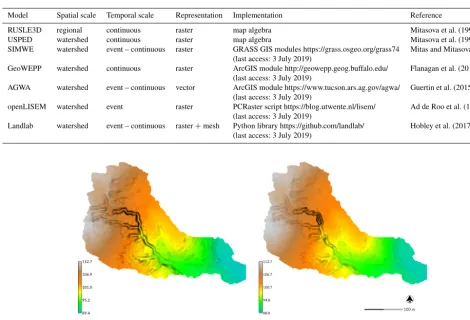
The numerical landscape evolution model r.sim.terrain was developed to simulate the spatiotemporal evolution of landforms caused by shallow overland water and sediment flows at spatial scales ranging from square meters to kilo-meters and temporal scales ranging from minutes to years. This open-source GIS-based landscape evolution model can simulate either steastate or unsteady flow regimes, dy-namically switch between soil erosion regimes, and simu-late the evolution of fine-scale morphological features such as ephemeral gullies (Fig. 1). It was designed as a research tool for studying how erosional processes scale over time and space, comparing empirical and process-based models, com-paring steady-state and unsteady flow regimes, and study-ing the role of unsteady flow regimes in fine-scale morpho-logical change. r.sim.terrain was tested with a subwatershed scale (450 m2) case study and the simulations were compared against a time series of airborne lidar surveys.
2 r.sim.terrain
Table 1.Examples of geospatial soil erosion models.
Model Spatial scale Temporal scale Representation Implementation Reference
RUSLE3D regional continuous raster map algebra Mitasova et al. (1996)
USPED watershed continuous raster map algebra Mitasova et al. (1996)
SIMWE watershed event – continuous raster GRASS GIS modules https://grass.osgeo.org/grass74 Mitas and Mitasova (1998) (last access: 3 July 2019)
GeoWEPP watershed continuous raster ArcGIS module http://geowepp.geog.buffalo.edu/ Flanagan et al. (2013) (last access: 3 July 2019)
AGWA watershed event – continuous vector ArcGIS module https://www.tucson.ars.ag.gov/agwa/ Guertin et al. (2015) (last access: 3 July 2019)
openLISEM watershed event raster PCRaster script https://blog.utwente.nl/lisem/ Ad de Roo et al. (1996) (last access: 3 July 2019)
Landlab watershed event – continuous raster+mesh Python library https://github.com/landlab/ Hobley et al. (2017) (last access: 3 July 2019)
Figure 1.The digital elevation model (DEM)(a)before and(b)after simulated landscape evolution with r.sim.terrain for a subwatershed of Patterson Branch, Fort Bragg, NC, USA. The before DEM was generated from an airborne lidar data acquired in 2012. The simulation used the SIMWE model for a 120 min rainfall event with 50 mm h−1for a variable erosion–deposition regime at steady state. In the evolved DEM, the gully channel has widened with depositional ridges forming along its thalweg.
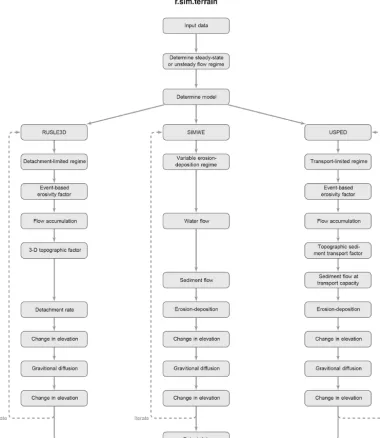
Revised Universal Soil Loss Equation (RUSLE3D) model, or the USPED model (Fig. 2). The r.sim.terrain model can simulate either steady-state or dynamic flow regimes. SIMWE is a physics-based simulation that uses a Monte Carlo path sampling method to solve the water and sediment flow equations for detachment-limited, transport-limited, and variable erosion–deposition soil erosion regimes (Mitas and Mitasova, 1998; Mitasova et al., 2004). With SIMWE, r.sim.terrain uses the modeled flow of sediment – a function of water flow and soil detachment and transport parameters – to estimate net erosion and deposition rates. RUSLE3D is an empirical equation for estimating soil erosion rates in detachment-capacity-limited soil erosion regimes (Mitasova et al., 1996, 2013). With RUSLE3D, r.sim.terrain uses an event-based rainfall erosivity factor, soil erodibility factor, land cover factor, and 3-D topographic factor – a function of slope and flow accumulation – to model soil erosion rates. USPED is a semi-empirical equation for net erosion and de-position in transport-capacity-limited soil erosion regimes (Mitasova et al., 1996, 2013). With USPED, r.sim.terrain
uses an event-based rainfall erosivity factor, soil erodibil-ity factor, land cover factor, and a topographic sediment transport factor to model net erosion or deposition rates as the divergence of sediment flow. For each of the models, topographic change is derived at each time step from the net erosion–deposition rate and gravitational diffusion. De-pending on the input parameters, r.sim.terrain simulations with SIMWE can represent variable soil erosion–deposition regimes, including prevailing detachment-capacity-limited or prevailing transport-capacity-limited regimes.
Figure 2.Conceptual diagram for r.sim.terrain.
SIMWE to regional watersheds of 100 km2with USPED or RULSE3D, although it does not model fluvial processes. It has been used at resolutions ranging from submeter scale to 30 m. The model has been implemented as a Python add-on module for the free, open-source GRASS GIS (https: //grass.osgeo.org/, last access: 3 July 2019) (GRASS Devel-opment Team, 2019). The source code is available at https: //github.com/baharmon/landscape_evolution (last access: 3 July 2019) under the GNU General Public License v2 (Har-mon, 2019a). It supports multithreading and parallel pro-cessing to efficiently compute simulations using large, high-resolution topographic datasets. The landscape evolution model can be installed in GRASS GIS as an add-on module with the command (Harmon, 2019f):
g.extension extension=r.sim.terrain
2.1 Landscape evolution
2.1.1 Elevation change
Assuming negligible uplift, the change in elevation over time is described by the continuity of mass equation expressed as the divergence of sediment flow (Tucker et al., 2001):
∂z
∂t = −∇ ·qs
ρs−1=dsρs−1, (2)
wherezis elevation [m],t is time [s],qs is sediment flow per unit width (vector) [kg m−1s−1],ds is the net erosion–
deposition rate [kg m−2s−1], andρsis sediment mass density
[kg m−3].
In r.sim.terrain, the net erosion–deposition rate ds driven
by overland flow is estimated at different levels of complex-ity based on the simulation mode selected by the user. Grav-itational diffusion is then applied to the changed topography to simulate the smoothing effects of localized soil transport between rainfall events. The change in elevation due to gravi-tational diffusion is a function of the diffusion coefficient and the Laplacian of elevation (Thaxton, 2004):
∂z ∂t =εg∇
2z, (3)
whereεgis the diffusion coefficient [m2s−1].
The discrete implementation follows Thaxton (2004):
zt+1t1 =zt+1zs (4)
zt+1t1+1t2=zt+1t1+1zg, (5)
where1zsis elevation change [m] caused by net erosion or
deposition during time interval1t1 (Eq. 2), and1zg is the
diffusion-driven elevation change [m] during time interval 1t1(Eq. 3).
2.1.2 Erosion–deposition regimes
Following experimental observations and qualitative argu-ments, Foster et al. (1977) proposed that the sum of the ratio of the net erosion–deposition ratedsto the detachment
capac-ityDc [kg m−2s−1] and the ratio of the sediment flow rate
qs= |qs|to the sediment transport capacityTc[kg m−1s−1]
is a conserved quantity (unity): ds
Dc +qs
Tc
=1. (6)
The net erosion and deposition ratedscan then be expressed
as being proportional to the difference between the sediment transport capacityTcand the actual sediment flow rateqs:
ds=
Dc
Tc
Tc−qs. (7)
This principle is used in several erosion models including the Water Erosion Prediction Project (WEPP) (Flanagan et al., 2013) and SIMWE (Mitas and Mitasova, 1998).
Using this concept, it is possible to identify two limiting erosion–deposition regimes. WhenTcDcleading toTc
qs, the erosion regime is detachment capacity limited and net
erosion is equal to the detachment capacity:
ds=Dc. (8)
For this case, the transport capacity of overland flow exceeds the detachment capacity, and thus sediment flow, erosion, and sediment transport are limited by the detachment capacity. Therefore, no deposition occurs. An example of this case is when a strong storm producing intense overland flow over compacted clay soils causes high-capacity flows to trans-port light clay particles, while the detachment of compacted soils is limited. WhenDcTc, sediment flow is at sediment
transport capacityqs=Tc, leading to a
transport-capacity-limited regime with deposition reaching its maximum extent for the given water flow. Net erosion–deposition is computed as the divergence of transport capacity multiplied by a unit vectors0in the direction of flow:
ds= ∇ ·(Tcs0) . (9)
This case may occur, for example, during a moderate storm with overland flow over sandy soils with high detachment ca-pacity but low transport caca-pacity. For 0< (Dc/Tc) <∞, the
spatial pattern of net erosion–deposition is variable and de-pends on the difference between the sediment transport ca-pacity and the actual sediment flow rate at the given location. The detachment capacity Dc and the sediment transport
capacityTcare estimated using shear stress and stream power
equations, respectively, expressed as power functions of wa-ter flow properties and slope angle. The relations between the topographic parameters of well-known empirical equations for erosion modeling, such as the Universal Soil Loss Equa-tion (USLE) and stream power, were presented by Moore and Burch (1986) and used to develop simple, GIS-based models for limiting erosion–deposition cases such as RUSLE3D and USPED (Mitasova and Mitas, 2001). The SIMWE model es-timatesTcandDc using modified equations and parameters
developed for the WEPP model (Flanagan et al., 2013; Mi-tasova et al., 2013).
The simulation modes in r.sim.terrain include (Fig. 2) – the process-based SIMWE model for steady-state and
unsteady shallow overland flow in variable erosion– deposition regimes with ds computed by solving the
shallow water flow and sediment transport continuity equations,
– the RUSLE3D model for detachment-capacity-limited cases withdsgiven by Eq. (8), and
– the USPED model for transport-capacity-limited regimes withdsgiven by Eq. (9).
The following sections explain the computation ofds for
2.2 Simulation of Water Erosion (SIMWE)
SIMWE is a physics-based simulation of shallow overland water and sediment flow that uses a path sampling method to solve the continuity equations with a 2-D diffusive wave approximation (Mitas and Mitasova, 1998; Mitasova et al., 2004). SIMWE has been implemented in GRASS GIS as the modules r.sim.water and r.sim.sediment. In SIMWE mode, for each landscape evolution time step, r.sim.terrain
– computes the first-order partial derivatives of the eleva-tion surface∂z/∂xand∂z/∂y,
– simulates shallow water flow depth, sediment flow, and the net erosion–deposition rate, and
– then evolves the topography based on the erosion– deposition rate and gravitational diffusion.
The first-order partial derivatives of the elevation surface are computed using the GRASS GIS module r.slope.aspect using the equations in Hofierka et al. (2009). r.sim.terrain simulates unsteady-state flow regimes when the landscape evolution time step is less than the travel time for a drop of water or a particle of sediment to cross the landscape, e.g., when the time step is less than the time to concentration for the mod-eled watershed. With longer landscape evolution time steps, the model simulates a steady-state regime.
2.2.1 Shallow water flow
The SIMWE model simulates shallow overland water flow controlled by spatially variable topographic, soil, land cover, and rainfall parameters using a Green function Monte Carlo path sampling method. The steady-state shallow water flow continuity equation relates the change in water depth across space to source, defined in our case as rainfall excess rate: ∇ ·q= ∇ ·(hv)= ∇ ·n−1h5/3s1/2s0
=ie, (10)
whereqis the water flow per unit width (vector) [m2s−1],h is the depth of overland flow [m],vis the water flow veloc-ity vector [m s−1] whose magnitude is computed with Man-ning’s equationv=n−1h2/3s1/2,nis Manning’s coefficient [s m−1/3],s is slope (unitless), andie is the rainfall excess
rate [m s−1] (i.e., rainfall intensity −infiltration− vegeta-tion intercept).
An approximation of diffusive wave effects is incorporated by adding a diffusion term proportional to∇2[h5/3]: −εw
2 ∇
2h5/3+ ∇ ·n−1h5/3s1/2s 0
=ie, (11)
where εw is a spatially variable diffusion coefficient
[m4/3s−1].
The path sampling method solves the continuity equation for h5/3 through the accumulation of the evolving source (Mitasova et al., 2004). The solution assumes that water flow
velocity is largely controlled by the slope of the terrain and surface roughness and that its change at a given location dur-ing the simulated event is negligible. The initial number of particles per grid cell is proportional to the rainfall excess rateie (source). The water depthh5/3 at timeτ during the
simulated rainfall event is computed as a function of particle (walkers) density at each grid cell. Particles are routed across the landscape by finding a new position for each walker at timeτ+1τ:
rnewm =rm+1τv+g, (12) wherer=(x, y) is themth walker position [m],1τ is the particle routing time step [s], andgis a random vector with Gaussian components with variance1τ [m].
The mathematical background of the method, including the computation of the temporal evolution of water depth and incorporation of approximate momentum through an in-creased diffusion rate in the prevailing direction of flow, is presented by Mitas and Mitasova (1998) and Mitasova et al. (2004).
2.2.2 Sediment flow and net erosion–deposition
The SIMWE model simulates the sediment flow over com-plex topography with spatially variable overland flow, soil, and land cover properties by solving the sediment flow con-tinuity equation using a Green function Monte Carlo path sampling method. Steady-state sediment flowqsis approxi-mated by the bivariate continuity equation, which relates the change in sediment flow rate to effective sources and sinks: ∇ ·qs=sources−sinks=ds. (13)
The sediment flow rateqs is a function of water flow and sediment concentration (Mitas and Mitasova, 1998): qs=ρscq=ρsc hv=%v, (14)
where ρs is sediment mass density in the water column
[kg m−3], c is sediment concentration [particle m−3], and %=ρschis the mass of sediment transported by water per
unit area [kg m−2].
The sediment flow equation (Eq. 13), like the water flow equation, has been rewritten to include a small diffusion term that is proportional to the mass of water-carried sediment per unit area∇2%(Mitas and Mitasova, 1998):
−εs 2∇
2%+ ∇ ·(%v)+%Dc
Tc
|v| =ds, (15)
whereεsis the diffusion constant [m2s−1].
soil detachment capacityDc(source). The particles are then
routed across the landscape by finding a new position for each walker at timeτ+1τ:
rnewm =rm+1τv+g, (16) while the updated weight is
wmnew=wmexp−1τ u rnewm
+
u (rm)/2, (17) whereu=(Dc/Tc)|v|.
Sediment flow is computed as the product of weighted par-ticle densities and the water flow velocity (Eq. 14), and the net erosion–deposition ratedsis computed as the divergence
of sediment flow using Eq. (13). See Mitas and Mitasova (1998) and Mitasova et al. (2004) for more details on the Green function Monte Carlo solution and equations for com-putingDcandTc.
This model can simulate erosion regimes from prevail-ing detachment-limited conditions whenTcDcto
prevail-ing transport-capacity-limited conditions whenDcTcand
the erosion–deposition patterns between these conditions. At each landscape evolution time step, the regime can change based on the ratio between the sediment detachment capac-ityDcand the sediment transport capacityTcand the actual
sediment flow rate. If the landscape evolution time step is shorter than the time to concentration (i.e., the time for water to reach steady state), then net erosion–deposition is derived from unsteady flow.
2.3 Revised Universal Soil Loss Equation for Complex Terrain (RUSLE3D)
RUSLE3D is an empirical model for computing erosion in a detachment-capacity-limited soil erosion regime for wa-tersheds with complex topography (Mitasova et al., 1996). It is based on the USLE, an empirical equation for esti-mating the average sheet and rill soil erosion from rainfall and runoff on agricultural fields and rangelands with sim-ple topography (Wischmeier et al., 1978). It models erosion-dominated regimes without deposition in which sediment transport capacity is uniformly greater than detachment ca-pacity. In USLE, soil loss per unit area is determined by an erosivity factorR, a soil erodibility factorK, a slope length factor L, a slope steepness factor S, a cover management factor C, and a prevention measures factorP. These fac-tors are empirical constants derived from an extensive col-lection of measurements on 22.13 m standard plots with an average slope of 9 %. RUSLE3D was designed to account for more complex, 3-D topography with converging and diverg-ing flows. In RUSLE3D, the topographic potential for ero-sion at any given point is represented by a 3-D topographic factor LS3-D, which is a function of the upslope contributing
area and the angle of the slope.
In this spatially and temporally distributed model, RUSLE3D is modified by the use of a event-based R fac-tor derived from rainfall intensity at each time step. For each
time step, this model computes the parameters for RUSLE3D – an event-based erosivity factor, the slope of the topogra-phy, the flow accumulation, and the 3-D topographic factor – and then solves the RUSLE3D equation for the rate of soil loss (i.e., the net soil erosion rate). The soil erosion rate is then used to simulate landscape evolution in a detachment-capacity-limited soil erosion regime.
2.3.1 Erosivity factor
The erosivity factorR in USLE and RUSLE is the combi-nation of the total energy and peak intensity of a rainfall event, representing the interaction between the detachment of sediment particles and the transport capacity of the flow. It can be calculated as the product of the the kinetic energy of the rainfall eventEand its maximum 30 min intensityI30
(Brown and Foster, 1987; Renard et al., 1997; Panagos et al., 2015, 2017). In this model, however, the erosivity factor is derived at each time step as a function of kinetic energy, rain-fall depth, rainrain-fall intensity, and time. First, rain energy is derived from rainfall intensity (Brown and Foster, 1987; Yin et al., 2017):
er
e0
=1.−bexp
i
r i0
, (18)
whereer is unit rain energy [MJ ha−1mm−1],ir is rainfall
intensity [mm h−1], b is empirical coefficient, i0 is
refer-ence rainfall intensity [mm h−1], ande0is reference energy
[MJ ha−1mm−1]. The parameters for this equation were de-rived from observed data published for different regions by Panagos et al. (2017). Then the event-based erosivity index Re is calculated as the product of unit rain energy, rainfall
depth, rainfall intensity, and time:
Re=ervrir1t, (19)
where Re is the event-based erosivity index
[MJ mm ha−1h−1], vr is the rainfall depth [mm] derived
fromvr=ir1t, and1tis the change in time [s].
2.3.2 Flow accumulation
Figure 3.Water and sediment flows modeled with spatially variable land cover for Patterson Branch, Fort Bragg, NC:(a)water depth [m] simulated by SIMWE for a 10 min event with 50 mm h−1in the subwatershed;(b)flow accumulation for RUSLE3D in the subwatershed; (c)erosion and deposition [kg m−2s−1] simulated by SIMWE in drainage area 1; and(d)erosion [kg m−2s−1] modeled by RUSLE3D in drainage area 1.
2.3.3 3-D topographic factor
The 3-D topographic factor LS3-Dis calculated as a function
of the upslope contributing area and the slope (Fig. 3e): LS3-D=(m+1)
a
a0
msinβ
β0 n
, (20)
where LS3-Dis the dimensionless topographic factor,ais
up-slope contributing area per unit width [m],a0is the length of
the standard USLE plot [22.1 m],βis the angle of the slope [◦],mis an empirical coefficient,n is an empirical coeffi-cient, andβ0is the slope of the standard USLE plot [5.14◦].
The empirical coefficients mandnfor the upslope con-tributing area and the slope can range from 0.2 to 0.6 and 1.0 to 1.3, respectively, with low values representing dominant sheet flow and high values representing dominant rill flow. 2.3.4 Detachment-limited erosion rate
The erosion rate is a function of the event-based erosivity fac-tor, soil erodibility facfac-tor, 3-D topographic facfac-tor, land cover factor, and prevention measures factor (Fig. 3d):
E=ReKLS3-DCP , (21)
whereE is soil erosion rate (soil loss) [kg m−2min−1],Re
is the event-based erosivity factor [MJ mm ha−1h−1],K is the soil erodibility factor [t ha h ha−1MJ−1mm−1], LS3-Dis
the dimensionless topographic (length–slope) factor,Cis the dimensionless land cover factor, andP is the dimensionless prevention measures factor.
The detachment-limited erosion represented by RUSLE3D leads to the simulated change in elevation:
1zs=Dcρs−1=Eρs−1, (22)
fac-tors adopted from USLE and RUSLE (Mitasova et al., 1996). Sediment flow is estimated by computing the event-based erosivity factor (Re) using Eq. (19), the slope and aspect of
the topography, the flow accumulation with a multiple flow direction algorithm, the topographic sediment transport fac-tor, and sediment flow at transport capacity. Net erosion– deposition is then computed as the divergence of sediment flow.
2.4.1 Topographic sediment transport factor
Using the unit stream power concept presented by Moore and Burch (1986), the 3-D topographic factor (Eq. 20) for RUSLE3D is modified to represent the topographic sediment transport factor (LST) – the topographic component of
over-land flow at sediment transport capacity:
LST=am(sinβ)n, (23)
where LST is the topographic sediment transport factor, a
is the upslope contributing area per unit width [m],β is the angle of the slope [◦],mis an empirical coefficient, andnis an empirical coefficient.
2.4.2 Transport-limited sediment flow and net erosion–deposition
Sediment flow at transport capacity is a function of the event-based rainfall factor, soil erodibility factor, topographic sedi-ment transport factor, land cover factor, and prevention mea-sures factor:
T =ReKCPLST, (24)
whereT is sediment flow at transport capacity [kg m−1s−1], Reis the event-based rainfall factor [MJ mm ha−1h−1],Kis
the soil erodibility factor [t ha h ha−1MJ−1mm−1],Cis the dimensionless land cover factor, andP is the dimensionless prevention measures factor.
Net erosion–deposition is estimated as the divergence of sediment flow, assuming that sediment flow is equal to sedi-ment transport capacity:
ds=
∂ (Tccosα)
∂x +
∂ (Tcsinα)
∂y , (25)
wheredsis net erosion–deposition [kg m−2s−1],αis the
as-pect of the topography (i.e., the direction of flow) [◦]. With USPED, the simulated change in elevation 1zs=ds is
de-rived from Eq. (2) for landscape evolution and then Eq. (3) for gravitational diffusion.
3 Case study
Military activity is a high-impact land use that can cause significant physical alteration to the landscape. Erosion is a
major concern for military installations, particularly at train-ing bases, where the land surface is disturbed by off-road vehicles, foot traffic, and munitions. Off-road vehicles and foot traffic by soldiers cause the loss of vegetative cover, the disruption of soil structure, soil compaction, and in-creased runoff due to reduced soil capacity for water infil-tration (Webb and Wilshire, 1983; McDonald, 2004). Gullies – ephemeral channels with steep headwalls that incise into unconsolidated soil to depths of meters – are a manifesta-tion of erosion common to military training installamanifesta-tions like Fort Bragg in North Carolina and the Piñon Canyon Maneu-ver Site in Colorado. While the local development of gul-lies can restrict the maneuverability of troops and vehicles during training exercises, pervasive gullying across a land-scape can degrade an entire training area (Huang and Nie-mann, 2014). To test the effectiveness of the different mod-els in r.sim.terrain, we compared the simulated evolution of a highly eroded subwatershed of Patterson Branch on Fort Bragg, North Carolina, against a time series of airborne li-dar surveys. The models – SIMWE, RUSLE3D, and USPED – were tested in steady-state and dynamic modes for design storms with constant rainfall.
3.1 Patterson Branch
With 650 km2of land, Fort Bragg is the largest military in-stallation in the US and has extensive areas of bare, erodible soils on impact areas, firing ranges, landing zones, and drop zones. It is located in the Sandhills region of North Carolina with a longleaf pine and wiregrass ecosystem (Sorrie et al., 2006). The study landscape – a subwatershed of Patterson Branch (Fig. 4) in the Coleman Impact Area – is pitted with impact craters from artillery and mortar shells and has an active, approximately 2 m deep gully. It is a pine-scrub oak Sandhills community composed primarily of longleaf pine (Pinus palustris) and wiregrass (Aristida stricta) on Blaney and Gilead loamy sands (Sorrie, 2004). Throughout the Cole-man Impact Area, frequent fires ignited by live munitions drive the ecological disturbance regime of this fire-adapted ecosystem. In 2016, the 450 m2study site was 43.24 % bare ground with predominately loamy sands, 39.54 % covered by the wiregrass community, and 17.22 % forested with the longleaf pine community (Fig. 5a). We hypothesize that the elimination of forest cover in the impact zone triggered ex-tensive channelized overland flow, gully formation, and sed-iment transport into the creek.
Figure 4.Subwatershed with 2014 orthoimagery(a)draped over the 2016 digital elevation model and(b)drainage areas with 2014 orthoim-agery, Patterson Branch, Fort Bragg, NC, USA.
in a time series of 1 m resolution orthoimagery collected by the National Agriculture Imagery Program. The land cover maps were derived from the classified lidar point clouds and the classified orthoimagery. Spatially variable soil erosion factors – the k factor, cfactor, Manning’s coefficient, and runoff rate – were then derived from the land cover and soil maps. The dataset for this study is hosted at https:// github.com/baharmon/landscape_evolution_dataset (last ac-cess: 3 July 2019) under the ODC Open Database License (ODbL) (Harmon, 2019b). The data are derived from pub-licly available data from the US Army, USGS, USDA, Wake County GIS, NC Floodplain Mapping Program, and the NC State Climate Office. There are detailed instructions for preparing the input data in the tutorial (https://github.com/ baharmon/landscape_evolution/blob/master/tutorial.md, last access: 3 July 2019, Harmon, 2019c) and a complete record of the commands used to process the sample data in the data log (https://github.com/baharmon/landscape_evolution_ dataset/blob/master/nc_spm_evolution/DATA.md, last ac-cess: 3 July 2019, Harmon, 2019d).
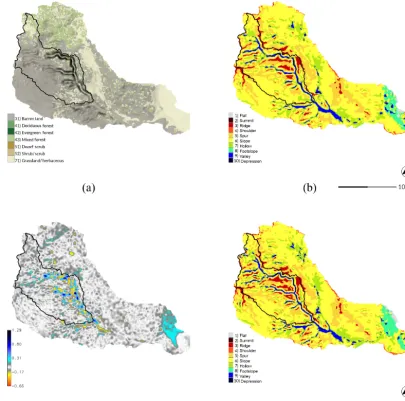
We used the geomorphons method of automated landform classification based on the openness of terrain (Jasiewicz and Stepinski, 2013) and the difference between the digital el-evation models to analyze the changing morphology of the study area (Figs. 5 and 6). The 2 m deep gully – its channels classified as valleys and its scour pits as depressions by ge-omorphons – has multiple mature branches and ends with a depositional fan. The gully has also developed depositional ridges beside the channels. Deep scour pits have developed where branches join the main channel and where the main channel has sharp bends. A new branch has begun to form in a knickzone classified as a mix of valleys and hollows on a grassy swale on the northeast side of the gully. Between 2012 and 2016 a depositional ridge developed at the foot of this
nascent branch where it would meet the main channel. The 2016 minus 2012 DEM of difference (DoD) – i.e., the differ-ence in elevation (Figs. 5c and 6c) – shows a deepening of the main channel by approximately 0.2 m and scours pits by ap-proximately 1 m, while depositional ridges have formed and grown up to approximately 1 m high. The DoD also shows that 244.60 m3 of sediment were deposited on the deposi-tional fan between 2012 and 2016.
3.2 Simulations
Figure 5.Morphological change in the subwatershed of Patterson Branch, Fort Bragg, NC, USA:(a)land cover in 2014,(b)landforms in 2012,(c)elevation difference between 2012 and 2016 [m], and(d)landforms in 2016.
Table 2.Landscape evolution simulations.
Flow regime Model Intensity Duration Interval m n ρs Threads Runtime
Dynamic RUSLE3D 50 mm h−1 120 min 3 min 0.4 1.3 2 min 36 s
Dynamic USPED 50 mm h−1 120 min 3 min 1.5 1.2 1.6 3 min 14 s
Steady state SIMWE 50 mm h−1 120 min 120 min 1.6 6 44 min 51 s
The simulations were automated and run in parallel us-ing Python scripts that are available in the software reposi-tory (https://github.com/baharmon/landscape_evolution, last access: 3 July 2019, Harmon, 2019a). The simulations can be reproduced using these scripts and the study area dataset by following the instructions in the Open Science Framework repository at https://osf.io/tf6yb/ (last access: 3 July 2019). The simulations were run in GRASS GIS 7.4 on a
Figure 6.Detailed morphological change for drainage area 1 of Patterson Branch, Fort Bragg, NC, USA:(a)land cover in 2014,(b)landforms in 2012,(c)elevation difference between 2012 and 2016 [m], and(d)landforms in 2016.
3.3 Results
We used the difference in DEMs to compute volumetric changes between the lidar surveys and the simulations (Ta-ble 3). We applied a threshold of±0.18 m to the lidar surveys since they had a vertical accuracy at a 95 % confidence level of 18.15 cm based on a 9.25 cm root mean square error in z(RMSEz) for non-vegetated areas in accordance with the National Digital Elevation Program guidelines (North Car-olina Risk Management Office, 2018). Given the presence of the mature gully with ridges along its banks, we hypothe-size that the study landscape had previously been dominated by a detachment-limited soil erosion regime but – given the net change of 654.77 m3– had switched to a transport-capacity-limited or variable erosion–deposition regime dur-ing our study period.
The dynamic RUSLE3D simulation carved a deep incision in the main gully channel where water accumulated (Fig. 7). As a detachment-capacity-limited model, RUSLE3D’s re-sults were dominated by erosion and thus negative elevation change. It eroded 1480.75 m3 of sediment with no deposi-tion.
Figure 7.Dynamic simulation with RUSLE3D for a 120 min event with a rainfall intensity of 50 mm h−1for Patterson Branch, Fort Bragg, NC: (a)flow accumulation and(b) erosion [kg m−2s−1] for the subwatershed in the final 3 min time step;(c)net difference [m] and (d)landforms for drainage area 1.
Table 3.Volumetric change.
Difference of DEMs (DoD) Threshold [m] Erosion [m3] Deposition [m3] Net change [m3]
2016–2012 ±0.18 152.96 807.74 654.77
Simulated with RUSLE3D – 2012 None 1480.75 0 −1480.75
Simulated with USPED – 2012 None 1235.08 727.46 −507.62
Simulated with SIMWE – 2012 None 758.56 608.91 −149.664
The steady-state SIMWE simulation for a variable erosion–deposition regime predicted the morphological pro-cesses and features expected of its regime including gradual aggradation, channel widening, the formation of depositional ridges along the thalweg of the channel, and the develop-ment of the depositional fan (Fig. 9). SIMWE was the closest to the observed baseline volumetric change. It balanced ero-sion and deposition with 785.56 m3of sediment eroded and 608.91 m3deposited for a net change of−149.66 m3. Only
the SIMWE simulation deposited sediment on the deposi-tional fan. While the difference of lidar surveys showed that 244.60 m3of sediment were deposited on the fan, SIMWE predicted that 54.05 m3would be deposited.
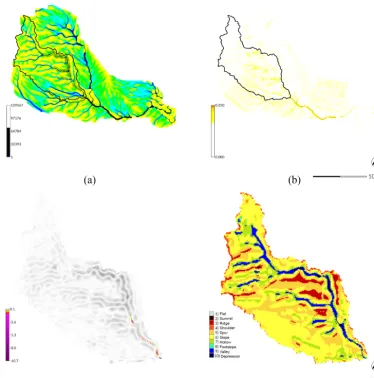
Figure 8.Dynamic simulation with USPED for a 120 min event with a rainfall intensity of 50 mm h−1for Patterson Branch, Fort Bragg, NC:(a)flow accumulation and(b)erosion–deposition [kg m−2s−1] for the subwatershed in the final 3 min time step;(c)net difference [m] and(d)landforms for drainage area 1.
simulated the key morphological patterns and processes – channel incision, filling, and widening. Given their speed and approximate modeling of erosive processes, RUSLE3D and USPED are effective for simulating landscape evolution on large rasters. RUSLE3D, for example, has been used to model erosion for the entire 650 km2Fort Bragg installation at 9 m resolution (Levine et al., 2018).
4 Discussion
Limitations of this landscape evolution model include shal-low overland fshal-low, units, computation time, and raster size. r.sim.terrain only models shallow overland flows, not fluvial processes or subsurface flows. It requires data – including elevation and rainfall intensity – in metric units. The im-plementation of SIMWE in GRASS GIS is computation-ally intensive and may require long computation times even
with multithreading. Because SIMWE uses a Green func-tion Monte Carlo solufunc-tion of the sediment transport equafunc-tion, the accuracy, detail, and smoothness of the results depend on the number of random walkers. While a large number of random walkers will reduce the numerical error in the path sampling solution, it will also greatly increase computation time. A customized compilation of GRASS GIS is needed to run SIMWE with more than 7 million random walkers. This limits the size of rasters that can be easily processed with SIMWE, while RUSLE3D and USPED are much faster, computationally efficient, and can easily be run on much larger rasters.
Figure 9.Steady-state SIMWE simulations for a 120 min event with a rainfall intensity of 50 mm h−1for Patterson Branch, Fort Bragg, NC: (a)depth of unsteady flow [m] and(b)erosion–deposition [kg m−2s−1] for the subwatershed;(c)net difference [m] and(d)landforms for drainage area 1.
landscape restoration. Planned enhancements to the model include modeling subsurface flows, accounting for bedrock, and a reverse landscape evolution mode for backward mod-eling.
5 Conclusions
The short-term landscape evolution model r.sim.terrain can simulate the development of gullies, rills, and hillslopes by overland water erosion for a range of hydrologic and soil erosion regimes. The model is novel for simulating land-scape evolution based on unsteady flows. The landland-scape evo-lution model was tested with a series of simulations for different hydrologic and soil erosion regimes for a highly eroded subwatershed on Fort Bragg with an active gully. For each regime, it generated the morphological processes and features expected. The physics-based SIMWE model
simulated morphological processes for a variable erosion– deposition regime such as gradual aggradation, channel widening, scouring, the development of depositional ridges along the thalweg, and the growth of the depositional fan. The empirical RUSLE3D model simulated channel incision in a detachment-limited soil erosion regime, while the semi-empirical USPED model simulated channel widening and filling in a transport-limited regime. Since r.sim.terrain is a GIS-based model that simulates fine-scale morphological processes and features, it can easily and effectively be used in conjunction with other GIS-based tools for geomorpho-logical research, land management and conservation, erosion control, and landscape restoration.
model, GIS, and dependencies are all free and open source, the study can easily be reproduced. The landscape evolution model has been implemented in Python as a module for GRASS GIS, a free and open-source GIS. The source code for the model is hosted on GitHub at https://github.com/baharmon/landscape_evolution (last access: 3 July 2019) under the GNU General Public License version 2 (Harmon, 2019a). The code repository also includes Python scripts for running and reproducing the simulations in this paper. The digital object identifier (DOI) for the version of the software documented in this paper is https://doi.org/10.5281/zenodo.3243699 (Harmon, 2019a). There are detailed instructions for running this model in the manual at https://grass.osgeo.org/grass76/manuals/addons/r.sim.terrain.html (last access: 3 July 2019) (Harmon, 2019f) and the tutorial at https://github.com/baharmon/landscape_evolution/blob/master/ tutorial.md (last access: 3 July 2019) (Harmon, 2019c). The geospatial dataset for the study area is available on GitHub at https://github.com/baharmon/landscape_evolution_dataset (last access: 3 July 2019) (Harmon, 2019b) under the Open Database License (https://opendatacommons.org/licenses/odbl/, last access: 3 July 2019) with the DOI: https://doi.org/10.5281/zenodo.3243700 (Harmon, 2019b). The data log (https://github.com/baharmon/ landscape_evolution_dataset/blob/master/nc_spm_evolution/ DATA.md, last access: 3 July 2019) has a complete record of the commands used to process the sample data. The source code, scripts, data, and results are also hosted on the Open Science Framework at https://osf.io/tf6yb/ (last access: 3 July 2019) (Har-mon, 2019e) with the DOI https://doi.org/10.17605/osf.io/tf6yb (Harmon, 2019e).
Author contributions. BH developed the models, code, data, case studies, and manuscript. HM contributed to the development of the models and case studies and revised the manuscript. AP and VP contributed to the development of the code. All authors read and approved the final manuscript.
Competing interests. The authors declare that they have no conflict of interest.
Acknowledgements. We acknowledge the GRASS GIS Develop-ment Community for developing and maintaining GRASS GIS.
Review statement. This paper was edited by Bethanna Jackson and reviewed by three anonymous referees.
References
Barton, C. M., Ullah, I., and Mitasova, H.: Computational Mod-eling and Neolithic Socioecological Dynamics: a Case Study from Southwest Asia, Am. Antiquity, 75, 364–386, available at: http://www.jstor.org/stable/25766199 (last access: 3 July 2019), 2010.
Bechet, J., Duc, J., Loye, A., Jaboyedoff, M., Mathys, N., Malet, J.-P., Klotz, S., Le Bouteiller, C., Rudaz, B., and Travelletti, J.: Detection of seasonal cycles of erosion processes in a black marl gully from a time series of high-resolution digi-tal elevation models (DEMs), Earth Surf. Dynam., 4, 781–798, https://doi.org/10.5194/esurf-4-781-2016, 2016.
Braun, J. and Sambridge, M.: Modelling landscape evolution on ge-ological time scales: a new method based on irregular spatial dis-cretization, Basin Res., 9, 27–52, https://doi.org/10.1046/j.1365-2117.1997.00030.x, 1997.
Brown, L. C. and Foster, G. R.: Storm Erosivity Using Ide-alized Intensity Distributions, Transactions of the Amer-ican Society of Agricultural Engineers, 30, 0379–0386, https://doi.org/10.13031/2013.31957, 1987.
Coulthard, T. J., Macklin, M. G., and Kirkby, M. J.: A cellular model of Holocene upland river basin and allu-vial fan evolution, Earth Surf. Proc. Land., 27, 269–288, https://doi.org/10.1002/esp.318, 2002.
Coulthard, T. J., Hancock, G. R., and Lowry, J. B. C.: Modelling soil erosion with a downscaled landscape evo-lution model, Earth Surf. Proc. Land., 37, 1046–1055, https://doi.org/10.1002/esp.3226, 2012.
Dabney, S., Vieira, D., Bingner, R., Yoder, D., and Altinakar, M.: Modeling Agricultural Sheet, Rill and Ephemeral Gully Erosion, in: ICHE 2014. Proceedings of the 11th International Conference on Hydroscience & Engineering, Karlsruhe, 1119–1126, 2014. Ehlschlaeger, C.: Using the ATSearch Algorithm to Develop
Hy-drologic Models from Digital Elevation Data, in: Proceedings of International Geographic Information Systems (IGIS) Sym-posium ’89, Baltimore, MD, 275–281, MArch 1989.
Flanagan, D. C., Frankenberger, J. R., Cochrane, T. A., Renschler, C. S., and Elliot, W. J.: Geospatial Application of the Water Ero-sion Prediction Project (WEPP) Model, T. ASABE, 56, 591–601, https://doi.org/10.13031/2013.42681, 2013.
Foster, G., Meyer, L., and Onstad, C.: An erosion equation derived from basic erosion principles, T. ASAE, 20, 678–682, 1977. Goodwin, N. R., Armston, J., Stiller, I., and Muir, J.:
As-sessing the repeatability of terrestrial laser scanning for monitoring gully topography: A case study from Arat-ula, Queensland, Australia, Geomorphology, 262, 24–36, https://doi.org/10.1016/j.geomorph.2016.03.007, 2016. GRASS Development Team: GRASS GIS, available at: https://
grass.osgeo.org, last access: 3 July 2019.
Guertin, D. P., Goodrich, D. C., Burns, I. S., Korgaonkar, Y., Bar-low, J., Sheppard, B. S., Unkrich, C., and Kepner, W.: Auto-mated Geospatial Watershed Assessment Tool (AGWA), 120– 130, https://doi.org/10.1061/9780784479322.012, 2015. Harmon, B. A.: r.sim.terrain, available at: https://github.com/
baharmon/landscape_evolution, last access: 3 July 2019a. Harmon, B. A.: Landscape Evolution Dataset, available at: https://
github.com/baharmon/landscape_evolution_dataset, last access: 3 July 2019b.
Harmon, B. A.: Landscape Evolution Tutorial, available at: https://github.com/baharmon/landscape_evolution/blob/master/ tutorial.md, last access: 3 July 2019c.
Harmon, B. A.: Landscape Evolution Repository, available at: https: //osf.io/tf6yb/, last access: 3 July 2019e.
Harmon, B. A.: r.sim.terrain, available at: https://grass.osgeo.org/ grass76/manuals/addons/r.sim.terrain.html, last access: 3 July 2019f.
Hobley, D. E. J., Adams, J. M., Nudurupati, S. S., Hutton, E. W. H., Gasparini, N. M., Istanbulluoglu, E., and Tucker, G. E.: Cre-ative computing with Landlab: an open-source toolkit for build-ing, couplbuild-ing, and exploring two-dimensional numerical mod-els of Earth-surface dynamics, Earth Surf. Dynam., 5, 21–46, https://doi.org/10.5194/esurf-5-21-2017, 2017.
Hofierka, J., Mitášová, H., and Neteler, M.: Geomorphometry in GRASS GIS, in: Developments in Soil Science, edited by: Hengl, T. and Reuter, H. I., Elsevier, 33, 387–410, https://doi.org/10.1016/S0166-2481(08)00017-2, 2009. Huang, X. and Niemann, J. D.: Simulating the impacts of small
con-vective storms and channel transmission losses on gully evolu-tion, in: Military Geosciences in the Twenty-First Century, edited by Harmon, R. S., Baker, S. E., and McDonald, E. V., Geo-logical Society of America, https://doi.org/10.1007/978-1-4020-3105-2_18, 2014.
Jasiewicz, J. and Stepinski, T. F.: Geomorphons – a pat-tern recognition approach to classification and map-ping of landforms, Geomorphology, 182, 147–156, https://doi.org/10.1016/j.geomorph.2012.11.005, 2013. Jeziorska, J., Mitasova, H., Petrasova, A., Petras, V., Divakaran, D.,
and Zajkowski, T.: Jeziorska, J., Mitasova, H., Petrasova, A., Pe-tras, V., Divakaran, D., and Zajkowski, T.: Overland Flow Analy-sis Using Time Series of sUAS-derived Elevation Models, ISPRS Ann. Photogramm. Remote Sens. Spatial Inf. Sci., III-8, 159– 166, https://doi.org/10.5194/isprs-annals-III-8-159-2016, 2016. Kasprak, A., Bransky, N. D., Sankey, J. B., Caster, J., and
Sankey, T. T.: The effects of topographic surveying tech-nique and data resolution on the detection and interpre-tation of geomorphic change, Geomorphology, 333, 1–15, https://doi.org/10.1016/j.geomorph.2019.02.020, 2019. Koco, Š.: Simulation of gully erosion using the SIMWE model and
GIS, Landsurface Analysis, 17, 81–86, 2011.
Landlab: http://landlab.github.io/, last access: 3 July 2019. Levine, J., Wegmann, K., Mitasova, H., Eads, C., Lyons, N.,
Har-mon, B., McCarther, C., Peart, S., Oberle, N., and Walter, M.: Freshwater Bivalve Survey for Endangered Species Branch Fort Bragg, NC,North Carolina State University, Raleigh, NC, Tech. rep., 1–53, https://doi.org/10.13140/RG.2.2.17512.11521, 2018. Malik, I.: Dating of small gully formation and establishing erosion rates in old gullies under forest by means of anatomical changes in exposed tree roots (Southern Poland), Geomorphology, 93, 421–436, https://doi.org/10.1016/j.geomorph.2007.03.007, 2008.
McDonald, K. W.: Military Foot Traffic Impact on Soil Compaction Properties, in: Studies in Military Geography and Geology, edited by: Caldwell, D. R., Ehlen, J., and Harmon, R. S., Springer Netherlands, Dordrecht, 229–242, https://doi.org/10.1007/978-1-4020-3105-2_18, 2004.
Metz, M., Mitasova, H., and Harmon, R. S.: Fast Stream Extraction from Large, Radar-Based Elevation Models with Variable Level of Detail, in: Proceedings of Geomorphometry 2009, 237–242, 2009.
Mitas, L. and Mitasova, H.: Distributed soil erosion simulation for effective erosion prevention, Water Resour. Res., 34, 505–516, https://doi.org/10.1029/97wr03347, 1998.
Mitasova, H. and Mitas, L.: Interpolation by regularized spline with tension: I. Theory and implementation, Math. Geol., 25, 641– 655, https://doi.org/10.1007/BF00893171, 1993.
Mitasova, H. and Mitas, L.: Multiscale soil erosion simulations for land use management, in: Landscape erosion and evolution modeling, edited by: Harmon, R. S. and Doe, W. W., Springer, Boston, MA, chap. 11, 321–347, https://doi.org/10.1007/978-1-4615-0575-4_11, 2001.
Mitasova, H., Hofierka, J., Zlocha, M., and Iverson, L. R.: Modelling topographic potential for erosion and deposi-tion using GIS, Int. J. Geogr. Inf. Sci., 10, 629–641, https://doi.org/10.1080/02693799608902101, 1996.
Mitasova, H., Thaxton, C., Hofierka, J., McLaughlin, R., Moore, A., and Mitas, L.: Path sampling method for modeling over-land water flow, sediment transport, and short term terrain evo-lution in Open Source GIS, Dev. Water Sci., 55, 1479–1490, https://doi.org/10.1016/S0167-5648(04)80159-X, 2004. Mitasova, H., Mitas, L., and Harmon, R. S.: Simultaneous spline
approximation and topographic analysis for lidar elevation data in open-source GIS, IEEE Geosci. Remote S., 2, 375–379, https://doi.org/10.1109/LGRS.2005.848533, 2005.
Mitasova, H., Barton, M., Ullah, I., Hofierka, J., and Harmon, R.: 3.9 GIS-Based Soil Erosion Modeling, in: Treatise on Geomor-phology, edited by: Shroder, J. F., Elsevier, San Diego, Califor-nia, USA, chap. 3.9, 228–258, https://doi.org/10.1016/B978-0-12-374739-6.00052-X, 2013.
Moore, I. and Burch, G.: Modeling Erosion and Deposition: Topo-graphic Effects, Transactions of the American Society of Agri-cultural Engineers, 29, 1624–1640, 1986.
North Carolina Risk Management Office: QL2 / QL1 LiDAR Col-lection, Tech. rep., 1–2, available at: https://sdd.nc.gov/sdd/docs/ LiDARSummary.pdf (last access: 3 July 2019), 2018.
Panagos, P., Ballabio, C., Borrelli, P., Meusburger, K., Klik, A., Rousseva, S., Tadi´c, M. P., Michaelides, S., Hra-balíková, M., Olsen, P., Aalto, J., Lakatos, M., Rymszewicz, A., Dumitrescu, A., Beguería, S., and Alewell, C.: Rain-fall erosivity in Europe, Sci. Total Environ., 511, 801–814, https://doi.org/10.1016/j.scitotenv.2015.01.008, 2015.
Panagos, P., Borrelli, P., Meusburger, K., Yu, B., Klik, A., Jae Lim, K., Yang, J. E., Ni, J., Miao, C., Chattopadhyay, N., Sadeghi, S. H., Hazbavi, Z., Zabihi, M., Larionov, G. A., Krasnov, S. F., Gorobets, A. V., Levi, Y., Erpul, G., Birkel, C., Hoyos, N., Naipal, V., Oliveira, P. T. S., Bonilla, C. A., Meddi, M., Nel, W., Al Dashti, H., Boni, M., Diodato, N., Van Oost, K., Nearing, M., and Ballabio, C.: Global rainfall erosivity assessment based on high-temporal resolution rainfall records, Scientific Reports, 7, 4175, https://doi.org/10.1038/s41598-017-04282-8, 2017. Perroy, R. L., Bookhagen, B., Asner, G. P., and
Chad-wick, O. A.: Comparison of gully erosion estimates using airborne and ground-based LiDAR on Santa Cruz Island, California, Geomorphology, 118, 288–300, https://doi.org/https://doi.org/10.1016/j.geomorph.2010.01.009, 2010.
(RUSLE), US Government Printing Office, Washington, DC, Tech. Rep. No. 703, 1–384, available at: https://www.ars.usda. gov/ARSUserFiles/64080530/rusle/ah_703.pdf, (last access: 3 July 2019), 1997.
Ad de Roo, A. P. J., Wesseling, C. G., Jetten, V. G., and Ritsema, C.: LISEM: A physically-based hydrological and soil erosion model incorporated in a GIS, in: Application of geographic information systems in hydrology and water resources management, edited by: Kovar, K. and Nachtnebel, H. P., Wallingford, UK, IAHS Publ. no. 235, 395-403, 1996.
Salles, T.: eSCAPE: Regional to Global Scale Landscape Evolution Model v2.0, Geosci. Model Dev. Discuss., https://doi.org/10.5194/gmd-2019-126, in review, 2019. Schoorl, J., Veldkamp, A., and Bouma, J.: Modeling Water and Soil
Redistribution in a Dynamic Landscape Context, Soil Sci. Soc. Am. J., 66, 1610–1619, 2002.
Schoorl, J. M., Sonneveld, M. P. W., and Veldkamp, A.: Three-dimensional landscape process modelling: the effect of DEM resolution, Earth Surf. Proc. Land., 25, 1025–1034, https://doi.org/10.1002/1096-9837(200008)25:9<1025::AID-ESP116>3.0.CO;2-Z, 2000.
Shobe, C. M., Tucker, G. E., and Barnhart, K. R.: The SPACE 1.0 model: a Landlab component for 2-D calculation of sediment transport, bedrock erosion, and landscape evolution, Geosci. Model Dev., 10, 4577–4604, https://doi.org/10.5194/gmd-10-4577-2017, 2017.
Sorrie, B. A.: An Inventory of the Significant Natural Areas of Hoke County, North Carolina, North Carolina Natural Heritage Program, Tech. rep., 1–125, available at: http://digital.ncdcr.gov/ cdm/ref/collection/p249901coll22/id/190173 (last access: 3 July 2019), 2004.
Sorrie, B. A., Gray, J. B., and Crutchfield, P. J.: The Vascu-lar Flora of the Longleaf Pine Ecosystem of Fort Bragg and Weymouth Woods, North Carolina, Castanea, 71, 129–161, https://doi.org/10.2179/05-02.1, 2006.
Starek, M. J., Mitasova, H., Hardin, E., Weaver, K., Overton, M., and Harmon, R. S.: Modeling and analysis of landscape evo-lution using airborne, terrestrial, and laboratory laser scanning, Geosphere, 7, 1340–1356, https://doi.org/10.1130/GES00699.1, 2011.
Telling, J., Lyda, A., Hartzell, P., and Glennie, C.: Review of Earth science research using terrestrial laser scanning, Earth-Sci. Rev., 169, 35–68, https://doi.org/10.1016/j.earscirev.2017.04.007, 2017.
Temme, A., Schoorl, J., Claessens, L., and Veldkamp, A.: 2.13 Quantitative Modeling of Landscape Evolution, in: Treatise on Geomorphology, edited by: Shroder, J. F., Academic Press, San Diego, 2, 180–200, https://doi.org/10.1016/B978-0-12-374739-6.00039-7, 2013.
Thaxton, C. S.: Investigations of grain size dependent sediment transport phenomena on multiple scales, PhD thesis, North Carolina State University, available at: http://www.lib.ncsu.edu/ resolver/1840.16/3339 (last access: 3 july 2019), 2004.
Thomas, J. T., Iverson, N. R., Burkart, M. R., and Kramer, L. A.: Long-term growth of a valley-bottom gully, Western Iowa, Earth Surf. Proc. Land., 29, 995–1009, https://doi.org/10.1002/esp.1084, 2004.
Tucker, G., Lancaster, S., Gasparini, N., and Bras, R.: The channel-hillslope integrated landscape development model (CHILD), in: Landscape erosion and evolution modeling, Springer, Boston, MA, 349–388, https://doi.org/10.1007/978-1-4615-0575-4_12, 2001.
Tucker, G. E. and Hancock, G. R.: Modelling land-scape evolution, Earth Surf. Proc. Land., 35, 28–50, https://doi.org/10.1002/esp.1952, 2010.
Tucker, G. E. and Slingerland, R. L.: Erosional dynamics, flexural isostasy, and long-lived escarpments: A numeri-cal modeling study, J. Geophys. Res., 99, 12229–12243, https://doi.org/10.1029/94JB00320, 1994.
Webb, R. and Wilshire, H.: Environmental Effects of Off-Road Vehicles: Impacts and Management in Arid Re-gions, Environmental Management Series, Springer New York, https://doi.org/10.1007/978-1-4612-5454-6, 1983.
Willgoose, G.: Mathematical Modeling of Whole Land-scape Evolution, Annu. Rev. Earth Pl. Sc., 33, 443–459, https://doi.org/10.1146/annurev.earth.33.092203.122610, 2005. Wischmeier, W. H., Smith, D. D., Science, U. S.,
Administra-tion, E., and StaAdministra-tion, P. U. A. E.: Predicting Rainfall Erosion Losses: A Guide to Conservation Planning, Washington, D.C., Tech. rep., 537, 1–58, available at: https://naldc.nal.usda.gov/ download/CAT79706928/PDF (last access: 3 July 2019), 1978. Yang, S., Guan, Y., Zhao, C., Zhang, C., Bai, J., and Chen, K.:
De-termining the influence of catchment area on intensity of gully erosion using high-resolution aerial imagery: A 40-year case study from the Loess Plateau, northern China, Geoderma, 347, 90–102, https://doi.org/10.1016/j.geoderma.2019.03.042, 2019. Yin, S., A. Nearing, M., Borrelli, P., and Xue, X.: Rainfall Erosivity:
An Overview of Methodologies and Applications, Vadose Zone J., 16, 12, https://doi.org/10.2136/vzj2017.06.0131, 2017. Zahra, T., Paudel, U., Hayakawa, Y., and Oguchi, T.: Knickzone
![Figure 3. Water and sediment flows modeled with spatially variable land cover for Patterson Branch, Fort Bragg, NC:(c) (a) water depth [m]simulated by SIMWE for a 10 min event with 50 mm h−1 in the subwatershed; (b) flow accumulation for RUSLE3D in the subwatershed; erosion and deposition [kg m−2 s−1] simulated by SIMWE in drainage area 1; and (d) erosion [kg m−2 s−1] modeled by RUSLE3D indrainage area 1.](https://thumb-us.123doks.com/thumbv2/123dok_us/8978126.1887494/8.612.128.472.68.369/spatially-patterson-subwatershed-accumulation-subwatershed-deposition-simulated-indrainage.webp)

![Figure 6. Detailed morphological change for drainage area 1 of Patterson Branch, Fort Bragg, NC, USA: (a) land cover in 2014, (b) landformsin 2012, (c) elevation difference between 2012 and 2016 [m], and (d) landforms in 2016.](https://thumb-us.123doks.com/thumbv2/123dok_us/8978126.1887494/12.612.98.497.58.460/detailed-morphological-drainage-patterson-landformsin-elevation-difference-landforms.webp)
![Figure 8. Dynamic simulation with USPED for a 120 min event with a rainfall intensity of 50 mm hand−1 for Patterson Branch, Fort Bragg,NC: (a) flow accumulation and (b) erosion–deposition [kg m−2 s−1] for the subwatershed in the final 3 min time step; (c) net difference [m] (d) landforms for drainage area 1.](https://thumb-us.123doks.com/thumbv2/123dok_us/8978126.1887494/14.612.112.487.63.446/simulation-intensity-patterson-accumulation-deposition-subwatershed-difference-landforms.webp)
![Figure 9. Steady-state SIMWE simulations for a 120 min event with a rainfall intensity of 50 mm h−1 for Patterson Branch, Fort Bragg, NC:(a) depth of unsteady flow [m] and (b) erosion–deposition [kg m−2 s−1] for the subwatershed; (c) net difference [m] and (d) landforms fordrainage area 1.](https://thumb-us.123doks.com/thumbv2/123dok_us/8978126.1887494/15.612.111.486.66.449/simulations-intensity-patterson-deposition-subwatershed-difference-landforms-fordrainage.webp)
