What is ephemera: theory & politics in organization?
ephemera is an independent journal, founded in 2001. ephemera provides its content free of charge, and charges its readers only with free thought.
theory
ephemera encourages contributions that explicitly engage with theoretical and conceptual understandings of organizational issues, organizational processes and organizational life. This does not preclude empirical studies or commentaries on contemporary issues, but such contributions consider how theory and practice intersect in these cases. We especially publish articles that apply or develop theoretical insights that are not part of the established canon of organization studies. ephemera counters the current hegemonization of social theory and operates at the borders of organization studies in that it continuously seeks to question what organization studies is and what it can become.
politics
ephemera encourages the amplification of the political problematics of organization within academic debate, which today is being actively de-politized by the current organization of thought within and without universities and business schools. We welcome papers that engage the political in a variety of ways as required by the organizational forms being interrogated in a given instance.
organization
ephemera 16(4), November 2016
Affective capitalism
Tero Karppi, Lotta Kähkönen, Mona
Mannevuo, Mari Pajala and Tanja
Sihvonen
Published by the ephemera editorial collective: Armin Beverungen, Bent M. Sørensen, Bernadette Loacker, Birke Otto, Christian Garmann Johnsen, Christos Giotitsas, Ekaterina Chertkovskaya, Emma Jeanes, Helen Delaney, Justine Grønbæk Pors, Katie Sullivan, Kenneth Weir, Konstantin Stoborod, Lena Olaison, Martyna Śliwa, Matthew Allen, Nick Butler, Ozan Nadir Alakavuklar, Rowland Curtis, Sara Louise Muhr, Stephen Dunne.
First published for free online at www.ephemerajournal.org and in print in association with MayFlyBooks (www.mayflybooks.org) in 2016.
ISSN (Online) 1473-2866 ISSN (Print) 2052-1499 ISBN (Print) 978-1-906948-33-7
This work is licensed under the Creative Commons Attribution-Noncommercial-No Derivative Works 3.0 Unported. To view a copy of this license, visit http://creativecommons.org/licenses/by-nc-nd/3.0/ or send a letter to Creative Commons, 171 Second Street, Suite 300, San Francisco, California, 94105, USA.
Table of contents
Editorial
Affective capitalism: Investments and investigations
Tero Karppi, Lotta Kähkönen, Mona Mannevuo, Mari Pajala and
Tanja Sihvonen 1-13
Articles
Wearing the world like a debt garment: Interface, affect, and gesture 15-31
Gregory J. Seigworth
Zopa’s lambs: Video ads, internet investment, and the financialization
of affect 33-49
John Carter McKnight and Adam Fish
Various joyful encounters with the dystopias of affective capitalism 51-74
Tony Sampson
75-97 ‘Cause I wuv you!’ Pet dog fashion and emotional consumption
Annamari Vänskä
Zen and the art of everything: Governing spirituality in
entrepreneurship education 99-119
Antti Saari and Esko Harni
Somatic pedagogies: Critiquing and resisting the affective discourse of
the neoliberal state from an embodied anarchist perspective 121-142
Rhiannon Firth
143-162 The work of humour in affective capitalism": A case study of celebrity
gossip blogs
Anne Graefer
Doing good reality, masculine care, and affective capitalism 163-184
Kaarina Nikunen
Understanding affective labor online: a depth-hermeneutic reading of
the My 22nd of July webpage 185-208
Notes
Sharing as labour and as gift: Couchsurfing as an ‘affective enterprise’ 209-222
Karolina Mikołajewska-Zając
Book reviews
Putting the inalienable to work: labour and life in contemporary
capitalism 223-228
the author(s) 2016 ISSN 1473-2866 (Online) ISSN 2052-1499 (Print) www.ephemerajournal.org volume 16(4): 1-13
editorial | 1
Affective capitalism: Investments and
investigations
Tero Karppi, Lotta Kähkönen, Mona Mannevuo, Mari Pajala
and
Tanja Sihvonen
Introduction
Experience taught me a few things. One is to listen to your gut, no matter how good something sounds on paper. The second is that you’re generally better off sticking with what you know. And the third is that sometimes your best investments are the ones you don’t make. (Trump, 1987: 58)
ephemera: theory & politics in organization 16(4): 1-13
2 | editorial
If affect has the potential to arouse the body beyond rationality and activate us as subjects, it is no wonder that its powers have been subject of capture and capitalisation. What we call affective capitalism in this special issue, was already formulated by Massumi (2002: 45): ‘The ability of affect to produce an economic effect more swiftly and surely than economics itself means that affect is itself a real condition, an intrinsic variable of the late-capitalist system, as infrastructural as a factory’. There are a number of industries that invest in affect production from reality TV shows to social media sites, from celebrity blogs to the credit industry and lending businesses. To capitalise on affect is to capture, structure, and modulate the infrastructures where it moves (see Parikka in Obsolete Capitalism, 2013). When a businessman becomes a reality TV host and then a presidential candidate, what binds these different fields together is the ability to build affective infrastructures that appeal to people and activate crowds. We see and feel it happening, and yet what actually happens in the process is difficult to describe.
While the scientific premises of Massumi’s argument may be subject to criticism (e.g. Hemmings, 2005; Leys, 2011; Wetherell, 2012: 55-65), his idea of a body and its capacities to affect and become affected has been influential in what has been defined as the affective turn in cultural studies. In this context, Massumi’s ‘Autonomy of affect’ is only one of several significant branches of affect theory. In fact, in the Affect theory reader, Gregory Seigworth and Melissa Gregg (2010) note that there are a number of different approaches to affect theory ranging from Spinoza to psychoanalysis, phenomenology, and theorisations of materiality. Moreover, theories of affect and its manifestations in capitalism do not follow one particular branch, but emerge from various strands of theorisations. The different strands and their differing notions of affect are adapted and crossbred across disciplines. Methodological takes on affect vary not only according to the theoretical frames, but also according to context, topic, and discipline. Thus, in this special issue we emphasise the multiplicity of approaches that can be used to understand and elaborate on the ways in which different bodies, individual and collective, material and immaterial, technological and cultural, financial and economic come together, affect and become affected in different encounters.
Interconnections of affect and capitalism
Tero Karppi, Lotta Kähkönen, Mona Mannevuo, Mari Pajala & Tanja Sihvonen Affective capitalism
editorial | 3
examination. Some of the strands approach affect more pragmatically – and may even offer an explicit definition of it – while others do not try to specify affect, but understand it rather as modes of intensification, movement, and capacities. The latter notion of ‘affect’ is based on the above-mentioned idea – the bodily capacities to affect and become affected. In this view, affect is not so much a property of a subject or a body, confined to subjective human or non-human experiences, but rather an active, moving relation, and a collectively formed and circulated capacity (e.g. Stewart, 2007; Clough et al., 2007; Anderson, 2014).
The conceptualisation draws on a broader philosophical project, particularly on Gilles Deleuze’s idea of reality as a field of quantities of forces. These forces have the capacity to affect and be affected by other forces. The definition draws on Baruch Spinoza’s Ethics (Deleuze, 1988; 1990; 1992), and appears in a series of Deleuze’s (and Felix Guattari’s) works. In the Spinozian-rooted notion of affect as bodily capacities, bodies are not seen as entities, but rather as assemblages that extend beyond clearly defined boundaries (e.g. Massumi, 2002; Seigworth and Gregg, 2010; Blackman, 2012). Moreover, this account ‘moves away from a distinctive focus on the human body to bodies as assemblages of human and non-human processes’ (Blackman, 2012: 1), which further accentuates the dynamic nature of affect. Indeed, affect is irreducible, as Ben Anderson (2014: 17) suggests, and involves different forms and multiple processes of organisation, which are interconnected.
ephemera: theory & politics in organization 16(4): 1-13
4 | editorial
Although theories of affect and capitalism have mostly been developed in the context of post-Fordist politics, we are aware that understanding capitalism as two monolithic frameworks, Fordism and post-Fordism, has been criticised. As Brett Neilson and Ned Rossiter (2008) argue, the historical tradition of Fordism is multidimensional and changing, not monolithic. Fordism entails, for instance, phases that Feruccio Gambino (1996) calls ‘pre-trade union Fordism’ during 1903-1941, and ‘regulationist Fordism’, which was connected to centralised union bargaining and Keynesian welfare systems. Therefore, theories of capitalism influenced by the Italian autonomist tradition should rather be seen as a European reaction to the erosion of the welfare state than as a universal theory of affect and capitalism. As Lauren Berlant notes, there have always been workers outside Fordist structures for whom ‘the ongoing prospect of low-waged and uninteresting labor is…nearly utopian’ (2007: 275). The articles in this special issue do not offer a universalising account of affective capitalism, but analyse affective capitalism in particular contexts – in fields such as entrepreneurial coaching, creative work, and brain research, mainly in Europe and North America.
There are tensions between the Italian autonomist tradition and feminist theory, labour history and affect theory due to the classed and gendered limits of the immaterial and affective labour debates (e.g. Dowling, 2007; Fantone, 2007; Morini, 2007; Weeks, 2007; Hearn, 2011; McRobbie, 2011). Nevertheless, autonomist theory has been essential for scholars analysing the affective structures of capitalism and new ways of making profit in post-Fordist capitalism. For autonomist theory, affect is key to understanding and contesting capitalism. The concept of affect is not only used to examine capitalism itself, but also to explain the highly affective relationship between capitalism and the worker. Mario Tronti, for instance, suggests that the path to the rejection of the ideology of self-management and capitalist production is through affect, as only the ‘alienated’ worker is truly revolutionary (Tronti, 1973: 117; see also Bowring, 2004: 108). In this tradition, affects thus have revolutionary potentiality.
Tero Karppi, Lotta Kähkönen, Mona Mannevuo, Mari Pajala & Tanja Sihvonen Affective capitalism
editorial | 5
the Fordist sexual contract (McRobbie, 2011; Adkins, 2016). Furthermore, in her discussion with Michael Hardt, Lauren Berlant argues that love is not entirely ethical as in both love and capitalism, ‘greed is good’ (2011b: 685). Taking into account these discussions, we want to highlight the ambivalence and messiness of affects, capitalism, and their interconnections. In other words, affective capitalism is a broad infrastructure in which the emotional culture and its classed and gendered history merge with value production and everyday life.
In addition to Deleuzian rooted conceptualisations of affect and the autonomist tradition, Eva Illouz’s (2007) historicisation of the emotional style of 20th century American capitalism has inspired contributors to this theme issue (Graefer, Vänskä, Mikołajewska-Zając). Illouz does not operate with the concept of affect, but rather, offers a sociological analysis of an emotional culture. Illouz argues that the development of modern capitalism coincided with the development of an emotional culture where ‘emotional and economic discourses and practises mutually shape each other’ (ibid.: 5). In Illouz’s analysis, a therapeutic emotional style was central to the development of 20th century ‘emotional capitalism’ (ibid.) in the USA. The therapeutic ideal of communication enabled a new kind of management of workers and provided a link between individuals’ self-understanding in the private and the public sphere. The contributions to this theme issue offer different approaches to analysing the characteristic formations of affect in contemporary capitalism. While the therapeutic discourse identified by Illouz continues to be influential in early 21st century management and self-help literature, the importance of affect for contemporary capitalism in many ways bypasses therapeutic discourse. With the development of big data, algorithmic culture and datafication – tools and technologies that make it possible to turn aspects of our life into computerised data and further into new forms of value – affect does not have to be verbalised as emotions in therapeutic communication in order for companies to be able to mine for profit the ‘archives of affect’ (Gehl, 2011) left by people’s digital media use, networked social relationships, and consumption habits.
ephemera: theory & politics in organization 16(4): 1-13
6 | editorial
issue likewise analyse the ways in which social media, blogs and digital ‘participatory culture’ (Jenkins, 2006) around television provide capitalism with the opportunity to exploit affective labour and the affects of media users (Graefer, Krüger, Nikunen, Sampson). However, by using the concept affective capitalism we want to signal a different focus than Dean’s concept of communicative capitalism, which is primarily concerned with the impact of networked communications on democracy. As Susanna Paasonen et al. (2015: 14) argue, affective values tie in with ‘political economy’, ‘human agency’, and ‘networked technologies’ in multiple ways. Moreover, digital networked communications, while important in contemporary capitalism, are not necessarily a defining feature of affective capitalism, as it is discussed in this special issue.
Mapping affective capitalism
The contributions to the special issue address ways of capturing affect in different contexts, such as debt, media and popular culture, brain research, humanitarianism, and pedagogy. The articles by Greg Seigworth and John Carter McKnight and Adam Fish offer two different approaches to understanding the role of affect in cultures of debt and lending. Seigworth’s article examines body as a ‘debt garment’; how our relationship to credit and debt is evolving in contemporary control societies as a bodily garment, woven into everyday life as wearable ‘expressive infrastructure’ (Thrift, 2012). In a Deleuzian vein, Seigworth studies debt as affective, related to affective capacities of bodies. Turning his attention to ontology, Seigworth suggests that we are becoming the embodiments of affective capitalism through the growing engineering of living-with-debt. Gradually, the weight of debt-carriage on bodies and subjectivities will be distributed less by touch and more by gestures, which are hard to restrain. Offering a series of ‘threats’ to the subject, Seigworth considers the ethological, ecological, existential, ethical, and aesthetic aspects of indebtedness.
Tero Karppi, Lotta Kähkönen, Mona Mannevuo, Mari Pajala & Tanja Sihvonen Affective capitalism
editorial | 7
The affectivity of the brain and triggering of the mind are discussed in several articles of this special issue. Tony Sampson develops a theoretical understanding of the dystopic conditions of affective capitalism through its various manifestations in everyday life. Beginning with Facebook’s recent study of manipulating the emotions of the platform’s users, Sampson turns attention to the brain as the folding of subjectivity and capitalism. Concepts such as neuroeconomics, neuromarketing, and neurospeculation point towards a turn where the brain is affected in order to manipulate emotions. Sampson’s examples of the sensory stimulation of the brain range from marketing to Nazi propaganda and the rise of right-wing populism in 2015. Affect for Sampson operates between the brain and social relationality and is manifested in the moods and movements of the crowd.
Following Eva Illouz’s thesis about the emotional style of 20th century capitalism, Annamari Vänskä’s article probes the role of emotions in pet dog consumerism, in the contemporary phase of emotional capitalism. Vänskä outlines the emotional history of the human-pet dog relationship, and shows how its formation intertwines with the emergence of capitalism and consumer culture. Analysing two contemporary companies as examples, Vänskä demonstrates how emotions are utilised in the language of marketing and how they are materialised through pet dog commodities. Using a posthumanist approach, she argues that the contemporary pet dog business constructs the dog as a privileged co-consumer.
Antti Saari and Esko Harni’s article focuses on the ways spiritual experience and Zen Buddhism-inspired mindfulness meditation are used in entrepreneurial adult education and coaching. They argue that learning discourses resonate with certain dynamics of production in which the labour force has become a mental category, perpetuating discourses of self-fulfilment and flexibility. According to Saari and Harni’s interpretation, mindfulness meditation highlights the ability to pay attention to the present, which is celebrated in business literature for its effect on concentration, creativity, and work efficiency. Mindfulness techniques can, therefore, be used to enhance well-being and productivity. The article analyses spiritual experience as an indicator of the inherent tensions in the economy and explores how these highest forms of human existence are used to generate profit. Saari and Harni observe that spiritual experience can be used to criticise capitalism and demonstrate the ways in which spirituality is often assimilated into the management of productive work.
ephemera: theory & politics in organization 16(4): 1-13
8 | editorial
‘well-being’, emotional support and self-help undermine collective political struggle. Firth emphasises the role of the body in effective resistance and focuses on critical pedagogies that have the power to resist state affective discourse. The article draws on psychoanalytic and practiced pedagogies that aim to transgress the mind-body dualism and hierarchy. According to critical pedagogies, it is possible to problematise affective states and thereby raise the political consciousness of learners. Firth’s treatise extends beyond these approaches by relying on utopian practices that involve learning through movement, play, and physical activity. These incorporate elements of ‘somatic’ theory that proposes a holistic approach to the relationships between body, mind, and (human and non-human) ‘others’.
A number of the contributions to this issue focus on the role of affect in contemporary media economy and participatory culture. In her article, Anne Graefer analyses the humour of celebrity gossip blogs in terms of affective and emotional labour. Drawing on a wide body of literature from cultural studies, media studies, gender studies, and studies of immaterial labour and cultural work, Graefer argues that celebrity gossip blogs offer a window to the complex, messy and multi-layered cycles of contemporary affective capitalism. Graefer’s article sets out to investigate the cycles of making profit in affective capitalism from three perspectives. Firstly, Graefer argues that humour valorises and masks the tiresome and precarious working conditions of bloggers. The work of being funny attaches bloggers to the cycles of contemporary affective capitalism, which relies on creative, precarious, and self-exploitative working conditions to create value. Secondly, humour accretes value for capital by creating a buzz or conversation about a celebrity story. Graefer’s examples illuminate humour as central to making economic profit in social media, because it has the capacity to stimulate online interactions through affective ‘stickiness’. Hence, thirdly, the uses of humour conceal how the ridiculing and shaming of seemingly ‘trashy celebrities’ functions to weave people deeper into economic circuits.
Tero Karppi, Lotta Kähkönen, Mona Mannevuo, Mari Pajala & Tanja Sihvonen Affective capitalism
editorial | 9
digital media environment, the affective technologies of reality television offer the promise of turning emotional audience reactions into participation and donations.
The question of the affectivity of participation is also central to Steffen Krüger’s analysis of the min 22. juli (my 22nd of July) internet page hosted by VG Nett, an online platform of the biggest Norwegian tabloid daily, Verdens Gang. The website was set up a year after Anders Behring Breivik mass-murdered 77 people in Norway. It was conceived as part of the public commemorations of the tragic events and was designed to give Norwegians a platform for individually articulating the ways in which they had been affected by the events. Krüger focuses on the emerging forms of interaction between users and the platform. By analysing both published and censored posts, Krüger notes that affect itself became a constitutive, a priori requirement for participating in the platform.
In her note, Karolina Mikołajewska-Zając highlights some of the difficulties in the changing nature of work done in the so-called sharing economy. Mikołajewska raises key theoretical questions concerning distinctions between production and consumption on the one hand, and between work and labour on the other. The note concentrates on an empirical case, Couchsurfing, which has been discussed in sociological and ethnographic studies focusing on affects and affective labour. However, as Mikołajewska-Zając points out, these studies need updating, because Couchsurfing changed its legal status from a non-profit organisation to a for-profit organisation in 2011. Through analysing the case of Couchsurfing, the note makes a critical intervention in discussions on notions of affective labour, immaterial labour, free labour and social factory.
An appealing mode of capture
The contributions in this special issue provide answers to the question of what affective capitalism is, not by giving essential definitions of the concept, but rather by mapping different places, conditions and apparatuses where we observe affective capitalism at work. We use the notion of affective capitalism to describe a particular mode of capture where resonances between bodies – both human and non-human alike – enter systems of value and value production. Affective capitalism appeals to our desires, it needs social relationships, and organises and establishes them. Our capacities to affect and become affected are transformed into assets, goods, services, and managerial strategies.
ephemera: theory & politics in organization 16(4): 1-13
10 | editorial
trace its ‘modalities and apparatuses’ (Grossberg, 2010) in late capitalism in particular. These modalities and apparatuses, which operate on cognitive, non-cognitive, and even pre-cognitive regimes have different names. In the context of this special issue, we identify only some of them. In other instances, affective capitalism merges with established therapeutic discourses and blurs the limits of intimacy and labour (Illouz, 2007; Seigworth and Gregg, 2010; Berlant, 2011a). Discussions of neuro-marketing (Sampson, 2012), analysis of how financial markets are affected by non-human actors such as trading algorithms (Borch et al., 2015), and analysis of how our relationships to credit/debit change (Deville, 2015), show how affective encounters challenge and supplement economic rationalism (Massumi, 2015). These instances, for us, are different faces of affective capitalism, which are constantly transforming.
The holistically understood concept of affect draws together bodies and their environment and relations with other bodies through ‘forces of encounter’ (Seigworth and Gregg, 2010: 3). To rephrase, then, affective capitalism is a mode of production where systems of organising production and distribution rely on the capacities of different bodies, human and non-human, to encounter each other. These encounters and the relations that emerge are surrounded by a vast array of technologies that produce, capture, valorise, commodify and eventually attempt to transform them into different modes of capital.
references
Adkins, L. (2016) ‘Contingent labour and the rewriting of the sexual contract’, in L. Adkins and M. Dever (eds.) The post-Fordist sexual contract: Working and living in contingency. London: Palgrave MacMillan.
Anderson, B. (2014) Encountering affect. Farnham, GB: Ashgate.
Berardi, F.B. (2009) The soul at work: From alienation to autonomy. Los Angeles: Semiotext(e).
Berlant, L. (2007) ‘Nearly utopian, nearly normal: Post-Fordist affect in La Promesse and
Rosetta’, Public Culture,19(2): 273-301.
Berlant, L. (2011a) Cruel optimism. Durham, NC: Duke University Press.
Berlant, L. (2011b) ‘A properly political concept of love: Three approaches in ten pages’,
Cultural Anthropology,26(4): 683-691.
Blackman, L. (2012) Immaterial bodies: Affect, embodiment, mediation. London: Sage. Blyth, M. (2013) Austerity: The history of a dangerous idea. New York: Oxford University
Press.
Boltanski, L. and E. Chiapello. (2007) The new spirit of capitalism, trans. by Gregory Elliott. London: Verso.
Tero Karppi, Lotta Kähkönen, Mona Mannevuo, Mari Pajala & Tanja Sihvonen Affective capitalism
editorial | 11
Bowring, F. (2004) ‘From mass worker to the multitude: A theoretical contextualization of Hardt and Negri’s Empire’, Capital & Class,28(2): 101-132.
Brown, W. (2015) Undoing the demos: Neoliberalism’s stealth revolution. New York: Zone Books.
Clough, P.T. (2008) ‘The affective turn: Political economy, biomedia and bodies’, Theory, Culture and Society, 25(1): 1-22.
Clough, P.T., G. Goldberg, R. Schiff, A. Weeks and C. Willse (2007) ‘Notes towards a theory of affect itself’, ephemera, 7(1): 60-77.
Dean, J. (2009) Democracy and other liberal fantasies: Communicative capitalism and left politics. Durham, NC: Duke University Press.
DeAngelis, M. and D. Harvie (2009) ‘“Cognitive capitalism” and the rat-race: How capital measures immaterial labour in British universities’, Historical Materialism, 17(3): 3-30.
Deleuze, G. (1988) Spinoza: Practical philosophy, trans. R. Hurley. San Francisco: City Light Books.
Deleuze, G. (1990) Expressionism in philosophy: Spinoza, trans. M. Joughin. New York: Zone Books.
Deleuze, G. (1992) ‘Ethology: Spinoza and us’, in J. Cary and S. Kwinter (eds.)
Incorporations. New York: Zone Books.
Deville, J. (2015) Lived economies of default: Consumer credit, debt collection and the capture of affect. London: Routledge.
Dowling, E. (2007) ‘Producing the dining experience: Measure, subjectivity and the affective worker’, ephemera, 7(1): 117-132.
Fantone, L. (2007) ‘Precarious changes: Gender and generational politics in contemporary Italy’, Feminist Review, 87(1): 5-20.
Fleming, P. (2014) Resisting work: The corporatization of life and its discontents. Philadelphia: Temple University Press.
Gambino, F. (1996) ‘A critique of the Fordism of the regulation school’, Trans. by E. Emery, Common Sense, 19: 42-64.
Gehl, R.W. (2011) ‘The archive and the processor: The internal logic of Web 2.0’, New Media & Society, 13(8): 228-244.
Gill, R. (2009) ‘Breaking the Silence: The hidden injuries of neo-liberal academia’, in R. Ryan-Flood and R. Gill (eds.) Secrecy and silence in the research process: Feminist reflections. London: Routledge.
Gill, R. and A. Pratt (2008) ‘In the social factory? Immaterial labour, precariousness and cultural work’, Theory, Culture & Society,25(7-8): 1-30.
Gregg, M. (2011) Work’s intimacy. Cambridge: Polity Press.
Grossberg, L. (2010) ‘Affect’s future: Rediscovering the virtual in the actual’, in M. Gregg and G.J. Seigworth (eds.) The affect theory reader. Durham, NC: Duke University Press. Hardt, M. (1999) ‘Affective labor’, boundary 2,26(2): 89-100.
Hardt, M. (2011) ‘For love or money’, Cultural Anthropology,26(4): 676-682.
Hearn, A. (2010) ‘Through the looking glass: The promotional university 2.0’, in M. Aronczyk and D. Powers (eds.) Blowing up the brand: Critical perspectives on promotional culture. New York: Peter Lang.
ephemera: theory & politics in organization 16(4): 1-13
12 | editorial
Hemmings, C. (2005) ‘Invoking affect: Cultural theory and the ontological turn’, Cultural Studies, 19(5): 548-567.
Huws, U. (2014) Labor in the global digital economy: The cybertariat comes of age. New York: Monthly Review Press.
Illouz, E. (2007) Cold intimacies: The making of emotional capitalism. Cambridge: Polity Press.
Jenkins, H. (2006) Convergence culture: Where old and new media collide. New York: New York University Press.
Lazzarato, M. (1996) ‘Immaterial labor’, in P. Virno and M. Hardt (eds.) Radical thought in Italy: A potential politics. Minneapolis: University of Minnesota Press.
Leys, R. (2011) ‘The turn to affect: A critique’, Critical Inquiry, 37(4): 434-472.
Massumi, B. (2002) Parables of the virtual: Movement, affect, sensation. Durham, NC: Duke University Press.
Massumi, B. (2015) The power at the end of the economy. Durham, NC: Duke University Press.
McRobbie, A. (2011) ‘Reflections on feminism, immaterial labour and the post-Fordist regime’, New Formations,70: 66-76.
Morini, C. (2007) ‘The feminization of labour in cognitive capitalism’, Feminist review, 87(1): 40-59.
Neilson, B. and N. Rossiter (2008) ‘Precarity as a political concept, or, Fordism as exception’, Theory, Culture & Society,25(7-8): 51-72.
Obsolete Capitalism (2013) 'Jussi Parikka's interview on Crowd, Power and Post-Democracy in the 21st Century’, a blog post in Obsolete Capitalism, September 13. [http://obsoletecapitalism.blogspot.com/2013/09/jussi-parikkas-interview-on-crowd-power.html, accessed 16 September 2016]
Paasonen, S., K. Hillis and M. Petit (2015) ‘Networks of transmission: Intensity, sensation, value’, in K. Hillis, S. Paasonen and M. Petit (eds.) Networked affect. Cambridge, MA: MIT Press.
Quiggin, J. (2010) Zombie economics: How dead ideas still walk among us. Princeton, NJ: Princeton University Press.
Ross, A. (2004) Low pay, high profile: The global push for fair labor. New York: The New Press.
Ross, A. (2009) Nice work if you can get it: Life and labor in precarious times. New York: New York University Press.
Sampson, T. (2012) Virality: Contagion theory in the age of networks. Minneapolis: University of Minnesota Press.
Scholz, T. (2013) Digital labor: The internet as playground and factory. New York: Routledge.
Seigworth, G.J. and M. Gregg (2010) ‘An inventory of shimmers’, in M. Gregg and G.J. Seigworth (eds.) The affect theory reader. Durham, NC: Duke University Press.
Skeggs, B. (2010) ‘The value of relationships: Affective scenes and emotional performances’, Feminist Legal Studies, 18(1): 29-51.
Skeggs, B. and H. Wood (2012) Reacting to reality television: Performance, audience, value. London and New York: Routledge.
Tero Karppi, Lotta Kähkönen, Mona Mannevuo, Mari Pajala & Tanja Sihvonen Affective capitalism
editorial | 13
Terranova, T. (2000) ‘Free labor: Producing culture for the digital economy’, Social Text, 18(2): 33-57.
Thrift, N. (2012) ‘The Insubstantial pageant: Producing an untoward land’, Cultural Geographies, 19(2): 141-168.
Tronti, M. (1973) ‘Social capital’, Telos, 17: 98-121.
Tronti, M. (1965/1980) ‘The strategy of refusal’, Semiotext(e), Italy: Autonomia. Post-political politics, 9: 28-35.
Trump, D. (1987) ‘How I do my deals. Trump on Trump’, New York Magazine, Nov 16: 50-66.
Weeks, K. (2007) ‘Life within and against work: Affective labor, feminist critique, and post-Fordist politics’, ephemera, 7(1): 233-249.
Weeks, K. (2011) The problem with work: Feminism, Marxism, antiwork politics and postwork imaginaries. Durham, NC: Duke University Press.
Wetherell, M. (2012) Affect and emotion: A new social science understanding. London: Sage.
the editors
Tero Karppi is Assistant Professor of Media Theory, State University of New York at Buffalo. In his work, Karppi focuses on disconnections in social media and network culture.
Email: [email protected]
Lotta Kähkönen is Academy of Finland Postdoctoral Research Fellow at Gender Studies, University of Turku, Finland. Her current research addresses questions of affect theory, narration, gender, embodiment, and science.
Email: [email protected]
Mona Mannevuo is FiDiPro Project Research Fellow at the University of Turku, Finland. Her research interests include capitalism, labour history, affect theory, class, and gender. Email: [email protected]
Mari Pajala is Visiting Associate Professor at Communication Studies, University of Minnesota Twin Cities (2015-2017), and University Lecturer at Media Studies, University of Turku, Finland. Her research focuses on critical media studies and media history. Email: [email protected]
Tanja Sihvonen is Professor of Communication Studies at the University of Vaasa, Finland. Her research interests span the areas of digital media, games, and online communication.
the author(s) 2016 ISSN 1473-2866 (Online) ISSN 2052-1499 (Print) www.ephemerajournal.org volume 16(4): 15-31
article | 15
Wearing the world like a debt garment: Interface,
affect, and gesture
Gregory J. Seigworth
abstract
What happens when the relationship to credit and debt becomes more about a body’s ‘going through the motions’, more about touch or gesture than about belief or guilt (or sin)? In what ways then does living-with-debt gradually and continuously alter the atmosphere of existence, weaving through and between bodies as a garment to be rhythmically engaged – worn loosely or tightly – and never too easily shrugged off? How should we understand the contact zones, infrastructures, and interfaces where credit and debt are managed, habituated, eluded? Bookended by scenes from Feed (a young adult’s dystopian science fiction tale of life under real subsumption in late-capitalism), this essay will pursue various ‘threads’ toward an ontology of debt – moving beyond the realm of the economic to also consider the ethological, ecological, existential, ethical, and aesthetic aspects of indebtedness in our era of affective capitalism.
ephemera: theory & politics in organization 16(4): 15-31
16 | article
First thing felt
1In an early scene from M. T. Anderson’s young adult sci-fi novel Feed (2002), the story’s teenage protagonist Titus wakes up somewhere on the moon – on the morning after his wireless brain-feed had been hacked at a dance-club – to discover that something even more sinister and truly unsettling has transpired.
The first thing I felt was no credit.
I tried to touch my credit, but there was nothing there.
I felt like I was in a little room.
My body – I was in a bed, on top of my arm, which was asleep, but I didn’t know where. I couldn’t find the Lunar GPS to tell me. (Anderson, 2002: 35)
Credit or, in this case, its absence is a thing to be felt, a point of contact, accessed by touch. Meanwhile, the body as a whole is adrift, and with parts (sleeping arm) out of place. Both of these details – the relation of credit and debt to our sense of embodiment (and disembodiment) – will prove instructive for the aims of this essay. But to linger for a moment longer over this ‘first thing felt’… why does the seemingly more pertinent matter (where am I? where is the rest of me?) follow after the tactile inquiry that Titus makes about his credit? In what kind of future, does the contact with credit precede the relation to one’s own limbs, to one’s entire body, to one’s sense of place in the world (even if that world is the moon)?
Meanwhile back on present-day Planet Earth, Bill Maurer – in his book How would you like to pay? How technology is changing the future of money (2015) – investigates the potentials that have arisen at the intersection of mobile money and digital currency. Maurer maintains that the basic factors giving contour and tempo to our everyday experience with money are fairly straightforward: ‘Existing behavior. Existing infrastructure. Backgrounded technology’ (2015: 18). For one brief moment though he does wonder aloud about the ways that the emergence of ‘wearable computing, the so-called Internet of Things, and new distributed [payment] systems’ bears upon the question ‘how should we like to pay? What are the moral and philosophical aspects of payment that the collision of new technologies and money brings to the fore?’ (28). Although answers to these questions are beyond the immediate scope of Maurer’s book, it is precisely the moral and philosophical aspects that arise with the intertwining of new
Gregory J. Seigworth Wearing the world like a debt garment
article | 17
technologies, money-practices, and the affective capacities of a body that will join up as the prime focus here.
Beginning with a brief traversal through debt and morality, this essay will – through a set of loosely connected sections that I’ll refer to as ‘threads’ – take up the adaptive behaviors, the algorithmically-refined interfaces & infrastructures, and ubiquitous technologies of mundane credit-debt practices that have come to array or drape themselves about and through the body as a kind of garment: what I am calling a ‘debt garment.’ Repurposing the words of St. Francis of Assisi who advised that one should ‘wear the world as a loose garment, which touches us in a few places and there lightly’ I will endeavor to show how – through ongoing processes of touch, even if only the barest wisp of a touch or the slightest flourish of a gesture – we find ourselves today wearing the world as a debt garment. Its weaves and folds are composed of the soft modulations that Gilles Deleuze claimed were the subtle suturing points and supple guidance systems that contribute to contemporary processes of subjectification within ‘societies of control.’ Unlike the segmented ‘molds’ and institutional encasements of disciplinary societies, Deleuze argues that, in our era, ‘control’ is much more about free-range undulations and the data-sampling derivations of cybernetic meshworks, continuous and unbounded. As such, Deleuze adds: we might speak then ‘no longer [of] a man confined, but a man in debt’ (1995: 181).
It is through attention to the lived socialities of debt that I hope to gradually pry apart the parentheses in Jussi Parikka’s epigraph regarding affective capitalism and its implications with the increasingly fluid ontologies of interface design. At this essay’s close, I will return to Feed’s Titus and the affective atmospheres that permeate the gestural space of his own body following its full re-immersion in the tactile interface-affordances of credit and debt. But this time, in his renewed awareness of the ways that he is perpetually wearing the world as a debt garment (where the lightest touch is smothering), Titus tears at the hem and seams of the debt garment interface: pushing, feeling, depleting, tracking its system-wide movements, punishing himself all the while. Far beyond the reaches of any kind of atonement. Until there is no credit left to touch.
Thread #1: A somewhat breathless and miniature genealogy of debt / guilt
ephemera: theory & politics in organization 16(4): 15-31
18 | article
excessively, capitalism is ‘a purely cultic religion’ (1921/1996: 288) such that it demands (2) ever greater fealty from each of its worshippers (‘no “weekdays”’ in capitalism: every day is Sunday in ‘all its sacred pomp’ [ibid.]) and (3) by growing so large in its expansion of despair and guilt that capitalism engulfs even God, ‘to the point where God, too, finally takes on the entire burden of guilt, to the point where the universe has been taken over by that despair which is actually its secret hope… until despair becomes a religious state of the world in the hope that this will lead to salvation’ (ibid.: 289). Within capitalism’s cult, Benjamin continues, God ‘is not dead; he has been incorporated into human existence’ but remains, at the same time, ‘hidden’ and ‘addressed only when his guilt is at its zenith’ (ibid.: 4).
Benjamin readily acknowledges of course that it is Nietzsche, in On the genealogy of Morals, who got here first, proclaiming that his philosophical understanding of the ‘paradigm of capitalist religious thought is magnificently formulated’ (ibid.: 289). In Nietzsche, the whole discourse of indebtedness parasites Christianity, becoming a morality play in parallel: concerned with its own historically particular construction of capitalist subjectivity around guilt and obligation and conscience and interiority (although Benjamin notes that this parasitic relationship of capitalism to Christianity in the West eventually undergoes a reversal). Hence, for instance, Nietzsche cannot help but call attention to the etymology of the German word Schuld; says Nietzsche: ‘the major moral concept guilt [Schuld] has its origins in the very material concept debts [Schulden]’ (cited in Conway, 2008: 61). It is a congruence that Benjamin refers to as ‘the demonic ambiguity of this word’ (1921/1996: 289) And, to some extent then, Benjamin’s fragment efficiently sketches – in miniature – Nietzsche’s Übermensch, as well as his notion of ‘the eternal return’, to describe how the ‘intensification and development’ of capitalism depends upon an ever-accumulating, continually proliferating recirculation of debt / guilt that finally grows ‘right through the sky’, breaking open the heavens (ibid.).
Gregory J. Seigworth Wearing the world like a debt garment
article | 19
assertion, one that is at least partially out-of-sync with those more standard readings of Nietzsche’s Christianity/capitalism mutual parasitism. It is as if Benjamin is saying: fealty to or belief in such structures, in the end, has less to do with morality or guilt or conscience or sin (as any kind of interiority or trajectory of redemption or transcendence) but, rather, is more connected to what is divulged through, say, more ‘practical’ externalizations and sets of outwardly directed acts as found across bodies, gestures, surfaces.
This is not unlike what Deleuze and Guattari, via their own uptake of Nietzsche in their Anti-Oedipus, trace out in their genealogy of the debtor-creditor relationship: not something derived through relations of exchange and mutualized states of obligation and reciprocity but, even more, forged through modes of inscription, markings, and codings (1971/1983: 190). The prime focus of these inscription-processes is the body (historically, at first, the body as a brute, physical entity but, later, located more within the adjacent atmospheres of a body’s capacities / affects). Additionally, like Benjamin, Deleuze and Guattari maintain that, in securing fidelity to the project of capitalism, an inner-dwelling sense of belief is not required –
the capitalist is merely striking a pose when he bemoans the fact that nowadays no one believes in anything any more. Language no longer signifies something that must be believed, it indicates rather what is going to be done…Moreover, despite the abundance of identity cards, files, and other means of control, capitalism does not even need to write in books to make up for the vanished body markings. (ibid.: 250)
In the transitions from sovereign to disciplinary to control societies, debt, say Deleuze and Guattari, has become simply ‘a debt of existence, a debt of the existence of the subjects themselves’ (ibid.:197). From actions taken directly upon – marking – a body (sovereign) to those enclosures that come to bear upon the souls of a citizenry (disciplinary) to the ‘self-transmuting’ weavings that transpire throughout and alongside the real-time movements and habitualized patternings of daily existences (control), we glimpse the dim outlines of making of a debt garment – perhaps growing looser or more intangible over time in some ways (in an era of flexibility, convenience, all-access) and yet tighter in others (with, for instance, the impersonal encroachments of various check-mechanisms, data-gatherings, and profiling machines).
ephemera: theory & politics in organization 16(4): 15-31
20 | article
there may be the vestiges of some residual form of morality-as-social-obligation still at work up and down the line of current entanglements of credit and debt, the affective frissons of guilt and conscience and belief do not quite operate with the same force or along the same vectors as they once (or ever?) did.
Thread #2: Materializing debt, or, debt has a hand in making and
destroying worlds.
Despite a great deal of (worthy) attention given to the calculative and speculative ambience of today’s credit and debt practices, debt is – and always has been – material: affectively so. Long before the time when old materialisms were new again, there was the ancient belief in the matter of our inextricable bindings to each other and to our world through an immanent and mutually constitutive indebtedness. In fact, the earliest known philosophical utterance in the Western World is a fragment credited to Anaximander (c.610‒c.546 BCE) that, in one translation, reads:
The beginning of all beings is the unbounded and from there is the coming to be of all things and into there is also their passing away according to necessity and they pay each other their justified debt and penance for their injustice according to the law of time. (cited in Gillespie 2013: 57)
For Anaximander, every being (human or non-) arises from and returns to undifferentiated matter – what he called the ‘apeiron’ which has been translated variously as the ‘unbounded’ or the ‘unlimited’ or the ‘infinite’ (Gillespie, 2013: 56‒57). But in that moment in the capacity for coming to be and of taking – however briefly – consistency of form, each being (and all beings) accrue debts to one another and to an always-more-than-‘natural’ world.
We then should never forget to remind ourselves that debt’s ontology binds us to the never-less-than inherently social and relational: despite any ongoing attempts to get each us to imagine that we must finally bear our debts individually / personally. In his The social life of money, Nigel Dodd says matter-of-factly:
Debt is arguably what makes money social, defining its capacity to be what Simmel called a claim upon society. Or to express this in another way, it is debt’s fundamental sociality that makes it possible for money to exist. (2014: 92)
Gregory J. Seigworth Wearing the world like a debt garment
article | 21
So, although we might primarily think of debt in strictly quasi-moral and monetary terms, debt is likewise always and necessarily ecological and ethological. Debts arise as the processual or lived-relations to the immanence of the world, of a world, of singular worldings, or what Jakob von Uexküll referred to as a creature’s ‘umwelt’: the interleaved milieu where it becomes impossible for a body and its world (or a world and its bodies) to ever be sifted out as fully separable entities. Thus, any critical discourse of debt must endeavor to unfold the variety of ways that relationships of credit / debt can be alternately world-making and unworld-making: and, in ways that do, by necessity, always fold the other-than-/more-than-human into their composition.
Thread #3: Debt always marks an imbalance, a mismatch of resources and
rhythms.
Credit / debt relationships are, by the very nature of their taking-place and by their ensuing trajectories, asymmetrical. It probably goes without saying that, around the issues of credit and debt, questions of access, power and lived potentials / precarities are arrayed or distributed unevenly across spaces and, especially, passages of time. An all-at-once collective and singularizing arrhythmia – sometimes barely perceptible, while at other times impossible to ignore – has long marked the expansion / contraction of human–nonhuman bonds as credit and debt. And, thus the constitutive materialities of credit and debt can never be fully discharged. That is one way to understand what Anaximander might have meant by the rising and falling rhythms (the bindings and dissipations) of ‘injustice according to the law of time’. The cumulative asymmetries / arrhythmias of human indebtedness to the whole matter of each other (and the entirety of impersonal matter that transcends any such intimate relatedness) can offer one way of registering this reciprocating-but-thoroughly-uneven worlding: the anthropocene, then, as simply the tipping point when the ecological debts owed by humans to the world strikes an irreconcilable imbalance.
Thread #4: Living debt today: a new aesthetics of existence, often a time of
bare existence.
ephemera: theory & politics in organization 16(4): 15-31
22 | article
life, but, more precisely, as Maurizio Lazzarato argues, focusing on ‘existential life’ or, that is, as he continues: existence as ‘the force of self-positioning, the choices that found and bear with them modes and styles of life’ and, hence, in debt we find a renewed emphasis upon the way that ‘the material of money is [grounded] not in labor time, but the time of existence’ (2012: 60). Debt long preceded market exchange and wage-labor as the chief means for securing the ties of human beings to the ongoing organization of the social. However, for a time – stretching from the late industrial age through the mid-20th Century Fordist era (when the ascendancy of productive capital and wage-labor served as the foregrounded bases for most efficiently holding social relations together) – the creation of debt as a prime project for subjectivation within the social fell briefly into eclipse in the West particularly. But it is now, once more, the intimacies and abstractions of everyday credit-and-debt management that have reasserted themselves, beginning in the mid‒1970s and surging more fully into the present. Debt returns with a vengeance (see: the re-emergence of new debtor prisons) as an effectively pre-primed and deep-seated suturing mechanism for fastening broken and frayed affective ties to the sub- and supra-personal conditions of sociality, as a chief marker for the time of existence itself.
This ‘renewed emphasis’ upon ‘the time of existence’ calls for, then, a means of evaluating the felt or sensed values that attend to living with credit / debt as modes or styles of life, as an alternately ruthless and occasionally opportune stylistics of living-on or living-through, as an art of timing and as a perpetual shuffling and transformation of affective–material forces. Thus, it becomes possible to imagine – not just the ethological, ecological, existential, and ethical approach to credit and debt – but an impersonal yet visceral aesthetics of credit and debt as well.
Lauren Berlant’s work in Cruel optimism – with its call for a ‘materialist context for affect theory’ – provides one way of glimpsing what an aesthetics of debt can offer to critical analyses. Here Berlant focuses on ‘how the activity of affective attachment can be located formally in a historical, cultural, and political field in ways that clarify the process of knotty tethering to objects, scenes, and modes of life that generate so much overwhelming yet sustaining negation’ (2010: 51-2). How, then, to offer a critical accounting of credit and debt that squares up with the paradoxical nature of ‘modes of life’ that remain tied optimistically, if not also precariously, to those obstacles that actually impede one’s flourishing? What might be revealed through an aesthetic inquiry into modes of living-with-debt that leans more decidedly on the realms of the material and sensory?
Gregory J. Seigworth Wearing the world like a debt garment
article | 23
never been more bare, yet more exposed to techniques of aestheticization today, for better and for worse, than at any time before in history? At the very least, one could plausibly claim that the matters of self-positioning – of locational awareness and embodied movement – are lived differently now than in times-past and, in part, this ongoing alteration is linked to significant technological and economic shifts. Or, from a slightly different angle, as Brian Massumi phrases this transitional moment in the opening pages of his Power at the End of the Economy (in his own darkly humorous way):
when markets react more like mood rings than self-steering wheels, the affective factor becomes increasingly impossible to factor out. It becomes obvious that the ‘rationality’ of the economy is a precarious art of snatching emergent order out of affect. The creeping suspicion is that the economy is best understood as a division of the affective arts. (2014: 2)
Perhaps then it is less the matter and more the manner of self-positioning, locational awareness, and embodiment movement that threads through and connects the frayed aestheticized layers and moods (more so than ‘modes’) of social existence. While this particular thread ends here, I promise that I will circle around to rings – ‘mood’ or otherwise – soon.
Thread #5: Debt is woven into everyday life as a wearable infrastructure of
feeling.
ephemera: theory & politics in organization 16(4): 15-31
24 | article
spreading lightly (but forcefully) across the sure and steady extraction of vastly smaller profit-takings through a heightened, densely packed coordination of pinprick pilferings of the mundane.
Perhaps, even more so, the ecologies of 21st Century credit–debt capturings – with their various mindings and tendings – are increasingly coming to function as new kinds of everyday textures to be engaged with and quite often worn: like a pair of shoes, like a ring, like a cloak, like a patch, like a badge, like a hairshirt, like a halo. This kind of lively, wearable, mobile texture fits around its in-dwellers as a swath of ceaselessly churning surface-effects strung along in the socially networked / experientially-attentive modes of digitized living and through the multiplying push-feeds of miniaturized, instantaneous self-to-ecosystem relays. This is what information-architectural theorist Malcolm McCullough calls ‘foraging across the abundant facades’ of our ‘ambient commons’ (2013: 161-4). Or, along the same lines, consider such texturings in the ways that Susan Elizabeth Ryan does, in her illuminating Garments of paradise, when she calls attention to the cultural interface of dress (‘skin/dress/tissue/textile’ as interconnected interfaces) and how the creation of ‘[a]ffective wearables reflect the biometric information registering on or through the skin, from on or beyond the body, and activate either a remote display or one that is worn as clothing or accessory’ (2014: 134-135). Promise or threat: wearables and the movements of capital steadily converge along ever-widening circuits of extraction and expressivity.
Gregory J. Seigworth Wearing the world like a debt garment
article | 25
So, this is the fresh (and perpetually refreshable) terrain where the extractive-conjunctive assemblages of creditworthiness and indebtedness roam – characterized by what, as Joe Deville (2015) observes, are a wide variety of ‘attachment devices’ for debt, each with their own particular ‘lures for feeling’. As such, these mobile and evanescent credit and debt assemblages must always seek the means to traverse – often in a single bound – the particular and general, the massed and the dividuated, the granular and the planetary in the ongoing process of soliciting and securing debtors’ bodily dispositions to their debt devices.
Thread #6: The shifting weight of debt–carriage is distributed through
posture and touch.
If this rolling composition of debt’s own architectural intimacy is best conceived as the sensory arrival of a more complexly interwoven, restlessly innovative texturizing worlding, then critical analyses of debt might be well-served to consider the sort of roles then that tactility and touch play in the accommodation and adaptation of bodies to the haptic affectivity of everyday indebtedness: along with bodies’ potentials for resisting, disarticulating, or swerving away from such apparatuses of capture too.
After all, Lauren Berlant argues that a materially-based affect theory can be understood as a means of writing a ‘proprioceptive history, a way of thinking about represented norms of bodily adjustment as key to grasping the circulation of the present as a historical and affective sense’(2010: 20, italics added). And I would likewise claim that the worlding-relationality and extra-somatic sociality that practices and assemblages of credit and debt have always brought into existence – perhaps now more pronounced than ever before – are also the primary affective interfaces by which we transduce the sense to our (shifting) place or non-place in the world: at once, existential-ecological-aesthetic-ethological. This continually evolving, expressive infrastructure raises fundamental questions about the ways that people – quite literally – ‘carry’ debt now and how they (we) will carry debt in the future.
The first thing I felt was no credit. I tried to touch my credit, but there was nothing there.
ephemera: theory & politics in organization 16(4): 15-31
26 | article
contour, and ‘feel’ to a visceral registering of debt-carriage? Still further, as techniques of perpetual digital connectibility pass from the handheld and into an ambient architecture of affective affordances and consumer / debtor captures, how do these real-time coordinations intersect with the more typical and historically sedimented moral, impersonal and financial calculations of credit-access and debt-opaqueness?
Debt weighs on the matter of bodies and subjectivities and worlds, and this weight is distributed across an expanse of small-scale, up-close interactions while simultaneously engaging with more far-flung large-scale calculations. If the ubiquitous nature of ‘proprioceptive’ debt has become one of the defining aspects of our era, then debt’s pervasiveness cannot be directly confronted as merely an issue for consciousness-raising and critique. Instead, debt must be met and addressed in its myriad entanglements with matter and the social, in debt’s extensions (and overextensions), its sympathies and aggressions, its engagement with bodily potentials and movement-restrictions, and combined then as an expressive infrastructure where the techniques and technologies of existence fold and flow in and through our touchy-tactile carrying capacities for indebtedness.
Thread #7: Practices of living debt and credit will come to be navigated
less by touch and more by gesture, like a fin slicing through air.
Treating touch and tactility as principal points of focus for future-oriented work on issues of credit-debt work are, however, not quite on the mark. If we are to begin to address the load-shifting moving-movements in the ways that credit and debt are carried, then we’ll need to understand that the hand is often the final place where things – like debt – pass on their way toward disappearing: like some new version of well-worn magic trick, disappearing into the surround, into the ambient umwelt of intimacy and extrusion (although such a disappearance is rarely fully complete and can come boomeranging back at you).
Gregory J. Seigworth Wearing the world like a debt garment
article | 27
how the turning points of history are often located in the gradual altering means of sensory appropriation (1936/1969: 240). Such is increasingly our circumstances today with the growing tactile and rhythmically attuned appropriations and expropriations of debt with the rise of the gestural interface.
William Bogard, in an essay called ‘Control surfaces and rhythmic gestures’ (2013: n.p.), shows how ‘haptic research has already discovered ways to diagram the surface of the human skin as a data entry and retrieval system’ and how these surfaces are a modulating space between a body’s capacity for gesture and a technical assemblage’s own complex modes of entrainment.
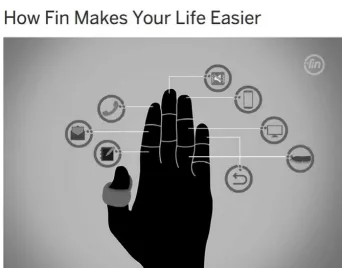
As an illustrative example, consider the ‘Fin’ ring. Tagged with the catchphrase ‘Wear the World’, this ring (currently in the midst of product design and testing) is a kind of wearable expressive infrastructure that turns your palm and fingers into a numeric keypad and your entire hand into a gestural interface. The hand thus serves as fin for navigating through thin air.
Figure 1: chart showing the basics for how the ‘Fin’ ring will operate2
2 https://www.indiegogo.com/projects/fin-wearable-ring-make-your-palm-as-numeric- keypad-and-gesture-interface
ephemera: theory & politics in organization 16(4): 15-31
28 | article
Bogard writes that:
…control is about engineering the human body’s interface with surfaces, flesh to glass, then distributing those connections in nested rhythmic figures, timing their onset and decay, and modulating their intensity (amplitude, frequency). How often do you check your email, or scroll through a screen? Tap, double tap, swipe, pinch, wave, hold, drag, blink, utter – a controlled gesture can be any rhythmic movement, including thinking, that connects you to a ubiquitous world of digital screens…Every interface, in effect, is a gesture, a moving diagram that marks the connection of bodies…[T]he control of interfaces is the control of the temporal distribution of gestural figures, the timing of connections, their onset, frequency, repetition, decomposition, and so on. (ibid.)
And this particular cybernetically-inflected historical turning point, as signaled by the gestural interface, reveals the capacity for technological assemblages to adjust to bodies, their machinic components, and ongoing events on the fly through ‘the ability to make minute and flexible adjustments in the timing of events, to produce moving figures, not just fixtures’ (ibid.): that is, to move not just at the rate of life itself but to inhabit its smallest, seemingly-inconsequential vibrations, its rhythms and gestures.
Similarly, as we saw in the case of Titus, the credit / debt gesture serves as an open-ended, congealing-and-re-congealing set of rhythmic affectivities continually contoured through their dovetailing with a seamless real-time access-loop of credit-debt modulations. The debt gesture is the infinitely adjustable accretion and replaying of gestural surfacing-contact moments; it is how the matter of indebtedness turns into the affective manner of bodily comportments. The debt gesture becomes an intimately-dividualized means of wearing the world.
Thread #8: The multitude beckons: ‘Pants sale’
Maurizio Lazzarato, at the end of The making of indebted man (2012), holds out some modicum of future hope for what Nietzsche called ‘a second innocence’, marked by the moment when Nietzsche says that ‘atheism might release humanity from this whole feeling of being indebted towards its beginnings, its causa prima. Atheism and a sort of second innocence belong together’ (Lazzarato, 2012: 164). Lazzarato argues this would be a
Gregory J. Seigworth Wearing the world like a debt garment
article | 29
But, as we have seen, ‘mundane debt’ is precisely what the gestural interface is set to rhythmically inhabit through the touch-free intimacies of surface control: making our wallets weightless perhaps while continuing to form and format subjectivities in new modulatory ways. It is, you might say, easier now to imagine the arrival of worldwide atheism than to somehow imagine an end to indebtedness.
In the penultimate scene from M.T. Anderson’s Feed, Titus – who, by this point in the story, has long been back in touch with his credit – has just arrived at home after leaving the death-bed of his ex-girlfriend Violet. (Violet has been turned down by her insurance company for risky brain surgery that might save her life: in part, because the algorithms that follow and guide her everyday buying behavior are no longer able to construct a recognizable consumer profile based on her purchase history and browsing activity.) At the same time, the planet is falling into environmental catastrophe. People are developing huge weeping lesions (which for a time become a new fashion statement, a new aesthetic). Hair is falling out. Lips are curling back exposing everyone’s gums and teeth. Giant cockroaches and rats are roaming in huge swarms through the ventilation systems of the decaying infrastructure. Forests are being chopped down because ‘air factories’ are more cost-efficient. The oceans are mostly dead. Yes, you won’t find a contemporary young teen science fiction story much more bleak. And Titus is no hero in this tale; he loves this world, he lives a life of privilege, and blithely perseveres in the midst of all this decay. He broke up with Violet at the onset of her illness, but her fate has also stirred something in him: something he cannot quite put his finger on.
While Titus cannot articulate anything close to a semblance of resistance or even the vaguest political tactic (whenever Titus tries to narrate a story it always ends up, he claims, sounding like the opening credits of a sit-com or like the voice-over to a movie trailer), he does have the debt gesture and so he uses it, voice-over and over again, feeling himself at one with the entire expressive infrastructure, its moving movement, its intimately exteriorizing impingements: the very (dis)embodiment of affective capitalism.
It all begins when Titus notices that there is ‘a special on draft pants at Multitude’ (yes, Multitude)