Http://www.ijetmr.com©International Journal of Engineering Technologies and Management Research [47]
APPLICATION OF SIMILARITY METHOD AND DIMENSIONAL
ANALYSIS IN DETERMINING THE PERFORMANCE PARAMETERS
OF AGITATOR PADDLES FOR CALTEX AQUATEX 3180 CUTTING OIL
Do Thi Tam 1, Tran The Long *1, Nguyen Hoang Quan 2
1 Department of Manufacturing Engineering, Faculty of Mechanical Engineering Thai Nguyen
University of Technology, Thai Nguyen, Vietnam
2 Mechanical and Chemical Company 13, TuyenQuang, Vietnam
Abstract:
Aquatex 3180 is the general purpose soluble oil, formulated for use in a wide variety of machining operations. In fact, the natural diffusion in the liquid is very slow, especially the mixing ratio, and the homogeneity of the solution is difficult to achieve according to the manufacturer's recommendation. Hence, the agitator is required to improve the uniformity of the solution in that the obtained cutting fluid can be effectively used in machining processes to fulfill the role of cooling and lubricating. In this work, the application of the similarity method and dimensional analysis for studying agitator model for mixing Aquatex 3180 cutting oil to build the set of input parameters in the experimental process. The results reveal that the input parameters in the study of the agitator model using 9 similarity criterions πi (i = 1 ... 9) instead of 12 independent parameters. In addition, the standard π2 can characterize the displacement properties of the fluid flow considering the influence of gravity. It means that the number of experiments reduce but still ensure that many experimental input parameters are still guaranteed, therefore ensuring proper description of the actual operation of the machine.
Keywords: Caltex Aquatex 3180; Similarity Method; Dimensional Analysis; Agitator; Mixing;
Cutting Oil.
Cite This Article: Do Thi Tam, Tran The Long, and Nguyen Hoang Quan. (2019).
“APPLICATION OF SIMILARITY METHOD AND DIMENSIONAL ANALYSIS IN DETERMINING THE PERFORMANCE PARAMETERS OF AGITATOR PADDLES FOR
CALTEX AQUATEX 3180 CUTTING OIL.” International Journal of Engineering
Technologies and Management Research, 6(1), 47-54. DOI: 10.29121/ijetmr.v6.i1.2019.345.
1. Introduction
Http://www.ijetmr.com©International Journal of Engineering Technologies and Management Research [48]
However, this solution is in the concentrated form and is needed to be diluted according to a recommended rate before use. In fact, the natural diffusion in the liquid is very slow, especially the mixing ratio, and the homogeneity of the solution is difficult to achieve according to the manufacturer's recommendation [15]. Accordingly, the agitators are needed to improve this. However, it can lead to waste of input energy, and the reduction of product quality when the system is not suitable. Therefore, it is necessary to have more studies to determine the specification of the Caltex Aquatex 3180 lubricant agitator model to improve the uniformity of the solution [2-8, 13].
A convenient and common method for studying the complicated systems and processes theoretically and experimentally with diverse and not perfectly known parameters is the similarity theory (also called dimensional analysis) [9–12]. The essence of this theory is in combining the independent variables and quantities into dimensionless quantities (i.e. similarity criteria) of certain structure, which are generalized variables and parameters of the problems concerned. The quantitative interrelations between these dimensionless quantities are further revealed [10]. The method of similarity method and dimensional analysis is used to determine the input allowable experimental parameters to replace the independent parameters by the similarity criterion by comparing the components in the line conservation program together. If a component as a unit is chosen and other components are taken to compare with it, there will be an independent set of criterion that characterizes the uniformity of processes occurring in the system. Thus, it is possible to reduce the number of experiments but still survey much input information independently. This method has recently applied in different fields of studies [16-18, 20]. The dimensional analysis was used in electrostatic precipitators (ESP) model building, showing both the reduction in effort and more effective modeling that can result. The obtained results show that it allows to reduce the number of parameters necessary for defining the ESP performance, provides a reliable scaling-up of the desired operating conditions from the pilot-scale to full-scale plant (based on the invariance of the pi-space) as well as a consistent extrapolation within the range covered by dimensionless numbers, and gives a greater flexibility in choice of parameters [19].
However, the literature suggests that there are almost no studies of the application of the similarity method and dimensional analysis for studying agitator model for mixing cutting oil. Therefore, in this paper, the authors are motivated to make the study of the application of the similarity method and dimensional analysis to build the set of input parameters in the experimental process for studying agitator model of the Caltex Aquatex 3180 cutting oil. From the results, they reveal that the input parameters in the study of the agitator model using 9 similarity criterions πi (i = 1 ... 9)
instead of 12 independent parameters. Among them, the standard π2 can characterize the
Http://www.ijetmr.com©International Journal of Engineering Technologies and Management Research [49]
2. Materials and Methods
2.1.The Properties of Mixing Process and Technological Parameters
2.1.1. Kinetic Mode of Mixing Process
In order for the agitator to rotate at the desired speed, it is necessary to provide the power to overcome the resistance of the solution. Many theoretical as well as experimental studies show that the power provided for stirring mechanism depends mainly on:
• Type of stirring mechanism;
• Speed of stirring mechanism;
• The rheological properties of the solution
• Geometric features of the container
Using the method of dimension analysis of collected data, there is a relationship between the following quantities [21,22].
+ Reynoldscriterion: 𝑅𝑒 =𝑑2𝑁𝜌
𝜇 (1)
+ Froudecriterion: 𝐹𝑟 =𝑁2𝐷
𝑔 (2)
+ Froude criterion: 𝑃𝑜 = 𝑃
𝑁3𝐷5𝜌 (3)
Where:
Po: Power factor of the mixing power P: Stirring power, kw;
N: Motor speed, s-1;
D: Diameter of the paddles, mm; g: Gravitational acceleration, m/s2; µ: Kinetic viscosity, mPa.s (cst)
: Density of liquid, kg/m3;
2.1.2. Mixing Time
Mixing time is one of the most important parameters in liquid-liquid mixing because it is also the time required to obtain a desired homogeneity in the mixing tank (Montanteet al, 2005; Jakobsen, 2008). The diameters ofpaddles and mixing tanks, liquid viscosity, and so on are effective parameters for determining mixing time (Jakobsen, 2008; Doran, 1995). Patwardhan and Joshi (1999) also determined the mixing time with about 40 types of axial flow propellers.
Http://www.ijetmr.com©International Journal of Engineering Technologies and Management Research [50]
oil is lighter than water, so it tends to combine and stay on the surface, resulting in poor dispersion of oil and increasing mixing time.
Pip and his colleagues [14] suggested the following correlations to calculate the mixing time for chaotic mixing:
𝑡𝑚 = 5.91𝑑𝑣2/3(𝜌𝑉
𝑃) 1/3
(𝑇
𝐷) 1/3
(4)
Where:
T: diameter of mixing tank, mm D: diameter of the impellers, mm V: liquid volume, l
P: mixing power, kw
2.1.3. The Density and Viscosity of Liquid
Bouwmans et al. [15] studied the effect of density and viscosity on mixing time when they were mixed under different conditions (paddles, machines, and mixing speed) as well as the position of the liquid supplement to the second liquid in the mixing chamber. The obtained results revealed an observation when an added liquid is lighter than the liquid in the mixing chamber, it will significantly increase the mixing time and lower mixing speed. In addition, as the liquid is added near the paddles, the mixing time is not different.
2.1.4. The Homogeneity
- The mathematical model of Pacкaтoвa E.A as below:
𝑉𝑐 = 𝐴(𝜔𝑡)𝐵+ 𝐶𝑙𝑔(𝜔𝑡) = 𝑓(
𝑙1
𝑙 , 𝛾1
𝛾 , 𝑔
𝑙𝜔2, 𝜑, 𝜔𝑡) (5)
Where:
A, B, C- the function of dimensionless quantities l1, l - the size of components
𝛾1, 𝛾 - intensity of components
g - gravitational acceleration 𝜔 - angular velocity
𝜑- container coefficients of the agitators t - mixing time
2.2.The Similarity Model and Dimensional Analysis
Http://www.ijetmr.com©International Journal of Engineering Technologies and Management Research [51]
by applying the similarity method and dimension analysis. During conducting the experiments, independent parameters can be replaced by similarity criterions by selecting a component as a unit and comparing other components with it. Then, the set of independent criterions will characterize the similarity of the process occurring in the system. This method helps to reduce the number of experiments but still possesses the ability to survey much information independently to ensure the reliability of the experimental results.
The application of the similarity method and dimension analysis to study the agitator of Caltex Aquatex 3180 cutting fluid is a new application. From that, the author builds the set of criterions as a basis for conducting experiments on the agitator of Caltex Aquatex 3180 cutting fluid.
2.3.The Application of the Similarity Method and Dimension Analysis to Determine the
Experimental Input Parameters on The Agitator of Caltex Aquatex 3180 Cutting Fluid
Determination of Similarity Criterions
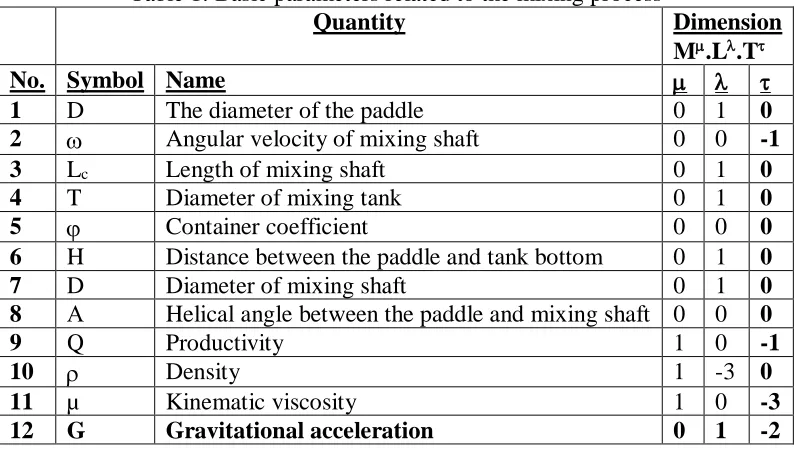
After studying the working characteristics of the agitator, the mixing productivity Q depending on the following main factors is determined:
Q = f (D, , Lc, T,, h, d,, ,µ,g) (6)
The quantities in the above equation are shown in the table below
Table 1: Basic parameters related to the mixing process
Quantity Dimension
M.L.T
No. Symbol Name
1 D The diameter of the paddle 0 1 0
2 Angular velocity of mixing shaft 0 0 -1
3 Lc Length of mixing shaft 0 1 0
4 T Diameter of mixing tank 0 1 0
5 Container coefficient 0 0 0
6 H Distance between the paddle and tank bottom 0 1 0
7 D Diameter of mixing shaft 0 1 0
8 Α Helical angle between the paddle and mixing shaft 0 0 0
9 Q Productivity 1 0 -1
10 Density 1 -3 0
11 µ Kinematic viscosity 1 0 -3
12 G Gravitational acceleration 0 1 -2
In the above table: M - mass, kg L - length, m T - time, s
Http://www.ijetmr.com©International Journal of Engineering Technologies and Management Research [52] 0 2 1 0 0 3 1 0 1 0 − − =
This proves that the basic quantities chosen are appropriate.
According to the dimension equation, the obtained criterions will be:
; 5 1 gD Q
= Fr
g D
= =
2 ; 3 ;
D Lc =
4 ;
D h = ; 5 D T =
6 ;
D d
=
7 =α;8 = µ; 9 = ;
Where: π2is Frut (Fr) criterion when the displacement properties of flows are studied by
considering the influence of gravity. The Frcriterion is the ratio between the inertial force and the
gravitational force. u E v p = = . 2
2 ; ;
1 . . 3 e R D v = =
According to Buckingham Pi Theorem, the equation for π1 is written as:
= = , , , , , , , 2 5 1 D d D h D T D L g D gD Q c (7)
To reduce the input parameters, the independent parameters in Table 1 are replaced with the criterions as equation (7). When conducting the experiments with the similarity criterions on the agitator model with the same condition (D, d, T, Lc, µ, εareconstant). The changing parameters are
ω, h, α, which characterize the criterions respectively:
r
F g
D =
=
2 ; 4 ;
D h
=
7 =α.
This is also the input parameters when conducting the experiments
3. Results and Discussions
The criterions affecting the mixing process of the solution are given by the equation (7).
Http://www.ijetmr.com©International Journal of Engineering Technologies and Management Research [53]
to reduce the number of experiments while still providing many input parameters as a basis for determining and evaluating their influence on the uniformity of the solution;
Three obtained criterions2, 4, 7are the numbers included in the study of mixer model. In
particular, the 2 is the Froude criterions, which characterizes the dynamics that is put into the
experiment, which allows for increasing the accuracy of the experimental model. For the obtained results, the experiments were carried out and their results will be discussed in detail in the next paper.
4. Conclusions and Recommendations
The similarity method and dimension analysis were successfully applied for the study of the application of the similarity method and dimensional analysis to build the set of input parameters in the experimental process for studying agitator model of the Caltex Aquatex3180 cutting oil. Based on the results of the present experimental investigation, the following conclusions can be drawn:
1) The similarity method and dimension analysis are the scientific research method that helps
to define and explain the general rules of phenomena and processes that occur and establish the relationship for studying the system.
2) On the basis of analyzing the influencing factors for solution mixers, the similarity criterions and the criterion equations are calculated and built to fully describe the physical process during mixing (equation 7). At the same time, they propose three basic criterions as input parameters in experiment 2, 4, 7). This is the basis for building experimental
models in accordance with research objectives.
3) The input parameters in the study of the model of liquid mixers use 9 similarity criterions
i (i = 1 ... 9) instead of using 12 independent parameters (as shown in Table 1). Among
them, the criterion 2 can characterize the displacement properties of the fluid flow
considering the influence of gravity. This helps to reduce the number of experiments but still ensure that many input experimental parameters can investigate while ensuring proper description of the actual operation of the machine.
Acknowledgements
The work presented in this paper is supported by Thai Nguyen University of Technology, Thai Nguyen University, Vietnam.
References
[1] https://cglapps.chevron.com/msdspds/PDSDetailPage.aspx?docDataId=336251&docFormat=PDF [2] Guangyu Sun, Chuanxian Li, Guoqing Wei, Fei Yang, Characterization of the viscosity reducing efficiency of CO2 on heavy oil by a newly developed pressurized stirring-viscometric apparatus, Journal of Petroleum Science and Engineering, Vol. 156, 2017, 299-306.
[3] D. AnkammaRao, P. Sivashanmugam, Experimental and CFD simulation studies on power consumption in mixing using energy saving turbine agitator, Journal of Industrial and Engineering Chemistry, Vol. 16 (1), 2010, 157-161.
Http://www.ijetmr.com©International Journal of Engineering Technologies and Management Research [54] [5] S. Masiuk, Mixing time for a reciprocating plate agitator with flapping blades, Chemical
Engineering Journal, Vol. 79 (1), 2000, 23-30.
[6] Bruce, W., Robert, E., 2004, Liquid- Liquid contacting in unbaffled, agitated vessels, AIChE J. 19. [7] Edward L. Paul, Victor A. Atiemo-Obeng Suzanne M. Kresta, 2004, Handbook of industrial
Mixing Science Practice, John wiley& Sons, inc, Publication.
[8] Shekhar, S.M., Jayanti, S., 2003, Mixing of Power Law F1uids Using Anchor's Metzner-Otto Concept Revisited, AIChE J., 49
[9] Yasuki Nakayama, Chapter 10: Dimensional Analysis and Law of Similarity, Introduction to Fluid Mechanics (Second Edition), 2018, 203-214.
[10] V. S. Protsenko, F. I. Danilov, Application of dimensional analysis and similarity theory for simulation of electrode kinetics described by the Marcus–Hush–Chidsey formalism, Journal of Electroanalytical Chemistry, Vol. 669, 2012, 50-54.
[11] J.C. Gibbings, Dimensional Analysis, Springer, 2011.
[12] A.A. Gukhman, Vvedenie v teoriyupodobiya (Introduction in the Similarity Theory), VysshayaShkola, Moscow, Russian, 1973.
[13] Yanlong Han, FuguoJia, XiangyiMeng, Bin Cao, Yawen Xiao, Numerical analysis of similarities of particle flow behavior in stirred chambers, Powder Technology, In press, accepted manuscript, Available online 10 December 2018.
[14] Pip, N.J., Gül, N.Ö.-T., 2005, Effects of physical property differences on blending, Chem. Eng. Technol. 28, No. 8.
[15] Bouwmans, I., Van den Akker, H. E. A., 1990, The influence of viscosity and density differences on mixing times in stirred vessels, IchemESymp Ser. 121.
[16] L. U. Frishter, Application of the Methods of the Theory Similarity and Dimensional Analysis for Research the Local Stress-strain State in the Neighborhood of an Irregular Point of the Boundary, Procedia Engineering, Vol. 153, 2016, 151-156.
[17] K. S. Nikhila, Vrinda V. Nair, Protein Sequence Similarity Analysis Using Computational Techniques, Materials Today: Proceedings, Vol.5 (1), Part 1, 2018, 724-731.
[18] Susan G. Sterrett, Similarity and Dimensional Analysis, Philosophy of Technology and Engineering Sciences, 2009, 799-823.
[19] F. J. Gutiérrez Ortiz, B. Navarrete, L. Cañadas, Assessment of plate–wire electrostatic precipitators based on dimensional and similarity analyses, Fuel, Vol.90 (9), 2011, 2827-2835.
[20] IlyaBlokh, VassilAlexandrov, News clustering based on similarity analysis, Procedia Computer Science, Vol. 122, 2017, 715-719.
[21] Le Ngoc Thuy, Machines and equipment for food production, Part 1, Hanoi University of Science and Technology Publisher, Hanoi, 2009.
[22] Le Ngoc Thuy, Machines and equipment for food production, Part 2, Hanoi University of Science and Technology Publisher, Hanoi, 2009.
[23] Tran The Long, Tran Minh Duc. Chapter 7: Micro/Nanofluids in Sustainable Machining. Book tittle: Microfluidics and Nanofluidics, 1st ed.; Editor: Mohsen SheikholeslamiKandelousi; Publisher: Intech Open, United Kingdom, 2018, 162-199. ISBN 978-1-78923-541-8. DOI: 10.5772/intechopen.75091.
[24] Duc Tran Minh, Long Tran The, Ngoc Tran Bao. Performance of Al2O3 nanofluids in minimum quantity lubrication in hard milling of 60Si2Mn steel using cemented carbide tools. Advances in Mechanical Engineering 2017, 9, 1-9.
[25] Tran Minh Duc, Tran The Long, Pham Quang Dong, Tran Bao Ngoc. Applied Research of Nanofluids in MQL to Improve Hard Milling Performance of 60Si2Mn Steel Using Carbide Tools,
American Journal of Mechanical Engineering 2017, 5, 228-233.
*Corresponding author.