ORIGINAL ARTICLE
IJPHY
ABSTRACT
Background: Lumbar radiculopathy is a disease of the spinal nerve root generally accompanied by radicular pain in dermatomal distribution and/or neurologic symptoms. The previous studies were focusing on finding the disability and pain caused due to Lumbar Radiculopathy. This study is focusing on the disability, pain, range of motion of the spine and SLR. The objective of the study is to evaluate the effectiveness of Mckenzie method with TENS on reducing symptoms and disability of Lumbar radiculopathy.
Methods: In the present prospective study patients with Lumbar radicular pain due to disc herniation or prolapse at level L4, L5 & S1 were randomized into two groups – Group A and Group B. the study included 40 patients, with 20 in each group. The selection criteria was based on the following - with age group 22-55years, both sexes – male and female, with radicular pain in L4, L5 & S1 dermatomes, disabling leg pain for 6-12 weeks duration, evidence of disc herniation confirmed on MR imaging. The radicular pain was measured using the SLR test, pain was measured using the VAS scale of 0 – 100, disability was measured using the MODI and Lumbar Spine ROM was measured using the MMST. Group-A were treated with McKenzie methods with TENS and Group-B were treated with general exercise with TENS.
Results: This study showed that there was a significant reduction of pain on the VAS, improvement in SLR, lumbar spine range of motion using MMST and disability using MODI for both the groups. The statistical analysis found that experimental group showed earlier control of all the outcome measures when compared to controlled group at the end of the 6th week.
Conclusion: After 6 weeks of Mckenzie method with TENS intervention for 30 minutes for 5 days in week the statis-tical analysis concluded that the experimental group had significantly faster rates of reducing the symptoms of lumbar radiculopathy and reducing the disability due to lumbar radiculopathy.
Keywords: Lumbar radiculopathy, Disc herniation, Mckenzie Method, TENS (Transcutaneous Electrical Nerve Stim-ulation), L4, L5
Received 16th January 2016, revised 30th January 2016, accepted 06th February 2016
www.ijphy.org
10.15621/ijphy/2016/v3i1/88919
CORRESPONDING AUTHOR
Int J Physiother. Vol 3(1), 94-99, February (2016) ISSN: 2348 - 8336
EFFECT OF MCKENZIE METHOD WITH TENS ON
LUM-BAR RADICULOPATHY – A RANDOMIZED CONTROLLED
TRIAL
¹Jay Indravadan Patel
*2Prem Kumar B N
3
Dr. Ravish V N
*2Prem Kumar .B .N
Mailing address: 2476, 7th cross, 7th B Main, R.P.C. layout, Vijayanagar-2nd stage, Bangalore-560 104. India ¹Post Graduate student,
Kempegowda Institute of Physiotherapy, Bangalore
²Assistant Professor,
Kempegowda Institute of Physiotherapy, Bangalore
³Associate Professor,
INTRODUCTION
Lumbar radiculopathy is a disease of the spinal nerve root generally accompanied by radicular pain in dermatomal distribution and/or neurologic symptoms [1]. Low back pain is the most common problem affecting both genders and most of the ages. Incidence of which is around 85% of the population. It is termed as chronic after 3 months because most normal connective tissue heal within 6-12 weeks. Only few cases of back pain are due to specific causes but most cases are non-specific. Along with pain sensation patients also encountered with problems of reduced lumbar flexibility and reduced flexion. Researchers also indicate the significance of the paraspinal and deep lumbar muscles as important stabilizers Repetitive flexion is a frequent insult to the back. This generally occurs in occupation like such as building work, gardening, and house-work etc. this results in shortening and tightening of anterior soft tissues and lengthening and weakening of the posterior elements. In some cases there is a chance of Lumbar disc herniation. Approximately 2% of the general population presents with low back pain a presenting complaint [1,2,3]. It is estimated that up to 70% of the population will experience back pain sometime in their life [1,2,3]. Dilliance reported that in 79% men and 89% women the specific cause were known [4]. They also noted that 40% of those reporting of low back pain also reported lumbar radiculopathy. However, clinically significant lumbar radiculopathy due to lumbar disc prolapse occurs in 4 – 6% of the population. The people affected are most commonly below 40 years who are in economically productive age group. Hence, low back pain affects the socio – economic status of a region
significantly [1,2,3].Epidemiological studies have shown
that 50 – 80% of the population is affected by low back pain once in life time [5]. It is surprising how many people claim to know all the correct procedures for reaching and/ or lifting objects, and yet they don’t actually internalize and use those safety procedures. ‘Picking up a mug of coffee from the opposite side of a table’, for example, can produce more force against the intervertebral discs than lifting a 20 pound weight next to one’s body [6]. Approximately two thirds of adults will suffer at some time in their life [7]. LDH results in clinical evidence of Radiculopathy, and if conservative treatment such as medication and physical therapy fails, diskectomy often is recommended [8].Degenerative joint changes are not limited to synovial joint though, and in the spine they commonly occur at the intervertebral disk articulations. The intervertebral disc changes include alterations in volume, shape, structure, and composition. Although there is not a 100% correlation between the presence of degenerative disk disease and pain complaints, the structural alterations will decrease motion and alter the mechanical properties of the spine. The intervertebral disk undergoes marked changes with age. The most significant alterations occur in the nucleus pulposus. The number of cells and the concentration of proteoglycans & water decrease. Once enough structural breakdowns occurs, what once were normal mechanical
loads acting upon a normal disk is now excessive loads on a compromised disk. At this point the degenerative process is accelerated [9].
Treatment for Lumbar radiculopathy includes physical therapy, coping skills, medical treatment, yoga therapy, surgical treatment, etc. It seems that Mckenzie method helps to centralize the pain radiating down the leg. It works on the passive/active extension of the patient which will centralize the pain to the back [10]. As per the traditional physiotherapy treatment, traction, TENS and general exercises has been advised for patients with lumbar radiculopathy [11, 12]. TENS is an apparatus used to relieve pain by way of stimulating the nerve via electrodes transcutaneously [13].
This study was implemented to know the effects of Mckenzie Method with TENS in early recovery from symptoms of lumbar radiculopathy and also to know the effects of Mckenzie Method with TENS in reducing the disability.
MATERIAL AND METHOD
Design: A randomized experimental study. Setting and Participants: The study included 40 samples referred from Kempegowda Institute of Medical Sciences both from Orthopedics OPD and Physiotherapy OPD with ethical clearance. Sample was randomized into two groups with equal size. Selection criteria was based on the following - with age group 22-55years, both sexes, male and female, with radicular pain in L4, L5 & S1 dermatomes, disabling leg pain for 6-12 weeks duration, evidence of disc herniation confirmed on MR imaging.
INTERVENTION
Subjects referred from the Orthopaedic OPD and Physiotherapy OPD was divided into 2 groups by asking them to pick up chits from a box which is written as Group A or Group B. Each group will consist of 20 samples. GROUP A which is an experimental group will receive Mckenzie Exercises along with TENS (Transcutaneous Electrical Nerve Stimulation). GROUP B which is a Controlled Group will receive General Exercises with TENS (Transcutaneous Electrical Nerve Stimulation).
Mckenzie exercise:
•
Reduction of derangement•
Maintenance of reduction•
Recovery of function•
Prevention of recurrence Correction of Posture: The patients sitting posture has
to be corrected. The patient will be made to sit in the arm and back rest chair with the support of the pillow behind the back.
Lying in Prone: The patient will made to lie prone on
the treatment couch by turning the head to one side and arms at the side.
Lying - Prone Extension: The patient will be made to
trunk. This will acquire the position of prone extension with elbow support
Extension in lying: The patient will be asked to assume the prone on elbows with extension of the spine and then made to extent the elbows so the extension in prone on hand position is acquired.
Extension Lying with Belt Fixation: The above position
is made and a belt fixed to the couch is used to stabilize the pelvic lifting.
Extension in standing: In this the patient stand in the
normal position. The patient is then instructed to do extension of the spine.
General Exercises:
• Back extensors (supine): Patient will stay supine lying
with knee flexed. Then the trunk is lifted to neutral position.
• Back extensors (prone): Patient will be lying in prone
position with pillow under the stomach. The patient is then instructed to lift the trunk to neutral position.
• Back Extensors (kneeling): Patient will do 4 point
kneeling and then attempt to lift alternate leg and arm in extension
• Back extensors (standing): patient will do active
extension of the back in standing
Transcutaneous Electrical Nerve Stimulation (TENS): Transcutaneous electrical nerve stimulation (TENS) a dual channel unit will be used. One channel is placed paraspinally at the level of origin of the sciatic nerve (L4, L5, S1, S2 and S3) and a second channel at the site of referred pain (e.g. Posterior thigh). The machine is on with High TENS (frequency of 100Hz & pulse duration of 150µs) for a duration of 30 minutes.
Dosage:
Mckenzie Exercises and TENS = 5 days a week. General Exercises and TENS = 5 days a week.
Outcome measures: The improvement is measured by long – arm goniometer for straight leg raise, visual analog scale for the pain, inch tape for lumbar spine range of motion and disability by MODI on the 1st day (pre test) then assess on the 2nd week(15th day),4th week(28th day) and on the 6th week(42 days, post-test).
Data Analysis: Descriptive statistical analysis has been carried out in the present study. Results on continuous measurements are presented on Mean ± SD (Min-Max) and results on categorical measurements are presented in Number (%). Significance is assessed at 5 % level of significance. Student t test (two tailed, independent) has been used to find the significance of study parameters on continuous scale between two groups Inter group analysis) on metric parameters and Student t test (two tailed, dependent) has been used to find the significance of study parameters on continuous scale with in each group. Chi-square/ Fisher Exact test has been used to find the significance of study parameters on categorical scale between experimental and controlled group.
RESULTS
In this study with 40 Subjects who were randomized in to two groups with 20 in Group A (Mckenzie method and TENS) and 20 in Group B (general exercises and TENS) were undertaken to find out the effect of Mckenzie method with TENS on lumbar radiculopathy.
In the evaluation of VAS, (Table-1, Graph-1) the mean and standard deviation with 20 subjects in Group A (Mckenzie Method +TENS), in the pre test (6.20±1.85), the mean and standard deviation at the end of 2nd week (4.65±1.49),
the mean and standard deviation at the end of 4th week
(2.55±1.36)and the mean and standard deviation at the
end of the 6th week of the pain is significantly reduced to (1.75±1.33).
The mean and standard deviation with 20 subjects in Group B (general exercise and TENS), in the pre-test (6.65±1.42),
the mean and standard deviation at the end of 2nd week
(5.70±1.59), the mean and standard deviation at the end of 4th week (4.35±1.39)and the mean and standard deviation at the end of the 6th week of the pain is significantly reduced to (3.15±1.59).
Table-1: Evaluation of Pain on VAS.
VAS Group A Group B P value
1st day 6.20±1.85 6.65±1.42 0.395
2nd week 4.65±1.49 5.70±1.59 0.038*
4th week 2.55±1.36 4.35±1.39 <0.001**
6th week 1.75±1.33 3.15±1.59 0.005**
Graph 1: Representation of VAS
0 1 2 3 4 5 6 7 8 9
1st day 2nd week 4th week 6th week
VA
S Sc
or
e
Group A Group B
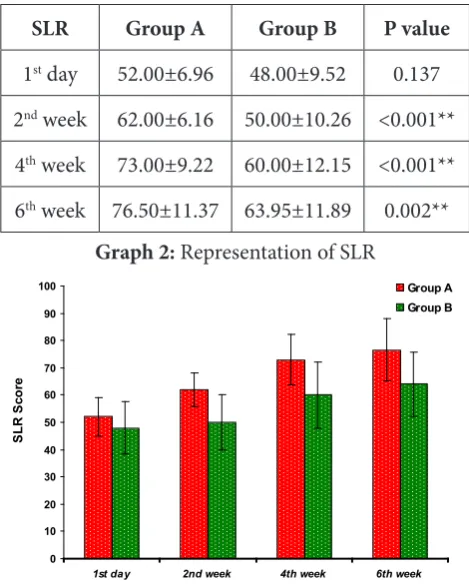
In the evaluation of SLR (Table-2, Graph-2), the mean and standard deviation with 20 subjects in Group A (Mckenzie method and TENS), in the pre-test (52.00±6.96), the mean and standard deviation at the end of 2ndweek (62.00±6.16),
the mean and standard deviation at the end of 4th week
(73.00±9.22) and the mean and standard deviation at the end of the 6th week of the Straight Leg Raise Score is significantly increased to (76.50±11.37).
(General Exercise and TENS), in the pre-test (48.00±9.52),
the mean and standard deviation at the end of 2ndweek
(50.00±10.26), the mean and standard deviation at the
end of 4thweek (60.00±12.15)and the mean and standard
deviation at the end of the 6th week of the Straight Leg Raise Score is significantly increased to (63.95±11.89).
Table 2: Evaluation of SLR
SLR Group A Group B P value
1st day 52.00±6.96 48.00±9.52 0.137
2nd week 62.00±6.16 50.00±10.26 <0.001**
4th week 73.00±9.22 60.00±12.15 <0.001**
6th week 76.50±11.37 63.95±11.89 0.002**
Graph 2: Representation of SLR
0 10 20 30 40 50 60 70 80 90 100
1st day 2nd week 4th week 6th week
SL
R S
co
re
Group A Group B
In the evaluation of lumbar spine range of motion (Table-3,Graph-3), the mean and standard deviation with 20 subjects in Group A (Mckenzie method+TENS), in the pre-test (4.70±1.08), the mean and standard deviation at
the end of 2ndweek (5.45±1.23), the mean and standard
deviation at the end of 4th week (6.65±0.81)and the mean and standard deviation at the end of the 6th week of the Lumbar spine range of motion is significantly increased to (6.75±0.72).
The mean and standard deviation with 20 subjects in Group B (General Exercise and TENS), in the pre-test (4.30±1.29), the mean and standard deviation at the end of
2ndweek (4.25±1.12), the mean and standard deviation at
the end of 4thweek (4.70±1.22) and the mean and standard
deviation at the end of the 6th week of the Lumbar spine
range of motion is significantly increased to (5.20±0.69).
Table 3: Evaluation of Lumbar spine ROM
LS ROM Group A Group B P value
1st day 4.70±1.08 4.30±1.29 0.259
2nd week 5.45±1.23 4.25±1.12 0.003**
4th week 6.65±0.81 4.70±1.22 <0.001**
6th week 6.75±0.72 5.20±0.69 <0.001**
Graph 3: Representation of Lumbar spine ROM.
0 1 2 3 4 5 6 7 8
1st day 2nd week 4th week 6th week
LS
RO
M
Group A Group B
In the evaluation of MODI score (Table-4,Graph-4), the mean and standard deviation with 20 subjects in Group A (Mckenzie Method +TENS), in the pre-test (50.20±12.48n),
the mean and standard deviation at the end of 2ndweek
(37.30±9.41), the mean and standard deviation at the end of 4thweek (26.75±9.14) and the mean and standard deviation at the end of the 6th week the MODI Score is significantly reduced to (18.25±9.71).
The mean and standard deviation with 20 subjects in Group B (General exercise + TENS), in the pre-test (54.40±11.62),
the mean and standard deviation at the end of 2ndweek
(44.00±11.95), the mean and standard deviation at the
end of 4th week (36.35±10.39) and the mean and standard
deviation at the end of the 6th week the MODI Score is
significantly increased to (29.70±10.07).
Table 4: Evaluation of MODI
MODI Group A Group B P value
1st day 50.20±12.48 54.40±11.62 0.278
2nd week 37.30±9.41 44.00±11.95 0.056+
4th week 26.75±9.14 36.35±10.39 0.004**
6th week 18.25±9.71 29.70±10.07 0.001**
Graph 4: Representation of MODI
0 10 20 30 40 50 60 70
1st day 2nd week 4th week 6th week
M
O
DI
S
co
re
Group A Group B
DISCUSSION
This study was implemented to know the effects of Mckenzie method with TENS in early recovery from symptoms of lumbar radiculopathy and also to know the effects of Mckenzie method with TENS in reducing the disability. The pre-treatment assessment was taken by using the following outcome measures – VAS, MMST, SLR, MODI and their assessment was repeated 2, 4, 6 week respectively According to the results obtained by VAS, SLR, MMST, MODI the changes in 2nd, 4th and 6th week showed there is improvement in both the groups. Following the statistical analysis, experimental group showed early recovery than controlled group. The VAS score at the pre-test was 6.20±1.85 and was decreased to 1.75±1.33 at
the end of the 6th week, the outcome measures based on
percentage change of VAS is significant for experimental group The SLR score at the pre-test was 52.00±6.96 and was increased to 76.50±11.37 at the end of the 6th week, the outcome measures based on percentage change of SLR is significant for experimental group The MMST score at the pre-test was 4.70±1.08 and was increased to 6.75±0.72 at the end of the 6th week, the outcome measures based on percentage difference of the pre and post tests for MMST is significant for experimental group The MODI value at the pre-test was 50.20±12.48 and was reduced to 18.25±9.71 at the end of the 6th week, the outcome measures based on percentage change of MODI is significant for experimental group The VAS score at the pre-test was 6.65±1.42 and was decreased to 3.15±1.79 at the end of the 6th week, the outcome measures based on percentage change of VAS is significant for controlled group. The SLR score at the pre-test was 48.00±9.52 and was increased to 63.95±11.89 at
the end of the 6th week, the outcome measures based on
percentage change of SLR is significant. The MMST score at the pre-test was 4.30±1.29 and was increased to 5.20±0.69 at the end of the 6th week, the outcome measures based on percentage difference of the pre and post tests for MMST is significant. The MODI value at the pre-test was 54.40±11.62 and was reduced to 29.70±10.07 at the end of
the 6th week, the outcome measures based on percentage
change of MODI is significant. CONCLUSION
Results showed that there was a significant reduction of pain on the VAS, improvement in SLR, Lumbar spine range of motion Using MMST and disability using MODI for both the groups. It is found from the statistical analysis that experimental group showed earlier control of all the outcome measures when compared to controlled group at the end of the 6th week.
Acknowledgement
I would like thank Prof. Dr. J N Sridharamurthy (HOD) Department of orthopaedics and Prof. Dr. I. Suresh, Department of orthopaedics for their support for conducting the study.
REFERENCES
[1] Joel A. Delisa, Bruce M. Gans. Nicolas E. Walsh, William L. Bockenek, Walter R. Fontera, Steve R. Geiringer, Lynn H. Gerber, William S. Pease, Lawrance R. Robinson, Jay Smith, Todd P. Stitik, Ross O. Zafonte. Physical Medicine & Rehabilitation. Principles and Practice. Low Back Pain, 4th edition; 2005.
[2] MD S. Terry Canale. Campbell Operative Orthopedics. 10th Edi; 2003.
[3] Abramovitz ZN, Neff S. Lumbar Disc Surgery. Results of prospective lumbar Discectomy study of joint section on disorders of spine of peripheral nerves of American Association of Neurological surgeons and Congress of neurological Surgeons. Neurosurgery.1991; 29(2):301-08, 1991.
[4] Finesson B E. Lumbar disc excision – Schidesk H.K., Sweet W.H. (Eds). Operative Neurosurgical Technique. 3rd Edi; 1995.
[5] Descarreaux M, Jean Sebastein Blouin, Marc Drolet, Stanislas Papadimitriou, Normand Teasdale. Efficacy of preventive spinal manipulation for chronic low back pain and related disabilities. A Preliminary study. J Manipulative Physiol Ther. 2004; 27(8):509-14.
[6] Pamela K Lavangie, Cynthia C Norkin; Joint structure and function- A comprehensive ananlysis; Jaypee brothers; 2nd edition; 1998.
[7] Alon Rabin, Peter C. Gerszten, Pat Karausky, Clareann H. Bunker. The sensitivity of the seated Straight – Leg Raise Test Compared with the Supine Straight-Leg Raise Test in Patients Presenting with Magnetic Resonance Imaging Evidence of Lumbar Nerve Root Compression. Arch Phys Med Rehabil. 2007;88(7):840-3.
[8] Andrew J. Hahne, Jon J Ford. Functional restoration for a chronic lumbar disk extrusion with associated radiculopathy. Phys Ther. 2006;86(12):1668-80.
[9] Catherine Goodman, William Boissonnault, Kenda Fuller Gary L Soderberg. Pathology: Implications for the Physical Therapist. 2nd Edition;1986.
[10] Donelson R, Silva G, and Murphy K. The centralization phenomenon: its usefulness in evaluating and treating referred pain. Spine. 1990;15(3):211-3.
[11] Jorn Rittweger, MD, Karsten Just, MD, Katjakautzsch, Ms Psych. Treatment of Chronic low back pain with lumbar extension and whole body vibration exercise. Spine (Phila Pa 1976). 2002;27(17):1829-34.
[12] Gladys L. Y. Cheing, Amy Y. Y. Tsui, Sing Kai Lo,
Christina W. Y. Hui-Chan. Optimal stimulation
duration of TENS in the management of osteoarthritis of knee pain. J Rehabil Med. 2003;35(2):62-8.
Citation
Jay Indravadan Patel, Prem Kumar B N, & Ravish V N. (2016). EFFECT OF MCKENZIE METHOD WITH TENS ON
LUMBAR RADICULOPATHY – A RANDOMIZED CONTROLLED TRIAL. International Journal of Physiotherapy,