journal homepage: http://civiljournal.semnan.ac.ir/
A Parametric Study on the Progressive Collapse
Potential of Steel Buildings under Truck Collision
V. Broujerdian1* and M. Torabi2
1. Assistant Professor, Department of Civil Engineering, Iran University of Science and Technology, Tehran, Iran. 2. M.Sc., Department of Civil Engineering, Iran University of Science and Technology, Tehran, Iran.
* Corresponding author:[email protected]
ARTICLE INFO ABSTRACT
Article history:
Received: 04 March 2017 Accepted: 15 May 2017
In this paper, the initiation and propagation of structural damage in a building due to the truck collision to one of its corner columns were investigated. For this purpose, a three-dimensional 4-story moment resisting steel frame with intermediate ductility was considered. The structure was designed using ETABS software under standard dead, live, and earthquake loads, and then impact loading was applied on the structure using ABAQUS software. The effect of truck collision with different weights and speeds was simulated conducting three-dimensional nonlinear dynamic analyses. The internal stresses and forces created in the directly impacted column, as well as other parts of the structure, were obtained. Using appropriate plasticity models, the shear failure of a steel material was considered. A parametric study was performed in order to investigate the effect of different parameters on the possibility of progressive collapse. To validate the procedure of impact modeling, some available experimental vehicle to column collision tests were simulated. The results revealed that the mass and speed of the impactor had a significant effect on the response of the structure. So that, for high-momentum impactors, the traditional column removal method may yield a good approximation of the behavior of the structure. However, for low-momentum impactors, a time-history analysis without removing the hit column is needed.
Keywords:
Progressive collapse, Impact,
Collision, ETABS, ABAQUS.
1. Introduction
To evaluate the structures against the progressive collapse, a conventional
is initiated. Depending on the load and deformation capacity of other parts of the structure, the building may continue to its damped free vibration with serious damage or it may experience a partial or even an overall collapse [4]. In fact, in this approach, it is assumed that the column is completely removed from the structure in a moment and the actual way of damage initiation is not considered. However, depending on different causes of damage initiation (e.g. impact, explosion, and etc.), other parts of the structure may receive different induced loads. This the approach of elimination of one column from the structure may give unreal results. In fact, removing a single column and analyzing the remained structure with existing gravity loads is like that the top and bottom of a column is cut and simply removed from the structure. In the recent few decades, several acts of sabotage around the world, e.g. attacks on twin towers of the world trade center, have widely raised the issue of progressive collapse. The progressive collapse is a situation, in which the incidence of a local damage in a structural member leads to failure of its neighbor members and additional collapsing in the building [1].
Progressive collapse is mostly not in proportion to the cause of damage and the structure might be exposed to progressive collapse due to a small event. In other words, during the progressive collapse, the amount of damage is much more than the initial damage [2]. Old buildings mostly with small-span frames had adequate strength and resistance against progressive collapse. However, changes in the architectural styles associated with the evolution of computer-aided structural design and using high strength materials have led to advanced building systems of large spans, relatively light weight, and with more ductility. Accordingly the modern buildings have high risk under unforeseen loads [3].
Generally, when one of the main bearing members of a structure such as a column or a bearing wall fails due to an explosion, collision, or another unforeseen accidental event, all the connected structural members are influenced. For instance, with destruction of a column, a part of the roof that is placed on the column is also destructed. In turn, this destruction leads to damage spreading into the other parts of structure and this sequence may continue until the destruction of the whole structure or a major part of it.
The most important events that led the progressive collapse to be considered were the accidental gas explosion in the 18th floor of Ronan Point in 1968, terrorist attack to the Murrah Federal Building in 1995, and the attack to the world trade center in 2001 (Fig.1). The conventional design and analysis methods against progressive collapse are mainly on preventing this phenomenon due to unusual load, such as collision, explosion and etc.
analyzing the remained structure with existing gravity loads is like that the top and bottom of a column is cut and simply removed from the structure. Many researchers have studied the behavior of structures in progressive collapse by using experimental works and numerical simulations. Astaneh-Asl and his colleagues [5] investigated the strength of a one-story structure equipped with composite roof against progressive collapse caused by column removing due to explosion. The test results showed that after removing a middle column, because of the chain-like reaction of the steel joists and main beams, the floor is not collapsed and it shows required resistance against dead and live loads.
Grierson et al. [6] presented a progressive-failure analysis procedure to evaluate the performance of a building framework after it had been damaged by unexpected abnormal loading, such as an impact or blast load caused by a natural, accidental, or deliberate event, or as a result of human error in design and construction. They concluded that the progressive-failure analysis procedure was quite general and, with the appropriate choice of material constitutive model, may be applied to building frameworks of any type (concrete, steel, composite, etc.).
Kaewkulchai et al. [7] proposed a relation for beam element and a procedure for dynamic analysis of progressive collapse, which provides necessary guidance for further forms of 2D models. The results of their modeling showed that the braced frames that Khandelwal and Tawil [9] presented a building systems by computing residual capacity and establishing collapse modes of a damaged structure. They suggested that seismic ‘fuses’ could play a role in the design for robustness. technique named ‘pushdown analysis’ that could be used to investigate the robustness of studies in this field. Khandelwal et al. [8] studied the structure
strength against progressive collapse in steel braced frames in have eccentric braces are less vulnerable to progressive collapse as compared to concentric special braces.
The issue of transverse impact to on the structure has been taken into consideration by numerous researchers since the last decade. Different procedures and approaches are developed for studying the behavior and damaging of these members under impact [10-14]. In each approach, many assumptions are performed in the analysis process based on the geometry, the type of used materials, the studied structure, dynamic properties of the impacting object (e.g., the speed, duration, and weight of the impact), expected deformation in the short time of the impact, and the failure mode that includes local failure or overall geometric instability of the structure member. The experimental study by Menkes and Opat [15] reported three failure modes for restrained aluminum beams subjected to cyclic dynamic transversal force:
1) Overall large plastic deformation of the beam with the formation of plastic hinge mechanism
2) Tensile rupture failure under catenary action
3) Transverse shear failure in the supports
Fig. 1, (a) World Trade Center, (b) Alfred P. Murrah Federal Building, (c) Ronan Point, 1968
Progressive collapse of structure is investigated in the present paper considering impact effect and assuming shear failure. In this research, the structure of building was modelled in 3 dimensions and an impact loading was applied to a corner column of the structure in order to show that the whole of structure is influenced by such an impact loading. Instead of the common approach of column elimination, the collision event is simulated here to obtain more realistic results.
2. Material and methods
A 4-story building with intermediate moment resisting frames in both x- and y-directions is considered (Fig. 2). The building has a similar plan in all stories and the height of its stories is 3.2 m. Beam to column connections is rigid and the connection of columns to the foundation is of fixed type. The structure floors are assumed of deck with composite
beams. The consumed steel is ST-37 steel with the ultimate strength of 3700 kg/cm2 and yield strength of 2400 kg/cm2. The structural design was performed by ETABS 2015 software in accordance with the tenth chapter of Iranian National Building Code [22]. Under the effects of dead, live, and earthquake loads computed based on the sixth chapter of afore mentioned Code.
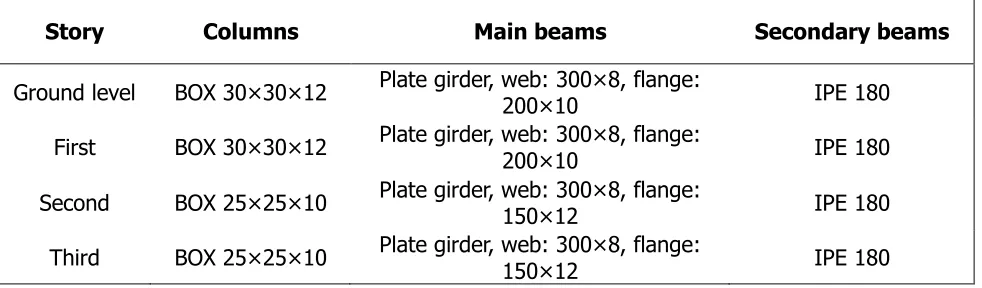
The amounts of dead and live loads, and the loads of interior and surrounding walls are presented in table 1. Earthquake loads were calculated with the assumption that the structure is located in Tehran. The soil under the foundation is assumed to be of type II. For the sake of simplicity and to avoid the need for several sections, the elements were categorized fore group designing. Then to obtain an economic design, the minimum required section is selected for each group. The design is performed according to LRFD- method. The obtained design sections are summarized in table 2.
Fig. 2, Plan of floors and 3D view of the steel building used in the present study
Table 1. The amounts of dead and live loads and the loads of interior and surrounding walls in the model
section Dead (kg/m2) Live (kg/m2) Interior walls
(kg/m2) Surrounding walls (kg/m)
Stories 485 250 100 550
Roof 550 150 - 465
Table 2. Summary of design results
Story Columns Main beams Secondary beams
Ground level BOX 30×30×12 Plate girder, web: 300×8, flange: 200×10 IPE 180
First BOX 30×30×12 Plate girder, web: 300×8, flange: 200×10 IPE 180
Second BOX 25×25×10 Plate girder, web: 300×8, flange: 150×12 IPE 180
Third BOX 25×25×10 Plate girder, web: 300×8, flange: 150×12 IPE 180
3.
Method Validation and ResultsIn order to ensure the accuracy of the used method, the numerical results corresponding to modeling of a lateral impact test on a column carrying an axial load were compared with the results from the research of reference [10]. The schematic test setup is
column length is 4 m and is impacted by a mass of 6 ton with the velocity of 40 km/h at the point 1.5m above the base of the column. [10]. In accordance with [10] a friction coefficient of 0.6 is used for the simulation of contact. Stress-strain curve of the S355 steel used in this analysis is shown in Fig. 4. Two methods are offered by ABAQUS/ Explicit to introduce the effects of strain-rate dependence in the material model. These are using the Cowper-Symonds over-stress power law and using the tubular input of yield ratios. The Cowper-Symonds equation is used in this research. The constants used in the shear failure are according to table 3. The calculated contours of plastic stress at different time steps obtained by dynamic analysis using ABAQUS are illustrated in Fig. 5. Also shown in this figure is the contours calculated by Reference [10]. As seen in this figure, the results are very close and ensure the validity of the numerical method.
6 ton V=40km/h
1.5m Section: UC 305×305×18
P=0.7 Pdesign
4m
Fig. 3, The schematic test setup
Fig.4, Properties of S355 steel used in this study [8]
Fig. 5, calculated stress contours of benchmark
impact model: a) results obtained by [8], b) present
Table 3. Properties of shear failure of S355 steel used in this study [8]
Plastic strain at
damage initiation Maximum shear stress ratio Maximum strain rate (sec-1) 𝜀𝑓𝑝𝑙 𝑢𝑓𝑝𝑙(𝑚)
0.0065 0.65 16.5 1.85 0.295
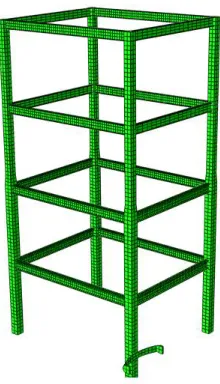
After the validation of the numerical method, the 4-story building is modeled in ABAQUS for finite element analysis under lateral impact of truck. All beams and columns are modeled using C3D8R ductile and brick elements. The impacting body is designed as a rigid body in the form of a truck’s bumper. The properties of used materials in this analysis are similar to the material properties presented in Fig. 4 and table 3. The building model is shown in Fig. 6.
Fig. 6, FEM model of the building used in the impact analysis
In order to reduce the analysis time, in the first step, a static analysis under the axial load was performed. Thereafter, the results from the static analysis were used as initial values for the impact analysis. The impact of truck is supposed to exert to the structure through the bumper of truck, 80 cm above the earth, on the corner column. So it is a local sever loading on the structure. Because of type and location of impact, it is expected
that only the corner panel of the structure be influenced. Thus, for simplicity, only this part of the structure is considered in this study for investigating the local effect of impact (Fig. 7).
In order to study the effect of mass and velocity of the projectile in the impact problem, three different model described in Table 4 were examined.
Fig. 7, The corner part of the structure under impact loading
In finite element model, mesh sizes of 2 cm and 5 cm were used for the flange and web of beams, respectively. The flange surfaces of beams were meshed with a size of 5 cm. The mesh size for the columns that are not subjected to impact loading is also equal to 5 cm. The mesh of the corner column that is subjected to the collision was selected of
meshing of different parts of the structure is presented in Fig. 8.
Based on the dynamic analysis, the equivalent plastic strain contours (PEEQ) corresponding to the analysis of lateral impact of truck in different types are shown in Fig. 9. As seen in this figure, the column is completely cut near the support with increase in the speed and weight of the projectile.
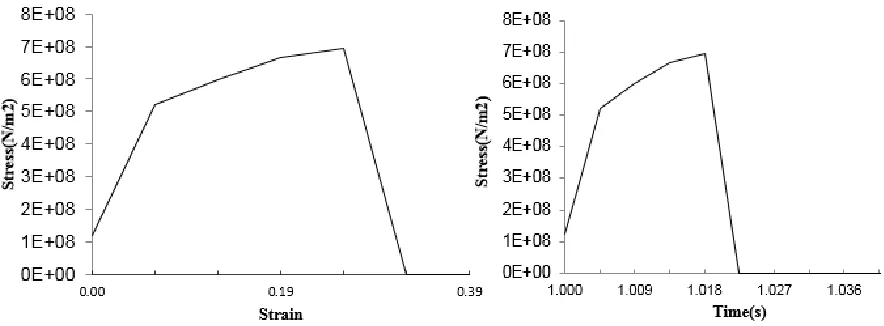
The von Misses stress contour for the corner panel under 12t40k impact type (table 4) is shown in Fig. 10. As seen in this figure, the column is cut near the support, which is due to the development of shear stresses in this region. Fig. 11, show strain and stress-time diagram of the corner panel for 6t40k impact model-cutting of the column close to the support.
Table 4. Specifications of projectile
Model Mass of truck
(ton)
Velocity of truck
(km/h)
Momentum
(ton.km/h)
12t80k 12 80 960
12t40k 12 40 480
6t40k 6 40 240
Fig. 8, Meshing of different parts of the structure, (a) flange surfaces beams, (b) meshing of the impact location for the corner column, (c) the connection of columns of first and second floors, (d) beam sections at
flange and web parts
Fig. 9, Equivalent plastic strain contour (PEEQ) for the corner panel of the structure subject three different impact: a) 6t40k impact type, b) 12t40k impact type, c) 6t80k impact type
Fig. 10, von Misses stress contours of the corner panel for 12t40k impact model – cutting of the column close to the support
Fig. 11, diagram of the corner panel for 6t40k impact model-cutting of the column close to the support, a:Stress-strain diagram, b: stress-Time diagram
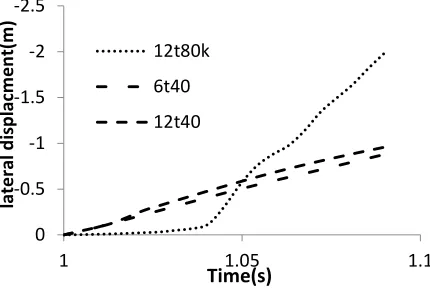
The diagrams related to axial and lateral deformations are presented in Figs. 12 and 13 for three impact types. As observed in these figures, both axial and lateral displacements are increased with increase in the weight and speed of the projectile. The first part of response curve of 12t80k in Fig. 12 shows a slow sleep line corresponding to local damage of the column which followed by a large sleep line corresponding to lateral deformation of the damaged structure. In fact, for the large values of momentum, the structure suffers large local damage at the beginning of collision which may result in cutting the element. Therefore, for such
Fig. 12, Axial displacement for three different impact models
Fig. 13, Lateral displacement for three different impact models
4
.
ConclusionIn this paper, the progressive collapse potential of a 4-story steel building under truck collision was investigated. A parametric study was performed in order to examine the effect of weight and speed of truck on the response of the structure. Based on the dynamic analyses done in this study, the following conclusions can be made:
1- The objective column damaged by the impactor was not immediately removed from the structure during this collision and a great shock was applied to the whole structure. In fact, this study proposed a different approach
to the progressive collapse study instead of the single column remove theory.
2- The results showed that the severity of damage applied to the objective column increased by increasing the mass and speed of impactor. For momentums above a special value, the objective column will cut from the base plate.
3- Column removal method may yield a good approximation of the behavior of the structure for high-momentum impactors. However, for low-momentum impactors, the progressive collapse investigation must be performed based on time-history analysis without removing the hit column.
4. In this research, the structure of building was modelled in 3 dimensions and an impacting load was applied to a corner column of the structure in order to show that whole of the structure were influenced from such impacting load and subsequent the stresses applied to the structure.
REFERENCES
[1] ASCE (2013), “Minimum Design Loads for Buildings and Other Structures,” American Society of Civil Engineers.
[2] Bažant, Z.P., Verdure, M. (2007). Mechanics of Progressive Collapse: Learning from World Trade Center and Building Demolitions. Journal of Engineering Mechanics, 133: 308-319.
[3] Burnett, E.F. (1975). The Avoidance of Progressive Collapse: Regulatory Approaches to the Problem [Final Report]. [4] Mohamed, O.A. (2006). Progressive Collapse
of Structures: Annotated Bibliography and Comparison of Codes and Standards. Journal of Performance of Constructed Facilities, 20:418-425.
[5] Astaneh-Asl, A., Jones, B., Zhao, Y., Hwa, R. (2001). Progressive Collapse Resistance of
-0.7 -0.6 -0.5 -0.4 -0.3 -0.2 -0.1 0
1 1.05 1.1
A xi al d isp lac m e n t( m ) Time(s) 12t40k 6t40k 12t80 -2.5 -2 -1.5 -1 -0.5 0
1 1.05 1.1
Steel Building Floors. Report Number UCB/CEE-Steel-2001.
[6] Grierson, D. E., Xu, L., & Liu, Y. (2005). Progressive‐failure analysis of buildings subjected to abnormal loading. Computer‐
Aided Civil and Infrastructure Engineering, 20(3), 155-171.
[7] Kaewkulchai, G., Williamson, E.B. (2004). Beam Element Formulation and Solution Procedure for Dynamic Progressive Collapse Analysis. Computers & Structures, 639-651.
[8] Khandelwal, K., El-Tawil, S., Sadek, F. (2009). Progressive Collapse Analysis of Seismically Designed Steel Braced Frames. Journal of Constructional Steel Research, 65:699-708.
[9] Khandelwal, K., & El-Tawil, S. (2011). Pushdown resistance as a measure of robustness in progressive collapse analysis. Engineering Structures, 33(9), 2653-2661. [10] Al-Thairy, H.A., Wang Y.C. (2014).
Behaviour and design of steel columns subjected to vehicle impact. Trans Tech Publications, 193-198.
[11] Alam, M.I., Fawzia, S. (2015). Numerical studies on CFRP strengthened steel columns under transverse impact. Composite Structures, 428-441.
[12] Yousuf, M., Uy, B., Tao, Z., Remennikov, A., Liew, J.R. (2013). Transverse impact resistance of hollow and concrete filled stainless steel columns. Journal of Constructional Steel Research, 177-189. [13] Makarem, F.S., Abed, F. (2013) Nonlinear
finite element modeling of dynamic localizations in high strength steel columns under impact. International Journal of Impact Engineering, 47-61.
[14] Ari-Gur, J., Weller, T., Singer, J. (1982). Experimental and theoretical studies of columns under axial impact. International Journal of Solids and Structures, 619-641 [15] Menkes, S. B., & Opat, H. J. (1973). Broken
beams. Experimental Mechanics, 13(11), 480-486.
[16] Chen, F. L., & Yu, T. X. (2000). Influence of axial pre-load on plastic failure of beams subjected to transverse dynamic
load. In Key Engineering Materials (Vol. 177, pp. 255-260).
[17] Yu, J., & Jones, N. (1989). Numerical simulation of a clamped beam under impact loading. Computers & structures, 32(2), 281-293.
[18] Jilin, Y., & Norman, J. (1991). Further experimental investigations on the failure of clamped beams under impact loads. International Journal of Solids and Structures, 27(9), 1113-1137.
[19] Yu, J.L. & JONES, N. (1997). Numerical simulation of impact loaded steel beams and the failure criteria. International Journal of Solids and Structures. 34, 3977-4004
[20] Mannan, M. N., Ansari, R., & Abbas, H. (2008). Failure of aluminium beams under low velocity impact. International Journal of Impact Engineering, 35(11), 1201-1212. [21] Bambach, M.R., JAMA, H., ZHAO, X. L. & GRZEBIETA, R. H. (2008). Hollow and concrete filled steel hollow sections under transverse impact loads. Engineering Structures, 30, 2859-2870