Volume 2, Issue 4, April 2013
Page 416
Abstract
A Vehicular Ad-Hoc Network or VANET is an emerging technology that utilizes the mobility of cars as nodes in a network scenario to create an entire mobile network. Every participating car is turned into a wireless router or node by VANET, thereby allowing the cars which are at an approximate distance of nearly 80 to 250 meters of each other to connect in and therefore a wide range network is established. VANET is a special application of MANET where the nodes act as vehicles by communicating with base station or other vehicles. This paper is mainly intended to improve the quality of service (QoS ) in vehicular ad hoc network by analyzing parameters like throughput, End-to-End delay, Average jitter, etc in protocols like AODV, DSR and ZRP… The Simulations are implemented using Qualnet software.
Keywords: VANET, MANET, AODV, DSR, ZRP, Qualnet
1.
I
NTRODUCTIONIf the cars fall away from the signal range and drop out of the network, remaining cars can join in, connecting vehicles to one another so that the mobile Internet is created. It is calculated that the first systems that would integrate this technology are police and flame vehicles, which are used to communicate with each other for security purposes [6]. The VANET has a vision to exchange the data using vehicles as a node so that it will be used for the applications like road safety, e- commerce and so on. It is a unique class of Mobile Ad hoc Networks (MANET), in which the nodes will be used as a vehicle for communication purposes with other vehicles or with the base station which acts as an alongside infrastructure for using protective and services applications [7]. Vehicular ad hoc networks (VANETs) is a subgroup of mobile ad hoc networks (MANETs) which distinguishes the property that all the nodes are using vehicles like cars, buses and motor cycles. This implies that movement of the nodes will be restricted by the factors such as road course and traffic regulations. Because of the movement of the node by some means of the fixed infrastructure in the network continuous access for the stationary networks could be easily achieved. The fixed infrastructure between the node and vehicles has been deployed at problematic locations such as slip roads and dangerous intersections . It is broadly accepted that the VANET must rely heavily on node-to-node communication [5]. There is no assurance that the nodes which were honest earlier may not be corrupted in the forthcoming circumstances. The detector-driven technique allows the nodes to detect if any wrong information is present in the nodes or not.
In this paper, the performance evaluation is compared and analyzed with some protocols like AODV, DSR, ZRP for VANET and the parameters like throughput (bit/sec), Average End-to-End Delay (sec), Average jitter is obtained. The graphical user interface unit of VANET is deployed to create the effective scenario in the simulation software, thereby all the analysis is easily and perfectly done.
Figure 1 : Vanet architecture
Performance Analysis of AODV, DSR and ZRP
Protocols in Vehicular Ad-Hoc Network Using
Qualnet
Mr. M. Suresh 1, Mr.S.Mohanraj2, Mr. C. Kamalnathan 3 and Dr.S.Valarmathy 4
1&2
PG Scholar, Department of ECE, Bannari Amman Institute of Technology
Assistant Professor, Department of ECE, Bannari Amman Institute of Technology
Volume 2, Issue 4, April 2013
Page 417
2.
PROTOCOLS
ANALYSED
IN
THIS
PAPER
1. AODV 2. DSR 3. ZRP
2.1 ADHOC ON DEMAND ROUTING (AODV)
AODV has a routing table and all of them will be guaranteed by a sequence of numbers. The routing table is updated when every node receives the control packet. The AODV routing protocol is developed for ad hoc mobile networks. It is capable of handling unicast and multicast routing. The AODV will be working only on demand. It has several advantages, namely, they are loop free and self starting [1]. The AODV develops a route using two routers one for route request and one for route reply. The route is maintained only when it is being used by the router and if it is not maintained properly the probable chances of getting expired is more. Source and destination maintain only one route in between them. AODV is attempted to improve the performance of DSR by maintaining the routing tables by maintaining that the data packets will not have a contain routes. The route is always maintained in between the nodes to communicate. This routing protocol will prefer on demand approach to find out the routes. If a source node wants transmit the data packets at that time only the route will be established. The destination sequence number is used for identifying the most recent path in this protocol [2]. The main application of AODV and DSR is that, it is used for both wireless and mesh networks. Both of them will be demand-driven it will form only one route on demand. If a node receives an RREQ it may send an RREP to the destination. There is route for the destination or for the sequence number that will be larger than or it will be equal to the contained RREQ. In this case, it has a unicast RREP back to the source. The route will be established only when a source node wants to transmits the data packets. It deploys numbers of the destination sequence to trace the path which has been recently used.. The main difference between AODV and Dynamic Source Routing (DSR) has been out from the fact that the source routing has been used for the purpose of data packet carried full path to be transverse [2]. There will be intermediate router occurring when the nodes are not within the transmission range for the purpose of communicating between the two nodes. The routing protocol does not exchange the information periodically on the demand approach. In an on-demand routing protocol, the source node floods the Route Request packet in the network when a route is not available for the desired destination. It may obtain multiple routes to different destinations from a single Route Request. The main difference between AODV and other on-demand routing protocols is that it uses a destination sequence number (DestSeq Num) is to determine an up-to-date path to the destination.
2.1.2 DYNAMIC SOURCE ROUTING (DSR)
Volume 2, Issue 4, April 2013
Page 418
The zone routing protocol will be provided by the frame work for other protocol. Neighbor discovery protocol will be used for the detection process. The size of the zone will be depending on strength of the signal, power which is available, node reliability etc. Zone Routing Protocol or ZRP was the first hybrid routing protocol with both a proactive and a reactive routing component [3]. The ZRP has been used to reduce the control overhead of proactive routing protocols and decrease the latency caused by route discovery in reactive routing protocols . ZRP defines a zone around every node which consists of the node's k-neighborhood (that is, all nodes within k hops of the node). For inside routing zones the intra zone routing protocol is considered. In between the routing zones the inter zone routing protocol is used [5]. Although the nature of the ZRP protocol seems to be hybrid, to show that it is a hierarchical protocol, it is emphasized to point out that the ZRP is in reality a flat protocol. In hierarchical network architecture, two different protocols are maintained for communication among every individual cluster's nodes and different clusters. The main difference here is that in the ZRP there is a one-to-one correspondence between nodes and routing zones, causing overlapping zones maintained by each individual node.3.
PERFORMANCE EVALUATION
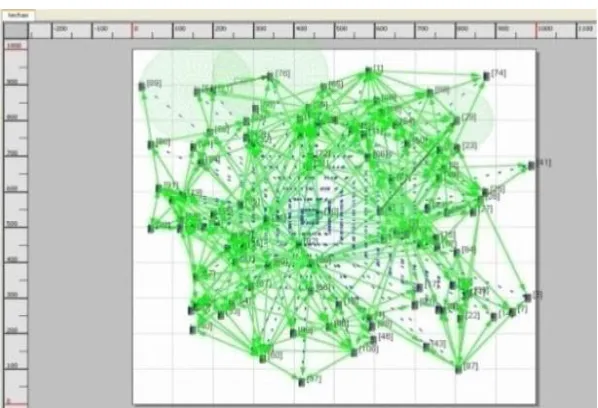
The protocol performance is analyzed using the Qualnet simulator version 5.0.2. The simulation parameters used for simulating the scenario of vehicular ad hoc network is shown in the table 1.
Table.1: Simulation Parameters
SCENARIO
DIMENSIONS(METERS) 1000m x 1000m
VERSION QUALNET 5.0
ROUTING PROTOCOL AODV, DSR,ZRP
SIMULATION TIME 3000 sec
MAC PROTOCOL 802.11
NO OF NODES 100
4.
IMULATION SCENARIO
Volume 2, Issue 4, April 2013
Page 419
5.
SIMULATION RESULTS
Figure 3: Comparison of average jitter for AODV, DSR, ZRP.
Figure 4: Comparison of throughput for AODV, DSR, ZRP.
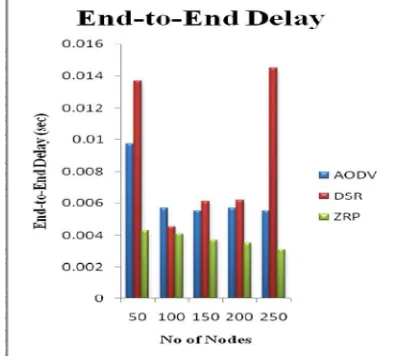
Figure 5: Comparison of end-to-end delay for AODV, DSR, and ZRP.
6.
RESULTS AND DISCUSSIONS
Volume 2, Issue 4, April 2013
Page 420
In this analysis, the performance of ZRP, AODV and DSR is thoroughly analyzed and from the observations it is finalized that ZRP has a good performance when compared to the other two protocols and is well suited for all the applications concerning VANET.References
[1] Ian D. Chakeres and Elizabeth M. Belding-Royer. “AODV Routing Protocol Implementation Design” Proceedings of the International Workshop on Wireless Ad Hoc Networking (WWAN), Tokyo, Japan, March 2004 (Slides). [2] Perkins. C, C. Belding-Royer E, Das. S(July 2003) . Ad Hoc On-Demand Distance Vector (AODV) Routing. [3] Johnson, Malts, Hu, 16-April-03.
[4] Josh Broch, David B, Johnson and David. A, Maltz. The Dynamic Source Routiing Protocol for Mobile Ad-Hoc Networks.
[5] David F. Bantz and Frederic J Bauchot, Wireless LAN Design Alternatives IEEE Network, 8(2);43-53, March April 1994.
[6] IEEE transactions on Vehicular technology, vol. 58, no.
[7] Malik M Alil Ibrahim Khan, “Performance Analysis of Routing protocols for Vehicular Ad-Hoc-Networks Literature”, April 2008.
[8] Luo Junhai Ye Danxia Xue Liu, Fan Mingyu. “A survey of multicast routing protocols for mobile Ad-Hoc Networik”, Communications Survey&Tutorials, IEEE Volume:11, Issue: 1; Page(s): 78-91.
[9] C. E Perkins, E. M. Royers, S. R. Das, M. K. Marina, Perfromance Comparison of Two On- Demand Routing Protocols for Ad-Hoc Networks, IEEE Personal Commmunications 8(1)(2001) 16-28.
[10] Akshai Aggarwal Savita Gandhi, “ Performance Analysis of AODV, DSR and DSDV in Manets” International Journal of Distributed and parallel Systems (IJDPS), November 2011, pp: 167-177.
AUTHOR
M. Suresh, born in the Sathyamangalam, Tamil Nadu State, India in 1991, received B.E in Electronics and Communication Engineering from Bannari Amman Institute of Technology, Sathyamangalam in 2012 and is currently pursuing his masters in Communication Systems in Bannari Amman Institute of Technology, Sathyamangalam. His areas of interest are Mobile Ad-hoc networks and mobile computing. He has published one paper in a reputed National Conference.
S.Mohanraj, born in the Erode, Tamilnadu State, India in 1989, received B.E in Electronics and Communication Engineering from Nandha Engineering college, perundurai in 2011 and is currently pursing his masters in Communication in Bannari Amman Institute of Technology, Sathyamangalam. His areas of interest are Mobile Ad-Hoc networks and mobile computing. He has published one journal and 8 papers in reputed national and international conference
C. Kamalanathan received his B.E.(ECE) degree from Anna University, Chennai in May 2005 and M.Tech.(Applied Electronics) degree from Dr.MGR University, Chennai, in April 2008. He is pursuing his Ph.D. degree at Anna University, Coimbatore in the area of Cloud Computing. He is presently working as Assistant Professor in the department of Electronics and Communication Engineering, Bannari Amman Institute of Technology, Sathyamangalam. He is having a total of 6 years of teaching experience in engineering colleges. His research interest includes Cloud Computing, wired and wireless networks and Network Security. He is the life member in Indian Society for Technical Education. He has published 12 papers in International conferences and National conferences.