Minimax Filter: Learning to Preserve Privacy
from Inference Attacks
Jihun Hamm [email protected]
Department of Computer Science and Engineering The Ohio State University
Columbus, OH 43210, USA
Editor:Amos Storkey
Abstract
Preserving privacy of continuous and/or high-dimensional data such as images, videos and audios, can be challenging with syntactic anonymization methods which are designed for discrete attributes. Differentially privacy, which uses a more rigorous definition of privacy loss, has shown more success in sanitizing continuous data. However, both syntactic and differential privacy are susceptible to inference attacks, i.e., an adversary can accurately infer sensitive attributes from sanitized data. The paper proposes a novel filter-based mechanism which preserves privacy of continuous and high-dimensional attributes against inference attacks. Finding the optimal utility-privacy tradeoff is formulated as a min-diff-max optimization problem. The paper provides an ERM-like analysis of the generalization error and also a practical algorithm to perform minimax optimization. In addition, the paper proposes a noisy minimax filter which combines minimax filter and differentially-private mechanism. Advantages of the method over purely noisy mechanisms is explained and demonstrated with examples. Experiments with several real-world tasks including facial expression classification, speech emotion classification, and activity classification from motion, show that the minimax filter can simultaneously achieve similar or higher target task accuracy and lower inference accuracy, often significantly lower than previous methods.
Keywords: inference attack, empirical risk minimization, minimax optimization, differ-ential privacy, k-anonymity
1. Introduction
Privacy is an important issue when data collected from or related to individuals are analyzed and released to a third party. In response to growing privacy concerns, various methods for privacy-preserving data publishing have been proposed (see Fung et al. 2010 for a review.)
Syntactic anonymization methods, such as k-anonymity (Sweeney, 2002) and l-diversity (Machanavajjhala et al., 2007) focus on anonymization of quasi-identifiers and protection of sensitive attributes in static databases. However, it is known that syntactic anonymization is susceptible to several types of attacks such as the DeFinetti attack (Kifer, 2009). An ad-versary may be able to accuratelyinfer sensitive attributes of individuals from insensitive, sanitized attributes. High-dimensional data also poses a challenge for syntactic anonymiza-tion methods. For example, k-anonymity is known to be ineffective for high-dimensional sparse databases (Narayanan and Shmatikov, 2008). In addition, syntactic anonymization methods are designed with discrete attributes in mind. However, continuous attributes such
c
as videos, images, or audios cannot be discretized by binning or clustering without loss of in-formation. Besides, conventional categorization of attributes as identifiers, quasi-identifiers, or sensitive information becomes ambiguous with multimedia-type data. For example, an image can be an identifier if it contains the face of the data owner. However, even if the face is blurred, other attributes considered sensitive by the owner such as gender or race can still be recognizable. Furthermore, identifying or sensitive information can be revealed through correlation with other information such as the background or other people in the scene.
Differential privacy (Dwork and Nissim, 2004; Dwork et al., 2006; Dwork, 2006) was proposed to address many weaknesses of syntactic methods (see the discussion by Clifton and Tassa 2013.) Differential privacy has a more formal privacy guarantee than that of syntactic methods, and is applicable to many problems beyond database release (Dwork et al., 2014). In particular, differential privacy can be defined for continuous and/or high-dimensional attributes as well as for functions (Hall et al., 2013). However, similarly to syntactic anonymization, differential privacy is not immune to inference attacks (Cormode, 2011), as differentially privacy only prevents an adversary from gainingadditionalknowledge by inclusion/exclusion of a subject (Dwork et al., 2014), and not from gaining knowledge from released data itself. Therefore, an adversary may still guess sensitive attributes of subjects from differentially-private attributes with confidence.
A notable assumption this paper makes is that the training data for computing an optimal filter are independent of the test data. For example, there are publicly available data sets that can be used to compute minimax filters such as those from the UCI data repository.1 As the training data set is already public information, the paper considers only the privacy of the subjects who use the filter at test time. A similar assumption was made in Hamm et al. (2016) for knowledge transfer purposes. After the filter is learned from training data, a new test subject can use the filter to obfuscate her data by herself without requiring a third party to collect and process her raw data. Note that this setting is analogous to the setting of local differential privacy (Duchi et al., 2013) where the entity that collects data is not trusted. Since the training procedure can only access empirical risks, the performance of the filter on test data is given in the form of expectation/probability. The paper presents an analysis of generalization error for empirical minimax optimizers in analogy with the analysis of empirical risk minimizers (ERM).
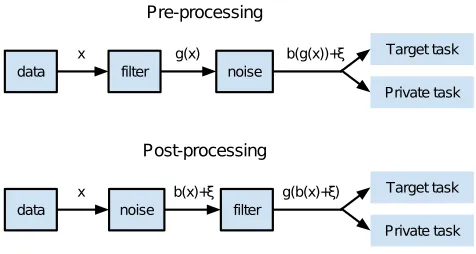
The goal of minimax filter is to prevent inference attacks, and its privacy guarantee is quite different from those of other privacy mechanisms. It is task-dependent and is given in probability or expectation rather than given absolutely, which may be considered weaker than other privacy criteria such as differential privacy. Furthermore, the sanitized data whose sensitive information is filtered out may become unsafe in the future if people’s perception of which attribute is sensitive changes over time. Since the goal of minimax filter and the goal of differential privacy are very different, it is natural to ask if the two methods can be combined to take advantages of both methods. Consequently, this paper presents an extension of minimax filter called noisy minimax filter, which combines the filter with additive noise mechanism to satisfy the differential privacy criterion. Two methods of combination—preprocessing and postprocessing—are proposed (see Fig. 2.) In the preprocessing approach, minimax filter is applied before perturbation to reduce the sensitivity of transformed data, so that the same level of differential privacy is achieved with less noise. Similar ideas have been utilized before, where data are transformed by Discrete Fourier Transform (Rastogi and Nath, 2010) and by Wavelet Transform (Xiao et al., 2011) before noise is added. In the postprocessing approach, minimax filter is applied after perturbation, and its performance is compared with the preprocessing approach.
Minimax filter and its extensions are evaluated with several real-world tasks includ-ing facial expression classification, speech emotion classification, and activity classification from motion. Experiments show that publicly available continuous and high-dimensional data sets are surprisingly susceptible to subject identification attacks, and that minimax filters can reduce the privacy risks to near chance levels without sacrificing utility much. Experiments with noisy minimax filter also yield intuitive results. Differential privacy and resilience to inference attack are indeed different goals, such that using differentially pri-vate mechanism alone to achieve the latter requires a large amount of noise that destroys utility of data. In contrast, minimax filters can suppress inference attack with little loss of utility with or without perturbation. Therefore, adding a small amount of noise to the minimax filter can provide a formal differential privacy to a degree and also high on-average task-dependent utility and privacy against inference attacks.
To summarize, the paper has the following contributions.
• The paper proposes a novel filtering approach which preserves privacy of continuous and high-dimensional attributes against inference attacks. This mechanism is different from previous mechanisms in many ways; in particular, it is a learning-based approach and is task-dependent.
• The paper measures utility and privacy by expected risks, and formulates the utility-privacy tradeoff as a min-diff-max optimization problem. The paper provides an ERM-like analysis of the generalization performance of empirical optimizers.
• The paper presents a practical algorithm which can find minimax filters for a broad family of filters and losses/classifiers. The proposed optimization algorithm and sup-porting classes can be found on the open-source repository.2
• The paper proposes preprocessing and postprocessing approaches to combine minimax filter with noisy mechanisms. The resulting combination can achieve resilience to inference attacks and differential privacy at the same time.
• The paper evaluates proposed algorithms on real-world tasks and compares them with representative algorithms from the literature.
The rest of the paper is organized as follows. Sec. 2 presents related work in the liter-ature. Sec. 3 presents minimax filters and analyzes its generalization performance on test data. Sec. 4 explains the difficulty of solving general minimax problems, and present a simple alternating optimization algorithm. Sec. 5 presents noisy minimax filters and two types of perturbation by additive noise. Sec. 6 evaluates minimax filters with three data sets compared to non-minimax approaches and also evaluates noisy minimax filters under various conditions. Sec. 7 concludes the paper with discussions.
2. Related work
Optimal utility-privacy tradeoff is one of the main goals in privacy research. Utility-privacy tradeoff has particularly been well-studied under differential privacy assumptions (Dwork and Nissim, 2004; Dwork et al., 2006; Dwork, 2006), in the context of the statistical estima-tion (Smith, 2011; Alvim et al., 2012; Duchi et al., 2013) and learnability (Kasiviswanathan et al., 2011). Other measures of privacy and utility were also proposed. Information-theoretic quantities were proposed by Sankar et al. (2010); Rebollo-Monedero et al. (2010); du Pin Calmon and Fawaz (2012) who analyzed privacy in terms of the rate-distortion theory in communication. One problem with using mutual information or related quantity is that it is difficult to estimate mutual information of high-dimensional and continuous variables in practice without assuming a simple distribution. In contrast, this paper pro-poses to use classification or regression risks to measure privacy and utility, which is directly computable from data without making assumptions on the distribution. Regarding the use of risks in this paper, classification error-based quantities have been suggested in the liter-ature (Iyengar, 2002; Brickell and Shmatikov, 2008; Li and Li, 2009). However, privacy in those works is measured either by syntactic anonymity or probabilistic divergence which are mainly suitable for discrete attributes. In this paper, privacy and utility are both defined using risks and are therefore directly comparable when defining the tradeoff of the two. Fur-thermore, the proposed method explicitly preserves privacy against inference attacks, which
both syntactic and differentially-private methods are known to be susceptible to (Cormode, 2011).
Most of the aforementioned works focused on the analyses of utility-privacy tradeoff using different measures and assumptions. Few studied efficient algorithms to actively find optimal tradeoff which this paper aims to do. For discrete variables, Krause and Horvitz (2008) showed the NP-hardness of optimal utility-privacy tradeoff in discrete attribute se-lection, and demonstrated near-optimality of greedy selection. In particular, they used a weighted difference of utility and privacy cost as the joint cost similar to this work. Ghosh et al. (2009) proposed geometric mechanism and linear programming to achieve near-optimal utility for unknown users. Note that the optimization problems with discrete distributions are quite different from the problems involving high-dimensional and/or continuous distri-butions.
Algorithms for preserving privacy of high-dimensional face images has been proposed previously. Newton et al. (2005) applied k-anonymity to images; Enev et al. (2012) proposed to learn a linear filter using Partial Least Squares to reduce the covariance between filtered data and private labels; Whitehill and Movellan (2012) also proposed a linear filter using the log-ratio of the Fisher’s Linear Discriminant Analysis metrics. Xu et al. (2017) presented a related method of preserving privacy of linear predictors using the Augmented Fractional Knapsack algorithm. This paper differs from these in several aspects: it is not limited to linear filters and is applicable to arbitrary differentiable nonlinear filters such as multilayer neural networks; it directly optimizes the utility-privacy risk instead of optimizing heuristic criteria such as covariance differences or LDA log-ratios.
The noisy minimax filter proposed in Sec. 5 bears a resemblance to the work of Rastogi and Nath (2010) and Xiao et al. (2011). Rastogi and Nath (2010) presented a differentially private method of answering queries on time-series data. They used Discrete Fourier Trans-form to reduce the data dimension and homomorphic encryption to perTrans-form distributed noise addition which outperformed the naive noise addition method. Xiao et al. (2011) presented a differentially private range-counting method where they used wavelets to trans-form the data before adding noise. Effectiveness of the method was analyzed and also demonstrated empirically. The noisy minimax filter presented in this paper, especially the preprocessing approach, is similar in concept to those works in that the combination of data transformation and perturbation is used to enhance utility. However, the transform in this paper (i.e., the minimax filter) is learned from data for specific tasks unlike the Fourier or the Wavelet transform which are data and task independent.
Lastly, the alternating optimization algorithm (Alg. 1) presented in this paper is related to the algorithm proposed by Goodfellow et al. (2014). The algorithm proposed in this paper solves a min-diff-max problem to find an optimal utility-privacy tradeoff, while Goodfellow et al. (2014) solve a minimax problem to learn generative models.
3. Minimax Filter
In this section, minimax filter is introduced and discussed in detail, and its generalization error is analyzed.
3.1 Formulation
Minimax filter is a non-invertible transformation of raw features/attributes such that the transformed data have optimal utility-privacy tradeoff. Non-invertibility is assumed so that original features are not always recoverable from the filtered data. Let’s assume the filter is deterministic; randomize filters will be discussed in Sec. 5. Let X ⊂ RD be the space of features/attributes as real-valued vectors. Note that discrete attributes can also be represented by real vectors, e.g., by one-hot vector. Let the filter be a map
g(x;u)∈G:X × U →Rd (1)
which is continuous inxand is continuously differentiable w.r.t. the parameteru∈ U. Given a filtered output g(x), an adversary can make a predictionhp(g(x);v) of a private variable y which can be an identifying or sensitive attribute. The prediction function hp(g(x);v)
parameterized byv∈ V is also assumed to be continuous invand continuously differentiable w.r.t. to the input g(x). The paper proposes to use expected risk to measure the privacy of filtered output against adversarial inference:
fpriv(u, v),E[lp(hp(g(x;u);v), y)], (2)
wherelp(·) is a continuously differentiable loss function. From the assumptions above,fpriv
is continuously differentiable w.r.t. the filter parameter u.
Trivial solutions to maximize privacy already exist, which are the filters that output random or constant numbers independent of actual data. However, such filters have no utility whatsoever for any party. To avoid such trivial solutions, it is necessary to consider the secondary goal of maximizing utility.
Suppose the disutility of filtered data is measured by the distortion of the original data. If
g(x;u) is the filter/encoderX →Rd, then one can construct the decoder h(·;w) :
Rd→ X, such that following reconstruction error
futil(u, w),E[khu(g(x;u);w)−xk2], (3)
is minimized (i.e., minwfutil(u, w).)
For another example of utility, let z be a target variable that is of interest to the subjects and analysts such as medical diagnosis of users’ data. An analyst can make a prediction hu(g(x);w) parameterized by w ∈ W, which is assumed to be continuous in w
and continuously differentiable w.r.t. the inputg(x). The (dis)utility of the filtered output for a non-adversarial analyst can also be measured by the expected risk
futil(u, w),E[lu(hu(g(x;u);w), z)], (4)
where lu(·) is a continuously differentiable loss function, such that futil is continuously
that the constraint setsW,V, andU are compact and convex subsets of Euclidean spaces such as a ball with a large but finite radius. Along with the assumption that the filtergand the risksfpriv andfutil are all continuous, min and max values are bounded and attainable.
In addition, the solutions to min or max problems are assumed to be in the interior of W,
V, and U, enforced by adding appropriate regularization (e.g, λkwk2) to the optimization
problems if necessary. For this reason, min or max problems that appear in the paper will be treated as unconstrained and the notationsu∈ U,v∈ V, and w∈ W will be omitted.
Having defined the privacy measure and the utility measure, the goal of a filter designer is to find a filter that achieves the following two objectives. The first objective is tomaximize privacy
max
u minv fpriv(u, v) (or equivalently, minu maxv −fpriv(u, v)) (5)
where minvfpriv(u, v) represents the risk of the worst (i.e., most capable) adversary: the
smaller the risk, the more accurately can she infer the sensitive variable y. As mentioned before, this problem alone has a trivial solution such as a constant filter that outputs zeros. The second objective is tominimize disutility
min
u minw futil(u, w) (or equivalently, minu −maxw −futil(u, w)) (6)
where minwfutil(u, w) represents the risk of the best analyst: the smaller the risk, the more
accurately can the analyst reconstruct original data x or predict the variable of interest
z. To achieve the two opposing goals, we can solve the joint problem of minimizing the weighted sum
min
u
h max
v −fpriv(u, v) +ρ minw futil(u, w)
i
, (7)
or equivalently the weighted difference of max values
min
u
h max
v −fpriv(u, v)−ρmaxw −futil(u, w)
i
. (8)
The constantρ >0 determines the relative importance of utility versus privacy. For a small
ρ1, the problem is close to a trivial privacy-only task, and for a largeρ1, the problem is close to a utility-only task. The solution to (7) or (8) will be referred to as minimax filter3 and is by definition an optimal filter for utility-privacy tradeoff in terms of expected risks given the family of filters {g(· ;u)|u ∈ U }, the family of private losses/classifiers
{lp(hp(·;v))|v∈ V} and the family of utility losses/classifiers{lu(hu(·;w))|w∈ W}. Note
that the choice of filter and loss/classifier families is very flexible, with the assumption of differentiability only. In practice, almost-everywhere differentiability suffices to use the algorithm in the paper. Fig. 1 shows an example filter/classifier from the class of multilayer neural networks. As an aside, the joint problem may be formulated as minimization of disutility with a hard constraint on privacy risk. When using interior-point methods, the procedure is similar to solving (8) iteratively with an increasingρ, which is more demanding than minimizing the weighted sum only once as the paper proposes.
Figure 1: Minimax filter with a filter/classifiers from the class of multilayer neural networks.
3.2 Notes on private and utility tasks
The private variable y can be any attribute which is considered sensitive or identifying. For example, let y be any number or string unique to a person in the data set. Such identifiers are bijective with {1, ..., S}, where S is the total number of subjects, so assume
y∈ {1, ..., S}. The private task for an adversary is then to predict the subject numberyfrom the filtered datag(x), whose inaccuracy is measured by the expected risk of the identification task. That is, the less accurate the private classifier is, the more anonymous the filtered output is. The identity variable can also be group identifiers, e.g., y is a demographic grouping based on age, sex, ethnicity, etc. Another example of private tasks is to single-out a particular subject among the rest, in which case y is binary: y = −1 means ‘not the target subject’ and y = 1 means ‘target subject’. To summarize, anonymity of filtered data in this paper means resilience to inference attacks on any variable y that we choose. This unifying approach is convenient since we need not determine whether an attribute is an identifier, a quasi-identifier or a sensitive attribute as in syntactic anonymization. Any information hidden in the continuous high-dimensional features which are relevant to the private variable y—whatever it may be—will be maximally filtered out by construction. Similarly, the target variable z of interest can be any variable that is not the same as the private variable y. In the pathological case where they are the same (z=y), the objective (8) becomes
min
u
h
(1−ρ) max
v −f(u, v)
i
(9)
Also, private and target tasks need not be classification tasks only. Regression tasks can also be used as a target task, as well as unsupervised tasks that do not require labelz. Unsupervised tasks are useful when the target task is unknown or non-specific. For example, (3) measures the expected least-squares error between the original and the reconstructed features.
3.3 Multiple tasks
Extension of the idea in the previous section to multiple private and target tasks is straight-forward. Suppose there are Np private tasks fpriv1 (u, v1), ..., fprivNp(u, vN p) associated with
private random variablesy1, ..., yN p. Note that fprivi (u, vi) =E[lpi(hi(g(x;u);vi), yi)].
Simi-larly, suppose there are Nu target tasks futil1 (u, w1), ..., futilNu(u, wN u) associated with target
random variables z1, ..., zN u. If κ1, ..., κN p are the coefficients representing relative
impor-tance of private tasks, and ρ1, ..., ρN u are the coefficients for utility tasks, then the final
objective is to solve the following problem
min
u
Np
X
i=1
κimax vi
−fprivi (u, vi) + Nu
X
i=1 ρimin
wi
futili (u, wi)
. (10)
Since this can be rewritten as
min
u
max
v1,...,vNp
− Np
X
i=1
κifprivi (u, vi) + min w1,...,wNu
Nu
X
i=1
ρifutili (u, wi)
, (11)
this multiple task problem is nearly identical to the original single task problem (7), with the new utility and privacy tasks defined as
ˆ
fpriv(u, v=(v1, ..., vN p)) ,
X
i
κifprivi (u, vi), and (12)
ˆ
futil(u, w=(w1, ..., wN u)) ,
X
i
ρifutili (u, wi), (13)
withρ= 1. Using this, it is straightforward to extend the analysis and algorithms developed for single tasks to those for multiple tasks.
3.4 Generalization performance of minimax filter
The proposed privacy mechanism is a learning-based approach. An optimal filter is one that solves the expected risk optimization (7). However, in reality, an optimal filter has to be estimated from finite training samples, and we need a guarantee on the performance of the learned filter on unseen test samples. This section derives generalization bounds for empirical minimax filter similar to the derivation of bounds for empirical risk minimizers (ERM).
The joint problem for expected risks was
min
u
h max
v −fpriv(u, v) +ρminw futil(u, w)
i
= min
u
h max
v −E[lp(u, v)] +ρminw E[lu(u, w)]
i
.
A joint losslJ is introduced for convenience:
lJ(u, v, w),−lp(u, v) +ρ lu(u, w). (15)
Let (u∗, v∗, w∗) be a solution to the expected risk optimization problem:
ED[lJ(u∗, v∗, w∗)] = min u
h max
v ED[−lp(u, v)] +ρminw ED[lu(u, w)]
i
, (16)
whereED[·] is the expected value w.r.t. the unknown data distribution P(x, y). Similarly,
let (ˆu,ˆv,wˆ) be a solution to the empirical risk minimax problem:
ES[lJ(ˆu,v,ˆ wˆ)] = min u
h max
v ES[−lp(u, v)] +ρminw ES[lu(u, w)]
i
, (17)
where the empirical meanES[·] forS ={(x1, y1),· · ·,(xN, yN)} is ES[l(x, y)],
1
N
X
(x,y)∈S
l(x, y). (18)
The goal in this analysis is to show that the expected and the empirical optimizers perform equally well in expectation/probability given enough training samples:
ED[lJ(ˆu,v,ˆ wˆ)]'ED[lJ(u∗, v∗, w∗)], as N → ∞. (19)
The main result is the Theorem 4 which is proved in the remainder of this section. Let’s define optimal parametersv(u) and w(u) givenu as
v∗(u) , arg max
v ED[−lp(u, v)], vˆ(u) , arg maxv ES[−lp(u, v)], (20) w∗(u) , arg min
w ED[lu(u, w)], wˆ(u) , arg minw ES[lu(u, w)]. (21)
One can then write
ED[lJ(u∗, v∗, w∗)] = min
u [ED[−lp(u, v
∗(u))] +ρE
D[lu(u, w∗(u))]] (22)
= min
u ED[lJ(u, v
∗(u), w∗(u))], (23)
and similarly
ES[lJ(ˆu,v,ˆ wˆ)] = min
u [ES[−lp(u,vˆ(u))] +ρES[lu(u,wˆ(u))]] = minu ES[lJ(u,ˆv(u),wˆ(u))].
(24) From these definitions we have for all u,
ED[lJ(u∗, v∗, w∗)] ≤ ED[lJ(u, v∗(u), w∗(u))], (25)
ES[lJ(ˆu,ˆv,wˆ)] ≤ ES[lJ(u,ˆv(u),wˆ(u))]. (26)
Also from definition, for all (u, v, w),
ED[lJ(u, v, w∗(u))] ≤ ED[lJ(u, v, w)] ≤ ED[lJ(u, v∗(u), w)], (27)
ES[lJ(u, v,wˆ(u))] ≤ ES[lJ(u, v, w)] ≤ ES[lJ(u,vˆ(u), w)]. (28)
Theorem 1 The risk difference of expected and empirical optimizers is at most twice the largest difference of expected and empirical risks of any set of parameters:
|ED[lJ(ˆu,v,ˆ wˆ)]−ED[lJ(u∗, v∗, w∗)]| ≤2 sup u,v,w
|ED[lJ(u, v, w)]−ES[lJ(u, v, w)]|. (29)
Proof The expected risk of empirical risk optimizers (ˆu,ˆv,wˆ) is upper-bounded by the risk of expected risk optimizers (u∗, v∗, w∗) as follows:
ED[lJ(ˆu,v,ˆ wˆ)]−ED[lJ(u∗, v∗, w∗)]
= ED[lJ(ˆu,v,ˆ wˆ)]−ES[lJ(ˆu,ˆv,wˆ)]−(ED[lJ(u∗, v∗, w∗)]−ES[lJ(ˆu,v,ˆ wˆ)])
≤ ED[lJ(ˆu,v,ˆ wˆ)]−ES[lJ(ˆu,ˆv,wˆ)]−(ED[lJ(u∗, v∗, w∗)]−ES[lJ(u∗,ˆv(u∗),wˆ(u∗))]) (from (26))
≤ ED[lJ(ˆu,v,ˆ wˆ)]−ES[lJ(ˆu,ˆv,wˆ)]−(ED[lJ(u∗,vˆ(u∗), w∗)]−ES[lJ(u∗,ˆv(u∗),wˆ(u∗))]) (from (27))
≤ ED[lJ(ˆu,v,ˆ wˆ)]−ES[lJ(ˆu,ˆv,wˆ)]−(ED[lJ(u∗,vˆ(u∗), w∗)]−ES[lJ(u∗,ˆv(u∗), w∗)]) (from (28))
≤ 2 sup
u,v,w
|ED[lJ(u, v, w)]−ES[lJ(u, v, w)]|.
The difference can also be lower-bounded as follows:
ED[lJ(u∗, v∗, w∗)]−ED[lJ(ˆu,v,ˆ wˆ)]
= ED[lJ(u∗, v∗, w∗)]−ES[lJ(ˆu,v,ˆ wˆ)]−(ED[lJ(ˆu,v,ˆ wˆ)]−ES[lJ(ˆu,v,ˆ wˆ)])
≤ ED[lJ(ˆu, v∗(ˆu), w∗(ˆu))]−ES[lJ(ˆu,v,ˆ wˆ)]−(ED[lJ(ˆu,v,ˆ wˆ)]−ES[lJ(ˆu,ˆv,wˆ)]) (from (25)) ≤ ED[lJ(ˆu, v∗(ˆu), w∗(ˆu))]−ES[lJ(ˆu, v∗(ˆu),wˆ)]−(ED[lJ(ˆu,v,ˆ wˆ)]−ES[lJ(ˆu,ˆv,wˆ)]) (from (28))
≤ ED[lJ(ˆu, v∗(ˆu),wˆ)]−ES[lJ(ˆu, v∗(ˆu),wˆ)]−(ED[lJ(ˆu,v,ˆ wˆ)]−ES[lJ(ˆu,ˆv,wˆ)]) (from (27))
≤ 2 sup
u,v,w
|ED[lJ(u, v, w)]−ES[lJ(u, v, w)]|.
To bound the RHS of (29), one can use the Rademacher complexity theory (e.g., Lemma 26.2 of Shalev-Shwartz and Ben-David (2014).)
Lemma 2 Let F be a class of real-valued functions, and let S be a set of N samples S ={(x1, y1), ...,(xN, yN)}. Then,
ES∼DN
"
sup
f∈F
|ED[f]−ES[f]|
#
≤2ES∼DN[R(F◦S)], (30)
where R(F ◦S) is the empirical Rademacher complexity
R(f◦S), 1
NEσ∼{−1,+1}N
"
sup
f∈F N
X
i=1
σif(xi, yi)
#
(31)
for the class of real-valued functions {(x, y)7→f(x, y) : ∀f ∈F}.
Consider the class of real-valued functions defined from the joint loss (15):
lJ◦HJ◦S , {(x, y, z)7→lJ(x, y, z;u, v, w) : u∈ U, v∈ V, w∈ W} (32)
Let R(lJ ◦HJ ◦S) denote the empirical Rademacher complexity of the joint loss class.
Furthermore, the Rademacher complexity of sum of functions can be upper-bounded by the sum of complexities:
Lemma 3 The empirical Rademacher complexity of the joint privacy-utility loss is upper-bounded as
R(lJ◦HJ◦S)≤R(lp◦Hp◦G◦S) +ρR(lu◦Hu◦G◦S), (ρ >0) (33)
where
lp◦Hp◦G◦S , {(x, y, z)7→lp(hp(gu(x)), y) : u∈ U, v∈ V}, (34)
lu◦Hu◦G◦S , {(x, y, z)7→lu(hu(gu(x)), z) : u∈ U, w∈ W}. (35)
Proof
R(lJ◦HJ ◦S) =
1
NEσ
" sup u,v,w N X i=1
σilJ(xi, yi, zi;u, v, w)
# (36) = 1
NEσ
" sup u,v,w N X i=1
σi(−lp(xi, yi;u, v) +ρ lu(xi, zi;u, w))
# (37) ≤ 1
NEσ
" sup u,v N X i=1
σilp(xi, yi;u, v)
+ρ sup
u,w N X i=1
σilu(xi, zi;u, w)
# (38)
= R(lp◦Hp◦G◦S) +ρR(lu◦Hu◦G◦S). (39)
From Theorem 1 and Lemmas 2 and 3, we get the following generalization bounds in terms of the Rademacher complexity.
Theorem 4
ES∼Dm[|ED[lJ(u∗, v∗, w∗)]−ED[lJ(ˆu,v,ˆ wˆ)]|]
≤ 4ES∼Dm[R(lp◦Hp◦G◦S) +ρR(lu◦Hu◦G◦S)]. (40)
A probabilistic bound instead of expected value can also be obtained by applying McDi-armid’s inequality, which is omitted.
The Rademacher complexity of privacy and utility losses depends on our choice of loss functions, hypothesis classes, and filter classes. For the simple case of linear filters and linear classifiers, one can compute the complexity using the following lemmas (26.9 and 26.10 from Shalev-Shwartz and Ben-David (2014)):
Lemma 5 Suppose φ : R → R is α-Lipschitz, i.e., |φ(a)−φ(b)| ≤ α|a−b|, ∀a, b ∈ R.
Then,
Lemma 6 For the class of linear classifiers H ={x7→wTx : kwk2≤1},
R(H◦S)≤ √1
N supx∈S
kxk2. (42)
.
From these lemmas and Theorem 4, we have a corollary for a simple case of linear filters and classifiers.
Corollary 7 Let the loss functions lu andlp be α-Lipschitz (e.g., α= 1 for logistic regres-sion.) Suppose U is a d×D real matrix with a bounded norm kUk2 ≤ 1, and w and v are vectors with bounded norms (kwk2 ≤1 and kvk2 ≤1). If the feature domain X is also bounded with a radius r = maxx∈Xkxk2, then we have
|ED[lJ(u∗, v∗, w∗)]−ED[lJ(ˆu,v,ˆ wˆ)]| ≤
4(1 +ρ)α r √
N . (43)
Alternatively, one can use the VC dimension to specify the bound.
In any case, the generalization bounds in this section justify the claim that minimax filter can preserve utility-privacy of unseen test data in expectation or probability.
4. Minimax Optimization
This section presents theoretical and numerical solutions of the joint problem (8), which is a variant of unconstrained continuous minimax problems. (See Rustem and Howe (2009) for a review.) The problem (8) can be written in an equivalent form
min
u Φ(u) = minu [Φpriv(u)−ρΦutil(u)] (44)
= min
u [maxv −fpriv(u, v)−ρ maxw −futil(u, w)] (45)
The optimization above is a min-diff-max problem and can be considered as simultane-ously solving two subproblems minu[maxv−fpriv(u, v)] and minu[−maxw−futil(u, w)], but
is evidently not the same as summing individual solutions
min
u Φ(u)6= minu [maxv −fpriv(u, v)] + minu [−ρmaxw −futil(u, w)]. (46)
Since the second subproblem minu[−maxw−futil(u, w)] = minu,wfutil(u, w) is a standard
minimization problem, let’s focus only on the first subproblem minu[maxv−fpriv(u, v)]
which is a continuous minimax problem. Continuous minimax problems are in general more challenging to solve than standard minimization problems, as the inner optimization Φpriv(u) = maxv−fpriv does not usually have a closed-form solution; when it does, the
whole problem can be treated as a standard minimization problem. Furthermore, there can be more than one solution to Φpriv(u) = maxv−fpriv. To better understand minimax
problems, we look at several examples starting from a simple case where Φpriv and Φutil
4.1 Simple case: eigenvalue problem
Consider finding a minimax filter for the following problem. The filter class is a linear dimensionality reduction (g(x;u) =UTx) parameterized by the matrix U ∈RD×d, and the private and target tasks are least-squares regressions parameterized by the matricesV and
W:
fpriv(U, V) =
1
N
X
i
kVTUTxi−yik2, and (47)
futil(U, W) =
1
N
X
i
kWTUTxi−zik2. (48)
In this case, Φpriv(U) = maxV −fp(U, V) and Φutil(U) = maxW−fu(U, W) are both concave
problems with closed-form solutions
ˆ
V = arg min
V fpriv = (U TC
xxU)−1UTCxy and (49)
ˆ
W = arg min
W futil= (U TC
xxU)−1UTCxz, (50)
where
Cxy =
1
N
X
i
xiyTi , Cxz =
1
N
X
i
xiziT, and Cxx =
1
N
X
i
xixTi . (51)
The corresponding min values are
Φpriv(U) = −fpriv(U,Vˆ) = Tr
(UTCxxU)−1UTCxyCxyT U
+ const, and (52)
Φutil(U) = −futil(U,Wˆ) = Tr
(UTCxxU)−1UTCxzCxzT U
+ const. (53)
The outer minimization over uis then
min
U Φ(U) = minU [Φpriv(U)−ρΦutil(U)] (54)
= min
U
h
−fpriv(U,Vˆ) +ρfutil(U,Wˆ) i
= min
U Tr
(UTCxxU)−1 UTCxyzU
,
(55)
where
Cxyz=CxyCxyT −ρCxzCxzT . (56)
The problem (55) can be reformulated as a generalized eigenvalue problem. LetQ=Cxx1/2U
be a D×dfull-rank matrix. The problem can be rewritten as
min
U Tr
(UTCxxU)−1UTCxyzU
= min
Q Tr
h
(QTQ)−1QTCxx−1/2CxyzCxx−1/2Q
i
. (57)
Furthermore, note that min value (55) is invariant to the right multiplication of U by any
d×dnonsingular matrixR. So choseR so thatQTQ=RTUTCxxU R=Id without loss of
generality. Let A = (Cxx−1/2)TCxyzC
−1/2
xx , and the minimax problem becomes the following
eigenvalue problem:
min
U Φ(U) ={Q|QminTQ=I d}
which is the sum of thedsmallest eigenvalues ofA which may not be positive semidefinite. Note that this special case problem is quite similar to the objective of Enev et al. (2012):
max
u [−λu TCT
xyCxyu+uTCxzT Cxzu], s.t. uTu= 1.
The paper also proposes a variant of the eigenvalue problem (58), called Privacy LDS
which is an analogue of linear discriminant analysis (LDS) for privacy-utility optimization problem. Define the symmetric positive semidefinite matrixCu as
Cu= K
X
k=1
Nk(µk−µ)(µk−µ)T, (59)
where
z∈ {1, ..., K}, Nk= N
X
i=1
I[zi=k], µk=
1
Nk N
X
i=1
xiI[zi =k], and µ=
1
N N
X
i=1
xi, (60)
Define Cp similarly with
y∈ {1, ..., K0}, Nk0 =
N0
X
i=1
I[yi=k], and µ0k=
1
Nk0 N0
X
i=1
xiI[yi =k]. (61)
The proposed Privacy LDS is a linear filter g(x;U) = UTx, where U = [u1, ..., ud] is a
matrix of top eigenvectorsui’s from the following generalized eigenvalue problem:
max kuk=1
uT(Cu+λI)u uT(C
p+λI)u
. (62)
This paper uses Privacy LDS as a heuristic to find the initial linear filter before fine-tuning the parameter u using a general optimization method presented in the following sections. Note that this initialization is applicable only to linear filters.
4.2 Saddle-point problem
Continuous minimax problems cannot in general be solved in closed form and require nu-merical solvers. There is a subclass of continuous minimax problems which are easier to solve than others. Saddle-point problems are minimax problems for whichf(u, v) is convex inu and concave inv, such as the following “saddle” problem
min
u maxv f(u, v) = minu maxv [u
2−v2]. (63)
Analogous to convex problems, f(u, v) has a global optimum (u∗, v∗) which satisfies
f(u∗, v)≤f(u∗, v∗)≤f(u, v∗). (64)
minumaxv−fpriv considered in this paper is not a saddle-point problem even for a relatively
simple case. Suppose one chooses linear filters, convex differentiable losses (e.g., least-squares, logistic, or exponential losses) and linear classifiers for the problem. Then
−fpriv(u, v) =−E[l(g(u);v)] =−E[l(yvTUTx)] (65)
is the negative expected value of the composition of a convex l(·) and a linearUTx, which is concave inU and is also concave in v, which cannot be a saddle-point problem.
4.3 General problem
A general numerical solution to the optimization (44) is described in this section. Let
f(u, v) be a real-valued function f :U × V →R, whereU andV are compact subsets of the Euclidean space. Suppose f is jointly continuous and has a continuous partial derivative
∇uf w.r.t. the first variable u. The maximum over v
Φ(u) = max
v∈V f(u, v) (66)
has a property that Φ(u) is in general not differentiable in u even if f(u, v) is (Danskin, 1967). SupposeV(u) is the set of maximizers off givenu:
V(u) ={vˆ∈ V |f(u,ˆv) = max
v∈V f(u, v)}. (67)
Danskin proved that the directional derivative DyΦ(u) in any direction y ∈ Rd can be written as the maximum directional derivatives off(u, v) over all ˆv∈V(u):
DyΦ(u) = max ˆ
v∈V(u)Dyf(u,ˆv), (68)
whereDyf(u, v) is the directional derivative of f w.r.t. u. Furthermore, in the case where V(u) is a singleton{vˆ(u)}for each u, we have
DyΦ(u) =Dyf(u,vˆ(u)). (69)
There are several classic minimax optimization algorithms using this property. Suppose
f(u, v) is also continuously differentiable w.r.t. v, and ∇uf is continuously differentiable w.r.t. v. A first-order method for minimax problems was proposed by Panin (1981) and was later refined by Kiwiel (1987). The latter uses a linear approximation off at a fixed ¯u
along the directionq
fl(q, v) =f(¯u, v) +h∇uf(¯u, v), qi, (70)
and uses it to compute the approximate max value
Φl(q) = max
v f
l(q, v). (71)
Using this approximation, a line search can be performed along the descent direction q
that minimizes the max function Φ(¯u+αq). In particular, with additional assumptions of Lipschitz continuity of∇uf and compactness of U andV, Kiwiel’s algorithm monotonically
which maxvh∇uf(u∗, v), qi ≥0 for all directionsq. Previously, Hamm (2015) used Kiwiel’s
algorithm to solve the optimization problems (44). However, one disadvantage of the method was its slow speed in practice, due to the auxiliary routine of finding the descent direction
q at each iteration, described in the supplementary material of Hamm (2015).
Instead, this paper proposes a simple alternating algorithm (Alg. 1) for solving min-diff-max problem based directly on Danskin’s theorem. The algorithm only assumesfpriv(u, v) andfutil(u, w) to be jointly continuous and have continuous partial derivatives ∇ufpriv and ∇ufutil. Additionally, if fpriv(u, v) andfutil(u, w) are convex in v and w respectively, then
the global minima
vt= arg min
v fpriv(ut, v) and wt= arg minw futil(ut, w) (72)
can be found easily, either approximately or accurately. Furthermore, iffutil and fpriv are
strongly convex (e.g., due to regularization), the solutions are unique. Consequently, the descent directionqt in Alg. 1 is truly the (negative) gradient of Φ(u) (44) as desired:
qt=∇ufpriv(u, vt)−ρ∇ufutil(u, wt) =−∇uΦpriv(u) +ρ∇uΦutil(u) =−∇uΦ(u). (73)
Note that it is still a heuristic for non-convex futil and fpriv such as when using neural networks for the filter and/or the classifiers. A related heuristic for minimax problems was proposed by Goodfellow et al. (2014) for learning generative models.
Algorithm 1 Alternating algorithm for min-diff-max
Input: data {(xi, yi, zi)}, filterg, lossl, classifierh, tradeoff coefficient ρ, max iteration T,
learning rates (αt)
Output: optimal filter parameter u Begin:
Initialize u1 for t= 1, ..., T do
Solve (approximately)
vt= arg min
v fpriv(ut, v) and wt= arg minw futil(ut, w), where (74)
fpriv(u, v) =
1
N N
X
i=1
lp(hp(g(xi;u);v), yi) and futil(u, w) =
1
N N
X
i=1
lu(hu(g(xi;u);w), zi).
(75) Compute the descent direction by
qt=∇ufpriv(u, vt)−ρ∇ufutil(u, wt) (76)
Perform line search alongqt and update ut+1=ut+αt·qt
Exit if solution converged
The proposed optimization algorithm and supporting classes are implemented in Python and are available on the open-source repository4.
5. Noisy Minimax Filter
The privacy guarantee that minimax filter provides is very different from that of differentially-private mechanisms. As the filter is learned from training data, its privacy guarantee for test data is given only in expectation/probability. Besides, it is a deterministic mechanism which cannot provide differential privacy. This section presents thenoisy minimax filterthat combines minimax filter with additive noise mechanism to satisfy the differential privacy criterion. Two methods of combination—preprocessing and postprocessing—are proposed and compared. For completeness, the definition of differential privacy is given briefly.
5.1 Differential privacy
A randomized algorithm that takes dataDas input and outputs ˜f(D) is called-differentially private if
P r( ˜f(D)∈ S)≤eP r( ˜f(D0)∈ S) (77)
for all measurable S ⊂ T of the output range and for all data sets D and D0 differing in a single item, denoted by D ∼ D0. That is, even if an adversary knows the whole data set
D except for a single item, she cannot infer much more about the unknown item from the output of the algorithm. A well-known mechanism for turning a non-private functionf into a private function ˜f is the perturbation by additive noise. When an algorithm outputs a real-valued vectorf(D)∈RD, its global sensitivity (Dwork et al., 2006) is defined as
S(f) = max
D∼D0kf(D)−f(D
0)k (78)
where k · kis a norm such as the Euclidean norm. An important result from Dwork et al. (2006) is that the perturbation by additive noise
˜
f(D) =f(D) +ξ, (79)
where ξ has the Laplace-like probability density whose scale parameter is proportional to
S(f)
P(ξ)∝e−
S(f)kξk, (80)
is-differentially private.
This paper considers local differential privacy (Duchi et al., 2013) of the filter output
g(x), that is, perturbation is applied by each subject beforeg(x) is released to a third party. Let X = {x1, ..., xS} be a collection of data from S subjects. Then, X ={x1, ..., xS} and X0 = {x01, ..., x0S} are defined as neighbors if xi = x0i for all i = 1, ..., S except for some j ∈1, ..., S. For this subject, xj and x0j can be any two samples from the common feature
space X of all subjects. Consequently, a randomized filter ˜g(·) is -differentially private if for all x, x0∈ X and all measurable S ⊂ T of the output range,
P r(˜g(x)∈S)≤eP r(˜g(x0)∈S). (81)
Pre-processing
Post-processing
data filter noise
g(x) b(g(x))+ξ
x
data noise filter
b(x)+ξ g(b(x)+ξ) x
Target task
Private task
Target task
Private task
Figure 2: Preprocessing and postprocessing approaches to differentially private minimax filtering.
To use additive noise mechanism (79), the sensitivity (78) of the output g(·) needs to be determined:
S(g) = sup
x,x0∈X
kg(x)−g(x0)k, (82)
which is finite if X is compact and g(·) is continuous. If X is unbounded, one can directly bound the diameter of g(X) by bounding functions. Examples of the bounding function
b:RD →RD are
1. Hard-bounding by clipping: b(h) = min{1/a, 1/khk} ·h for somea >0, 2. Soft-bounding by squashing: b(h) = tanh(akhk) for some a >0, and 3. Normalization after clipping: b(h) =h/khk,
where h = g(x) is the filter output of a sample x ∈ X. Note that these functions enforce the sensitivity S(b(g)) to be at most 2, regardless of X or g(·). The threshold a can be determined from the training data.
5.2 Preprocessing vs postprocessing
Minimax filters can be made locally differentially private using the additive noise mechanism (79) in the signal chain of filtering. The paper proposes two approaches. In thepreprocessing
approach, filtering is performed first and is followed by perturbation. In the postprocessing
approach, perturbation is applied first and is followed by filtering. Note that preprocessing and postprocessing approaches are similar to output perturbation and input perturbation in Sarwate and Chaudhuri (2013). Fig. 2 shows the signal chains of the two approaches. In preprocessing, the original feature x is first filtered by g(x), and then made differential private by a bounding function and perturbationb(g(x)) +ξ. In postprocessing, the original featurexis first made differentially private by a bounding function and perturbationb(x)+ξ
distribution P(x, y, z), preprocessing and postprocessing approaches have different effects that depend on the distribution.
A scenario when preprocessing is preferable to postprocessing is as follows. For the convenience of explanation, let’s assume that subject identification is the private task. Let
y(x) be the subject identity label of sample x and let z(x) be the target label of sample
x for any target task. Definebetween-subject diameter as the max distance of two samples
x, x0 from different subjects that have the same target label:
Sb, max
x,x0∈Xkx−x
0k s.t. y(x)6=y(x0), z(x) =z(x0). (83)
Similarly, definewithin-subject diameter as the max distance of two samplesx, x0 from the same subject that have different target labels:
Sw, max
x,x0∈Xkx−x
0k
s.t. y(x) =y(x0), z(x)6=z(x0). (84)
Also for the purpose of explanation, assume that the filter g is an orthogonal projection onto a lower-dimensional Euclidean space. For a given data set X, if the between-subject diameter is larger than the within-subject diameter (Sb > Sw) in the original feature space
(Fig. 3a), then minimax filtering can potentially reduce the diameterS(g) = maxx,x0kg(x)− g(x0)ksignificantly. This translates to less amount of noise required to achieve the same -privacy than the amount of noise required before filtering, as the data diameter has shrunk. This will result in better utility of the preprocessing approach over the postprocessing approach where noise is added before filtering. From the same reasoning, if the opposite is true (Sw > Sb) (Fig. 3b), then the diameter S(g) after minimax filtering does not change
much, and the preprocessing approach may not offer much benefit over the postprocessing approach. However, there are still other differences between the two approaches. This paper assumes that the training data are public information and their privacy is not the primary concern unlike the privacy of test data. However, if we begin to consider the privacy of training data as well, then one should be aware that the learned filters can leak private information, analogous to how the PCA components can leak information about training data (Chaudhuri et al., 2012), and that the filters also need to be sanitized before release. The postprocessing approach makes the whole process simpler. In this case, after each data owner perturbs the data by herself, any subsequent postprocessing, whether it is the process of applying pretrained filters or the process of training minimax filters, does not worsen differential privacy guarantees (Dwork et al., 2014), and therefore the postprocessing approach is a safer choice when the data owners cannot trust the entity that collects training data.
6. Experiments
Subj 1 z = -1
Subj 1 z = +1
Subj 2 z = -1
Subj 2 z = +1
z = -1
z = +1 Filtering
a. b.
Subj 1 z = -1
Subj 1 z = +1
Subj 2 z = -1
Subj 2 z = +1
z = -1
z = +1 Filtering
Figure 3: Two example data distributions which have the same data diameter before filter-ing but have different diameters after filterfilter-ing. a. an example where between-subject diameter (83) is large. b. an example where within-between-subject diameter (84) is large.
6.1 Methods
Filters. The following minimax and non-minimax filters are compared.
• Rand: random subspace projection with g(x;U) = UTx, where U is a random full rank D×dmatrix.
• PCA: principal component analysis with g(x;U) =UTx, whereU is the eigenvectors corresponding todlargest eigenvalues of Cov(x).
• PPLS: private partial least squares, using Algorithm 1 from Enev et al. (2012).
• DDD: discriminately decreasing discriminability (DDD) from Whitehill and Movellan (2012) with a mask-type filter from the code5.
• Minimax 1: linear filter g(x;U) =UTx whereU is computed from Alg. (1).
• Minimax 2: nonlinear filter g(x) from a two-layer sigmoid neural network with of hidden nodes of 20 and 10, computed from Alg. 1.
Remarks. DDD requires analytical solutions to eigenvalue problems which are unavailable for multiclass problems, and is used only in the binary problem with the face database. Also, DDD uses a mask-type filter in the codes, and the dimension dis same as the image size. The dimension dis also irrelevant to nonlinear Minimax filter 2 since it does not use linear dimensionality reduction. The nonlinear filter is pretrained as a stacked denoising autoencoders (Vincent et al., 2008) followed by supervised backpropagation with the target task. Classifier/loss. For all experiments, binary or multinomial logistic regression is used a classifier for both utility and privacy risks, where the lossl(h(g(x;u);v), y) is the negative log-likelihood with regularization:
l=−v(y)Tg(x;u) + log(
K
X
k=1
ev(k)Tg(x;u)) +λ 2
K
X
k=1
kv(k)k2 (85)
where K is the number of classes. The regularization coefficient was λ = 10−6 and the utility-privacy tradeoff coefficient was ρ = 10. The main iteration in Alg. 1 was stopped when the progress was slow, which was betweenT = 20−200.
6.2 Data sets
Gender/expression classification from face: The GENKI database (Whitehill and Movellan, 2012) consists of face images with varying poses and facial expressions. The original data set is used unchanged, which has N = 1740 training images (50% male and 50% female; 50% smile and 50% non-smile). The test set has 100 images (50 males and 50 females; 50 smiling and 50 non-smiling) not overlapping with the training set. The dimen-sionality of the original data isD= 256, and the filters are tested with d= 10,20,50,100. The data set has gender and expression labels but no subject label. Consequently, gender classification is used as the private task and expression classification is used as the target task.
Emotion classification from speech: The ENTERFACE database (Martin et al., 2006) is an audiovisual emotion database of 43 speakers from 14 nations reading predefined English sentences in six induced emotions. From the raw speech signals sampled in 48 KHz, MFCC coefficients are computed using 20 ms windows with 50% overlap and 13 Mel-frequency bands. The mean, max, min, and standard deviation of the MFCC coefficients over the duration of each sentence are computed, resulting in N = 427 samples of D = 52 dimen-sional feature vectors from S = 43 subjects. Each subject’s samples are randomly split to generate training (80%) and test (20%) sets. Average test accuracy over 10 such trials is re-ported. Filters are tested withd= 10,20,30,40. The target task is the binary classification of ‘happy’ and ‘non-happy’ emotions from speech, and the privacy task is the multiclass (S = 43) subject classification.
Activity classification from motion: The UCI Human Activity Recognition (HAR) data set (Anguita et al., 2012) is a collection of motion sensor data on a smartphone by 30 subjects performing six activities (walking,walking upstairs,walking downstairs,sitting,
standing, laying). Various time and frequency domain variables are extracted from the signal, resulting in N = 10299 samples of D= 561 dimensional features from 30 subjects which are used unchanged. Out of 30 subjects, 15 subjects are chosen randomly. For each domain, each subject’s samples are randomly split to generate training (50%) and test (50%) sets. At each trial, the subjects and the training/test sets are randomized, and the average test accuracy over 10 such trials is reported. Filters with dimensionsd= 10,20,50,100 are used. The target task is the multiclass (C = 6) classification of activity, and the privacy task is the multiclass (S = 15) subject classification.
6.3 Result 1: Minimax filters
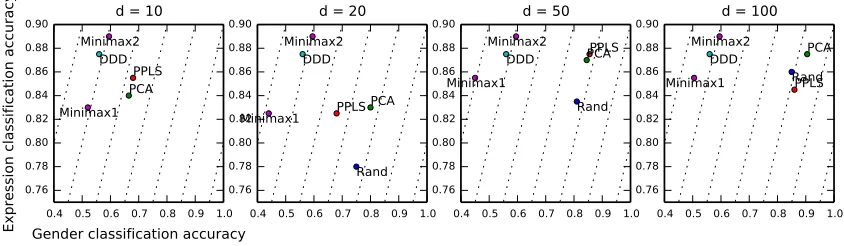
0.4 0.5 0.6 0.7 0.8 0.9 1.0 Gender classification accuracy 0.76 0.78 0.80 0.82 0.84 0.86 0.88 0.90
Expression classification accuracy
PCAPPLS DDD
Minimax1 Minimax2
d = 10
0.4 0.5 0.6 0.7 0.8 0.9 1.0 0.76 0.78 0.80 0.82 0.84 0.86 0.88 0.90 Rand PCA PPLS DDD Minimax1 Minimax2
d = 20
0.4 0.5 0.6 0.7 0.8 0.9 1.0 0.76 0.78 0.80 0.82 0.84 0.86 0.88 0.90 Rand PCAPPLS DDD Minimax1 Minimax2
d = 50
0.4 0.5 0.6 0.7 0.8 0.9 1.0 0.76 0.78 0.80 0.82 0.84 0.86 0.88 0.90 Rand PCA PPLS DDD Minimax1 Minimax2
d = 100
Figure 4: GENKI: Expression classification vs and gender classification from faces.
0.0 0.2 0.4 0.6 0.8 1.0 Subject identification accuracy 0.76 0.78 0.80 0.82 0.84 0.86 0.88 0.90
Emotion classification accuracy
Rand PCA PPLS Minimax1 Minimax2
d = 10
0.0 0.2 0.4 0.6 0.8 1.0 0.76 0.78 0.80 0.82 0.84 0.86 0.88 0.90 RandPCA PPLS Minimax1 Minimax2
d = 20
0.0 0.2 0.4 0.6 0.8 1.0 0.76 0.78 0.80 0.82 0.84 0.86 0.88 0.90 RandPCA PPLSMinimax1 Minimax2
d = 30
0.0 0.2 0.4 0.6 0.8 1.0 0.76 0.78 0.80 0.82 0.84 0.86 0.88 0.90 Rand PCA PPLSMinimax1 Minimax2
d = 40
Figure 5: ENTERFACE: Emotion classification vs and subject identification from speech.
against inference attack is to perform dimensionality reduction on the original data, such as Rand and PCA projections. As the dimensionalityddecreases from the original valueD
towards zero, one can expect both the private and the target accuracy to decrease toward the chance level. This trend is indeed the case with both the non-private (Rand,PCA) and the private (PPLS,DDD,Minimax) filters used in the paper. Therefore these filters are eval-uated at several different values of the dimensionality dto make fine-grained comparisons of utility-privacy.
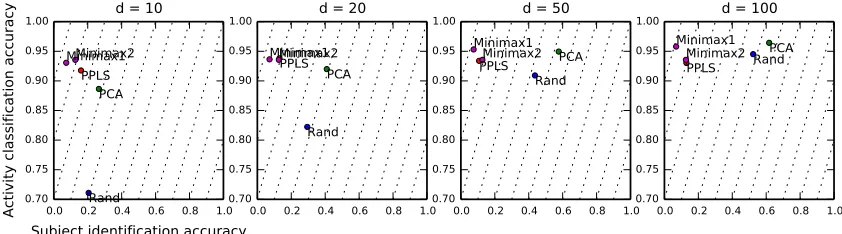
0.0 0.2 0.4 0.6 0.8 1.0 Subject identification accuracy 0.70
0.75 0.80 0.85 0.90 0.95 1.00
Activity classification accuracy Rand PCA PPLS Minimax1Minimax2
d = 10
0.0 0.2 0.4 0.6 0.8 1.0 0.70
0.75 0.80 0.85 0.90 0.95 1.00
Rand PCA PPLS Minimax1Minimax2
d = 20
0.0 0.2 0.4 0.6 0.8 1.0 0.70
0.75 0.80 0.85 0.90 0.95 1.00
Rand PCA PPLS
Minimax1Minimax2 d = 50
0.0 0.2 0.4 0.6 0.8 1.0 0.70
0.75 0.80 0.85 0.90 0.95 1.00
RandPCA PPLS
Minimax1 Minimax2
d = 100
Figure 6: HAR: Activity classification vs subject identification from motion.
expected, non-private methods Rand and PCA also do not reduce the privacy task accuracy. As dimension dincreases from 10 to 100, the accuracy of both the target and the private tasks increase (toward the top-right corner of the plot) for PPLS, PCA and Rand, but the value of utility-privacy tradeoff (i.e., target task accuracy - private task accuracy) remains relatively similar even thoughdchanges. Note thatdis irrelevant to Minimax 2 and DDD. Fig. 5 shows the test accuracy of ENTERFACE. Minimax 2 achieves the best utility (i.e., most accurate emotion classification) and the best privacy (i.e., least accurate subject classification) at the same time. PPLS performs well in this task; its private and target task accuracy is close to those of Minimax 2. The private task accuracy of Minimax 2 is near the chance level (1/S = 0.02) compared to 0.4−0.5 of non-private methods, suggesting that seemingly harmless statistics (mean, max, min, s.d. of MFCC) are quite susceptible to identification attacks if no privacy mechanism is used. Similar to GENKI, the accuracy of both the target and the private tasks increases with the dimensiondfor PCA and Rand, and the value of utility-privacy tradeoff remains similar regardless ofd.
Fig. 6 shows the test accuracy of HAR. Minimax 1 achieves the best utility (i.e., most accurate activity recognition) and the best privacy (i.e., least accurate subject classification), while Minimax 2 and PPLS performs similarly well. The private task accuracy of Minimax 1 is lower than others close to the chance level (1/S = 0.067). The figure also shows that motion data are susceptible (0.2−0.7) to identification attacks when no privacy mechanism is used. For all dimensions d, Minimax 1 achieves the best compromise of all methods similar to previous experiments. Also the accuracy of both the target and the private tasks roughly increases withdfor PCA and Rand, but the value of utility-privacy tradeoff remains similar.
6.4 Result 2: Noisy minimax filters
Minimax-0.0 0.001 0.01 0.1 1.0 10.0 1/eps 0.4 0.5 0.6 0.7 0.8 0.9
1.0GENKI - expression recognition accuracy PCA-pre PCA-post Minimax-pre Minimax-post
0.0 0.001 0.01 0.1 1.0 10.0
1/eps 0.4 0.5 0.6 0.7 0.8 0.9
1.0GENKI - gender recognition accuracy PCA-pre PCA-post Minimax-pre Minimax-post
0.0 0.001 0.01 0.1 1.0 10.0
1/eps 0.4 0.5 0.6 0.7 0.8 0.9 1.0
ENTERFACE - emotion recognition accuracy PCA-pre PCA-post Minimax-pre Minimax-post
0.0 0.001 0.01 0.1 1.0 10.0
1/eps 0.0 0.2 0.4 0.6 0.8 1.0
ENTERFACE - subject identification accuracy PCA-pre PCA-post Minimax-pre Minimax-post
0.0 0.001 0.01 0.1 1.0 10.0
1/eps 0.0 0.2 0.4 0.6 0.8
1.0HAR - activity recognition accuracy PCA-pre PCA-post Minimax-pre Minimax-post
0.0 0.001 0.01 0.1 1.0 10.0
1/eps 0.0 0.2 0.4 0.6 0.8
1.0HAR - subject identification accuracy PCA-pre PCA-post Minimax-pre Minimax-post
Figure 7: Impact of four noisy filters (PCA-pre/post and Minimax-pre/post) on the ac-curacy of target and private tasks for three data sets (GENKI, ENTERFACE, HAR), over the range of −1 = {0,10−3,10−2,10−1,100,101}. Top row is the target task accuracy (higher the better) and bottom row is the private task ac-curacy (lower the better.) Minimax-pre/post can limit the acac-curacy of inference attack (bottom row) to almost chance levels regardless of the value of , while PCA-pre/post requires a significantly high to prevent inference attacks which also destroy the utility.
pre/post from Fig. 2. For Minimax-pre/post, a linear filter of the same dimension d as PCA-pre/post is used. Tests are performed for the same ranges of dimension d as in Sec 6.3. The results for d= 20 with all three data sets are summarized in Fig. 7. Results for different dimensions show similar trends and are summarized in Fig. 8. Optimization of (7) is done similarly to the previous section. All tests are repeated 10 times for different noise samples of (80), for each of 10 random training/test splits.
different between pre/post and non-minimax PCA-pre/post. For both Minimax-pre and Minimax-post, the private task accuracy is almost as low as the chance accuracy of each data set (0.5, 0.03, 0.07) regardless of the noise level. This demonstrates that minimax filter can prevent inference attacks with little help of noise. In contrast, the non-minimax filters (PCA-pre/post) allow an adversary to infer private variables quite accurately (0.8, 0.5, 0.3) when no noise is used. Preventing such attacks for non-minimax filters requires a significant amount of additive noise (e.g.,−1≥0.1) which destroys the utility of data. These results show that differentially privacy is indeed different from privacy against inference attacks and the combination of two methods is beneficial.
7. Conclusion
This work presents a new learning-based mechanism for preventing inference attacks on continuous and high-dimensional data. In this mechanism, a filter transforms continuous and high-dimensional raw features to dimensionality-reduced representations of data. After filtering, information on target tasks remains but information on identifying or sensitive attributes is removed which makes it difficult for an adversary to accurately infer such attributes from the released filtered output. Minimax filters are designed to achieve the optimal utility-privacy tradeoff in terms of expected risks. The paper proves that a filter learned from empirical risks is not far from an ideal filter that is learned from expected risks as the number of samples increases. This property and its dependency on the task make this mechanism quite different from previous mechanisms, including syntactic anonymiza-tion and differential privacy. Algorithms for finding minimax filters are presented and evaluated on real-world data sets to show its practical usages. Experiments show that pub-licly available multisubject data sets are surprisingly susceptible to subject identification attacks, and that even simple linear minimax filters can reduce the privacy risks close to chance level without sacrificing target task accuracy by much.
0.0 0.001 0.01 0.1 1.0 10.0 1/eps 0.4 0.5 0.6 0.7 0.8 0.9 1.0
Expression recog. accuracy
d=10
PCA-pre PCA-post Minimax-pre Minimax-post
0.0 0.001 0.01 0.1 1.0 10.0 1/eps 0.4 0.5 0.6 0.7 0.8 0.9 1.0 d=20 PCA-pre PCA-post Minimax-pre Minimax-post
0.0 0.001 0.01 0.1 1.0 10.0 1/eps 0.4 0.5 0.6 0.7 0.8 0.9 1.0 d=50 PCA-pre PCA-post Minimax-pre Minimax-post
0.0 0.001 0.01 0.1 1.0 10.0 1/eps 0.4 0.5 0.6 0.7 0.8 0.9 1.0 d=100 PCA-pre PCA-post Minimax-pre Minimax-post
0.0 0.001 0.01 0.1 1.0 10.0 1/eps 0.4 0.5 0.6 0.7 0.8 0.9 1.0
Gender recog. accuracy
d=10
PCA-pre PCA-post Minimax-pre Minimax-post
0.0 0.001 0.01 0.1 1.0 10.0 1/eps 0.4 0.5 0.6 0.7 0.8 0.9 1.0 d=20 PCA-pre PCA-post Minimax-pre Minimax-post
0.0 0.001 0.01 0.1 1.0 10.0 1/eps 0.4 0.5 0.6 0.7 0.8 0.9 1.0 d=50 PCA-pre PCA-post Minimax-pre Minimax-post
0.0 0.001 0.01 0.1 1.0 10.0 1/eps 0.4 0.5 0.6 0.7 0.8 0.9 1.0 d=100 PCA-pre PCA-post Minimax-pre Minimax-post
0.0 0.001 0.01 0.1 1.0 10.0 1/eps 0.4 0.5 0.6 0.7 0.8 0.9 1.0
Expression recog. accuracy
d=10
PCA-pre PCA-post Minimax-pre Minimax-post
0.0 0.001 0.01 0.1 1.0 10.0 1/eps 0.4 0.5 0.6 0.7 0.8 0.9 1.0 d=20 PCA-pre PCA-post Minimax-pre Minimax-post
0.0 0.001 0.01 0.1 1.0 10.0 1/eps 0.4 0.5 0.6 0.7 0.8 0.9 1.0 d=30 PCA-pre PCA-post Minimax-pre Minimax-post
0.0 0.001 0.01 0.1 1.0 10.0 1/eps 0.4 0.5 0.6 0.7 0.8 0.9 1.0 d=40 PCA-pre PCA-post Minimax-pre Minimax-post
0.0 0.001 0.01 0.1 1.0 10.0 1/eps 0.0 0.2 0.4 0.6 0.8 1.0
Gender recog. accuracy
d=10
PCA-pre PCA-post Minimax-pre Minimax-post
0.0 0.001 0.01 0.1 1.0 10.0 1/eps 0.0 0.2 0.4 0.6 0.8 1.0 d=20 PCA-pre PCA-post Minimax-pre Minimax-post
0.0 0.001 0.01 0.1 1.0 10.0 1/eps 0.0 0.2 0.4 0.6 0.8 1.0 d=30 PCA-pre PCA-post Minimax-pre Minimax-post
0.0 0.001 0.01 0.1 1.0 10.0 1/eps 0.0 0.2 0.4 0.6 0.8 1.0 d=40 PCA-pre PCA-post Minimax-pre Minimax-post
0.0 0.001 0.01 0.1 1.0 10.0 1/eps 0.0 0.2 0.4 0.6 0.8 1.0
Activity recog. accuracy
d=10
PCA-pre PCA-post Minimax-pre Minimax-post
0.0 0.001 0.01 0.1 1.0 10.0 1/eps 0.0 0.2 0.4 0.6 0.8 1.0 d=20 PCA-pre PCA-post Minimax-pre Minimax-post
0.0 0.001 0.01 0.1 1.0 10.0 1/eps 0.0 0.2 0.4 0.6 0.8 1.0 d=50 PCA-pre PCA-post Minimax-pre Minimax-post
0.0 0.001 0.01 0.1 1.0 10.0 1/eps 0.0 0.2 0.4 0.6 0.8 1.0 d=100 PCA-pre PCA-post Minimax-pre Minimax-post
0.0 0.001 0.01 0.1 1.0 10.0 1/eps 0.0 0.2 0.4 0.6 0.8 1.0
Subject ident. accuracy
d=10
PCA-pre PCA-post Minimax-pre Minimax-post
0.0 0.001 0.01 0.1 1.0 10.0 1/eps 0.0 0.2 0.4 0.6 0.8 1.0 d=20 PCA-pre PCA-post Minimax-pre Minimax-post
0.0 0.001 0.01 0.1 1.0 10.0 1/eps 0.0 0.2 0.4 0.6 0.8 1.0 d=50 PCA-pre PCA-post Minimax-pre Minimax-post
0.0 0.001 0.01 0.1 1.0 10.0 1/eps 0.0 0.2 0.4 0.6 0.8 1.0 d=100 PCA-pre PCA-post Minimax-pre Minimax-post
Acknowledgments
This research was supported in part by funding from OFRN-C4ISR 2016 and Google Faculty Research Award 2015.
References
M´ario S Alvim, Miguel E Andr´es, Konstantinos Chatzikokolakis, Pierpaolo Degano, and Catuscia Palamidessi. Differential privacy: on the trade-off between utility and informa-tion leakage. In Formal Aspects of Security and Trust, pages 39–54. Springer, 2012.
Davide Anguita, Alessandro Ghio, Luca Oneto, Xavier Parra, and Jorge L Reyes-Ortiz. Human activity recognition on smartphones using a multiclass hardware-friendly support vector machine. InAmbient assisted living and home care, pages 216–223. Springer, 2012.
Justin Brickell and Vitaly Shmatikov. The cost of privacy: destruction of data-mining utility in anonymized data publishing. In Proceedings of the 14th ACM SIGKDD international conference on Knowledge discovery and data mining, pages 70–78. ACM, 2008.
Kamalika Chaudhuri, Anand Sarwate, and Kaushik Sinha. Near-optimal differentially pri-vate principal components. InAdvances in Neural Information Processing Systems, pages 989–997, 2012.
Chris Clifton and Tamir Tassa. On syntactic anonymity and differential privacy. Transac-tions on Data Privacy, 6(2):161–183, 2013.
Graham Cormode. Personal privacy vs population privacy: learning to attack anonymiza-tion. In Proceedings of the 17th ACM SIGKDD international conference on Knowledge discovery and data mining, pages 1253–1261. ACM, 2011.
John M Danskin. The theory of max-min and its application to weapons allocation problems. Springer, 1967.
Fl´avio du Pin Calmon and Nadia Fawaz. Privacy against statistical inference. In Commu-nication, Control, and Computing (Allerton), 2012 50th Annual Allerton Conference on, pages 1401–1408. IEEE, 2012.
John C Duchi, Michael I Jordan, and Martin J Wainwright. Local privacy and statistical minimax rates. In Foundations of Computer Science (FOCS), 2013 IEEE 54th Annual Symposium on, pages 429–438. IEEE, 2013.
Cynthia Dwork. Differential privacy. InAutomata, languages and programming, pages 1–12. Springer, 2006.
Cynthia Dwork and Kobbi Nissim. Privacy-Preserving Data Mining on Vertically Parti-tioned Databases. In Proc. CRYPTO. Springer, 2004.
Cynthia Dwork, Aaron Roth, et al. The algorithmic foundations of differential privacy.
Foundations and Trends in Theoretical Computer Science, 9(3-4):211–407, 2014.
Miro Enev, Jaeyeon Jung, Liefeng Bo, Xiaofeng Ren, and Tadayoshi Kohno. Sensorsift: balancing sensor data privacy and utility in automated face understanding. InProceedings of the 28th Annual Computer Security Applications Conference, pages 149–158. ACM, 2012.
Benjamin Fung, Ke Wang, Rui Chen, and Philip S Yu. Privacy-preserving data publishing: A survey of recent developments. ACM Comp. Surveys (CSUR), 42(4):14, 2010.
Arpita Ghosh, Tim Roughgarden, and Mukund Sundararajan. Universally utility-maximizing privacy mechanisms. InProceedings of the forty-first annual ACM symposium on Theory of computing, pages 351–360. ACM, 2009.
Ian Goodfellow, Jean Pouget-Abadie, Mehdi Mirza, Bing Xu, David Warde-Farley, Sherjil Ozair, Aaron Courville, and Yoshua Bengio. Generative adversarial nets. In Advances in Neural Information Processing Systems, pages 2672–2680, 2014.
Rob Hall, Alessandro Rinaldo, and Larry Wasserman. Differential privacy for functions and functional data. Journal of Machine Learning Research, 14(Feb):703–727, 2013.
Jihun Hamm. Preserving privacy of continuous high-dimensional data with minimax filters. In Proceedings of the Eighteenth International Conference on Artificial Intelligence and Statistics (AISTATS), 2015.
Jihun Hamm. Enhancing utility and privacy with noisy minimax filters. In Acoustics, Speech and Signal Processing (ICASSP), 2017 IEEE International Conference on, pages 6389–6393. IEEE, 2017.
Jihun Hamm, Paul Cao, and Mikhail Belkin. Learning privately from multiparty data. In
Proceedings of The 33rd International Conference on Machine Learning (ICML), pages 555–563, 2016.
Vijay S Iyengar. Transforming data to satisfy privacy constraints. In Proceedings of the eighth ACM SIGKDD international conference on Knowledge discovery and data mining, pages 279–288. ACM, 2002.
Shiva Prasad Kasiviswanathan, Homin K Lee, Kobbi Nissim, Sofya Raskhodnikova, and Adam Smith. What can we learn privately? SIAM Journal on Computing, 40(3):793– 826, 2011.
Daniel Kifer. Attacks on privacy and definetti’s theorem. In Proceedings of the 2009 ACM SIGMOD International Conference on Management of data, pages 127–138. ACM, 2009.
Krzysztof C Kiwiel. A direct method of linearization for continuous minimax problems.
Journal of optimization theory and applications, 55(2):271–287, 1987.