Research Article
Probiotic Supplements do not Increase the Effectiveness of Antibiotics
in the Treatment of Bacterial Vaginosis
Suplemen Probiotik tidak Meningkatkan Efektivitas Antibiotik
dalam Terapi Bakterial Vaginosis
Ratnah Hamid, Eddy Tiro, Josephine Tumedia
Department of Obstetrics and Gynecology Faculty of Medicine University of Hasanuddin/
Dr. Wahidin Sudirohusodo Hospital Makassar
INTRODUCTION
Bacterial vaginosis (BV) is the most common infec-tion in vagina. BV is also the most common cause of the abundant vaginal secret. BV could cause ab-normal vaginal secret, itchy sensation and foul smell.1,2
Clinical criteria used for diagnosing bacterial vaginosis is the Amsel criteria, ie vaginal pH > 4.5, the existence of a homogeneous vaginal discharge, the occurrence of fishy odor after application of KOH (potassium hydroxide) to the vaginal secret, and the presence of clue cells on microscopic ex-amination. The diagnosis of BV is made when at least three out those four criteria are fulfilled.2
Bacterial vaginosis usually occurs due to an im-balance of the normal vaginal microorganisms population. Lactobacilli bacteria is found to be re-duced while other microorganism, Gardnerella vaginalis, increase. The main therapy for Bacterial vaginosis is metronidazole 500 mg, given 2 times a day for 7 days . However, treatment with antibi-otics can be followed with the incidence of recur-rent Bacterial vaginosis and resistance to the anti-biotic. Therefore, we need to try finding other al-ternatives as therapy. One of the proposed alternative is using probiotics to restore the nor-mal population of Lactobacilli in vagina.3-5 The use of probiotics can be also used as a preventive ther-Abstract
Objective : This study aims to assess the effect of the addition of pro-biotic supplement to the standard therapy on the recovery of Bacte-rial vaginosis infection.
Methods: The research was conducted by taking samples from Ob-stetrics and Gynecology Department in several teaching hospitals of Faculty of Medicine, Hasanuddin University. This study was an ex-perimental study. Consecutive sampling was conducted on 50 sam-ples, which were then divided into two groups. Group 1 received Metronidazol therapy 2 times a day for 7 days, while group 2 re-ceived Metronidazol therapy 2 times a day supplemented with oral Probiotic of once a day for 7 days. The data were analysed by using the chi-square test.
Results: There is no significant difference in the recovery of bacte-rial vaginosis infection between the group that received the probi-otic supplementation and the group that did not.
Conclusion: The addition of probiotic supplement to the standard therapy of BV infection does not show any signifcant effect. [Indones J Obstet Gynecol 2013; 1-4: 194-8]
Keyword: bacterial vaginosis, probiotic supplement, recovery, standard therapy
Abstrak
Tujuan: Penelitian ini bertujuan untuk menilai efek suplemen probio-tik bersama terapi standar terhadap penyembuhan Bacterial vagi-nosis.
Metode: Penelitian ini dilakukan dengan mengambil sampel peneli-tian di beberapa rumah sakit pendidikan Bagian Obstetri dan Gine-kologi Fakultas Kedokteran Universitas Hasanuddin. Metode peneli-tian yang digunakan dalam penelipeneli-tian ini adalah uji klinis. Dilakukan consecutive sampling terhadap 50 sampel yang terbagi atas dua kelompok, yaitu kelompok 1 yang mendapat terapi Metronidazol oral 2 x sehari selama 7 hari, sedang kelompok 2 diberikan terapi Metroni-dazol 2 x sehari ditambahkan dengan Probiotik oral 1 x sehari selama 7 hari. Data dianalisis dengan menggunakan uji Chi-Square. Hasil: Hasil penelitian ini menunjukkan tidak ada perbedaan yang sig-nifikan dari efek penambahan probiotik pada terapi standar terhadap Bacterial vaginosis (p>0,05).
Kesimpulan: Penambahan probiotik pada terapi standar tidak menunjukkan efek terhadap penyembuhan Bacterial vaginosis. [Maj Obstet Ginekol Indones 2013; 1-4: 194-8]
Kata kunci: bacterial vaginosis, penyembuhan, suplemen probiotik, terapi standar
apy against bacterial vaginosis, where probiotics can restore normal vaginal flora.5 Several studies have also reported that probiotics can be an alter-native as a substitute for antibiotics.6
Many studies showed that the H2O2 produced by vaginal lactobacilli can prevent Bacterial vaginosis, although some other studies do not support this hypothesis. The use of probiotics for the preven-tion and treatment of infecpreven-tion has a strong foun-dation and relatively safe, especially for Bacterial Vaginosis . Side effects from the use of probiotics is rarely found, and even if found, it tends to be a mild gastrointestinal complaints.7,8
In the study conducted by Falagas et al, it was re-ported that the use of probiotics is an effective ele-ment in the treatele-ment and prevention of bacterial vaginosis . Study demonstrated a significant relation-ship between low concentrations of vaginal lactoba-cilli and the incidence of Bacterial vaginosis. The in-vitro study showed that certain strains of Lactobacilli can inhibit the development of Gardnella vaginalis in vaginal epithelium and the production of H2O2 and lactic acid can inhibit the growth of bacteria that can cause bacterial vaginosis.8
Based on this background, we found that it is necessary to conduct a clinical trial on the effects of probiotic supplementation with standard ther-apy in the recovery of bacterial vaginosis.
METHOD
The research was conducted by taking samples from Obstetrics and Gynecology Department in several teaching hospitals of Faculty of Medicine, Hasanuddin University. This study was an experi-mental study. Consecutive sampling was conducted on 50 subjects who fulfilled the inclusion criteria, which were then divided into two groups. Group 1 received Metronidazol therapy 2 times a day for 7 days, while group 2 received Metronidazol therapy 2 times a day supplemented with oral Probiotic of once a day for 7 days. The data were analysed by using the chi-square test.
RESULT
This study was performed on 50 women with com-plaints of vaginal discharge that met the inclusion criteria. The subjects were divided into 2 groups. Group 1 consisted of 25 patients who received standard therapy and group 2 consisted of 25 peo-ple who received standard therapy and a probiotic
supplement. The subject assignment into these two groups were performed randomly.
Characteristics of the samples include maternal age, parity, maternal education, and maternal em-ployment. Basic characteristics of the study sample was obtained from the value of a statistical descrip-tion of which is illustrated by the number of each variable, as can be seen in the Table 1.
Table 1. The Characteristic of the Subject
Variable
Metronidazole
only group + probiotic groupMetronidazole
(n=25) % (n=25) %
Age 20 - 30 31 - 40
5 20 20 80 5 20 20 80 Parity 0 1 2 3 ≥ 4
4 5 5 2 9 16 20 20 8 36 2 1 7 4 11 8 4 28 16 44 Education
Junior high school Senior high school College graduate 5 15 5 20 60 20 4 18 3 16 72 12 Occupation Housewife Enterpreneur Public officer 17 6 2 68 24 8 15 6 4 60 24 16
Table 1 shows that most subjects were in the age group of 31-40 years (80%) in both group 1 and group 2. Most subjects had given birth ≥ 4 times, as many as 9 subjects (36%) in group I and 11 subjects (44%) in group II. The majority of sub-jects were graduated from senior high school. The most common occupation was housewife.
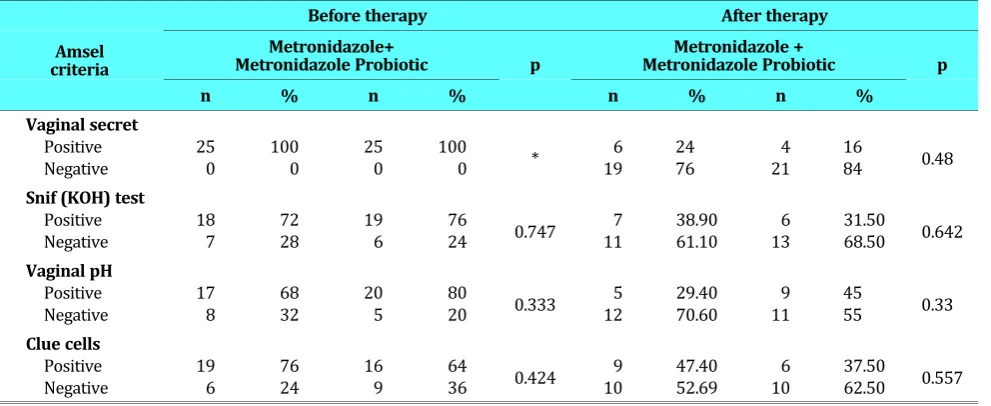
Before therapy, the homogenous vaginal secret was found in all subjects in both groups. After ther-apy, there was only 6 people (24%) in group 1 who were still positive and 4 people (16%) in group 2 who were stil positive. Based on the statistical test, we found that there was no significant differences regarding the presence of vaginal discharge after treatment in both groups (p > 0.05).
in group 1, while 13 subjects ( 68.5 % ) were tested negative in group 2. There was no significant dif-ference in the examination of KOH test after treat-ment in both groups.
From the examination of vaginal pH, there were 17 subjects (68%) tested positive in group 1 and 20 subjects (80%) tested positive in group 2. Then after therapy 12 subjects (70.6%) were tested negative in group 1 and 11 subjects (55%) were negative. Based on statistical tests found no signifi-cant differences in the pH of the vaginal examina-tion after therapy in both groups with p > 0.05
From the examination of clue cells, there were 19 subjects (76%) tested positive in group 1 and 16 subjects (64%) in group 2. After therapy there were 10 people (52.6%) tested negative in group 1, and 10 subjects (62.5%) in group 2 . Then the obtained value of the test statistic p > 0.05 means that there is no significant difference in the exami-nation of vaginal clue cells after treatment in both groups.
Table 3. Bacterial Vaginosis after Therapy in both Groups
Groups
Result
Total p Cured Not cured
n % n %
Metronidazole 19 76 6 24 25 100 0.747
Metronidazole+ probiotic
18 72 7 28 25 100
Note: p: Pearson Chi-Square test
Table 3 shows that 19 subjects (76%) were cured in group 1 and 18 people (72%) were cured in group 2. From statistical tests using Pearson Chi-Square test, it was found that there was no signifi-cant difference between the two groups (p> 0.05).
DISCUSSION
Bacterial vaginosis (BV) is the most common infec-tion in vagina. BV is also the most common cause of the abundant vaginal secret.1,2 We performed a clinical trial comparing the use of metronidazole only and metronidazole supplemented by probiotic in the management of bacterial vaginosis.
In this study, most subjects were in the age group of 31-40 years (80%) in both groups. Several previous studies reported that Bacterial vaginosis is more common in younger women.9 Meanwhile, another study showed that the risk of bacterial vaginosis increases with increasing age.10 Our study’s finding was similar to the later study. This may be associated with the lower estrogen levels at this age. Decreased levels of estrogen causes an increase in vaginal pH, so this condition is not op-timal for the development of Lactobacillus sp, a normal vaginal flora , but very conducive to the growth of microorganisms that cause bacterial vaginosis.10
Most subjects had given birth ≥ 4 times in both treatment groups . Research conducted by P. Bhalla and A. Kaushika in 1994 found a significant rela-Table 2. The Examination of Amsel Criteria before and after Therapy in both Group
Amsel criteria
Before therapy After therapy
Metronidazole+
Metronidazole Probiotic p Metronidazole ProbioticMetronidazole + p
n % n % n % n %
Vaginal secret
Positive
Negative 25 0 100 0 25 0 100 0 * 619 24 76 421 16 84 0.48
Snif (KOH) test
Positive Negative
18 7
72 28
19 6
76
24 0.747 7 11
38.90 61.10
6 13
31.50
68.50 0.642
Vaginal pH
Positive Negative
17 8
68 32
20 5
80
20 0.333 5 12
29.40 70.60
9 11
45
55 0.33
Clue cells
Positive
Negative 19 6 7624 16 9 6436 0.424 910 47.4052.69 610 37.5062.50 0.557 Note:* : No statistics are computed because variable is a constant
tionship between the incidence of bacterial vagi-nosis with higher parity.11 Meanwhile, in 2004 a study by multivariate analysis found that there was no relationship between the incidence of bacterial vaginosis and parity.12
The majority of subjects were graduated from senior high school. The most common occupation was housewife. Both of these variables are related to the socio-economic level. Research conducted by Tamonud Modak et al in 2011 found that all sub-jects with bacterial vaginosis were from a low so-cioeconomic level.13 It could be explained that the subjects with lower socioeconomic had a low awareness in personal and environmental hygiene, thus more susceptible to infection.
Bacterial vaginosis usually occurs due to an im-balance of the normal vaginal microorganisms population. Lactobacilli bacteria is found to be re-duced while other microorganism, Gardnerella vaginalis, increase. The main therapy for Bacterial vaginosis is metronidazole 500 mg, given 2 times a day for 7 days. However, treatment with antibi-otics can be followed with the incidence of recur-rent Bacterial vaginosis and resistance to the anti-biotic. Therefore, we need to try finding other al-ternatives as therapy. One of the proposed alternative is using probiotics to restore the nor-mal population of Lactobacilli in vagina.3-5
The goal of probiotic therapy in addition to standard therapy is to restore the normal balance of vaginal microorganisms populations, which con-tains probiotics lactobacilli required by normal vaginal ecosystem. Research conducted by Gabriela Lilies et al showed that probiotic supplementation therapy may increase the effectiveness in the man-agement of Bacterial vaginosis.14
The result of homogeneity examination towards both group based on the amsel criteria before ther-apy showed that both groups were homogenous population with p>0.05.
The influence of probiotic supplementation in the standard therapy were reassessed after 7 day of therapy. The reassessment included vaginal se-cret examination, Sniff test, vaginal pH examination and the examination for the presence of clue cells. The statistical analysis towards all criteria after therapy showed that there was no significant dif-ference in both groups. There was no difdif-ference either in the overall recovery of subjects in both groups.
This result is consistent with the research con-ducted by Katarina Eriksson et al. which found that there was no significant difference in the recovery rates between treatment with only antibiotic and antibiotic supplemented with probiotic.15 But in re-search conducted by Lilior et al, it was showed that treatment with probiotic supplements can increase the effectiveness of management on bacterial vagi-nosis.14 Similarly, the study by Valentine Marcone also found that probiotics can significantly increase the effectiveness of antibiotic therapy.16
CONCLUSION
Addition of probiotic supplements do not increase the effectiveness of antibiotics in the treatment of bacterial vaginosis.
REFERENCES
1. Phillip Hay. Bacterial Vaginosis. J Pediat Obstet Gynaecol. 2002: 36-40.
2. David A, Eschenbach M. Screening, Diagnosis and Manage-ment of Bacterial Vaginosis. ManageManage-ment of STDs in Family Planning Settings. 1999; 13:71-5.
3. Roberta B. Ness, Kevin E. Kip, Sharon L. Hillier, David E. Soper, Carol A. Stamm, Richard L. Sweet, et al. A Cluster Analysis of Bacterial Vaginosis-associated Microflora and Pelvic Inflammatory Disease. Am J Epidemiol. 2005; 162: 585-90.
4. Catriona S. Bradshaw, Anna N. Morton, Jane Hocking, Suzanne M. Garland, Margaret B. Morris, Lorna M. Moss, et al. High Recurrence Rates of Bacterial Vaginosis over the Course of 12 Months after Oral Metronidazole Therapy and Factors Associated with Recurrence. J Infect Diseases. 2006; 193: 1478-86.
5. Abiola C Senok, Hans Verstraelen, Marleen Temmerman, Gi-useppe A Botta. Probiotics for the treatment of bacterial vaginosis. Cochrane Database of Systematic Reviews. 2009. 6. T. Iannitti, B. Palmieri. Therapeutical use of probiotic
for-mulations in clinical practice. Clin Nut. 2010:701-25. 7. Sarah Cribby, Michelle Taylor, Gregor Reid. Vaginal
Micro-biota and the Use of Probiotics. Interdisciplinary Perspec-tives on Infectious Diseases. 2008:1-9.
8. M. E. Falagas, G. I. Betsi, S. Athanasiou. Probiotics for the treatment of women with bacterial vaginosis. Clin Microbiol Infect. 2006; 13:657-64.
9. Seblewongiel Ayenalem, Lukman Yusuf, Mogessie Ashenafi. Lactic Acid Bacterial Vaginosis among Outpatients in Addis Ababa. Journal Ethiop Health Dev. 2010; 24:198-204. 10. Dwiana Ocviyanti, Yeva Rosana, Shanty Olivia, Ferry
Dar-mawan. Risk factors for bacterial vaginosis among Indone-sian women. Med J Indones. 2010;19:130-5.
12. Shimano S, Nishikawa A, Sonoda T, Kudo R. Analysis of the prevalence of bacterial vaginosis and Chlamydia trachoma-tis infection in 6083 pregnant women at a hospital in Otaru, Japan. J Obstet Gynecol Res. 2004; 30:230-6.
13. Tamonud Modak, Preeti Arora, Charan Agnes, Raja Ray, Se-banti Goswami, Pramit Ghosh, et al. Diagnosis of bacterial vaginosis in cases of abnormal vaginal discharge: compari-son of clinical and microbiological criteria. J Infect Dev Ctries. 2011; 5:353-60.
14. Gabriela Lilios MD, Cristina Farcas MD, Violeta Sapira MD, Dragos Doicescu MD, Iulian Bratu MD. Probiotics - a com-plementary therapeutic necessity in non-specific vaginitis. Practica Medicalå. 2012; 25:63-5.
15. Katarina Eriksson, Bodil Carlsson, Urban Forsum, P-G Lars-son. A Double-blind Treatment Study of Bacterial Vaginosis with Normal Vaginal Lactobacilli after an Open Treatment with Vaginal Clindamycin Ovules. Acta Derm Venereol. 2005; 85:42-6.