Temperature studies of Urbach absorption edge in
implanted Cu6PS5Br crystals
1
Studenyak I.P., 1Izai V.Yu., 1Panko V.V., 2Kúš P. and 2Plecenik A.
1
Uzhhorod National University, 46 Pidhirna St., 88000 Uzhhorod, Ukraine, e-mail: [email protected]
2
Comenius University, Mlynska Dolina, 84248 Bratislava, Slovakia Received: 30.06.2010
Abstract
Cu6PS5Br crystals grown with a chemical vapour transport technique are
im-planted with sulphur ions. Optical absorption edge for the imim-planted crystals is studied in the temperature range of 77–320 K. Temperature dependences of the optical pseudogap and the Urbach energy are analysed. The parameters of exci-ton-phonon interaction resulting from the Urbach behaviour of the optical ab-sorption edge are determined. Ordering-disordering processes in Cu6PS5Br
crys-tals induced by the ion implantation are studied.
Keywords: superionic conductors, implantation, phase transitions, Urbach absorption edge, structural disorder
PACS: 78.40.Ha; 77.80.Bh UDC: 535.343.2
1. Introduction
Cu6PS5Br crystals belong to the family of compounds with an argyrodite structure [1].
They are characterised by high concentration of disordered vacancies and manifest both superionic and ferroelastic properties. High ionic conductivity at the room temperature [2, 3] stipulates different possibilities for their practical applications as solid electrolyte sources of energy, sensors, and highly efficient capacitors.
Cu6PS5Br crystals belong to the cubic syngony (the space group F43m) at the room
temperature and two phase transitions (PTs) occur at lower temperatures: a ferroelastic one at TII = (268±2) K and a superionic one at TI = (166–180) K [2]. Below the
ferroelas-tic PT temperature, Cu6PS5Brcrystals are monoclinic (the space group Cc), while the
su-perionic PT reveals some features of an isostructural transformation [4]. Anomalous be-haviours of the calorimetric, acoustic and optical properties have been revealed in the re-gion of the PTs [5–8].The studies of the optical absorption edge in Cu6PS5Br have shown
long-wavelength absorption edge. The temperature behaviour of those exponential re-gions at T > TI is known to be described by the empirical Urbach rule [8].
The present work is aimed at the studies of influence of ion implantation on the Ur-bach absorption edge in superionic Cu6PS5Br conductors and the role of
ordering-disordering processes occurring in the crystal lattice in the formation of the absorption edge.
2. Experimental
Single Cu6PS5Br crystals were grown using a chemical vapour transport technique [2]. A
standard experimental set-up with magnetic separation was used for the implantation. The angle of incidence was equal to 10° and the sulphur ion energy was 150 keV. The implan-tation of the Cu6PS5Br crystals was performed using a
32
S+ isotope obtained from a sul-phur powder heated above 400°C and delivered in the gaseous state to the ion source.
Spectral dependences of the absorption coefficient
were studied in the tempera-ture range of 77–320K. The samples prepared for the transmittance and reflectance measurements were oriented at the room temperature while staying in their cubic phase. The linear absorption coefficient as a function of transmittance, Ttr, and thereflec-tance of the surface, R, were calculated using the well-known formula which takes mul-tiple internal reflections of light into account:
2 2 2 2 2 1 2 1 ln 1 R T R T Rd tr tr
, (1)
with d denoting the thickness of a plane-parallel sample. The experimental setup and the working technique have been described elsewhere (see, e.g., [2]). The relative error
/ for determining the absorption coefficient does not exceed 10% at the conditions given by 0.3 d 3 [9].
3. Results and discussion
The temperature studies of the optical absorption edge have shown that, like in the case of unimplanted Cu6PS5Br crystals, the shape of the absorption edge of the implanted crystals
is exponential and follows the Urbach rule [10]:
0 0
0 0
( )
( , ) exp exp
( )
U
h E h E
h T
kT E T
, (2)
where EU is the Urbach energy, the slope parameter of the absorption edge, 0 and
0
E the coordinates of the convergence point of the Urbach bundle, k the Boltzmann
con-stant, T the temperature, and h the photon energy. As an example, Fig. 1 presents the spectral dependences of the absorption coefficient at different temperatures for the case of Cu6PS5Br crystal implanted with the fluence of 110
15
177
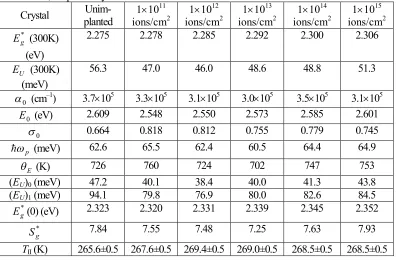
convergence point of the Urbach bundle for the unimplanted crystal and the crystals im-planted with different fluences are gathered in Table 1. It should be noticed that the coor-dinates and E0 of the convergence point remain unchanged in the region of the
second-order structural PT (i.e., near the temperature point Т = ТІІ).
Fig. 1. Spectral dependences of Urbach absorption edge obtained at different temperatures for the Cu6PS5Br crystal implanted with the fluence of
11015 ions/cm2: 1 – 200, 2 – 250, 3 – 280, 4 – 300, and 5 – 320 K. The insert shows temperature dependence of the slope parameter
.Table1. Parameters of the Urbach absorption edge, parameters of the EPI and the PT temperatures for the unimplanted and implanted Cu6PS5Br crystals at T > TII. The 0, E0
and E*g, and EU values are determined with the errors of 3105 cm–1, 510–4 eV, and
210–4 eV, respectively.
Crystal
Unim-planted
11011 ions/cm2
11012 ions/cm2
11013 ions/cm2
11014 ions/cm2
11015 ions/cm2
* g
E (300K)
(eV)
2.275 2.278 2.285 2.292 2.300 2.306
U
E (300K) (meV)
56.3 47.0 46.0 48.6 48.8 51.3
0
(cm–1) 3.7105 3.3105 3.1105 3.0105 3.5105 3.1105
0
E (eV) 2.609 2.548 2.550 2.573 2.585 2.601
0
0.664 0.818 0.812 0.755 0.779 0.745
p
(meV) 62.6 65.5 62.4 60.5 64.4 64.9
E
(K) 726 760 724 702 747 753
(EU)0 (meV) 47.2 40.1 38.4 40.0 41.3 43.8
(EU)1 (meV) 94.1 79.8 76.9 80.0 82.6 84.5
* g
E (0) (eV) 2.323 2.320 2.331 2.339 2.345 2.352
* g
S 7.84 7.55 7.48 7.25 7.63 7.93
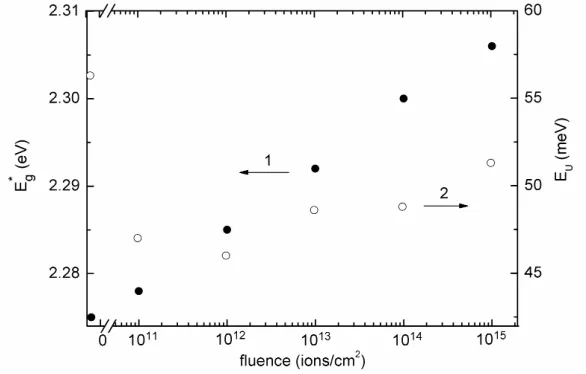
Following from our analysis of the Urbach absorption edge, the optical pseudogap
* g
E and the Urbach energy EU have been obtained (see Fig. 2). Here the E*g parameter
means the absorption edge energy position taken at a fixed value of the absorption
coeffi-cient ( = 103 cm–1 in our case), while EU is the energy width of the exponential
absorp-tion edge. It has been revealed that the optical pseudogap E*g increases as a result of ion
implantation. On the other hand, the Urbach energy EU decreases for the fluence values
less than 11012ions/cm2 and increases if the latter exceed 11012ions/cm2. This testifies that the small fluences initiate some crystal lattice ordering processes, while in case of the fluences larger than 11012ions/cm2 we deal with lattice disordering.
Fig. 2. Dependences of optical pseudogap E*g (1) and Urbach energy EU
(2) on the fluence value for the implanted Cu6PS5Br crystals. The sizes of
the symbols of experimental data points exceed the error bars which are
510–4 eV for Eg* and 210–4 eV for
E
U.Exponential shape of a long-wavelength tail of the absorption edge is usually attrib-uted to an exciton-phonon interaction (EPI) [11]. In the whole temperature interval under study, both the implanted and unimplanted Cu6PS5Br crystals manifest the temperature
dependences of the slope parameter described by the Mahr relation [11]:
kT kT
T p
p 2
tanh 2
0
, (3)
where 0 is a constant independent of temperature, which is related to the EPI constant g
(0 = 2/3g), and p denotes an average effective phonon energy in a single-oscillator
model describing the EPI [11]. An example of such dependence is presented in the insert
of Fig. 1. It is worthwhile that the inequality 0 < 1 indicating a strong EPI (see [12])
179
effective phonon energy p and the 0 parameter are given in Table 1. It is seen that
both the0 and
p parameters first increase with increasing fluence (by 23% and 5%,respectively), then decrease (for the fluence values less than 11013 ions/cm2) and eventu-ally increase weakly (for the fluences exceeding 11013 ions/cm2).
Among numerous theoretical treatments of the Urbach rule, a model of self-trapped exciton by Sumi and Toyozava (ST) [13] and a microelectric-field theory (a so-called internal Franz-Keldysh effect) by Dow and Redfield (DR) [14] are the most often cited. In our earlier work [2] we have shown that the mechanism of EPIin Cu6PS5Br crystals is
well explained in the framework of the DR theory. According to the latter, broadening of excitonic maxima that occurs with increasing temperature and a resulting exponential absorption edge are associated with the interaction of excitons with microelectric fields generated by LO phonons [14]. In order to check whether the DR theory could also de-scribe the EPI in the implanted Cu6PS5Br crystal, we have applied the procedure
sug-gested in the study [15]. Here influence of the external electric field Fe causing the
inter-nal Franz-Keldysh effect is replaced by the root-mean square value of the phonon-induced internal electric field Fp, thus leading to the expression
kT E
E kT
E g p
p g
2 tanh 1 ) 0 ( 2
tanh 0
*
* , (4)
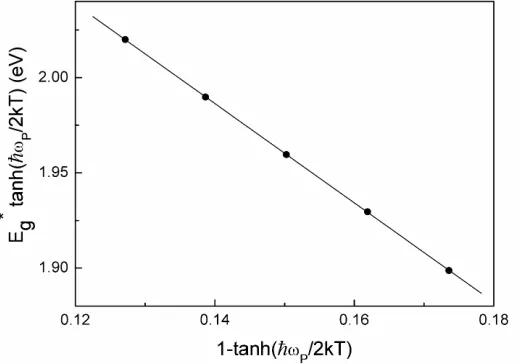
where E*g(0) is the band gap at zero temperature. A linear relation between
kT
Eg* tanhp /2 and
1tanh
p /2kT
depicted in Fig. 3 supports a qualitativeagreement between the DR theory and the absorption processes in these crystals.
Fig. 3. Illustration of linear relation between the parameters
kT
Eg*tanh p/2 and
1tanh
p/2kT
taking place for the Cu6PS5BrTemperature dependences of the optical pseudogap Eg* and the Urbach energy EU
for the Cu6PS5Br crystal implanted by sulphur ions with the fluence of 110 15
ions/cm2 are shown in Fig. 4. We are to emphasise that, due to the EPI, the temperature behaviour
of Eg* seen in Fig. 4 can be described in frame of the Einstein model by the relation [16]
1 ) / exp( 1 ) 0 ( ) ( * * * T k S E T E E E g g g
, (5)
where E*g(0) is the energy gap at 0 K, Sg* a dimensionless constant, and E the Einstein
temperature corresponding to the average frequency of phonon excitations of a system of non-coupled oscillators. The calculations performed by us prove that the experimental
* g
E values are well described by Eq. (5). The Eg*(0), Sg* and E parameters obtained
for the unimplanted and implanted crystals are given in Table 1, whereas a solid line
shown in Fig. 4 represents the temperature dependence of the optical pseudogap E*g
cal-culated basing on Eq. (5) for the Cu6PS5Br crystal implanted with the fluence of
11015 ions/cm2.
It is well known that the Urbach energy EU in frame of the Einstein model is
de-scribed as [17]
1 ) / exp( 1 ) ( ) ( )
( 0 1
T E E E E U U U
, (6)
where (EU)0 and (EU)1 are constants. The values of (EU)0 and (EU)1 obtained by
fit-ting Eq. (6) to the experimental temperature dependences of EU for the unimplanted and
implanted crystals are also listed in Table 1. The temperature dependence of the Urbach
energy EU for the Cu6PS5Br crystal implanted with the fluence of 110 15
ions/cm2 is
shown in Fig. 4 as a dashed line.
In [18] it has been shown that both the temperature-related effect and the structural disordering affect the shape of the Urbach absorption edge, so that the Urbach energy EU
is described by the relation
dyn X U stat X U T U X U T U
U E E E E E
E ( ) ( ) ( ) ( ) , ( ) , , (7)
where (EU)T and (EU)X are respectively the temperature-related and structural
disor-dering contributions to EU, while (EU)X,stat and (EU)X,dyn imply the contributions of
static structural disordering and dynamic structural disordering to (EU)X, respectively.
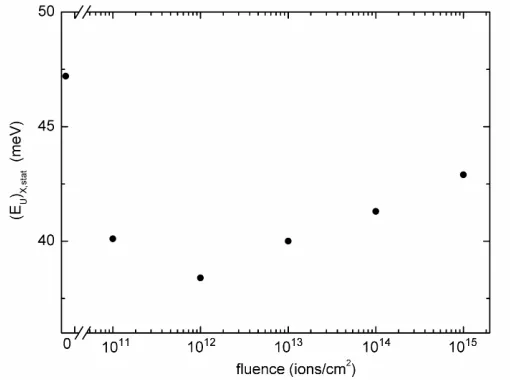
The static structural disordering (EU)X,stat in the Cu6PS5Br crystal is caused by
structural imperfection due to high concentration of disordered copper vacancies, while the dynamic disordering (EU)X,dyn is concerned with intense motion of mobile copper
181
should notice that the first term in the right-hand side of Eq. (6) represents the static struc-tural disordering and the second one – the temperature-related types of disordering. These are the temperature disordering due to thermal lattice vibrations and the dynamic struc-tural disordering linked with the presence of mobile ions in superionic conductors.
Fig. 4. Temperature dependences of optical pseudogap E*g (curve 1) and
Urbach energy EU (curve 2) for the Cu6PS5Br crystal implanted with the
flu-ence of 11015 ions/cm2: circles correspond to the experiment and curves to the calculations. Solid and dashed lines are obtained by using Eqs. (5) and (6) for fitting the experimental data, with the parameters listed in Table 1. The sizes of the symbols of experimental data points exceed the error bars (510–4 eV for E*g and 210–4 eV for
E
U).Fig. 5. Dependence of contribution of the static structural disordering
stat X U
E ) ,
We have evaluated contribution of the static structural disordering to the Urbach en-ergy EU for the implanted Cu6PS5Br crystals. As one can see from Fig. 5, the absolute
value of that contribution decreases initially with increasing fluence, reaches a minimum at the fluence of 11012 ions/cm2, and then increases again. At the fluence of 11015 ions/cm2 it amounts to 93 per cent of the absolute value of contribution of the static structural disordering for the unimplanted crystal (see Fig. 5 and Table 1).
4. Conclusions
Cu6PS5Br single crystals grown with the chemical vapour transport technique have been
implanted with different fluences of 150 keV 32S+ ions. The optical absorption edges for the both unimplanted and implanted Cu6PS5Br crystals have exponential shapes,
follow-ing the well-known Urbach rule. The temperature behaviour of the Urbach absorption edge is determined by the EPI, which is strong enough in both the unimplanted and
im-planted crystals. The temperature dependences of the optical pseudogap E*g and the
Ur-bach energy EU are successfully obtained. They are well described by the theoretical
curves calculated in the framework of the Einstein model. We have also shown that the ordering processes take place in the crystal lattice for the fluences less than 11012ions/cm2, while the fluence values larger than 11012 ions/cm2 cause disordering of the lattice.
References
1. Kuhs W F, Nitsche R and Scheunemann K, 1978. The crystal structure of Cu6PS5Br,
a new superionic conductor. Acta Cryst. B. 34: 64–70.
2. Studenyak I P, Kranjcec M, Kovacs Gy S, Panko V V, Desnica I D, Slivka A G and Guranich P P, 1999. The effect of temperature and pressure on the optical absorption edge in Cu6PS5X (X = Cl, Br, I) crystals. J. Phys. Chem. Solids. 60: 1897–1904.
3. Beeken R B, Garbe J J and Petersen N R, 2003. Cation mobility in the Cu6PS5X
(X=Cl, Br, I) argyrodites. J. Phys. Chem. Solids. 64: 1261–1264.
4. Haznar A, Pietraszko A and Studenyak I P, 1999. X-ray study of the superionic phase transition in Cu6PS5Br. Solid State Ionics. 119: 31–36.
5. Fiechter S and Gmelin E, 1985. Thermochemical data of argyrodite-type ionic con-ductors: Cu6PS5Hal (Hal= Cl, Br, I). Thermochimica Acta. 85: 155–158.
6. Samulionis V, Banys J, Vysochanskii Y and Studenyak I, 2006. Investigation of ul-trasonic and acoustoelectric properties of ferroelectric-semiconductor crystals. Ferro-electrics. 336: 29–38.
7. Girnyk I, Kaynts D, Krupych O, Martunyuk-Lototska I and Vlokh R, 2003. X,T-phase diagram of the Cu6PS5IxBr1-x mixed crystals. Optical, dilatation and ultrasonic
velocity studies. Ukr. J. Phys. Opt. 4: 165–179.
8. Studenyak I P, Kranjčec M and Kurik M V, 2006. Urbach rule and disordering proc-esses in Cu6P(S1-xSex)5Br1-yIy superionic conductors. J. Phys. Chem. Solids. 67: 807–
183
9. Oswald F, 1959. Zur megenauigkeit bei der bestimmung der absorptionskonstanten von halbleitern im infraroten spektralbereich. Optik. 16: 527–537.
10. Urbach F, 1953. The long-wavelength edge of photographic sensitivity and electronic absorption of solids. Phys. Rev. 92: 1324–1326.
11. Kurik M V, 1971. Urbach rule (Review). Phys. Stat. Sol. (a). 8: 9–30.
12. Sumi H and Sumi A, 1987. The Urbach-Martiensen rule revisited. J. Phys. Soc. Ja-pan. 56: 2211–2220.
13. Sumi H and Toyozawa Y, 1971. Urbach-Martiensen rule and exciton trapped mo-mentarily by lattice vibrations. J. Phys. Soc. Japan. 31: 342–357.
14. Dow J D and Redfield D, 1972. Toward a unified theory of Urbach’s rule and expo-nential absorption edge. Phys. Rev. B. 5: 594–610.
15. Samuel L, Brada Y, Burger A and Roth M, 1987. Urbach rule in mixed single crys-tals of ZnxCd1-xSe. Phys. Rev. B. 36: 1168–1173.
16. Beaudoin M, DeVries A J G, Johnson S R, Laman H and Tiedje T, 1997. Optical ab-sorption edge of semi-insulating GaAs and InP at high temperatures. Appl. Phys. Lett. 70: 3540–3542.
17. Yang Z, Homewood K P, Finney M S, Harry M A and Reeson K J, 1995. Optical absorption study of ion beam synthesised polycrystalline semiconducting FeSi2. J.
Appl. Phys. 78: 1958–1963.
18. Cody G D, Tiedje T, Abeles B, Brooks B and Goldstein Y, 1981. Disorder and the optical-absorption edge of hydrogenated amorphus silicon. Phys. Rev. Lett. 47: 1480–1483.
Studenyak I.P., Izai V.Yu., Panko V.V., Kúš P. and Plecenik A. 2010. Temperature studies of Urbach absorption edge in implanted Cu6PS5Br crystals. Ukr.J.Phys.Opt. 11: 175–183.
Анотація. Кристали Cu6PS5Br, вирощені методом газотранспортних реакції і
ім-плантовані іонами сірки. Досліджений край оптичного поглинання імплантованих кристалів в температурному діапазоні 77–320 K. Проаналізовані температурні залежності забороненої зони і енергії Урбаха. На основі урбахівської поведінки краю оптичного поглинання визначені параметри екситон-фоннонної взаємодії. В кристалах Cu6PS5Br досліджений процес впорядкування - розупорядкування,