The Thirty-Third AAAI Conference on Artificial Intelligence (AAAI-19)
Cycle-SUM: Cycle-Consistent Adversarial
LSTM Networks for Unsupervised Video Summarization
Li Yuan,
1Francis EH Tay,
1Ping Li,
2Li Zhou,
1Jiashi Feng
11National University of Singapore 2Hangzhou Dianzi University
{ylustcnus,zhouli2025}@gmail.com, {mpetayeh,elefjia}@nus.edu.sg, [email protected]
Abstract
In this paper, we present a novel unsupervised video sum-marization model that requires no manual annotation. The proposed model termed Cycle-SUM adopts a new cycle-consistent adversarial LSTM architecture that can effectively maximize the information preserving and compactness of the summary video. It consists of a frame selector and a cycle-consistent learning based evaluator. The selector is a bi-direction LSTM network that learns video representations that embed the long-range relationships among video frames. The evaluator defines a learnable information preserving met-ric between original video and summary video and “super-vises” the selector to identify the most informative frames to form the summary video. In particular, the evaluator is composed of two generative adversarial networks (GANs), in which the forward GAN is learned to reconstruct orig-inal video from summary video while the backward GAN learns to invert the processing. The consistency between the output of such cycle learning is adopted as the information preserving metric for video summarization. We demonstrate the close relation between mutual information maximization and such cycle learning procedure. Experiments on two video summarization benchmark datasets validate the state-of-the-art performance and superiority of the Cycle-SUM model over previous baselines.
Introduction
With explosion of video data, video summarization tech-nologies (Ma et al. 2002; Pritch et al. 2007; Lu and Grau-man 2013) become increasingly attractive to help efficiently browse, manage and retrieve video contents. With such tech-niques, a long video can be shortened to different forms, e.g. key shots (Gygli et al. 2014), key frames (Kim, Sigal, and Xing 2014) and key objects (Meng et al. 2016). Here, we aim at selecting key frames for summarizing a video.
Video summarization is usually formulated as a structure prediction problem (Zhang et al. 2016; Mahasseni, Lam, and Todorovic 2017). The model takes as input a sequence of video frames, and outputs a subset of original video frames containing critical information. Ideally, the summary video should keep all key information of the original video with minimal redundancy. Summarycompletenessand compact-nessare expected for good video summarization.
Copyright c2019, Association for the Advancement of Artificial Intelligence (www.aaai.org). All rights reserved.
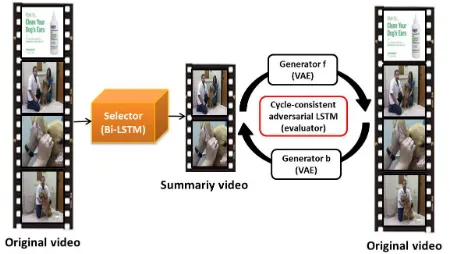
Figure 1: Overview of the Cycle-SUM model. The sum-mary video is selected by the selector from the input original video. To optimize the selector, a cycle-consistent adversar-ial LSTM evaluator is introduced to evaluate the summary quality through cycle-consistent learning to measure the mu-tual information between the original and summary video.
Existing approaches can be roughly grouped into su-pervised and unsusu-pervised ones. Many susu-pervised ap-proaches (Zhang et al. 2016; Gygli, Grabner, and Van Gool 2015) utilize human-annotated summary as ground truth to train a model. However, sufficient human-annotated video summarization examples are not always available or expen-sive to collect. Thus, unsupervised approaches that do not re-quire human intervention become increasingly attractive due to their low cost. For these methods, it is very critical to de-sign a proper summary quality metric. For instance, (Mahas-seni, Lam, and Todorovic 2017) adopt the GAN (Goodfel-low et al. 2014) to measure the similarity between summary and original video and improve the summarization model by optimizing the induced objective, based on a basic idea that a good summary video should be able to faithfully re-construct the original input video. However, this approach only considers one-direction reconstruction, thus some sig-nificant frames may dominate the quality measure, leading to severe information loss in the summary video.
learning objective to pursue optimal information preserving for the summary video, partially inspired by the cycle gen-erative adversarial network (Zhu et al. 2017; Yi et al. 2017). Moreover, to effectively capture the short-range and long-range dependencies among sequential frames (Zhang et al. 2016), we propose a VAE-based LSTM network as the back-bone model for learning video representation. We name such a cycle-consistent adversarial LSTM network for video sum-marization as the Cycle-SUM.
Cycle-SUM performs original and summary video re-construction in a cycle manner, and leverages consistency between original/summary video and its cycle reconstruc-tion result to “supervise” the video summarizareconstruc-tion. Such a cycle-consistent objective guarantees the summary com-pleteness without additional supervision. Compared with the one-direction reconstruction (i.e., from summary video to original video) (Zhu et al. 2017; Yi et al. 2017), the bi-direction model performs a reversed reconstruction and a cycle-consistent reconstruction to relieve information loss.
Structurally, the Cycle-SUM model consists of two com-ponents: aselectorto predict an importance score for each frame and select the frames with high importance scores to form the summary video, and a cycle-consistent evalu-atorto evaluate the quality of selected frames through cycle reconstruction. To achieve effective information preserving, the supervisor employs two VAE-based generators and two discriminators to evaluate the cycle-consistent loss. The for-ward generator and discriminator are responsible for recon-structing the original video from the summary video, and the backward counterparts perform the backward reconstruction from original to the summary video. Both reconstructions are performed in the learned embedding feature space. The discriminator is trained to distinguish the summary video from original. If the summary video misses some informa-tive frames, the discriminator would tell its difference with the original and thus serves as a good evaluator to encourage the selector to pick important frames.
An illustration of the proposed framework is given in Fig. 1. The summary video is a subset of all training video frames, selected by the selector based on the predicted frame-wise importance scores. The original video is recon-structed from the summary video, and then back again. Given a distance between original video and summary video in the deep feature space, the Cycle-SUM model tries to op-timize the selector such that the distance is minimized over training examples. The closed loop of Cycle-SUM is aimed at 1) assisting the Bi-LSTM selector to select a subset of frames from the original video, and 2) keeping a suitable distance between summary video and original video in the deep features space to improve summary completeness and reduce redundancy.
Our contributions are three-fold. 1) We introduce a new unsupervised video summarization model that does not re-quire any manual annotation on video frame importance yet achieves outstanding performance. 2) We propose a novel cycle-consistent adversarial learning model. Compared with one-direction reconstruction based models, our model is su-perior in information preserving and facilitating the learning procedure. 3) We theoretically derive the relation of mutual
information maximization, between summary and original video, with the proposed cycle-consistent adversarial learn-ing model. To our best knowledge, this work is the first to transparently reveal how to effectively maximize mutual in-formation by cycle adversarial learning.
Related Work
Supervised video summarization approaches leverage videos with human annotation on frame importance to train models. For example, Gong et al. formulate video summa-rization as a supervised subset selection problem and pro-pose a sequential determinantal point processing (seqDPP) based model to sample a representative and diverse sub-set from training data (Gong et al. 2014). To relieve hu-man annotation burden and reduce cost, unsupervised ap-proaches, which have received increasing attention, gen-erally design different criteria to give importance ranking over frames for selection. For example, (Wang et al. 2012; Potapov et al. 2014) propose to select frames according to their content relevance. (Mei et al. 2015; Cong, Yuan, and Luo 2012) design unsupervised critera by trying to recon-struct the original video from selected key frames and key shots under the dictionary learning framework. Clustering-based models (De Avila et al. 2011; Kuanar, Panda, and Chowdhury 2013) and attention-based models (Ma et al. 2002; Ejaz, Mehmood, and Baik 2013) are also developed to select key frames.
Recently, deep learning models are developed for both su-pervised and unsusu-pervised video summarization, in which LSTM is usually taken as the video representation model. For example, (Zhang et al. 2016) treat video summariza-tion as a sequential predicsummariza-tion problem inspired by speech recognition. They present a bi-direction LSTM architecture to learn the representation of sequential frames in variable length and output a binary vector to indicate which frame to be selected. Our proposed Cycle-Sum model also adopts LSTM as backbone for learning long-range dependence be-tween video frames.
Method
The proposed Cycle-SUM model formulates video summa-rization as a sequence-to-sequence learning problem, taking as input a sequence of video frames and outputting a se-quence of frame-wise importance scores. The frames with high importance scores are selected to form a summary video. Throughout the paper, we useOandSto denote the original input video and summary video respectively, ando
andsto denote the frame-level features ofOandS respec-tively. To train Cycle-SUM in an unsupervised manner, we develop the cycle-consistent learning method for maximiz-ing mutual information betweenoands.
Mutual Information Maximization via Cycle
Learning
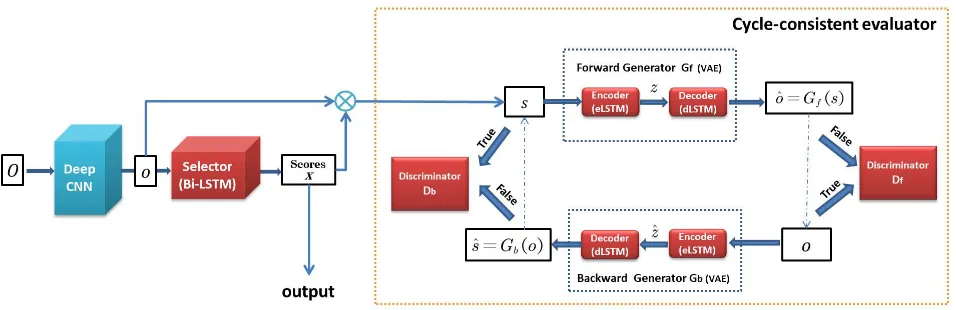
Figure 2: Demonstration of Cycle-SUM architecture. Red parts denote the components of our Cycle-SUM model while blue one denotes data-processing. Cycle-SUM has two parts: the selector for selecting frames and the cycle-consistent evaluator to ”supervise” the selection. The feature of the frame in original videoois extracted from videoOby a deep CNN. The selector takesoas input and outputs the importance scoresx. During training, the generatorGf takessas input and reconstructs a
sequence of features,Gf(s). The discriminator Df is trained to distinguishobando. The generatorGb takeso as input and
outputsGb(o); the discriminatorDbalso tries to distinguish betweensandbs. To achieve cycle consistency, the forward cycle s → Gf(s) → Gb(Gf(s))≈ sand the backward cycleo → Gb(o) → Gf(Gb(o))≈ oare implemented to encourage the
information to be consistent betweenoands.
of maximizing the mutual information between the summary videosand the original videoo.
Formally, the mutual informationI(o, s)is defined as
I(o, s),X
o
p(o)DKL(p(s|o)||p(s)),
whereDKLis the KL-divergence between two distributions.
Then the objective of video summarization is to extract the summary videos from o to maximize their mutual infor-mation. The video summarization model should try to pro-ducessuch that its conditional distributionp(s|o)gives the maximal mutual information withp(s). However, though it is easy to obtain empirical distribution estimation of orig-inal video o, it is difficult to obtain ground truth distribu-tion p(s) of corresponding s in an unsupervised learning scenario. This makes one major challenge to unsupervised video summarization.
We propose a cycle-consistent learning objective to re-lieve such learning difficulty. We notice that
I(o, s) = 1 2
" X
o
p(o)DKL(p(s|o)||p(s))
+X
s
p(s)DKL(p(o|s)||p(o))
#
.
(1)
The above mutual information computation “anchors” at
p(o)that can be faithfully estimated and thus eases the pro-cedure of learning distribution ofseven in an unsupervised learning setting.
To effectively model and optimize the above learning ob-jective, we adopt the Fenchel conjugate to derive its bound that is easier to optimize. The Fenchel conjugate of a func-tion f is defined as f∗(t) , supu∈dom
f{ut−f(u)}, or
equivalentlyf(u) = supt∈domf∗{ut−f
∗(t)}.
Thus, definingf(u) = logu, we have the following upper bound for the KL-divergence between distributionspandq:
DKL(p||q) =− X
x
q(x) logp(x) q(x)
=−X
x
q(x) sup t
tp(x) q(x)−f
∗ (t)
=−X
x
q(x) sup t
tp(x)
q(x)+ 1 + log(−t)
≤ −sup T∈T
X
x
p(x) logT(x) +X x
q(x) log(1−T(x))
!
,
wheret=T(x)−1andT is an arbitrary class of functions
T : X → R. The above inequality is due to the Jensen’s inequality and functions T is only a subset of all possible functions. Therefore, we have
DKL(p(s|o)||p(s))
≤ −sup T∈T
X
p(s|o) logT(s) +Xp(s) log(1−T(s))
≈ −sup T∈T
1 |S|
X
s∼p(s|o)
logT(s) + X s∼p(s)
log(1−T(s))
.
HereSis the set of produced summary videos. We can use a generative model to estimatep(s|o). To this end, we fol-low the generative-adversarial approach (Goodfelfol-low et al. 2014) and use two neural networks,Gf andDf, to
imple-ment sampling and data transformation. HereGf is the
for-ward generative model, taking the conditionoas input and outputting a sample of summary samples.Dfis the forward
discriminative model. We learn the generative modelGf by
we minimize w.r.t.Gf and maximize w.r.t.Df:
min
Gf max
Df
L(Gf, Df)
= 1
|S|
X
s∼Gf(o)
logDf(s) +
X
s∼p(s)
log(1−Df(s))
.
(2) The above objective is similar to the one of GANs, but the generative model is a conditioned one.
Similarly, we can obtain the learning objective to optimize the KL-divergenceDKL(p(o|s)||p(o))by solving
min
Gb max
Db
L(Gb, Db)
= 1
|O|
X
o∼Gb(s)
logDb(o) +
X
o∼p(o)
log(1−Db(o))
.
(3) Substituting Eqn. (2) and Eqn. (3) into Eqn. (1) gives the following cycle learning objective to maximize the mutual information between the original and summary video:
min
Gf,Gb max
Df,Db
L(Gf, Gb, Df, Db)
= X
s∼Gf(o)
logDf(s) +
X
s∼p(s)
log(1−Df(s))
+ X
o∼Gb(s)
logDb(o) +
X
o∼p(o)
log(1−Db(o)),
(4)
where we omit the constant number of original frames. To relieve the difficulties brought by the unknown distribution
p(s), we use the following cycle-consistent constraint to fur-ther regularize the generative model and the cycle learning processing:
Gb(Gf(o))≈o, andGf(Gb(s))≈s.
We name cycle learning with the above consistent constraint as the cycle-consistent learning.
Architecture
Based on the above derivations, we design the cycle-consistent adversarial model for video summarization (Cycle-SUM). The architecture of our Cycle-SUM model is illustrated in Fig. 2. The selector is a Bi-LSTM network, which is trained to predict an importance score for every frame in the input video. The evaluator consists of two pairs of generators and discriminators. In particular, the forward generator Gf and the discriminator Df form the forward
GAN; the backward generatorGband the discriminatorDb
form the backward GAN. The two generators are imple-mented by variational auto-encoder LSTM, which encode the frame feature to the latent variablezand then decode it to corresponding features. The two discriminators are LSTM networks that learn to distinguish generated frame features and true features. We extensively use the LSTM architec-ture here for comprehensively modeling the temporal in-formation across video frames. Moreover, by adopting the joint structure of VAE and GAN, the video similarity can be
more reliably measured by generating better high-level rep-resentations (Larsen et al. 2015). The cycle structure (for-ward GAN and back(for-ward GAN) convert from original to summary video and back again, in which information loss is minimized.
Given a videoOofkframes, the first step is to extract its deep featureso={ot|t= 1, . . . , k}via a deep CNN model.
Given these features o, the selector predicts a sequence of importance scoresx = {xt:xt∈[0,1]|t= 1, . . . , k}
indicating the importance level of corresponding frames. During training, the frame feature of summary video s =
{st=xtot|t= 1, . . . , k}. But for testing, Cycle-SUM
out-puts discretized importance scoresx={xt:xt∈ {0,1}};
then frames with importance scores being 1 are selected. With s and o, the supervisor performs cycle-consistent learning (see Fig. 2) to evaluate the quality of summary video sw.r.t. both completeness and compactness. Specif-ically, within the selector, the forward generatorGf takes
the current summary video s as input and outputs a se-quence of reconstructed features for the original video, namely Gf(s) = {bot|t= 1, ..., k}. The paired
discrim-inator Df then estimates the distribution divergence
be-tween original video and summary video in the learned fea-ture space. The backward generator Gb and discriminator
Db have a symmetrical network architecture and training
procedure to the forward ones. In particular, the genera-torGb takes the original video feature oas input, and
out-puts Gb(o) = {ˆst:t= 1, ..., k} to reconstruct the
sum-mary video. The discriminatorDb then tries to distinguish
betweensandbs. The forward cycle-consistency processing
s → Gf(s) → Gb(Gf(s)) ≈ sand the backward
cycle-consistency o → Gb(o) → Gf(Gb(o)) ≈ o are
imple-mented to enhance the information consistency between o
ands. This cycle-consistent processing guarantees the orig-inal video to be reconstructed from the summary video and vice versa, meaning the summary video can tell the same story as the original.
Training Loss
We design the following loss functions to train our Cycle-SUM model. The sparsity loss Lsparsity is used to control
the summary length for the selector; the prior loss Lprior
and the reconstruction lossLrecon are used to train the two
VAE-based generators; adversarial lossesLGANare derived
from the forward GAN and backward GAN; andLcycleis the
cycle-consistent loss.
Sparsity lossLsparsity This loss is designed to penalize the
number of selected frames forming the summary video over the original video. A high sparsity ratio gives a shorter sum-mary video. Formally, it is defined as
Lsparsity= 1 k
k
X
t=1 xt−σ
2
15% (Gygli et al. 2014; Song et al. 2015), but we empiri-cally setσas 30% for the selector in training (Mahasseni, Lam, and Todorovic 2017).
Generative lossLgen We adopt VAE as the generator for
reconstruction, thusLgen contains the prior lossLprior and
the reconstruction lossLrecon. For the forward VAE (forward
generator Gf), the encoder encodes input features s into
the latent variablez. Assumepz(z)is the prior distribution
of latent variables, and the typical reparameterization trick is to set pz(z) as Gaussian Normal distribution (Kingma
and Welling 2013). Define qψ(z|s)as the posterior
distri-bution andpθ(s|z)as conditional generative distribution for
s, whereψis the parameter of the encoder and θis that of the decoder. The objective of the forward generator is
Lgen,f=DKL(qψ(z|s)kpz(z))−E[log(pθ(s|z))],
where the first term is KL divergence for the prior loss: Lprior =DKL(qψ(z|s)kpz(z)).
The second term is an element-wise metric for measuring the similarity between samples, so we use it as the recon-struction lossLrecon. The typical reconstruction loss for auto
encoder networks is the Euclidean distance between input and reconstructed output: kx−xˆk2. According to (Larsen et al. 2015), element-wise metrics cannot model properties of human visual perception, thus they propose to jointly train the VAE (the generator) and the GAN discriminator, where hidden representation is used in the discriminator to measure sample similarity. Our proposed Cycle-SUM also adopts the same structure to measure the video distance and achieves a feature-wise reconstruction. Specifically, if xand xˆ are the input and output of the VAE (the generator), the out-put of the last hidden layer of the discriminator areφ(x)and
φ(ˆx). Then, considerp(φ(x)|e) ∝ exp(− kφ(x)−φ(ˆx)k). The expectationEcan be computed by empirical average. The reconstruction loss can be re-written as
Lrecon=E[−log(pθ(s|e))]∝
1
kkφ(o)−φ(ˆo)k2.
The backward generatorGB has the sameLprior andLrecon
as the forward generator. The only difference is that their input and output are reversed.
Adversarial lossLGAN The learning objective of the
eval-uator is to maximize the mutual information between the original and summary video. According to Eqn. (4), the ad-versarial losses for the forward GAN (Gf andDf) and the
backward GAN (GbandDb) are
LGAN,f=E[logDf(o)] +E[1−logDf(Gf(s))],
LGAN,b=E[logDb(s)] +E[1−logDb(Gb(o))].
To avoid mode collapse and improve stability of optimiza-tion, we use the loss suggested in Wasserstein GAN (Ar-jovsky, Chintala, and Bottou 2017):
LGAN,f=Df(o)−Df(Gf(s)),
LGAN,b=Db(s)−Db(Gb(o)).
Cycle-Consistent LossLcycle Since we expect summary
frame features to contain all the information of original frame features, the original video should be fully recon-structed from them. Thus, when we convert from original to summary video and then back again, we should obtain a video similar to the original one. In this way we can safely guarantee the completeness of the summary video. This processing is more advantageous than the one-direction reconstruction in existing image reconstruction works (Zhu et al. 2017; Yi et al. 2017). Based on such an intuition, we introduce the below cycle-consistent loss. The proce-dure for forward cycle is s → Gf(s) → Gb(Gf(s)) ≈
s. The Lcycle, f is correspondingly defined as Lcycle, f = 1
kkGb(Gf(s))−sk. For the backward cycle, the procedure
is o → Gb(o) → Gf(Gb(o)) ≈ o. So the Lcycle, b is
Lcycle, b = 1kkGf(Gb(o))−ok. We adopt L1 distance for
Lcycle, since theL2 often leads to blurriness (Larsen et al.
2015; He et al. 2016).
Overall LossL The overall loss function is the overall ob-jective for training the Cycle-SUM model:
L=Lsparsity+λ1(LGAN,f+LGAN,b)
+λ2(Lgen,f+Lgen,b) +λ3(Lcycle,f+Lcycle,b),
whereλ1,λ2andλ3are hyper parameters to balance
adver-sarial processing, generative processing and cycle-consistent processing.
Training Cycle-SUM Given the above training losses and final objective function, we adopt the Stochastic Gradient Variational Bayes estimation (Kingma and Welling 2014) to update the parameters in training. The selector and the gen-erators in the Cycle-SUM are jointly trained to maximally confuse the discriminators. To stabilize the training process, we initialize all parameters with Xavier (Glorot and Bengio 2010) and clip all parameters (Arjovsky, Chintala, and Bot-tou 2017). The clipping parametercin this training falls in
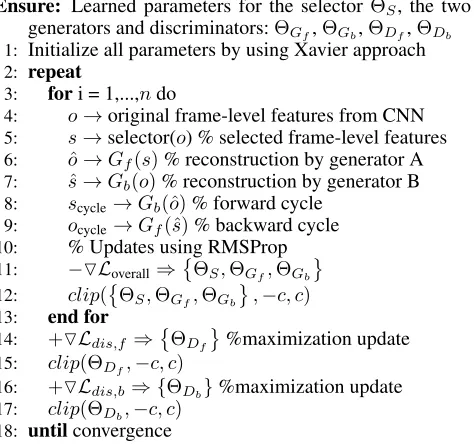
[−0.5,0.5]. The typical value for the generator iteration per discriminator iterationnis2 ∼ 5, which means the gener-ator will iteratentimes per discriminative iteration. Algo-rithm 1 summarizes all steps for training Cycle-SUM.
Experiment
Experiment Setup
Datasets and Protocol We evaluate Cycle-SUM on two benchmark datasets: SumMe (Gygli et al. 2014) and TV-Sum (Song et al. 2015). The TV-SumMe contains 25 videos ranging from 1 to 7 minutes, with frame-level binary impor-tance scores. The TVSum contains 50 videos downloaded from YouTube, with shot-level importance scores for each video taking constant from 1 to 5.
Algorithm 1Training Cycle-SUM model
Require: Frame features of the training video:o
Ensure: Learned parameters for the selectorΘS, the two
generators and discriminators:ΘGf,ΘGb,ΘDf,ΘDb
1: Initialize all parameters by using Xavier approach 2: repeat
3: fori = 1,...,ndo
4: o→original frame-level features from CNN 5: s→selector(o) % selected frame-level features 6: oˆ→Gf(s)% reconstruction by generator A
7: sˆ→Gb(o)% reconstruction by generator B
8: scycle→Gb(ˆo)% forward cycle
9: ocycle→Gf(ˆs)% backward cycle
10: % Updates using RMSProp 11: −OLoverall⇒ΘS,ΘGf,ΘGb
12: clip(
ΘS,ΘGf,ΘGb ,−c, c)
13: end for
14: +OLdis,f ⇒
ΘDf %maximization update
15: clip(ΘDf,−c, c)
16: +OLdis,b⇒ {ΘDb}%maximization update
17: clip(ΘDb,−c, c)
18: untilconvergence
For the TVSum dataset, shot-level ground truths are pro-vided while the outputs of Cycle-SUM in testing are frame-level scores. Thus we follow the method in (Zhang et al. 2016) to convert frame-level evaluation to shot-level evalua-tion.
Implementation Details For fairness, the frame features used for training our model are the same with (Zhang et al. 2016; Mahasseni, Lam, and Todorovic 2017). We ex-tract 1024-d frame features from the output of pool5 layer of the GoogLeNet network (Szegedy et al. 2015) which is pre-trained on ImageNet (Deng et al. 2009).
Each of the two generators in our Cycle-SUM is a VAE-based LSTM network consisting of an encoder and a decoder, which has two-layers with 300 hidden units per layer. The decoder LSTM which reconstructs the se-quence reversely is easier to train (Srivastava, Mansimov, and Salakhudinov 2015), so the decoders in Cycle-SUM also reconstruct the frame features in a reverse order. The discriminators are LSTM networks followed by a fully-connected network to produce probability (true or false) for the input. Following the architecture of WGAN (Arjovsky, Chintala, and Bottou 2017), we remove the Sigmoid func-tion in the last layer of the discriminator to make the model easier to train. The selector is a Bi-LSTM network consist-ing of three layers, each with300hidden units.
The two VAE generators are initialized by pre-training on frame features of the original video. Similar to (Mahasseni, Lam, and Todorovic 2017), such an initialization strategy can also accelerate training and improve overall accuracy.
All experiments are conducted for five times on five ran-dom splits and we report the average performance.
Table 1: Comparison on F-scores of Cycle-SUM with other
unsupervisedlearning approaches on SumMe and TVSum.
SumMe TVSum
De Avila, et al. (De Avila et al. 2011) 33.7
-Li, et al. (Li and Merialdo 2010) 26.6
-Khosla, et al. (Khosla et al. 2013) - 50
Song, et al. (Song et al. 2015) 26.6 50
SUM-GAN (Mahasseni, Lam, and Todorovic 2017) 39.1 51.7
Cycle-SUM 41.9 57.6
Table 2: Performance comparison (F-scores) of the vanilla Cycle-SUM model and its ablation variants on SumMe and TVSum.
SumMe TVSum
Cycle-SUM-C 34.8 49.5 Cycle-SUM-1G 38.2 51.4 Cycle-SUM-2G 39.7 53.6 Cycle-SUM-Gf 40.3 55.2 Cycle-SUM-Gb 39.9 55.0 Cycle-SUM 41.9 57.6
Quantitative Results
We compare our Cycle-SUM model with several unsuper-vised state-of-the-arts in Tab. 1. One can see that the Cycle-SUM model outperforms all of them by a margin up to 2.8%. In particular, Cycle-SUM outperforms SUM-GAN (Mahas-seni, Lam, and Todorovic 2017) across the two datasets, clearly demonstrating effectiveness of our proposed cycle-consistent loss. On TVSum, the performance improvement is over 5.9%. These results well prove the superior perfor-mance of Cycle-SUM for video summarization.
Ablation Analysis of Cycle-SUM
We further conduct ablation analysis to study the effects of different components of the Cycle-SUM model, includ-ing the generative adversarial learninclud-ing and cycle-consistent learning. In particular, we consider following ablation vari-ants of Cycle-SUM.
• Cycle-SUM-C. This variant is proposed to verify the ef-fects of adversarial learning. It drops the adversarial loss LGAN,fandLGAN,b and keeps all other losses, especially
cycle-consistent lossLcyclein the overall loss.
• Cycle-SUM-2G. The cycle-consistent loss Lcycle,f and
Lcycle,bare removed in overall loss. The forward GAN and
backward GAN are still kept. We compare the results of Cycle-SUM-2G with Cycle-SUM to analyze the functions of cycle-consistent reconstruction.
• Cycle-SUM-1G. The cycle-consistent loss Lcycle,f and
Lcycle,b are not used when training this variant.
Mean-while, we remove the generatorGband discriminatorDb,
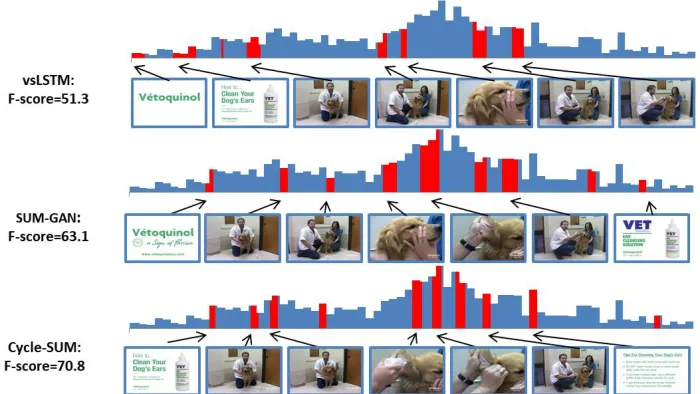
Figure 3: Comparison of selected frames w.r.t. importance score by Cycle-SUM and other state-of-arts (vsLSTM and SUM-GAN). Dark blue bars show ground-truth frame-level annotation; Red bars are selected subset shots of all frames. The example video (# 15) is from TVSum.
This model is similar to SUM-GAN (Mahasseni, Lam, and Todorovic 2017). It only has forward GAN, and Cycle-SUM-2G contains the two GANs during training. We are also interested in comparing Cycle-SUM-2G and Cycle-SUM-1G.
• Cycle-SUM-Gf. The backward cycle-consistent loss Lcycle,bis not included in overall objective when training,
while forward cycle-consistent loss is still kept. The for-ward and backfor-ward adversarial learning are still kept. • Cycle-SUM-Gb. The forward cycle-consistent loss
Lcycle,fis not included in overall objective when training,
and backward one is kept. The forward and backward ad-versarial learning are still kept.
Comparing F-scores of Cycle-SUM and Cycle-SUM-C in Tab. 2, we can see the adversarial learning improves the per-formance significantly, proving the positive effects of de-ploying GAN in unsupervised video summarization. Com-pared with one GAN variant Cycle-SUM-1G, the results of Cycle-SUM-2G have 2% gain on average. Both compar-isons verify adversarial learning helps improve video sum-marization.
By comparing Cycle-SUM-2G and Cycle-SUM, we can see averagely F-scores rise by 2.2% on SumMe and 4.0% on TVSum. This proves that cycle-consistent reconstructions can ensure the summary video contain full information of the original video.
The results of Cycle-SUM-Gf are slightly better than Cycle-SUM-Gb. However, both variants bring performance gain over Cycle-SUM-2G, which also proves the forward and backward cycle-consistent processing can promote the ability to select a fully summary video from the original.
To sum up, the adversarial learning ensures the summary
and original video to keep a suitable distance in the deep feature space, and the cycle-consistent learning ensures se-lected frames to retain full information of the original video.
Qualitative Results
Fig. 3 shows summarization examples from a sample video in TVSum. We compare the selected frames of Cycle-SUM with other two recent state-of-the-arts, vsLSTM (Zhang et al. 2016) and SUM-GAN (Mahasseni, Lam, and Todorovic 2017) by using a successful example for all three models. As shown in Fig. 3, Cycle-SUM selects shorter but more key shots than the other two models. Compared with results of vsLSTM and SUM-GAN, some topic-specific and informa-tive details, e.g. frames showing the doctor pushing medic-inal liquid into dog’s ear, are correctly selected by Cycle-SUM.
Conclusion
In this paper, we theoretically reveal how to effectively max-imize mutual information by cycle-consistent adversarial learning. Based on the theoretical analysis, we propose a new Cycle-SUM model for frame-level video summariza-tion. Experimental results show that the cycle-consistent mechanism can significantly improve video summarization, and our Cycle-SUM can produce more precise summary video than strong baselines, which well validates effective-ness of our method.
Acknowledgments
Provincial Natural Science Foundation of China under Grant LY18F020015.
References
Arjovsky, M.; Chintala, S.; and Bottou, L. 2017. Wasserstein gan. arXiv preprint arXiv:1701.07875.
Cong, Y.; Yuan, J.; and Luo, J. 2012. Towards scalable summarization of consumer videos via sparse dictionary se-lection. IEEE Transactions on Multimedia14(1):66–75. De Avila, S. E. F.; Lopes, A. P. B.; da Luz Jr, A.; and de Al-buquerque Ara´ujo, A. 2011. Vsumm: A mechanism de-signed to produce static video summaries and a novel evalu-ation method. Pattern Recognition Letters32(1):56–68. Deng, J.; Dong, W.; Socher, R.; Li, L.-J.; Li, K.; and Fei-Fei, L. 2009. Imagenet: A large-scale hierarchical image database. InCVPR, 248–255. IEEE.
Ejaz, N.; Mehmood, I.; and Baik, S. W. 2013. Efficient visual attention based framework for extracting key frames from videos. Signal Processing: Image Communication 28(1):34–44.
Glorot, X., and Bengio, Y. 2010. Understanding the diffi-culty of training deep feedforward neural networks. In AIS-TATS, 249–256.
Gong, B.; Chao, W.-L.; Grauman, K.; and Sha, F. 2014. Di-verse sequential subset selection for supervised video sum-marization. InAdvances in Neural Information Processing Systems, 2069–2077.
Goodfellow, I.; Pouget-Abadie, J.; Mirza, M.; Xu, B.; Warde-Farley, D.; Ozair, S.; Courville, A.; and Bengio, Y. 2014. Generative adversarial nets. InAdvances in neural information processing systems, 2672–2680.
Gygli, M.; Grabner, H.; Riemenschneider, H.; and Van Gool, L. 2014. Creating summaries from user videos. InECCV, 505–520. Springer.
Gygli, M.; Grabner, H.; and Van Gool, L. 2015. Video sum-marization by learning submodular mixtures of objectives. InCVPR, 3090–3098.
He, D.; Xia, Y.; Qin, T.; Wang, L.; Yu, N.; Liu, T.; and Ma, W.-Y. 2016. Dual learning for machine translation. In Ad-vances in Neural Information Processing Systems, 820–828. Khosla, A.; Hamid, R.; Lin, C.-J.; and Sundaresan, N. 2013. Large-scale video summarization using web-image priors. InCVPR, 2698–2705.
Kim, G.; Sigal, L.; and Xing, E. P. X. 2014. Joint summa-rization of large-scale collections of web images and videos for storyline reconstruction. InCVPR. IEEE.
Kingma, D. P., and Welling, M. 2013. Auto-encoding vari-ational bayes. arXiv preprint arXiv:1312.6114.
Kingma, D. P., and Welling, M. 2014. Stochastic gradient vb and the variational auto-encoder. InICLR.
Kuanar, S. K.; Panda, R.; and Chowdhury, A. S. 2013. Video key frame extraction through dynamic delaunay clustering with a structural constraint. Journal of Visual Communica-tion and Image RepresentaCommunica-tion24(7):1212–1227.
Larsen, A. B. L.; Sønderby, S. K.; Larochelle, H.; and Winther, O. 2015. Autoencoding beyond pixels using a learned similarity metric.arXiv preprint arXiv:1512.09300. Li, Y., and Merialdo, B. 2010. Multi-video summarization based on video-mmr. InInternational Workshop on Image Analysis for Multimedia Interactive Services, 1–4. IEEE. Lu, Z., and Grauman, K. 2013. Story-driven summarization for egocentric video. InCVPR, 2714–2721. IEEE.
Ma, Y.-F.; Lu, L.; Zhang, H.-J.; and Li, M. 2002. A user attention model for video summarization. InACM Multime-dia, 533–542. ACM.
Mahasseni, B.; Lam, M.; and Todorovic, S. 2017. Unsuper-vised video summarization with adversarial lstm networks. InCVPR.
Mei, S.; Guan, G.; Wang, Z.; Wan, S.; He, M.; and Feng, D. D. 2015. Video summarization via minimum sparse re-construction.Pattern Recognition48(2):522–533.
Meng, J.; Wang, H.; Yuan, J.; and Tan, Y.-P. 2016. From keyframes to key objects: Video summarization by repre-sentative object proposal selection. InCVPR, 1039–1048. Potapov, D.; Douze, M.; Harchaoui, Z.; and Schmid, C. 2014. Category-specific video summarization. In ECCV, 540–555. Springer.
Pritch, Y.; Rav-Acha, A.; Gutman, A.; and Peleg, S. 2007. Webcam synopsis: Peeking around the world. InICCV, 1–8. IEEE.
Song, Y.; Vallmitjana, J.; Stent, A.; and Jaimes, A. 2015. Tv-sum: Summarizing web videos using titles. InCVPR, 5179– 5187.
Srivastava, N.; Mansimov, E.; and Salakhudinov, R. 2015. Unsupervised learning of video representations using lstms. InICML, 843–852.
Szegedy, C.; Liu, W.; Jia, Y.; Sermanet, P.; Reed, S.; Anguelov, D.; Erhan, D.; Vanhoucke, V.; Rabinovich, A.; et al. 2015. Going deeper with convolutions. InCVPR. Wang, M.; Hong, R.; Li, G.; Zha, Z.-J.; Yan, S.; and Chua, T.-S. 2012. Event driven web video summarization by tag localization and key-shot identification. IEEE Transactions on Multimedia14(4):975–985.
Yi, Z.; Zhang, H.; Tan, P.; and Gong, M. 2017. Dualgan: Unsupervised dual learning for image-to-image translation. arXiv preprint.
Zhang, K.; Chao, W.-L.; Sha, F.; and Grauman, K. 2016. Video summarization with long short-term memory. In ECCV, 766–782. Springer.