http://dx.doi.org/10.22161/ijeab/2.5.52 ISSN: 2456-1878
Effects of Electromagnetic Fields on the
Bacterial
Load of Waste Water Samples from Selected
Industries in Akure Metropolis
Adetuyi F. C.
1,Boboye B.
1, Balogun O. B.
2Department of Microbiology Federal University of Technology, AkureOndo State, Nigeria. Department of Microbiology Joseph Ayo babalola University, Ikeji-arakejiOsun State, Nigeria.
Abstract— Wastewater is any water that has been adversely affected in quality by anthropogenic influence which can serve as habitat for pathogenic microbes and can constitute to health hazard of the populace. The present study was designed to enumerate and identify microorganisms in wastewaters and to investigate the effect of Electromagnetic Field (EMF) on the populations and identities of bacteria in the wastewaters from selected industries in Akure Metropolis. Wastewater samples were collected from two different industries in Akure Metropolis. The waste water samples were subjected to microbiological analyses before and after exposure to Electromagnetic field (EMF) at 1150nT, 1310nT, 3000nT, 5000nT. The presence of some bacteria in the waste water collected from different companies showed their occurrence at different hours during the treatment of the wastewater sample with different EMF strength. It was observed that at the early part (hours) of the experiment the heavy presence of microbes were seen but as the experiment progresses the microbial population were observed been reduced. It is therefore recommended that wastewater from industries should be treated with EMF before discharging them to the other water bodies so as to avoid contamination. This will help reduce microbial population that constitute a serious hazard to public health. And could also help protect other life forms inhabiting the water body and thus guard against ecological imbalance of the microbiota.
Keywords— Wastewater, Electromagnetic field, Microorganisms, bacteriological analysis.
I. INTRODUCTION
Wastewater: Is any water that has been adversely affected in quality by anthropogenic influence. Is one of the most critical problems of developing countries is improper management of vast amount of wastes Wastewater can originate from a combination of domestic, industrial,
commercial or agricultural activities, surface runoff or storm water, and from sewer inflow or infiltration (7). Municipal wastewater (also called sewage) is usually conveyed in a combined sewer or sanitary sewer, and treated at a wastewater treatment plant. Treated wastewater is discharged into receiving water via an effluent pipe (10). Wastewaters generated from industries and there should be an on-site treatment unit. The management of wastewater belongs to the overarching term sanitation, just like the management of human excreta, solid waste and stormwater (drainage)(9).
Water of good drinking quality is of basic importance to human physiology as well as indispensable to man’s continued existence. It serve as a medium of water borne disease which constitutes a significant percentage of the diseases that affect human and animals cannot be underestimated. This is the most important concern about the quality of water. Guideline for bacteriological water differs from country to country but they all conform to WHO recommendation (22). The standards for drinking water are more stringent than those for recreational waters. Investigations of how magnetic and electric fields affect living organisms at the molecular level have revealed impacts on the biological functions of organisms via changes in the concentration of hormones, activity of enzymes, transport of ions by the cell membrane or changes in the synthesis or transcription of DNA (13)
small-http://dx.doi.org/10.22161/ijeab/2.5.52 ISSN: 2456-1878
scale wastewater such as cassava power plant and some water industry. Moreover, a greater population of Nigerians lack knowledge concerning the reusability potentials of treated wastewater. The waste generated from both small and large scale industry therefore does not go through any segregation and treatment Polluted water has been the cause of all such cases, in which the major sources of pollution are domestic and municipal wastes from urban and industrial activities, runoff from farmland, etc. (14). Most countries of the world now have water resources management policies aimed at achieving sustainable use Preliminary studies have suggested that the application of electric and electromagnetic fields are potentially useful methods of non thermal decontamination (9).The menace of water-borne diseases and epidemics still looms large on the horizon of developing countries as a result of lack of accessibility to good quality water (13). Chemicals that have been used to inhibit the microorganisms can cause deteriorating effects on aquatic microbiota and humans (22). Better alternative that does not have adverse effect is by the use of Electromagnetic Field.The aim of this study was to assess and to isolate and enumerate microorganisms associate with waste water, characterize microorganisms associated with wastewater from some industries in Akure. Metropolis, investigate the effects of electromagnetic field on wastewater microorganism.
II. MATERIALS AND METHODS 2.1 Study Area
Akure is situated at 7.25º North latitude, 5.19º East
longitude and 396 meters elevation above the sea level. Akure is a big town in Nigeria, having about 420,594 inhabitants.Owena which is located in the suburb of Owena town in Ifedore Local Government Area of Ondo-State, between latitude 7.15º N, longitude 5.0ºE.
2.2 Collection of wastewater samples
Wastewater sample were collected at septic tank of different companies using sterile container and transported to the laboratory for experiment.
2.3 Characterization and Identification of Bacterial Isolates
The isolates were characterized using colonial and cellular morphology as well as biochemical reactions as described
in Benson’s microbiological application (5). They were subsequently identified using cowan and steels manual for identification of bacteria (17).
2.4 Serial dilution
The wastewater sample was prepared using serial dilution. 1.0ml of waste water sample was taken into 9ml sterilized distilledwater in a test tube to form a stock solution. The solution was mixed vigorously and 1ml was taken with the aid of sterile syringe into 9ml of sterilized water in another test tube under aseptic condition. These were repeated until 8th dilution factor from which 0.5ml was taken into a sterile plate and then pour plate. The inoculated nutrient agar was
incubated at
at 37
ºC for 24hours.
2.5Determination of the effects of EMF on bacterial load of waste waters.
An electric circuit that generated the electromagnetic field wave used for this research work was designed and constructed at the Department of Physics, Federal University of Technology, Akure, Nigeria. The electromagnetic field pulse was generated from solenoid coil of hundreds of turns of copper wire. The coil was connected across a voltage source of which induced magnetic field around the coil. 1ml inoculums was taken and introduced into 9 ml freshly prepared test tubes which was serially dilutedtubes. Then, the conical system were treated with electromagnetic field generated at different EMF strength respectively. Treatment of waste water with EMF: (A= 1150nT, B= 1310nT, C=3000nT, D=5000nT) and sampling was done before exposure and at four (4) hours interval until 24 hours and 24 hours interval until 168 hours.
III. RESULTS 3.1 Occurrence of the bacteria isolate
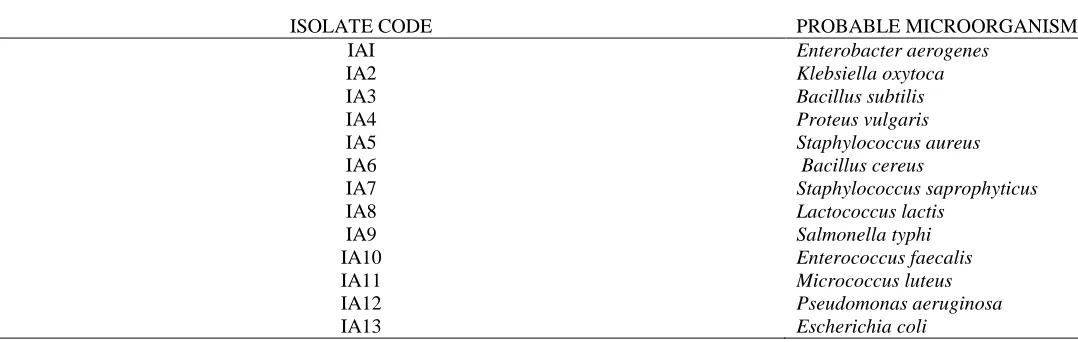
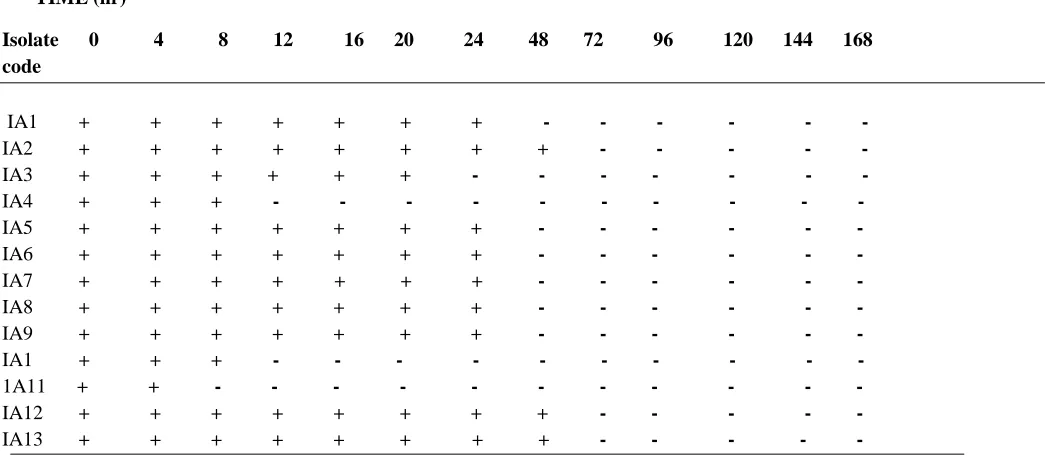
Table 1 to 8 below shows the occurrence of the bacteria isolated from wastewater from different food companies in South West, Nigeria. The different companies where the wastewater samples were collected were named industry A and B. In the table below, the suspected organisms, the various time in which the wastewater was exposed to different EMF strengths were shown. The time of exposure and the EMF strength affects the population of the isolates, different isolates had different reaction to these paramount and ponderous factor. The lowest EMF strength (1150nT) had the least effect on all the isolates while the highest EMF strength
Table 1 shows the effects ofemf (1150nT) on the occurrence of the bacteria on waste water from industry A from 0 hours to 144 hours i.e (7days) whichhad the lowest emf strength (nT).
http://dx.doi.org/10.22161/ijeab/2.5.52 ISSN: 2456-1878
to 144 hours which had higher effect on microbial load than the emf strength with (1150nT).
Table 3 shows the effects of EMF (3000nT) on the occurrence of the bacteria in waste water from industry A from 0 hours to 144 hours whichhad higher effect on microbial load than the emf strength with (1310nT ). Table 4 shows the effects of EMF (5000nT) on the occurrence of the bacteria in waste water from industry A from 0 hours to 144 hours which had higher effect on microbial load than the previous emf strength.
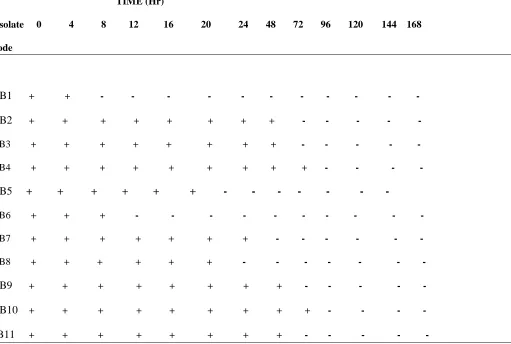
Table 5 shows the effects of EMF (1150nT) on the occurrence of the bacteria in waste water from industry B from 0 hours to 144 hours whichhad the lowest emf strength (nT).
Table 6 shows the effects of EMF (1310nT) on the occurrence of the bacteria in waste water from industry A from 0 hours to 144 hours whichhad higher effect on microbial load than the emf strength with (1150nT).
Table 7 shows the effects of EMF (3000nT) on the occurrence of the bacteria in waste water from industry A from 0 hours to 144 hours whichhad higher effect on microbial load than the emf strength with (1310nT ).
Table 8 shows the effects of emf (5000nT) on the occurrence of the bacteria in waste water from industry A from 0 hours to 144 hours whichhad higher effect on microbial load than the previous EMF strength.
3.2 Bacteria load of the wastewaters
Figure 1 and 2 shows the microbial loads of wastewater samples from different industrial site that was subjected to different EMF strength (A= 1150nT, B= 1310nT, C=3000nT, D=5000nT) at various time. The values of the bacteria colony count was counted and recorded. Sample collected at industry A had the highest mean values with EMF strength 1150nT, after exposure to EMF at lowest hour at hours were 230cfu/ml, 225cfu/ml and 220cfu/ml respectively, while the lowest value with EMF strength at 5000nT were 0cfu/ml, 2cfu/ml, 4cfu/ml, respectively. For sample collected at industry B had the highest values with EMF strength 1150nT, after exposure to EMF at lowest hour at 4 hours were 179cfu/ml, 176cfu/ml and 173cfu/ml respectively, while the lowest value with EMF strength at 5000nT were 1cfu/ml, 3cfu/ml, 5cfu/ml, respectively.
T
ABLE 1: Microganisms isolated from industry A wastewater
ISOLATE CODE PROBABLE MICROORGANISM
IAI Enterobacter aerogenes
IA2 Klebsiella oxytoca
IA3 Bacillus subtilis
IA4 Proteus vulgaris
IA5 Staphylococcus aureus
IA6 Bacillus cereus
IA7 Staphylococcus saprophyticus
IA8 Lactococcus lactis
IA9 Salmonella typhi
IA10 Enterococcus faecalis
IA11 Micrococcus luteus
IA12 Pseudomonas aeruginosa
http://dx.doi.org/10.22161/ijeab/2.5.52 ISSN: 2456-1878
Table.2: Effects of EMF (1510nT) on the occurrence of the bacteria on waste water from industry A.
TIME (hr)
Isolate 0 4 8 12 16 20 24 48 72 96 120 144 168 code
IA1 + + + + + + + - - - - - -
IA2 + + + + + + + + + - - - -
IA3 + + + + + + + + - - - - -
IA4 + + + - - - - - - - - - -
IA5 + + + + + + + + + - - - -
IA6 + + + + + + + + + + - - -
IA7 + + + + + + + + + - - - -
IA8 + + + + + + + + + + - - -
IA9 + + + + + + + + - - - - -
IA10 + + + - - - - - - - - - -
1A11 + + - - - - - - - - - - -
IA12 + + + + + + + + + + + - -
IA13 + + + + + + + + + + + - -
Table.3: Effects of emf (1310nT) on the occurrence of the bacteria on waste water from industry A.
TIME (hr)
Isolate 0 4 8 12 16 20 24 48 72 96 120 144 168 code
IA1 + + + + + + + - - - - - -
IA2 + + + + + + + + + - - - -
http://dx.doi.org/10.22161/ijeab/2.5.52 ISSN: 2456-1878
IA4 + + + - - - - - - - - - -
IA5 + + + + + + + + + - - - -
IA6 + + + + + + + + + - - - -
IA7 + + + + + + + - + - - - -
IA8 + + + + + + + + + - - - -
IA9 + + + + + + + + - - - - -
IA10 + + + - - - - - - - - - -
1A11 + + - - - - - - - - - - -
IA12 + + + + + + + + + + - - -
IA13 + + + + + + + + + + - - -
Legend: (+) Present, (-) Absent
IA1-IA13=First Isolate –Thirteen Isolate A13
Table.4: Effects of EMF (3000nT) on the occurrence of the bacteria on waste water from industry A.
TIME (hr)
Isolate 0 4 8 12 16 20 24 48 72 96 120 144 168 code
IA1 + + + + + + + - - - - - -
IA2 + + + + + + + + + - - - -
IA3 + + + + + + + - - - - - -
IA4 + + + - - - - - - - - - -
IA5 + + + + + + + + + - - - -
IA6 + + + + + + + + + - - - -
IA7 + + + + + + + + + - - - -
IA8 + + + + + + + + + - - - -
IA9 + + + + + + + + - - - - -
IA10 + + + - - - - - - - - - -
http://dx.doi.org/10.22161/ijeab/2.5.52 ISSN: 2456-1878
IA12 + + + + + + + + + - - - -
IA13 + + + + + + + + + - - - -
Legend: (+) Present, (-) Absent
IA1-IA13=First Isolate –Thirteen Isolate A1
Table.4: Effects of EMF (5000nT) on the occurrence of the bacteria on waste water from industry A.
TIME (hr)
Isolate 0 4 8 12 16 20 24 48 72 96 120 144 168 code
IA1 + + + + + + + - - - - - -
IA2 + + + + + + + + - - - - -
IA3 + + + + + + - - - - - - -
IA4 + + + - - - - - - - - - -
IA5 + + + + + + + - - - - - -
IA6 + + + + + + + - - - - - -
IA7 + + + + + + + - - - - - -
IA8 + + + + + + + - - - - - -
IA9 + + + + + + + - - - - - -
IA1 + + + - - - - - - - - - -
1A11 + + - - - - - - - - - - -
IA12 + + + + + + + + - - - - -
IA13 + + + + + + + + - - - - - Legend: (+) Present, (-) Absent
IA1-IA13=First Isolate –Thirteen Isolate A13
TABLE 6 :Microganisms isolated from industry B wastewater
ISOLATE CODE PROBABLE MICROORGANISM
IAI Micrococcus luteus
IA2 Lactococcus lactis
IA3 Listeria spp
IA4 Escherichia coli
IA5 Erwinia caratova
IA6 Proteus vulgaris
IA7 Staphylococcus saprophyticus
IA8 Enterobacter aerogenes
IA9 Bacillus subtilis
IA10 Pseudomonas aeruginosa
http://dx.doi.org/10.22161/ijeab/2.5.52 ISSN: 2456-1878
Table.7: Effects Of EMF(1150nT) On The Occurrence Of The Bacteria On Waste Water From Industry B.
TIME (Hr)
Isolate 0 4 8 12 16 20 24 48 72 96 120 144 168 code
IB1 + + - - - - - - - - - - -
IB2 + + + + + + + + + + - - -
IB3 + + + + + + + + + + - - -
IB4 + + + + + + + + + + - - -
IB5 + + + + + + - - - - - - -
IB6 + + + - - - - - - - - - -
IB7 + + + + + + + - - - - - -
IB8 + + + + + + + - - - - - -
IB9 + + + + + + + + + + - - -
IB10 + + + + + + + + + + + - -
IB11 + + + + + + + + - - - - - Legend: (+) Present, (-) Absent
IA1-IA13=First Isolate –Thirteen Isolate A13
Table.8:effects of EMF (1310nT) on the occurrence of the bacteria on waste water from industry B.
TIME (Hr)
Isolate 0 4 8 12 16 20 24 48 72 96 120 144 168 code
IB1 + + - - - - - - - - - - -
IB2 + + + + + + + + + - - - -
IB3 + + + + + + + + + - - - -
http://dx.doi.org/10.22161/ijeab/2.5.52 ISSN: 2456-1878
IB5 + + + + + + - - - - - - -
IB6 + + + - - - - - - - - - -
IB7 + + + + + + + - - - - - -
IB8 + + + + + + + + - - - - -
IB9 + + + + + + + + + - - - -
IB10 + + + + + + + + + + - - -
IB11 + + + + + + + + - - - - - Legend: (+) Present, (-) Absent
IA1-IA13=First Isolate –Thirteen Isolate A13
Table. 9: Effects of EMF (3000nT) on the occurrence of the bacteria on waste water from industry A
TIME (Hr)
Isolate 0 4 8 12 16 20 24 48 72 96 120 144 168 code
IB1
+ + - - - - - - - - - - -IB2
+ + + + + + + + - - - - -IB3 + + + + + + + + - - - - -
IB4 + + + + + + + + + - - - -
IB5 + + + + + + - - - - - - -
IB6 + + + - - - - - - - - - -
IB7 + + + + + + + - - - - - -
IB8 + + + + + + - - - - - - -
IB9
+ + + + + + + +IB10
+ + + + + + + + + - - - -IB11
+ + + + + + + + - - - - -Legend: (+) Present, (-) Absent
http://dx.doi.org/10.22161/ijeab/2.5.52 ISSN: 2456-1878
Table.10: Effects of EMF (5000nT) on the occurrence of the bacteria on waste water from industry B.
TIME (Hr)
Isolate 0 4 8 12 16 20 24 48 72 96 120 144 168 code
IB1 +
+ - - - - - - - - - - -IB2 +
+ + + + + + - - - - - -IB3 + + + + + + + - - - - - -
IB4 + + + + + + + + - - - - -
IB5 + + + + + + - - - - - - -
IB6 + + + - - - - - - - - - -
IB7 + + + + + + + - - - - - -
IB8 + + + + + + - - - - - - -
IB9
+ + + + + + +IB10
+ + + + + + + + - - - - -IB11
+ + + + + + + - - - - - -Legend: (+) Present, (-) Absent
IA1-IA13=First Isolate –Thirteen Isolate A13.
IV. DISCUSSION
The presence of some microorganisms in the wastewater collected from different companies is demonstrating their occurrence at different hours during the treatment of the wastewater sample with different EMF strength. It was observed that at the early part (hours) of the experiment the heavy presence of microbes were seen but as the experiment progresses the microbial population were reduced.The EMF had most dwinding effect on Microcccus luteus because it was not visible after four hours of exposure for each EMF strength. Even some microbes (Bacillus subtillis, Staphylococcus aureus, Staphylococcus saprophyticus, Klebsiella oxytoca) were not visible at 96 hours of exposure for three EMF strength(1150nT, 1310nT and 3000nT) and it was not visible after seventy two hours of
exposure for the last EMF strength (5000nT). (Enterococcus faecalis, Proteus vulgaris)were no longer visible after twelve hours for all EMF strength (1150nT, 1310nT, 3000nT and 5000nT) similar to the findings of (12). Enterobacter aerogenes after fourty eight hours for all
EMF strength (1150nT, 1310nT, 3000nT and
http://dx.doi.org/10.22161/ijeab/2.5.52 ISSN: 2456-1878
aeruginosa) was not visible after one hundred and forty four (144) hours of exposure at 1150nT, it was no longer visible, while at 1310nT it was no longer apparent after. Industry B had lesser number of microbes than industry A is consistent to the finding of (13). The EMF had most dwinding and receeding effect on Microcccus luteus
because it was not visible after Eight hours of exposure for each EMF strength(1150nT, 1310nT, 3000nT and 5000nT).
Esherichia coli and Pseudomonas aeruginosa was observed after 120 hours of the wastewater sample with EMF treatment and. For industry B Proteus vulgaris is no longer visible after twelve hours at all the EMF strength (1150nT, 1310nT, 3000nT and 5,000nT) which is in contrast to what of (6) found where certain bacteria responds positively well in terms of increased growth rate and activities to electromagnetic field treatment. .Enterobacter aerogenes
and Salmonella typhi is no longer visible after forty eight hours from the wastewater collected from industry B after the treatment of the wastewater sample, Lactococcus lactis,
Listeria spp, Bacillus subtilis is no longer visible after one hundred and twenty hours with EMF treatment at 1150nT, while at 1310nT it was not visible after exposure to ninty six hours, then after exposure to seventy two hours it was not visible at 3000nT and after exposure to seventy two hours it was not visible at 5000nT and other microbes were observed but in reduced population which is in contrast to what of (12) found where certain bacteria responds
http://dx.doi.org/10.22161/ijeab/2.5.52 ISSN: 2456-1878
Fig.1:Effect of EMF on Bacteria Loads in Waste Water fromIndustry A
Fig.2: Effect of EMF on Bacteria Loads In Waste Water From Industry B.
0 50 100 150 200 250
0hrs 4hrs 8hrs 12hrs 16hrs 20hrs 24hrs 48hrs 72hrs 96hrs 120hrs144hrs168hrs
Bacteria
lo
ad
(c
fu
/m
l)
Time
5000nT
3000nT
1300nT
1150nT
0 50 100 150 200 250 300
0hrs 4hrs 8hrs 12hrs 16hrs 20hrs 24hrs 48hrs 72hrs 96hrs 120hrs144hrs168hrs
b
ac
ter
ial
lo
ad
(
cf
u
/m
l)
Time
5000nT
3000nT
1300nT
http://dx.doi.org/10.22161/ijeab/2.5.52 ISSN: 2456-1878
www.ijeab.com Page | 2696 The results of this investigation also revealed that increased
duration of exposure of bacteria to electromagnetic field resulted in the reduction in the population of the bacterial isolates as there was a considerable decrease in the colony count. The period of exposure of microbial cells to electromagnetic field plays an important role in the production of the biological effect and this can cause desirable changes in them. Human activities such as pollution also affect the activity of microbes in water and this can lead to Eutrophication, consequently have a negative effect on the relationship that exist between the microbial groups.
V CONCLUSION
The EMF treatments reduced the microbial population as well as the rate of contamination in the wastewater samples as the exposure time increased and it also inhibit growth and proliferation of microorganisms thus making it to have both bacteriostatic and bacteriocidal effect.
VI. RECOMMENDATION
It is therefore recommended that wastewater from industries should be treated with a better alternative mean by the use of electromagnetic field before discharging them to the other water bodies so as to avoid contamination. This will help reduce microbial population that constitute a serious hazard to public health. EMF treatments could also help protect other life forms inhabiting the water body and thus guard against ecological imbalance of the microbiota.
Plate 1: Electromagnetic field (EMF) apparatus set up
Plate 2: Setup of EMF with wastewater inside the conical flasks during the experiment
COMPETING INTERESTS
Authors have declared that no competing interests exist.
REFERENCES
[1] Aaron J., Shipman, Todd and Wilson.. Introduction to Physical Science (12th edition.). Cengage Learning
2014. pp. 205–206.
[2] Abdullah, MP. andKhalik, WM. A Microbial analysis of water. Malaysian Journal of Analytical Science; 2012; 16 (45). 163.
[3] APHA. Standard Methods For Examination of Water and Wastewater, (20th edition), American Public
Health Association, Washington D. C. 2015.
[4] ASTM International. Annual Book of ASTM Standards, Water and Environmental Technology, West Conshohocken, Pennsylvania; 2003; pp 6-7. [5] Al-Bastaki, NM. Performance of advanced methods
for treatment of wastewater: Chemical Engineering and Processing2009 ; 43 (7): 34
[6] Brunette S. and Gary .. (4th edition), CDC Health
Information for International Travel. The Yellow Book, chapter 3. Oxford University Press. pp 56 Content source: Centers for Disease Control 2013. [7] Burton, FL, and Tchobanoglous, G. and Stensel, HD.
Wastewater Engineering (Treatment Disposal Reuse) / Metcalf & Eddy, Inc. (6th edition.). McGraw-Hill Book Company 2013.
[8] Carl RN. "Electromagnet".Hyperphysics. Departmentt. of Physics and Astronomy, Georgia State University 2012.
http://dx.doi.org/10.22161/ijeab/2.5.52 ISSN: 2456-1878
www.ijeab.com Page | 2697 [10]Mizuno, A and Hori, Y. Destruction of living cells by
pulsed high-voltage application. IEEE Industrial Application.1991;24(3):387-394.
[11]Moulder JE. The electric and magnetic fields research and public information dissemination. (EMF-RAPID).
Programme Radiation. Research. 2002 ;153: pp 613-616.
[12]Naoum, O. and Karchev, P. "Itinerant ferromagnetism and superconductivity". In Paul S. (CON) Castro.
Superconductivity research at the leading edge. 2003 pp. 169.
[13]Nawlakhe, W.G.,Lutade, S.L., Patni, P.M. and Deshpande, L.S.Indian Journal of Environment. Protection;1995;37(4), pp 278-284.
[14]Oyhakilome, GI.,Aiyesanmi AF. And Akharaiyi FC. Water Quality Assessment of the Owena Multi-Purpose Dam, Ondo State, Southwestern Nigeria,
Journal of Environmental Protection; 2012; 3, (22):14-25.
[15]Qin, BL., Zhang, Q., Barbos, GV, Swanson, BG, Pedrow, PD). Inactivation of microorganisms by pulsed electric fields with different voltage waveforms. IEEE Trans. Dielectric. Insulations; 2014;1(6):1047-1057.
[16]Watkin, J. and Sleath KP. (1981). Journal. Applied. Bacteriology. 50: pp 1-9.
[17]Welch. Limnology (2nd edition). McGraw Hill Book
Co., New York 1952.
[18]WHO Geneva Guidelines for drinking-water quality (electronic resource), (3rdedition) incorporating (1st
and 2nd agenda), Recommendations (2008).
[19]Willey, Prescott, Harley and Klein‟s Microbiology, New York: The McGraw-Hill publications, 2008. [20]Windelspecht. and Michael Ground breaking
Scientific Experiments, Inventions, and Discoveries of the 19th Century, xxii, Greenwood Publishing Group,
2003. pp 33.
[21]World Health Organisation. Chloride in Drinking Water, Background Document for Preparation of WHO Guidelines for Drinking-Water Quality, World Health Organization, Geneva, Switzerland 2003. [22]World Health Organisation.Water and Sanitation:
Protection of the Human Environment,”World Health
Organisation, Geneva, Switzerland 2014.
[23]WHO. WHO Guidelines for the Safe Use of Wastewater, Excreta and GreywaterVolume IV: Excreta and greywater use in agriculture. World Health Organization (WHO), Geneva, Switzerland 2006.