202
Copyright © 2017. Vandana Publications. All Rights Reserved.
Volume-7, Issue-5, September-October 2017
International Journal of Engineering and Management Research
Page Number: 202-206
Comparative Study of Bim Method with Conventional Method for
Building Construction
Vandana Tiwari1, Prof. Ghanshyam Sarode2 1
ME Student, Dr. D.Y. Patil College of Engineering, Pune,INDIA 2
Assistant Professor, Dr. D.Y. Patil College of Engineering, Pune, INDIA
ABSTRACT
Building Information Modeling (BIM) is becom-ing a comprehensive collaborative process in the construc-tion industry. Despite its short history, BIM has had an increasing growth during the last decade. This is happening mainly due to its capabilities on construction projects. BIM can create a common language between all parties and system divisions in a project and make them an integrated team. The approach of BIM strongly matches with inte-grated project delivery systems. The role of BIM as a coor-dinator of project system is quite similar to the duties of a project manager. BIM integrates different disciplines by effective communication, analyzes the project systems for constructability, estimates the cost and time of projects at any time using quantity takeoffs, draws a big picture of projects using visualization and builds collaborative teams. All these are what a project manager does in a different scale during a project life cycle.
This paper aims to show the correspondence of BIM and project managers’ roles on construction projects. It emphasizes the importance of having proper BIM knowl-edge and experience for project managers to succeed. This paper also discusses the requirements of BIM knowledge and experience enrichment of project managers.
Keywords-- Building Information Modelling, Project
Management, Construction
I.
INTRODUCTION
1-1. History
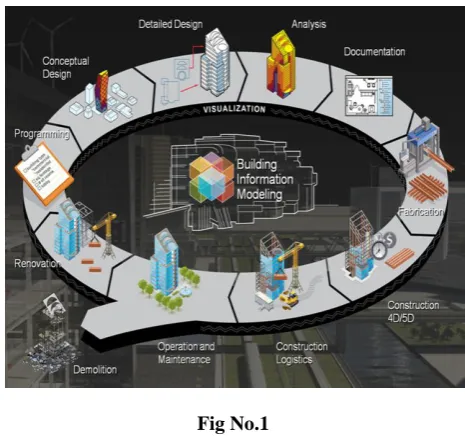
Building Information Modeling (BIM) can be defined as a reliable, digital, three dimensional, virtual representation of the project to be built for use in design decision-making, construction scheduling and planning, cost estimates and maintenance of construction projects (Words & Images, 2009).The BIM Handbook (2008) defined BIM as a computer-aided modeling technology for the purpose of managing the information of a con-struction project focusing on production, communication and analysis of building information models. The Na-tional Building Information Model Standard Project Committee defined the BIM as following: “A BIM is a digital representation of physical and functional
charac-teristics of a facility. As such it serves as a shared knowledge resource for information about a facility forming a reliable basis for decisions during its lifecycle from inception onward.”
The concept of BIM theoretically emerged and was developed at Georgia Institute of Technology in the late 1970s and grew rapidly after that. The growth hap-pened because of the increasing attention paid to con-struction teams and firms that found merits in using BIM in order to integrate the process of the construction pro-jects and managing them. The term Building Information Modeling was first used in 2002 to describe virtual de-sign, construction and facilities management (Harris, 2010).
Graphi soft in 1986 introduced its new software as a solution for virtual building. This software, Archi cad, was really a drastic improvement in CAD programs of that time since Archicad allowed the creation of three dimensional (3D) models of projects (Dey, 2010). The terms Building Information Modeling and Building In-formation Model and the acronym of BIM were wide-spread when Autodesk released the "Building Informa-tion Modeling” (Autodesk, 2003).
203
Copyright © 2017. Vandana Publications. All Rights Reserved.
1-2. Construction Project ManagementConstruction projects constitute the main part of all disciplines projects due to their amount, variety and cost. The U.S. Census Bureau News (2013) esti-mated that the construction industry would spend more than $874 billion in 2013. These projects range from small residential or retail projects to mega multifunction projects. Needless to say, with any scale of a construc-tion project, there is a necessity for managing it. The management of construction projects requires knowl-edge of modern management as well as an understanding of all construction processes. Along with the change in technology, organizational arrangement or procedures and new features and methods, the management of con-struction projects differs (Hendrickson, 2000). Construc-tion project management is a series of activities for de-termining how, when and by whom the work, including all life cycle activities, will be performed.
Similar to the Project Management Body of Knowledge (PMBOK) definitions, the construction pro-ject manager handles propro-ject management planning, cost management, time management, quality management, contract administration, safety management and risk management. The project manager is also in charge of communication between all stakeholders on the project including owner, designers, engineers, professional crew and administrative staffs. Generally, construction project management shares the common and overall characteris-tics of general projects, therefore, the rules and methods required for general project management can be applied to this type of projects.
II.
BUILDING INFORMATION
MODELING ASPECTS
Technical Aspects of BIM
BIM has some specific features that can effec-tively be used in project management. These features, which are increasingly developed, can be summarized as follows (Lahdou & Zetterman, 2011):
1. Clash Detection
One of the common problems of different dis-ciplines’ plans for a construction project is the geome-trical design inconsistencies. This issue happens when there is an overlap between the plans of different discip-lines.Using BIM, it would be possible to bring the plans together and detect the clashes. Modifying the aesthetic problems is another possibility of this visual checking. 2. Constructability
Using BIM, it would be possible for teammates in a project to review and handle constructability issues and (if needed) promote issues into RFIs. In addition, visual information can be provided from a vantage point to show the problems. This visual information accompa-nying markup allows further investigation for finding solutions and, thus, mitigates the risks.
3. Analysis
Helping the project managers, designers and engineers in doing more analyses and enabling better decision making is another aspect of BIM. By linking
the building information models to appropriate tools, it would be possible to analyze the energy consumption of a construction project and then find better solutions such as changing materials and orientation, mass and space, etc. Moreover, light, mechanical and acoustics analyses are also available to be performed by BIM.
4. Time & Cost Estimation (4D & 5D)
Time and cost estimation are other features of BIM which enable project managers to visualize the construction project at any point in time and have a clear understanding of project phases. Time and cost estima-tion, which are generally called 4D and 5D, can be prop-erly utilized in the first stages of a project and facilitate the decision making process with minimum cost and time needed. Furthermore, BIM has the capability to simulate the various alternatives for a construction project and hence helps project managers and executives to reliably predict the consequences of their decisions. 5. Integratin
The project team can deal and interact with a unified model when a composite model is built from an amalgam of various disciplines’ models. Having this capability, and through the different phases of a con-struction project, BIM can coordinate the design, analy-sis, and construction activities on a project and, there-fore, results in integrity of projects.
6. Quantity Take-off
Quantity takeoffs in a BIM model can be very helpful for the project teams and managers to analyze their decision and have a clear and reliable insight to various alternatives in the design phase or even through-out the project lifecycle. Since there is a possibility of integration between the BIM model and a database
III.
ROLE OF BIM IN PROJECT
MANAGEMENT
3-1. BIM vs. PMBOK Knowledge Areas
Capabilities of BIM on construction projects correspond to the PMBOK knowledge areas, since the nature and role of each item are alike. Therefore, BIM can be considered as an effective and powerful tool in project management in the construction industry.
204
Copyright © 2017. Vandana Publications. All Rights Reserved.
management considers as a project management area.Communication is a main feature of BIM which facili-tate the professional relationship between all parties in-cluding project managers, designers and engineers on a construction project by creating effective and direct communication channels. Finally, procurement man-agement would be possible by quantity takeoffs which are produced by BIM. In addition, changes in any item can be easily reflected in cost and time and work needed for its procurement. In spite of the extensive framework of project management, BIM can be presented as a main and effective concept corresponding to project manage-ment knowledge areas. Figure 2 shows model of PBOK knowledge areas considering BIM on construction projects.
3-2. BIM Benefits and Advantages
Different sources of construction project man-agement identify key advantages of using BIM as fol-lows (Qian,
2012):
“Enhanced project collaboration and control among stakeholders
Improved productivity (less re-work, conflicts and changes)
Better project quality and performance
Faster project delivery
Reduced wastages
Reduced construction costs
New revenue and business opportunities” BIM Tools available for construction practice
There are plenty of Building Information Mod-eling tools. This subsection will identify these products. The following table, figure 8, depicts the BIM authoring tools and their primary functions. The list includes MEP, structural, architectural, and site work 3D model-ing software’s. Some of these software’s are also capa-ble of scheduling and cost estimation.
Product Name Manufacturer Primary Function
Cad-pipe HVAC
AEC Design Group
3D HVAC Modeling Revit
Architec-ture
Autodesk 3D Architec-tural Modeling and parametric design. AutoCAD
Ar-chitecture
Autodesk 3D Architec-tural Modeling and parametric design. Revit Structure Autodesk 3D Structural
Modeling and parametric design. Revit MEP Autodesk 3D Detailed
MEP Modeling
IV.
FLOW CHART
FLOW CHART OF CONVENTIONAL MODELLING
FLOW CHART OF BUILDING INFORMATION MODELLING
V.
PROBLEM STATEMENT
A G+4 proposed building of 24 flats and of 4 shops is taken for case study location is in Ravet, PUNE under PCMC for plot size 6800 sq. feet
Case study of a G+4 proposed building of 24 flats and of 4 shops in Ravet, PUNE
Design Team : Apex consultant
Owner and Developer :Shivaji Patil
Architect :Ravi Varma
Structural Engineer :Navneet Patil and Prashant Patil
Builder : Praj Infra Solutions pvt.ltd.
Area : 6800 sq.feet
Cost of land : 1.98 Cr.
Cost of construction: 2.5 Cr.
Area of 1 BHK:464 square feet
Area of 2 BHK:800 square feet
Total No. of flats:24
No. of skilled labours required:25
No. of site engineer required :1
No. of structural engineer required :1
No. of architect required :1
Location: Ravet,PCMC
Set back distance: 14”
Side distancs-9”
205
Copyright © 2017. Vandana Publications. All Rights Reserved.
VI.
RESULT AND DISCUSSION
6D model in REVIT +NAVISWORKS
GRAPH NO.1 CONVENTIONAL vs BIM
GRAPH NO.2 NO.OF DAYS
GRAPH NO.3 COST OF ACTIVITY
GRAPH NO.4 COST OF MATERIAL
VII.
CONCLUSION AND
RECOMMENDATIONS
This work studies effectiveness of building information modeling for effective project planning , management.
• A 6D model of G+4 building. is prepaired as per methodology of BIM as mentioned which includes 3D models, scheduling ,quantity and costing
• For present case study it was observed that total 39 days can be saved in total for tasks like scheduling, planning, monitoring, cost analysis which will leads to saving in costs and 25-30% reduced due to coordination and reduction in man power. But however the cost of material will remains same.
REFERENCES
[1] Ning, X., Lam, K., and Lam, M., A decision making system for construction site layout planning, Automation in Construction, 20, 459-473, 2011.
[2] Pradhananga, N. and Teizer, J., Congestion Analysis for Construction Site Layout Planning using Real-time Data and Cell-based Simulation Model, Computing in Civil and Building Engineering, 681-688, 2014.
[3] Yahya, M. and Saka, M., Construction site layout planning using multi-objective artificial bee colony algo-rithm with Levy flights, Automation in Construction, 38, 14-29, 2014.
[4] Andayesh, M. and Sadeghpour, F., The time dimen-sion in site layout planning, Automation in Construction,
206
Copyright © 2017. Vandana Publications. All Rights Reserved.
[5] Astour, H. and Franz, V., BIM-and SimulationbasedSite Layout Planning, Computing in Civil and Building Engineering, 291-298, 2014.
[6] Cheng, J. and Kumar, S., A BIM Based Construction Site Layout Planning Framework Considering Actual Travel Paths, The 31st International Symposium on Au-tomation and Robotics in Construction and Mining,
2014.
[7] Olearczyk, J., Lei, Z., Ofrim, B., Han, S., and Al-Hussein M., Intelligent Crane Management Algorithm for Construction Operation (iCrane), The 32nd Interna-tional Symposium on Automation and Robotics in Con-struction and Mining, 2015.
[8] Hollermann, S. and Bargstädt, H., 4D Site Installa-tion Planning in Virtual Reality for Multiuser, Compu-ting in Civil and Building Engineering, 777-784, 2014. [9] Eastman, C., Lee, J., Jeong, Y., and Lee, J., Automat-ic rule-based checking of building designs, Automation in Construction, 18, 1011-1033, 2009.
[10] Solibri Model Checker, On-line:
http://www.solibri.com/products/solibri-modelchecker/, Accessed: 11/08/2015.
[11] Kim, K. and Teizer, J., Automatic design andplan-ning of scaffolding systems using building information modeling, Advanced EngineeringInformatics, 28, 66-80, 2014.
[12] Zhang, S., Sulankivi, K., Kiviniemi, M., Romo, I., Eastman, C., and Teizer. J., BIM-based fall hazard iden-tification and prevention in construction safety planning,
Safety Science, 72, 31-45, 2015.
[13] Autodesk Revit, On-line: http://www.autodesk.com/products/revitfamily/overview , Accessed: 12/06/2015.