ADVANCES IN SURFACE IRRIGATION-1/
E. G. Kruse, D. D. Fangmeier, A. S. Humphreys and H. L. Mange/i ll
Ten years ago about 81 percent of the irrigated land in the United States was surface irrigated. Surface irrigated area has increased gradually, but sprinkler irrigated area has increased faster so as to gain about 1 percent of the total area each year. Of all irrigated land in 1975, surface irriga-ted areas comprised about 75 percent; in 1979, only 58 percent.2 /
The potential for auto mechanization of surface irrigation was discussed at the first National Irrigation Symposium where several applicable systems were described. During the subsequent decade considerable mechanization has taken place. Siphon tubes are now used on many fields where the ditch banks were cut previously. Gated pipe has replaced siphon tubes in many cases. Earthen ditches have been replaced by concrete lined channels or by buried pipe sys-tems to reduce seepage and to allow the irrigator to better control his farm water supply.
Automation of surface systems has proceeded slowly since 1970. Research and development have produced several new systems and improved others. Some com-mercially produced systems have been used on farms in the central plains and the irrigated valleys of the Southwest. However, total use is small and only a few manufacturers or irrigation equipment suppliers promote the sale of automated surface systems or components.
Advances in design procedures for surface irrigation during the past decade include techniques for computer solution of the hydrodynamic equations de-scribing irrigation water advance and recession. Simultaneously, computer techniques have been developed to solve empirical/theoretical systems of equations for practical field use. It is still difficult to measure and de-scribe variables affecting design like intake rates and flow resistance, so the design equations can be used with assurance.
Surface irrigation methods will continue to change as new technology becomes available. The need for more efficient irrigation with low labor and energy consumption will cause changes in methods to continue. Environmental and wa-ter conservation considerations will require irrigation systems that operate with little or no surface runoff. Deep percolation will be controlled to
1/ Contribution Contribution from the Science and Education Administration - Agricultural Research, USDA; University of Arizona; and Kansas State University
(Contribution 81-62-A); in cooperation with Colorado State University and the University of Idaho Experiment Stations.
2/
- Agricultural Engineer, USDA, Fort Collins, Colo.; Professor of Soils, Wa-ter and Engineering, University of Arizona, Tucson, Ariz.; Agricultural Engineer, USDA, Kimberly, Idaho; and Research Agricultural Engineer, Kansas State University, Manhattan, Kans.
3/ Irrigation Irrigation Journal - Annual Survey IssUes.
mesrea
COPV
6''
conserve water, prevent groundwater contamination, and provide an optimum ,n-vironment for crop growth, yet provide the leaching required to maintain salt balance in the root zone. Mechanization and automation will continue to develop, not only to reduce labor requirements, but also to ensure that irri-gation applications are made at the proper times and in the proper amounts.
ADVANCES IN EQUIPMENT AND OPERATING PROCEDURES
Tailwater Reuse Systems
Tailwater-reuse systems are an integral part of many modern, well designed and operated surface-irrigation systems. They allow the use of large streams with their accompanying runoff, which are necessary for high water distribu-tion uniformity, especially for net water applicadistribu-tions of 50 to 80 mm. The collection and reuse of tailwater reduces the demand on available water sup-plies through increased water application efficiences. At the same time, en-ergy use for pumping from wells is reduced because pumping lift is much less from tailwater reservoirs than from deep wells. Tailwater-reuse systems pre-vent damage to the adjacent property by irrigation tailwater and make it pos-sible to meet regulations that prohibit runoff from leaving irrigated farms. If fertilizer or other chemicals are distributed in irrigation water or, if the irrigation streams erode and transport sediment, the reuse system pre-vents nutrients or pollutants from leaving the farm. Fischbach and Somerhalder (1971) obtained an average uniformity coefficient of 92 percent, while applying 50 mm irrigations, by graded furrows using a tailwater-reuse system. Water application efficiencies were 65 percent without a reuse sys-tem and 92 percent with one.
A tailwater-reuse system includes drainage ditches to collect tailwater and convey it to the storage facility, a reservoir to retain tailwater for later use, and
a
pumping plant and pipeline to deliver tailwater either to the head end of the field from which it is generated, or to another field. Section 13.8 of the ASAE Irrigation Monograph (1981) describes planning and design procedures for reuse systems. The section contains up-to-date methods for: (1) planning operational procedures, (2) designing pumps and sumps, (3) siz-ing reservoirs, (4) estimatsiz-ing runoff rates and volumes and (5) handlsiz-ing sediment, trash and storm runoff safely.Information on reuse system design is also available in the ASAE Engineering Practice "Design and Installation of Surface Irrigation Reuse Systems". 1/
Automation
Advances in automation hardware during the past decade were limited. However, there have been improvements in controllers and in mechanisms to re-lease flows from valves and gates.
Use of microprocessors and other solid-state electronic equipment in control-ler design is especially promising. Microprocessors can provide improved capability for individual irrigation station control, variable time periods (including cutback and surge flow control), lower power requirement, and sen-sor input, such as using weather and soil moisture data to determine need for irrigation and then automatically start the irrigation process. Duke, et al. (1978) developed a microprocessor controller that stops irrigation after
a
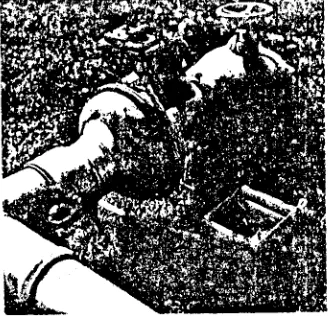
Figure 2. Flexible plastic gated pipe. Gates are inserted by the irrigator in the field at the be-ginning of the season. Soil shoveled onto the pipe helps main-tain pressure on up slope gates. Figure 1. Automated valve and timer
for gated pipe irrigation. Valve is activated by low pressure water in irrigation systems.
Trash screens
Clean water is essential for automated irrigation systems and trash screens are usually requirgd. Newly developed trash screens include a commercially manufactured unit-// and a wheel-type screen reported by Humpherys (1979). Energy dissipation in gated pipes
Design criteria for orifice plates used to dissipate excess energy in gated pipe systems was presented by Humpherys (1979). Design information for but-terfly valves was also obtained. Energy dissipation should be avoided in pump pressurized systems to minimize energy consumption.
Plastic Gated Pipe
Two new types of plastic pipe, flexible and rigid, can be gated to distribute irrigation water to crops. The flexible pipe folds flat when not under pressure. Since the pipe does not become round under the low pressures at which it operates, transmission capacity is considerably less than for rigid pipe of the same diameter. Flow capacities for the commonly available sizes of flexible plastic pipe range from 15 to 170 L/s at a hydraulic gradient of 0.003.
Flexible plastic pipe can follow the contours of most field boundaries or turn 90° corners with a radius of only a few meters. Gates are installed by the irrigator where necessary after the pipe has been laid and partly inflat-ed by filling with water, Fig. 2. Flexible plastic pipe is normally intendinflat-ed to last only a single season. The plastic decomposes rapidly and is often plowed into the soil before the next irrigation season.
Inhibitors in Polyvinyl Chloride (PVC) compounds to prevent solar radiation damage have made it possible to use rigid PVC pipe for aboveground
1)
Manufactured by J.D. Naffziger, Route'l, Box 34, Loma, CO 81524.application. Several manufacturers sell such pipe in sizes that can be used interchangeably with aluminum gated pipe. Except for difference in weight and appearance, the pipe functions identically to aluminum gated pipe. Fiberglass irrigation pipe, which can be gated, has also been developed.
Laser-Leveling
The use of lasers to control earth-moving equipment was developed by USDA in the Midwest to aid in lay-ing buried drains with a uniform gradient. This concept has recent-ly been expanded for precision lev-eling or grading of irrigated fields. A laser-generated plane of light parallel to the desired fin-ished soil surface can guide one or more pieces of earthmoving equipment, Fig. 3. Precision of the laser beam is such that a sin-gle transmitter can provide the re-ference plane for a radius of about 300 m.
Figure 3. "Touch-up" leveling of an irrigated level basin using la-ser controlled scraper.
Application of Chemicals in the Irrigation Water
Two general requirements for effective application of chemicals in irrigation water are (1) infiltration of the water over the field surface must be very uniform and (2) deep percolation and surface runoff must be small. Two cur-rently used surface-irrigation systems meet the conditions for effective chemical application -- graded furrows with tail water reuse facilities and .tors can be used to operate such
controllers where conventional 'electrical power is not available.
Descriptions of the state-of-the art of surface irrigation automa-tion systems are contained in Sec-tion 13.9 of the ASAE Irrigation Monograph. Advances made during the past decade include the development, improvement, and com-mercial production of valves for use in automated surface systems including 0-ring, pillow disc, pneumatic and water operated valves, Fig. 1. Pneumatically op-erated lift gates and tile outlet discharge controls are being used to automate level basins in the Southwestern U. S. Commercially produced traveling-dam irrigators have come in general use in some areas. Improvements were made in drop open and drop closed gates. Progress has been made toward the development of single pipe conveyance/distribution systems.
Figure 4. Experimental low pressure, center pivot irrigator. Irrigator applies water to micro-basins between bedded crop rows.
level basins. The chemicals, such as water-soluble nutrients, are dissolved in a tank adjacent to the irrigation water supply. The solution is then pumped or siphoned into the supply at a rate such that all sets on the field receive equal chemical application. Nitrogen fertilizers in water soluble forms are particularly well-suited for this method of application. Herbicide application in surface systems is being studied, but has not yet progressed to the point of general use.
CONCEPTS FOR IMPROVED SURFACE IRRIGATION Multiset Irrigation
In recent years, a multiset irrigation system has been under development in Idaho (Rasmussen, et al, 1973). In its present form (Worstell, 1979), the multiset system consists of several shallowly buried pipelines at regular in-tervals across the field. Water is supplied to each furrow from each of these pipelines, thus breaking up a long length of run into two or more short runs. The small streams, introduced at several points in the furrow to mini-mize erosion, achieve more nearly uniform intake opportunity time for the
entire field, and reduce surface runoff. The buried pipelines allow most normal tillage and cultural operations without restriction. Some difficulty has occurred in establishing the proper furrow flows because water does not always readily move upward from the pipe openings to the furrow channels. Current research is concerned with developing simple, practical methods of introducing water from buried lines to each furrow with the required precision.
Automatic Cut-back
Cut-back, graded furrow irrigation to increase infiltration uniformity and reduce runoff has been a recommended procedure for several years. In such systems, streams are introduced to the furrow at or near the maximum nonerosive flow rate. Then, when water nears the far end of the furrow, the stream size is reduced so only small amounts of surface runoff occur. Manual cut-back systems have not been popular, because they require extra labor to adjust flows from gated pipe or siphon tubes and because reducing furrow streams leaves excess water in the supply channel to be wasted or used to start a small number of new furrows. Three methods of cutback furrow irrigation, as well as the possibility for automation, are described in Sec-tion 13.9.2 of the ASAE IrrigaSec-tion Monograph.
Surge Flow for Automatic Irrigation
To overcome the difficulties in achieving cutback furrow irrigation with ex-isting automation components, Stringham and Keller (1979) conceived a tech-nique of "surging" furrow flows by short-term opening and closing of valves supplying water to the furrows. The concept is to "cut back time," rather than flow rate. An initial application rate, applied (in short surges) for 50 percent of overall application time is assumed to have an effect similar to a stream equal to one-half the flow applied continuously for the same interval. Such surging flowS could then replace cutback streams to minimize runoff after initial continuous streams have advanced the length of a set of furrows.
In field studies, surged flows often advanced down furrows faster than the same size furrow streams applied continuously, thus showing even greater ad-vantages than anticipated. If tests confirm the adad-vantages of surged flows. the benefits in improved furrow irrigation water-application efficiencies could be significant. Effects of surges on intake rates, intake distribution, erosion, and optimum surge times are yet to be determined.
Traveling Low Energy Irrigator
Irrigation systems recently have been developed that do not fit neatly into the traditional categories of surface, sprinkler, or trickle. The Low Energy Precision Applicator (LEPA) is one such system (Lyle and Bordovsky, 1979). The mechanical portion of this system resembles in many respects a linear move, self-propelled, sprinkler system. A lateral pipe, supported on towers, moves slowly across the field being irrigated. Water is supplied through
a
flexible hose to the lateral from low pressure underground pipe. Water travels from the lateral pipe through manifolds to a drop tube and emitter for each furrow, where it is discharged about 8 cm above the ground surface. An essential feature of this system is treatment of the field surface to form micro-basins (each 1 to 10 m long) in each furrow. Thus, if water is applied at rates that exceed the soil-intake rate, it is ponded near the point of ap-plication until infiltration is complete. Furthermore,
all but the largest
rains are held on the field, reducing irrigation requirements to a minimum. Center pivot sprinklers are being modified in Arizona, to develop similar, irrigators, Fig. 4.
Waste Water Application
Surface irrigation satisfies an im-portant economic function when it cen be used for effective disposal or recycling of waste waters. Water-quality control agencies are stressing the need to apply munici-pal wastes to the land, rather than discharging them into flowing streams. Likewise, discharge re-strictions imposed by regulatory agencies on feed lot waste make ap-plication to crop or pasture lands one of the few acceptable alternatives. The nutrients in many waste waters can be reclaimed when they are applied as the irri-gation supply to agricultural lands.
Important characteristics of sur-face irrigaton systems for waste water application resemble those of any other highly efficient surface system. Water must be uniformly
applied, surface runoff eliminated, and percolation depths closely controlled to avoid groundwater pollution. Thus, graded surface systems should be used only if tailwater is collected and recycled. Level basin systems prevent surface runoff and can be designed to provide the control and uniformity of application necessary using waste waters. The large irrigation streams de-sirable for level basin systems also facilitate the passage of large solid particles through the system and on to the land without plugging pipe gates or other restrictions in the delivery system. Significant advances have been made during the past decade in the design and operation of surface irrigation systems for waste water application.
On-farm Water Storage
.low-Oelding wells. On-farm reservoirs are increasingly being used to store . smbll flows .and release them as larger flows within a shorter time interval to allow greater flexibility of water use and to save labor. Such reservoirs need to•be carefully designed, with their size based on the optimum irriga-tion stream size and the rate of water delivery to the farm. If reservoirs are constructed in permeable soils, they must be lined, chemically treated or compacted to prevent large seepage losses. Surface area should be minimized to reduce evaporation. On-farm water-storage reservoirs can also be used effectively with tailwater recovery systems.
Level-Top Ditches
Level-top ditches allow the irrigation stream size to vary in time without requiring manually adjusted control structures on the ditch. Automated con-trols can then be used to either accept or completely stop inflow to the farm. Such systems, described by Merriam (1977), are in common usage in North Africa. Each reach of the ditch is level or near level so water, checked at the lower end of the reach, ponds all the way to the upstream end. Automatic gates, at the upstream end of each reach, maintain a constant water-surface elevation. An on-farm reservoir, such as described previously, may be used to continuously receive water from the primary supply and release it, when needed, to the level top ditch system. With the level top ditch, for instance, cut back irrigation can be used without concern for the differ-ence in flow rated needed for the initial supply and the cutback supply to an irrigation set. Different supply rates can be provided as necessary to row crops or close-growing crops, to sets with different run lengths, or to sets where different soil intake characteristics require different inflows. Water can be released to the fields from the level top ditches by manual or auto-mated gates or turnouts.
The same concept of flexibility in flow rates and times can be used with bur-ied pipelines, instead of open ditches. Water is drawn from the reservoir at the same rate as released from the pipe to the fields. Float valves in risers on the pipe line limit the pressure in each reach (Merriam, 1974). If the buried pipeline is supplied from a reach of open ditch, automatic gates are again required to prevent water in the ditch from overtopping when pipe-line discharge is decreased.
Level-top ditches are used most economically where land slopes are low, so that long reaches of ditches can be constructed at constant elevation and few automatic regulating devices are required.
Furrow Intake Control
A major difficulty in achieving uniform, efficient surface irrigation results from differences in intake rates in "packed" furrows (those where tractor wheels have run, compacting the soil) and "unpacked" furrows. Since streams advance much more rapidly in the packed furrows, runoff can be considerable whereas in the unpacked furrows streams advance slowly. Several solutions are available to at least partially improve irrigation applications.
If soils are not extremely sandy, only every other furrow may be irrigated. For typical row spacings, lateral movement of water in the soil distributes infiltrated water adequately. In heavier soils, only the unpacked furrows may be used to take advantage of their higher infiltration rates. In medium textured soils, packed and unpacked furrows may be used for successive irrigations.
Furrow compaction and resistance to flow can be modified by using specially shaped cultivator shovels or attachments that compress the soil near the sur-face and smooth the furrow wall. Such an operation requires little tillage energy over and above the usual furrowing and cultivating. It can be especi-ally useful in obtaining rapid rates of advance where furrows are unusuespeci-ally rough, slope is low, or the available furrow stream is small.
68
ADVANCES IN DESIGN METHODS SCS Design Procedures
The Western Technical Service Center of the Soil Conservation Service (SCS) developed a procedure of computerized surface irrigation analysis in 1978. Their concepts and procedures are still being reviewed and revised, but are summarized here. The procedures contained in the Irrigation Method Analysis Progiam (IRMA) are, in general, procedures given in the Surface Irrigation Section of the SCS National Engineering Handbook, (1974, 1979) dealing with border and furrow irrigation. The equations are a combination of theoretical and empirical developments generally applicable in irrigated areas of the Western United States.
To use the IRMA procedures, one must specify the field dimensions and field slope in the direction of irrigation run, the soil moisture characteristics of the soil, especially the depth of soil moisture to be replaced with each irrigation, and the SCS intake family that characterizes the soil for the ir-rigation method to be used. The program then calculates optimal inflow rate and water application time for the field, as well as water-application efficiency and amounts of runoff and deep percolation. Details of the SCS design for level basins, borders and furrows are given in Sections 13.3.5, 13.4.5 and 13.6.5 of the ASAE Irrigation Monograph.
Hydrodynamics Applied to Surface Irrigation
Surface flow in borders is two-dimensional and the resulting hydrodynamic equations are much simpler than the classical hydrodynamic equations for three-dimensional flow. However, the equations are still complex and diffi-cult to solve with the boundary conditions for surface irrigation.
Ten years ago, a few simple models describing the flow in irrigation borders were available. During the past decade, model development has been aided by several factors: (1) a better understanding of the flow and stronger eductional background in fluid mechanics by the researchers involved; (2) the a-vailability of larger, faster computers; and (3) improved techniques for the numerical solution of differential equations.
Models currently available, based on the complete hydrodynamic equations for flow in irrigation borders, are potentially very accurate but expensive to use. They are complex and sensitive to distance and time increments. The developer of the model is probably the only one who can make it operate satisfactorily. But such models are worthwhile to compare accuracy with oth-er simploth-er models.
A zero-inertia model has been developed by dropping the inertia or acceleration terms from the hydrodynamic equations. It is much simpler, less expensive to operate, and accurate when the Froude number of the flow is small. The zero-inertia model is the most developed and tested model avail-able (Clemens, 1979). Chapter 12 of the ASAE Irrigation Monograph contains detailed descriptions of models for border irrigation, including the complete hydrodynamic model, the zero-inertia model, and others.
Furrow flow models are being developed but are complicated by furrow geometry. In the near future, these should be more complete and the same types of analyses can be conducted for furrows as are now conducted for bOrders.
Eventually a package of models can be provided for both borders and furrows that will select the appropriate model based on input data, then return to the user a complete description of the irrigation including efficiencies, uniformities, and infiltrated depth profile. When developed sufficiently, the model package would select the best design, using dynamic flow equations.
CONCLUSIONS
We haye briefly described several surface-irrigation developments during the
past decade. Some of these developments will make possible a more rational design of surface irrigation in the future and allow prediction of the ef-fects of changes in stream size, soil characteristics, and field length on irrigation performance. Other developments are in the nature of improved hardware that will allow high efficiencies to be attained while, at the same time, reducing the labor requirement. In total, these developments permit many existing surface irrigation systems to be upgraded. Surface irrigation can be considered an efficient, low energy requirement alternative to other irrigation methods for present and future irrigated lands.
REFERENCES
1. Clemmens, A. J. 1979. Verification of the zero-inertia model for border irrigation. TRANS. of the ASAE, 22:1306-1309.
2. Dedrick, A. R. 1979. Land leveling - precision attained with laser con-trolled drag scrapers. Paper No. 79-2565. ASAE Winter Meeting, New Orleans. 10p.
3. Duke, H. R., M. L. Payne and D. C. Kincaid. 1978. Volumetric control for irrigation automation. Paper_ No. 78-2545. ASAE Winter Meeting, Chicago.
4. Fischbach, P. E. and B. R. Somerhalder. mated surface irrigation system with TRANS. of the ASAE, 14:717-719. 5. Humpherys, A. S. 1979. Trash screens
for farm irrigation systems. Presented on Irrig., Drain. and Flood Control, U 26-29.
1971. Efficiencies of an auto-and without
a
runoff reuse system. and energy dissipating orifices at the Eight Technical Conference . S. ICID, Phoenix, Az., Sept.6. Jensen, M. E. (ed). 1981. Design and operation of farm irrigation systems. ASAE Monograph, St. Joseph, MI. 816 pp, March.
7. Lyle, W. M. and J. P. Bordovsky. 1979. Traveling low energy precision irrigator. Proc. Am. Soc. Civil Engr. Irrig. and Drain. Div. Spec. Conf. Albuquerque, New Mexico. pp. 121-132.
8. Merriam, John L. 1974. Float valve provides variable flow rates at low pressures. Proc. Am. Soc. Civil Engr. Irrig and Drain. Div. Spec. Conf. Fort Collins, CO. pp. 385-402.
9. Merriam, John L. 1977. Level top canals for semi-automation of on-farm irrigation and supply systems. Proc. Am. Soc. Civil Engr. Irrig. and Drain Div. Spec. Conf. Reno, Nevada. pp. 217-224.
10. Rasmussen, W. W., J. A. Bondurant and R. D. Berg. 1973. Multiset irri-gation systems. Bulletin, International Congress on Irriirri-gation, Drainage and Flood Control. January. pp. 48-52.
11. Soil Conservation Service, USDA. 1974. Border Irrigation. Chapter 4 of Irrigation Section, National Engineering Handbook. Washington, D. C. 12. Soil Conservation Service, USDA. 1979. Furrow Irrigation (Advance Copy
- subject to change) Chapter 5 of Irrigation Section, National Engineer-ing Handbook, WashEngineer-ington, D. C.
13. Soil Conservation Service, USDA. 1979. User's Guide to the Irrigation Method Analysis Program (IRMA). Western . Technical Service Center. Portland, OR.
14. Worstell, R. V. 1979. Selecting a buried gravity irrigation system.
TRANS. of the ASAE, 22:110-114.