Volume 3, Issue 5, May 2014
Page 143
ABSTRACT
How can you make a decision for students from their test scores and test information? The purpose of this study is to propose a standard setting method for test based on the combination of grey prediction models (GM) and Receiver Operating Characteristic (ROC) method. Using the previous measurement data, grey prediction models predict the ability scores of students during testing. ROC method uses this result as a reference to find out the optimal cut score based on students’ performance. The experiment result showed that the proposed method found out objective pass mark that can differentiate passing and failing students. This method is considered easy to apply and not time consuming, but the results obtained are reliable, it helps educators more convenient to make their decision in teaching process.
Keywords: test; GM; ROC; ability score; pass mark; teaching process
1. INTRODUCTION
An equally important job after assessing the ability of students through the test is standard setting for test, unless the cut scores are appropriately set, the results of the assessment could come into question. Standard setting is the methodology used to define levels of achievement or proficiency and the cut scores corresponding to those levels. Therefore, if the cut scores are appropriately set, the results of the assessment could be valid [1]. Over the past decades, there were many standard setting methods established in order to discriminate between competent and incompetent students. These methods identify different passing scores, which can be classified into two main groups, the test-centered and examinee-centered approaches [2].
Nedelesky, Angoff, and Ebel methods are typical ones belonging to test-centered approaches. These traditional methods are grounded in the subjective judgments of standard setters. The criterion-referenced testing has an important connotation of absolute, rather than relative, interpretations of achievement. Thus, the method for setting standards has inspected test content and to decide what percentage of correct answers looks like evidence of mastery. In this way, only the merit of the questions and the expectations of the examiners determined the standard rather than the performance of examinees [3]. Another technique is the bookmark method where the items in a test are ordered by difficulty (e.g., Item Response Theory b-parameters) from easiest to hardest. A bookmark is placed in the sequence where it is considered that the location of the cut-score should be placed where examinee on the boundary of the performance level could not answer correctly any more when the test gets harder [4]. However, the test-centered approaches are based on a mathematical consensus of judgments of the standard setters rather than an analysis of the test questions. The problem with these approaches is that the passing score is dependent on minimal mastery of study content but the minimum mastery point is determined a priori (e.g., by a school-wide policy), and that ignores error variance due to unwanted variation in the quality of teaching and the test [5].
Instead of the test questions perform the “task” distinguishing competent and incompetent examinees, examinee-centered method classify the examinees themselves. The typical methods for this are borderline method and contrasting groups method. In these approaches, examinees’ abilities are calculated to identify a minimally competent student. Where standard setters identify the examinees who performed between competent and incompetent levels using a global rating scale. The passing mark is the average of the checklist scores for borderline examinees [3]. The limitation of these methods is that the passing score is dependent on performance of the reference group, it can correct for variation in teaching and assessment quality, but ignores error variance due to sampling in the reference group [5].
In the examinee-centered (student-centered) approaches, if the ability (or ability scores) of students are accurately predicted predicted during testing, setting standard for the test becomes easier. Nowadays, the grey model of Grey System Theory has been widely applied in many research fields to solve efficiently the predicted problems of uncertainty systems. Grey prediction model (GM) is one of the most important parts in grey system theory, and grey model is the core of grey prediction models [6, 7]. The advantage of grey model is that when the number of data is not enough for mathematical
The Combination of Grey System Theory and
Receiver Operating Characteristic Method for
Setting the Standard of Tests
Tian-Wei Sheu1, Phung-Tuyen Nguyen2, Phuoc-Hai Nguyen3 Duc-Hieu Pham4, Ching-Pin Tsai5 and Masatake Nagai6
1,2,3,4,5,6
Graduate Institute of Educational Measurement and Statistics, National Taichung University of Education,
Volume 3, Issue 5, May 2014
Page 144
statistics, probabilistic and regression analysis, the application of grey model can get good results. Moreover, GM can be used for multifunction system and its operation is easy [8, 9].In recent years, the standard setting technique using the Receiver Operating Characteristic (ROC) method has been interested to apply. ROC method commonly used in evaluation and comparison of diagnostic technologies, it is now widely recognized as the best technique for measuring the quality of diagnostic information and diagnostic decisions, because it has discrimination capacity from decision-threshold effects [10, 11]. There were some studies using the ROC method to set passing standards for a standardized-patient examination of clinical competence, and for hypothetical multiple choice physiology test [12, 13], for example. The results showed that the method could generate an objective pass-mark based on subject performance. However, the history showed that there was no perfect method to determine cut score on a test and none was agreed upon as the best method because setting standard is not an exact science. Legitimacy of the standard was supported when performance standard was linked to the requirement of practice[14].Therefore, the hypothesis is put out, that is, in a specific condition a standard setting method which satisfies the validity, reliability, objectivity, and meet the objectives of the users will be the best approach.
This paper proposes the standard setting method for a mid-term test based on the combination of GM and ROC method with advantage that the students’ ability scores are accurately predicted during testing. The proposed method is considered to be simple and easy to set up, and not much time consuming. The obtained results are easily evaluated about the validity, reliability, flexibility and legal issues related to standard setting.
2. BASIC THEORY
This study proposes a standard setting method based on the combination of GM and ROC method, so the basic theories are introduced in the following section.
2.1. Grey Prediction Model GM(1,1)
In Grey System Theory, grey prediction model GM(1,1) conducts the prediction based on the existing data, in essence, is to find out the future dynamic status of various elements in a vector. GM(1,1) model represents the first differential calculus, it has the main advantages that the required data are not too much, at least only four, and its calculation process is fairly simple [15, 16].
In order to establish GM(1,1) model, a series of numbers x(0) is needed to determine:
Z n n k
n x x
x k x x
; , , 2 , 1
)) ( , ), 2 ( ), 1 ( ( )
( (0) (0) (0)
) 0 ( ) 0 (
(1)
This series of numbers can be selected from the experimental data or the statistical data. These data are fluctuating in a definite range. Some of the factors which cause the variation of the data are known, but some of the factors are unknown. This series of numbers is treated by accumulated generating operation (AGO):
k
i i x x
x x
1 ) 0 ( ) 1 ( ) 0 ( )
1
( AGO () that means
) 1 ( ) 1 ( (0) )
1
( x
x
) ( )
2 ( ) 1 ( ) (
) 2 ( ) 1 ( ) 2 (
) 0 ( )
0 ( ) 0 ( ) 1 (
) 0 ( ) 0 ( ) 1 (
n x x
x n x
x x x
(2)
Then a series of new numbers x(1) is formed:
x(1) (x(1)(1),x(1)(2),,x(1)(n)) (3)
It seems that the fluctuation of this new series number is smoother than the original one. So the dynamic differential equation can be established:
ax b
dt t dx
(1)
) 1 (
) (
(4)
where a,b are the coefficients; in Grey System theory terms, a is said to be a developing coefficient and b is the grey input.
This is a GM(1,1) model differential equation with the first order and one variable, a series of coefficients is aˆ
a
ˆ
[
a
b
]
T (5)Using the least square method,
a
ˆ
can be obtained:Volume 3, Issue 5, May 2014
Page 145
where
) ( ) 3 ( ) 2 ( ) 0 ( ) 0 ( ) 0 ( n x x x Y ,
1 )) ( ) 1 ( ( 5 . 0 1 )) 3 ( ) 2 ( ( 5 . 0 1 )) 2 ( ) 1 ( ( 5 . 0 ) 1 ( ) 1 ( ) 1 ( ) 1 ( ) 1 ( ) 1 ( n x n x x x x x B (7)
The solution of differential equation (4) is:
a b ak a b x k
xˆ( 1)( (0)(1) )exp( )
Inverse AGO (IAGO):
) ( ˆ ) 1 ( ˆ ) 1 ( ˆ ) 1 ( ˆ ) ( ˆ ) ( ˆ ) 1 ( ) 1 ( ) 0 ( ) 1 ( ) 1 ( ) 0 ( k x k x k x k x k x k x
Obtained: xˆ(xˆ(0)(1),xˆ(0)(2),,xˆ(0)(n)) (8)
This series of numbers is the modeling calculated values. The modeling calculated values are compared with experimental values, and the error is also determined. The precision of this model is tested by post error test. If the precision of this model is good, the model is available for prediction. If the precision of the model is lower than the good level, the error will be treated by GM(1,1) model once again and the calculated values need to reform.
2.2. Grey Model (2, 1) [17, 18]
GM (2, 1) can be expressed by one variable and the second order differential equation.
2 ) 1 ( ) 3 ( ) 1 ( ), 1 ( ) 1 ( ) 0 ( ) 0 ( ) 0 ( ) 1 ( 2 ) 1 ( 1 2 ) 1 ( 2 ) 1 ( ) 1
( x x
dt x d x x b x a dt dx a dt x d (9)
where x(1)(1) and dt x dˆ(1)(1)
are initial calculated values of system at the time t0, the solution for x(1)(k) is:
2 ) 1 ( ) 1 ( ) ( * ˆ ) ( ˆ a b k x k
x (10)
where xˆ*(1)(k) is called general solution, it has three kinds of type for the following equation:
b x a dt dx a dt x d
2 (1)
) 1 ( 1 2 ) 1 ( 2 (11)
According to the relationship between a1 and a2, there are three root types of characteristic equation of (11),
Only consider the case of: 0
2 4 ;
0 2
4 1 12 2
2 2 2 1 1 1
a a a a a a
(12)
(1) If 12 (with a124a20) 2 2 1 ) 1
( ( 1) ( )
ˆ a b k C C e k
x k where C1 and C2 are the coefficients (13)
(2) If
2 4 ;
2
4 1 12 2
2 2 2 1 1 1 a a a a a
a
(with a124a20)
2 2
1 )
1
( ( 1) 1 2
ˆ a b e C e C k
x k k (14)
(3) If a j a a j a j a a j
2 4 2 ; 2 4 2 2 1 2 1 2 2 1 2 1
1 (with a124a20)
2 ' 2 ' 1 ) 1 ( . ) sin( ) cos( ) 1 ( ˆ a b e k C k C kx k (15)
Volume 3, Issue 5, May 2014
Page 146
Y B B B b aa1 2 ]T ( T ) 1 T
[ (16) 1 )) ( ) 1 ( ( 5 . 0 ) ( 1 )) 3 ( ) 2 ( ( 5 . 0 ) 3 ( 1 )) 2 ( ) 1 ( ( 5 . 0 ) 2 ( ) 1 ( ) 1 ( ) 0 ( ) 1 ( ) 1 ( ) 0 ( ) 1 ( ) 1 ( ) 0 ( n x n x n x x x x x x x B
and
) 1 ( ) ( ) 2 ( ) 3 ( ) 1 ( ) 2 ( ) 0 ( ) 0 ( ) 0 ( ) 0 ( ) 0 ( ) 0 ( n x n x x x x x Y
(17)
By 1-IAGO, the predicted equation is
) ( ˆ ) 1 ( ˆ ) 1 (
ˆ(0) k x(1) k x(1) k
x (18) where k2,3,,n,
ˆ
(0)(
1
)
(0)(
1
)
x
x
. The predicted data series xˆ(0)(1),xˆ(0)(2),,xˆ(0)(n) is called the GM(2,1) fitted sequence, while xˆ(0)(n1),xˆ(0)(n2), are called the GM(2,1) forecast values.2.3 Verifying the data for fitting the model
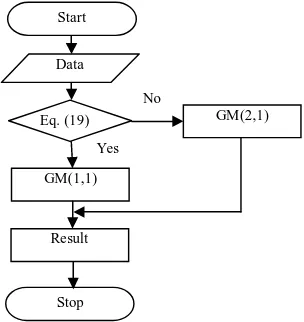
This study offers two prediction models: GM(1,1) and GM(2,1) to create the chance to choose so that the initial data are in accordance with the chosen model. Before using these models, the initial data have to be tested based on Eq. (19) whether the initial data consistent with the prediction model. If the initial data have n4,x(0)R, and
) ( ) 1 ( ) ( , ) ( ) 0 ( ) 0 ( ) 0 ( ) 0 ( 1 2 1 2 k x k x k e e
k n n
(19)
where k2,3,,n; (0)(k) is called class ratio, then initial data are considered consistent with the model. In this study, n5,(0)(k)[0.717,1.396], using the following flowchart to test the data.
Figure 1: Flowchart of verifying data for fitting the model
After collecting the predicted results, the mean absolute percentage error (MAPE) is considered, they can be calculated by using (20) as the error analysis methods [19].
% 100 ) ( ) ( ˆ ) ( 1 MAPE 2 ) 0 ( ) 0 ( ) 0 (
nk x k
k x k x n (20)
If the MAPE is less than 10%, the prediction result will be accepted.
2.4 Receiver Operating Characteristic analysis methods
ROC analysis is a useful tool for evaluating the performance of diagnostic tests and more generally for evaluating the accuracy of a statistical model such as logistic regression and discriminant analysis, it classifies the objects into one of two categories, diseased or non-diseased [20], corresponding to the tests in education context, those two states can be achieved qualification and non-achieved qualification. Therefore, for applying ROC method in education assessment, the concepts of sensitivity and specificity have to be defined.
2.4.1 Sensitivity and specificity with their calculation:
In the context of clinical tests, sensitivity refers to the ability of a test to correctly identify disease when disease is actually present (correctly identified positives). Specificity refers to the ability of a test to correctly identify non-disease when
Volume 3, Issue 5, May 2014
Page 147
disease is actually absent (correctly identified negatives). In context of academic achievement assessment and classification classification through the tests, sensitivity and specificity are defined as follows [13]:Definition 1: Sensitivity SN represents to the proportion of correct answers, predicted by standard setting of actual status, which are correctly answered by students. Specificity SP refers to the proportion of incorrect answers predicted according to standard setting of actual status which are incorrectly answered by students.
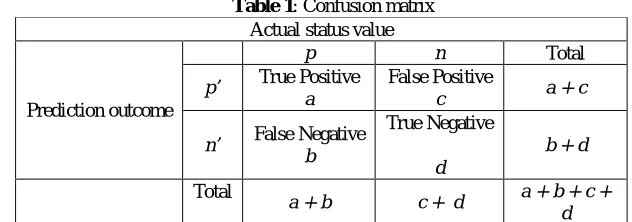
In establishing the relationship between the actual status values and predicted values, two-class prediction problems are considered in which the outcomes are labeled either as positive p or negative n. There are four possible outcomes from a binary classifier. If the outcome from a prediction is p and the actual status value is also p, then it is called a true positive a, however if the actual status value is n then it is said to be a false positive c. Conversely, a true negative d occurs when both the prediction outcome and the actual status value are n, and false negative b occurs when the prediction outcome is n while the actual status value is p. The four outcomes can be formulated in confusion matrix [20], as follows:
Table 1: Confusion matrix Actual status value
Prediction outcome
p n Total
p’ True Positive a
False Positive
c a + c
n’ False Negative b
True Negative
d
b + d
Total
a + b c + d a + b + c + d
Note: Adapted from “Receiver-operating characteristic analysis for evaluating diagnostic tests and predictive models” by Zou et al., 2007, Circulation, 115(5), p. 655.
Definition 2: In the case of test evaluating academic achievement of student, the actual status value of a student is his or her capacity status value predicted based on the previous evaluated data. Prediction outcomes are determined by results of predicted test.
The sensitivity
S
N or true positive rate is determined by the following formula using analysis result of Table 1 [21]:
b a
a SN
(21)
and the specificity
S
P or true negative rate is also calculated as follows:
d c
d SP
(22)
2.4.2 ROC curve
In the coordinate plane Oxy, the ROC curve is the graph comes from the origin O and shows true positive rate (SN) on the y-axis and false positive rate (1SP) on the x-axis for varying all cut-off points of test values which are indicated in table of hypothetical data for the sensitivity and specificity at various cut-off scores. This is generally depicted in a square box with its both axes are from 0 to 1 [22].
The area under the ROC curve (AUC) is the area bounded by the ROC curve with the horizontal x-axis and straight line
1
x
. The perfect test has an AUC of 1.0, the test has an AUC of 0.5 indicative of a test useless in diagnosis, and the test having an AUC more than 0.8 indicates that its accuracy is high, that is a good test [22-24].2.5 Standard Setting for Tests
In order to classify achievement of students into pass-fail states, a cut score is calculated by using a test-centered or examinee-centered method, the students with marks less than the cut score are labeled as failures and those with values greater than or equal to the cut score are labeled as passers [25].Using ROC method to create the standard setting for test is new perspective in measurement science. In ROC method, there are some ways to find out the optimal threshold point giving maximum correct classification. For example, three criteria are used to find optimal threshold point from ROC curve, they are known as points on curve closest to the point (0, 1) in a square box of space of ROC curve with its both axes are from 0 to 1[22],but this method is rarely used because it is difficult to implement. The method is popular used for measuring the performance of diagnostic tests is method of Youden index (J) [24].
3. METHODOLOGY
3.1 Establishing the values for actual status
Volume 3, Issue 5, May 2014
Page 148
semester. In this study, the data which were applied for GMs were the ability score of students in the previous semesters. When applying GM(1,1) to predict, if the prediction results have MAPE error relative high maybe even more than 10%, the GM(2,1) will be applied. The obtained results are the predicted results that will serve as a basis for classifying the ability scores of students into positive and negative states.3.2 Establishing ROC method for standard setting of test
Let mPN be the total number of students in the class, wherein P is the number of students in the state of positive standard setting and N is the number of students in the state of negative standard setting. The sensitivity and specificity at various cut-off scores are determined and shown in Table 2, the factors in table are explained as follows:
i
a
is the number of students in the state of positive standard setting correctly answer a number of questions at levelx
i,i
b
is the number of students in the state of positive standard setting that do not satisfy levelx
i,i
i P a
b (23)
i
d
is the number of students in the state of negative standard setting correctly answer a number of questions at levely
i,i
c
is the number of students in the state of negative standard setting that do not satisfy level yi ci Ndi (24)Table 2: Hypothetical data for the sensitivity and specificity at various cut-off scores
Predicted test (Number of correct answers:x,y)
Positive standard setting
P
Negative standard setting
N Sensitivity
N S
Specificity
P S
Youden Index J True
positive a
False negative
b
False positive c
True negative
d
m y m
x1 ; 1 a1 b1 c1 d1 SN1 SP1 J1
1 ; 1
2 2
m y
m x
2
a b2 c2 d2 SN2 SP2 J2
1 ; 1
i m i y
i m i x
m
i1,2,, ai bi ci di
i i
i Ni
b a
a S
i i
i Pi
d c
d S
J SNiSPi1
m
x amP bm0 cmN dm0 SNm SPm Jm
The Youden index is used to maximize difference between true positive and false positive rates. It is helpful for setting a performance standard on the test that can be obtained by doing a search of plausible values, where sum of sensitivity and specificity can be maximum. Therefore, this index indicates the optimal potential for the pass mark (pass-fail cut-off) and should have a maximum value [22, 26]:
1
max
max
S
Ni
S
Pi
J
i i1,2,,m (25) At the point of
J
max, the students are classified maximum correctly.4. RESULTS AND DISCUSSION
4.1 Data collection
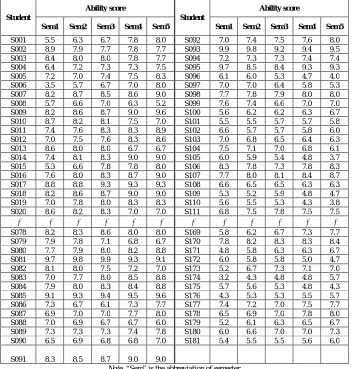
The study has performed an experiment to set the standard for a 40-multiple choice question English test. There were 181 students who participated this mid-term test are the twelfth grade students learning at a high school in the South of Vietnam, the test result had Cronbach’s Alpha reaching 0.843. The measurement data for applying GMs are the English ability score of students in the previous five semesters (as shown in Table 5 of appendix).
4.2 Results
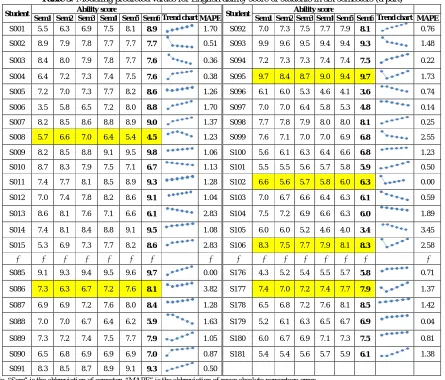
Through the measurement data, the study applied GMs to predict English ability score of students in the sixth semester. The result of modeling predicted values (in six semesters) is presented in Table 3. The data were highlighted in this table to show that they were calculated by GM(2,1), others were calculated by GM(1,1), they were all tested by equations (19) and (20) and accepted.
Volume 3, Issue 5, May 2014
Page 149
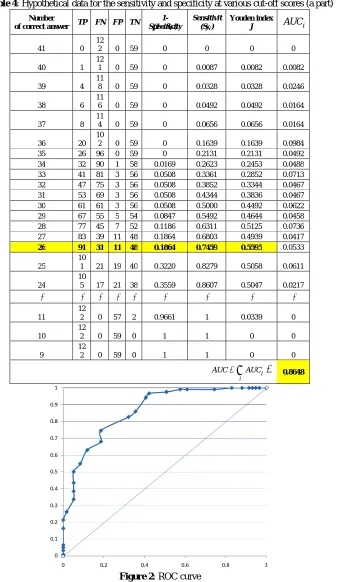
Table 4, the line of data is highlighted to indicate the optimal cut point by using Youden index method. The sensitivity SN is plotted against one subtracts specificity (1 - SP) in the coordinate plane Oxy (x-axis performs 1 - SP and y-axis performs SN), the ROC curves is presented by using the possible cut scores of the test (as decribed in Figure 1).Table 3: Modeling predicted values for English ability score of students in six semesters (a part)
Student Ability score Student Ability score
Sem1 Sem2 Sem3 Sem4 Sem5 Sem6 Trend chart MAPE Sem1 Sem2 Sem3 Sem4 Sem5 Sem6 Trend chart MAPE
S001 5.5 6.3 6.9 7.5 8.1 8.9 1.70 S092 7.0 7.3 7.5 7.7 7.9 8.1 0.76
S002 8.9 7.9 7.8 7.7 7.7 7.7 0.51 S093 9.9 9.6 9.5 9.4 9.4 9.3 1.48
S003 8.4 8.0 7.9 7.8 7.7 7.6 0.36 S094 7.2 7.3 7.3 7.4 7.4 7.5 0.22
S004 6.4 7.2 7.3 7.4 7.5 7.6 0.38 S095 9.7 8.4 8.7 9.0 9.4 9.7 1.73
S005 7.2 7.0 7.3 7.7 8.2 8.6 1.26 S096 6.1 6.0 5.3 4.6 4.1 3.6 0.74
S006 3.5 5.8 6.5 7.2 8.0 8.8 1.70 S097 7.0 7.0 6.4 5.8 5.3 4.8 0.14
S007 8.2 8.5 8.6 8.8 8.9 9.0 1.37 S098 7.7 7.8 7.9 8.0 8.0 8.1 0.25
S008 5.7 6.6 7.0 6.4 5.4 4.5 1.23 S099 7.6 7.1 7.0 7.0 6.9 6.8 2.55
S009 8.2 8.5 8.8 9.1 9.5 9.8 1.06 S100 5.6 6.1 6.3 6.4 6.6 6.8 1.23
S010 8.7 8.3 7.9 7.5 7.1 6.7 1.13 S101 5.5 5.5 5.6 5.7 5.8 5.9 0.50
S011 7.4 7.7 8.1 8.5 8.9 9.3 1.28 S102 6.6 5.6 5.7 5.8 6.0 6.3 0.00
S012 7.0 7.4 7.8 8.2 8.6 9.1 1.04 S103 7.0 6.7 6.6 6.4 6.3 6.1 0.59
S013 8.6 8.1 7.6 7.1 6.6 6.1 2.83 S104 7.5 7.2 6.9 6.6 6.3 6.0 1.89
S014 7.4 8.1 8.4 8.8 9.1 9.5 1.08 S105 6.0 6.0 5.2 4.6 4.0 3.4 3.45
S015 5.3 6.9 7.3 7.7 8.2 8.6 2.83 S106 8.3 7.5 7.7 7.9 8.1 8.3 2.58
S085 9.1 9.3 9.4 9.5 9.6 9.7 0.00 S176 4.3 5.2 5.4 5.5 5.7 5.8 0.71
S086 7.3 6.3 6.7 7.2 7.6 8.1 3.82 S177 7.4 7.0 7.2 7.4 7.7 7.9 1.37
S087 6.9 6.9 7.2 7.6 8.0 8.4 1.28 S178 6.5 6.8 7.2 7.6 8.1 8.5 1.42
S088 7.0 7.0 6.7 6.4 6.2 5.9 1.63 S179 5.2 6.1 6.3 6.5 6.7 6.9 0.04
S089 7.3 7.2 7.4 7.5 7.7 7.9 1.05 S180 6.0 6.7 6.9 7.1 7.3 7.5 0.81
S090 6.5 6.8 6.9 6.9 6.9 7.0 0.87 S181 5.4 5.4 5.6 5.7 5.9 6.1 1.38
S091 8.3 8.5 8.7 8.9 9.1 9.3 0.50
Note. “Sem” is the abbreviation of semester, “MAPE” is the abbreviation of mean absolute percentage error.
4.3 Discussion
With the hypothesis that in a specific condition, it is possible to design a standard setting method which is considered the best one and the most suitable. This study has proposed a combination of GM and ROC method to build standard setting method for mid-term test, belonging to the type of examinee-centered method, with advantage that students’ ability scores can be accurately predicted. It can be seen that the proposed method has made the task of setting the standard for test and determining the pass mark reasonably and reliably.
First, the ability scores of students in the sixth semester, in which the interested test happened, is predicted based on their ability scores of the previous five semesters, using grey models to predict has given quite accurate results, namely at MAPE (as shown in Table 3), these values are very small and less than 10%. Therefore, prediction results are considered as the accurate and reliable basis [27-29] for the application of ROC method. Next, ROC method is applied to provide information which can be used to calculate all possible cut scores according to relationships between the sensitivity and (1 - specificity) of the test. Finally, the optimal cut score that can differentiate between passing and failing students is found out satisfying the ultimate goal of the proposed method.
Volume 3, Issue 5, May 2014
Page 150
addition, the AUC of the test is calculated 0.86 greater than 0.5 as shown in Table 4 and Figure 2, this confirms that the proposed method is reliable in the mentioned condition.The finding above indicates that the proposed method can perform its task very well in the case of the difficulty of the test is easier than or more difficult than the ability of students. The outstanding advantage is easy to apply and not time consuming, but the results obtained are reliable and objective. The limitation of the proposed method is that the accurate prediction of ability scores of students in semester is a hard work that requires measurement data to be accurate data.
Table 4: Hypothetical data for the sensitivity and specificity at various cut-off scores (a part)
Number
of correct answer TP FN FP TN
1-Specificity (1 - SP )
Sensitivit y (SN )
Youden index
J AUCi
41 0
12
2 0 59 0 0 0 0
40 1
12
1 0 59 0 0.0087 0.0082 0.0082
39 4
11
8 0 59 0 0.0328 0.0328 0.0246
38 6
11
6 0 59 0 0.0492 0.0492 0.0164
37 8
11
4 0 59 0 0.0656 0.0656 0.0164
36 20
10
2 0 59 0 0.1639 0.1639 0.0984
35 26 96 0 59 0 0.2131 0.2131 0.0492
34 32 90 1 58 0.0169 0.2623 0.2453 0.0488 33 41 81 3 56 0.0508 0.3361 0.2852 0.0713 32 47 75 3 56 0.0508 0.3852 0.3344 0.0467 31 53 69 3 56 0.0508 0.4344 0.3836 0.0467 30 61 61 3 56 0.0508 0.5000 0.4492 0.0622 29 67 55 5 54 0.0847 0.5492 0.4644 0.0458 28 77 45 7 52 0.1186 0.6311 0.5125 0.0736 27 83 39 11 48 0.1864 0.6803 0.4939 0.0417
26 91 31 11 48 0.1864 0.7459 0.5595 0.0533
25
10
1 21 19 40 0.3220 0.8279 0.5058 0.0611
24
10
5 17 21 38 0.3559 0.8607 0.5047 0.0217
11
12
2 0 57 2 0.9661 1 0.0339 0
10
12
2 0 59 0 1 1 0 0
9
12
2 0 59 0 1 1 0 0
i i
AUC
AUC 0.8648
Volume 3, Issue 5, May 2014
Page 151
5. CONCLUSION
This study has proposed a standard setting method for a test based on the combination of grey prediction models and ROC method with advantage that the ability scores of students can be accurately predicted during testing, the method performed its task very well. The findings are as follows:
• Using measurement data which are about ability scores of students in the previous semesters to predict ability scores of students in semester occurs the test, the grey prediction models give accurate results being reliable basis for applying ROC method.
• ROC method is applied to determine the optimal cut-score which indicates the objective pass mark to differentiate passing and failing students based on their performance.
• The reliability of result obtained from the ROC diagnostic method is considered by the area under ROC curve.
REFERENCES
[1] I. I. Bejar, "Standard Setting: What Is It? Why Is It Important?," R & D Connections, vol. 7, pp. 1-6, 2008.
[2] S. M. Downing, A. Tekian, and R. Yudkowsky, "RESEARCH METHODOLOGY: Procedures for Establishing Defensible Absolute Passing Scores on Performance Examinations in Health Professions Education," Teaching and learning in medicine, vol. 18, pp. 50-57, 2006.
[3] L. Shepard, "Standard setting issues and methods," Applied Psychological Measurement, vol. 4, pp. 447-467, 1980.
[4] J. Lin, "The bookmark procedure for setting cut-scores and finalizing performance standards: Strengths and weaknesses," Alberta journal of educational research, vol. 52, pp. 36-52, 2006.
[5] J. Cohen-Schotanus and C. P. van der Vleuten, "A standard setting method with the best performing students as point of reference: Practical and affordable," Medical teacher, vol. 32, pp. 154-160, 2010.
[6] R. B. Zou, "Non-equidistant new information optimum GM (1, 1) model and its application," Journal of Mathematical and Computational Science, vol. 2, pp. 1909-1917, 2012.
[7] L. R. Deng, Z. Y. Hu, S. G. Yang, and Y. Y. Yan, "Improved Non-equidistant Grey Model GM(1,1) Applied to the Stock Market," Journal of Grey System, vol. 15, pp. 189-194, 2012.
[8] S. R. Hui, F. Yang, Z. Z. Li, Q. Liu, and J. G. Dong, "Application of Grey System Theory to Forecast The Growth of Larch," International Journal of Information and Systems Sciences, vol. 5, pp. 522-527, 2009.
[9] B. Chen, S. Q. Sun, and G. Liu, "An Optimized Unbiased GM (1, 1) Power Model for Forecasting MRO Spare Parts Inventory," Modern Applied Science, vol. 6, pp. 12-17, 2012.
[10]C. E. Metz, B. A. Herman, and C. A. Roe, "Statistical comparison of two ROC-curve estimates obtained from partially-paired datasets," Medical Decision Making, vol. 18, pp. 110-121, 1998.
[11]K. Hajian-Tilaki, "Receiver Operating Characteristic (ROC) Curve Analysis for Medical Diagnostic Test Evaluation," Caspian Journal of Internal Medicine, vol. 4, pp. 627-635, 2013.
[12]J. A. Colliver, A. J. Barnhart, M. L. Marcy, and S. J. Verhulst, "Using a receiver operating characteristic (ROC) analysis to set passing standards for a standardized-patient examination of clinical competence," Journal of the Association of American Medical Colleges, vol. 69, pp. 37-39, 1994.
[13]M. Tavakol and R. Dennick, "Standard Setting: the application of the Receiver Operating Characteristic method," International Journal of Medical Education, vol. 3, pp. 198-200, 2012.
[14]A. Barman, "Standard setting in student assessment: is a defensible method yet to come," Ann Acad Med Singapore, vol. 37, pp. 957-963, 2008.
[15]J. L. Deng, "Introduction to Grey System Theory," Journal of Grey System, vol. 1, pp. 1-24, 1989.
[16]K. L. Wen, C. Chao, H. Chang, S. Chen, and H. Wen, Grey system theory and applications. Taipei: Wu-Nan Book Inc, 2009.
[17]G. D. Li, D. Yamaguchi, and M. Nagai, "New methods and accuracy improvement of GM according to Laplace transform," Journal Grey System, vol. 8, pp. 13-25, 2005.
[18]G. D. Li, D. Yamaguchi, K. Mizutani, and M. Nagai, "New proposal and accuracy evaluation of grey prediction GM," IEICE Transactions On Fundamentals Of Electronics Communications And Computer Sciences E Series A, vol. 90, pp. 1188-1197, 2007.
[19]L. Qua, D. Heb, and R. Jiaa, "Optimized Grey Model Based on Cuckoo Search Algorithm and Its Prediction Application⋆," Journal of Information & Computational Science, vol. 11, pp. 1419-1426, 2014.
[20]K. H. Zou, A. J. O’Malley, and L. Mauri, "Receiver-operating characteristic analysis for evaluating diagnostic tests and predictive models," Circulation, vol. 115, pp. 654-657, 2007.
[21]T. Fawcett, "ROC graphs: Notes and practical considerations for researchers," Machine Learning, vol. 31, pp. 1-38, 2004.
[22]R. Kumar and A. Indrayan, "Receiver operating characteristic (ROC) curve for medical researchers," Indian pediatrics, vol. 48, pp. 277-287, 2011.
Volume 3, Issue 5, May 2014
Page 152
[24]N. J. Perkins and E. F. Schisterman, "The inconsistency of “optimal” cutpoints obtained using two criteria based on the receiver operating characteristic curve," American Journal of Epidemiology, vol. 163, pp. 670-675, 2006.
[25]S. A. Livingston and M. J. Zieky, "Passing Scores: A Manual for Setting Standards of Performance on Educational and Occupational Tests," 1982.
[26]W. Youden, "Index for rating diagnostic tests," Cancer, vol. 3, pp. 32-35, 1950.
[27]K. M. Ko, J. F. Chen, T. L. Nguyen, B. M. Hsu, and M. H. Shu, "Forecasting Inbound Tourism Demand in Thailand with Grey model," WSEAS Transactions On Mathematics, vol. 13, pp. 96-104, 2014.
[28]Y.-L. Huang and Y.-H. Lee, "Accurately Forecasting Model for the Stochastic Volatility Data in Tourism Demand," Modern economy, vol. 2, 2011.
[29]M. Memmedli and O. Ozdemir, "An application of fuzzy time series to improve ISE forecasting," WSEAS Transactions On Mathematics, vol. 9, pp. 12-21, 2010.
APPENDIX
Table 5: Measurement data for ability score of students in the previous five semesters (a part)
Student
Ability score
Student
Ability score
Sem1 Sem2 Sem3 Sem4 Sem5 Sem1 Sem2 Sem3 Sem4 Sem5
S001 5.5 6.3 6.7 7.8 8.0 S092 7.0 7.4 7.5 7.6 8.0 S002 8.9 7.9 7.7 7.8 7.7 S093 9.9 9.8 9.2 9.4 9.5 S003 8.4 8.0 8.0 7.8 7.7 S094 7.2 7.3 7.3 7.4 7.4 S004 6.4 7.2 7.3 7.3 7.5 S095 9.7 8.5 8.4 9.3 9.3 S005 7.2 7.0 7.4 7.5 8.3 S096 6.1 6.0 5.3 4.7 4.0 S006 3.5 5.7 6.7 7.0 8.0 S097 7.0 7.0 6.4 5.8 5.3 S007 8.2 8.7 8.5 8.6 9.0 S098 7.7 7.8 7.9 8.0 8.0 S008 5.7 6.6 7.0 6.3 5.2 S099 7.6 7.4 6.6 7.0 7.0 S009 8.2 8.6 8.7 9.0 9.6 S100 5.6 6.2 6.2 6.3 6.7 S010 8.7 8.2 8.1 7.5 7.0 S101 5.5 5.5 5.7 5.7 5.8 S011 7.4 7.6 8.3 8.3 8.9 S102 6.6 5.7 5.7 5.8 6.0 S012 7.0 7.5 7.6 8.3 8.6 S103 7.0 6.8 6.5 6.4 6.3 S013 8.6 8.0 8.0 6.7 6.7 S104 7.5 7.1 7.0 6.8 6.1 S014 7.4 8.1 8.3 9.0 9.0 S105 6.0 5.9 5.4 4.8 3.7 S015 5.3 6.6 7.8 7.8 8.0 S106 8.3 7.8 7.3 7.8 8.3 S016 7.6 8.0 8.3 8.7 9.0 S107 7.7 8.0 8.1 8.4 8.7 S017 8.8 8.8 9.3 9.3 9.3 S108 6.6 6.5 6.5 6.3 6.3 S018 8.2 8.6 8.7 9.0 9.0 S109 5.3 5.2 5.9 4.8 4.7 S019 7.0 7.8 8.0 8.3 8.3 S110 5.6 5.5 5.3 4.3 3.8 S020 8.6 8.2 8.3 7.0 7.0 S111 6.8 7.5 7.8 7.5 7.5
S078 8.2 8.3 8.6 8.0 8.0 S169 5.8 6.2 6.7 7.3 7.7 S079 7.9 7.8 7.1 6.8 6.7 S170 7.8 8.2 8.3 8.3 8.4 S080 7.7 7.9 8.0 8.2 8.8 S171 4.8 5.8 6.3 6.3 6.7 S081 9.7 9.8 9.9 9.3 9.1 S172 6.0 5.8 5.8 5.0 4.7 S082 8.1 8.0 7.5 7.2 7.0 S173 5.2 6.7 7.3 7.1 7.0 S083 7.0 7.7 8.0 8.5 8.8 S174 3.2 4.3 4.8 4.8 5.7 S084 7.9 8.0 8.3 8.4 8.8 S175 5.7 5.6 5.3 4.8 4.3 S085 9.1 9.3 9.4 9.5 9.6 S176 4.3 5.3 5.3 5.5 5.7 S086 7.3 6.7 6.1 7.3 7.7 S177 7.4 7.2 7.0 7.5 7.7 S087 6.9 7.0 7.0 7.7 8.0 S178 6.5 6.9 7.0 7.8 8.0 S088 7.0 6.9 6.7 6.7 6.0 S179 5.2 6.1 6.3 6.5 6.7 S089 7.3 7.3 7.3 7.4 7.8 S180 6.0 6.6 7.0 7.0 7.3 S090 6.5 6.9 6.8 6.8 7.0 S181 5.4 5.5 5.5 5.6 6.0
S091 8.3 8.5 8.7 9.0 9.0
Note. “Sem” is the abbreviation of semester.
AUTHORS
Volume 3, Issue 5, May 2014
Page 153
Phung-Tuyen Nguyen is currently a Ph.D. candidate in Graduate Institute of Educational Measurement and Statistics, National Taichung University, Taiwan. He received Master’s degree in Physics, in 2003 from Hanoi University of education, Vietnam. His research interests focus on item response theory, grey system theory, and educational measurement.
Phuoc-Hai Nguyen received Master’s degree in Biology from Hanoi University of education of Vietnam in 2006. He is currently a Ph.D. candidate in Graduate Institute of Educational Measurement and Statistics, National Taichung University, Taiwan. His research interests include biology, item response theory, grey system system theory, ordering theory and educational measurement.
Duc-Hieu Pham received Master’s degree of education at Hanoi Pedagogical University No2 of Vietnam in 2009. He works as a lecturer the Primary Education Faculty of Hanoi Pedagogical University No2, Vietnam. He He is currently a Ph.D. candidate in Graduate Institute of Educational Measurement and Statistics, National Taichung University, Taiwan. His research interests include grey system theory, educational measurement and primary education.
Ching-Pin Tsai received his Master’s degree in Department of Applied Mathematics, National Chiao Tung University of Taiwan in 1996. He is a Mathematics Teacher in Changhua County Hsiu Shui Junior High School, Taiwan now. He is currently a Ph.D. candidate in Graduate Institute of Educational Measurement and Statistics, National Taichung University, Taiwan. His research interests include numerical analysis, grey grey system theory, research of action teaching, mathematics education and chaotic behavior of electron tunneling.