scikit-multilearn: A scikit-based Python environment for
performing multi-label classification
Piotr Szyma´nski piotr.szymanski@{pwr.edu.pl,illimites.edu.pl}
Department of Computational Intelligence Wroc law University of Science and Technology Wroc law, Poland
illimites foundation Wroc law, Poland
Tomasz Kajdanowicz [email protected]
Department of Computational Intelligence Wroc law University of Science and Technology Wroc law, Poland
Editor:Alexandre Gramfort
Abstract
The scikit-multilearn is a Python library for performing multi-label classification. It is com-patible with the scikit-learn and scipy ecosystems and uses sparse matrices for all internal operations; provides native Python implementations of popular multi-label classification methods alongside a novel framework for label space partitioning and division and includes modern algorithm adaptation methods, network-based label space division approaches, which extracts label dependency information and multi-label embedding classifiers. The li-brary provides Python wrapped access to the extensive multi-label method stack from Java libraries and makes it possible to extend deep learning single-label methods for multi-label tasks. The library allows multi-label stratification and data set management. The imple-mentation is more efficient in problem transformation than other established libraries, has good test coverage and follows PEP8. Source code and documentation can be downloaded fromhttp://scikit.mland also viapip. The project is BSD-licensed.
Keywords: Python, multi-label classification, label-space clustering, multi-label embed-ding, multi-label stratification
1. Introduction
The Python language with its machine learning library stack has grown to become one of the leading technologies of building models for the industry and developing new methods for the researchers. While the Python community boasts with the excellent culture of development, well-defined API traditions and well-performing implementations of methods from most machine learning areas it did not have a high-quality solution for multi-label classification.
In this paper we introduce scikit-multilearn, a well-tested, multi-platform, Python 3 compatible, BSD-licensed library with bleeding edge approaches for multi-label problems, which is actively developed and has a growing user base. We also show that it is faster than
c
2019 Piotr Szyma´nski and Tomasz Kajdanowicz.
its competition in other languages. It is also entirely compatible with the scientific/machine learning ecosystem of well-known Python libraries which allows it to fill the niche of the missing multi-label classification solution, while also benefits from complementary solutions present in the scikit-learn community, while providing it with efficient implementations of missing classification methods, data stratification, dataset access and manipulation.
We start with a summary of what multi-label classification is in Section 2. Followed by Section 3 where we present related work and a description of the machine learning ecosystem that scikit-multilearn fits in. In Section 4 we describe what scikit-multilearn brings to the community. We evaluate how scikit-multilearn performs in comparison to libraries implemented in other languages in Section 5 and present conclusions and future ideas in Section 6.
2. Multi-label classification
Multi-label classification deals with the problem of assigning a subset of available labels to a given observation. Such problems appear in multiple domains - article and website classification, multimedia annotation, music categorization, the discovery of genomics func-tionalities and are performed either by transforming a problem into a single/multi-class classification problem or by adapting a single/multi-class method to take multi-label infor-mation into account. An excellent introduction to the field has been provided by Tsoumakas et al. (2009).
Madjarov et al. (2012) divide approaches multi-label classification into three groups: method adaptation, problem transformation and ensembles thereof. The first idea is to adapt single-label methods to multi-label classification by modifying label assigning frag-ments in a single-label method. An example of this is introducing a multi-label version of a decision function in Decision Trees (ex. Kocev et al., 2013).
Problem transformation concentrates on converting the multi-label problem to one or more single-label problems. The most prominent examples include classifying each label separately such as Binary Relevance or Classifier Chains (Read et al., 2009) and treat-ing each label combination as a separate class in one multi-class problem as in the Label Powerset case.
Both of these approaches suffer not only from standard problems of machine learning such as over- and under-fitting but also from the issue of label imbalance (Sun et al., 2009) or numerical anomalies related to label ordering when Bayesian approaches are used for taking correlations into account. Ensemble methods aim to correct this by learning multiple classifiers trained on label subspaces (ex. RAkEL by Tsoumakas et al., 2011a), observation subsets with pruning and replacement, or analyzing various label orderings in chains (ex. Probabilistic Classifier Chains by Dembczynski et al., 2010).
Com-ponent Analysis; Feature-aware Implicit Label Space Encoding (Lin et al., 2014) based on matrix decompositions; SLEEC (Bhatia et al., 2015) which uses k-means clustering and per cluster embedding; CLEMS (Huang and Lin, 2017) which performs Multi-Dimensional Scal-ing (see Kruskal, 1964) with extra multi-label quality measure optimization; and LNEMLC (Szyma´nski et al., 2018) which embeds label networks using network embeddings such as LINE or node2vec. Most of these use linear, ridge or random forest regressors to predict embeddings for unseen samples and a variant of kNN to classify them with labels. CLEMS and LNEMLC are among the best performing multi-label embeddings at this time.
Multi-label advances in recent years also include developments in a sub-area called ex-treme multi-label where new methods emerged such as deep-learning based domain-specific approaches for: image classification frameworks (Zhao et al., 2015; Wang et al., 2016; Wei et al., 2016) or text (Liu et al., 2017; Yen et al., 2017). The field also includes tree-based (Prabhu and Varma, 2014) or embedding-based (Bhatia et al., 2015) approaches. While extreme multi-label is an interesting task it differs strongly from classical multi-label clas-sification in performance expectations, benchmark datasets and quality measures and falls beyond the main focus of scikit-multilearn but its methods can be used to classify these scale of problems.
3. Related work
As with every applied science, research requires environments for performing experiments. The most prominent multi-label classification stack to date (regarding method count and popularity) is implemented in Java: MULAN (Tsoumakas et al., 2011b) and MEKA (Read et al., 2016). Both depend heavily on the famous WEKA library (Hall et al., 2009) which implements a plethora of classification and regression methods for single-label classification. MULAN and MEKA are large multi-purpose libraries which support not only multi-label classification tasks but also regression and multi-instance/multi-output tasks.
Python’s scientific ecosystem’s philosophy (Oliphant, 2007) is a different one, instead of having few large multi-purpose libraries, it provides a foundation of libraries that de-liver most important approaches and a network of smaller and more specialized libraries that interact thanks to a well-defined API, coding and documentation standards set out for common machine learning tasks such as prediction or data transformation. With numpy (Oliphant, 2006), scipy (Jones et al., 2001) as numerical operation and data structure foun-dations. The machine-learning foundation provided by scikit-learn (Pedregosa et al., 2011) follows a different approach than WEKA as it does not aim at being a large mono-library where all functionality is gathered. Instead, it concentrates on implementing most cited well-established methods alongside a stable API design.
often than perceptrons, and new tree-based classifiers like fastXML (Prabhu and Varma, 2014) outperform traditional random forests of multi-label trees. One-vs-all/rest multi-class classifiers can now be replaced with inherently multi-label variants of the methods, ex. SVM classification scheme has been enhanced by multi-label SVM approaches such as MLTSVM (Chen et al., 2016). Binary Relevance provides worse performance than data-driven label space division (Szyma´nski et al., 2016) or stacking (Monta˜nes et al., 2014). Classifier chains have been extended in multiple ways to overcome artifacts related to sample distribution changes between label orderings either by learning shorter chains via data-driven label space divisions or chain sampling methods (PCC by Dembczynski et al., 2010), (MCC by Read et al., 2013). However scikit-learn’s classifiers are extremely useful when used as a base for more comprehensive methods in scikit-mutlilearn such as label space partitioning ensembles or multi-label embedding.
The scikit-learn project also forms a hub of a large network of complementary libraries for more specific tasks, new techniques or emergent sub-fields. Such libraries include among many others scikit-multiflow and imbalanced-learn.
The scikit-multiflow library (Montiel et al., 2018) concerns multi-label streams, which differs from the traditional multi-label setting where a method is trained once to predict data - in multi-label streams the methods are retrained or adopted as new samples arrive. Even though scikit-multiflow provides reimplementations selected methods of scikit-learn, the authors note that scikit-learn’s implementations should be applied while using the library. Authors claim that the provided implementations are less optimal (kNN) or masks over the original scikit-learn code for internal purposes. more Modern version of classifier chains (PCC, MCC) and stream classifiers are the core contribution of the library. They are optimized towards partial updating as new evidence arrives. The library is well unit-tested and should be used for multi-label stream tasks which scikit-multilearn does not handle out of the box. However, scikit-multilearn provides more vibrant and various offering of state of the art methods optimized for the classic multi-label problem formulation.
The imbalanced-learn library (Lemaˆıtre et al., 2017) is dedicated to overcoming class imbalance problems in single-label tasks by a variety of under/over-sampling strategies. As many problem transformation approaches transform the problem to a multi-class problem imbalanced-learn can be used to improve learning capabilities of scikit-multilearn classifiers by fitting them to resampled data.
Domain and sub-field related deep neural networks with multi-label classification sup-port are also available such as magpie1, CNN-RNN for images or a variety of different models for biological data2 for text classification.
Multi-label classification problems can also be addressed in general purse deep learning libraries such as Tensorflow (Abadi et al., 2015) or Keras (Chollet et al., 2015). However, deep neural networks often do not demonstrate an appropriate level of robustness and require significant differences in architecture to accommodate a concrete problem. This introduces an additional level of complication while applying deep learning to multi-label problems. While these libraries are instrumental in their areas, scikit-multilearn is dedicated to providing domain-independent solutions as efficient per domain specialization is rarely possible in one unified code base. However, scikit-multilearn does provide support for using
1.https://github.com/inspirehep/magpie
Java Python R Matlab Octave
MULAN MEKA scikit-learn scikit-m
ultilearn
util.ml MLC
to
olb
o
x
Algorithm-adaptation methods
Multi-label SVM X X
Trees X X X X
Nearest Neighbors X X X X
Neural X X X X X
Problem transformation approaches
To single-class X X X X X X
To multi-class X X X X
To deep learning models X
Ensemble approaches
Stacking X X X X X X
Label space partitioning X X X X
Overlapping models X X X X
Embeddings X X
Related tasks
Multi-label stratification X X X
Quality measures X X X P X X
Multi-label dataset management X X P X X
Multi-label regression X X X
Multi-output learning X
Sparse label space representation P X
Multi-label ARFF support X X X X
Project quality
End-to-end use cases X X
Developer documentation X X X
API documentation X X X X X
Unit-tests X X X X X
Multi-platform X X X X X P
Continuous integration on all platforms X X
Keras-compatible models for multi-label classification independent of the backend used by Keras (i.e. Tensorflow, CNTK) or PyTorch (via the skorch3 library).
The scikit-multilearn project fits in the Python community similarly as to how MEKA or MULAN fit to the Java machine learning projects network, however, it is focused on multi-label classification problems to provide state of the art approaches and efficient im-plementation of more advanced methods.
Recently multi-label classification libraries were made available in R (R Core Team, 2013) and Matlab/Octave (Eaton et al., 2017): utiml (Rivolli and de Carvalho, 2018) R library built on top of the dataset management library mldr (Charte and Charte, 2015) and offers a larger variety of available methods than other R libraries and a more welcoming API; MLC Toolbox (Kimura et al., 2017) provides multi-label methods for Matlab/Octave communities.
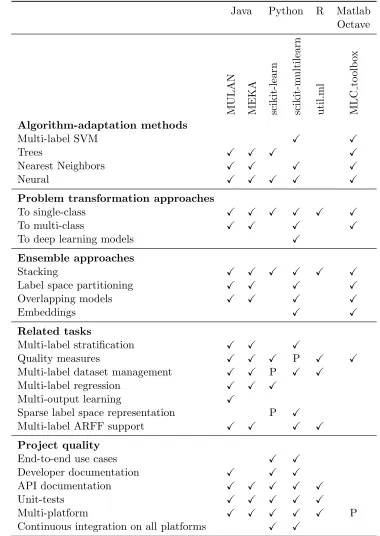
Table 1 provides a general point of view on the functionality offered by multi-label classification methods in Java, Python, R and Matlab/Octave.
4. The scikit-multilearn library
The proposed library follows the idea of building a multi-label classification library on top of an existing classification solution. In the case of Python, the obvious choice for a base library is the scipy stack with scikit-learn. The concept of scikit-learn compatible projects (scikits in short, not to mistake with the old scipy notion of scikits), has been present for several years in many formats, most prominently exemplified in scikit-contrib. We follow the ideas of these communities, the scikit-learn API principles and licensing.
The primary goal of scikit-multilearn is to provide an efficient Python implementation of as many multi-label classification algorithms as possible both to the open source community and commercial users of the Python data science stack. With such focus in mind, we concentrate on delivering a library dedicated to provide domain-independent solutions for solving multi-label classification problems, allowing other toolkits to excel in their areas such as: scikit-multiflow when it comes to multi-label streams or imbalanced-learn when it comes to handling imbalance multi-class data or many deep learning approaches described in the previous section.
Extensions of scikit-learn. The scikit-multilearn library extends the multi-label classi-fication offering of scikit-learn by:
• extending the family of classifiers available to the Python community with more ad-vanced algorithm adaptation and problem transformation (label space division) ap-proaches
• implementing multi-label embedding-based classification methods
• providing additional features too specific for scikit-learn such as the general framework for classification based on label space division or the wrapper for MEKA,
• implementing non-classification tools for label classification, including multi-label dataset manipulation from ARFF, loading and saving sparse representations of
these datasets and the only Python implementations of multi-label data stratification methods (see work by (Sechidis et al., 2011), (Szyma´nski and Kajdanowicz, 2017))
Advanced Multi-label Adapted Algorithms. Within scikit-multilearn we provide im-plementations of recent multi-label algorithm adaptation methods, that do not meet the selectiveness criteria of scikit-learn due to their novelty. These include:
• ML-ARAM: the hierarchical multi-label adaptive resonance associative map (Benites and Sapozhnikova, 2015)
• BR-kNN and ML-kNN: Binary Relevance kNN (Spyromitros et al., 2008) and multi-label kNN (Zhang and Zhou, 2007) - their scikit-multilearn implementations are built on top of scikit-learn’s NearestNeighbors multiclass classifier,
• MLTSVM: the multi-label twin support vector machine (Chen et al., 2016) which does not require a training quadratic number of SVM classifiers.
Problem Transformation with Label Space Division. One of the significant contri-butions of the library is a framework for performing ensemble classification with different label space division strategies. The library provides ways to divide the label space based on:
• clustering of the label matrix representations, using any of the scikit-learn compat-ible clusterers (i.e. classes that inherit scikit-learn’s ClusterMixin base class). The clusterer is executed on a transposed label assignment matrix and detected clustering is used as the label space division for the ensemble method. An example of this ap-proach is the k-means clustering of labels which has been applied by many apap-proaches (Tsoumakas et al., 2008; Yu et al., 2017)).
• communities detected in a network which embeds information about relations be-tween labels. In scikit-multilearn there is a general API for defining graph generators based on the label matrix, such graphs can exploit relations based on co-occurrence, correlation or any other pairwise measure defined over labels. The library supports community detection methods based on three popular graph/network packages in Python: (NetworkX, BSD by Hagberg et al., 2008)), (igraph, GPL by Csardi and Nepusz, 2006), (graphtool, GPL by Peixoto, 2014). An example of this approach is the label space division based on label co-occurrence graphs (Szyma´nski et al., 2016).
• random division, present in the random k-label sets (RAkEL) approaches
• predefined fixed division obtained from expert knowledge
Multi-Label Embeddings. Another significant contribution of the library is a frame-work for multi-label classification using multi-label embeddings and scikit-multilearn is the first Python library to provide a general multi-label embedding scheme with an embed-ding regressor and embedembed-ding-based classifier. Currently two state of the art embedembed-ding approaches are provided Cost-Sensitive Label Embedding with Multidimensional Scaling (CLEMS)(Huang and Lin, 2017), Label Network Embeddings for Multi-Label Classifica-tion (LNEMLC)(Szyma´nski et al., 2018) alongside a general embedder that can use any scikit-learn manifold learning or dimension reduction to embed the output space.
Compatibility. The scikit-multilearn project aims to be compatible with the Python data science stack. It follows the scikit-learn API and requirements specified in check estimator code. Multi-label classifiers in scikit-multilearn inherit scikit-learn’s BaseEstimator and
ClassifierMixin classes. They can be thus easily incorporated into scikit-learn pipelines and cross-validations, evaluation measures, and feature space transformators. It is easy to use scikit-learn’s extensive feature-space manipulation methods, single-label classifiers and classification evaluation functions with scikit-multilearn.
BSD licensing. As innovations in machine learning happen in both academia and com-panies, it is important to create a library that allows both communities to grow and profit from common work. Thus, scikit-multilearn is released under the BSD license to permit the for-profit ecosystem to use the library while opening the possibility of sharing development and maintenance tasks. While most of scikit-multilearn’s functionality is available via BSD licensed libraries, the package also allows using GPL-licensed libraries to be used for label space division such as igraph or graphtool. Importing fromskmultilearn.cluster.igraph
or skmultilearn.cluster.graphtool will require your code to submit to GPL licensing requirements.
Access to the Java stack. The library provides scikit-compatible wrapper to reference libraries such as MEKA, MULAN and WEKA through MEKA when a need arises to use methods that have not yet been implemented in Python natively. Using these libraries via scikit-multilearn wrapper does not induce a licensing (GPL-BSD) conflict. Support for MULAN is limited to methods available via MEKA’smeka.classifiers.multilabel. MULANclassifier4.
Using Deep Learning models. Scikit-multilearn provides a wrapper that allows using any Keras (Chollet et al., 2015) compatible backend such as Tensorflow (Abadi et al., 2015) CNTK (Seide and Agarwal, 2016) or PyTorch (Paszke et al., 2017), to provide a single-class or multi-single-class model that can be used to solve multi-label problems through problem transformation approaches.
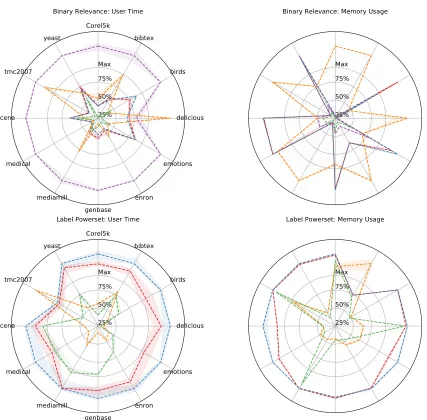
Sparsity. Multi-label classification problems often do not provide cases for all possible label combinations - in most benchmark sets there are less than 5% labels per row on average. The output space is thus very sparse. As opposed to MULAN and MEKA, scikit-multilearn operates on sparse matrices internally yielding a large memory boost as displayed in Figure 1.
setMethod-java.lang.String-Using scikit-multilearn. The steps for using scikit-multilearn are very simple: loading the data, selecting the method and performing classification. The library supports loading matrices from all well-established formats thanks to scipy and operates on scipy/numpy representations internally, converting to dense matrices or lists of lists only if required by a scikit-base classifier, if one is employed in the problem transformation scenario.
Other output types and subproblems. Scikit-multilearn does not support multi-label regression or multi-output prediction at the moment. Multi-label regression is considered for future releases, while multi-output approaches will not be supported due to scikit-multilearn’s concentration on efficient sparse matrix usage throughout the codebase. Ex-treme Multi-label Classification is not the main focus of scikit-multilearn but both the label network embedding methods and label space partitioning methods are capable of handling extreme multi-label datasets. Keras-based deep learning models can also be deployed with the label partitioning strategy to solve extreme multi-label problems.
Structure of scikit-multilearn. Scikit-multilearn provides three subpackages following the established categorization of multi-label methods: method adaptation approach (in
skmultilearn.adapt), problem transformation approach (in skmultilearn.pt) and en-sembles of the two (in skmultilearn.ensemble). The label space division methods and label relationship graph builders are present inskmultilearn.cluster. To use multi-label-adapted version of a single-label method one only needs to import it and instantiate an ob-ject of the class. A problem transformation approach takes a scikit-learn compatible base classifier and optional information whether the base classifier supports sparse input. Ensem-ble methods require a classifier and relevant method’s parameters. The classifier is trained using the fit method, which takes the training input and output matrices, and classification is performed using the predict method on test observations - just as in scikit-learn. The MEKA wrapper provides a scikit-learn compatible classifier class in skmultilearn.meka. Dataset download, loading and manipulation tools are available inskmultilearn.dataset. Multi-label data stratification methods and dataset fold division quality measures are avail-able inskmultilearn.model selection. Multi-label embedding approaches are located in
skmultilearn.embeddings.
4.1. Documentation and Availability
Scikit-multilearn is hosted on GitHub and managed via the fork and pull-request paradigm. Both user and developer documentation is available at http://scikit.ml/. After 4 years of development, in July 2018, the library has reached a stable 0.1.0 release. The newest version - 0.2.0 - was released in December 2018. The code is released under BSD licence using GitHub and releases are available via PyPI. Implementation follows PEP8 and is maintained with a high level of test coverage (82% for the 0.2.0 release). The develop-ment undergoes continuous integration on Windows, Ubuntu Linux and Mac OS X, with Python 2.7 and Python 3.3. At the moment of the 0.2.0 release scikit-multilearn has been starred 242 times and forked 72 times. Development is managed on the GitHub repository
scikit-multilearn5 and is accompanied with communication and discussion in the Slack
channel6. All commits undergo continuous testing on Windows, Ubuntu and Mac OS X, both under Python 2.7 and 3.3. The library also has its tag7 on StackOverflow.
5. Benchmark
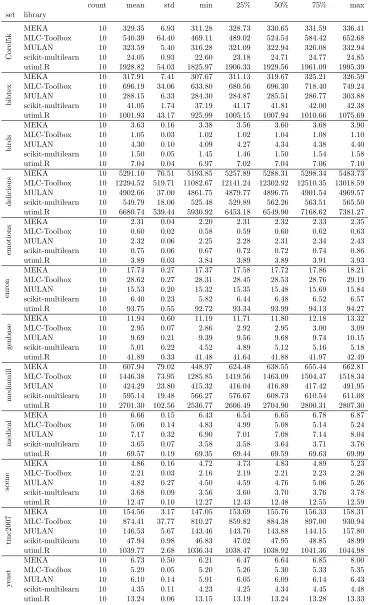
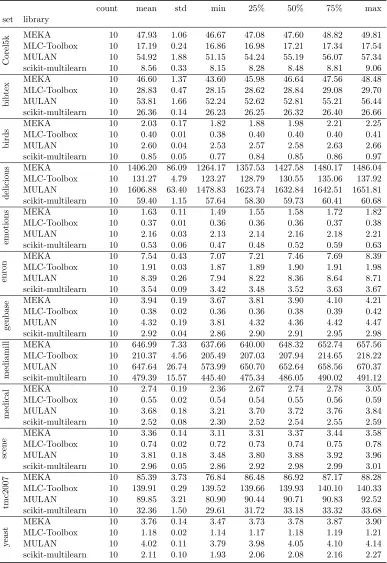
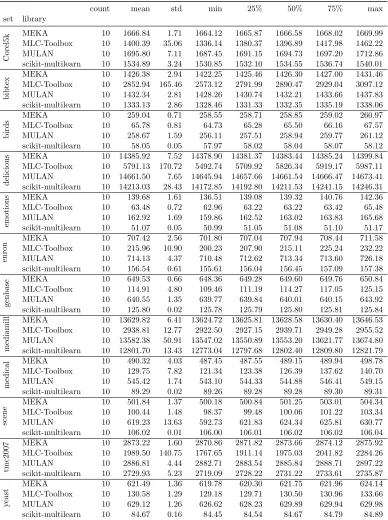
We found that scikit-multilearn is faster than its competition. We have tested MEKA, MULAN and scikit-multilearn on 12 well-cited benchmark multi-label classification datasets using two comparison scenarios: Binary Relevance and Label Powerset. The two selected problem transformation approaches are widely used both in regular classification tasks and as the base for more sophisticated methods. We did not test algorithm adaptation methods as there are no algorithm adaptation methods present in all three libraries. We use these methods to illustrate two aspects of the classification performance of the libraries: the cost of using many classifiers with splitting operations performed on the label space matrix and the cost of using a single classifier which requires to access all label combinations to perform the transformation. To minimize the impact of base classifiers, we have decided to use a fast Random Forest base classifier with 10 trees. As Octave does not provide Matlab’s random forest implementation, we used the one provided by the shogun toolbox (Sonnenburg et al., 2017). We have checked the classification quality and did not find significant differences between Hamming Loss, Jaccard and Accuracy scores between the outputs. The benchmark is performed with scikit-multilearn 0.1.0, MEKA 1.9.2, MULAN 1.5.0, scikit-learn 0.19.2, Octave 4.2.2, shogun 6.1.3, MLC Toolbox for Matlab/Octave code from GitHub master commit hash e798779, R 3.4.1, utiml 0.1.2. As utiml does not provide a Label Powerset implementation, we do not evaluate it in this subexperiment.
Figure 1 presents the time and memory required to perform classification, including loading the ARFF dataset (or Matlab export in case of the toolbox) and measuring errors, i.e. a complete classification use case scenario. As different datasets require a different amount of time and memory we decided to normalize the charts. The results on the chart are normalized for each dataset separately. To normalize we calculated the median of every library’s time or memory performance and selected the highest of the medians in the dataset as the normalization point, i.e. 100% is the worst median performance. We present the best, median, and worst performance of each library per dataset, normalized performance with the worst median performance on that dataset. The closer the library is to point 0, the better it performed, thus the smaller area inside the library curve, the better.
All the libraries were forced to use a single core using thetasksetcommand to minimize parallelization effects on the comparison. Time and memory results were obtained using the
time -v command and represent User time, and Maximum resident set size respectively. All results taken into consideration reported that 100% of their CPU core had been assigned to the process which performed the classification scenario.
We notice that in both classification schemes scikit-multilearn always uses less or, in a few edge cases the same amount of, memory than MEKA or MULAN due to its sparse matrix support. In most cases scikit-multilearn also operates faster than MEKA, MULAN. When it comes to label space division approaches modeled in the experiment by Binary Relevance, scikit-multilearn is the most efficient choice on every data set. With Label
Pow-6.https://scikit-ml.slack.com
Corel5k
bibtex
birds
delicious
emotions
enron genbase
mediamill medical
scene tmc2007
yeast
25% 50% 75% Max Binary Relevance: User Time
25% 50% 75% Max
Binary Relevance: Memory Usage MEKA MULAN MLC Toolbox scikit-multilearn utiml.R
Corel5k
bibtex
birds
delicious
emotions
enron genbase
mediamill medical
scene tmc2007
yeast
25% 50% 75% Max Label Powerset: User Time
25% 50% 75% Max
Label Powerset: Memory Usage
Figure 1: User running time (s) and memory usage ranks of utiml, MLC Toolbox, scikit-multilearn, MEKA and MULAN, with RandomForest, and two different multi-label classifiers.
erset multi-class transformation it is in most cases more efficient than MEKA and MULAN and outperforms the MLC Toolbox on datasets with larger numbers of label combinations while on smaller data sets the MLC Toolbox tends to be more efficient.
scikit-learn does not convert the output matrix to a Compressed Sparse Column matrix8 while scikit-multilearn does. The observed results were that scikit-learn’s implementation was always slightly faster than scikit-multilearn’s, while it always used a slightly larger amount of memory, both changes can be attributed to a difference between formats used for the output space. We, therefore, do not report this comparison in extensive detail.
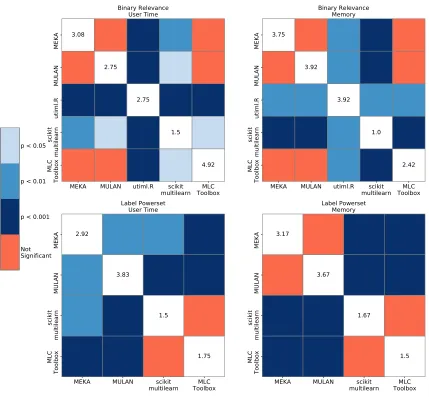
As there is no statistical procedure that allows performing a non-parametric repeated measure tests on multiple measurements per test, we decided to compare the worst case time/memory usage of scikit-multilearn against the best case MEKA/MULAN/utiml/MLC
8.https://docs.scipy.org/doc/scipy/reference/generated/scipy.sparse.csc_matrix.html
MEKA MULAN utiml.R scikit
multilearn ToolboxMLC
MEKA MULAN utiml.R scikit multilearn MLC Toolbox 3.08 2.75 2.75 1.5 4.92 Binary RelevanceUser Time
MEKA MULAN utiml.R scikit
multilearn ToolboxMLC
MEKA MULAN utiml.R scikit multilearn MLC Toolbox 3.75 3.92 3.92 1.0 2.42 Binary RelevanceMemory
MEKA MULAN scikit
multilearn ToolboxMLC
MEKA MULAN scikit multilearn MLC Toolbox 2.92 3.83 1.5 1.75 Label PowersetUser Time
MEKA MULAN scikit
multilearn ToolboxMLC
MEKA MULAN scikit multilearn MLC Toolbox 3.17 3.67 1.67 1.5 Label PowersetMemory
Not Significant p < 0.001 p < 0.01 p < 0.05
Toolbox performance. We used the Quade test with Bergmann-Hommel post hoc multiple hypothesis testing scenario (as laid out by Garc´ıa et al., 2010), the significances of rank difference and mean ranks of each libraries performance are provided in Figure 2.
We see that even in this negative averaging scenario scikit-multilearn is statistically significantly more efficient the other libraries when label space division approach (Binary Relevance) is deployed.
When Label Powerset multi-class transformation is used both scikit-multilearn and MLC Toolbox perform better than MULAN/MEKA with statistical significance. In terms of speed scikit-multilearn ranks slightly higher than the MLC Toolbox but consumes a little more memory. The differences between scikit-multilearn and the MLC Toolbox in this approach are not statistically significant.
6. Conclusions
The presented library - scikit-multilearn - is the most extensive scikit-learn compatible multi-label classification library. It provides implementations of both the most popular algorithms and new families of methods such as network-based label space division ap-proaches. It is fast thanks to performing transformations on sparse matrices internally and using well-optimized methods from scikit-learn as base classifiers, and also integrates well with the Python data science stack of scipy. It also provides wrappers to Keras models which allows quick adaptation of deep learning approaches to multi-label classification via problem-transformation approaches, and MEKA/WEKA with parts of MULAN - the stan-dard Java classification stack - and allows easy use of those methods with the rest of the Python stack.
Acknowledgments
We would like to thank Wojciech Stachowski for initial versions of BR/ML-kNN & Clas-sifier Chains implementations, Christian Schulze for asking multiple questions, report-ing and fixreport-ing bugs, Felipe Almeida for bug fixes and testreport-ing, Fernando Benites for pro-viding the implementation of ML-ARAM (Brucker et al., 2011), and Jose Perez-Parras Toledano for his implementation of balanced k-means clustering and other contributions. The work was partially supported by The National Science Centre the research projects no. 2016/21/N/ST6/02382 and 2016/21/D/ST6/02948, by the European Union’s Horizon 2020 research and innovation programme under the Marie Sk lodowska-Curie grant agreement No 691152 (RENOIR); the Polish Ministry of Science and Higher Education fund for support-ing internationally co-financed projects in 2016-2019 (agreement no. 3628/H2020/2016/2) and by the Faculty of Computer Science and Management, Wroc law University of Science and Technology statutory funds.
References
Jozefow-icz, Lukasz Kaiser, Manjunath Kudlur, Josh Levenberg, Dan Man´e, Rajat Monga, Sherry Moore, Derek Murray, Chris Olah, Mike Schuster, Jonathon Shlens, Benoit Steiner, Ilya Sutskever, Kunal Talwar, Paul Tucker, Vincent Vanhoucke, Vijay Vasudevan, Fernanda Vi´egas, Oriol Vinyals, Pete Warden, Martin Wattenberg, Martin Wicke, Yuan Yu, and Xiaoqiang Zheng. TensorFlow: Large-scale machine learning on heterogeneous systems, 2015. URL http://tensorflow.org/. Software available from tensorflow.org.
F. Benites and E. Sapozhnikova. Haram: A hierarchical aram neural network for large-scale text classification. In 2015 IEEE International Conference on Data Mining Workshop (ICDMW), pages 847–854, Nov 2015. doi: 10.1109/ICDMW.2015.14.
Kush Bhatia, Himanshu Jain, Purushottam Kar, Manik Varma, and Prateek Jain. Sparse local embeddings for extreme multi-label classification. InAdvances in Neural Information Processing Systems, pages 730–738, 2015.
Florian Brucker, Fernando Benites, and Elena Sapozhnikova. Multi-label classification and extracting predicted class hierarchies. Pattern Recognition, 44(3):724 – 738, 2011.
Francisco Charte and David Charte. Working with multilabel datasets in R: The mldr pack-age. The R Journal, 7(2):149–162, December 2015. URLhttps://journal.r-project. org/archive/2015-2/charte-charte.pdf.
Wei-Jie Chen, Yuan-Hai Shao, Chun-Na Li, and Nai-Yang Deng. Mltsvm: a novel twin support vector machine to multi-label learning. Pattern Recognition, 52:61–74, 2016.
Yao-Nan Chen and Hsuan-Tien Lin. Feature-aware label space dimension reduction for multi-label classification. In Advances in Neural Information Processing Systems, pages 1529–1537, 2012.
Fran¸cois Chollet et al. Keras. https://keras.io, 2015.
Gabor Csardi and Tamas Nepusz. The igraph software package for complex network re-search. InterJournal, Complex Systems:1695, 2006. URLhttp://igraph.org.
Krzysztof Dembczynski, Weiwei Cheng, and Eyke H¨ullermeier. Bayes optimal multilabel classification via probabilistic classifier chains. InICML, volume 10, pages 279–286, 2010.
John W. Eaton, David Bateman, Søren Hauberg, and Rik Wehbring. GNU Octave version 4.2.1 manual: a high-level interactive language for numerical computations, 2017.
Salvador Garc´ıa, Alberto Fern´andez, Juli´an Luengo, and Francisco Herrera. Advanced non-parametric tests for multiple comparisons in the design of experiments in computational intelligence and data mining: Experimental analysis of power. Information Sciences, 180 (10):2044–2064, 2010.
Mark Hall, Eibe Frank, Geoffrey Holmes, Bernhard Pfahringer, Peter Reutemann, and Ian H. Witten. The WEKA data mining software: An update. SIGKDD Explor. Newsl., 11(1):10–18, November 2009. ISSN 1931-0145.
Marti A. Hearst, Susan T Dumais, Edgar Osuna, John Platt, and Bernhard Scholkopf. Support vector machines. IEEE Intelligent Systems and their applications, 13(4):18–28, 1998.
Kuan-Hao Huang and Hsuan-Tien Lin. Cost-sensitive label embedding for multi-label clas-sification. Machine Learning, 106(9-10):1725–1746, 2017.
Eric Jones, Travis Oliphant, Pearu Peterson, et al. SciPy: Open source scientific tools for Python, 2001. URLhttp://www.scipy.org/. Online; Accessed 2018-11-30.
Keigo Kimura, Lu Sun, and Mineichi Kudo. Mlc toolbox: A matlab/octave library for multi-label classification. arXiv preprint arXiv:1704.02592, 2017.
Dragi Kocev, Celine Vens, Jan Struyf, and Saˇso Dˇzeroski. Tree ensembles for predicting structured outputs. Pattern Recognition, 46(3):817–833, 2013.
Joseph B Kruskal. Multidimensional scaling by optimizing goodness of fit to a nonmetric hypothesis. Psychometrika, 29(1):1–27, 1964.
Guillaume Lemaˆıtre, Fernando Nogueira, and Christos K. Aridas. Imbalanced-learn: A python toolbox to tackle the curse of imbalanced datasets in machine learning. Journal of Machine Learning Research, 18(17):1–5, 2017. URL http://jmlr.org/papers/v18/ 16-365.html.
Zijia Lin, Guiguang Ding, Mingqing Hu, and Jianmin Wang. Multi-label classification via feature-aware implicit label space encoding. In International conference on machine learning, pages 325–333, 2014.
Jingzhou Liu, Wei-Cheng Chang, Yuexin Wu, and Yiming Yang. Deep learning for extreme multi-label text classification. InProceedings of the 40th International ACM SIGIR Con-ference on Research and Development in Information Retrieval, pages 115–124. ACM, 2017.
Gjorgji Madjarov, Dragi Kocev, Dejan Gjorgjevikj, and Saˇso Dˇzeroski. An extensive ex-perimental comparison of methods for multi-label learning. Pattern Recognition, 45(9): 3084–3104, September 2012.
Elena Monta˜nes, Robin Senge, Jose Barranquero, Jos´e Ram´on Quevedo, Juan Jos´e del Coz, and Eyke H¨ullermeier. Dependent binary relevance models for multi-label classification. Pattern Recognition, 47(3):1494–1508, 2014.
Jacob Montiel, Jesse Read, Albert Bifet, and Talel Abdessalem. Scikit-Multiflow: A Multi-output Streaming Framework. CoRR, abs/1807.04662, 2018.
Travis E Oliphant. Python for scientific computing. Computing in Science & Engineering, 9(3), 2007.
Adam Paszke, Sam Gross, Soumith Chintala, Gregory Chanan, Edward Yang, Zachary DeVito, Zeming Lin, Alban Desmaison, Luca Antiga, and Adam Lerer. Automatic dif-ferentiation in pytorch. In NIPS-W, 2017.
Fabian Pedregosa, Ga¨el Varoquaux, Alexandre Gramfort, Vincent Michel, Bertrand Thirion, Olivier Grisel, Mathieu Blondel, Peter Prettenhofer, Ron Weiss, Vincent Dubourg, et al. Scikit-learn: Machine learning in python. Journal of machine learn-ing research, 12(Oct):2825–2830, 2011.
Tiago P. Peixoto. The graph-tool python library. figshare, 2014. doi: 10.6084/m9.figshare. 1164194. URLhttp://figshare.com/articles/graph_tool/1164194.
Yashoteja Prabhu and Manik Varma. Fastxml: A fast, accurate and stable tree-classifier for extreme multi-label learning. InProceedings of the 20th ACM SIGKDD international conference on Knowledge discovery and data mining, pages 263–272. ACM, 2014.
R Core Team. R: A Language and Environment for Statistical Computing. R Foundation for Statistical Computing, Vienna, Austria, 2013.
Jesse Read, Bernhard Pfahringer, Geoff Holmes, and Eibe Frank. Classifier chains for multi-label classification. In Joint European Conference on Machine Learning and Knowledge Discovery in Databases, pages 254–269. Springer, 2009.
Jesse Read, Luca Martino, and David Luengo. Efficient monte carlo optimization for multi-label classifier chains. In Acoustics, Speech and Signal Processing (ICASSP), 2013 IEEE International Conference on, pages 3457–3461. IEEE, 2013.
Jesse Read, Peter Reutemann, Bernhard Pfahringer, and Geoff Holmes. MEKA: A multi-label/multi-target extension to Weka. Journal of Machine Learning Research, 17(21):1–5, 2016.
Adriano Rivolli and Andre C. P. L. F. de Carvalho. The utiml Package: Multi-label Classi-fication in R. The R Journal, 2018. URL https://journal.r-project.org/archive/ 2018/RJ-2018-041/index.html.
Konstantinos Sechidis, Grigorios Tsoumakas, and Ioannis Vlahavas. On the stratification of multi-label data. In Joint European Conference on Machine Learning and Knowledge Discovery in Databases, pages 145–158. Springer, 2011.
Soeren Sonnenburg, Heiko Strathmann, Sergey Lisitsyn, Viktor Gal, Fernando J. Iglesias Garc´ıa, Wu Lin, Soumyajit De, Chiyuan Zhang, frx, tklein23, Evgeniy Andreev, Jonas-Behr, sploving, Parijat Mazumdar, Christian Widmer, Pan Deng / Zora, Giovanni De Toni, Saurabh Mahindre, Abhijeet Kislay, Kevin Hughes, Roman Votyakov, khalednasr, Sanuj Sharma, Alesis Novik, Abinash Panda, Evangelos Anagnostopoulos, Liang Pang, Alex Binder, serialhex, and Bj¨orn Esser. shogun-toolbox/shogun: Shogun 6.1.0, Novem-ber 2017.
Eleftherios Spyromitros, Grigorios Tsoumakas, and Ioannis Vlahavas. An empirical study of lazy multilabel classification algorithms. In Hellenic conference on artificial intelligence, pages 401–406. Springer, 2008.
Yanmin Sun, Andrew KC Wong, and Mohamed S Kamel. Classification of imbalanced data: A review. International Journal of Pattern Recognition and Artificial Intelligence, 23(04): 687–719, 2009.
Piotr Szyma´nski and Tomasz Kajdanowicz. A Network Perspective on Stratification of Multi-Label Data. In First International Workshop on Learning with Imbalanced Do-mains: Theory and Applications, LIDTA 2017, 22 September 2017, ECML-PKDD, Skopje, Macedonia, Proceedings of Machine Learning Research, volume 74, pages 22–35, 2017.
Piotr Szyma´nski, Tomasz Kajdanowicz, and Kristian Kersting. How is a data-driven ap-proach better than random choice in label space division for multi-label classification? Entropy, 18(8):282, 2016.
Piotr Szyma´nski, Tomasz Kajdanowicz, and Nitesh Chawla. Lnemlc: Label network em-beddings for multi-label classifiation, 2018.
Farbound Tai and Hsuan-Tien Lin. Multilabel classification with principal label space transformation. Neural Computation, 24(9):2508–2542, 2012.
Grigorios Tsoumakas, Ioannis Katakis, and Ioannis Vlahavas. Effective and efficient multi-label classification in domains with large number of multi-labels. InProc. ECML/PKDD 2008 Workshop on Mining Multidimensional Data (MMD’08), volume 21, pages 53–59. sn, 2008.
Grigorios Tsoumakas, Ioannis Katakis, and Ioannis Vlahavas. Mining multi-label data. In Data mining and knowledge discovery handbook, pages 667–685. Springer, 2009.
Grigorios Tsoumakas, Ioannis Katakis, and Ioannis Vlahavas. Random k-labelsets for mul-tilabel classification. IEEE Transactions on Knowledge and Data Engineering, 23(7): 1079–1089, 2011a.
Jiang Wang, Yi Yang, Junhua Mao, Zhiheng Huang, Chang Huang, and Wei Xu. Cnn-rnn: A unified framework for multi-label image classification. InProceedings of the IEEE conference on computer vision and pattern recognition, pages 2285–2294, 2016.
Yunchao Wei, Wei Xia, Min Lin, Junshi Huang, Bingbing Ni, Jian Dong, Yao Zhao, and Shuicheng Yan. Hcp: A flexible cnn framework for multi-label image classification. IEEE transactions on pattern analysis and machine intelligence, 38(9):1901–1907, 2016.
Ian EH Yen, Xiangru Huang, Wei Dai, Pradeep Ravikumar, Inderjit Dhillon, and Eric Xing. Ppdsparse: A parallel primal-dual sparse method for extreme classification. InProceedings of the 23rd ACM SIGKDD International Conference on Knowledge Discovery and Data Mining, pages 545–553. ACM, 2017.
Zhilou Yu, Hong Hao, Weipin Zhang, and Hongjun Dai. A classifier chain algorithm with k-means for multi-label classification on clouds. Journal of Signal Processing Systems, 86 (2-3):337–346, 2017.
Min-Ling Zhang and Zhi-Hua Zhou. Ml-knn: A lazy learning approach to multi-label learning. Pattern recognition, 40(7):2038–2048, 2007.
count mean std min 25% 50% 75% max set library
Corel5k
MEKA 10 329.35 6.93 311.28 328.73 330.65 331.59 336.41
MLC-Toolbox 10 540.39 64.40 469.11 489.02 524.54 584.42 652.68
MULAN 10 323.59 5.40 316.28 321.09 322.94 326.08 332.94
scikit-multilearn 10 24.05 0.93 22.60 23.18 24.71 24.77 24.85 utiml.R 10 1928.82 54.03 1825.97 1906.33 1929.56 1961.09 1995.39
bibtex
MEKA 10 317.91 7.41 307.67 311.13 319.67 325.21 326.59
MLC-Toolbox 10 696.19 34.06 633.80 680.56 696.30 718.40 749.24
MULAN 10 288.15 6.33 284.30 284.87 285.51 286.77 303.88
scikit-multilearn 10 41.05 1.74 37.19 41.17 41.81 42.00 42.38 utiml.R 10 1001.93 43.17 925.99 1005.15 1007.94 1010.66 1075.69
birds
MEKA 10 3.63 0.16 3.38 3.56 3.60 3.68 3.90
MLC-Toolbox 10 1.05 0.03 1.02 1.02 1.04 1.08 1.10
MULAN 10 4.30 0.10 4.09 4.27 4.34 4.38 4.40
scikit-multilearn 10 1.50 0.05 1.45 1.46 1.50 1.54 1.58
utiml.R 10 7.04 0.04 6.97 7.02 7.04 7.06 7.10
delicious
MEKA 10 5291.10 76.51 5193.85 5257.89 5288.31 5298.34 5483.73 MLC-Toolbox 10 12294.52 519.71 11082.67 12141.24 12302.92 12510.35 13018.59 MULAN 10 4902.66 37.00 4861.75 4879.77 4896.75 4901.54 4969.57 scikit-multilearn 10 549.79 18.06 525.48 529.89 562.26 563.51 565.50 utiml.R 10 6680.74 539.44 5930.92 6453.18 6549.90 7168.62 7381.27
emotions
MEKA 10 2.31 0.04 2.20 2.31 2.32 2.33 2.35
MLC-Toolbox 10 0.60 0.02 0.58 0.59 0.60 0.62 0.63
MULAN 10 2.32 0.06 2.25 2.28 2.31 2.34 2.43
scikit-multilearn 10 0.75 0.06 0.67 0.72 0.72 0.74 0.86
utiml.R 10 3.89 0.03 3.84 3.89 3.89 3.91 3.93
enron
MEKA 10 17.74 0.27 17.37 17.58 17.72 17.86 18.21
MLC-Toolbox 10 28.62 0.27 28.31 28.45 28.53 28.76 29.19
MULAN 10 15.53 0.20 15.32 15.35 15.48 15.69 15.84
scikit-multilearn 10 6.40 0.23 5.82 6.44 6.48 6.52 6.57
utiml.R 10 93.75 0.55 92.72 93.34 93.99 94.13 94.27
gen
base
MEKA 10 11.94 0.60 11.19 11.71 11.80 12.18 13.32
MLC-Toolbox 10 2.95 0.07 2.86 2.92 2.95 3.00 3.09
MULAN 10 9.69 0.21 9.39 9.56 9.68 9.74 10.15
scikit-multilearn 10 5.01 0.22 4.52 4.89 5.12 5.16 5.18
utiml.R 10 41.89 0.33 41.48 41.64 41.88 41.97 42.49
mediamill
MEKA 10 607.94 79.02 448.97 624.48 638.55 655.44 662.81
MLC-Toolbox 10 1446.38 73.95 1285.85 1419.56 1463.09 1504.47 1518.34
MULAN 10 424.29 23.80 415.32 416.04 416.89 417.42 491.95
scikit-multilearn 10 595.14 19.48 566.27 576.67 608.73 610.54 611.08 utiml.R 10 2701.30 102.56 2536.77 2606.49 2704.90 2800.31 2807.30
medical
MEKA 10 6.66 0.15 6.43 6.54 6.65 6.78 6.87
MLC-Toolbox 10 5.06 0.14 4.83 4.99 5.08 5.14 5.24
MULAN 10 7.17 0.32 6.90 7.01 7.08 7.14 8.04
scikit-multilearn 10 3.65 0.07 3.58 3.58 3.64 3.71 3.76
utiml.R 10 69.57 0.19 69.35 69.44 69.59 69.63 69.99
scene
MEKA 10 4.86 0.16 4.72 4.73 4.83 4.89 5.23
MLC-Toolbox 10 2.21 0.03 2.16 2.19 2.21 2.23 2.26
MULAN 10 4.82 0.27 4.50 4.59 4.76 5.06 5.26
scikit-multilearn 10 3.68 0.09 3.56 3.60 3.70 3.76 3.78
utiml.R 10 12.47 0.10 12.27 12.43 12.48 12.55 12.59
tmc2007
MEKA 10 154.56 3.17 147.05 153.69 155.76 156.33 158.31
MLC-Toolbox 10 874.41 37.77 810.27 859.82 884.38 897.00 930.94
MULAN 10 146.53 5.67 143.46 143.76 143.88 144.15 157.80
scikit-multilearn 10 47.94 0.98 46.83 47.02 47.95 48.85 48.99 utiml.R 10 1039.77 2.68 1036.34 1038.47 1038.92 1041.36 1044.98
y
east
MEKA 10 6.73 0.50 6.21 6.47 6.64 6.85 8.00
MLC-Toolbox 10 5.29 0.05 5.20 5.26 5.30 5.33 5.35
MULAN 10 6.10 0.14 5.91 6.05 6.09 6.14 6.43
scikit-multilearn 10 4.35 0.11 4.23 4.25 4.34 4.45 4.48
utiml.R 10 13.24 0.06 13.15 13.19 13.24 13.28 13.33
count mean std min 25% 50% 75% max set library
Corel5k
MEKA 10 841.26 5.66 831.88 837.45 842.15 845.64 849.58 MLC-Toolbox 10 20062.98 24.13 20032.54 20042.36 20058.43 20085.25 20100.32 MULAN 10 829.86 4.53 824.72 826.75 827.35 833.10 837.73 scikit-multilearn 10 168.79 0.05 168.72 168.75 168.78 168.80 168.88 utiml.R 10 506.28 1.88 502.55 505.85 506.18 507.63 508.95
bibtex
MEKA 10 790.58 5.33 778.96 791.70 793.06 793.50 794.51 MLC-Toolbox 10 30794.48 79.82 30670.80 30734.07 30794.87 30858.47 30920.78 MULAN 10 787.87 3.13 785.26 786.10 786.86 788.13 795.67 scikit-multilearn 10 445.47 0.07 445.40 445.42 445.44 445.53 445.59 utiml.R 10 992.02 3.12 983.88 992.73 992.82 992.86 994.79
birds
MEKA 10 535.83 1.69 534.09 534.66 535.35 537.34 538.52 MLC-Toolbox 10 112.99 0.72 111.29 113.08 113.19 113.34 113.63 MULAN 10 366.19 2.80 361.58 364.39 366.54 368.41 369.66 scikit-multilearn 10 57.03 0.01 57.01 57.02 57.03 57.04 57.05 utiml.R 10 108.24 0.00 108.24 108.24 108.24 108.24 108.25
delicious
MEKA 10 2943.83 7.09 2934.48 2937.81 2943.49 2949.36 2954.81 MLC-Toolbox 10 140445.37 8393.01 119607.80 139070.95 144463.25 145189.90 145481.35 MULAN 10 2902.95 4.46 2896.79 2899.11 2903.03 2906.44 2909.23 scikit-multilearn 10 1301.89 1.44 1299.53 1301.04 1301.73 1302.37 1304.74 utiml.R 10 2401.63 12.06 2380.95 2394.94 2401.16 2408.31 2421.12
emotions
MEKA 10 163.80 2.01 160.37 162.80 164.58 165.30 165.70 MLC-Toolbox 10 78.75 0.63 78.07 78.41 78.69 78.76 80.36 MULAN 10 183.30 1.63 180.41 183.02 183.24 184.68 185.20 scikit-multilearn 10 50.80 0.01 50.78 50.79 50.80 50.80 50.82 utiml.R 10 100.75 0.88 100.30 100.30 100.30 100.30 102.32
enron
MEKA 10 664.52 3.56 661.21 662.56 663.84 665.20 673.58 MLC-Toolbox 10 1685.68 18.74 1657.18 1671.94 1687.40 1697.67 1716.76 MULAN 10 665.95 3.25 662.15 663.86 664.72 667.29 673.14 scikit-multilearn 10 102.01 0.01 102.00 102.00 102.01 102.02 102.02 utiml.R 10 219.62 4.54 216.90 216.98 217.09 220.97 229.98
gen
base
MEKA 10 662.21 1.73 658.96 661.69 662.61 663.14 664.42 MLC-Toolbox 10 438.85 6.97 430.62 433.28 436.34 443.71 450.86 MULAN 10 682.95 3.31 677.60 681.85 682.10 683.88 690.77 scikit-multilearn 10 125.75 0.02 125.73 125.74 125.75 125.76 125.79 utiml.R 10 146.65 0.07 146.58 146.58 146.64 146.72 146.72
mediamill
MEKA 10 1122.80 4.01 1119.86 1121.22 1121.39 1122.73 1133.81 MLC-Toolbox 10 14529.87 85.39 14416.90 14479.99 14506.57 14551.84 14717.54 MULAN 10 1057.10 29.06 974.44 1065.56 1065.99 1066.99 1067.45 scikit-multilearn 10 572.13 0.31 571.48 572.05 572.11 572.34 572.60 utiml.R 10 909.74 3.17 904.12 911.34 911.34 911.34 911.34
medical
MEKA 10 645.37 1.23 642.86 645.07 645.28 646.36 646.94 MLC-Toolbox 10 593.72 4.43 588.30 590.20 593.54 596.65 602.43 MULAN 10 642.04 2.46 639.50 639.79 642.54 642.62 647.13 scikit-multilearn 10 89.29 0.02 89.26 89.28 89.29 89.30 89.31 utiml.R 10 158.05 2.52 156.46 156.46 156.51 158.93 162.40
scene
MEKA 10 628.31 1.92 624.99 627.08 628.97 629.00 631.96 MLC-Toolbox 10 154.23 2.95 150.09 152.42 153.38 155.38 159.36 MULAN 10 637.62 1.87 635.83 636.15 636.59 639.01 640.55 scikit-multilearn 10 105.90 0.04 105.88 105.88 105.89 105.90 106.02 utiml.R 10 149.66 0.67 149.44 149.44 149.44 149.44 151.46
tmc2007
MEKA 10 804.08 2.02 801.53 802.19 804.07 805.65 806.88 MLC-Toolbox 10 11013.90 142.29 10827.76 10946.62 10962.75 11055.96 11321.70 MULAN 10 823.86 1.89 821.51 822.77 823.19 824.86 827.12 scikit-multilearn 10 536.68 1.53 534.21 535.62 537.36 537.78 538.13 utiml.R 10 918.84 13.66 912.77 913.02 914.89 915.48 955.07
y
east
MEKA 10 627.35 3.28 623.79 626.16 626.79 626.86 636.20 MLC-Toolbox 10 319.40 1.94 316.86 318.17 319.49 320.00 323.11 MULAN 10 631.91 2.94 627.02 630.77 632.25 633.77 635.93 scikit-multilearn 10 69.11 0.01 69.09 69.10 69.11 69.11 69.12 utiml.R 10 132.98 0.63 132.78 132.78 132.78 132.78 134.76
count mean std min 25% 50% 75% max set library
Corel5k
MEKA 10 47.93 1.06 46.67 47.08 47.60 48.82 49.81
MLC-Toolbox 10 17.19 0.24 16.86 16.98 17.21 17.34 17.54
MULAN 10 54.92 1.88 51.15 54.24 55.19 56.07 57.34
scikit-multilearn 10 8.56 0.33 8.15 8.28 8.48 8.81 9.06
bibtex
MEKA 10 46.60 1.37 43.60 45.98 46.64 47.56 48.48
MLC-Toolbox 10 28.83 0.47 28.15 28.62 28.84 29.08 29.70
MULAN 10 53.81 1.66 52.24 52.62 52.81 55.21 56.44
scikit-multilearn 10 26.36 0.14 26.23 26.25 26.32 26.40 26.66
birds
MEKA 10 2.03 0.17 1.82 1.88 1.98 2.21 2.25
MLC-Toolbox 10 0.40 0.01 0.38 0.40 0.40 0.40 0.41
MULAN 10 2.60 0.04 2.53 2.57 2.58 2.63 2.66
scikit-multilearn 10 0.85 0.05 0.77 0.84 0.85 0.86 0.97
delicious
MEKA 10 1406.20 86.09 1264.17 1357.53 1427.58 1480.17 1486.04 MLC-Toolbox 10 131.27 4.79 123.27 128.79 130.55 135.06 137.92 MULAN 10 1606.88 63.40 1478.83 1623.74 1632.84 1642.51 1651.81 scikit-multilearn 10 59.40 1.15 57.64 58.30 59.73 60.41 60.68
emotions
MEKA 10 1.63 0.11 1.49 1.55 1.58 1.72 1.82
MLC-Toolbox 10 0.37 0.01 0.36 0.36 0.36 0.37 0.38
MULAN 10 2.16 0.03 2.13 2.14 2.16 2.18 2.21
scikit-multilearn 10 0.53 0.06 0.47 0.48 0.52 0.59 0.63
enron
MEKA 10 7.54 0.43 7.07 7.21 7.46 7.69 8.39
MLC-Toolbox 10 1.91 0.03 1.87 1.89 1.90 1.91 1.98
MULAN 10 8.39 0.26 7.94 8.22 8.36 8.64 8.71
scikit-multilearn 10 3.54 0.09 3.42 3.48 3.52 3.63 3.67
gen
base
MEKA 10 3.94 0.19 3.67 3.81 3.90 4.10 4.21
MLC-Toolbox 10 0.38 0.02 0.36 0.36 0.38 0.39 0.42
MULAN 10 4.32 0.19 3.81 4.32 4.36 4.42 4.47
scikit-multilearn 10 2.92 0.04 2.86 2.90 2.91 2.95 2.98
mediamill
MEKA 10 646.99 7.33 637.66 640.00 648.32 652.74 657.56 MLC-Toolbox 10 210.37 4.56 205.49 207.03 207.94 214.65 218.22 MULAN 10 647.64 26.74 573.99 650.70 652.64 658.56 670.37 scikit-multilearn 10 479.39 15.57 445.40 475.34 486.05 490.02 491.12
medical
MEKA 10 2.74 0.19 2.36 2.67 2.74 2.78 3.05
MLC-Toolbox 10 0.55 0.02 0.54 0.54 0.55 0.56 0.59
MULAN 10 3.68 0.18 3.21 3.70 3.72 3.76 3.84
scikit-multilearn 10 2.52 0.08 2.30 2.52 2.54 2.55 2.59
scene
MEKA 10 3.36 0.14 3.11 3.31 3.37 3.44 3.58
MLC-Toolbox 10 0.74 0.02 0.72 0.73 0.74 0.75 0.78
MULAN 10 3.81 0.18 3.48 3.80 3.88 3.92 3.96
scikit-multilearn 10 2.96 0.05 2.86 2.92 2.98 2.99 3.01
tmc2007
MEKA 10 85.39 3.73 76.84 86.48 86.92 87.17 88.28
MLC-Toolbox 10 139.91 0.29 139.52 139.66 139.93 140.10 140.33
MULAN 10 89.85 3.21 80.90 90.44 90.71 90.83 92.52
scikit-multilearn 10 32.36 1.50 29.61 31.72 33.18 33.32 33.68
y
east
MEKA 10 3.76 0.14 3.47 3.73 3.78 3.87 3.90
MLC-Toolbox 10 1.18 0.02 1.14 1.17 1.18 1.19 1.21
MULAN 10 4.02 0.11 3.79 3.98 4.05 4.10 4.14
scikit-multilearn 10 2.11 0.10 1.93 2.06 2.08 2.16 2.27
count mean std min 25% 50% 75% max set library
Corel5k
MEKA 10 1666.84 1.71 1664.12 1665.87 1666.58 1668.02 1669.99
MLC-Toolbox 10 1400.39 35.06 1336.14 1380.37 1396.89 1417.98 1462.22
MULAN 10 1695.80 7.11 1687.45 1691.15 1694.73 1697.20 1712.86
scikit-multilearn 10 1534.89 3.24 1530.85 1532.10 1534.55 1536.74 1540.01
bibtex
MEKA 10 1426.38 2.94 1422.25 1425.46 1426.30 1427.00 1431.46
MLC-Toolbox 10 2852.94 165.46 2573.12 2791.99 2890.47 2929.04 3097.12
MULAN 10 1432.34 2.81 1428.26 1430.74 1432.21 1433.66 1437.83
scikit-multilearn 10 1333.13 2.86 1328.46 1331.33 1332.35 1335.19 1338.06
birds
MEKA 10 259.04 0.71 258.55 258.71 258.85 259.02 260.97
MLC-Toolbox 10 65.78 0.81 64.73 65.28 65.50 66.16 67.57
MULAN 10 258.67 1.59 256.11 257.51 258.94 259.77 261.12
scikit-multilearn 10 58.05 0.05 57.97 58.02 58.04 58.07 58.12
delicious
MEKA 10 14385.92 7.52 14378.90 14381.37 14383.44 14385.24 14399.84
MLC-Toolbox 10 5791.13 170.72 5492.74 5709.92 5826.34 5919.17 5987.11
MULAN 10 14661.50 7.65 14645.94 14657.66 14661.54 14666.47 14673.41
scikit-multilearn 10 14213.03 28.43 14172.85 14192.80 14211.53 14241.15 14246.31
emotions
MEKA 10 139.68 1.61 136.51 139.08 139.32 140.76 142.36
MLC-Toolbox 10 63.48 0.72 62.96 63.22 63.22 63.42 65.48
MULAN 10 162.92 1.69 159.86 162.52 163.02 163.83 165.68
scikit-multilearn 10 51.07 0.05 50.99 51.05 51.08 51.10 51.17
enron
MEKA 10 707.42 2.56 701.80 707.04 707.94 708.44 711.58
MLC-Toolbox 10 215.96 10.90 200.23 207.90 215.11 225.24 232.22
MULAN 10 714.13 4.37 710.48 712.62 713.34 713.60 726.18
scikit-multilearn 10 156.54 0.61 155.61 156.04 156.45 157.09 157.38
gen
base
MEKA 10 649.53 0.66 648.36 649.28 649.60 649.76 650.84
MLC-Toolbox 10 114.91 4.80 109.46 111.19 114.27 117.05 125.15
MULAN 10 640.55 1.35 639.77 639.84 640.01 640.15 643.92
scikit-multilearn 10 125.80 0.02 125.78 125.79 125.80 125.81 125.84
mediamill
MEKA 10 13629.82 6.41 13624.72 13625.81 13628.58 13630.40 13646.53
MLC-Toolbox 10 2938.81 12.77 2922.50 2927.15 2939.71 2949.28 2955.52
MULAN 10 13582.38 50.91 13547.02 13550.89 13553.20 13621.77 13674.80
scikit-multilearn 10 12801.70 13.43 12773.04 12797.68 12802.40 12809.80 12821.79
medical
MEKA 10 490.32 4.03 487.45 487.55 489.15 489.94 498.78
MLC-Toolbox 10 129.75 7.82 121.34 123.38 126.39 137.62 140.70
MULAN 10 545.42 1.74 543.10 544.33 544.88 546.41 549.15
scikit-multilearn 10 89.29 0.02 89.26 89.28 89.28 89.30 89.31
scene
MEKA 10 501.84 1.37 500.18 500.84 501.25 503.01 504.34
MLC-Toolbox 10 100.44 1.48 98.37 99.48 100.06 101.22 103.34
MULAN 10 619.23 13.63 592.73 621.83 624.34 625.81 630.77
scikit-multilearn 10 106.02 0.01 106.00 106.01 106.02 106.02 106.04
tmc2007
MEKA 10 2873.22 1.60 2870.86 2871.82 2873.66 2874.12 2875.92
MLC-Toolbox 10 1989.50 140.75 1767.65 1911.14 1975.03 2041.82 2284.26
MULAN 10 2886.81 4.44 2882.71 2883.54 2885.84 2888.71 2897.22
scikit-multilearn 10 2729.93 5.23 2719.09 2728.22 2731.22 2733.61 2735.87
y
east
MEKA 10 621.49 1.36 619.78 620.30 621.75 621.96 624.14
MLC-Toolbox 10 130.58 1.29 129.18 129.71 130.50 130.96 133.66
MULAN 10 629.12 1.26 626.62 628.23 629.89 629.94 629.98
scikit-multilearn 10 84.67 0.16 84.45 84.54 84.67 84.79 84.89