Some Reactive and Non-Reactive Surfaces
A Thesis submitted for the degree of
Doctor of Philosophy in Chemical Engineering
Niveen W Assaf
B.Sc. Chemical Engineering
School of Engineering and Information Technology,
Murdoch University, Western Australia
iii
I dedicate this thesis to
my parents, my husband and my lovely daughter for their unending support and unfailing love.
iv
I am greatly indebted to my principal supervisor Dr Mohammednoor Altarawneh and
my co-supervisors, Professor Bogdan Dlugogorski and Professor Marian Radny
(University of Newcastle, Australia), for their insightful guidance, long hours of fruitful
discussions, valuable inputs, continuous support, and encouragement throughout the time of
my study.
I greatly acknowledge Murdoch University, Australia, for the award of a postgraduate
research scholarship which provided a valuable financial support for this research. All
computational work in the thesis was carried out at The National Computational
Infrastructure (NCI) in Canberra, Australia and Pawsey Supercomputing Centre in Perth
The project has been supported by the Australian Research Council (ARC).
I express my sincere gratitude to Dr Ibrahim Suleiman (Taibah University), Dr
Marco De Le Pierre (Curtin University), Mr Kris Parker (Murdoch University) as well as
Dr Jakub Skut and Dr Juita (staffs of the Fire Safety and Combustion Kinetics Research
Laboratory) for their professional and technical assistance. My sincere thanks to my fellow
student colleagues, Ibukun Oluwoye, Zhe Zeng, Arif Abdullah, Kamal Siddique, Oday
Ahmed, Rafiq Mohammed, Jomana Al-Nu’airat, Nassim Zeinali, Rukshima Dabare
Sidra Jabeen, Sana Zahid, Anam Saeed as well as all my friends on and off campus with
whom I have shared my journey over these years. My appreciation to all members at the School
v
encouragement, prayers, and understanding throughout the realization of this thesis, without
which this completion would not be possible. I have been so blessed with you; to stand by me
and hold my hand through the hard times and the good times of this journey. Thank you,
Bara’a; I love you beyond any words that could be written on paper. I greatly appreciate my
baby, my little girl Wateen. You have given me the extra strength and motivation to achieve
success. Your infectious smile made me happier and made my days a lot more bearable. Thank
you, Wateen. I am beyond grateful and blessed to have such lovely and caring family. Words
would never express how thankful I am to both of you.
At this moment of accomplishment, I am thankful to my family for their unending
support and prayers. My Father, you have always been my greatest mentor, my motivation
and my deepest root, you gave me my bravery, my strength, and my morality. Thank you,
daddy. Thank you for your love. Thank you for the memories. Your spirit will forever dwell
in my heart. I am eternally grateful for everything. My Mum, my greatest teacher of giving
and receiving. I cannot say thank you enough for the patience, devotion, unconditional love,
support, blessing, and everything that you have given me throughout my entire life. Mum and
Dad, I could not do it without you.
My warm thanks to my brothers and sisters; Khaled, Qais, Abdallah, Aseel and Esra’a
for their love and support.
vi
The thesis is composed of two broad themed sections with the underlying aim of understanding
on a precise atomic basis, the electronic and structural factors governing the reactive and
non-reactive surfaces of two metal oxides belonging to the same group in the periodic table; boron
(B) and aluminium (Al). Using accurate density functional theory (DFT) computations, we
first elucidate the initial reaction steps of the surface oxidation of elemental boron into its
respective oxide; boron trioxide (B2O3). The highly exoergic reaction obtained for the
dissociative adsorption of molecular oxygen over the boron surface coincides with the widely
used boron oxidation reaction as a secondary energy source in rockets. The relatively large
activation energy for the O-O dissociation step marks the non-spontaneity of elemental boron
oxidation at room temperature. Having established routes for the formation of B2O3-like
precursors, we then investigate the relative stability of four index surfaces of the
low-pressure B2O3 phase; namely the B2O3-I configuration. We demonstrate that none of the
investigated low-index surfaces have dangling bonds, which reasonably relates to the
experimentally observed low reactivity of this compound. The most stable surface terminations
of B2O3 orientations entail tetrahedral BO4 units. Such termination incurs a lower surface
energy than orientations that consist of only triangular BO3 units. Electronic and structural
factors provide atomic-base elucidation of the observed inertness of B2O3.
Combined experimental techniques (i.e. diffuse reflectance infrared spectroscopy) and DFT
simulation are used to answer some of the most intriguing questions pertinent to factors
underpinning the well-documented catalytic inhibition by B2O3 and its hygroscopic behaviour.
vii
molecules. The Lewis acid properties of B2O3 -I lead to the formation of a molecular adsorption
state (rather than dissociative adsorption) of the H2S molecule via the acceptance of an electron
pair into the low-energy orbital of the boron valence shell. While acting as water scavenger to
generate dissociated radicals, B2O3 exhibits an inhibitor characteristic towards the dissociation
of H2S molecules, representing an ideal reactor wall coating in such systems.
Alumina have been widely utilised as independent catalysts or as support materials for other
catalysts. From an environmental perspective, alumina nanoclusters dispersed on surfaces of
particulate matter PM12 generated from various combustion processes play a critical role in the
synthesis of environmental persistent free radicals (EPFR). Of particular importance are
phenoxy-type EPFR that often acts as building blocks for the formation of notorious pollutants.
Herein, we provide a comprehensive thermo-mechanistic account of alumina-surface mediated
formation of phenoxy-type EPFR on different structural alumina models encompassing the
following surfaces: dehydrated alumina surface, fully hydrated alumina surface, surfaces with
different hydration coverage, and silicon-alumina doped surface. We show that fission of the phenol’s hydroxyl bond over dehydrated alumina systematically incurs lower energy barriers
in reference to the hydrated surfaces. The catalytic activity of the alumina surface in producing
the phenoxy/phenolate species reversibly correlates with the degree of hydroxyl coverage.
Furthermore, we clarify the effect doping on the catalytic activity of alumina. The activation
energy barrier required to form phenoxy moiety on Si-substituted Al2O3 (0001) surface is ~40%
lower than that of analogous barriers encountered over undoped dehydrated alumina surface.
viii
Thus, the fate of adsorbed phenolate is most likely to be dictated by decomposition affording
ix
Journal articles
1.
Assaf
, N. W.; Altarawneh, M. K.; Radny, M.W.; Jiang, Z. T.; Dlugogorski, B. Z.;Interaction of oxygen with α-rhombohedral boron (001) surface, J. Phys. Chem. C, 120
(2016) 5968-5979.
2016 impact factor: 4.536
2.
Assaf
, N. W.; Altarawneh, M.; Oluwoye, I.; Radny, M.; Lomnicki, S. M.;Dlugogorski, B. Z.; Formation of environmentally persistent free radicals on α-Al2O3,
Environ. Sci. Technol., 50 (2016) 11094-11102.
2016 impact factor: 6.198
3.
Assaf
, N. W.; La Pierre, M. De; Altarawneh, M. K.; Radny, M. W.; Jiang, Z. T.;Dlugogorski, B. Z.; Structure, stability, and (non) reactivity of the low-index surfaces
of crystalline B2O3–I, J. Phys. Chem. C, 121 (2017) 11346–11354.
2016 impact factor: 4.536
4.
Assaf
, N. W.; Altarawneh, M.; Radny, M.; Al-Nu'airat, J.; Dlugogorski, B. Z.;Formation of environmentally-persistent free radicals (EPFR) on α-Al2O3 clusters,
RSC Adv. 7 (2017) 52672-526683.
x
S. M.;
Assaf
, N. W.; Altarawneh, M.; Formation of PCDD/Fs in oxidation of2-chlorophenol on neat silica surface, Environ. Sci. Technol., 50 (2016) 412-1418.
2016 imact factor: 6.198
Conferences
1. Assaf, N. W.; Altarawneh, M.; Radny, M. Dlugogorski, B. Z.; “Formation of
Environmentally-Persistent Free Radicals (EPFR) on α-Al2O3. Different hydroxyl
coverage.” 9th Conference of the Asian Consortium on Computational Materials
Science (ACCMS-9), 2017, Kuala Lumpur, Malaysia.
2. Assaf, N. W.; Altarawneh, M.; Radny, M.; Dlugogorski, B. Z.; “Formation of
Environmentally-Persistent Free Radicals (EPFR) on α-Al2O3. A hydrated surface.”
xi
CHAPTER1
Introduction and Overview
1.1 Introduction ... 19
1.2 Research Motivations ... 22
1.3 Thesis Objectives ... 24
1.4 Thesis Outline and an Overview ... 25
1.5 References ... 31
CHAPTER 2
Literature Review
2.1 Introduction ... 362.2 Chemistry of Borates: Diboron Trioxide. ... 39
2.2.1 Context... 39
2.2.2 Structure of Diboron Trioxide ... 42
2.2.3 Reactivity of B2O3 ... 46
2.2.3.1 B2O3 Coating ... 46
2.2.3.2 B2O3 Hygroscopic ... 50
2.3 Alumina From Fundamentals to Applications ... 52
2.3.1 Context... 52
xii
2.3.4 α-Al2O3 (0001) Surface ... 61
2.3.5 Hydration of Alumina ... 63
2.3.6 Acidity and Basicity of Alumina ... 64
2.3.7 Models of Surface Hydroxyl Group over Alumina Surfaces ... 66
2.3.7.1 Peri’s Model... 66
2.3.7.2 Tsyganenko’s Model ... 67
2.3.7.3 Morterra’s Model... 68
2.3.7.4 Knozinger’s Model ... 68
2.3.7.5 Busca’s Model ... 69
2.3.9 Water Interaction with the α-Al2O3 (0001) Surface ... 71
2.3.9 Effect of Surface Hydration on the Catalytic Activity of Alumina ... 76
2.3.10 Alumina Mediated Formation of Polychlorinated Dibenzo-p-Dioxin and Polychlorinated Dibenzofurans (PCDD/Fs). ... 79
2.3.10.1 Heterogeneous Pathways From the Precursor ... 83
2.3.10.2 Role of Alumina... 87
2.4 Summary ... 90
2.5 References ... 92
CHAPTER 3
Theoretical Background
3.1 Schrödinger Equation ... 1243.2 Density Function Theory ... 126
xiii
3.3 Ab Initio Atomistic Thermodynamic ... 132
3.3.1 Surface Free Energy Phase Diagram ... 135
3.4 Transition State Determinations ... 139
3.5 Optimisation of the Atomic Structure of a System within Density Functional Theory 142
3.6 Codes ... 143
3.6.1 DMol3 ... 143
3.6.2 CRYSTAL 14 ... 145
3.7. References ... 145
CHAPTER 4
Interaction of Oxygen with α-Rhombohedral Boron (001)
Surface
4.1. Introduction ... 1524.2. Computational Methodology... 154
4.3. Results and Discussion ... 158
4.3.1. Bulk Boron ... 158
4.3.2. Clean α(001)B12 Surface ... 161
4.3.3. Geometric and Energetic Properties for On-Surface and Substitutional Adsorption ... 164
4.3.3.1. Adsorption of Atomic Oxygen on the α(001)B12 Surface ... 164
xiv
4.3.3.4. Phase Diagram... 179
4.3.4 Charge Analysis ... 182
4.4 Conclusions ... 185
4.5 References ... 186
CHAPTER 5
Structure, Stability and (non) Reactivity of the Low-Index
Surfaces of Crystalline B
2O
3-I
5.1 Introduction ... 1945.2 Computational Methodology... 196
5.2.1 Effect of the Hamiltonian ... 198
5.3 Results and Discussion ... 200
5.3.1 Bulk Properties ... 200
5.3.2 Structure of the Low-Index Surfaces ... 202
5.3.3 Electronic Properties of the Low-Index Surfaces ... 209
5.3.4 Surface Energies ... 212
5.4 Conclusions ... 213
5.5 References ... 213
CHAPTER 6
Probing the Chemical Reactivity of the B
2O
3-I (101) Surface:
xv
6.2.1 First-Principle DFT Settings ... 223
6.2.2 Theoretical Thermodynamic and Kinetic Analysis ... 224
6.3 Experimental ... 225
6.3.1 Sample Preparation ... 225
6.3.2 Apparatus and Method ... 226
6.3.3 Desorption Kinetics ... 229
6.4 Results and Discussion ... 231
6.4.1 Bulk Properties ... 231
6.4.2 Clean B2O3 -I (101) Surface ... 235
6.4.3 Molecular Adsorption ... 237
6.4.4 Dissociative Adsorption ... 242
6.4.5 Computed Kinetic Parameters ... 248
6.5 Conclusions ... 249
5.6 References ... 250
CHAPTER 7
Formation of Environmentally-Persistent Free Radicals
(EPFR) on α-Al
2O
3 7.1 Introduction ... 2607.2 Computational Methodology... 263
7.3 Results and Discussion ... 265
xvi
7.3.3 O-H and C-OH Bond Fissions in the Gas Phase ... 268
7.3.4 Molecular Physisorption of Phenol ... 269
7.3.5 Surface-Mediated Dissociation of Phenol ... 272
7.3.5.1 Formation of Adsorbed Phenolate Moiety ... 272
7.3.5.2 Formation of Hydroxyl Radical ... 275
7.3.6 Kinetic Considerations ... 278
7.4. Conclusion ... 280
7.5. References ... 280
CHAPTER 8
Formation of Phenoxy-Type EPFR over Hydrated Pure
Alumina and Si-alumina Surfaces
8.1 Introduction ... 2918.2 Computational Methodology... 292
8.3 Results and Discussion ... 294
8.3.1 Bulk Properties of Aluminium Oxide ... 294
8.3.2 Clean Al2O3 Surface ... 294
8.3.3 Molecular Physisorption of Phenol ... 297
8.3.4 Surface-Mediated Dissociation of Phenol ... 300
8.3.4.1 Undoped α-Al2O3 (0001) Surface ... 300
8.3.4.2 Doping α-Al2O3 (0001) Surface with Silicon ... 304
xvii
8.3.5 Kinetic Considerations ... 312
8.4 Conclusions ... 314
8.5 References ... 315
CHAPTER 9
Formation of Environmentally-Persistent Free Radicals
(EPFR) on α-Al
2O
3Clusters
9.1 Introduction ... 3229.2 Methodology ... 326
9.3 Results and Discussions ... 327
9.3.1 Water Adsorption on Al2O3 Cluster ... 327
9.3.2 Reaction of Phenol with Dehydrated Alumina Cluster ... 331
9.3.3 Reaction of Phenol with Al2O3.nH2O Cluster ... 336
9.3.4 Kinetic Consideration ... 344
9.4 Conclusion ... 347
9.5 References ... 348
CHAPTER10
Conclusions and Recommendations for Future work
10.1 Conclusions ... 357xix
The following table defines all acronyms used throughout the thesis as well as the page on
which each one is defined or first used.
Abbreviation Meaning Page
TEM Transmission electron
microscopy
19
STM Tunnelling microscope 19
EPFR Environmental persistent free radicals
22
B2O3 Diboron trioxide 22
PCDD/Fs Polychlorinated dibenzo-p -dioxin and polychlorinated
dibenzofurans
23
DFT Density function theory 25
IC Integrated circuit packages 52
TBCs Thermal barrier coatings 52
α-Al2O3 Corundum 53
DOS Density of states 59
UVB Upper valence band 59
CB Conduction band 59
LVB Lower valence band 60
LDA Local density approximation 62
δH Chemical shift changes 63
T1 Spin-lattice relaxation 63
TPD Temperature programed
desorption
63
IR Infrared spectroscopy 70
DFT-MD Density functional theory-based molecular dynamics
xx
LITD Laser-induced thermal desorption
76
FT Fourier transform 77
PM2.5 Airborne fine particles 80
ROS Reactive oxygen species 80
PCDD Polychlorinated
dibenzodioxine
83
PCDF Polychlorinated
dibenzofurans
83
EPR Electron paramagnetic
resonance
84
XANES X-ray absorption 84
L-H Langmuir-Hinshelwood
mechanism
84
E-R Eley-Rideal 84
EELS Energy loss spectrometry 87
2-MCP 2-monochlorophenol
precursor
87
2-CP 2-chlorophenol 89
GGA Generalised gradient
approximation
130
LST/QST Linear synchronous and Quadratic synchronous
transit approaches
240
PBE Perdew-Burke-Ernzerhof
functional
150
DNP Double-polarised numeric basis set
150
DFT-D
E Total corrected energy 155
disp
xxi
E Cohesive energy 156
Eb Binding energies 156
b subst
E Substitutional adsorption 157
ads
γ T,P Gibbs free energy at a given temperature and pressure
157
O
μ Chemical potential of
oxygen
157
v-B2O3. Vitreous (amorphous) form
of diboron trioxid
194
γ Specific surface energy 197
PDOS Projected density of states 211
HBO2 metaboric 222
SBZ Surface Brillouin zones 224
TST Transition state theory 218
DRIFT Diffuse reflectance infrared fourier transform (DRIFT)
spectroscopy
226
MWI Municipal waste incinerators 262
TNT Trinitrotoluene 297
PFR Plug flow reactor 344
T90% Temperature of 90%
destruction
CHAPTER1
Introduction and Overview
Quantum
Dmol3
Material
A
lu
mi
na
EPF
R
Coating
Surface
Dib
oron
trio
x
ide
Science
Che
m
is
tr
y
Reaction
AtomCatalyst
19
1.1 Introduction
Modelling of molecular-solid interactions offers a valuable insight into the understanding of
heterogeneous catalysis/inhibition. Unprecedented advancements in theoretical frameworks,
software, and hardware over approximately the last two decades have enabled the description
of chemical systems encompassing solid-gas reactions with a profound accuracy in reference
to experimental measurements.1-3 Atomic-based understanding of these interactions is of fundamental importance to optimise pertinent chemical phenomena by either enhancing or
eliminating catalytic reactivity, depending on the specific application.
A wide variety of experimental techniques has been instrumental in our understanding of
surface science in general, and catalytic/inhibiting systems in particular. These techniques
have enabled the control4, imaging5, placement6, and manipulation7 of individual adsorbate (i.e. atoms and molecules) on surfaces. Common examples include electron microscopy
techniques (i.e. transmission electron microscopy (TEM)8), surface probing techniques (i.e. tunnelling microscope (STM)9 and/or noncontact atomic force microscopy (AFM)9-10), and
20
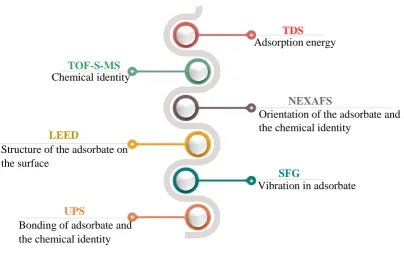
Figure 1.1. Selected surface science techniques and the corresponding information attained
from them.15
Along the same line of inquiry, theoretical simulation techniques, based on computational
quantum-mechanical calculations, are at the heart of our understanding of sophisticated
systems in an Ångström spatial domain. Performing theoretical modelling calculations in
conjunction with experiments has now become a common approach in both academia and
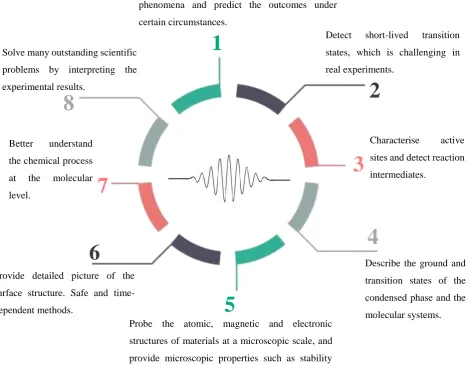
industry (i.e. R& D departments).16-18 Substitutional progress has been made in terms of computational experiments, which are fast becoming a key requirement. Figure 1.2 displays
the selected apparent advantages of applying computational techniques. Structure of the adsorbate on
the surface
Orientation of the adsorbate and the chemical identity
LEED
Bonding of adsorbate and the chemical identity
TDS Adsorption energy
TOF-S-MS
Chemical identity
NEXAFS
UPS
SFG
21
Figure 1.2. Selected advantages of applying computational techniques.
The main aim of performing quantum chemical calculations is to obtain the geometries and
total energy of the system under investigation. Then, numerous physical and chemical
properties are obtained based on the optimised ground state system (molecules or surfaces).
Chapter 3 of this thesis lays out the underlying theoretical background.19 For instance, calculations of bulk or unit cells typically target the optimisation of the geometries, and thermo-Solve many outstanding scientific
problems by interpreting the
experimental results.
Probe the atomic, magnetic and electronic
structures of materials at a microscopic scale, and
provide microscopic properties such as stability
and elasticity. Provide detailed picture of the
surface structure. Safe and
time-dependent methods.
Better understand
the chemical process
at the molecular
level.
Describe the ground and
transition states of the
condensed phase and the
molecular systems. Reveal the causes of physical/chemical
phenomena and predict the outcomes under
certain circumstances.
Characterise active
sites and detect reaction
intermediates. Detect short-lived transition
states, which is challenging in
22
elastic and optical properties.20 Surface calculations address different topics, most notably, their reactivity.21-30 The latter requires modelling of an adsorbate-surface combined system, which in turn provides insights into prominent reaction properties, such as the nature of active
sites, adsorption energies, activation barriers for surface-mediated bond fissions, and surface
diffusion.24-25. Despite the great progress made by using both experimental and theoretical techniques, the details of many molecular-surface interactions remain unclear, especially the
dictation of kinetics parameters and the effect of surface dopants on key surface reaction steps.
This thesis presents a series of scientific studies by means of ab initio density function theory
calculations, and comprises two parts. In the first part, we focuse on diboron trioxide as a
potent oxidation inhibitor extensively deployed in many commerical and laboratory-scale
applications. In contrast, in the second part, we investigate the structures and reactivity of
alumina (surfaces and clusters) with a focus on their well-documented catalytic role in the
synthesis of so-called phenoxy-types environmental persistant fee radicals (EPFR).
1.2 Research Motivations
The two prime motivations behind the present work are as follows:
To prevent/eliminate catalytic-assisted wall reactions in gas
phase experiments, several materials are deployed as reactor
coatings. The most widely used coating material is diboron
trioxide (B₂O₃). The molecular attributes of the truly unreactive
23
investigated in detail. These factors must include a combination
of structural and electronic properties that make B2O3 surfaces
inert chemical entities. Recent studies attempted to link the
degree of surface underactivity with certain properties such as
band gap and interatomic bond strength. In principle, all solid
surfaces have potent adsorption sites; thus, it is very interesting
to elucidate why certain materials are specifically chemically
inert.
The second theme of the thesis is part of a larger project aimed
at revealing the mechanistic and kinetic factors dictating the
formation of polybrominated dibenzofurans, PCDD/Fs, and
their strucurally-related precursors. A great deal of literature
recognises the critical role of alumina in catalysing the
formation of PCDD/Fs via surface-assisted coupling of
phenoxy-type EPFR. However, the exact reaction steps and
underlying energy requirements are not known. Pertinent
literature often presents conflicting views in regard to many
factors, most notably, the desorption of surface adsorbates
versus surface reaction, and the manner in which heterogeneous
mechanisms for the formation of EPFR differ from the
24
1.3 Thesis Objectives
The overall aim of this thesis is to understand the precise atomic-basis electronic and structural
factors dictating reactive and non-reactive surfaces of two metal oxides of the same group in
the periodic table; boron (B) and aluminium (Al). Specifically, this thesis sets out to:
1. Theoretically inspect the initial steps governing the conversion of elemental boron into
B2O3 via adsorption of molecular oxygen into elemental boron.
2. Perform accurate quantum chemistry calculations to provide atomic-based elucidation of
the inertness of B2O3 and the structure of its crystalline form.
3. Use combined theoretical and experimental approaches (i.e. diffuse reflectance infrared
spectroscopy) to explore the mechanistic hygroscopic effect of diboron trioxide.
4. Use computational quantum-mechanical calculations to probe the inhibition role of B2O3
surfaces, as a coating material for quartz reactor walls, in the course of the H2S oxidation
process.
5. Use DFT theory to explore the catalytic role of dehydrated and hydrated alumina (with
varying hydroxylation degree) surfaces in mediating the formation of phenoxy-type EPFR.
6. Examine theoretically the potential role of atomic dopants in the catalytic activity of
25
1.4 Thesis Outline and an Overview
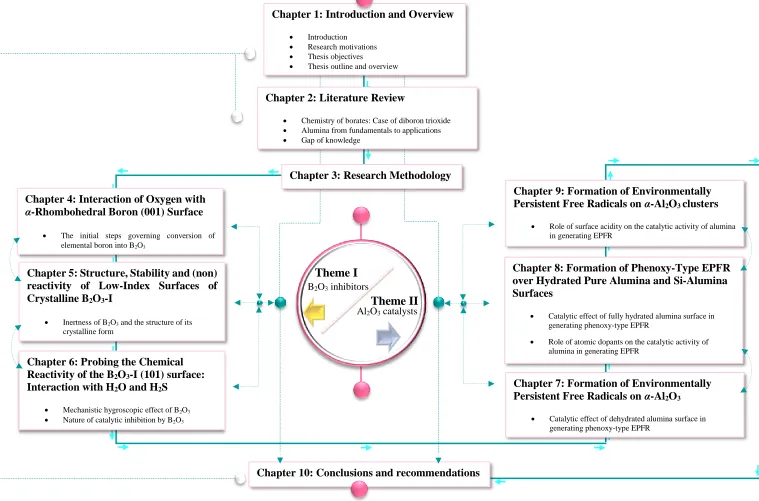
The thesis is organised as follows:
Chapter 2 presents a critical analysis of the relevant available literature on: (i) the chemistry
of borate with a primary focus on reactivity, synthesis procedures, properties and, structures of
diboron trioxide; and (ii) the catalytic activity, structures, and electronic properties of the
thermodynamically stable phase of alumina i.e. α-Al2O3. Basically, Chapter 2 achieves the
following:1) critically summarises the industrial synthesis of boron oxide; 2) discusses the
catalytic inhibition properties of B2O3; 3) presents the molecular structure of diboron trioxide
(vitreous and crystalline forms); 4) presents alternative industrial applications of diboron
trioxide; 5) summarises the classification of alumina; 6) analyses the acidity and basicity of
alumina; 7) surveys the effect of alumina’s hydration on its surface reactivity; 8) highlights
the role of various transitional metal oxides, particularly alumina, in the formation of notorious
PCDD/Fs, and phenoxy-type EPFR.
Chapter 3 introduces the theoretical background of the computational techniques employed in
this study, along with a brief review of the basic concepts of ab initio atomistic thermodynamics
and the density function theory (DFT) approaches. Moreover, the experimental approaches
and computer codes employed within the scope of this thesis (i.e. DMol3 cod and CRYSTAL14 code) are described briefly.
Chapter 4 offers a computational account of the strong and exothermic interaction of atomic
and molecular oxygen with the α(001)B12 surface of boron. We found that physisorbed
26
considerable exothermicity in the range of 2.47 – 3.45 eV/mol, depending on the adsorbed sites
of the two oxygen atoms. Nonetheless, rupture of dioxygen on the surface involves a sizable
intrinsic reaction barrier of 3.40 eV. Such a high level of energy clearly explains the chemical
inertness (i.e. lack of oxidation) of boron at room temperature. However, elevated temperatures
encountered in real applications of boron, such as cutting machinery, overcome the high-energy
barrier for the dissociative adsorption of molecular oxygen (3.40 eV). A stability T-P phase
diagram reveals the spontaneous nature of the substitutional O/α(001)B12 adsorption modes
that lead to the formation of diboron trioxide, at temperatures and pressure pertinent to practical
applications. The finding of this Chapter conclusively collaborates the experimental
observation of the formation of the B2O3 phase from the adsorption of oxygen on boron.
Finally, charge analysis provides an atomic-scale probe for the predicted stability ordering of
the considered O/α(001)B12 configurations.
Chapter 5 presents accurate quantum mechanical calculations using the PW1PW hybrid HF/DFT
functional of four low-index surfaces of the low-pressure phase of B2O3: (101), (100), (011) and
(001). Bond lengths, bond angles, and net Mulliken charges of the surface atoms are analysed in
detail. The total and projected density of states and surface energies are discussed. The
occurrence of tetrahedral BO4 units on the lowest energy structures of two of these surfaces is
demonstrated for the first time. The corresponding surface orientations incur larger energies in
reference to the two orientations featuring only BO3 units. None of the four investigated lowest
energy structures have dangling bonds, which reasonably relates to the experimentally observed
low reactivity of this compound. The findings in this Chapter pave the way for potential interest
in future studies regarding the surfaces of amorphous B2O3, as well as on the hydroxylation of
27
Chapter 6 focuses on the adsorption and dissociation mechanisms of two hydrogen
chalcogenides, namely water (H2O) and hydrogen sulfide (H2S) molecules, over the B2O3 -I (101)
surface. Aided by both experimental diffuse reflectance infrared spectroscopy and computational
first-principle techniques, this Chapter confirms the hygroscopic behaviour of diboron trioxide,
elucidating the corresponding enthalpic requirements. We show that the diboron trioxide surface
exhibits high physiochemical reactivity towards water molecules with an activation energy of 39
kJ/mol dissociative adsorption. Furthermore, desorption of both molecularly adsorbed and
dissociated structures of water molecules from the B2O3 -I (101) surface requires activation
energies of 124–127 kJ/mol, in agreement with the experimentally derived isoconversional
activation energies for the same process. Our investigation on the other hydrogen-chalcogenide
compound, i.e. H2S, reveals that diboron trioxide attracts H2S molecules and forms molecular
adsorption via sp3 hybridisation between the lone pair electron of the H2S and the empty p orbital
of the Bsurf atom without activation barrier. However, the energy barrier required to dissociate
H2S over the B2O3 -I (101) surface appears exceedingly high at 310 kJ/mol. The present insight
resolves the two different behaviours of B2O3 concerning hydrogen chalcogenides reported in the
literature. While acting as a water scavenger to generate dissociated radicals, it exhibits an
inhibitor characteristic towards the dissociation of H2S molecules, representing an ideal reactor
wall coating for desired pure gas phase reactions.
Chapter 7 uses first-principle calculations to investigate the activity of the alumina neat α
-Al2O3(0001) surface in the formation of phenolic EPFR, under conditions relevant to cooling
zones of combustion systems. We show that the molecular adsorption of phenol on α
-Al2O3(0001) entails binding energies in the range of -202–-127 kJ/mol. The dehydroxylated
alumina catalyses the conversion of phenol into its phenolate moiety with a modest activation
28
1000 K, confirm the formation of the phenolate as the preferred pathways for the adsorption of
phenol on alumina surfaces, corroborating the role of metal oxides deposited on particulate
matter in the cooling zone of combustion systems in the generation of
environmentally-persistent free radicals.
Chapter 8 presents a computational study of the catalytic role of the hydrated α-Al2O3 (0001)
surface and Si modified Al2O3 surfaces in producing phenolic EPFR. First, we present the
geometric and electronic properties of bulk α-Al2O3. Then, we investigate in detail the
molecular adsorption of phenol over the α-Al2O3 (0001) surface. This is followed by an
investigation of surface-mediated dissociation of phenol over both doped and undoped
hydroxylated alumina surfaces. Molecular phenol is found to interact in vertical and flat/title
configurations with calculated binding energies of -91 and 136 kJ/mol, respectively. The
hydrated alumina surface is active toward the attack phenol molecule and forms a phenoxy
moiety, via the H2O elimination mechanism. The Si-α-Al2O3 (0001) substituted surface is
considered for both hydrated and dehydrated alumina systems. The activation energy barrier
required to form phenoxy moiety over the Si- Al2O3 (0001) surface was found to be nearly 37%
lower than that of the undoped dehydrated alumina surface.
Chapter 9 analyses dissociative adsorption mechanisms of phenol molecules over Al2O3 and
hydrated Al2O3.nH2O clusters that mimic dehydrated and hydrated alumina structures,
respectively. We show that fission of the phenol’s hydroxyl bond over dehydrated alumina
systematically incurs lower energy barriers than that of the hydrated structures. In contrast, a
1,2-water elimination step marks the most feasible channel in the interaction of phenol and
hydrated clusters. It is found that the catalytic activity of the alumina surface in producing the
29
Desorption of adsorbed phenolates requires sizable desorption energies and is expected to
facilitate surface-mediated condensation into dioxin-like moieties.
Finally, Chapter 10 highlights the concluding remarks of this thesis and provides insights for
future research.
Research motivations
Thesis objectives
Thesis outline and overview
Chapter 2: Literature Review
Chemistry of borates: Case of diboron trioxide
Alumina from fundamentals to applications
Gap of knowledge
Chapter 3: Research Methodology
Chapter 4: Interaction of Oxygen with
α-Rhombohedral Boron (001) Surface The initial steps governing conversion of
elemental boron into B2O3
Chapter 5: Structure, Stability and (non) reactivity of Low-Index Surfaces of Crystalline B2O3-I
Inertness of B2O3 and the structure of its crystalline form
Chapter 6: Probing the Chemical Reactivity of the B2O3-I (101) surface: Interaction with H2O and H2S
Mechanistic hygroscopic effect of B2O3
Nature of catalytic inhibition by B2O3
Chapter 9: Formation of Environmentally Persistent Free Radicals on α-Al2O3 clusters
Role of surface acidity on the catalytic activity of alumina in generating EPFR
Chapter 8: Formation of Phenoxy-Type EPFR over Hydrated Pure Alumina and Si-Alumina Surfaces
Catalytic effect of fully hydrated alumina surface in generating phenoxy-type EPFR
Role of atomic dopants on the catalytic activity of alumina in generating EPFR
Chapter 7: Formation of Environmentally Persistent Free Radicals on α-Al2O3
Catalytic effect of dehydrated alumina surface in generating phenoxy-type EPFR
Chapter 10: Conclusions and recommendations Theme I
Theme II B2O3 inhibitors
Al2O3 catalysts
31
1.5 References
1. Venables, J., Introduction to Surface and Thin Film Processes. Cambridge University
Press, 2000.
2. Binnig, G.; Rohrer, H., In touch with atoms. Rev. Mod. Phys. 1999, 71, S324-S330.
3. Barth, J. V.; Costantini, G.; Kern, K., Engineering atomic and molecular nanostructures
at surfaces. Nature 2005, 437, 671-9.
4. Lin, J.; Balabin, I. A.; Beratan, D. N., The nature of aqueous tunneling pathways
between electron-transfer proteins. Science 2005, 310, 1311-3.
5. Drakova, D., Theoretical modelling of scanning tunnelling microscy: Scanning
tunnelling spectroscopy and atomic force microscopy. Rep. Prog. Phys. 2001, 64, 205-290.
6. Harikumar, K.; Lim, T.; McNab, I. R.; Polanyi, J. C.; Zotti, L.; Ayissi, S.; Hofer, W.
A., Dipole-directed assembly of lines of 1, 5-dichloropentane on silicon substrates by
displacement of surface charge. Nat. Nanotech. 2008, 3, 222-228.
7. Ternes, M.; Lutz, C. P.; Hirjibehedin, C. F.; Giessibl, F. J.; Heinrich, A. J., The force
needed to move an atom on a surface. Science 2008, 319, 1066-1069.
8. McDowell, M. T.; Jungjohann, K. L.; Celano, U., Dynamic nanomaterials phenomena
investigated with in situ transmission electron microscopy: A nano letters virtual issue. Nano
Lett. 2018, 18, 657-659.
9. Pavliček, N.; Gross, L., Generation, manipulation and characterization of molecules by
atomic force microscopy. Nat. Rev. Chem.2017, 1, 0005 DOI: 10.1038/s41570-016-0005.
10. Cui, X.; Troadec, C.; Wee, A. T.; Huang, Y. L., Surface Nanostructure Formation and
32
11. Ceyer, S. T., Dissociative chemisorption: Dynamics and mechanisms. Annu. Rev. Phys.
Chem. 1988, 39, 479-510.
12. Arumainayagam, C. R.; Madix, R. J., Molecular beam studies of gas-surface collision
dynamics. Prog. Surf. Sci. 1991, 38, 1-102.
13. Rettner, C. T., Dynamics of Gas-surface Interactions. Surendra Kumar, 1991.
14. Hamers, R. J., Scanned probe microscopies in Chemistry. J. Phys. Chem. 1996, 100,
13103-13120.
15. Bhattacharjee, T., Towards Understanding Catalytic Processes for the Reactivity of
Hydrocarbons on Rh Surface: A Quantum Chemical Study, University of Heidelberg, 2011.
16. Bischoff, F.; Seufert, K.; Auwärter, W.; Seitsonen, A. P.; Heim, D.; Barth, J. V.,
Metalation of porphyrins by lanthanide atoms at interfaces: Direct observation and stimulation
of cerium coordination to 2H-TPP/Ag (111). J. Phys. Chem. C 2018, 122, 5083-5092.
17. Barrera, O.; Bombac, D.; Chen, Y.; Daff, T.; Galindo-Nava, E.; Gong, P.; Haley, D.;
Horton, R.; Katzarov, I.; Kermode, J., Understanding and mitigating hydrogen embrittlement
of steels: A review of experimental, modelling and design progress from atomistic to
continuum. J. Mater. Sci. 2018, 53, 6251–6290.
18. Oudda, H.; Touir, R.; El M'Rabet, M.; Warad, I.; Guenbour, A.; Lakhrissi, B., Coupling
of electrochemical and theoretical techniques to study the interaction of steel/terazole based on
8-hydroxyquinoline in 1.0 M Hcl. 2018, 9, 1086-1097.
19. Schwarz, K.; Blaha, P., Solid state calculations using WIEN2k. Comput. Mater. Sci.
2003, 28, 259-273.
20. Anstis, G. R.; Chantikul, P.; Lawn, B. R.; Marshall, D. B., A critical evaluation of
indentation techniques for measuring fracture toughness: I, Direct crack measurements. J. Am.
33
21. Amin, M. A.; Khaled, K.; Mohsen, Q.; Arida, H., A study of the inhibition of iron
corrosion in HCl solutions by some amino acids. Corros. Sci. 2010, 52, 1684-1695.
22. Obot, I. B.; Obi-Egbedi, N. O., Adsorption properties and inhibition of mild steel
corrosion in sulphuric acid solution by ketoconazole: Experimental and theoretical
investigation. Corros. Sci. 2010, 52, 198-204.
23. González-Lezana, T.; Honvault, P.; Jambrina, P.; Aoiz, F. J.; Launay, J.-M., Effects of
the rotational excitation of D2 and of the potential energy surface on the H+ + D2→ HD + D+
reaction. J. Chem. Phys. 2009, 131, 044315.
24. Davies, P. R.; Bowker, M., On the nature of the active site in catalysis: the reactivity of
surface oxygen on Cu (110). Catal. Today 2010, 154, 31-37.
25. Zweidinger, S.; Hofmann, J.; Balmes, O.; Lundgren, E.; Over, H., In situ studies of the
oxidation of HCl over RuO2 model catalysts: Stability and reactivity. J. Catal. 2010, 272,
169-175.
26. Lo, C. S.; Tanwar, K. S.; Chaka, A. M.; Trainor, T. P., Density functional theory study
of the clean and hydrated hematite (1102) surfaces. Phys. Rev. B 2007, 75, 075425.
27. Sinapi, F.; Issakova, T.; Delhalle, J.; Mekhalif, Z., Study of (3-Mercaptopropyl)
trimethoxysilane reactivity on zinc: Comparison with organothiol and organosilane thin films.
Thin Solid Films 2007, 515, 6833-6843.
28. Efil, K.; Obot, I. B., Quantum chemical investigation of the relationship between
molecular structure and corrosion inhibition efficiency of benzotriazole and Its
alkyl-derivatives on iron. Prot. Met. Phys. Chem. Surf.2017,53, 1139.
29. El Adnani, Z.; Mcharfi, M.; Sfaira, M.; Benzakour, M.; Benjelloun, A.; Ebn Touhami,
M.; Hammouti, B.; Taleb, M., DFT study of 7-R-3methylquinoxalin-2 (1H)-ones (R = H; CH3;
34
30. El Adnani, Z.; Mcharfi, M.; Sfaira, M.; Benzakour, M.; Benjelloun, A.; Touhami, M.
E., DFT theoretical Study of 7-R-3methylquinoxalin-2 (1H)-thiones (Rh; CH3; Cl) as corrosion
CHAPTER 2
Literature Review
36
2.1 Introduction
The boron family signifies a unique group of fascinating complex elements located in group
13 of the p-block in the periodic table (Figure 2.1). It encompasses the semi-metal boron (B)
and the metals aluminium (Al), gallium (Ga), indium (In), and thallium (Tl), all of which share
the valence electron configuration of ns2np1.1 The elements in the boron group have
remarkable similarities and differences.2 For example, boron, as a semi- metal unlike other elements, features superior hardness, refractivity, and reluctance to participate in metallic-type
bonding. Likewise, Tl possess an oxidation state of +1, unlike other elements that adopt
oxidation states of +3. Their electrode potential increases down the group, whereas the
opposite applies to the ionization energy. Owing to their novel physical and chemical
properties, the boron family elements have unique applications.2-3
Figure 2.1. Boron family elements.
The existing literature on boron family elements and their compounds is rather extensive and
focuses particularly on boron- and/or aluminium-containing compounds owing to increasing
applications in many commercial and industrial applications, or simply merely derived by pure
scientific curiosity (as it is the case in literature pertinent to the structures of elemental boron). B
37
A significant number of experimental and theoretical studies have addressed many aspects
related to boron- and aluminium- containing compounds, mainly focusing on their structures,
electronic properties, stability, and most importantly their applications. Herein, we limit this
survey to the chemical reactivity of the surfaces with an emphasis on the truly contrasting
catalytic behaviour spanning both reactive (catalysts) surfaces and non-reactive (inhibitors)
surfaces of alumina and boron oxides, respectively. The structures of both oxides are discussed
to shed a light on their relations with the experimentally observed inhibiting/catalysing effects.
It follows that this Chapter presents literature pertinent to;
B2O3 as a coating and hygroscopic material, and applications that stem from these unique
properties.
Reactivity of α-Al2O3 as one of the most important catalysts with prominent industrial
and environmental applications.
This critical review consists of two sections, with the following specific objectives:
1- To briefly discuss the chemistry of borates, the case of diboron trioxide, introducing the
importance of boron oxides, their industrial synthesis, and their occurrence and supply;
2- To discuss the T-P thermodynamic stability diagrams of diboron trioxide, introducing the
most stable crystalline phase;
3- To evaluate the inhibition characterization of diboron trioxide, including its applications
as a coating and hygroscopic material;
4- To presents alumina from fundamentals to applications, with a focus on its most
38
5- To discuss the acidity and basicity of alumina; a surface attribute that largely dictates its
environmental catalytic capacity;
6- To discuss the reactivity of alumina toward water molecules (i.e. hydration reactions);
7- To evaluate the effect of surface hydration on the catalytic activity of alumina;
8- To critically review the well-documented role of alumina in mediating the formation of
notorious PCDD/Fs.
Scheme 2.1 represents the structural configurations of investigated in this Chapter.
Scheme 2.1. Structural configurations investigated in this Chapter.
α-Al2O3 catalyst
B2O3 inhibitor
ι -Al2O3
θ -Al2O3
χ -Al2O3
δ-Al2O3
κ -Al2O3
η-Al2O3
Diboron trioxide Boron suboxide Boron monoxide Alumina carbides, nitrides and related
materials In Ga Al element Boron elements group
B element TI
Alumina halides
Alumina
Hydrides Halides
Oxides
(B2O) (B6O) (B23)
α -Al2O3
Boron compounds Alumina compounds
39
2.2 Chemistry of Borates: Diboron Trioxide
2.2.1 Context
Boron-rich compounds display novel properties,4-13 such as a lightweight structure, superior thermal stability, and high hardness. Because of these unique features, boron and its
compounds are employed in many commercial applications. Of particular importance is their
deployment as hard, wear-resistant, chemically inert coatings.14-18 Other applications are an
abrasives, nuclear applications, and lightweight armour applications.19-22 Boron-rich compounds are frequently prescribed in terms of their complex structures. For this reason,
numerous theoretical and experimental investigations have studied the structures of elemental
boron as a key step in the pursuit to understand their electronic properties.
Boron (B) tends to be chemically inert at room temperature, with a significant hardness,
relatively low density, and high melting point.23-24 The literature on elemental boron has highlighted its crystal structures, constructed a governing thermodynamic stability diagram,
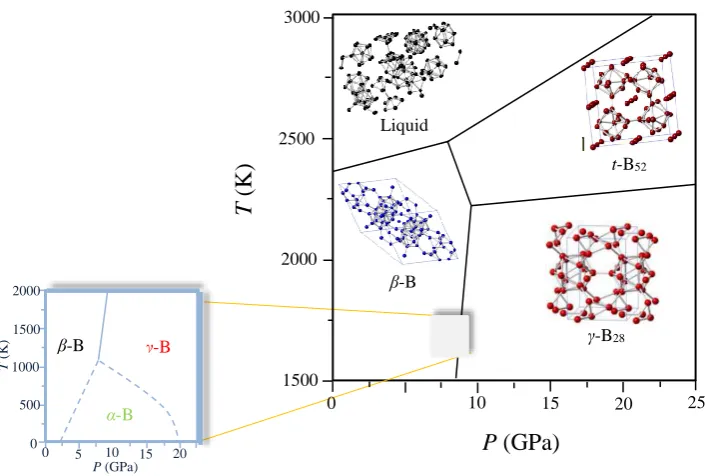
and reported its thermal and mechanical properties. Typically, the boron element adopts five
different crystallographic structures, namely: α-B12 (α-phase),25-26 β-B
106 (β-phase),27-28
orthorhombic γ-B28 (γ-phase),29 tetragonal t-B192,30 and t-B52 (t-phase).29, 31 Of these phases, γ
40
Figure 2.2. Thermodynamic stability phase diagram of elemental boron.32
It has been shown that boron clusters, which are produced from the decomposition of boron
rich compounds (i.e. in high temperature regimes), are further oxidized in
temperature-controlled processes, producing boron oxides.33 The high enthalpy change in this reaction (303.9 kcal) derives its application as a secondary energy source in rocket fuel.34
4B+3O → 2B2O335-36 R2.1
In nature, boron does not exist in its elemental form, but rather it adapts to the form of
boron-containing oxyanions, with the generic formula BxOy (where O represents the oxygen atom).
It is found as an oxide either in minerals and natural water and/or in biological systems (i.e.
borate esters). Borate can broadly be defined as any compound that contains B2O3.37-38 Table
2.1 displays selected borate compounds, whereas Table 2.2 enlists common borate minerals
that are defined by their B2O3 content.
Liquid
t-B52
γ-B28
β-B γ-B α-B β-B 2000 1500 1000 500 0 0
5 10 15 20
P (GPa)
T ( K ) 1500 2000 2500 3000
0 10 15 20 25
P (GPa)
T
(K
)
41
Table 2.1. Selected borate compounds.37
Compound Oxide formula
diboron trioxide (boric oxide) B2O3
orthoboric acid B2O3_3H2O
metaboric acid B2O3_ H2O
anhydrous sodium tetraborate (anhydrous borax)
Na2O_ 2B2O3
Sodium tetraborate tetrahydrate (kernite) Na2O_2B2O3_4H2O
disodium octaborate tetrahydrate Na2O_4B2O3_4H2O
sodium metaborate Na2O_B2O3_4H2O
sodium metaborate hydrated Na2O_B2O3_8H2O
sodium pentaborate pentahydrate Na2O_5B2O3_10H2O
zinc polytriboratee 2ZnO_3B2O3_3H2O
Table 2.2. Common borate minerals.37
Mineral Semiempirical formula Wt% B2O3 Location
borax(tincal) Na2B4O7.10H2O 36.5 United States, Turkey, Argentina
Kernite Na2B4O7.4H2O 51 United States
ulexite NaCaB5O9.8H2O 43 Turkey, South America
colemanite Ca2B6O11.5H2O 50.8 Turkey
inderite Mg2B6O11.15H2O 37.3 Kazakhstan
szaibelyite (ascharite) Mg2B2O.5H2O 41.4 China
suanite Mg2B2O5 46.3 China
hydroboracite CaMgB6O11.6H2O 50.5 Argentina
42
Of the boron oxides, diboron trioxide is an essential oxide for a wide range of technologies. It
has received broad attention39-44 owing to its distinguished performance in electrolysis and ceramics, glass technology, and as oxidation inhibitors.45-50 Extensive research has shown that B2O3 is an excellent glass-former. It largely remains in its vitreous (amorphous) form at
ambient pressure conditions, even at temperatures in the vicinity of its melting point and/or at
exceedingly slow cooling rates.51-53 Crystallization from the melting phase is attained when
the pressure is within the range of 0.4–1.0 GPa.52-53
In the following sections we report the vitreous and crystalline structure of B2O3, as well as its
chemical reactivity.
2.2.2 Structure of Diboron Trioxide
The molecular structure of vitreous diboron trioxide, v-B2O3, has been a controversial matter
of debate for many years.54-67 Earlier studies68-70 indicated that its structure is composed of
randomely ordered BO3 building blocks in which each BO3 triangle consists of oxygen atoms
at the corners and a boron atom at the centre. However, the presumed randomization of the
BO3 unit structure failed to elucidate some physical properties of v-B2O3.71 This has made
describing the correct structural arrangments of v-B2O3 a challenging task for a relatively long
period of time. Later experimental developments by Jellison. et al.72 led to a renewed interest
in the structure of v-B2O3. Authors proposed that the O17 isotopein v-B2O3 produces different
spectra, affording two distincit sites in the structure. The first site is related to BO3 triangles
43
triangles fully connected to each other by their corners. Subsequent experimental studies have
attained a similar structural configuration.73-75
Figure 2.3. Molecular structure of vitreous diboron trioxide v-B2O3.
Over a wide range of operational pressures and temperatures, above a threshold level of 0.4–1
GPa52-53, B2O3 adopts two crystallographic structures namely, B2O3-I and B2O3-II.
Figure 2.4. Diboron trioxide crystallographic structures; B2O3-I (left); B2O3-II (right).
Planar BO3 triangle
Planar boroxol ring
B2O3-I
B2O3-II
a =b= 4.33 Å
c = 8.34 Å
c
a
b
c
b
a
a = 4.613 Å b = 7.803 Å
b = 4.129 Å BO3 unit
44
With 0.4 GPa (>483.15 K) applied to the amorphous form of B2O3, it crystallises to its first
crystalline form, B2O3-I.76 It presents a hexagonal structure with lattice parameters of a = 4.33
Å and c = 8.34 Å.76-77 The exact crystal structure of B2O3-I has been a subject of conflicting
remarks. The contested point was that the oxygen atoms around boron are either connected to
each other in a trigonal coordination (BO3) and/or tetrahedral configuration (BO4).
Subsequently, some experimental observations69 have excluded the presence of tetrahedral
groups (BO4) in the structure. This was been confirmed by Gurr et al.76 who also ruled out the
presence of BO4 units; this is in a clear agreement with the early structures proposed by
Berger78, and Strong and Roy.79 Following this, the recent refinement structure of crystalline B2O3-I was proposed by Effenberger et al.77 They found that the structure of crystalline B2O3
-I represents a high space group symmetry P3121 (152), instead of Gurr et al.’s proposed
structure with the low symmetric space group of P31. The planar triangles of BO3 are lost with
the continuity of pressure in difficult processes,51; therefore, the coordination number of boron atoms in the crystalline structure transforms from the threefold to fourfold coordination
number.80-81
An approximately 6.5 GPa (>1000 K)82-83 high pressure crystal, B2O3 –II, with the fourfold
coordination number of boron, is the stable crystalline form. It consists of a three-dimensional
network of tetrahedral units of BO4. Based on the aforementioned findings, transformation in
the coordination number of boron represents the main source of signficant complexity in the
structures of diboron trioxide.84 Figure 2.5 displays the thermodynamic P-T phase diagram of
45
Figure 2.5. Thermodynamically consistent P-T phase diagram of diboron trioxide.85
Theoretically, Huang et al.86 described the slow conversion of the structure of diboron trioxide as a function of pressure, initiating with the disintegration of the boroxol ring and ultimately
leading to the formation of the BO4 unit, as revealed in Figure 2.6.
Figure 2.6. Gradual conversion of the structure of diboron trioxide as a function of pressure.86 0 2 4 6 8
600 800 1000 1200 1400 1600
Liquid
P (GPa)
T
(K
)
B2O3-I
B2O3-II
8 GPa
12 GPa 15 GPa
5 GPa
46
Recent evidence suggests that diboron trioxide is described by its complex structure;
consequently, very little is known about its surfaces. One study by Bredow et al.87 investigated the structures and relative stability of four B2O3-I low index surfaces, namely 101,100,001, and
11̅1 at 0 K. They found that the stability ordering follows the sequence 101> 111> 100> 001.
However, the authors made no attempt to relate the thermodynamic stability to elevated
temperatures and pressures, nor did they address the effect of the atomic type termination on
the predicted stability order. This indicates that a future study aimed at an atomic–based
understanding of B2O3 surfaces and their reactivity would be very insghtful.
2.2.3 Reactivity of B2O3 2.2.3.1 B2O3 Coating
B2O3 coatings play a critical role in the maintenance of industrial materials subject to very
harsh conditions, allowing higher operating temperature, and most importantly increasing their
lifespan.88 Typically, this can be attained in three basic ways, diffusion coating, overlay coating, and thermal barrier coating.89
Common examples includes, boron oxides,90 boron nitride,91 silicon silicide,92 and phosphorus93. In particular, B2O3 is one of the most widely deployed oxidation inhibitors.49-50
An important example of its use as an oxidation inhibitor includes carbons-carbon composite
oxidation. A thin layer of B2O3 is commonly deployed in chemical reaction experiments to
47
Recent trends in high temperature oxidation resistance have led to a proliferation of studies on
carbon-carbon composite oxidation reactions95-99 as an important composite in many industrial applications.100-101 Existing research recognises the critical role played by oxidation inhibitors in providing complete protection either short-term and/or at high temperature (i.e. ~1273 K).93,
102-105
Of the reported inhibition additives (i.e. boron containing additive, phosphorous containing
additive, and halogenated glass), boron-containing inhibitors have the most promising
inhibition effect. The mechanistic inhibition effect of boron oxides operates by blockage of
the active site; however, oxidative fragmentation of B2O3 and its rapid reaction with
atmospheric water molecules reduces its inhibition effect.93, 102, 104-106 B
2O3 is extremely
sensitive to moisture; in moist low-temperature environments, B2O3 spontaneously interacts
with water molecules; however, heating can reversibly remove the water molecules on the B2O3
surfaces, leading to spallation of the coating layer.107 B2O3 exhibits low viscosity which can
give rise to uneven spreading.108 At high temperature, (i.e. 673-873 K), boron oxide forms volatile species (i.e. H3BO3 and HB2), which can decrease its efficiency as a coating during the
oxidation processes.109 For this reason, many studies have aimed to improve its inhibition characterisation by adding some additives as a combination of various inhibitors, to form a
hermetic binary system coating. Table 2.3 summarise selected binary system coatings and their
48
Table 2.3. Selected materials and their effect in enhancing the reaction inhibition of B2O3.
Material Description effects Reference
B₂O₃ modified MoSi₂-CrSi-Si/B modified SiC coating
Increases the oxidation protection up to 1173 K for
150 h.
110-111
ZrB₂+ B₂O₃ SiC coating Increases the oxidation protection up to 1500K
112
SiO₂ + B₂O₃ SiC coating Increase the oxidation protection up to 1800 K
108, 113
Al4B₂O₉ + B₂O₃ on stainless steel Increases the sintering degree
89
SiO₂-ZrO₂- B₂O₃ Denser and stronger protection layer
114
Ba (Nd₂_xSmx) TiO₁₂ Decreases the sintering temperature
115
Experimental evidence has proven some inhibitors to be unreliable (silicon-based coatings such
as Si3N4 and SiC). The major drawback of these coatings is the thermal expansion mismatch
between the coating and the substrate layer, which is the leading cause of the formation of the
cracks in the coating (873–1373 K). Such cracks lead to the deactivation of the coating layer
and allow oxygen molecules to diffuse and oxidise the substrate layer.116-121 Significant efforts have been devoted to develop more effective coatings to overcome this cracking problem. For
this purpose, multi-layer coatings have been synthesised.112, 119, 122-127
An effective multi-layer coating is the combination of SiC (outer-layer) and B4C (inner layer)
49
allows oxygen diffusion into the second layer (i.e. B4C). This facilitaes the formation of B2O3,
which seals the cracks, and accordingly prevents oxidation.
B₄C + 4O₂ → 2B₂O₃ + CO₂ R2.2
Diboron trioxide as a crack sealant is of interest because of its important properties, such as
low melting point, low oxygen permeability, superior wettability for easy penetration into
cracks, and easy sealing treatment.88, 128 However, the use of a binary system (i.e. B2O3 and
SiO2) generally affords better performance.129
Several sources of evidence suggest that passifying quartz reactor walls by coating them with
boron oxide eliminates the catalytic effects of the surface of the reactor.130 For instance, some studies have been carried out to investigate B2O3 coatings in H2 and hydrocarbon oxidation
processes,131-135 proving its inert properties toward the decomposition of peroxy species. Along
the same line of inquiry, Zhou et al.136, in a more recent study, investigated H2S oxidation in a
B2O3 coated reactor and compared it with an uncoated reactor. The authors found that the
oxidation process is strongly catalysed when the oxidation reaction takes pace in an uncoated
reactor. The profound wall effect can be completely eliminated by applying a B2O3 coating,
confirming the inhibition characterisation of diboron trioxide in H2, S2, and H2S oxidation
50
Figure 2.7. H2S oxidation with and without B2O3 coating.136
2.2.3.2 B2O3 Hygroscopic
B2O3 signifies a highly hygroscopic material.137 When B2O3 is produced from the oxidation of
boron at high temperature138, it cools and is converted upon its interaction with atmospheric moisture139 to boric acid (H
3BO3), a material that exhibits potent self-lubricating behavior.138, 140
4B+6O → 2B2O3 R2.3
1 2
⁄B2O3+3⁄2H2O → H3BO3 R2.4
500 600 700 800 900 1000 1100 1200
0 50 100 150 200 250 300 350 H2 S c o n ce n tr at io n ( p p m ) Temperature (K)
500 600 700 800 900 1000 1100 1200
0 50 100 150 200 250 300 350 Y A x is T it le
X Axis Title
B H2 S co n ce n tr atio n ( p p m )
T (K)
Oxidation process with B2O3 coating
Oxidation process without B2O3 coating
Heating process
51
The behaviour of self-lubricating films of boric acid is an important industrial problem. Of
particular importance is propellant processing, ignition, and combustion141-144 , as well as B2O3
coating applications (as mentioned previously). For instance, the presence of both H3BO3 and
B2O3 in airbreathing propulsion systems undesirably increases the viscosity.145 Efforts to
overcome this problem considered inhibition of the surface oxidation of boron by adding
passivating agents such as organic amines and hydroxylamine146 and/or via adding a coating
agent to the surface of boron.147-148 The latter interacts with B2O3 and facilitates its removal
during combustion.
In a temperature-controlled process, the interaction of diboron trioxide with water molecules
takes place in two stages as shown in Figure 2.8:149
Figure 2.8. Interaction of diboron trioxide with water molecules.
Reversible process (by heating)
Formation of orthoboric
H3BO3
52
Heating can reversibly remove water molecules on the B2O3 surfaces. The surface loses a
fraction of its water content and forms HBO2 at approximately 400 K, whereas it is completely
dehydrated at approximately 525 K.150-151
2.3 Alumina From Fundamentals to Applications
2.3.1 Context
Alumina have been a focal topic of research owing to their variety of features, such as its
hardness, corrosion resistance, abrasion resistance, compression strength, large surface area,
good electric insulation, optical properties, and catalytic surface activity.152-153 Owing to these
properties, alumina have unique applications.154-159 Common examples of its usage include firebricks, abrasives, integrated circuit (IC) packages, electronic, ceramics, catalysis, and in
thermal barrier coatings (TBCs).160-168
Over a wide range of operational pressures and temperatures, alumina exhibits a variety of
crystallographic structures.169-171 As early as the 1920s, researchers pointed out the presence of several alumina transition phases.172 According to Haber classification, alumina can be categorized into two main groups, namely α-group and γ-group.172 Afterwards, aluminium tridroxide-bayerite (β-group) was observed and subsequently added as a new group next to the