A SVM adaptive approach for Ventricular
disease classification
Anu Ahlawat
1, Shamsher Malik
21
Department of Electronics & communication, UIET, MDU Rohtak, Haryana, India 2Assistant Professor, Dept. of Elec. & Communication, UIET, MDU Rohtak,
Haryana, India
ABSTRACT
ECG signal is the electrical signal form to represent the heart rate. ECG signal processing is effective to identify and classify the heart disease. The most critical heart disease form is vehicular disease. In this work, a HMM integrated SVM model is presented to identify the ventricular disease. The model is applied on the real time ECG signals. A layered model is presented in this work to transform the signal to the feature form. After generating the feature set, the classifier is applied to perform the disease identification. The implementation result shows that the work model has provided the significant identification of disease.
Keywords: ECG, Ventricular, SVM, Classification, HMM.
INTRODUCTION
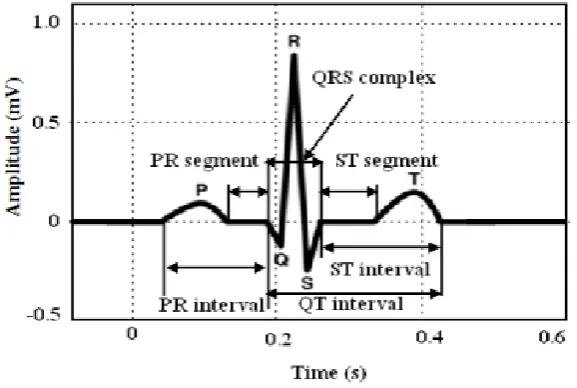
ECG is the signal form to represent the heart activity and it was introduced by a German psychiatrist Hans Berger. ECG signal processing is the electric form of heat signal. It is analyzed to identify the various associated disease and disorder. There are number of classification methods to identify these diseases. One of such critical disease form is ventricular disease identification. The ECG Signal form is given here under in figure 1.
Figure 1: ECG Signal
A) Types of ECG Signals
ECG signal form can be divided in different signal waves defined under the frequency and amplitude specification. The description of these forms is given here under:
Alpha waves: This signal form basically represents the rhythemic signal and provides the signal form representation at 8 to 13 Hz.
Theta waves: Theta activity analysis at the frequency is defined at 4 to 7 Hz. The age group for these is mainly 13 year group. The signal connection analysis is performed under different cases including day dreaming, intuition, and creativity analysis.
Delta Waves: These are low frequency wave and available in lowest frequency range i.e. between 0.1 to 4 Hz. These waves define the unconscious mind and deep sleep of the patient or the person so that the sleep apnea based analysis can be performed on these signal values. In this paper, HMM integrated SVM model is applied for signal feature extraction and classification. In this section, ECG signal specifications and its types is discussed. In section II, the work defined by the earlier researchers is discussed. In section III, the proposed work model is presented. In section IV, the results obtained from the work are discussed. In section V, the conclusion obtained from the work is presented.
I. RELATED WORK
Lot of work is provided on to identify the ventricular disease over the ECG signal. Some of the work defined by earlier researchers is discussed in this section. Author[1] has defined a work on QRS detection on ECG signal under entropy value analysis. Author defined an entropy improved SVM approach for ECG signal classification. Author has defined a digital filtration based approach for power line interference analysis. Author has defined work to analyze the complex ECG signal so that QRS detection over the signal will be obtained. Author [2] has defined a threshold analysis based dynamic work to identify the QRS over the EEG signal. Authors analyze the signal complexities to analyze the signal and generated the improved quantization model to generate the adaptive results from the system. Author has defined the algorithm to obtain the automatic threshold values and defined the static analysis over the signal to detection the QRS. Author[3] defined a work to analyze the ECG signal to measure the heart rate and relative regulateries. Author analyzes the signal under arrhythemia identification and diagnosed approach. Author has defined an assessment model based on feature analysis.
This model used the DWT at the earlier stage to extract the signal features. This signal feature is adaptive to the signal noise and reduces the signal noise. The wavelet coefficient vector is used as the decision vector to retain the relevant information and discard the abnormal information Author [4] defined a neural network based work to classify the Arrhythemia dataset for cardiac disease identification. Author has defined the ECG signal processing under neural network approach perform the detection and classification under heart beat analysis. Author has defined an error adaptive back propagation approach for block level analysis defined over the signal. Author has defined a branch block analysis scheme for beat identification in ECG signal. By analyzing different beats patterns over the signal, the network architecture is defined to generate the model under feature level analysis. Once the feature set is identified, the next work is to perform the recognition.
The multilayer perceptron model is here been used to identify the QRS complexities over the signal and classify them under feature paramerers Author[5] defined an ECG processing scheme using non linear transformation and neural network approach. Author has defined a study based work for ECG signal processing and recognition. Author has defined the analysis of signal under pattern level analysis. Author has defined a parameter enabled analysis to generate the signal patterns and to obtain the non linear transformation over the signal. Author has defined a PCA based approach to classify the ECG signal and to recognize the input signal. Author worked on different singal level disorders such as P, QRS and T waves. Author has defined the scheme for beat and atrial fibrillation analysis to classify the signal using NN approach and radial basis function network approach. Author [6] defined an ICA based approach for beat detection in ECG signal and to perform the recognition and classification over the signal. Author has defined an artefact analysis approach to identify the distortion over the signal.
Author has defined an improvement over the Christov’s beat detection algorithm, which detects beat using combined adaptive threshold on transformed ECG signal. Author has defined the noise analysis based predictive approach to improve the signal performance under beat detection algorithm. Author[7]defined a neural network based embedded classifier to classify the signal and identify the abnormalities over the signal. Author has defined a feature enable approach to identify the prediction characterstics and used these characteristics model as input process for neural network scheme. Author enables the implementation of a simple ANN architecture with lower requirements for hardware resources. The features of the ECG signal are reduced dramatically using principle component analysis (PCA) while keeping the error rate of the ANN at an acceptable level, near 5%. In this study, field programmable gate arrays (FPGA) implementation of a fully parallel, fault-tolerant ANN for ECG arrhythmia classification (FPAAC) is realized. Author[8] defined a patient adaptive ECG signal classification approach for beat classification.
improvement over the detection. Author[9] has defined a work on QRS detection for complex ECG signals. Author has defined the work using DWT approach. Author has presented a robust algorithm for the QRS detection using the properties of the wavelet transforms. Author[10] has presented a QRS detection approach over ECG signal under wavelet singularity analysis. Author has defined a complex detection algorithm under wavelet transformation approach. Author used this decomposition approach based on spectral characteristics analysis applied on ECG signal.
II. WORK MODEL
In this paper, a feature adaptive classification approach was defined to identify the ventricular disease over the ECG signal. The presented work model was divided in three main stages. In first stage, the improvement to the ECG signal form was done using dynamic thresholding approach. In this stage, the baseband effective thresholding was applied to remove the signal noise. When the improved signal form was obtained, the next work was to extract the signal features. In this work, HMM based statistical feature identification was done. In final stage, SVM was applied to perform the signal classification. The work model is shown in figure 2.
Figure 2: Broad Work Model
Filtration Stage: In this stage, the ECG signal was processed to improve the signal. As the signal is captured it can have some noise or some non necessary signal instance over the ECG signal. To perform the effective feature extraction, there was the requirement to improve the signal features, to improve the signal feature; the low pass filtration was applied in this work. The signal level decomposition was applied which has separated the high and low frequency signal. Based on this analysis, the low frequency signal was kept and the high frequency signal was discarded.
HMM: In this work, HMM was used as the probabilistic measure to extract the signal features. To perform this feature extraction, the work was divided in three main stages. In first stage, the window was defined and applied over the signal. Based on this window complete signal was divided in smaller segmented. In second stage of this model, the relational analysis on thesewindow segmented signal was applied based on the statistical parameters. These parameters includes mean value, peak value and frequency value analysis .Based on these parameters, the weights to the window over the signal were generated under linear combinations signal derivation is here applied with component level specification.
SVM: SVM is the classifier used in this work to identify the apnea and normal instances. This classifier has ability to provide the high accuracy in classification process whiling working with high dimensional data. This classifier also provides the modeling for diverse sources of data. SVM classifier actually comes under kernel based algorithmic approaches. The kernel specification was here defined to control the classification process. There is different classification method along with the specification of relative kernel parameters. The simplest form of SVM is called linear classifier that can be applied on balanced dataset.
III. RESULTS
The presented work will be implemented in MATLAB environment. It provides the effective information processing for different application and data values. It contains many toolkits integrated in itself such as neural network, genetics, neuro fuzzy etc In this work, an HMM adaptive neural network approach is defined to perform ventricular signal classification. The signal is here divided in two main categories called ventricular
Stage 1: Filtration Stage Dynamic Threshold approach
Stage 2: Feature Exploration HMM improved statistical filter
disease category and normal category. The work is here defined in a series of stages. In first stage, the signal feature analysis is performed. The feature extraction is here improved using HMM approach. HMM level features are generated as the effective parameter for recognition. Once the HMM features are generated, some statistical features are also considered to build the dataset. Based on these the feature dataset is generated.
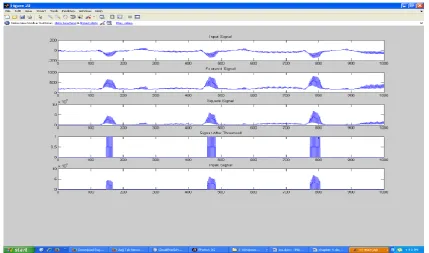
Figure 3: Signal Feature Process
Here figure 3 is showing the different process applied on input signal to generate the signal features. The first subplot of this figure is showing the input signal which is later on processed using filtration stage HMM to generate the signal feature. Third subplot is here showing the squared signal. Fourth subplot is here showing the threshold process results. The last subplot is showing the peaks obtained from the signal.
Figure 4: RR Interval Result
CONCLUSION & FUTURE WORK
In this paper, a feature adaptive SVM model is applied to perform the disease identification. The work is here divided in two main stages. In first stage, the feature extraction is performed. To extract the signal features, the predictive HMM model is applied. . As the features are extracted, the next work is defined to convert the signal in statistical form. Finally the SVM is applied for feature set classification..The results show that the presented work model has provided the significant results. In future, we can work with more critical disease such as sleep atnea.
REFERENCES
[1]. S. S. Mehta," Comparative study of qrs detection in single lead and 12-lead ecg based on entropy and combined entropy criteria using support vector machine", Journal of Theoretical and Applied Information Technology 2007 [2]. Mohamed Elgendi," Improved QRS Detection Algorithm using Dynamic Thresholds", International Journal of
Hybrid Information Technology 2009.
[3]. K. Vimala," International Journal of Innovative Research in Computer and Communication Engineering", 2014, ISSN(Online): 2320-9801 ISSN (Print): 2320-9798.
[4]. Saini," Cardiac Arrhythmia Classification Using Error Back Propagation Method", International Journal of Computer Theory and Engineering 2012.
[5]. Nicos Maglaveras," ECG pattern recognition and classification using non-linear transformations and neural networks: A review", International Journal of Medical Informatics (1998).
[6]. Jakub Kuzilek," Electrocardiogram beat detection enhancement using Independent Component Analysis", Medical Engineering & Physics (2012).
[7]. Ahmet Turan OZDEM˙IR," Fully parallel ANN-based arrhythmia classifier on a single-chip FPGA: FPAAC", Turk J Elec Eng & Comp Sci, Vol.19, No.4, 2011.
[8]. Yu Hen Hu," A Patient-Adaptable ECG Beat Classifier Using a Mixture of Experts approach", IEEE transactions on biomedical engineering 1997, 0018–9294/97@ 1997 IEEE.
[9]. S. Sumathi," Comparative Study of QRS Complex Detection in ECG Based on Discrete Wavelet Transform", International Journal of Recent Trends in Engineering 2009.