Romantie Beliefs and Myths in Spain
Ana Barrón López de Roda, David Martínez-Iñigo, Pilar de Paúl, and Carlos Yela*
Complutense Uriiversity of
Madrid
Data from a representative sample of the Spanish popuiation (1,949 participants between ages IB and 65) were analyzed túexamine Ihe strength of ihe principal romantic myths aud the link between sex, low, and marriage in Spain. A survey was made up and was administered by interviewers. The resulis show the strength of these myths and the relationship between the (bree above-mentioned variables. Wonien, people ~vithfewer ycars of formal education, and older people weremorelike¡ytú believein the myths and íhe relotion between sez, love, and marriage ‘vaS sironger in these groups. The findings are discusscd in lerma of different psychosocial theories.
Key wordv:~onIontíc,nvths,se.v, love, Iflarriage
rn este artículo se analizan los datos de una investigación realizada con una muestra representativa de la población española respecto a la vigencia de los principales mitos románticos y la vinculación entre sexo, amor y matrimonio. Se elaboré un cuestionario paraevaluar dichas variables, que fue administrado, en forma de entrevista, a 1.949 personas. Los resultados indican la gran vigencia de dichos mitos y la estrecha relación entre las tres variables indicadas anteriormente, especialmente en el caso de las mujeres, personas de mayor edad y con menor nivel de estudios. Los resultados se comentan desde diferentes teorías psicosociales.
Palabras claves: mitos románticos, sexo, amor, matrimonio
* Authors appear in alphabetical order.
This paper is part of Ihe research ‘Loving Behavior: A representative sample of Spanish population,’ funded by the Comision Interministerial de Ciencia y Tecnología, carried out by J. L. Sangrador García, A. Barrón López de Roda. P. de Padí Velasco, C. Yela García. anó O. Martínez Iñigo, and supervised by Florencio Jiménez Burillo.
Correspondence concerning this article should be addressed túl)r. Ana Barrón López de Roda. Departamento de Psicología Social. Facultad de Psicología. Universidad Complutense de Madrid. Campos cte Somosaguas. 28223 Madrid (Spain).
ROMANTIC MYTHS
SinceRougemonLs (1938) and Burgess and Lock&s (1945) pioneer works, myths aud cultural bel jeis concerning love, marriage, sex and [he interconnection between them has been considered a key issue to understand intimate relationships (Cancian, 1987; Crosby, 1973; Goede, ¡959; 1-letch, Marsion, & Larkey, 1994; Kayser, 1993; Martínez-Iñigo, ¡997; Noller, 1996; Solomon, 1988; Yela, 1995, ¡996, 1997, 1998). Recen[ly, Dion aud Dion (1996) have claimed more artention for cultural variables related to close re¡a[ionships. Despite rhe universal or particular nature of love, the main issue has been [he meaning and function that each culture, throughou[ diffcrent historical periods, has assigned to ¡ove, and [he consequences [bis has on intimate relationships (Jankowiak & Fisher, 1992). Taking into aceount te majorole leve plays jo human happiness, health,
and general satisfaction (Argyle, 1987; Baiión, 1990), and the relevance to the social síructure of interpersonal relations based en ove, marriage is s[ill [he comerstone of the farnily in our culture (Simpson, Campbel¡. & Berscheid, 1986; C.LR.E.S,, 1992). One can see that scientific knowledge of thesc issues could offer solutions abeur how te confrent and
solve te- preblerns, which may emerge in and froto rclatienships.
Sorne authers, belonging te academic research and clinical practice, luye pointed out Ihar expecrations, beliefs, and the meaning that subjects ahach to sorne events in their intimate uelatienships are seurces of disappeintment, lack of affection, and instability (Beck, 1988; Pien & Dion, 1996; Ellis & Grieger, 1977; Kayser, 1993; Noller, 1996). Mos[ of [hese beliefs are cultural censtructs sharcd by individuals. Each historical period has developed a differcnt view of leve, sex, and marriage; censequently, thc rela[ionship between these three elemenís has changed rhreugheut time.lii ancleol Greece, affectiverelatieoships (hctere~ and fundarnentally homosexual) were clesely linked [o the sexual sphere and clearly separated frorn marriage. In marriage, enly [he wife was required te be sexually faithful fo her husband, and the purpose of sex was exclusively procreatien. During [he Roman Empire, eretie and recreational pleasure was alse separate from marriage, linked to eccasional and speradic cenquests. In <he l-ligh Middle Ages, leve, marriage, and sexual pleasure were regarded as [hree independent entities te be satistied in different relarionships. Frem the 16th te the lSth century, arranged marriage centinued to exis[ simul[aneously wi[h extramarital “remantie leve,’ which was oeosexLval, originaring in medieval genteel leve. Since the beginning of [he l9th century, [he links between [he remantic leve cencep[s, marriage, and sexuality emerge, and [his trend was censelidated in eur cen[ury. From then en, remantic ¡ove ceased to be minority aud became popular and nermative. Marriage emerged as a personal choice; be[h remantic love and sexual satisfaction sheuld be satisfied
within marriage Gr a stable relatienship (Fisher, 1992; Hendrick & Hendrick, 1992; Iglesias de Ussel, 1987; Malo
de Molina, 1992; Martín Gaite, 1987; Ortega y Gasse[, 1926, 1952; Reugemon[, 1938; Selernon, 1988; Yela, ¡995).
Taking into account [bis historical process and the initial censiderations about culture and intimate relatienships, we carried eut a survey en a representative sample of te Spanish pepulatien in erder lo explore whe[her lay peeple hold the beliefs [bat sorne au[hors define as distinctive of contemporary leve (Averilí & Beothroyd, 1977; Ceek & McHenry, 1978; Geed, 1976; Hendrick & Hendrick, 1992; Liebowitz, 1983; Peele, 1975; Schaef 1989; Simen, Eder, & Evans, 1992; Simpsen e[ al., 1986; Sternberg, ¡988; Tennov, 1979; Van Sommers, 1987). Wc classiñed these beijeis, using [be recení review of scientific literature en intirnate-relationship beliefs carried out by Yela (1995). We consider tUs elassiticatioo useful lcr eur research aims. Cencretely, we assessed [he following myths er beliefs:
1. The equivalence myth: leve understeed necessarily as a strong passion, supposedly the same as “being in leve~’ (so that if one does not feel the same passion as in the first days, it means one does fol really ove ene’s partner, and should íherefere pul an eral te te relationship).
2. Ihe “heuer-haIf’ myíh: the belief thaI, in sorne way, [here is semeene predestined lot each person.
3. Re cxciUSIV«/WSS (of beingiii ¡ove> my[h: which
assumes that it is impessible [e be in love with twe people at te same time.
4. The eternal passion rnyth: [be belief that the intense passien of the firs[ síages, II it is real, will last, er it sheuld las[, foreven
5. The omnipotente (¡ove conquers oil) myth: which implies [hat [rus[ing real leve will get areund and everceme all ebstacles.
6. Thefidelity myth: which, iii lís extreme fermulatien, suppeses tha[ if someene is really in leve, he or she will always be sexually faithful [e the partuer (therefere, il ene is ne[ faithful, ene dees neí really leve one’s partner).
7. The Inarriage niyth: which censiders that leve, thaI is, passion er being in leve, is te ene and enly reason lot marriage.
8. The cauple myth: which síates that [he ceuple-relatienship is inheren[ te human nature and, as such, presení in ah eras and cultures.
As [entative hypoíhesis, we posited that mest people in Spain, as in other western ceuntries, would held <bese beliefs, whieh we called romanric rnyths. Mereever, we explered [he dilferences according te sex, age, and social and cultural level. Finally. we were interested in te cennection betwecn these myrhs, marriage, and sex. Accerding [o the historical precess described aboye, we expected [o find a strong connection be[ween these three elemenís. The role of seciedemographic variables was alse considered. This is [he Iirst time [bese issues were ernpirically [estcd en a representative sample of Spanish pepulatien.
Meted
Participanís
Participants were Spanish men (u=955)
and
women (n= 994). ranging freír 18 te 65 years of age, ¡iving in towns
of ever 2,000 inhabitants. including island previnces. In aH, 1,949 interviews were carried out. The participants were divided into ¡Wc age ranges: ¡8-24 years oíd (u= 367). 25-34 (u=487), 35-44 (u= 398), 45-54 (u =329), and 55-64
(a= 366).
We ernployed multiple steps and layers by clusters. selecting sample prirnary units (tewns) and secondary units (sectiens) randem¡y, aud the smallest unís (individuals) by random paths and quotas el sex and age. The layers were formed by correla[ing the 17 regiens te the size of habitat, divided inte seven categeries: Iess iban 2,000 inbabi[ants; 2,001 te 10,000 inhabilants; 10,001 te 50,000; 50,001 te 100,000; ¡00,001 te 400,000; 400,001 [e 1,000,000; and ever a million inhabi[ants. The sample error, a[ he level of cenfidence of 95 5% was + 2.23 for te whole sample.
Measu res
Eren the above-mentiened iheoretical backgrounds, a survey was created, which gathered informatien about <he follewing variables: degree el support of romantic myths, link between leve, sex, and marriage, seciedemographic variables (such as sex, age, and educador,) and the elher factors íhat the previcus review of specialized literature en leve shew te be related <heoretically or empirically te love relarienships, sexual aítirudes, sexual behavior, jealousy, and duration of ihe relationship (Yela, 1995). The survey was administered ir the forn of interviews, betwecn July 5 and 30, 1995.
Romaníic n¡yths. Each myth was assessed wirh a speciflc
iten, whieh was simply the descriptien of the myth (see aboye), with which <he subject expressed bis er her degree of agreement en a Sinterval centinuum: 1 = strot,glv
disagree; 2= disagree; 3 = neutral or mediuní; 4= agree; and 5= strougíy agree. The alterratives “den’t know’ aud “no reply’ were added. Wc also oblained a global myth score fer each subjecr, which was <he mean el <he stibjects sceres en <he myth iterns.
Link betweeti sex, leve, and níarriage. A set of ilems.
including the separatien be[ween each possible cembination of twe elernents from [he trio “sex, leve, and marriage,” assessed the cennection between these three elemenis. ihe subject specificd bis or her level el agreement en a 5-interval con dnuum, wherc 1 = e¡enients tvere completelv
connected aud 5 e¡eníen¡s Itere coníp¡etelv separate. Therefere, subjects had <o decide wlie<her lo exp]ici<iy accept or rejeer (point 3 being mediun¡ or neutral) sex
witheut niarriage, leve without marriage, sex without leve, love witheut sez, marriage witheut sex, aud marriage without leve. A general score fez se.x-mnarriage-ieve separation was cIsc calculated, represenled by ihe mean of the six preceding seeres.
/‘eelings ofjectlousv. Two dimensices el jealeusy (ernetienal and sexual, according te Buunk & Bringle, 1987) were assessed hy two items, with which the subject expressed his or her degree of agrcernent en a 5-intcrval centinuurn, where 1 = strongiv disagree. and 5 = síronglv
agrer. Lmetieral jealousy refers <o <be partner’s intiniacy
with ether people, aud sexual jealousy refers explicitly te sexual reiatienships.
A ttiníde íoíuards fiJe/ity. 5u bjects were requested te
exprcss <he impertance of fidelity lcr <bern en a 4-interval continuum, where 1 tun at alí itaportaní, aud 4 = verv
ímportatit.
Altraction towards oíhers. Measured by twe items,
subjects wcrc requested te cheese freír seven categeries, indicating <he number of peeple te whorn [hey Fiad felt sexually (en ene item) and emotienally (en the e[her) attracted. These categories were: “nene,’ “1,“ “2 te 4,” “5
te l0,~’ “11 te 20,’ “21 te 100,~~ “mere <han l00~
Sexual experience. As with leelirgs el sexual a[traction
tewards ethers, subjects were requested te check ene categery. indicatirg with how many peeple they had had sexual rela[iens, using the sane categoríes as mentioned aboye.
Years of jorníal educauion. One question requested
subjects te indicate the level el formal educatien they had achieved.
Religloas beliefs a,íd behavior. Seven optiens were
effercd: Cathoiic, other reiigiens, indifferent, agnostic, atheist, ce open eption, and “1 don’t know er no reply”. Wc greuped tegether the “believers’ (Carholics and echer religiens) en the one hand. and <he “non-believers” (atheists and agnos<ics) en the ether. Wc alse asked abeul te frequency of attending church services (categeries were never a kw tutíes a vea,; a few titties a mon.th, alitiost «ven’ Sitada y. and severa! dais a week).
Finally,WC alse asked suhjects about Iheir sex. age, and duratien of their reiationship.
Results aral Discussien
Roníande Myths
Thc first data analysis previded us witb the global percentages, the difference of mean scores between men and women, and Pearsen’s cerrelations between certain sociedemegraphic variables, such as age and level of studies. it is importad te note <he s[rength el romantic my<hs in rernan<ic reialionships in etir .society nowadays (see Tables
ROMANT1C MYTHS
Table 1
Percentage of Behevers ir Mxths, Means, Standard Deviations, atíd D~fferencesiiiRo¡nantic Myths, according lo Sex
Myth % believers
Men Won,en Difference Total
¡14 SD a M SD u í M SD
Equivalenee “Better-half’ Exclusiveness 45 50 55 3.12 3.04 3.23 1,18 1.26 1.26 924 934 934 3.10 3.34 3.39 1.26 t.21 1.3(1 965 964 966 ~ ~5.32* ~.2,69* 3.11 3.19 3.31 1.22 1.24 1.28 Bernal Passion Omnipotence Sexual Fidelity Marriage Ceuple 65 25 80 85 95 3.56 3.84 3.91 3.99 4.30 1.16 1.05 0.99 1.03 0.68 938 943 947 944 947 3.59 3.99 4.16 4.23 4.37 <.23 1.02 0.91 0.86 0.65 971 966 987 990 990 ~ ~335* ~5.86* ~5.69* — 3.57 3.91 4.03 4.11 4.33 1,02 1.03 0.96 0.95 0.66
Global my<h seGre 75% 3.63 0.58 865 3.28 0.57 875 —5.54’ 3.71 0.52
Note. Empty celís indicate statiscally nonsignifican< dilferences.
*p<.01
Table
1 reveals [hat 75 % of <he sample seored higher than 3 en <he global myth scere (which measured agreement with rornantic myths). Only 15 % scered 3 er below (thc remaining 10% did not repiy te any my[h items).Cencerning significan[ sex diflerences, Table 1 shows that wemen expressed síronger beliel in live of <he eigbt myths (better-half, exciusiveness, emnipetence, sexual fideiity, md narriage). The fact thai women believed ir rornantic myths mere than men is in accordance with the greater value they place en remanticisn in eccasional relatienships as well
as in stable enes
(Dien & Dien, 1979; Houston, 1981). On the ene hand, sex diflerences can be explained by [he differential secializatien process el sex. Sociobiologists peint out that te choese a love-sex strategy, which wouid newadays be considered romantie, has higher repreductive value for women, prebably because of their greater adaptive capacity from an evelutienary point of view.n E a, E 45. 4,4— 4,3— 4,2— 4,1— 4— 3,9— 38— 3,7— 3,6— 3,5 3,4— 3,3— 3,2— 3,1— 3—
When we censider the nyths aitogether,Wc alse observed a slightiy stronger belief in wornen (general rneans were 3.63 and 3.78 br men and wemen, respectiveiy, p = .000, as seen ir Table 1).
Although <he sex differences were sta[is[ically significan[, they were s[ill síralí and the mean for men (lewer than [hat el wernen) fer ah myths was always over 3 (<he so-cailed
rnedium rarge value
-
althougb we cannel be sure of <he psychelogical rneaning of that central value as a “medium” or “central’ point, as acknewledged by alí researchers en a[titudes). There were no statisticaily signif¡cant differences in [he equivalence mytb (M = 3.12 and 3.10 fer men and women, respectively), [he eternal passion myth (M= 3.56 and 3.59 ter men and women, respectively), and <he ceuple myth (M =4.30 and 4.37 br mer and women, respectively). This shows [he strength of remande myths in today’s Spanish pepulation.E Men
E
WomenEquiv ‘Beller Hall
Ev
Excius Elernal OmnipRomantio myths
F¡delily Marriage Cauple
figure 1. intensi<y of <bebelief o romantie my<hs o<beSpanish pepuia<ion.
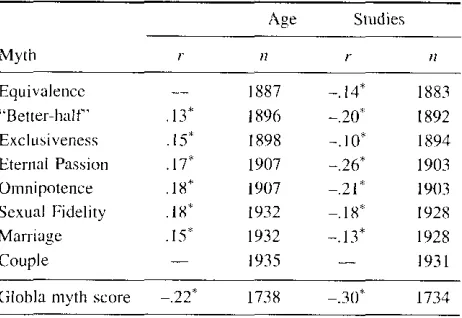
As displayed in Table 2. the majerity el the rornantie
my[hs
cerrelate pesi<ively, although enly medera<ely, withage (the correlation be<wecn age and the global seore was
r= .22, p
.000). The dilferences between the remantie
heliefs of <he yeungesr group (18-25 years) and <he oldes< greup (55-65 years)— where <he grea<es< dillerences wereobserved — we¡e almos< always rela<ively srnall, and. in any
case, síraller than expec<ed (assuming
<hat yeung peeple possess certain eharac<eristics, sueh os rebellieusness, noneenforrni<y, etc.). It rnay be <hat the new generations are sornehow mere conservative than the previous enes, and <his includes issues of leve and sex. Hewever, remandemyths seern te be very ex<ended.
Cenceming <he cerrelarions between rornantic rnyths and level of studies (see Table 2), they were. in general, negative and statis[ically signilicant at [he level of cenfidence of 99%.
In sorne cases, sueh as <he eterral passien my<h and
the global my[h seore, tbe correlatien was higher [han r= -.25, p= .000.
Significant eorrelations and dilferences alse appearcd when taking into account religicus beliefs. Agnosties and atheists (n = 177) seored 3.25 en <he global mylh score, whereas helievers (almest ah were Cathelics) scored 3.80. p .000. Religieus behavier was positively ard signif¡cantly related <e alí my[hs, aud also te <he global myth sco¡e, r .25, p=
.~U. Therefere, belief
iiiremantie nyths was stronger ter Cathelics asid peeple with a Iovíer leve1 el educatien, asid weaker br agnes[ics aud people wi<h higher educatien levels. However, as shewn in Tables 1 and 2, Wc wiIl analyze each myth separately:1. The equivalence ínyrh. This was accepted by 45% of
<he sampie (scoring 4 er 5), whereas 40% rejected it (seoring
1 er 2; only 7% tetally disagreed), and <he rernaining
15 % were made up of those whe were deubtful (scering 3) 01 <lid not reply. There were no statisí.ically significare dilferences In sex er age, but, OR the edier haud, we feund a statistically significant negative relatien with the level of studies, r=-.14, p < .01. Belief in <his myth has a notable effect en
remande rclationships. Psychesocial inves<igations have sta[ed
tha< physieiegieal, psychelegical, and interpersenal relation processes, <ypical of <he intense state of “falling and being
in leve,” sIowly lade away and <urn into different processes
as the relationship develeps (Liebowitz, 1983; Selomen,
1980; Sternbcrg, 1988; Wilson. 1981; Yela, 1997). That is why it is imper<an< leí beth members of <he ceuple te aceept Ibis change as senething natural instead of experiencing it as traumatie, as is usually <he case.
2. ‘[he better-haif ;nyth. This my<h was aceepted by 50%
of the sample, whereas 35% disagreed (answers in total
disagreement did not reach 10%). Tbis is where scx differenees were mere proneuneed (but only 3.34 Vs. 3.04 for wemen and men, respec<ively). Women agreed mere, as with the rest el <he myths. Resui<s showed lhat belief in ¡lis rny<h increased wi<h age, r = .l3.p < .01, and tended te deerease witb <he level el studies, r = -.20, p < .01.
Table 2
Correlations between Roníantic Alvrhs, Age, aíd Siudies
My<h
Age Sudies
r a
Equivalenee ..-. 1887 ~.l4* 1883
‘Beí<er-half .13 ¡896 —.20’ 1892
Exelusiveness .15 1898 —.10’ 1894
Eternal Passion .17 <907 ~.26* 1903
Omnipetence .18 1907 ~.2¡* ¡9(13
Sexual Eideli<y .18 <932 —. IR’ 1928
Maniage .15’ 1932 ~,l3* 1928
Ceuple — 935 — 193<
(ilobla rny<h seore —.2t 1738 —.3<) 1734
Note. Emp<ycelE indicate s<a<i.seally nensignif¡ean< differenees.
*p < .0<
3. ‘[he e.rclusive,iess <ff1,Ciap ja love myíh. Thi s was
accepted by 55% of <he sample (enIy 8% disagreed <otally). Mere women tended <o share ¡he belief as did older people and <hese wi<h a lower level of studies, al<hough these diflerences were ne< large in either case.
4. ‘[he eternal passion nívth. This myth is a problem
because, seoner os later, it conrradicts reality- due te
well-knewn physiolegical, psyehelogical, and interpersenal processes, fer exaniple. sa<uratien. reduction of uneertainty, <oleranee, [he Ceelidge effecí, <he law of changing emo<iens, etc. (Frijda, 1988; Skinner, 1953; Selomon. 1980; Wilson, 1981). Never<heless, it was shaíed by appreximately two íhirds el <he sample, whereas barely 5% of the sample disagreed te<ally with <he myíb. Beth men and women believed in it: tlíis myth cerrelated pesitively with age, r= .17, p < .01, and ‘vas the ene witl< the highest correladon with <he level of studies, r=-.26, p < .01.
5. ‘[líe o;nnipotetice ,nvth. This my[h xvas aceepted by
75</o of <he sample; only 2% disagreed to<a¡ly. As witb <he
previcus my<hs, the belief was weaker among ¡he yeungest and <hese wi<h a higher level el studies. Up te 85% el <he people wi<h no síLidies aud abou< half of <he pos<graduates accepted <his behiel as <rue.
ROMANTIC MYTI-IS
69
Table 3
Percentage of Accepuance of I)is.s’ociation of Love-Sex-Marriage: Means, Standard Deviations, aud Diferentes Aeeording lo Sex
D¡mens¡ons
<Yo Who agree Agreemen< Men Women Diff.
Men Wornen lotal M SL) M Sl) o M Sl) o u
Sex without Marriage Leve wi<hou< Marriage Sex without Love Leve without Sex
82 70 63 34 66 65 1.3 30 74 67 47 32 3.74 3.57 2.91 2.57 1.23 1.21 t.44 1.31 3.98 364 3.38 2.66 1.05 1.16 1.34 1.28 946 919 940 929 3.52 3.50 2.46 2.47 1.34 1,24 1.40 1.33 976 962 976 957 8.33* 2.32* 14.1< 3.15* Marriagewithou<Sex Marriage without Leve
<8 <9 21 18 8 8 2.14 2.01 1.18 1,21 2.10 2,02 1.14 1.21 933 927 2.19 2.00 1.22 1.2< 952 973 —
Global my<h seGre
(separation of ¡líe three} 2.83 0.80 2.97 875 868 2.70 0.84 896 7.35’
Note.Ernp<y celís indicate stauiscally nonsigniñcan< dilferences.
*i’<.0<
we enphasize [hat <he nyth was expressed ir its mes[ radical
fern. The influence of <he seciecultural lactors can be seen
in the signiflcant correlations revealed be[ween belief in [his
myth and age, r= .18. p < .01, and with the level of studies,
r= -.18, p < .01.
7 ‘[he ¡narricuge ;nyth. The marriage myth was accepted
by 85 % of <he sanple. Ihese data are similar lo those of other s[udies carried out recently abroad (Simpson et al., 1986) as well as in Spain (C.I.R.E.S., 1992). As with the rnajeíity el the ether myths, wemen, older peeple, and <hese
with a lewer level of s<udies accep<ed it more, p.< .01.
8. ‘[he couple ,nyth. Finally, [he ceuple myth was
accepted by almost ah the sample (over 95%). whereas only 0.6% disagreed tetally. Its acceptance was se everwhelming, [hat it ended up being independent of sex, age, er level of studies. Nevertheless, as social sciences have shown (Fisher, 1992; Ford & Beach, 1951; Nie<e, 1989; Rosenbla[t & Andersen, 1981; Wilsen & Nias, 1976), <he ceuple is lar from inherent te human na<ure, nor is it presen[ in ah cultures (polygamy, etc.). Once again, Wc can see the imníense power of wha[ we ceuld calI “remantie secialization” en eur atti[udes and beliefs regarding leve and romantie relatienships.
We will new cornrnent en the correlatiors ebtained be<ween the “general beliel in myhs” seere with other variables studied in <he investigation. Specificaliy, taking inte consideration only <he correlations higher <han .20, general belief in rny[hs was pesitively correlated wi<h: (a) duratien of the rela[ionship, r= .26, p = .000 (semewhat
surprisingly; maybe it can be explained by Bem’s seIl-percep<ion theery. 1972); (b) feelings of sexual jealousy, r
— .26, p= .000: and (e) attitude towards fideli<y, r .25. p
— .000. On <he other hand, it was nega<ively correlated with:
a) separa<ion of sex, leve, and marriage, r = -.29, p= .000;
b) leeling sexual attraction towards o<hers, r = -.28. p
.000; and c) sexual experienee, r = -.23, p = .0(10.
Liízk betweeíi sex, ¡ove, nuid marríage
Conceming <he link between sex, leve, and marriage (see Tables 3 and 4, and Figure 2), <he results suggest that, as a rule, Spaniards tend <o accep< tha< leve and sex de exist outside of marriage (altheugh, of ceurse, percentages are far frorn 100%). 1-lewever, it is dillicu¡t for <be Spanish population te understand sexual relatiens witheut leve, or leve witheut sexual relatiens, or, even mere se, marriage
wi[hout sez or without leve.
On <he global score, obtained by averaging <he seores
en <he six items, nearly 50 % of [he sample seored below
3 (that is, they disagreed with the dissociation of the dimensions), lO % seored in the explicitly medium peint,
ane<her lO % was missing, and 30 % scored aboye 3 (that
is, [hey agreed with the dissociation of [he <bree dirnensiens).
Less than 5 % obtained a global seere of 4 or aboye.
Table 4
Correlations hetween aud Age a¡¡d Studies
Dissociation of Love-Ses-Marriage
Dimensions
Age S<udics
r o r o
Sex wi<hout Marriage Leve withou< Marriage Sex withour Leve
—.40< —.24< —.28’ 1920 1879 1914 .18* .15< .16* 1916 1875 1910
Luye wi<hout Sex —.10 1884 — 1880
Marriage wi<hou< Sex Marriage wi<hout Leve
— — 1883 1898 — 1879 1894
Global L-S-M score (dissociation of <he three)
—.30< 1762 .17< 1758
3
MenE
Werner¡ ¡
Leve ¡ Marriage Sex 1 Leve Leve ¡ Sex
Pairs of concepts
HT
Marriage1 Sex Marriage 1 Sex
Figure 2, Accepranceof the dissoc¡ation of <he pairs of concepts. (Slash rneans “wi<hout.) Higher coIurnns indicate mere aceeptanee of <he dissociation. Lewer colurnns indicate <bat [he dissocia<ion of <he concep<s is r~jec<ed.
Qn the other hand. coinciding with [he resuIts obtained by
other authors (Avia, Canille, & Rejo, 1990; liuss & Schmitt. 1993;
Clark & Hatf¡eld, 1989; Fea et al., 1987; Hendrick &
Hendrick, 1992; Yela, 1995, 1998), wemen <ended <o perceive such phenomena as mere clesely related than men, with greater sex differences appearing in the legitimization el loveless sex or sex ou[side of marriage. Por example, 63% of <he men
approved of leveless sexual relationships, as cempared te 33%
of the women; the difference between the means (3.38 vs.
2.46 br men and women, respectively) was proneunced and highly significant, p= .000.
As a rule, we ebserved a tendency fer older peeple <o perceive less dissocia[ion between leve, sex, and marriage,
r = -.30, p < .01,
especially with regard te the lalter [wo.
Thus, 59% of the yeuths (18-25 years) legitimated loveless
sex, as cempared te 25% el the eldest greup (55-65 years). Whereas 90% of <he yeuths appreved of sex outside of
marriage, this percentage dropped te 44% arnong the eldest
group (see Table 5).
With
regard te these aspects (legitimizatien of loveless
sex, sex outside el marriage, and leve witheuí malTiage), it seenís [hat a higher level of studies coincided with
pernissiveness. that is te say, greater accep<ance of discenneeting the three dirnensions. Tbe correla<ion between <he “separation el sez-love-marriage” and the level of s[udies xvas r= .17, p < .01. Ihus, anong college graduates, the
percentages of people <ha[ accepted such separa<ions reached 63% (leveless sex), 85% (sex witheu< narriage), and 74% (leve withou[ marriage), whereas arnong people with no s[udies, those percentages were 30%, 44%. and 46%, respectively. On the other hand, the concep<s el Ieveless er sexless marriage, and leve wi¡hout sex were ve¡y uncomníen and this did no[ seem te be iníluenced ei[her by age oc level of studies, indicating that it is a learned social factor (see Table 6).
Ilie separation be<ween sexual relatiens, leve, and narriage was alse modera[ely related with religious belicís (agnostics-atheists’ mean was 3.24 vs. the Catholics mean. 2.74, p =
.000) and wi<h religious behavior, r - .28,¡~ .000.
As in the case of romantic myths, we would like te highligh< the correIations el the variable “separation of sex-love-marriage’ wiíh other relevant variables of <he investigation. In <his case, we obtained positive correlations (always higher than .20) with: a) sexual experience, r= .25,
Table 5
Percentage of Acceptance of Díssoeialion of Love-Sex-Maíriage According to Age Range
Age ranges a¡íd number of subjects in cadi range
<8—24 25—34 35—44 45—54 55—64
Dimensions o = 367 n = 487 o 398 o = 329 o = 366
Sex withou< Marriage 90 87 81 61 44
Leve wi<heut Marriage 77 78 71 60 47
Sex withou< Leve 59 58 52 37 25
Luye without Sex 34 36 35 28 24
Marriage without Sex 22 19 20 <7 7
Manlage without 1~ove 16 20 22 <7 13
4— 3,8—
E 3~—
o
,~ 34—
o o
~ 32—
—o 3—
~ 2,8— E
<e ~
2,6-O) ~ 2,4—
2,2—
2
ROMANTIC MYTHS
Table 6
Pereentage of Acceptance of Dissociauion of Love-Ses-Marríage According to Educatinnal Leve!
hEducational level and number of subjee<s in each level
Nene Primary Secendary Associa<e Degree Seme College College Degree
Dírnenstoes u = 223 it = 355 778 it = 208 u = <4< u = <45
Sex without Marriage 44 57 82 91 80 85
Love withou< Marriage 46 54 78 78 76 74
Sex without Leve 30 33 31 63 45 63
Leve without Sex 25 27 32 39 32 37
Marriage without Sex 16 ¡8 20 20 17 21
Marriage withou[ Leve <5 15 19 18 20 27
p= .000; and b) leeling sexual attractien <ewards others, r
— .21,p= .000. At <he same time, we eb[ained negative
correlatiens with: (a) dura<ion el <he relationship, r= -.32,
p= .000; (b) belief in nyths, r = -.29, p= .000; and (c)
a<ti<ude tewards fídeiity,
r = -.20, p = .000.Cencluding Comments
The
data obtained suggest tha< Spanish society s<rengly
accepts most of <he remantie myths (especially elder people, religious people, and people with fewer years of formal edueatien). At <he sane time, women tend te be slightly more remache <han men, especialhy cencerning [he impertasice of sexual “loyalty” ter dieto. Finally, vuith regard te belicls about leve, thcre secms <o be an important trend
te iink leve with sez and with marriage, and <bis is also more
proneunced among wernen, elder peeple, religieus people, and peeple with fewer years el formal education.
I3asically, ah these general <rends cenlirm what was expec<ed, <aking inte account the roles and the implicit precedures by which peeple become socialized in our culture. Re dilferences between sexes can also be explained from a sociobiohogical approach, theugh [his explains more abeut <he origin el <be diflerences rather <han <heir
maintenance and current strength.
We believe the censequences el holding thesc beliefs and
niytbs deserve sorne consideration. For instance, [he impact tbat hinking marriage necessariIy [e passienate leve has en
<be stability of marriage. Several au[hors have theorized abeut the paradex of <he stabi¡i<y of a social institution such as marriage, built en <he exis<ence of an emo[ienah link as vulnerable aud lluctuating as te feeling experienced in te firs[ phases of <he rehatienship (Liebewi[z. 1983; Mathes & Wise, 1983; Ortega y Gasset, 1917; Reugement, 1938; Wihsen & Nias, ¡976). Sorne el the possible negative ellec<s <bat [he cennec<ien be<ween passien and marriage coníd produce are: idealization, negauive evaluatien of conflicí, internal a<tributien el negative aspec<s, and, aboye ahí, disappoinímcnt with <he relationship.
The use el romantie myths as a standard by which te
evaluate relationships generates expecta[ions that are difflcul<
te meet. The irnpessibility of maintaining the original
idealization (Beek, 1988; Graziano & Musser, 1982; Kers[en
& Kersten, 1988) at times becemes a seurce of dissatisfaction
with the relationship, whieh leads te [ypical negative behaviors (avoiding interactien, lack el emotional suppert <owards one’s partner, separate decisien-rnaking, decrease in jeint activities, etc.) <bat make it hard te main<ain <he relationship (Kayser, 1993). The beliel that enletien
(passiona[e [ove) is a necessary aud suff<cient condidon fer maintaining a relationship leads te atti[udes and behaviers <Fiat are harreful br <he stability of a long-temí relationship. One of [hese attitudes is <he negative interpíetation of cenflict,
ja which confliel is considered a symptorn of indifíerence. Ihese internal attributiens of <he causes el <he cenflict (“II
we have preblems, it mus< mean that we den’t leve each other”) have a negative effect en satislaction (Bradbury &
Fincbam, 1990, Barrón & Martínez-Thige, in press). The
beliel <ha[ “comrnunicating about [he situation el the relationship is destruc<ive, ineffectual, lu<ihe, and dangereus” (Bax<er & Wilmot, 1985), also hinders management and reselutien of contlicts.
Censequen[Iy, in order te ob[ain satisfactien and stability
in hong-<erm relationships such as maniage, [heceuple sheuld
restructure and medify part of <heir behiels and nyths. en which they based <heir initial expec[atiens before <he rehationship began. The studs’ and comprehensien of <his
restructuring process will be of great hehp in [emnísof
<herapeutie in<ervention. This is a prornising trend br lu<ure research.
Referene es
Argyhe. M. (1987), Thc ,tsychology ofhappiness. New York:
Methuen.
Averilí. IR.. & Boothroyd. 9, (1977>. On falling in leve o conformance wiíh the mmantic ideal.Mcd¡‘atico ant! Emotion,
3.235-247.
Avia. MD, Carrillo, J.M., & Rojo. N. (<990). Personalidad y
diferencias sexuales: el papel del sexo, la edad y la experiencia.
Revista oc Psicología Social, 1, 7~22.
Barrón, A. (1990). Estrés vital, apoyo social y creencias de salud. In 5. Barriga. J.M. León. M. Martínez. & 1. Jiménez (Eds4. Psicología da la salud (PP. 197-2 18). Sevilla. Spain: SEDAL. BarrénA., & Martínez-iñigo, O. (iiipressj. Patrones de atribución
y estabilidad matrimonial: atribuciones de causalidad y responsabilidad en una muestra de casados y divorciados.
Psicothenía.
Baxter. LA.. & Wiimot. W.N. (<985). Taboo topies in clese
relatienships. Joarnal of Social ant! Personal Relarion.rJ,ips,
2, 253-69.
Beck, A.T. (1988). tova is never eoough. New York: Goilford I’ress.
Bem, Di. (1972). Selí-perception theory. In L. Berkowitz (Ed.),
Advances ¡o axperimenla! socio! psychologv (Vol. 6). New
York: Academie Press.
Bradbury, T.N., & Fincham. F.D. (1990). At<riburions in marriage: Review and cri<ique. P.¡ychological Bulletio, 107. 3-33.
Burgess, E.W.. & Locke.Hl. (1945). TOe fa,oily: Ero,,, in.stúurioo to companionships. New York: American Bock.
Buss,DM.. & Sehmitt. D.R (1993). Sexual stra<egies theory: An
evolutionary perspective on human mating. Psvcho!ogical Review, /00, 204-32.
Buunk. B., & Bringle. R.G. (1987). iealousy in ove rela<ionships.
In D. PerIman. & 5W. Duck (Edsj, Inliníate relauionships (pp.l23-I48). Beverly Huís, CA: Sage.
Cancian, F. (1987). LaveliiArnerica: (Janderand .selj’developn¡ent.
Cambridge, MA: Cambridge University Press.
C.l.R.E.S. (Centro de Investigaciones <lela Realidad Social) (1992).
La realidadsocio! en España. Erandio. Spain: Ellacuría.
Charlo R.D.. & Hatf¡eld. E. (¡989). Gender differences in receptivity ro sexual offers.Journal of Psycho!ogvant! 1-fuman Sc.rualilv,
Z 39-55.
Coek, M.. & McHenry, R. (1978). Sexual altraction. Oxford, UK:
Pergamen Press.
Crosby. iP. (1973). Illusion ant! disil!usioo: ‘[he selj jo ¡ove ant!
toarríage. Belmont. CA: Wadsworth.
Dion. K.K., & Dien K.L. (1996). Cultural perspec<ive en rt,mantic
¡ove. Personal Relationslzips. 3. 5-17.
Dien, KL., & Dien, K.K. (1979). Penonali<y and behavier correlates of remande leve. In Nf. Cook & O. Wi seuj (Ed.s.). Lave ancí alíraction(pp. 213-220). Oxford, <.1K: Pergamon Press. Bilis. A.. & Grieger. R. (>977). Hcndbock of ratioaal-emouive
rhcrapv. New York: Springer-Verlag.
Fisher. 1-1. (1992). The anatnmvcf ¡cíe. New York: Norton.
Pca, V.G., Andersen. B., Converse Jr. 1., Urbansky, W.A.. Cawley. Mi., Muhihausen, SM.. & Tornblem. K,Y. (1987). Gender-related sexual a<ti<udes: Some cross-cul<ural similarities and differences. Sex Rolas. 16. 511-519.
Ford, C.S.. & Beach, FA. (1951). Palteros ofsexual helíavior.
New York: Harpor & Row.
Frijda. N. 11. (1988). The laws of ernotion.American Psvchoíogist.
5. 349-358.
Geod. L.R. (1976). Beliel in romantie leve.Psvchology. 13, 6-7.
Goede, W.J. (1959). The <heoretical importance of l,ve. American
Socíological Revíew24.38.47.
Graziano. XV.. & Musser, L.M. (1982). The joining and <he parting
of <he ways. in 5W. Duck (Ed.), Personal relationshíps 4:
D i.sso 1v i’¡ g ~>e rsoo al re/aulo oslí ips (PP~ 75— 1<16). London: Acadcniic Poss.
Hendrick, 5.. & Hendrick. C. (1992). Li/do5, !oviog, ant! relauiog. Pacifie Greve. CA: Broeks Cole.
Helch. M.. Marsten. Pi., & Larkey. L.K. (1994). Leve ways and reí at ionsh ips qoal Uy. Jouroal of Social ant! Personal
Relalionslíips, 11. 25-43.
Houston. L.N. (1981). Romanticism and eroticism ameng Black and Whi<e cellege students. Adolesceoce, 16. 263-72. Iglesias de lJsscI, J. (1987). Sociología del noviazgo en España.
Granada, Spain: Caja General de Ahorros y Monte de Piedad de Granada.
iankewiak, W.R., & Fiseher, EF. (1992). A cross-cultural perspective on romantie leve. Erhnology, 3/, <49-155. Kayser. K. (¡993). When ¡ove dies: ‘[he process of marital
dtsaffacíio,,. New York: Guilford Press.
.Kersíen. K.K.. & Kers<en. L.K. (¡988). Marriage ant!lOe fonuily:
Srudviog e/ose relaíionships. New York: Harper & Row. l.iebowilz. M. R. (1983). lije chemistre of lave. Bos<on. MA: Lit<le
Brown.
Malo de Molina, C. (<992). Los españolesyla sexualidad. Madrid: lemas de Hoy.
Martín Gaite. C. (1987). Usos amorosos en la España del~. XVIII.
Barcelona: Anagrama.
Martínez-Iñigo, D. (1997). Aspectos psicosociales de los procesos
de disolución de las relaciones interpersooaíes íntimas.
Lopublished doctoral disser<ation. Complutense University of Madrid, Spain.
Mathes. E.W.. & W¡se, PS. (1983). Reman<ic leve and <he ravages of eme. Psvchologícal Reporus, 53, 839-846.
Nieto. 1 A. (<989). Cultura ysociedad e,, las prácticas sexuales. Madrid: Fundación Universidad-Empresa.
Neller, 1>. (1996). What 5¡his thing called leve? Defining <he leve thai supports marriage and fami¡y. Personal Relatíooships, 3, 97-115.
Ortega y Gasset. .1. (1917). Para la cultura del amor. Obras
Co~op¡eras(1< cd,. Vol. II. pp. ¡38-145). Madrid: Revista de Occidente.
Ortega y Gasset, 1. (<926). Sobre el ‘amor cortés.’ Obras
Ccñnp/e:as (W cd.. Vol. /11. pp. 442-446). Madrid: Revista de
Occidente.
Ortega y Gasset. J. (1952). Prólogo a “EJ Cellar de la Paloma.”
Obras Completas (U” cd,, Vol. VII, pp. 41-55). Madrid: Alianza/Revista de Occidente.
Peele, 5. (<975). Lave ant! oddictioo. New York: Taplinger. Rosenhla<t, PC.. & Andersen, R.M. (1981). Human sexuality in
c¡oss-cuitural perspectivc. In M. Coek (EJ.), lito bases of human
sea-aa! autraczlo,, (pp. 215-25<)). New Yorlc Academie Press.
ROMANTIC MYTHS
.73
Scbaet A,W. (1989).E.¡ca¡efro;n inñmacw ‘[he p.set¿do-relauionship oddic¡ioos. San Francisco, CA: Harper & Row.
Simon, R.W., hEder, D.. & Evans. C. (t992). The develepment of feeling norms underhying romantic leve among adolescent fenia¡es.Social Psvc/íologv Quarteriy, It 29-46.
Simpsen. i.A., Campbell. B., & Berseheid, E. (1986). The associatien between remantic leve and marriage: Kephart twice revisited,
Persona/ityant! Social Psvchology /3ullauio. /2. 363—22. Skinner. B .F. (1953). Sc/ence an.d human i,eha y/os. New York:
Macmillan.
Sohomon. R.C. (<988). Ahouu love. New York: Simon & Sehuster. Sohomon. RL. (<980). The opponent process theery of acquired inotivatien: The costs of pleasure zod che benefits of pain.
American Psvchologi.sí. 35. 691-7 t2.
Sternberg, R.J. (1988). ‘[he triongle of lave: Innimacy, pass¡on,
commitmcot. New York: Basic Beoks.
Tennov. 0. (<979). Leve and unieron ce. New York: Stein Day. Van Semníera, P. (1987). Jealon.sy Whaí is ji? V¡’ho ¡ce/a- it?
London: Penguin.
Wil.sen, (3. (1981). fue Coo//dge úI/tci.An avohajonorv ctr.connt
ofhamon sexoalitv. New York: Mtwrow.
Wilson. G.. & Nias. D, (1976). Love my,steries. Glasgow, UK:
Collins,
Ye la. C. (>995). Análisis psicosociolágico del cúrnportcimictato
amoroso. Unpubíished doctoral dissertation, Complutense
University of Madrid. Spain.
Yela, C. (1996). Componentes básicos del amor: algunas matizaciones al modelo de Sternberg. Revista de Psicología Social, 1/,
¡85-201.
Yela. C. (<997). Curso temporal de los componentes básicos del amor a lo largo de la relación de pareja. Psicot/zema, 9, 1-lS. YeIa. <2. (1998), Diferencias entre sexos en los juicios verbales
sobre su comportamiento amoroso y sexual. Revista de
Psicología General yAplicada, 5]. <¡5-147.