Research Journal
Volume 9, No. 28, Dec. 2015, pages 134–138
DOI: 10.12913/22998624/60801 Research Article
Received: 2015.10.04 Accepted: 2015.11.14 Published: 2015.12.04
THE ROLE OF COMPUTER ANIMATION IN TEACHING TECHNICAL
SUBJECTS
Krzysztof Dziedzic1, Marcin Barszcz1,
Magdalena Paśnikowska-Łukaszuk2, Agnieszka Jankowska2
1 Fundamentals of Technology Faculty, Lublin University of Technology, Nadbystrzycka 38 Str., 20-618 Lublin,
Poland, e-mail: [email protected]; [email protected]
2 Student of the Fundamentals of Technology Faculty, Lublin University of Technology, Nadbystrzycka 38 Str.,
20-618 Lublin, Poland
ABSTRACT
Computer animation has a positive effect on memorizing knowledge by students. Used in the process of teaching of technical subjects, it is conductive to the development of mind. Animation allows to familiarize the students with the schemes of solving technical problems and shows the mode of operation of machinery and equipment. In the technique, animations are used, inter alia, in the processes of designing, engineer -ing calculations, visualisation and monitor-ing technological processes and visualisa -tion of assembly processes. The article discusses the role of computer anima-tion in the teaching process and the examples of applications using computer animation and supporting the teaching process of technical subjects. Selected examples of technical processes in both computer-aided design and manufacturing programs as well as in graphics and animation programs are presented.
Keywords: computer animation, teaching, computer-aided design.
INTRODUCTION
Nowadays it is possible to use a lot of teach -ing materials in the teach-ing process to support
the work of a teacher and facilitate memorizing the material by students. It is worth noting that
along with the development of technologies in education the innovative solutions for the transfer
of knowledge are being introduced. Many teach
-ers use computer programs which familiarize stu -dents with solutions for solving some problems that are encountered in the classroom and help
them deal with problems in both everyday life and future career. Memorization process is influenced by many factors. Human mind develops during the performance of brain-training exercises. Skil
-ful brain-training exercises affect the rapid pro -cess of remembering. The human brain consists of two hemispheres. The right hemisphere is re-sponsible for creative thinking or spatial
imagina-tion, while the left hemisphere is responsible for logical thinking. In the teaching process, it is es -sential to introduce visual elements that will help
develop the right hemisphere, but also mathemat
-ical elements, logic puzzles, geometric shapes, etc., which support the development of the other
hemisphere. Such solutions affect the so-called
brain synchronization and thus its development, faster mastery of knowledge and the process of understanding the problem [1–3]. Therefore, so -lutions supporting the development process are
introduced into the teaching process. An example
of such a solution is computer animation. Using it
in the process of teaching, facilitates students’ re -membering the material and gives them a general idea of a given issue.
The use of computer animation in the
in-dustry is very broad. In practice, all automated
industrial processes does the animation support
at every stage of “life” of a product, starting from conceptual and design phases, through manufac
-turing, operation and withdrawal of a product from the market or its disposal. Currently, the so-called “virtual manufacturing” is developed very intensively. The use of computer-aided techniques CAx in designing and manufacturing supports visualisation processes, including both technology and production process control. CAx programs (CAD/CAM/CAE) are part of systems that control the life-cycle of a product (product life-cycle management – PLM). CAx programs are widely used in the process of teaching tech
-nical subjects [4–6].
COMPUTER ANIMATION IN TEACHING
TECHNICAL SUBJECTS
Computer animation is a process of creating a series of images appearing one after another syn -chronised into a single whole and causing the so-called image animation effect. Animation shows
the mode of functioning of many elements. It has
wide application in the processes of teaching of
various technical, medical and natural science subjects. A still image is more and more frequent
-ly substituted by an image that changes over time – animation – while presenting different types of content. In technical disciplines, computer ani
-mation is used, inter alia, to teach subjects related to material science, both engineering and utility graphics, fundamentals of machine design, auto -mation of processes and production engineering.
It shows the way of operation of many machines
which makes it easier for students to design such
a machinery, join its parts into a single unit, as
-semble, etc. Animation can be also used to pres
-ent differ-ent types of processes, such as the pro
-cess of wear and tear of elements, pro-cessing and monitoring processes. In this way, a student has a general idea of how many devices work. It is
worth noting that the introduction of tasks aimed
at obtaining animated elements by the students
into the process of education fosters the develop-ment of their both technical and spatial
imagina-tion [7-8]. Also in educaimagina-tion of students of medi
-cal courses relating to biotechnology and biomed
-ical engineering, computer animation is applied in the presentation of the processes of the body’s internal organs, the way of moving and function
-ing of the human body, affected by the use of
medical devices and mechanisms replacing
hu-man organs or parts of the body (artificial inserts, bones, screws). It should be also mentioned that
students of such courses use simulation process
related to animation as well, e.g. during virtual
operations.
The teaching process must take into account
the current state of knowledge, methods and the means used in the industry. Both virtualization
and animation facilitate the presentation of
cur-rent issues. In the teaching of technical subjects, it is important to combine theory and practice. Hence, animation allows to present a proper ap
-plication of knowledge. It facilitates the under -standing of the issues being presented and the
interpretation thereof. It should be remembered, however, that animation does not always include the laws of physics and, therefore, it is often an
element of simulation and visualisation of
tech-nological processes [9–10].
EXAMPLES OF USING COMPUTER
ANIMATIONS OF TECHNICAL ISSUES
Students who study technical majors find it difficult to imagine 2D-drawings in a 3D-system and to analyze complex issues. Therefore, it is right to solve such problems by creating anima
-tions. It is necessary to familiarize students with programs that make it possible to execute com
-puter animations. Teaching CAx programs, in particular computer-aided design programs plays
a leading role in the process of teaching technical
subjects. In the field of technological-computer education at the Faculty of Fundamentals of Tech
-nology of the Lublin University of Tech-nology it is implemented, inter alia, in teaching of such subjects as utility CAD programs in machinery design, engineering graphics, 3D modelling, pro
-duction engineering. Creation of digital geomet -ric models which determine the structural form
of a product (one or more objects) is character
-istic for CAD. Computer-aided design programs
are intended to support the work of an engineer
primarily in the first phases of product develop
-ment. Modern CAD programs make it possible to perform computer animation. It is used for the presentation of 3D models, creation of technical documentation, unit movement simulation, as
-sembly processes, presentation of the results of computational processes, etc. [11].
Animation of 3D models is possible by us
-CAD. It is possible to perform animations of 3D models using such techniques as animation along a trajectory, flight or walk through or next to a 3D model. An example of setting trajectory, cam -era and a shot action of a shield-like element is
shown in Figure 1.
Another important application of computer animation in technical issues is creation of
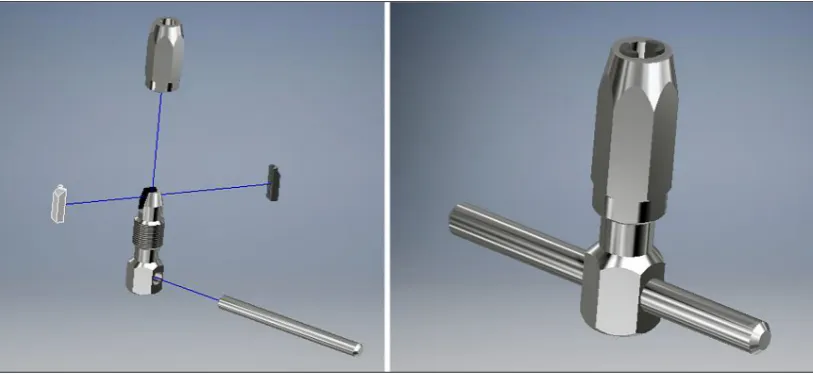
assem-blies of modelled parts. This type of activities is possible by using most CAD programs, including Autodesk Inventor. Using Autodesk Inventor, a student has the opportunity to perform the assem
-bly of elements into units and then to transform these elements into animation, e.g. of an assem
-bly process. In this way he/she learns a method
of combining parts into a whole. This will help him/her understand the operation of the units
be-ing designed. An example of performbe-ing an ani
-mation of a tap handle is shown in Figure 2. The
creation of an assembly animation makes it easier
for a student to prepare technical documentation and to make the handle.
Using assemblies of virtual models, it is pos -sible to simulate circular or linear motion of in-dividual elements (motion animation). This gives
the opportunity not only to present a visualization of his/her work, but also helps eliminate mistakes
during operation. Motion simulation is possible
by using such CAD programs as Solid Edge, Sol
-id Works, Inventor, Catia, NX [12].
CAD programs allows you to create an ani
-mation in order to graphically present the results of calculations, e.g. strength calculations using a FEM method. Using FEM, one may examine
structural strength in the framework of computer
mechanics, simulate deformations, strains, dis
-placements, heat transfer and liquid flow. Dynam
-ics, kinematics and statics of machines as well as
Fig. 1. Computer animation using AutoCAD: a) trajectory and camera setting, b) 3D model animation shot action
electrostatic, magnetostatic and electromagnetic interactions are examined as well.
Another important group that uses anima-tion are computer-aided manufacturing programs
CAM. Computer-aided manufacturing consists in
the integration of the design and manufacturing
phases. CAM programs facilitate designing tech
-nological processes. In the field of tech-nological-
technological-computer education it is implemented in such
subjects as: manufacturing engineering, simula -tion and visualisa-tion of both technological and research programs. Animation is often used as a graphical element of presentations of simulated technological processes of milling and rolling
(Fig. 3). Computer animation of the machining process is applicable finds its application in e.g. verification of the correctness of the machining process, whether it is free from the collisions be -tween the tool and the workpiece or be-tween the machine components. This will help avoid the
risk of damaging expensive tools during machin
-ing, tool breakage, damages to frames or handles.
This also guarantees the machine to avoid a
col-lision as a result of CNC software errors. Edge
-CAM or Sinutrain software by Siemens are the examples of CAD programs supporting the learn
-ing of machin-ing processes [13–15]. Figure 3 presents a virtual machining process by rolling using EdgeCAM and Sinustrain software.
Virtualization with elements of animation
and simulation of machining processes makes it
easier for the students to learn CNC machines
programming through checking the correctness
of the accuracy of the process and elimination of possible errors. Utility graphics software, such as 3 ds. Max or Blender are also used in the teach
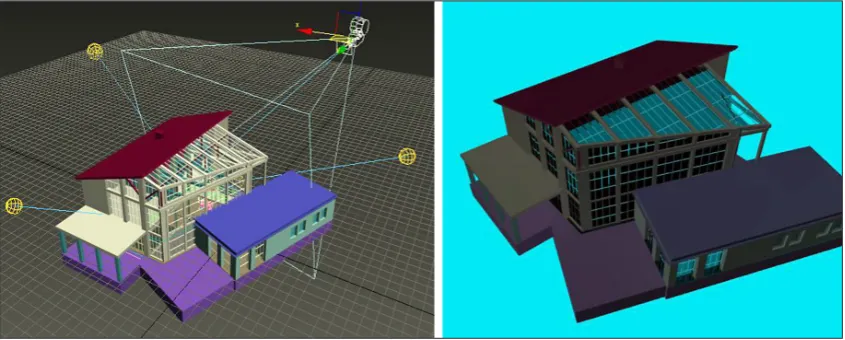
-ing process of technical subjects. In the field of technological-computer education, it is used in the framework of 3D Graphics-Animation. They make it possible to create advance animations, including technical, architectural or production process animations [15]. Figure 4 presents an
animation of a residential building along with its
interiors created using 3ds Max program.
Fig. 3. Virtual machining by rolling using CAM programs: a) Sinutrain, b) EdgeCAM
CONCLUSIONS
Computer animation is currently a rapidly developing field of IT that has found wide ap
-plication in many fields of science. In the frame
-work of engineering applications, the anima
-tions are created using different types of CAx programs (CAD, CAM, CAE), which are the basic tool for a modern engineer. In the field of technology, they are used, inter alia, in the pro
-cess of designing products, engineering calcu
-lations, visualisations of both technological and assembly processes, both monitoring and con
-trol industrial processes, etc.
In the teaching process, computer animation has a positive effect on memorization of knowl
-edge by students. Its use in teaching technical subjects is conductive to the development of the mind. Animation allows to familiarize the
students with the schemes of solving technical
problems. It makes it possible to show the prin
-ciples of operation of machinery and equipment.
The use of computer animation in teaching
tech-nical subjects ensures more effective way of preparing students to carry out the task assigned to modern engineers. In conclusion, one can say
that computer animation is an important element supporting the process of teaching students in
technical fields.
REFERENCES
1. Anderson J., Uczenie się i pamięć, integracja zagadnień. Warszawa 1998.
2. Arnheim R., Sztuka i percepcja wzrokowa: psy -chologia twórczego oka. Akademia Sztuk Pięk -nych, Gdańsk 2004.
3. McCleary L., Trening mózgu, popraw pamięć, koncentrację i samopoczucie korzystając z naj -nowszych odkryć nauki, 2010.
4. Płuciennik P., Projektowanie elementów maszyn z wykorzystaniem programu Autodesk Inventor. PWN, Warszawa 2013.
5. Stasiak F., Autodesk Inventor. Zbiór ćwiczeń. Wy -dawnictwo ExpertBooks, Łódź 2011.
6. Jaskulski A., AutoCAD 2013/LT2013/WS+, Kurs projektowania parametrycznego i nieparametrycz -nego 2D i 3D, PWN, Warszawa 2013.
7. Lis R., Role of visualization in engineering edu -cation. Advances in Science and Technology Re -search Journal, 8(24), 2014, 111–118.
8. Montusiewicz J, Dziedzic K., Nauczanie trójwy -miarowej animacji na kierunku ETI. Postępy Na -uki i Techniki, 11, 2011, 148–155.
9. Dziedzic K, Włodarczyk M, Paśnikowska M., The usage of computer visualization in teaching techni -cal subjects. Advances in Science and Technology Research Journal, 8(24), 2014, 72–75.
10. Dziedzic K., Modelowanie 3D jako element na -uczania grafiki komputerowej na kierunku eduka -cja techniczno-informatyczna. W: M. Śniadkowski (red.) Społeczno-pedagogiczna użyteczność tech -nologii informacyjnych, Tom VI. Lublin 2014, 112–145.
11. Park H., Phuong X., Structural optimization based on CAD–CAE integration and metamodeling tech -niques. Computer-Aided Design, Vol. 42, 2010, 889–902.
12. Penkała P., Modelowanie złożenia silnika w pro -gramie Solid Edge. Postępy Nauki i Techniki, 10, 2011, 5–13.
13. Zagórski I., Barszcz M., Virtual machines in edu -cation – CNC milling machine with Sinumerik 840D control system. Advances in Science and Technology Research Journal, 8(24), 2014, 32–37. 14. Józwik J., Włodarczyk M., ŚcierkaT., Geometric
and kinematics model of vertical CNC machine centre FV-580A. Postępy Nauki i Techniki, 5, 2010, 85–96.