Copyright © 2014 CTTS.IN, All right reserved 331
Designing, Developing and Testing of Cellular Lightweight Concrete Brick
(CLC) Wall built in Rat-Trap bond
A. K. Marunmale1, A.C.Attar2
Civil Engineering (Shivaji University)
Rajarambapu Institute of Technology, Rajaramnagar, Sakharale(Islampur), Tal. Walwa, Dist. Sangli-415414
[email protected] [email protected]
Abstract - Although building techniques and materials have evolved over thousands of years, construction is still a long, complex, and expensive process. Construction industry boom can be seen in almost all the developing countries. With the increase in material costs in the construction industry, there is a need to find more cost saving alternatives so as to maintain the cost of constructing houses at prices affordable to people. There is need to develop an alternative system of building component which would impart more benefits and are multifunctional with optimum use of labour and material. Cellular light weight brick wall in Rat-trap bond is an innovative technique for building masonry unit which reduces the construction cost, time and labor considerably. This may not solve all construction problems but they do resolve many issues associated with traditional materials.
Keywords - Rat-Tarp Bond, Cellular lightweight concrete, alternative building material, Cost Effective.
1.
I
NTRODUCTIONThe construction method of using conventional bricks has been revolutionized by the development and usage of lightweight concrete blocks. The tedious and time-consuming traditional brick-laying tasks are greatly simplified by the usage of these effective alternative solutions. The focus is now more on seeking environmental solutions for greener environment. The usage of Cellular Light-weight Concrete (CLC) blocks in Rat-Trap bond would gives a prospective solution to building construction industry along with environmental preseration.
Despite all initiatives to introduce alternative walling materials like cellular light weight concrete, sand lime bricks, compressed earth blocks, concrete / stonecrete blocks, and fly ash bricks, it is envisaged that sand lime bricks and cellular light weight concrete bricks would still occupy the dominant position in the foreseeable decade. The excellent mechanical properties and durability of CLC and fly ash brick enlarges its scope for application in building construction and development of infrastructure, construction of pavements, dams, tanks, under water works, canal lining and irrigation work etc. Enormous quantities of CLC and fly ash are available in and around thermal power stations in all the states. The
demand of bricks could be met by establishing small units near thermal power stations and to meet the local demand with less transportation costs.
1.1 Cellular Lightweight concrete Bricks:
Foam concrete is cellular material made with a mixture of cement, Fly ash, and sand (optional), stable Foam and special additives (if required) which will help to form unique cellular structure material. The hardened material consists of small enclosed air bubbles thereby resulting in a lightweight stable cellular material with densities ranging from 400kg/m3 to 1800kg/m3 according to various compositions. Foam concrete manufacturing consumes higher amounts of fly ash (which is waste material from thermal power stations) hence it is considered as green building material. The Basic foam concrete is made from mixing aquas which is produced from foam generator into slurry of cement, fly ash, sand (optional) water and other additives in a precisely specially designed mixer for accurately mixing without disturbing its original chemical and physical properties. The final mixture results in many small cells uniformly distributed throughout the concrete which will create cellular structural material from densities ranging from 400kg/m3 to 1800kg/m3. The precise control of volume of air cell in foam will result controlled densities and strengths of foam concrete.
Copyright © 2014 CTTS.IN, All right reserved
1.2 Rat-Tarp bond:
The rat-trap bond technology has been developed by Architect Laurie Baker in India and is a result of its experimentations in cost-effective housing technologies conducted over 40 years. This technology has been used in India for over 20 years. Rat-Trap bond is innovative type of technique which is strength compatible with standard 9” brick wall, but consumes 20% less material. The rat-trap brick can be constructed in 8” or 9” thicknesses. The air medium that is created by the bond helps maintaining a good thermal comfort inside the building. As the construction is appealing to the eye both internally & externally, plastering is not necessary. The overall cost saving on this wall compared to the conventional 9” wall is about 26%.
In Rat-Trap bond the bricks were laid in alternate Shiner and rowlock pattern but the dimensions of the brick are so kept that even though the bricks are laid in header and stretcher pattern the cavity in the Rat-trap bond is kept intact. In brick the brick is narrowed on the stretcher side i.e. horizontally and its height is increases on shiner side i.e. vertically.
This gives the wall with an internal cavity bridged by the rowlock. This is the major reason where virgin materials like brick clay and cement can be considerably saved. This adds this technology to the list of Green building technologies and sustainability for an appropriate option as against conventional solid brick wall masonry. as against conventional solid brick wall masonry.
Rat trap bond wall is a cavity wall construction with added advantage of thermal comfort. The interiors remain cooler in summer and warmer in winters. It is a step towards green building innovative.
The Rat trap bond construction is a modular type of masonry construction. Due care must be taken while designing the wall lengths and heights for a structure. The openings and the wall dimensions are to be in multiples of the module. Also the course below sill and lintel are to be a solid course by placing bricks on edge. The masonry on the sides of the openings also to be solid as will help in fixing of the opening frame.
Fig.1 Typical picture of Rat-Trap bond
The focus is now more on seeking environmental solutions for greener environment. The usage of Cellular Light-weight Concrete (CLC) blocks in Rat-Trap bond would give a prospective solution to building
construction industry along with environmental preservation.
1.3 Housing Problem:
Non-affordability of housing by economically weaker sections of society and low income families in urban areas is directly linked with the magnitude of urban poverty. Housing is one of the basic requirements for survival of human beings. Ownership of house provides significant economic security and social status in a society. The total housing shortage in the country at the end of 10th five year plan was estimated to be 24.71 million dwelling units for 67.40 million households where 98% of shortage was in the low income and economically weaker sections. The situation even at the end of 11th five year plan, the total housing requirement will be 26.53 million dwelling units for 75.01 million households.
2. A
DVANTAGES OFU
SINGR
ATT
RAPB
ONDT
ECHNOLOGY1. By adopting this method of masonry, one can save approx. 20-35% less bricks and 30-50% less mortar; also this reduces the cost of a 250 mm wall by 20-30 % and productivity of work enhances.
2. For 1 m3 of Rat trap bond, 470 bricks are required compared to conventional brick wall where a total of 550 bricks are required.
3. Rat trap bond wall is a cavity wall construction with added advantage of thermal comfort. The interiors remain cooler in summer and warmer in winters. 4. Rat-trap bond when kept exposed, create
aesthetically pleasing wall surface and cost of plastering and painting also may be avoided.
5. Rat trap bond can be used for load bearing as well as thick partition walls.
6. All works such as pillars, sill bands, window and tie beams can be concealed.
7. The walls have approx. 20% less dead weight and hence the foundations and other supporting structural members can suitably be designed, this gives an added advantage of cost saving for foundation. 8. Service’s installations should be planned during the
masonry construction if not exposed.
9. Virgin materials such as bricks, cement and steel can be considerably saved by adopting this technology. It will also help reduce the Embodied Energy of virgin materials and reduces the production of Green House Gases into the atmosphere.
10. In case for more structural safety, reinforcement bars can be inserted through the cavity till the foundation.
2.1 Advantages of Using CLC Bricks:
1. CLC is a light weight brick where water absorption is less compare to red and fly-ash brick
2. High thermal insulation 3. High sound Insulation
4. Compressive strength is more than other bricks 5. Environmental friendly
6. Quantity of cement is less when making a wall why because accurate edges and even surface
Copyright © 2014 CTTS.IN, All right reserved 8. CLC block size can be made of any size according to
our requirements
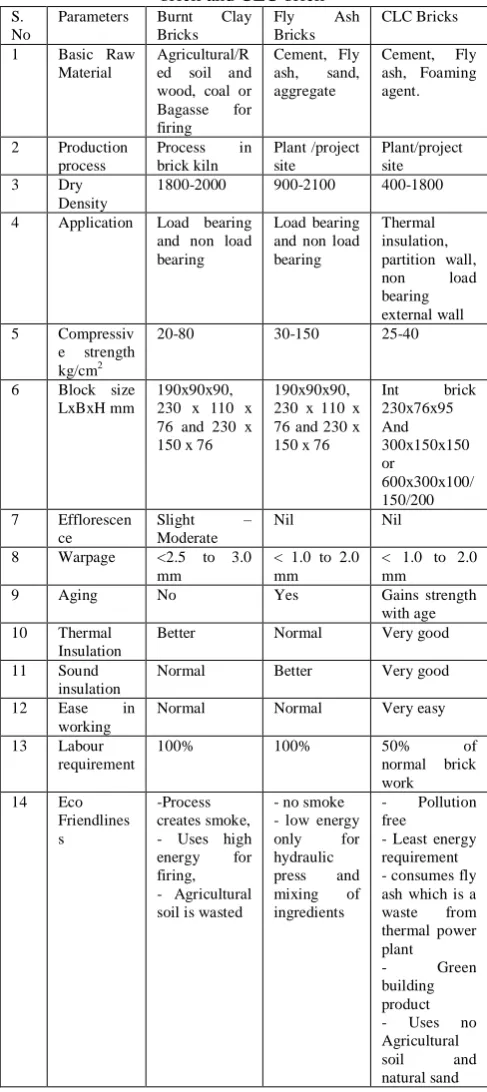
2.2 Comparison between Burnt clay brick, Fly ash brick an CLC brick:
Table 1 Comparison between burnt clay brick, Fly ash brick and CLC brick
S. No
Parameters Burnt Clay Bricks
Fly Ash Bricks
CLC Bricks
1 Basic Raw Material
Agricultural/R ed soil and wood, coal or Bagasse for firing
Cement, Fly ash, sand, aggregate
Cement, Fly ash, Foaming agent.
2 Production process
Process in brick kiln
Plant /project site
Plant/project site 3 Dry
Density
1800-2000 900-2100 400-1800
4 Application Load bearing and non load bearing
Load bearing and non load bearing
Thermal insulation, partition wall, non load bearing external wall 5 Compressiv
e strength kg/cm2
20-80 30-150 25-40
6 Block size LxBxH mm
190x90x90, 230 x 110 x 76 and 230 x 150 x 76
190x90x90, 230 x 110 x 76 and 230 x 150 x 76
Int brick 230x76x95 And 300x150x150 or 600x300x100/ 150/200 7 Efflorescen
ce
Slight – Moderate
Nil Nil
8 Warpage <2.5 to 3.0 mm
< 1.0 to 2.0 mm
< 1.0 to 2.0 mm
9 Aging No Yes Gains strength with age 10 Thermal
Insulation
Better Normal Very good
11 Sound insulation
Normal Better Very good
12 Ease in working
Normal Normal Very easy
13 Labour requirement
100% 100% 50% of normal brick work 14 Eco
Friendlines s
-Process creates smoke, - Uses high energy for firing, - Agricultural soil is wasted
- no smoke - low energy only for hydraulic press and mixing of ingredients
- Pollution free
- Least energy requirement - consumes fly ash which is a waste from thermal power plant - Green building product - Uses no Agricultural soil and natural sand
3.
D
ESIGN ANDC
ASTINGP
ROCESS OFCLC
B
RICKFig. 1 Rat-Trap and Flemish bond in CLC brick
Dimensions of brick: Length : 230 mm Width : 100 mm Height : 76 mm
Material used for producing 1m3 CLC Cement – 250 kg
Fly ash – 950 – 1000 kg
Chemical (foaming agent) – 1.2liters
Once diluted in 40 parts of potable water.
Water – 250 – 300 liters
3.1 Production Procedure of CLC brick:
The production of CLC brick requires much precision than the burnt clay brick. The casting brick in clay soil was not easy. Also making brick in cement concrete was not feasible as the brick would be heavy in weight and cost more.
The best option for producing brick was to use the material which is easy to cast, with precision and should be cost effective. The material which fulfills these requirements is Cellular light weight concrete brick. CLC brick is easy to produce, precise in dimensions due to use of moulds and light in weight.
Following are the steps of casting brick in Cellular light weight concrete:
3.1.1 Preparation of moulds:
For smooth surfaces clean the moulds completely of remaining concrete, the steel/ wood surface must be oiled. Mostly vegetable oil is preferred. Trials with different materials will have to show best results. The oil is applied thoroughly to the corners of the mould so that the brick can be easily dismantled from mould without breaking its edges. Oil will not destroy the mix, once the foam has been mixed in the mortar.
3.1.2 Preparation and mixing of foam:
Copyright © 2014 CTTS.IN, All right reserved of diluted compound and air compressor for mixing air
and producing foam.
There is a unit which mixes the compressed air with diluted compound at given pressure resulting in foam. The foam is dense and containing small uniform shape bubbles. The bubbles in the foam do not disperse like soap bubbles but when mixed with the cement fly ash mixture it forms a homogenous mixture. The bubble in the foam gets trapped in the cement fly ash mixture making the brick light weight.
3.1.3 Charging and Mixing:
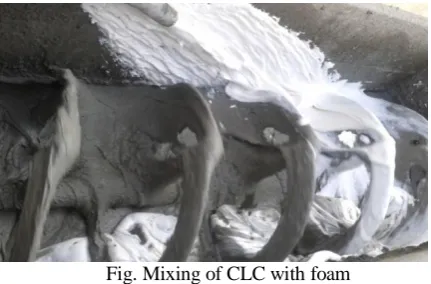
Before charging the mixer with material, it must be rinsed, in particular if the concrete produced before, used any additive, which might have adverse reaction on the foam. Where possible, start the mixer before charging it with material. The material viz. cement and fly is placed in the mixing drum in 1:5 proportion and mixed by adding water, if the mixture is dry mixed the fly ash will disperse away as it is very fine. The mixture is of different type than normal concrete mixture. It has stationary outer drum unlike the moving drum of concrete mixture, and inner helix which is revolving at 250-300 RPM. The helical operation is used instead of revolving entire drum so that the bubbles in the foam do not get dispersed. If the drum is used for mixing instead of helix the bubbles would get dispersed due to descending of material on each other.
Fig. Mixing of CLC with foam
3.1.4 Placing/Pouring of CLC in the mould:
The oiled mould is placed on clean surface preferably in shade avoiding direct sunlight. The prepared foam is then poured slowly in the mould and at the same time the mould is shaken so that the material reaches in every corner of the mould. The mould is filled completely and the extra material top surface is striped out and made plain. The mould is then kept for 24 hours for setting of material.
In between pours, the mixer should be kept in motion until it is completely discharged. CLC always should be poured in the shortest possible time. Use aluminum or other straight and sharp-edged screed slats immediately after pouring the CLC.
3.1.5 Curing &Transport:
The brick should be positioned upwards on the curing yard, resting on a soft underground - best on a rake or wooden beams. All possible efforts should be taken, in particular in dry and hot climate or more even when windy, to keep the brick damp for at least three, better for
more days. It should be preferably kept in shade and in damp condition as the dry condition would absorb the moisture from the brick reducing its strength. A sprinkler will be helpful or gunny bag that is kept wet. Curing compound would be the costly alternative. Standards call for a 24 day curing period for cement-based bricks. Due to reduced weight, more volume of CLC more bricks can be transported at the same (increased pay-load) then of CC. Brick should be kept upright during transport and also on a soft/wooden underground. Unload properly.
3.1.6 Assembly:
Assembly of brick in CLC happens usually the same way as with normal bricks. Special care has to be taken not to apply any mechanical force to avoid damage. If necessary, CLC bricks may be sawn (no gravel), definitely nailed (without the use of dowels as in AAC), drilled or profiled. In densities of 1200 kg/m³ and higher, where reinforcement is used, CLC requires no special coating/plaster on the outside. Water-repellent paint (dispersion paint) will be suitable.
4. R
ESULTS ANDD
ISCUSSION4.1 Test on CLC brick:
Test on brick was carried out in accordance with reference to IS codes on Burnt clay brick (IS 2691:1988 & IS 1077:1992) and IS code on Pulverized fuel ash lime brick (IS 12894:2002). The test results of CLC brick are compared with Pulverized fuel ash lime brick as both have common raw material i.e. Fly ash and sand. Even though CLC brick is light in weight due to use of foam it should not compromise with the required strength.
Table no.2 Test Results compared with Standard values confirming IS Code
Particulars Unit Value CLC Brick
Standard values Confirming of (Red
brick Is 2691 – 1988 IS 1077 – 1992 & pulverized Fuel Ash
Lime brick IS 12894:2002)
Size (LxBxH) mm 230x76x9 5 mm
190x90x90 mm
Avg Compressive strength (9 Brick samples)
Is 3495 part 1 1992
N/mm2 2.9 – 3.7
N/mm2
3.5 N/mm2
Avg Water absorption (9 Brick samples) Is 3495 part 2 1992
% 18-20% <20 %
Determination of efflorescence (9 Brick samples) Is 3495 part 3 1992
% Nil <12.5 %
Determination of warpage (9 Brick samples) Is 3495 part 4 1992
mm < 2mm <2.5mm for height <3.0mm for length and width
Crushing strength of Wall (1m x 1m) tested
N/mm
2 0.87
N/mm2
Greater than 0.35 N/mm2
Copyright © 2014 CTTS.IN, All right reserved Following tests were conducted on Brick:
Compressive strength Is 3495 part 1 1992 Water absorption
Is 3495 part 2 1992 Determination of efflorescence
Is 3495 part 3 1992 Determination of warpage
Is 3495 part 4 1992 Crushing strength of Wall
(1m x 1m) tested
4.2 Cost Analysis of CLC brick:
Brick of dry density 1400 kg/m3 was selected. To produce 1 m3 CLC the brick of dry density 1400 kg/m3 raw material is used in following quantity:
Cement - 250 kg & Fly ash – 1000 kg: Making proportion of 1:5
Table no.3 Cost Analysis
Item Qty. Rate Amount
(Rs.)
Cement 250 kg 6 /kg 1500
Fly ash 1000 kg 1.5/kg 1500
Foaming
agent 1.2 liter 200 /liter 240
Labour
(semi-skill) 2 200 /day 400
Operating cost & over head charges
- - 250
Total 3890
Profit (Add 5% in total) 4100
Therefore cost for producing 1m3 CLC material is = Rs. 4100/-
4.3 Cost of CLC brick of size 9” x 4” x 3”:
Brick size – 9” x 4” x 3” - 0.23 x 0.10 x 0.075 m = 0.001725m3
Bricks casted in 1 m3 CLC material =
001725 .
0 1
=
579.71 ≈ 575 Nos.
In Rat-Trap bond for every 9 brick 2 brick are saved due to cavity.
Therefore total saving in 1 m3 = 7
9 575
= 447.22 ≈ 445 nos.
Therefore cost of brick =
575
4100
= 7.013 ≈ Rs. 7.00 /-
5.
C
ONCLUSIONCLC brick in Rat-Trap bond is an innovative technique for efficient brick work system with many advantages over the conventional brick work system. It reduces the use of material (natural river sand and red soil) and uses the waste material (fly-ash), hence it is green construction
material. CLC brick is designed specially to build wall in Rat-Trap bond as efforts have not yet been made to design CLC brick in Rat-Trap bond. The test results on CLC brick are quite satisfactory and it can be used for non load bearing exterior and interior wall. Also the light weight of CLC brick in Rat-trap reduces the dead load on the structure and provides good thermal insulation. Thus this CLC brick in Rat-trap bond has a very good future scope for its development as a commercial product.
A
CKNOWLEDGEMENTI would like to thank Dr. A. C. Attar, all technical and non technical staff for continuous guiding and helping for completion of this project.
R
EFERENCES[1] Agus Setyo Muntohar, (2011), Engineering characteristics of the compressed-stabilized earth brick, Construction and Building Materials, Elsevire, vol – 25, pp – 4215-4220.
[2] Alex Liew, Mazhar ul Haq, Light Weight/Low Cost Construction Methods For Developing Countries, CBM-CI International Workshop, Karachi, Pakistan, pp – 491-504.
[3] B. V. Venkatarama Reddy, (Feb 2007), Richardson Lal, and K. S. Nanjunda Rao, Enhancing Bond Strength and Characteristics of Soil-Cement Block Masonry, Journal Of Materials In Civil Engineering, ASCE, Vol. – 19, pp – 164-172.
[4] K. B. Anand and K. Ramamurthy, (May-June 2003), Laboratory-Based Productivity Study on Alternative Masonry Systems, Journal Of Construction Engineering And Management ASCE, volume/issue-129, pp – 237-242.
[5] Krishna Bhavani Siram, (Dec 2012), Cellular Light-Weight Concrete Blocks as a Replacement of Burnt Clay Bricks, International Journal of Engineering and Advanced Technology (IJEAT) ISSN: 2249 – 8958, Volume-2, Issue-2, pp – 149-151.
[6] Mucahit Sutcu, Juan José del Coz Díaz, Felipe Pedro Álvarez Rabanal, Osman Gencel, Sedat Akkurt, (Feb 2014) Thermal performance optimization of hollow clay bricks made up of paper waste, Energy and Building ELSEVIER, Vol. – 75, pp – 96-108.
[7] S. Krishnaiah, P. Suryanarayana Reddy. 1-6 October (2008), Effect of Clay on Soil Cement Blocks. 12th International Conference of International Association for Computer Methods and Advances in Geomechanics (IACMAG), pp – 4362-4363.
Copyright © 2014 CTTS.IN, All right reserved [9] Publication, Wall Using Rat-Trap Bond
Technology, Practical Action, Intermediate Technology Development Group,
[10] APTICO Limited, Project Profile For Cellular Light Weight Concrete (CLC) & Sand Lime Brick,
Books Referred:
[11] 11th Five Year Plan 2007-12 Planning Commission Government of India.
[12] Bhatia Gautum, “Laurie Baker – life, work & writings.” Penguin Books India Pvt. Ltd., New Delhi, 1991.
[13] “National Building Code of India 1983”Bureau of Indian Standards, New Delhi.
[14] District Schedule of Rates (DSR) is prepared for the year 2012-13. Applicable for P.W. Circle. Pune / Solapur / Kolhapur and it is also applicable to Sangli District under Kolhapur Circle.
IS Codes Referred:
[15] IS 1077 – 1992; Common burnt clay building bricks – specification (fifth revision)
[16] IS 12894 – 2002; Pulverized fuel ash-lime bricks – specification (first revision)
[17] IS 3495 (Parts 1 to 4) – 1992; Methods of tests of burnt clay building bricks (third revision)
[18] IS 1805 – 1987; Structural use of unreinforced masonry (third revision)
[19] IS 2212 – 1991; Brick work code of practice (first revision)
[20] IS 2185 (Part 4): 2005; concrete masonry units – specification, Preformed cellular concrete block. [21] IS 2185 (Part 1&3): 2005; concrete masonry units