International Journal of Computer Techniques – Volume 4 Issue 6, November - December 2017
ISSN :2394-2231 http://www.ijctjournal.org Page 24
Discrete Cosine Transform DCT Methods on Compression RGB
and Grayscale image
Fifit Alfiah
1, Ade Setiadi
2, Saepudin
3, Ajay Supriadi
4, Ihsan Maulana
51
(Teknik Informatika, STMIK Raharja, and Tangerang)
2,3,4
(Computer Science, Budi Luhur University, and Jakarta)
5
(Teknik Informatika, STMIK Raharja, and Tangerang)
---
************************
---Abstract:
This paper presents a study of image compression methods algorithm for techniques on lossy image compression. One of the major difficulties encountered in lossy image compression is how to protect image quality in a way that the compressed image remains identical to the original, different from the types of methods that exist in the lossless image that can maintain the quality of the image's authentiqly. Digital image compression is a data compression application that aims to reduce the redundancy of data so that theimage can be stored and transmitted efficiently. For compression image, the methods that are often always used is lossy compression and for this research we try to use Discrete Cosine Transform (DCT). Discrete Cosine Transform (DCT) is a technique for graphics signals into basic frequency components. Base on the result this research will be show comparison size of compressing image between grayscale image and color (RGB) image measurement of experimental results using PSNR and MSE. The better one compression scheme having a lower MSE and a high PSNR is DCT method for RGB or color image that is: peppers.bmp (MSE:0.02 and PSNR: 65.6070).
Keywords —Image Compression, DCT, PSNR, MSE.
---
************************
---I. INTRODUCTION
Image is the combination of dots, lines, planes, and colors to create an imitation of an object-usually a physical or human object. Image can be a two dimensional picture, such as painting, photo, and three-dimensional tangible, like a statue which with many visual information in the meaning. Reviewed from a mathematical point of view, image is a continuous function of the light intensity on the plane two dimensional. Light source illuminates object, object reflects back part of the beam of light. This light reflection is captured by optical devices, such as the eye in humans, camera and so on.
One form of image processing operations that is compression. Because compression is a compression process size of a certain data for example here is the image is changed to a smaller data size. Image files, especially raster images tend to be very large. It can be useful or necessary to compress them for ease of storage or delivery[5].
As the problem that occurs in the image is the amount of storage space required. In addition, large image data if sent over the network also makes the time to transmit images from one place to another to be slow. For example, if the transfer rate is 9600 bits per second, then the time required for 512 x 512 pixel image shaded imagery is grayish at 3.64 minutes. The slow delivery of this data must also be paid at a high cost when multiple images have to be transferred or sent on a network. That new kind of grayish image yet for the colored (RGB) the required bits will be bigger and the time used will be longer of course. Restrictions on storage space and limited width of fields in communication systems have forced the efficient image compression technique to be obtained.
II. METHODOLOGY
1. Discrete Cosine Transform (DCT)
The most popular technique for image compression, over the past several years, was Discrete cosine transform (DCT). Its selection as the standard for JPEG is One of the major reasons
for its popularity[3]. Discrete cosine transform is a function two directions that map the set N of real numbers into the N set of real numbers. Discrete Cosine Transform (DCT) is a digital compression technique into JPEG format. In JPEG compression, DCT receives input is an 8x8 image matrix, which is then convert it into a frequency matrix with same size. The nature of DCT is to change information a significant image is concentrated only to some DCT coefficients. Discrete cosine transform is a lossy compression scheme where NxN blocks transformed from the spatial domain to the DCT domain[2].
The discrete cosine transform (DCT) helps separate the image into parts (or spectral sub-bands) of differing importance (with respect to the image's visual quality). The DCT is similar to the discrete Fourier transform: it transforms a signal or image from the spatial domain to the frequency domain [4].
Fig.1 Transformation of function into DCT
It is a process intended to yield a compact representation of an image, thereby reducing the image storage or transmission requirements. Compression is achieved by the removal of one or more the redundancy present in it there are three types of redundancies[1]:
1. Coding redundancy
Which is due to the correlation or dependence between neighbour pixel values;
2. Interpixel redundancy,
Which is due to the correlation between different colour planes or spectral bands; 3. Psychovisual redundancy,
Which is present because of correlation between different frames in images.
Image compression research aims to reduce the number of bits required to represent an image by removing the spatial and spectral redundancies as much as possible. Data redundancy is of central issue in digital image compression. If n1 and n2 denote the number of information carrying units in original and compressed image respectively, then the compression ratio CR can be defined as:
CR =Size of Compressed Codestream = Size of Original Image Size in byteSize in byte .
Block Diagram Compression:
Fig.2 Block Diagram For Compression Algorithm
Description:
1. This compression system is totally based on DCT.
2. This system used for compressing grayscale images.
3. Then DCT is applied to an image.
4. In 5th block all the DCT coefficients are sorted with sorting algorithm.
5. After sorting algorithm the repeated DCT coefficients are eliminated so size is reduced. 6. Then image is again rearranged for applying
IDCT, and after applying IDCT finally compressed image is obtained.
In addition, the DCT packs energy in the low frequency regions. Therefore, some of the high frequency content can be discarded without significant quality degradation. Such a (course) quantization scheme causes further reduction in the entropy (or average number of bits per pixel).
DCT advantages although the image is compressed with lossy compression will not arouse suspicion because of this method occurs in the frequency domain inside the image, not on Spatial domains so there will be no changes seen in the image. While the drawback, DCT does not resistant to changes in an object due to a message easily deleted due to location of data insertion and making data with DCT method known. The high-frequency minimization method reduces matrix size, increases compression ratio, and encrypts the matrix by using two different keys[6].
For color images with moderately complex scenes, all DCT based modes of operation typically produce the following levels of picture quality for
Source Grayscale
Image
Applying DCT to
Image
Use Sorting Algorithm to DCT
Coeeficients
Rearrange DCT Coeeficient Apply
IDCT compressed
Image
DCT
International Journal of Computer Techniques – Volume 4 Issue 6, November - December 2017
ISSN :2394-2231 http://www.ijctjournal.org Page 26
the indicated ranges of compression. These levels are only a guideline quality and compression can vary significantly according to source image characteristics and scene content.
The most commonly used distortion measures in image compression are MSE and PSNR as discussed in previous section[7].
2. Color Image Compression using DCT
Image dispose of greatly use DCT, notably for compression. While static image compression and dispose of individual video frames are performed by some appliance of two-dimensional DCT, compression of video streams is the best prevailing appliance of multidimensional DCT. We adoption DCT to compress the image in our suggested method. This is performed by occupy DCT to each non coincidental block of the image as illuminate in the following formula[8]:
, = 1
√2"# # $ $ % &, ' ()* +
2 & + 1 -2" .
/01
234 /01
534
()* +2 ' + 1 -2" .
# 6 = 7√21 8 6 = 0 1 8 6 > 0
;
On board I(x,y) produce the (x,y) the element of the image produced by I. Nis the size of the block that the DCT is done on. The formula calculates one entry (i,j) the of the transformed image from the pixel values of the real image matrix[8].
3. Peak-Signal to Noise Ratio (PSNR)
The PSNR is most commonly used as a measure of quality of reconstruction of lossy compression codec’s (e.g., for image compression). The signal in this case is the original data, and the noise is the error introduced by compression. When comparing compression codec’s it is used as an approximation to human perception of reconstruction quality, therefore in some cases one reconstruction may appear to be closer to the original than another, even though it has a lower PSNR (a higher PSNR would normally indicate that the reconstruction is of higher quality). The PSNR is calculated by using following formula:
<="> = 10 ?)@14ABC1D
A=E
A=E = FG $ $[I , − K , ]1 D M01
N34 O01
P34
4. Mean Square Error(MSE)
The mean squared error (MSE) is defined as the mean of the square of the difference between the original and reconstructed pixels, x and x 0 . Mean square error is a criterion for an estimator: the choice is the one that minimizes thesum of squared errors due to bias and due to variance. The average of the square of the difference between the desired response and the actual system output. As a loss function,
As MSE increases, the image quality degrades and as the MSE would decrease, image quality would be enhanced with the help of changing the co -efficient for DCT Blocks[4]. MSE is called squared error loss. MSE measures the average of the square of the "error. TheMSE is the second moment (about the origin) of the error, and thusincorporates both thevariance of the estimator and its bias. For an unbiased estimator, the MSE is the variance. In an analogy to standard deviation, taking the square root of MSE yields the root mean squarederror or RMSE. Which has the same units as the quantity being estimated. for an unbiasedestimator, the RMSE is the square root of the variance, known as the standard error.
A=E = FG $ $[% , − K , ]1 D M01
N34 O01
P34
Where m x n is the image size and I (i,j) is the input image and K (i,j) is the retrieved image.
III. RESULT AND DISCUSSION
This research using 3 image grayscale and 3 image RGB for compare the DCT method be best for compression image in what kind of images.
1. Grayscale Images
The first step for compression image using DCT method is grayscale images, in here we try to compare 3 kind of images with different extension for every image.
Figure 3. Baby grayscale image
Figure 4 shows the input image is peppers.bmp (left) which is then compressed into a small size of the image using the DCT method for grayscale images, as in the compressed image (right).
Figure 4. Peppers grayscale image
Figure 5 shows the input image is Cameraman.tif (left) which is then compressed into a small size of the image using the DCT method for grayscale images, as in the compressed image (right).
shows the input image is peppers.bmp (left) which is then compressed into a small size of the image using the DCT method for grayscale images, as in the compressed image (right).
shows the input image is Cameraman.tif (left) which is then compressed into a small size of the image using the DCT method for grayscale images, as in the compressed
Figure 5. Cameraman grayscale image
2. Color/RGB Image
The next step or second step for compression image using DCT method is colour or RGB images, in here we try to compare 3 kind of images with different extension for every image.
Figure 6 shows the input image is Baby.jpg (left) which is then compressed into a small size of the image using the DCT method for RGB images, as in the compressed image (right). And then for this section in the Figure 4
from the original and compress image have the different size.
Figure 6. Baby color image
Figure 7 shows the input image is peppers.bmp (left) which is then compressed into a small size of the image using the DCT method for RGB images, as in the compressed image (right).
Figure 7. Peppers color image
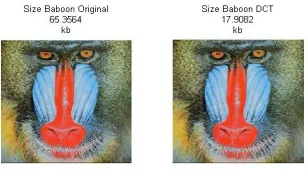
Figure 8 shows the input image is Baboon.jpg (left) which is then compressed into a small size
. Cameraman grayscale image
econd step for compression image using DCT method is colour or RGB images, in here we try to compare 3 kind of images with different extension for every image.
shows the input image is Baby.jpg (left) which is then compressed into a small size the image using the DCT method for RGB images, as in the compressed image (right). And then for this section in the Figure 4 that the image from the original and compress image have the
. Baby color image
shows the input image is peppers.bmp (left) which is then compressed into a small size of the image using the DCT method for RGB images, as in the compressed image (right).
. Peppers color image
International Journal of Computer Techniques – Volume 4 Issue 6, November - December 2017
ISSN :2394-2231 http://www.ijctjournal.org Page 28
of the image using the DCT method for RGB images, as in the compressed image (right).
Figure 8. Baboon color image
A.Table comparison PSNR and MSE from grayscale and RGB images
From each of the above pictures, we make a summary from the image about the file name of the image, the size before and after compression, as well as the PNSR and MSE to know the quality of image itself. Then with this result of the contents from image we created in the form of tables in order to reading and knowing the information from each image thusfinish compression of the images.
TABLE I
DCT method for Grayscale Image Name of
Image
Size of Original
Image
Size of Compress
Image
PSNR MSE
Baby.jpg 2844kb 1499kb 43.1855 3.15 Peppers.bmp 768kb 248kb 36.8871 13.42 Cameraman.tif 63kb 57kb 33.8191 27.20
From the table the best image compression using DCT method for grayscale image is Baby.jpg, because the images have the biggest value of PSNR and the smallest value of the MSE.
TABLE III
DCT method for Color Image Name of
Image
Size of Original
Image
Size of Compress
Image
PSNR MSE
Baby.jpg 939kb 17kb 41.6807 4.45 Peppers.bmp 768kb 14kb 65.6070 0.02 Baboon.jpg 66kb 18kb 41.4011 4.75
From the table the best image compression using DCT method for RGB/color image is peppers.bmp, because the images have the biggest value of PSNR and the smallest value of the MSE.
IV. CONCLUSIONS
In this research we have considered for the result presented by the images and comparison of the table. The DCT method show compression image can approve. So the conclusion is a lower value for MSE means lesser error, and as seen from the inverse relation between the MSE and PSNR, thistranslates to a high value of PSNR. Logically, a higher value of PSNR is good because itmeans that the ratio of Signal to Noise is higher. Here, the 'signal' is the original image, andthe 'noise' is the error in reconstruction. So, the better one compression scheme having a lowerMSE and a high PSNR is DCT method for RGB or color image that is: peppers.bmp (MSE:0.02 and PSNR: 65.6070).
ACKNOWLEDGMENT
Thanks to all colleagues who have helped and cooperated in completing research writing on compressing images, especially for prof. Anton satria prabuwono who has given this writing be an assignment to be useful and expected future there is a better writing.
REFERENCES
[1] S.A. Muzhir and H.A. Fouad, “The Jpeg Image Compression Algorithm”, International Journal of Advances in Engineering & Tech nology, May 2013, Vol. 6, Issue 3, pp. 1055-1062.
[2] A.M. Raid, W.M. Khedr, M.A. El-dosuky and Wesam Ahmed, "Jpeg Image Compression Using Discrete Cosine Transform - A Survey", International Journal of Computer Science & Engineering Survey (IJCSES), April 2014, Vol.5, No.2.
[3] Gupta Maneesha and Dr. K.G. Amit, "Analysis of Image Compression Algorithm Using DCT", International Journal of Engineering Research andApplications (IJERA), ISSN: 2248-9622, Vol. 2, Issue 1, Jan-Feb 2012, pp.515-521.
[4] Yashodha Devi, "A Robust Approach for Image Compression Using PCA and DCT Algorithms", International Journal of Computer Science Trends and Technology (IJCST), ISSN: 2347-8578, Sep - Oct 2016, Volume 4 Issue 5.
[5] K. Kadhim Qusay, "Image Compression Using Discrete Cosine Transform Method", International Journal of Computer Science and Mobile Computing, ISSN 2320–088X, Vol.5 Issue.9, September- 2016, pg. 186-192.
[7] ZainEldin Hanaa, A.E. Mostafa and A.A. Hesham, "Image compression algorithms in wireless multimedia sensor networks: A survey", Ain Shams Engineering Journal, Oktober 2015, 6, 481–490.