Isolation and identification of local Bacillus isolates for xylanase
biosynthesis
Hassan Ammoneh, Muhanad Harba, Yasser Akeed, Mohanad Al-Halabi, Yasser Bakri*
Department of Molecular Biology and Biotechnology, AECS, Damascus, Syria.
Received: November 2012, Accepted: October 2013.
ABSTRACT
Background and Objectives: Bacillus species are attractive industrial organisms due to their rapid growth rates leading to a short fermentation cycle and for their capacity to secrete important enzymes and proteins such as xylanase into the extracellular medium. Considering the industrial importance of xylanase, in this current study, Bacillus spp. were isolated from different soils and were screened for their xylanase production.
Materials and Methods: Bacillus isolates used in this study were obtained from a national screening program carried out during 2006-2007 in which soil samples that covered areas throughout the interior of Syria were collected. The prepared inoculum from each of Bacillus isolates was aliquoted onto xylan agar plates, incubated at 30°C for 72 h and screened for
xylanase synthesis.
Results: Xylanolytic isolates were selected depending on the clear zones of xylan hydrolysis. Fifteen isolates having the highest clearing zone were determined and grown in a solid state fermentation. Of the 15 isolates, three bacilli namely
SY30A, SY185C and SY190E that showed maximum xylanase production, were identified using the 16S rDNA sequencing method. According to 16S rDNA gene sequence data, the closest phylogenetic neighbor for SY30A was Bacillus pumilus and
for SY185C and SY190E isolates was Bacillus subtilis. Optimal pH and temperature for xylanase activity was 7.0 and 55°C
for SY30A and 6.0 and 60°C for SY185C and SY190E, respectively. Under these conditions, the following activities were
found to be around 1157 ± 58, 916 ± 46 and 794 ± 39 (U/g) for SY30A, SY185C and SY190E, respectivly.
Conclusions: Selected local Bacillus isolates were found to be a potential source of xylanase which was proven to be quite suitable for multiple biotechnological applications. These isolates might after extensive optimization steps be an alternative to commercially available strains.
Keywords:Bacillus sp, Xylanase, Solid state culture
INTRODUCTION
Xylans, major structural heteropolysaccharides in
plants, are α-1,4-linked polymers of xylopyranosyl
units with a degree of polymerization ranging from
70 to 200. Depending on their origin, xylans may
also contain variable amounts of arabinosyl- and
4-O-methylglucuronic acid residues and acetyl groups (18, 21). Xylanolytic enzymes are a group of enzymes that hydrolyze xylan and arabinoxylan
polymers. This group includes endo-α-1,4-xylanase, β-xylosidase, arabinofuranosidase and acetylxylan esterase (5). Endo-α-1,4-xylanase plays an important
role in the animal feed as it increases the body weight gains (14). In pulp and paper industry, xylanases are employed in the prebleaching process to reduce the use of the toxic chlorine chemicals (27). In bread and
bakery industry, xylanases are used to increase the
dough viscosity, bread volume, and shelf life (19). Other potential applications include the conversion of xylan in wastes from agriculture and food industries
* Corresponding author: Yasser Bakri Ph.D
Address: Department of Molecular Biology and Bio-technology, AECS, P. O. Box 6091, Damascus, Syria. Tel: +963-11-2132580
Fax: +963-11-6112289 E-mail: [email protected]
127
AMMONeHeT AL .
into xylose, and the production of fuel and chemical
feedstocks (26).
Many bacteria and fungi have been studied for
xylanase production (4, 9, 10). However, Bacillus
species have been the major workhorse industrial
microorganisms for more than a thousand years.
Bacillus species are attractive industrial organisms for several reasons, including their high growth rates leading to short fermentation cycle times and their capacity to secrete proteins into the extra cellular
medium. It is estimated that Bacillus spp. enzymes
make up about 50% of the total enzyme market
(24).
For the production of any industrial enzyme, an
inexpensive substrate and an efficient fermentation
process are essential for commercial viability. It has been established that solid-state fermentation has several advantages over submerged fermentation, due to a smaller volume of solvent required for product recovery, resulting in higher productivity per unit volume, lower contamination and foaming problems and better exploitation of various agro-residues as substrates (2-7).
Considering the industrial importance of xylanase,
in the present study, Bacillus spp. were isolated from
different soils and screened for xylanase production in a solid state fermentation process. The investigation
led to the identification of three high producing
xylanase isolates, B. pumilus SY30A and B. subtilis
SY185C and SY190E.
MATeRIALS AND MeTHODS
Bacterial strains and growth conditions. Bacillus
isolates analyzed in this study were obtained from a national screening programme carried out in 2006 and 2007 from soil samples distributed throughout the interior of Syria (1). Isolates were routinely cultured
on nutrient agar plates (NA). Plates were incubated at
30°C until bacterial colonies developed, kept at 4°C and sub-cultured every fifteenth day. Subsequently, selected isolates were maintained in 20% glycerol at
-80°C.
Inoculum preparation. Five milliliter of medium containing nutrient broth was transferred to a 50 ml
tube and sterilized in an autoclave at 121°C for 20
min. After cooling, a loopful of bacterial culture was aseptically transferred and rotated overnight at 200 rpm and 30°C. 1% of this culture was used
to inoculate 20 ml of the same medium in 100 ml
flask and incubated in an orbital shaker at 30°C until the optical density at 600 nm (OD600) reached 0.15
(cell density about 2 × 10⁸ colony-forming unit
(CFU)/ml).
Screening of xylanase producing bacteria.
Twenty five microliter of the prepared inoculum for
each Bacillus isolate was aliquoted onto xylan agar
plates, incubated at 30°C for 72 h and screened for
xylanase synthesis. Positive xylanolytic isolates were
decided according to the clear zones of hydrolysis on the xylan. Fifteen isolates having the highest clearing zone were selected and grown in solid state fermentation. The amount of xylanase produced by each isolate was determined from the extract culture
filtrate. Subsequently, the selected isolates were
grown on NA plates at 30°C and maintained at 4 ±
1°C. Isolates were routinely subcultured every two
weeks on NA plates.
Solid state fermentation. Enzyme production
was checked for selected Bacillus isolates in solid state fermentation using wheat bran procured from
local market. Enzyme production was carried out in 100 ml Erlenmeyer flasks containing 5 g-of wheat
bran and nutrients plus distilled water to adjust the
moisture to 60%. The fermentation medium consisted of (g/L): K2HPO4, 1; NaCl,3; MgSO4.7H2O, 0.3; and
yeast extract, 3 and peptone 5, as nitrogen source. 1
ml of the prepared inoculum for each Bacillus isolate
was transferred into the solid medium and placed
in an incubator. After 3 days of cultivation flasks
were removed and the enzyme was extracted by the
addition of 25 mL distilled water containing 0.1% Triton X 100. Flasks contents were stirred for 1.5 h
on a magnetic stirrer and the clear supernatant was obtained by centrifugation at 9800 × g for 15 min and used as enzyme source.
Xylanase assay. Xylanase activity was determined
as described by Bailey et al. (3) using 1% birch wood
xylan as substrate. Xylan solution and the enzyme at an appropriate dilution were incubated at 55ºC for 5 minutes and the reducing sugars were determined by
the dinitrosalicylic acid (DNS) procedure with xylose
as a standard (15). The released xylose was measured spectrophotometrically at 540 nm. One unit (U) of
enzyme activity is defined as the amount of enzyme
XYLANASe BIOSYNTHeSIS fROM BACILLUS
IRAN. J. MICROBIOL. Vol. 6, No. 2 (April 2014), 127-132 129 http://ijm.tums.ac.ir
described assay conditions.
effect of temperature on xylanase activity and stability. Enzyme activity was evaluated by measur-ing the xylanase activity at different temperatures
ranging from 40 to 75°C in 0.1 M sodium phosphate
buffer (pH 7.0) and 1% soluble birchwoodxylan. To
evaluate thermal stability, the remaining xylanase activity was determined after preincubation of the
crude enzyme preparations at 30-90°C in buffers of
optimal activity, without substrate, for 1 h.
effect of pH on xylanase activity and stability.
The optimal pH for enzyme activity was determined by changing the assay reaction mixture pH using the
following buffers (0.1 M): sodium acetate (pH 5.0),
sodium phosphate (pH 6.0–7.0), Tris–HCl (pH 8),
glycine–NaOH buffer (pH 9–10) and 1% soluble
birchwood as a substrate. To evaluate the stability of the enzyme at each pH, xylanase activity was measured after incubation the enzyme solution in pH
buffers ranging from 4.0 to 10.0 at 25°C for 24 hours.
Residual activity was determined under optimal assay conditions for each isolate.
Polymerase chain reaction (PCR) amplification
and 16S rDNA sequencing. Two primers BacF
(5’-GTGCCTAATACATGCAAGTC-3’) and BcaR
(5’-CTTTACGCCCAATAATTCC-3’) flanking a
highly variable sequence region of 545 bp towards
the 5’end of the 16S rDNA region were used (16). Genomic DNA was extracted and purified using DNA extraction kit according to the manufacturer’s recommendations (BIOTOOLS, Cat. NO. 21.002). PCR mixtures were prepared using 10–20 ng of template DNA, 0.4 µM of each primer, 1U of Taq DNA polymerase (Promega), 0.2 mM each of dATP, dCTP, dGTP and dTTP (Promega), 2 mM MgSO4, and 3% dimethyl sulfoxide (DMSO). Amplification
was done in a Bio-Rad T gradient thermocycler under the following conditions: a 5 min denaturation step at 95°C, followed by 30 amplification cycles (1 min at
95°C, 1 min at 56°C and 1 min at 72°C) and an extra
extension step of 10 min at 72°C. PCR products were
separated on a 1% agarose gel to which ethidium bromide was added and photographed under UV light. Amplification products were purified using QIAqick Gel Extraction kit (QIAGEN, Cat. No.
28704) and sequenced on both strands using an ABI
310 sequencer machine (Department of Molecular
Biology and Biotechnology, AECS). The sequences
were subjected to a BLAST search against the full EMBL ⁄ GenBank database available at NCBI public
database (http://www.ncbi.nlm.-nih.gov).
ReSULTS AND DISCUSSION
Screening of xylanase producing Bacilli. Five
hundred and twenty-five bacterial isolates from 200
soil samples collected from different areas of Syria
including cereal fields, olive fields, forests, desert
and gardens, were evaluated for xylanase production. Fifteen of these isolates with a high xylanase production level were determined (Fig. 1) and thus three isolates SY30A, SY185C and SY190E were selected for further studies.
Identification of the selected isolates. DNA
sequence analysis methods are an objective,
reproducible, and rapid means of species identification,
therefore, they have been widely utilized (13).
SY30A, SY185C and SY190E Identification was performed using the 16S DNA gene sequences. The nucleotide BLAST similarity search analysis, based on the 16S DNA gene sequence revealed that these
isolates belong to the genus Bacillus. The closest
phylogenetic neighbors according to the 16S DNA
gene sequence data for SY30A was Bacillus pumilus
and for the SY185C and SY190E isolates were
Bacillus subtilis with a 100 % homology.
effect of temperature on xylanase activity and
stability. The effect of temperature on xylanase
activity against birch wood xylan at pH 6.0 was
examined in the temperature range of 40-75°C.
Xylanases produced by SY30A exhibited maximum
activity at 55°C compared with 60°C for the other two
isolates, SY185C and SY190E (Fig. 2). Under these conditions, enzyme activity were 1013, 854 and 731
26. Sunna A, Antranikian G. Xylanolytic enzymes from fungi and bacteria. Crit Rev
˾
Biotechnol 1997; 17: 39-67.
˿
27.Wong,K.K.Y.;James,C.S.;Campion,S.H.XylanasepreͲandpostͲtreatmentsof ̀
bleachedpulpsdecreaseabsorptioncoefficient.JPulpPapSci2000;26:377Ͳ383.
́
28. Yang VW, Zhuang Z, Elegir G, Jeffries TW. Alkaline active xylanase produced by an
̂
alkaliphilicBacillus spisolated from kraft pulp. J Ind Microbiol 1995; 15: 434–441.
˺˹ ˺˺
˺˻
˺˼
˺˽
˺˾
Fig.1.ExtracellularxylanaseproductionfromBacillusisolates
˺˿ fig. 1. Extracellular xylanase production from Bacillus
AMMONeHeT AL .
130 IRAN. J. MICROBIOL. Vol. 6, No. 2 (April 2014), 127-132 http://ijm.tums.ac.ir (U/g) for SY30A, SY185C and SY190E, respectively.
Similar temperature optima have been reported by
many other workers for xylanase production from varied sources. Sá-Pereira et al. (20) reported that
optimal xylanase activity of a B. subtilis strain was at
60°C on phosphate buffer, at pH 6.0.
Additionally, xylanase from a thermo alkaliphilic
bacterium showed optimum activity at 50°C (23). The
highest activity of xylanase obtained from both B.
circulans and B.amyloliquefaciens was at 50.0°C (11,
12). Sanghi et al. (22) found that xylanase produced
from Bacillus subtilis ASH gave the best activity at
55°C
Enzyme stability is the most important factor in studying enzyme characteristics. Thus, thermal stability tests were carried out by pre-incubating xylanase for 60 min in a temperature range of 30 to
90°C (Fig. 3). Our results showed that there was no
significant decrease in xylanase activity during 60
min incubation at 30 – 50°C, while at 50°C the residual xylanases activities were 93.4, 90.2 and 89.6% for
SY30A, SY185C and SY190E, respectively. The
enzyme was sensitive at 70°C, retaining 17.1%
activity for SY30A, while retaining 58 and 70.8%
activities for SY185C and SY190E, respectively. At higher temperature values xylanase stability gradually was found to decline. Thermal stability of xylanase is an important property due to its potential applications in several industrial processes. The industrial importance of an enzyme will be more when the effect of temperature input on its optimal activity is less. Strains isolated by us could be a good source for biotechnological applications.
effect of pH on xylanase activity and stability.
Enzyme activity is markedly affected by pH because
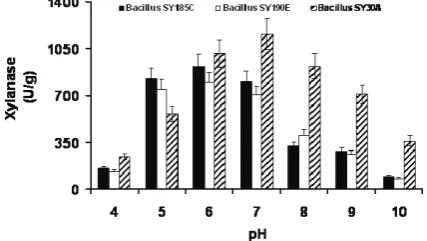
substrate binding and catalysis are often dependent on charge distribution on both, substrate and, in particular enzyme molecules (25). A pH range from 4 to 10 was used to study the effect of pH on xylanase activity and the results are given in (Fig. 4). Optimum pH was found to be 7 for SY30A and 6 for both SY185C and SY190E. Enzyme activity at pH 8 and 9 was 920 and 711 U/g for SY30A, 325 and 286 U/g for SY185C and 405 and 265 U/g for SY190E, respectively. Xylanase activity was shown to decrease at pH 10. These clearly indicates that SY30A produced enzyme is more suitable for any application in the pH range of 6.0-9.0 and 5-8 for the SY185C and SY190E enzymes.
Up to date, xylanases produced by most alkaliphiles
are reported to have their optimum pH around
neutrality. Nakamura et al. (17) reported the first alkaline xylanases produced by Bacillus sp. strain 41
M-1, which had an optimum pH at 9.0. Yang et al. (28) isolated an alkaliphilic Bacillus sp. VI-4 from a hard wood kraft pulp, which produced xylanase
having an optimum pH of 6-8.5. Similarly, the optimum pH activity at 6.8-7.0 of xylanase reported
from B. amyloliquefaciens (11). Thermostable
alkaline xylanase from a Bacillus sp. showed three
˺
Fig.2.EffectoftemperatureonthexylanaseactivityofthreeBacillusstrains. ˻ ˼ ˽ ˾ ˿ ̀ ́ ̂ ˺˹ ˺˺ ˺˻ ˺˼ ˺˽ ˺˾ ˺˿ ˺̀ ˺́ ˺̂
fig. 2. Effect of temperature on the xylanase activity of three Bacillus strains.
˺
Fig.3.EffectoftemperatureonthexylanasestabilityofthreeBacillusstrains
˻ ˼ ˽ ˾ ˿ ̀ ́ ̂ ˺˹ ˺˺ ˺˻ ˺˼ ˺˽
fig. 3. Effect of temperature on the xylanase stability of three Bacillus strains.
˺
Fig.4.EffectofpHonthexylanaseactivityofthreeBacillusstrains ˻ ˼ ˽ ˾ ˿ ̀ ́ ̂ ˺˹ ˺˺ ˺˻
fig. 4. Effect of pH on the xylanase activity of three
IRAN. J. MICROBIOL. Vol. 6, No. 2 (April 2014), 127-132 131 http://ijm.tums.ac.ir
optimum peaks for pH 6.5, 8.5 and 10.5 (23). A wide
range of pH activity from 5.0-8.0 was observed in
B. circulans BL53 upon solid state cultivation (12).
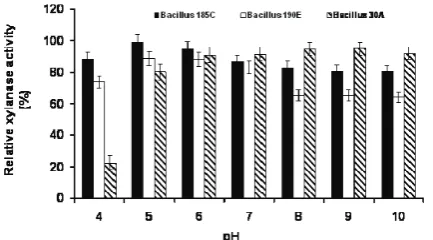
The activity persistence in a large range of pH is a desirable quality of an industrial enzyme. When pH stability was measured at values between 4 and 10, the
xylanase stability was over a broad neutral to alkaline pH range (6-10) and retained more than 75% of its
activity after 24 h of incubation at room temperature (Fig. 5). Stability at extreme pH values may be due to charged amino acid residues. The enzymes stable in
alkaline conditions were characterized by a decreased
number of acidic residues and an increased number of arginines (8).
CONCLUSION
Results obtained in the current study demonstrate
that the local Bacillus isolates are a potential source
of xylanase production. The temperature properties
for enzyme activity and stability make the enzyme
from some of the tested isolates a quite suitable for biotechnological applications. Therefore, these isolates could be alternative of the commercial strains. However, the process of xylanase production from the
new local Bacillus isolates may be commercialized
after further optimization for enhanced enzyme production.
ACKNOWLeDGeMeNT
The authors thank the Director General of AECS and the Head of the Molecular Biology and Biotechnology Department for their continuous support throughout this work.
RefeReNCeS
Ammouneh H, Hraba M, Idris E, Makee H. Isolation
1.
and characterization of native Bacillus thuringiensis
isolates from Syrian soil and testing their insecticidal activities against some insect pests. Turk J Agric For
2011; 35: 421-431.
Archana A, Satyanarayana T. Xylanase production by 2.
thermophilic Bacillus licheniformis A 99 in solid state
fermentation. Enzyme and Microb Technol. 1997;21:
12-17.
Bailey MJ, Biely P,Poutanen K. Interlaboratory testing
3.
of methods for assay of xylanase activity. J Biotechnol
1992; 23: 257-270.
Bakri Y, Jawhar M, Arabi MIE. Improvement of
4.
Xylanase Production by Cochliobolussativus in Solid State Fermentation. Brazi J Microbiol 2008; 39: 238-240.
Biely, P(1993). Biochemical aspects of the production
5.
of microbial hemicellulases. pp. 29-51. In: Coughlan
MP, and Hazlewood GP (eds) Hemicellulose and Hemicellulases. Portland Press, London.
Duarte MCT, Pellegrino ACA, Portugal EP, Ponezi AN,
6.
FrancoTT. Characterization of alkaline xylanases from
Bacillus pumilus. Brazi J Microbiol 2000; 31: 90-94.
Gupta U, Kar, R. Xylanase Production by a
Thermo-7.
tolerant Bacillus Species under Solid-state and
Submerged Fermentation. Braz. Arch. Biol. Techn.
2009; 52: 1363-1371.
Hakulinen N, Turunen O, Jänis J, Leisola M, Rouvinen
8.
J. Three-dimensional structures of thermophilic
β-1,4-xylanases from Chaetomium thermophilum and
Nonomuraea flexuosa comparison of twelve xylanases
in relation to their thermal stability. Eur J Biochem
2003; 270: 1399-1412.
Heck JX, Hertz PF, Ayab MAZ. Cellulase and xylanase
9.
production by isolated amazon Bacillus strains using soybean industrial residue based solid state cultivation.
Brazi J Microbiol 2002; 33: 213-218.
Kinegam S, Tanasupawat S, Akaracharanya A.
Screen-10.
ing and identification of xylanase-producing bacteria from Thai soils.J Gen Appl Microbiol 2007; 53: 57-65.
Javier DB, Faustino S, Mario, D.B, Guillermo RC, Rajni
11.
HK. Purification and characterization of a thermostable
xylanase from Bacillus amylolique faciens. Enzyme
Microb Technol1998; 22: 42-49.
Júlio XH, Luís HBS, Plinho FH, Marco AZA.
12.
Purification and properties of a xylanase produced
by Bacillus circulansBL53 on solid-state cultivation.
Biochem Eng J. 2006; 32: 179-184.
Li Y, Liu Z, Cui F, Xu Y, Zhao H. Production of
13.
xylanase from a newly isolated Penicillium sp. ZH-30.
World J Microbiol Biotechnol 2007; 23: 837-843.
Medel P, Baucells F, Gracia MI, De-Blas C, Mateos
14.
GG. Processing of barley and enzyme supplementation
in diets for young pigs. Anim Feed Sci Tech 2002; 95: 113-122.
GL Miller. Use of dinitrosalicylic acid reagent for
15.
determination of reducing sugars. Anal Chem 1959; 31:
426-428.
Nair JR, Singh G, Sekar V. Isolation and characterization
16. ˺
Fig.5.EffectofpHonthexylanasestabilityofthreeBacillusstrains ˻
˼
˽
˾
˿
fig. 5. Effect of pH on the xylanase stability of three
AMMONeHeT AL .
of a novel Bacillus strain from coffee phyllosphere showing antifungal activity. J Appl Microbiol 2002; 93: 772–780.
Nakamura S, Wakabayashi K, Nakai R, Horikoshi K.
17.
Production of alkaline xylanase by a newly isolated alkaliphilic Bacillus sp. strain 41M-1. World J Microbiol
Biotechnol 1993; 3: 221-224.
Poutanen K, Rättö M, Puls J, Viikari L. Evaluation of
18.
different microbial xylanolytic systems. J Biotechnol 1987; 6: 49-60.
Romanowska I, Polak J, Jonowska K, Bielecki S. The
19.
application of fungal endoxylanase in bread-making.
Comm Agr Appl Biol Sci 2003; 68: 317-320.
Sa´-Pereira P, Costa-Ferreira M, Aires-Barros MR.
20.
Enzymatic properties of a neutral endo
-1,3(4)-β-xylanaseXyl II from Bacillus subtilis. J Biotechnol 2002; 94: 265-275.
Saha BC. Hemicellulose biocon version.
21. J Ind Microbiol
Biotechnol 2003; 30: 279-291.
Sanghi A, Garg N, Gupta VK, Mittal A, Kuhad RC.
22.
One step purification and characterization of cellulase
free xylanase produced by alkalophilic Bacillus subtilis
ASH. Brazi J. Microbiol 2010; 41: 467-476.
Sapre M, Jha H, Patil M. Purification and characterization
23.
of a thermoalkalophilic xylanase from Bacillus sp.
World J Microbiol Biotechnol 2005; 21: 649-654.
Schallmey M, Singh A, Ward OP. Developments in the
24.
use of Bacillus species for industrial production. Can J
Microbiol 2004; 50: 1-17.
Shah AR, Madamwar D. Xylanase production by a
25.
newly isolated Aspergillus foetidus strain and its charac-terization. Process Biochem 2005; 40: 1763-1771.
Sunna A, Antranikian G. Xylanolytic enzymes from
26.
fungi and bacteria. Crit Rev Biotechnol 1997; 17: 39-67.
Wong K.K.Y., James C.S., Campion S.H. Xylanase
27.
pre- and post-treatments of bleached pulps decrease absorption coefficient. J Pulp Pap Sci 2000; 26:377-383.
Yang VW, Zhuang Z, Elegir G, Jeffries TW. Alkaline
28.