Optimize Adaptive Coding Techniques to
Improve BER in OFDM System
Rajeshree Raut
Associate Professor & Associate Dean R & D SRKNEC, Nagpur-13
Priti Subramanium Asst. Professor S.S.G.B.C.O.E.T, Bhusawal
Abstract—Adaptive modulation and diversity combining represent very important adaptive solutions for the future generations of communication systems. In order to improve the performance and the efficiency of wireless communication systems these two techniques have been recently used jointly in new schemes named joint adaptive modulation and diversity combining .The highest spectral efficiency with the lowest possible combining complexity, given the fading channel conditions and the required error rate performance. Increase the spectral efficiency with a slight increase in the average number of combined path for the low signal to noise ratio (SNR) range while maintaining compliance with the bit error rate (BER).
Keywords—BER, OFDM, WCDMA, DAB, DVB.
I. I
NTRODUCTIONWireless communications is an emerging field, which has seen enormous growth in the last several years. The huge uptake rate of mobile phone technology, Wireless Local Area Networks (WLAN) and the exponential growth of the Internet have resulted in an increased demand for new methods of obtaining high capacity wireless networks. Most WLAN systems currently use the IEEE802.11b standard, which provides a maximum data rate of 11 Mbps. Newer WLAN standards such as IEEE802.11a and HiperLAN2, are based on OFDM technology and provide a much higher data rate of 54 Mbps. However systems of the near future will require WLANs with data rates of greater than 100 Mbps, and so there is a need to further improve the spectral efficiency
and data capacity of OFDM systems in WLAN
applications.
For cellular mobile applications, we will see in the near future a complete convergence of mobile phone technology, computing, Internet access, and potentially many multimedia applications such as video and high quality audio. In fact, some may argue that this convergence has already largely occurred, with the advent of being able to send and receive data using a notebook computer and a mobile phone.
Although this is possible with current 2G (2nd Generation) Mobile phones, the data rates provided are very low (9.6 kbps – 14.4 kbps) and the cost is high (typically $0.20 - $1.30 AUD per minute), limiting the usefulness of such a service.
The goal of third and fourth generation mobile networks is to provide users with a high data rate, and to provide a wider range of services, such as voice communications, videophones, and high speed Internet access. The higher data rate of future mobile networks will be achieved by
increasing the amount of spectrum allocated to the service and by improvements in the spectral efficiency. OFDM is a potential candidate for the physical layer of fourth generation mobile systems. This thesis presents techniques for improving the spectral efficiency of OFDM systems applied in WLAN and mobile networks.
Third Generation Wireless Systems
Third generation mobile systems such as the Universal Mobile Telecommunications System (UMTS) [1], [2], [3], [4] and CDMA2000 [6] will be introduced over the next 1-5 years (2002 onwards) [1-5]. These systems are striving to provide higher data rates than current 2G systems such as the Global System for Mobile communications (GSM) and IS-95. Second generation systems are mainly targeted at providing voice services, while 3rd generation systems will shift to more data oriented services such as Internet access. Third generation systems use Wide-band Code Division Multiple Access (WCDMA) as the carrier modulation scheme [10]. This modulation scheme has a high multipath tolerance, flexible data rate, and allows a greater cellular spectral efficiency than 2G systems. Third generation systems will provide a significantly higher data rate (64 kbps – 2 Mbps) [1] than second-generation systems (9.6 – 14.4 kbps). The higher data rate of 3G systems will be able to support a wide range of applications including Internet access, voice communications and mobile videophones. In addition to this, a large number of new applications will emerge to utilise the permanent network connectivity, such as wireless appliances, notebooks with built in mobile phones, remote logging, wireless web cameras, car navigation systems, and so forth. In fact most of these applications will not be limited by the data rate provided by 3G systems, but by the cost of the service.
represents a value of around $450 Million (US) per MHz. The length of these license agreements is 20 years [8] and so to obtain a reasonable rate of return of 8% on investment, $105 Million (US) per MHz must be raised per year. It is therefore vitally important that the spectral efficiency of the communication system is maximised, as this is one of the main limitations to providing a low cost high data rate service.
4th Generation Systems and Beyond
Research has just recently begun on the development of 4th generation (4G) mobile communication systems. The commercial rollout of these systems is likely to begin around 2008 - 2012, and will replace 3rd generation technology. Few of the aims of 4G networks have yet been published, however it is likely that they will be to extend the capabilities of 3G networks, allowing a greater range of applications, and improved universal access. Ultimately 4G networks should encompass broadband wireless services, such as High Definition Television (HDTV) (4 -20 Mbps) and computer network applications (1 - 100 Mbps). This will allow 4G networks to replace many of the functions of WLAN systems. However, to cover this application, cost of service must be reduced significantly from 3G networks. The spectral efficiency of 3G networks is too low to support high data rate services at low cost. As a consequence one of the main focuses of 4G systems will be to significantly improve the spectral efficiency. In addition to high data rates, future systems must support a higher Quality Of Service (QOS) than current cellular systems, which are designed to achieve 90 - 95% coverage [11], i.e. network connection can be obtained over 90 -95% of the area of the cell. This will become inadequate as more systems become dependent on wireless networking. As a result 4G systems are likely to require a QOS closer to 98 - 99.5%.
Orthogonal Frequency Division Multiplexing
Orthogonal Frequency Division Multiplexing (OFDM) is an alternative wireless modulation technology to CDMA. OFDM has the potential to surpass the capacity of CDMA systems and provide the wireless access method for 4G systems. OFDM is a modulation scheme that allows digital data to be efficiently and reliably transmitted over a radio channel, even in multipath environments. OFDM transmits data by using a large number of narrow bandwidth carriers. These carriers are regularly spaced in frequency, forming a block of spectrum. The frequency spacing and time synchronisation of the carriers is chosen in such a way that the carriers are orthogonal, meaning that they do not cause interference to each other. This is despite the carriers overlapping each other in the frequency domain. The name ‘OFDM’ is derived from the fact that the digital data is sent using many carriers, each of a different frequency (Frequency Division Multiplexing) and these carriers are orthogonal to each other, hence Orthogonal Frequency Division Multiplexing. The origins of OFDM development started in the late 1950’s with the introduction of Frequency Division Multiplexing (FDM) for data communications. In 1966 Chang patented the structure of OFDM and published the concept of using orthogonal overlapping multi-tone signals for data communications.
In 1971 Weinstein introduced the idea of using a Discrete Fourier Transform (DFT) for implementation of the generation and reception of OFDM signals, eliminating the requirement for banks of analog subcarrier oscillators. This presented an opportunity for an easy implementation of OFDM, especially with the use of Fast Fourier Transforms (FFT), which are an efficient implementation of the DFT. This suggested that the easiest implementation of OFDM is with the use of Digital Signal Processing (DSP), which can implement FFT algorithms. It is only recently that the advances in integrated circuit technology have made the implementation of OFDM cost effective. The reliance on DSP prevented the wide spread use of OFDM during the early development of OFDM. It wasn’t until the late 1980’s that work began on the development of OFDM for commercial use, with the introduction of the Digital Audio Broadcasting (DAB) system.
II D
IGITALA
UDIOB
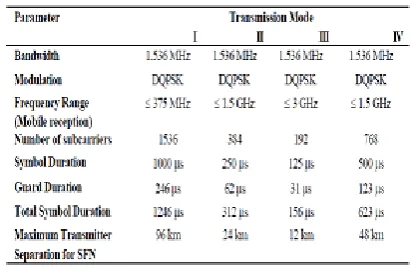
ROADCASTINGTable 1-1 shows the system parameters for DAB. DAB has four transmission modes.
The transmission frequency, receiver velocity and required multipath tolerance all determine the most suitable transmission mode to use. Doppler spread is caused by rapid changes in the channel response due to movement of the receiver through a multipath environment. It results in random frequency modulation of the OFDM subcarriers, leading to signal degradation. The amount of Doppler spread is proportional to the transmission frequency and the velocity of movement. The closer the subcarriers are spaced together, the more susceptible the OFDM signal is to Doppler spread, and so the different transmission modes in DAB allow trade off between the amount of multipath protection (length of the guard period) and the Doppler spread tolerance.
The high multipath tolerance of OFDM allows the use of a Single Frequency Network (SFN), which uses transmission repeaters to provide improved coverage, and spectral efficiency. For traditional FM broadcasting, neighbouring cities must use different RF frequencies even for the same radio station, to prevent multipath causes by rebroadcasting at the same frequency. However, with DAB it is possible for the same signal to be broadcast from every area requiring coverage, eliminating the need for different frequencies to be used in neighbouring areas. The data throughput of DAB varies from 0.6 - 1.8 Mbps depending on the amount of Forward Error Correction (FEC) applied. This data payload allows multiple channels to be broadcast as part of the one transmission ensemble. The number of audio channels is variable depending on the quality of the audio and the amount of FEC used to protect the signal. For telephone quality audio (24 kbps) up to 64 audio channels can be provided, while for CD quality audio (256 kb/s), with maximum protection, three channels are available.
III D
IGITALV
IDEOB
ROADCASTINGThe development of the Digital Video Broadcasting (DVB) standards was started in 1993 [14]. DVB is a transmission scheme based on the MPEG-2 standard, as a method for point to multipoint delivery of high quality compressed digital audio and video. It is an enhanced replacement of the analogue television broadcast standard,
user allocation scheme where users were allocated small blocks of time and frequency. In this scheme, each transmission block consists of a small group of subcarriers, (5 - 10) and a small number of symbols, about 11 in length. The aim of this structure is to allocate time and frequency slots to utilise the high correlation between neighbouring subcarriers, and the small channel variation between a small group of symbols. This allows the block to be characterised with a simple pilot tone structure.
IV M
ULTIUSEROFDM
DAB and DVB systems are only uni-directional from the base station to the users. Not much work has been done on using OFDM for two-way communications or for multiuser applications. These applications include wireless modems, Wireless Local Area Networks (WLAN's), Wireless Local Loop (WLL), mobile phones, and mobile high speed internet. This thesis aims to look at applying OFDM to such applications, and to look at the resulting advantages and problems. This thesis also presents some new techniques that can be used to improve broadcast and multiuser OFDM systems. The performance of adaptive modulation and adaptive user allocation schemes in a multiuser OFDM system. These techniques improve the spectral efficiency and QOS. Fattouche patented a method for implementing a wireless multiuser OFDM system in 1992, predating any published research in this field. This system used half duplex Time Division Multiplexing (TDM) to allow multiuser access, with the base stations and portable units taking turns to transmit. Carrier modulation was fixed and used D8-PSK (Differential 8 Phase Shift Keying). The system was bandwidth limited by using a raised cosine guard period. Fattouche is the founder WiLan Inc., which is one of the few companies currently producing multiuser OFDM modems. Williams and Prodan [82], patented the use of multiuser OFDM in cable applications in 1995. This introduced the use of a hybrid user allocation, using Frequency Division Multiplexing (FDM) and TDM. In this system the users were allocated time and frequency slots depending on the data demand. This patent however, fails to address problem of obtaining and maintaining accurate time and frequency synchronisation between users, which is critical for maintaining orthogonality between users. Cimini, Chuang, Sollenberger outlined an Advanced Cellular Internet Service using multiuser OFDM. The aim of this system was to provide Internet access at a data rate of 1– 2 Mbps. This system uses time synchronised base stations, which are allocated time slots in a self-organising fashion. These base station time slots are then broken down in to time slots for users. In addition to TDM, users are allocated subcarriers dynamically based on the channel Signal to Interference Ratio (SIR), to allow minimisation of inter-cellular interference.
Wahlqvist described one possible implementation of multiuser OFDM in a wireless environment, outlining a
V C
ONCLUSIONThe detail knowledge of a current key issue in the field of communications named Orthogonal Frequency Division Multiplexing (OFDM). We elaborated on the performance theory of the codes. First I developed an OFDM system model then try to improve the performance by applying forward error correcting codes to our uncoded system. From the study of the system, it can be concluded that we are able to improve the performance of uncoded OFDM by conVol.utional coding scheme.
R
EFERENCES[1] Rajeshree Raut & Kishore Kulat,“SDR Design with Advanced Algorithms for Cognitive Radio”.
[2] Shanon Wichman,“Comparison of speech coding Algorithms ADPCM Vs CELP”.
[3] S. Shirani, “Multimedia communications Sub-band coding”, McMaster Univ.
[4] Transform Coding”, from Wikipedia, the free
[5] Othman O. Khalifa, Sering Habib Harding and Aisha-Hassan A. Hashim,“Compression using Wavelets transform”.
[6] Othman O. Khalifa, Sering Habib Harding and Aisha-Hassan A. Hashim,“Compression using wavelet transform”.
[7] MATLAB & Simulink on www.mathwork.com [8] MATLAB 7.13. MATLAB and Simulink book.
[9] Aki Harma and Matti Karjalainen, Sept. 15, 2000 Feb 11, 2009, “WARPTB-MATLAB Toolbox for Warped DSP”.
[10] “Software Defined Radio, “from Wikipedia, the free encyclopedia
[11] Jeffrey H. Reed, Charles W. Bostain,“Presentation, Virginia Tech”Bradly Dept. of Electrical & Computer Engg. [12 ] “Cognitive Radio”, from Wikipedia, the free encyclopedia . [13] Rajeshree Raut & Kishore Kulat,“Software Defined Adaptive
Codec for Cognitive Radio”, ISSN 1109-2742, Vol.No 8, Dec 2009.
[14] Bin Le, Thomas W. Rondeau and Charles W. Bostain“Cognitive Radio Realities”.
[15] Bruce Fette Ph.D. Chief Scientist, General Dynamics C4 systems,” Implementing SDR Technologies with Matlab/ Simulink”.
[16] W. T. Webb and R. Steele, "Variable Rate QAM for Mobile Radio," IEEE Trans. Comm., Vol. 43, pp. 2223-2230, July 1995. [17] A. J. Goldsmith and S.-G. Chua, "Variable-rate Variable-Power MQAM for Fading Channels," IEEE Trans. Comm., Vol. 45, pp. 1218-1230, Oct. 1997.
[18] A. J. Goldsmith, S-G Chua, "Adaptive Coded Modulation for Fading Channels" IEEE Trans. Comm., Vol. 46, No. 5, May 1998.
[20] S. Le Goff, A. Glavieux, and C. Berrou, "Turbo-Codes and High Spectral Efficiency Modulation," Proc. ICC'94, pp. 645-649, May 1994.
[21] U. Wachsmann and J. Huber, "Power and Bandwidth Efficient Digital Communication using Turbo Codes in Multilevel Codes," European Trans. Telecommun., Vol. 6, No. 5, 1995. [22] L. Hanzo, W. Webb, and T. Keller, "Singleand Multi-Carrier
Quadrature Amplitude Modulation", Chichester: Wiley/IEEE Press, 1999.
[23] Sigen Ye, Rick..Blum, "Adaptive Modulation for Variable-Rate OFDM System with Imperfect Channel Information ", Proc of Int. Conf. on Comm., Vol. 6, pp 1861-1865, June 2001. [24] T. Keller, L. Hanzo "Unscheduled Report for the Median
Project", Technical Report, Dept. of ECS, University of Southampton, 1998.
[25] P. Robertson "An overview of bandwidth Efficient Turbo Coding Schemes", Proc. Int. Symposium on Turbo Codes and Related Topics, Brest, France, pp. 103 -110, Sept. 1997. [26] L. Piazzo," TTCM-OFDM over Wideband Fading Channels"
TMR - Marie Curie Grant, the final scientific report.
[27] L. Bahl, J. Cocke, F. Jelinek, and J. Raviv, "Optimal Decoding of Linear Codes for Minimizing Symbol Error Rate," IEEE Trans. Inform. Theory, Vol. IT-20, pp. 284-287, Mar. 1974. [28] A. J. Goldsmith and S. Chua, "Adaptive Coded Modulation for
Fading Channels," IEEE Trans. on Comm, Vol. 46, No. 5, pp.595-602, May 1998.
[29] A. J. Goldsmith and S.-G. Chua, "Variablerate Variable-power MQAM for Fading Channels," IEEE Trans. on Commun., Vol. 45, pp. 1218-1230, Oct. 1997.
[30] L. Hanzo, T. H. Liew, B. I. Yeap, "Turbo Coding Turbo Equalization and Sparse Time Coding for Transmission over Fading Channels", John Wiley & Sons, Chichester, 2002. [31] Pinar Ormeci, Xueting Liu, Dennis L. Goeckel, and Richard D.
Wesel, "Adaptive Bit-Interleaved Coded Modulation", IEEE Trans. Comm., Vol. 49, No. 9, Sept. 2001.
A
UTHOR’
SP
ROFILEDr. Rajeshree D. Raut Associate Dean R & D,
Shri Ramdeobaba College of Engineering & Management, Asociate Professor,
Electronics & Communication Engineering Nagpur, (M.S.) [email protected]
Dr. Rajeshree D. Raut, born on Aug. 2nd, 1976, completed her bachelor’s degree in Electronics & Telecommunication Engineering, from Government College of Engineering, Amravati, M.S., India. She Completed her Masters in Electronics from the same institute in 2002. She is Ph. D in Electronics and her research has made significant contribution in the field of Error Control Coding in Cognitive Environment. Having an experience of 13 years, she currently is actively associated with Research & Development Cell at Shri Ramdeobaba Kamla Nehru Engineering College, as the Associate Dean R & D. Dr. Raut is also crowned by“Shiksha Rattana Award”, for Excellence in technical Education, conferred by the IIFS, Delhi and Best Citizen of India Award for her research Contribution in the Field of Cognitive Radio, by Best Citizen Publishing House , New Delhi.. She is awarded the IDEAL TEACHER of RTM, Nagpur University. She also had the honour of being the chairperson at International Conference at Kuala-Lampur, Malaysia, this April. She is the Reviewer for IEEE Communication Letters, IEEE TENCON, IEEE ICEOE 2012 Conference, China, WSEAS International conferences and is also on the Advisory & Editorial panel of International Journal for Computer Applications(IJCA), IJCTEE, IJACS, Reviewer for WET. She has on her accord more than 30 International Journal and conference papers, organized by countries like USA, Italy, Mexico, UK and Malaysia. She has delivered many expert talks in the field. She was invited as a guest speaker at IFToMM -2011 at Mexico, in June 2011. She is the member of professional bodies like ISTE, IETE & WSEAS. At this very young age of 35 she has worked as an expert in Selection Committees constituted for the appointment of Ass. Prof/ Lecturer at Engineering Colleges like Vincent Paloti and PCE in Nagpur. Along with all her technical abilities, the administrative and organizational expertise is also portrayed from the national level events organized under her leadership. These include ICCVGIVP-09, a national level conference, TECHNOARENA a national
level student convention, STTPs etc. She also convened national level Technical Fest TECHNOVISION-6, inaugurated at the hands of Honorable Dr. A. P. J. Abdul Kalam. With all her knacks Dr. Raut is a down to earth personality, encouraging her students & colleagues, with her actions speaking more than her words. She believes “Work is Worship”.
Priti Subramanium Asst. Professor