Energy Saving in Building Thermal System using Model
Predictive Control
Sharafaddin Samandar
1, Mohmmad Ali Pourmina
2and Mahmoud Aleshams
3 1Department of Electrical Engineering, Fasa Branch, Islamic Azad University, Fasa, Iran 2
Department of Electrical Engineering, Science and Research Branch, Islamic Azad University, Tehran, Iran 3
Department of Electrical Engineering, Fasa Branch, Islamic Azad University, Fasa, Iran Abstract—This paper presents a model predictive control
(MPC) algorithm applied to the temperature control of building. Thermal model of building is obtained using system identification method, that by this method almost all types of buildings can be modeled. Simulation results show that using the proposed algorithm, the energy consumption while providing thermal comfort of residents has greatly decreased. Applied algorithm compared with the common control system of type PI.
Key Words— model predictive control, temperature regulation, energy saving,system identification, thermal system .
I. I
NTRODUCTIONToday, natural gas as a clean and environmentally friendly fuel, and one of the important factors of production in the energy basket of the world has opened its. The increasing demand for natural gas as an energy carrier it has to be considered the twenty-first century energy. Natural gas is considered as an environmentally friendly clean fuel, offering important environmental benefits when compared to other fossil fuels. Of course this does not mean that this fuel is not polluting the environment. Based on the results, the world natural gas consumption in residential and commercial sectors in 2008 was 38% contribution [1]. In Iran, this share was 57.07 percent. The obtained information show that the residential and commercial sector have most share in production of CO2 (25.7%).Also contribution of natural gas in production of CO2 (that 55 percent of global warming is result of this gas production) is 50.6% [2]. Also in the household sector, about 71% is used for heating buildings.
Therefore According to above statistics, can be concluded that by reducing natural gas consumption in households and commercial sectors and in the field of building heating specially, very big steps to reduce pollutants and as a result, growth in global warming can be taken.
Recently many studies were performed in order to optimize the energy consumption of heating systems. In [3] self-tuning PID-type fuzzy adaptive control for an HVAC (Heating, Ventilation and Air Conditioning) system was designed. The major problem of thermal systems is their slow dynamic, usually with time delays [4]. Using optimization methods have been proposed in many articles. In [5,6] use of genetic algorithms (GAs) for operating standard HVAC systems in order to optimize
performance was described. In [7,8] neural networks and in [9], [10] fuzzy logic for HVAC system optimization have been proposed.
In recent years researcher proposed model predictive control to optimize building heating systems in order to reduce energy consumption and providing thermal comfort. In [11] a model based control algorithm applied to nonlinear systems of building that obtained from thermodynamic laws was presented. In [12] different strategies based on model predictive control have been proposed. In [13] model predictive control to reduce the energy consumption without decreasing the thermal comfort during the occupation have been used. And [14] presents model predictive controller applied to the temperature control of real building model predictive control.
The paper is organized as follows. Section II introduces the control problem in a single zone . In Section III, Simulation results obtained by using an hourly weather data of a cold week in the city of Gorgan, Iran. The efficiency of the proposed control strategy is illustrated by a comparison with common PI controller.
II. M
ODELP
REDICTIVEC
ONTROLModel predictive control (MPC) is the most successful advanced control technique applied in the processes, which nowadays tend to implement MPC systems in more plant units. MPC originated in the late seventies and has developed considerably since then . Model Predictive Control does not designate a single control strategy but a vast range of control methods which use an explicit model of the process to obtain the control signal by minimizing an objective function [15]. In All the MPC algorithms first an explicit model of process based on physical laws or system identification methods is define. Then Cost function defined by using the output prediction, the reference signal and the control signal. this cost function is optimized as a function of the set of future control signals. In this step, constraints in output and output signals can be added. and finally only the first control signal computed from the cost function optimization is applied to the real process and, in the next step time, all the algorithm is repeated.
As mentioned in previous section, the first step in predictive control system design, identifying an explicit model of process. In many literatures, examples of modeling and simulation of building heating system is shown. In [11],[16]-[19] from physical and thermodynamic relations for modeling of heating system in Simulink/MATLAB environment were used. Also in [12]-[14] system identification methods have been used. several different approaches to system identification presented in [20].In [12] A process model based on a linear discrete time representation of the system ARMAX(auto-regressive with exogenous input) form is defined. Also in [13] a linear discrete time representation of the system for a single room building ARX form was used. and in [14] subspace method for model identification have been used.
In this paper is used the model presented in [12].the model is defined by a MISO (multiple-input/single-output) ARMAX representation of a building heating system. The manipulated input signal is which represents the signal applied to a heating/cooling system and the disturbance inputs are the outdoor temperature.
) ( ) ( ) ( ) ( ) ( ) ( ) ( ) ( ) ( ) ( ) ( rad S out RH out T k q C k S B k RH q B k T q B k u q B k y q A (1)
Where u(k) is the control signal indicating the heating power (KW) and y(k) is output that represents the indoor temperature (°C) and the disturbance inputs are the outdoor temperature, Tout(k) (°C), outdoor relative humidity, RHout(k) (%), and total solar radiation ,
) ( rad k
S (
KW
/ m
2).ξ(k) is a random disturbance signal,zero mean, variance σ. The models parameters are given
by the A(q),Bi(q) and C(q) which have the following form:
c c b b a a n n n n i n n q c q c q C q b q b q B q a q a q A 1 1 1 1 1 1 1 ) ( ) ( 1 ) ( (2)
Applied algorithm to heating system was shown in Figure 1.
Figure 1. MPC Algorithm
B. Defining cost function
Consider the following discrete-time LTI state-space model . ) | ( ˆ ) ( ) ( ˆ ) | ( ˆ ) ( ) | 1 ( ˆ k k u D k Cx k y k k u B k Ax k k x (3) where u(k) is the real input to the plant; the controlled variable is yˆ(k), x(k) is the current plant state and
) | 1 (
ˆ k k
x denotes an estimate of the plant state obtained using Kalman filter. The cost function to be minimized is:
1 0 2 ) ( 2 ) ( ) | ( ˆ ) | ( ) | ( ˆ ) ( u p w H i i R H H i i Q k i k u k i k r k i k y k J (4)The first term in (4) penalizes deviations of the controlled variables from the reference trajectory r(k + i) and the second term penalizes changes in the control input
)
1
(
ˆ
)
(
ˆ
)
(
ˆ
u
k
u
k
u
k
.Hp and Hu are the output and control horizons; Q(i)≥0 and R(i)≥0 are the weights on tracking error . It is assumed that Hu ≤ Hp and0
)
|
(
ˆ
u
k
i
k
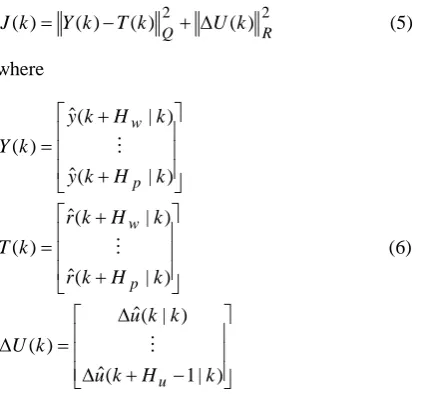
for i ≥ Hu. The cost function can be rewritten as: 2 2 ) ( ) ( ) ( )(k Y k T k Q U k R
J (5)
where ) | 1 ( ˆ ) | ( ˆ ) ( ) | ( ˆ ) | ( ˆ ) ( ) | ( ˆ ) | ( ˆ ) ( k H k u k k u k U k H k r k H k r k T k H k y k H k y k Y u p w p w (6)
Therefore, the control law is given by the following optimization problem :
min Jk
subject to: (7)
0 ) |
(
u k i k
p w
u H H
H
i
,,
max min u(k i|k) u
u
u
H i1,,
max min yˆ(k i|k) y
y
p
w H
H
i
1,,
Only the first part of the solution is used in accordance with the receding horizon strategy and the implemented control input is therefore,
opt H
l l l
opt I U k
k u
u
) ( ] 0 , 0 , [ ) (
1
(8)
That l is the number of inputs and state at the next time instant x(k + 1) is measured and the process of setting up the QP and calculating the new control action is repeated.
III. S
IMULATIONR
ESULTSIn this section a predictive control system with observer to control building temperature is shown. Then Control system performance is reviewed by changing the cost function weights during inoccupation periods. also the effects of parameters on the control system are evaluated. Finally predictive Control system performance is compared with the usual control system of type PI.
In order to evaluate the performance of control system a single-zone building used that identified ARMAX model according [12] presented as follows:
) ( ) 6767 . 0 1 ( ) ( ) 07245 . 0 (
) ( ) 2034 . 0 ( ) ( ) 02527 . 0 (
) ( ) 08395 . 0 ( ) ( ) 97 . 0 1 (
1 rad
1
out 1 out
1
1 1
k q k
S q
k RH q k
T q
k u q k
y q
(9)
The sampling time is 5 minutes. In these model u(k) is given by :
) ( ) ( )
(k u k u k u p
(10) Where u(k)is the control signal and up(k)is a disturbance representing the heating generated by the building equipments and occupants.
The weather data, includes external temperature, external relative humidity and solar radiation during 10 days in cold season for Gorgan city, are shown in Fig.1.
Figure 1. The external climate data includs external temperature, external relative humidity and solar radiation
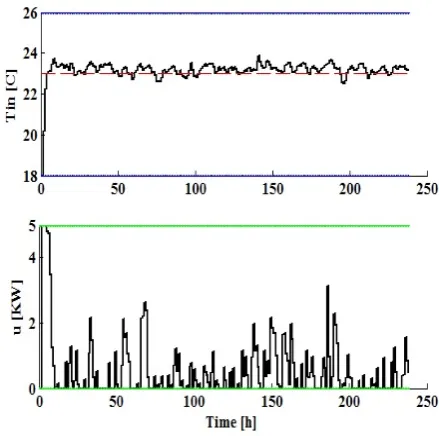
during 10 days in cold season for Gorgan city. Predictive control strategy with observer explained in section is shown in Figure 2. horizons have been chosen to this:Hu=1,Hw=1and Hp=30.input power of heating system 0 to 5kW. Also setpoint temperature is selected 23°C . As can be seen in Figure 2. Setpoint tracking is very good and Energy consumption is greatly reduced.
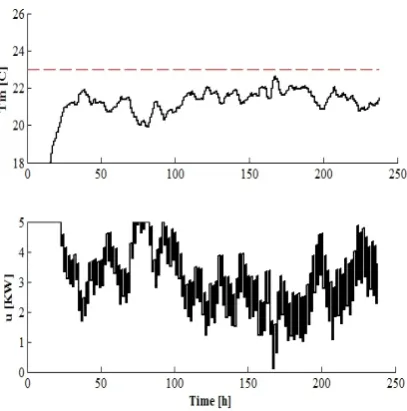
In Figure 4 Performance of the PI controller used in most existing heating control systems, is shown. To implement of this controller, the Ziegler- Nichols algorithm is used. Controller coefficients are selected such that the reduced energy consumption, and indoor temperatures was in the acceptable range of thermal comfort. . Comparing the proposed system and conventional PI control system shown that faster system response time, better tracking the reference temperature and energy consumption is less than.
Figure 3. Building temperature control using PI controller
IV. C
ONCLUSIONIn this paper the model predictive control algorithm has been applied to building temperature control. Proposed control system in a single-zone building equipped with an heating system in Gorgan city has been analyzed.
Simulation results have shown that using control algorithm presented in this paper the energy consumption while providing thermal comfort of residents has greatly decreased. Finally with comparing the proposed system and conventional PI control system has shown that MPC algorithm has faster response, better setpoint tracking and lower energy consumption.
A
CKNOWLEDGMENTThis work supported by “Sherekat behinesazi masraf sookht”. The authors thank “Sherekat behinesazi masraf sookht” and “Havashenasi golestan” for their cooperation.
R
EFERENCES[1] “International Energy Outlook 2011”, U.S. Energy
Information Administration
[2] “Energy in Iran 1388”, Ministry of Energy,(PEPD)
[3] S. Soyguder, M. Karakose and H. Alli, “Design and
simulation of self-tuning PID-type fuzzy adaptive control
for an expert HVAC system,” Expert System with Application, Vol. 36, pp. 4566-4573, 2009.
[4] J. Bai, S. Wangb and X. Zheng,”Development of an
adaptive Smith predictor-based self-tuning PI controller for an HVAC system in a test room,” Energy and Buildings, No.40, pp. 2244-2252, 2008.
[5] V. Congradac and F. Kulic, “HVAC system optimization
with CO2concentration control using genetic algorithms,” Energy and Buildings, Vol. 41, pp. 571-577, 2009.
[6] N. Nassif, S. Kajl, and R. Sabourin, “Optimization of
HVAC control system strategy using two-objective genetic algorithm,” HVAC & R RESEARCH, No. 3,pp. 459-486, 2005.
[7] M. Zaheer-uddin and N. Tudoroiu, “Neuro-PID tracking
control of a discharge air temperature system,” Energy Conversion and Management, Vol. 45, pp. 2405-2415, 2004.
[8] J. Liang and R. Du, “Design of intelligent comfort control system with human learning and minimum power control
strategies,” Energy Conversion and Management, Vol. 48, pp. 517-528, 2008.
[9] M. Hamdi and G. Lachiver, “A fuzzy control system based on the human sensation of thermal comfort,” IEEE International Conference on Fuzzy Systems, pp. 487-492, 1998.
[10]M. He, W. J. Cai and S. Y. Li, “Multiple fuzzy model-based
temperature predictive control for HVAC systems,”
Information Sciences, Vol. 169, pp. 155-174, 2005.
[11] R. Balan, S. D. Stan and C. Lapusan, “A model based
predictive control algorithm for building temperature
control,” 3rd IEEE International Conference on Digital Ecosystems and Technologies, Istanbul, Turkey, pp. 540-545, 2009.
[12] R. Z. Freire, G. H. Oliveira and N. Mendes, “Predictive
controllers for thermal comfort optimization and energy
savings” Energy and Buildings, No.40, pp. 1353-1365, 2008.
[13] P. D. Moroşan, R. Bourdais,D. Dumur and J. Buisson,
“Distributed model predictive control for building temperature regulation” American Control Conference(ACC), Baltimore, pp. 1353-1365, 2010. [14] S. Privara, G. H. Oliveira and N. Mendes, “Predictive
controllers for thermal comfort optimization and energy
savings” Energy and Buildings, Vol. 55, No.40, pp. 1353-1365, 2008.
[15] E. F. Camacho and C. Bordons, Model Predictive Control. Springer, 2004.
[16]J. Gustafsson, J. Delsing, J. van Deventer, “Thermodynamic
Simulation of a Detached House with District Subcentral,”
IEEE International System Conference, Montreal, 2008. [17] N. Mendes, G. H. Olivera, H. X. Araujo and L. S.
Coelho,”A Matlab-based simulation tool for building
thermal performance analysis,” Eighth International IBPSA
[18]G. Hudson and C. P. Underwood, ”A simple building modeling procedure for matlab/simulink,” Proceeding of
Building Simulation ’99, Vol. 2, 1999.
[19]B. Yu and A. H. C. van Paasen, “Simulink and bond graph modeling of an air conditioned room,”Simulation Modeling Practice and Theory, Vol. 12, pp. 61-76, 2004
[20] L. Ljung, System Identification: Theory for user, Prentice-Hall, 1999.
A
UTHOR’
SP
ROFILESharafaddin Samandar
was born in 1986. He received the B.S. degree in electronic engineering from the University of Sadjad, Mashad, Iran, in 2008, and he working on the M.Sc. thesis at the Islamic Azad University branch Fasa,Iran. His interests include real-time processors, MPC algorithms and Home Automation Systems
Mohammad Ali Pourmina
was born in 1961. He received the B.S. and M.Sc degrees in electrical engineering, and phd degree in electrical engineering from Islamic Azad University, science and research branch. He is currently with the Department of electrical engineering at the Islamic Azad University, Science and Research Branch. His research interests include digital signal processors and its applications.