Journal of Applied Pharmaceutical Science Vol. 3 (07), pp. 018-024, July, 2013 Available online at http://www.japsonline.com
DOI: 10.7324/JAPS.2013.3704 ISSN 2231-3354
Evaluation of the MRSA Sensitivity to Essential Oils Obtained from
four Algerian Medicinal Plants
KHADIR Abdelmounaïm
1, BENDAHOU Mourad
1,*, BENBELAID Fethi
1, BELLAHCENE Chafika
1, ABDELOUAHID
Djamel-Eddine
1, MUSEILI Alin
2, PAOLLINI Julien
2, DESJOBER Jymy
2, COSTA Jean
21
Laboratory of Applied Microbiology in Food, Biomedical and Environment (LAMAABE),Department of Biology, Faculty of Nature and Life, Earth and Universe Sciences,AboubekrBelkaïd University of Tlemcen, 13000 Tlemcen, Algeria.
2
UMR De Produits naturels, Université Pascal Paoli, Corte, France.
ARTICLE INFO ABSTRACT
Article history: Received on: 29/03/2013 Revised on: 07/04/2013 Accepted on: 06/05/2013 Available online:30/07/2013
In this work, we evaluated the anti-MRSA activity of essential oils obtained from four Algerian medicinal plants which are: Ammoides verticillata, Origanum vulgare subsp. glandulosum, Lavandula multifida, and Thymus munbyanus subsp. ciliatus. The anti-MRSA activity was evaluated by the technique of agar diffusion and determination of MICs. We also studied the kinetics of destruction of these oils against MRSA strain ATCC 43300. The four essential oils showed a good anti-MRSA activity. Oils with the highest activity are; Origanum vulgare subsp. glandulosum, Thymus munbyanus subsp. ciliatus, Lavandula multifida and Ammoides verticillata respectively. The kinetics of destruction of all essential oils against MRSA ATCC 43300 strain is dependent on concentration. The Concentration 1% allows a total destruction; while the concentration 0.5% was bactericidal only with Origanum vulgare, whereas the concentration 0.25% and 0.125% have had a low destruction respectively. We concluded that the essential oils can be used as an anti-MRSA.
Key words:
MRSA, essential oils, kinetics of destruction, bactericidal.
INTRODUCTION
The rapid emergence of antibiotic resistance over the past six decades has been accompanied by a decrease in production of new antimicrobial agents (Talbot et al., 2006). This slowdown is mainly due to the lack of discovery of new molecules of antibiotics (Fischbach and Walsh 2009), but also to the lack of research programs on these molecules, since the pharmaceutical industry has reduced its research in this field because of its low profitability (Nathan 2004, von Nussbaum et al., 2006).
MRSA is now ranked among the top pathogen causing fatal nosocomial infections in hospital and community (Chambers and DeLeo 2009) with several types of skin infections, mucous membranes and endocarditis. It is also responsible for severe lung infections such as fatal necrotizing pneumonia (Tang and Stratton 2010). Initially sensitive to penicillin, Staphylococcus aureus was
able to adapt quickly to the action of antimicrobial agents by creating of many mechanisms of resistance against most
.
* Corresponding Author BENDAHOU Mourad, email: [email protected], BP1080, 13000 Tlemcen-Algeria Tel: +213 43204279 Fax: +213 43203719
antibiotics (Descloux et al., 2007). The acquisition of the mecA gene that codes for the protein (PBP2') (or PBP 2a) gives Staphylococcus aureusresistance to methicillin and most β-lactams (Deurenberg and Stobberingh 2008).
Another mechanism involved in multidrug resistance of methicillin resistance Staphylococcus aureus MRSA to many
classes of antibiotics other than the β-lactam antibiotics, is the
efflux pumps that allow for the pathogen to remove the molecules of antibiotics which penetrate inside the cell to the extracellular medium (Piddock 2006). Glycopeptides are the last lines of defense effective in treating MRSA infection, however strains with reduced susceptibility or resistance to these molecules have been described (Tenover 1998, Tenover 2001).
The natural plant extracts may contain interesting antibacterial compounds that can be considered as a new strategy to fight against nosocomial infections (Palaniappan and Holley 2010, Ramalhete et al., 2011).Many recent studies have evaluated the antimicrobial activity of essential oils on bacteria, including those involved in nosocomial infections (Billerbeck 2008),
Nevertheless, a few studies have been conducted on eradication of nosocomial pathogen such as MRSA.
In this work we evaluated the effect of four essential oils obtained from Algerian medicinal plants which are Amoides verticillata, Origanum vulgare subsp. glandulosum, Lavandula multifida, and Thymus munbyanus subsp. ciliatus on 19 clinical MRSA, two references MRSA and three references methicillin sensitive Staphylococcus aureus MSSA strains. We also studied the kinetics of destruction of these oils on reference MRSA strain ATCC 43300.
MATERIALS AND METHODS
Plant material
Aerial parts of the medicinal plant species (stems, leaves and flowers) used in this work were collected in full inflorescence. Lavandula multifida L. and Thymus munbyanus subsp. ciliatus (Desf.) Greuter & Burdet. were harvested from Bouhanak, located in West of Tlemcen (West of Algeria) at 34 ° 53 North and -1 ° 22 West, 700 m of altitude. While Origanum vulgare subsp. glandulosum (Desf.) Ietsw. and Ammoides verticillata (Desf.) Briq. were harvested from Mefrouche station which is located in the South of Tlemcen at an altitude of 1190 m, between latitudes 34 ° 49 North and longitude 1 ° 19 West. Harvests were made during June 2011. Specimens of all spices in this study were identified by laboratory of ecological management of natural ecosystems, university of Tlemcen. The plants materials were Left to dry for a week by spreading it in open air and away from sunlight.
Obtaining essential oils
Essential oils extraction was performed by
hydrodistillation in a Clevenger-type apparatus for three hours. The obtained essential oils was dried with magnesium sulfate (MgSO4) and stored in smoked vials at +4 °C.
GC and GC / MS analysis
GC analyses were performed by a device type Perkins Elmer GC Autosystem equipped with a single injector and two flame ionization detectors (FID).
The device has two columns of fused silica capillary (60 mx 0.22 mm, film thickness 0.25 µm) with different stationary phases: Rtx-1 (polydimethylsiloxane) and Rtx-Wax (polyethylene glycol). Temperature program: 60-230 ° C at 2 ° C / min and then held isothermal at 230 ° C (30 min). Carrier gas: helium (1 ml / min). Temperatures of injector and detector were held at 280 ° C. Injection was performed with a split ratio of 1:80. Injected volume: 0.1 µl. Analyses GC / MS were made using a detector
Perkin Elmer TurboMass, directly coupled to a Perkin Elmer Autosystem XL columns equipped with fused silica capillary (60 m × 0.22 mm, film thickness 0 , 25 um), Rtx-1 (polydimethyl siloxane) and Rtx-Wax (polyethylene glycol).
Analysis GC / MS was performed with the following conditions: temperature of the ion source 150 ° C, ionization energy: 70 eV electron spectra ionization mass were acquired over the mass range of 35 to 350 Da. Scan time: 1 sec. The injection was performed with a division ratio of 1:80.
Bacterial strains
19 Clinical Strains of Staphylococcus aureus were isolated from postoperative wound, nasal swabs and central venous catheters incubations of patients hospitalized in several services (surgery, pediatrics, internal medicine, maternity and pulmonology) at the University Hospital of Tlemcen during a period of 14 months ranged from April 2010 to June 2011. These strains were identified by API Staph system (BioMérieux®, France). Reference MRSA strains ATCC 43866 and ATCC 43300, and MSSA strains ATCC 25923 and MSSA ATCC 29213 were also tested.
Selection of strains resistant to methicillin MRSA
Isolation of methicillin resistant Staphylococcus aureus strains was performed by two methods as recommended by the Clinical and Laboratory Standards Institute (CLSI 2011), strains of Staphylococcus aureus correctly identified have suffered an antibiogram using oxacillin disk and cefoxitin. All strains resistant to oxacillin or cefoxitin were considered MRSA strains (CLSI 2011). The second method is a screening in Muller-Hinton agar (CondaPronadisa™, Spain) supplemented with 6 µg / ml of oxacillin or 4 µg / ml of cefoxitin. The strains were inoculated by spot using a sterile swab, all strains grown on agar were considered MRSA strains (CLSI 2011).
Agar diffusion technique
The strains tested were grown for 18 h in Muller-Hinton broth (CondaPronadisa™, Spain), and then the inoculum was prepared at a concentration of 107 CFU / ml. inoculation was done by swabbing on Mueller-Hinton agar according to the recommendations of CLSI (CLSI 2011). A sterile disk of 6 mm in diameter impregnated with 2 µl of oil was placed in the center of the box sown.
Determination of the minimum inhibitory concentration
108UFC/ml were diluted 1/1000 to the concentration of 105UFC/ml. in Microplate, 180 µl of bacterial suspension at 105UFC/ml were deposited inside the wells. Then 20 µl of the solution of the oil was added. The final concentration of Tween 80 is 0.1% (v/v) in each well and the final concentrations of the essential oil is ranged from 4% to 0.0078%. Susceptibility testing of essential oils (agar diffusion method and e MICs were repeated three times).
Destruction kinetics of MRSA strain 43300 with essential oils
The kinetics of destruction of MRSA exposed to essential oils tested in this work was evaluated according to the experimental protocol Christoph, et al.,., 2001 (Christoph et al., 2001); The inoculum preparation was done by cultivating the strain tested in 10 ml of trypticase soy TSB (Fluka BioChemika®, France) during 18 h of incubation. Then the culture was centrifuged for 10 min at 250 rpm at 25 ° C. After that, the pellet is recovered and suspended in 0.9 ml of sterile saline for a concentrated suspension of bacteria 3x10⁹ CFU / ml. MRSA ATCC 43300 strain (100 µl of the final inoculum) were inoculated into 50 ml containing the concentrations 1, 0.5, 0.25, and 0.125 % oil and Tween 80 (0.5%) in sterile distilled water and stirred continuously. After incubation for 5, 10, 15, 30, 60,120, and 240 min at 37C °, aliquots of 1 ml were sampled and transferred to a broth inactivation (9 ml of nutrient broth) and vortexed. After 2 min, serial dilutions were prepared in saline, and 100 µl of each dilution and broth inactivation were spread on Mannitol salt agar medium (Merck®, France) for enumerating colonies. For this work we used the reference strain ATCC 43300 MRSA.
RESULTS AND DISCUSSION
GC and GC / MS analysis
The chemical composition of the essential oils is presented in Table 1. Based on this composition, we find that the essential oil of A. verticillata is rich in thymol (51.1%), p. cymene (16.4%) and limonene (14.1%). As well as the essential oil of O. v. subsp. glandulosum is rich also in thymol (43.3%), p-cymene
(15.3%), and γ terpinene (27.0%). In addition, the oil of A.
verticillata contains more oxygenated monoterpenes than oregano oil while the reverse is true for hydrocarbon monoterpenes. Analysis of T. m. subsp. Ciliatus showed a chemotype carvacrol as major compound with a percentage of 80.1% and an abundance of Monoterpenes hydrocarbons, while the chemical composition of L. multifida showed that it is rich in carvacrol with a percentage of
57, 1%, but also with the β-bisabolene, with 25.2%.
The results of the antimicrobial activity of essential oils of the four medicinal plants on methicillin resistant S. aureus MRSA strains have shown that the four oils showed strong activity against MRSA strains, the level of this activity was variable. The essential oils showed the strongest activities are: T. m. subsp. Ciliatus, O. v. subsp. glandulosum L. multifida and A. verticillata, respectively. Results of inhibition diameters and minimum inhibitory concentrations are presented in Tables 2 and 3. The
results of the anti-MRSA activity of the four essential oils showed that MRSA strains tested were either sensitive or highly sensitive towards the four essential oils such as the lowest inhibition diameters were 14 mm (Ponce et al., 2003). O. v. subsp. glandulosum, showed the highest activity with diameters that reach 55 mm and MIC ≤ 0.06%, which explains the use of this
herb by the ancient population and confirms the broad spectrum action of its essential oil (Bendahou et al., 2008). Comparing this with the anti-MRSA effect of other species of the same genus, Chao et al.,, 2008 showed that the species Origanum majorana has a remarkable effect on MRSA with diameters of 28 mm, as these authors tested the essential oil of Thymus vulgaris species, the latter showed a very strong effect with a diameter of 57 mm (Chao et al., 2008). Indeed Nostro et al.,, 2004 showed the effect of purified carvacrol and thymol essential oil of Origanum vulgare on the strain of MRSA ATCC 43300, the results showed a strong inhibition of these compounds against this MRSA strain (Nostro et al., 2004). We obtained the same results with Algerian O. v. subsp. glandulosum which has as the major compound the Thymol, while the species A. verticillata showed an average anti-MRSA activity although the composition of its essential oil is rich in thymol. In addition, the species T. m. subsp. Ciliatus showed a significant anti-MRSA effect, the antibacterial activity of this essential oil is mainly due to its high content of carvacrol (Bousmaha-Marroki et al., 2007).
On the active species of lavender we tested, L. multifida which presented a remarkable activity. The anti-MRSA effect of this species can be explained by the fact that L. multifida is the only species that produces large amounts of carvacrol (Harborne and Williams 2002). Indeed, carvacrol act on the membrane of the bacterium by a reduction in ATP synthesis and membrane electrical potential, and therefore the result is an increase in the permeability of the membrane, which results in the destruction of the bacterial cell (Husnu Can Baser 2008). Moreover, studies have shown that another major component that this plant has; called "β -bisabolene" has an interesting antimicrobial activity on microorganisms and MRSA strains (Nascimento et al., 2007, Simic et al., 2005).
The results for the diameters of inhibition showed that the larger diameters of inhibition were observed with O. v. subsp. glandulosum with an average of 29.45 mm, and T. m. subsp. Ciliatus of 25.8 mm then less large diameter with A. verticillata of 24.33 mm and L.multifida with an average of 19.75 mm. Furthermore, we observed some differences in the effect between
inhibition zones and MICs. The minimum inhibitory
Table 1: Chemical composition of plants studied
Plants T. m. subsp. Ciliatus O. v. subsp. glandulosum A. verticillata L. multifida
Yield % (w/w) 6 4 4.5 0.6
Constituents RIa RIp
α-Thujene 928 1023 0.4 1.3 0.2 -
α-Pinene 931 1022 0.5 0.6 0.1 0.6
Camphene 943 1066 0.1 0.1 - -
1-Octen-3-ol 959 1446 tr 0.1 - 0.2
3-Octanone 963 1253 0.1 0.1 - -
Sabinen 966 1120 - - 0.1 -
β-Pinene 970 1110 0.1 0.1 0.1 0.2
Myrcene 979 1159 1.2 2.0 0.7 0.7
α-Phellandrene 997 1164 0.1 0.3 - -
∆-3-Carene 1005 1147 0.1 0.1 tr tr
α-Terpinene 1008 1178 1.3 2.7 0.1 -
p-Cymene 1011 1268 7.1 15.3 16.4 2.2
Limonene 1020 1199 0.3 0.5 14.1 -
Eucalyptol 1020 1209 - - - 0.9
α-phellandrene 1021 1212 - 0.2 - -
(Z)-β-Ocimene 1024 1230 0.1 tr - tr
(E)-β-Ocimene 1034 1247 0.1 tr - tr
ϒ-Terpinene 1047 1243 4.2 27.0 7.5 -
Cis-hydrate sabinene 1050 1451 - - tr -
trans-Sabinene hydrate 1051 1451 0.2 0.3 - -
Fenchone 1071 1401 - - - tr
p-cymenene 1073 1469 - - - -
Terpinolene 1078 1280 0.1 0.1 0.1 0.1
Linalool 1081 1544 0.7 0.6 0.2 tr
Borneol 1148 1698 0.1 0.1 - -
Terpinen-4-ol 1161 1600 0.4 0.2 0.3 -
α-Terpineol 1172 1697 0.2 0.2 0.2 -
Cis-carveol 1208 1863 - - tr -
Thymoquinone 1216 - - - - -
Carvacrol methyl ether 1231 1603 - - - 0.3
Carvone 1235 1739 - - - tr
Thymol 1266 2189 0.2 43.3 51.1 -
Carvacrol 1278 2219 80.1 2.0 7.5 57.1
α-Terpenylacetate 1334 1695 - - - 0.1
carvacryl acetate 1345 1876 0.1 - - -
Methyleugenol 1367 2009 - - - 0.2
β-Caryophyllene 1424 1591 1.2 1.2 - 2.1
β-Farnesene 1448 1661 - - - 0.1
α-Humulene 1456 1665 0.1 0.1 - -
β-Bisabolene 1500 1720 0.1 0.1 - 25.2
β-Sesquiphellandrene 1516 1765 0.1 0.4 - -
(E)-α-bisabolene 1534 1772 - tr - -
Spathulenol 1560 2119 - - - 3.4
Caryophyllene oxide 1576 1980 0.2 0.2 - 3.7
Total (%) 99,5 99,6 98,7 97,1
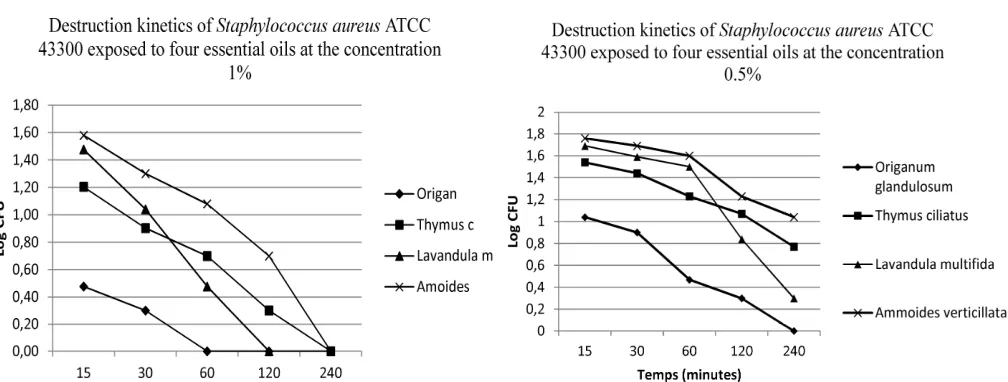
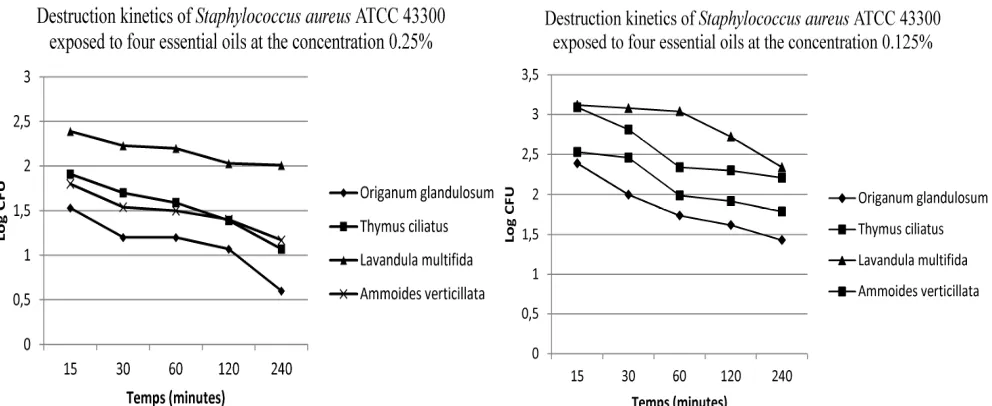
Fig . 1: destruction kinetics of MRSA strain ATCC 43300 exposed to four essential oils (O. v. subsp. Glandulosum, T. m. subsp. Cilliatus, L. multifida and A.verticillata ) in time 15; 30; 60; 120; and a four concentration 1%, 0.5%, 0.25% and 0.15%.
Table. 2: Inhibition diameter of essential oils of four medicinal plants collected in western Algeria.
Strains diameter (mm)
T. m. subsp. Ciliatus O. v. subsp. glandulosum A. verticillata L. multifida
MRSA1 30 31 25 27
MRSA2 32 34 15 14
MRSA3 34.66 28 28 15
MRSA4 28 28 28 17
MRSA5 16.5 26 24 14
MRSA6 16.5 24 18 23
MRSA7 17.5 23 19 22
MRSA8 16.5 24 15 22
MRSA9 20 25 20 18
MRSA10 20 25 21 20
MRSA11 15 29 22 24
MRSA12 19 28 30 19
MRSA13 36.66 32 27 21
MRSA14 29 25 34 18
MRSA15 36 26 27 21
MRSA16 19 26 25 18
MRSA17 18.5 30 25 21
MRSA18 34 25 16 20
MRSA19 21 25 22 22
MRSA 43300 27 32 30 18
MSSA 25923 40 36 30 19
MSSA 33862 35.5 34 25 22
MSSA 29213 30 36 28 19
MRSA 43866 27 55 30 20
Table. 3: Minimum inhibitory concentration of four medicinal plants collected in western Algeria.
Strains Minimum inhibitory concentration MIC% (v/v)
T. m. subsp. Ciliatus O. v. subsp. glandulosum A. verticillata L. multifida
MRSA1 0.25 0.125 0.25 0.125
MRSA2 0.25 0.125 0.125 0.5
MRSA3 0.125 0.25 0.25 0.25
MRSA4 0.125 0.25 0.25 0.125
MRSA5 0.125 0.25 0.5 0.5
MRSA6 0.5 0.25 0.25 0.125
MRSA7 0.5 0.25 0.125 0.125
MRSA8 0.125 0.25 0.25 0.125
MRSA9 0.125 0.25 0.125 0.0625
MRSA10 0.25 0.125 0.5 0.25
MRSA11 0.5 0.25 0.5 0.5
MRSA12 0.125 0.125 0.25 0.25
MRSA13 0.25 0.25 0.25 0.125
MRSA14 0.125 0.25 0.5 0.5
MRSA15 0.06 0.06 0.5 0.25
The effect of essential oils on different MRSA strains was more or less similar; in general, essential oils with high activities have maintained this activity for the majority of MRSA strains tested. There is not a clear difference between the effect of essential oils on clinical MRSA strains and MSSA references strains, however, the inhibition diameters were the lowest recorded for MRSA strains as it is for MSSA strains case for MRSA11 (15 mm oil T. m. subsp. Ciliatus) and MRSA2 (14 mm oil L. multifida).
Destruction kinetics of MRSA strain 43300 with essential oils
The study of the kinetics of destruction of the MRSA strain 43300 with the four essential oils showed that after 240 min at the concentration 1%, all four death kinetic curves reached the x-axis with a reduction of 6.8 log10 which means that the four oils
exerted a bactericidal effect whereas at the concentration 0.5%, O. v. subsp. glandulosum oil exercise a high bactericidal effect with complete destruction of bacterial cells, while L. multifida destruction was observed from log 6.8 log10 to 0.25 log10. However
T. m. subsp. Ciliatus and A. verticillata exerted lower reductions of bacterial cells which were from 6.8 log10 to 0.8 log10 and 1.05 log10
respectively. Nevertheless, the concentration 0.25% showed almost complete destruction of O. v. subsp. glandulosum and average destruction of L. multifida, A. verticillata and T. m. subsp. Ciliatus. However, the curves of the concentration 0.125% showed a very low activity of the four oils with low decreases of bacterial cells which ranged from 6.8 log10 to 2.34 log10 and 1.43 log10
within 240 min (see fig. 1), it follows that the bactericidal activity
of all essential oils tested in this study is dependent on concentration. Indeed, these oils because they have dependent on concentrations, they are bactericidal at concentrations required and destroying cells at the stationary phase, but when concentrations are low they exert more bacteriostatic activity (Christoph et al., 2001).
In fact, the most studies of the antimicrobial activity of essential oils concern inhibition of microbial growth rather than lethal effects (Lattaoui andTantaoui-Elaraki 1994). However there is some studies on time killing kinetics on MRSA strains; Dadalioglu and Evrendilek, 2004, presented the kinetics of destruction of the MRSA strain ATCC 43300 and found a very strong effect of oregano oil followed by the effect of lavender from Turkey (Dadalioglu and Evrendilek 2004). These results agree well with ours as we recorded a faster kinetics of O. v. subsp. glandulosum and stronger than that exerted by L. multifida. In another study, May et al.,., have studied the kinetics of destruction of MRSA and MSSA strains exerted by tea tree oils,
they have found that tea tree oil was more active against methicillin sensitive Staphylococcus aureus than methicillin resistant Staphylococcus aureus (May et al., 2000).
CONCLUSION
The evaluation of the anti-MRSA activity of four essential oils obtained from Algerian medicinal plants tested in this work showed that oils had a remarkable inhibitory effect on Staphylococcus auerus, especially, against MSSA than strains MRSA. In addition, the kinetics of destruction showed that all essential oils tested in this study is dependent on concentration to exercise its bactericides. We also concluded that the essential oils can be used as an anti-MRSA, since our results showed their effectiveness. Further studies are needed to develop formulations for pharmaceutical use based on these essential oils to fight this nosocomial pathogen.
REFERENCES
Bendahou M., Muselli A., Grignon-Dubois M., Benyoucef M., Desjobert J.-M., Bernardini A.-F., Costa J. Antimicrobial activity and chemical composition of Origanum glandulosum Desf. essential oil and extract obtained by microwave extraction: Comparison with hydrodistillation. Food Chem 2008;106: 132-139.
Billerbeck V. G. Huiles essentielles et bactéries résistantes aux antibiotiques. Phytothérapie 2008;5: 249-253.
Bousmaha-Marroki L., Atik-Bekkara F., Tomi F., Casanova J. Chemical Composition and Antibacterial Activity of the Essential Oil of Thymus ciliatus (Desf.) Benth. ssp. eu-ciliatus Maire from Algeria. J Essent Oil Res 2007;19: 490-493.
Chambers H. F., DeLeo F. R. Waves of resistance: Staphylococcus aureus in the antibiotic era. Nature Rev Microbiol 2009;7: 629-641.
Chao S., Young G., Oberg C., Nakaoka K. Inhibition of methicillin-resistant Staphylococcus aureus (MRSA) by essential oils. Flavour Fragr J 2008; 23: 444-449.
Christoph F., Stahl-Biskup E., Kaulfers P. M. Death kinetics of Staphylococcus aureus exposed to commercial tea tree oils. J Essent Oil Res 2001;13: 98-102.
CLSI. Clinical and Laboratory Standards Institute, Performance Standards for Antimicrobial Susceptibility Testing; Twenty-First Informational Supplement. M100-S21 2011;31
Dadalioglu I., Evrendilek G. A. Chemical compositions and antibacterial effects of essential oils of Turkish oregano (Origanum minutiflorum), bay laurel (Laurus nobilis), Spanish lavender (Lavandula stoechas L.), and fennel (Foeniculum vulgare) on common foodborne pathogens. J Agric Food Chem 2004;52: 8255-8260.
Daurel C., Leclercq R. Faut-il abandonner la vancomycine ? Arch Pediatr 2010;17, Supplement 4: 121-128.
Descloux E., Mohammedi I., Gillet Y., Francois B., Etienne J. Pneumonie nécrosante à Staphylococcus aureus communautaire résistant à la méticilline et producteur de leucocidine de Panton-Valentine chez un adulte. Réanimation 2007;16: 256-258.
MRSA17 0.5 0.25 0.25 0.25
MRSA18 0.25 0.06 0.125 0.5
MRSA19 0.5 0.06 0.5 0.5
MRSA 43300 0.25 0.5 0.125 0.25
MSSA 25923 0.25 0.25 0.25 0.125
MSSA 33862 0.25 0.25 0.25 0.0625
MSSA 29213 0.25 0.25 0.25 0.125
MRSA 43866 0.5 0.25 0.25 0.25
Deurenberg R. H., Stobberingh E. E. The evolution of Staphylococcus aureus. Infect Genet Evol 2008;8: 747-763.
Fischbach M. A., Walsh C. T. Antibiotics for emerging pathogens. Science 2009;325: 1089-1093.
Harborne J., Williams C. (2002). Lavender The Genus Lavandula. In Lis-Balchin M. (ed.) Medicinal and aromatic plants – industrial profiles (pp. 86-99). New York: Taylor & Francis.
Hood J. R., Wilkinson J. M., Cavanagh H. M. A. Evaluation of Common Antibacterial Screening Methods Utilized in Essential Oil Research. J Essent Oil Res 2003;15: 428-433.
Husnu Can Baser K. Biological and Pharmacological Activities of Carvacrol and Carvacrol Bearing Essential Oils. Curr Pharm Des 2008;14: 3106-3120.
Lattaoui N., Tantaoui-Elaraki A. Comparative Kinetics of Microbial Destruction by the Essential Oils of Thymus broussonettii, T. zygis and T. satureioides. J Essent Oil Res 1994;6: 165-171.
May J., Chan C. H., King A., Williams L., French G. L. Time kill studies of tea tree oils on clinical isolates. J Antimicrob Chemother 2000;45: 639-643.
Mohtar M., Johari S. A., Li A. R., Isa M. M., Mustafa S., Ali A. M., Basri D. F. Inhibitory and Resistance-Modifying Potential of Plant-Based Alkaloids Against Methicillin-Resistant Staphylococcus aureus (MRSA). Curr Microbiol 2009;59: 181-186.
Nascimento A. M., Brandao M. G., Oliveira G. B., Fortes I. C., Chartone-Souza E. Synergistic bactericidal activity of Eremanthus erythropappus oil or beta-bisabolene with ampicillin against Staphylococcus aureus. Antonie van Leeuwenhoek 2007;92: 95-100.
Nathan C. Antibiotics at the crossroads. Nature 2004;431: 899-902.
Nostro A., Blanco A. R., Cannatelli M. A., Enea V., Flamini G., Morelli I., Sudano Roccaro A., Alonzo V. Susceptibility of methicillin-resistant staphylococci to oregano essential oil, carvacrol and thymol. FEMS Microbiol Lett 2004;230: 191-195.
Palaniappan K., Holley R. A. Use of natural antimicrobials to increase antibiotic susceptibility of drug resistant bacteria. Int J Food Microbiol 2010;140: 164-168.
Piddock L. Multidrug-resistance efflux pumps-not just for resistance. Nature Rev Microbiol 2006;4: 629-636.
Ponce A. G., Fritz R., del Valle C., Roura S. I. Antimicrobial activity of essential oils on the native microflora of organic Swiss chard. LWT - Food Sci Technol 2003;36: 679-684.
Ramalhete C., Spengler G., Martins A., Martins M., Viveiros M., Mulhovo S., Ferreira M.-J. U., Amaral L. Inhibition of efflux pumps in meticillin-resistant Staphylococcus aureus and Enterococcus faecalis resistant strains by triterpenoids from Momordica balsamina. Int J Antimicrob Ag 2011;37: 70-74.
Simic N., Palic R., Randjelovic V. Composition and antibacterial activity of Achillea clypeolata essential oil. Flavour Fragr J 2005;20: 127–130.
Talbot G. H., Bradley J., Edwards J. E., Gilbert D., Scheld M., Bartlett J. G. Bad bugs need drugs: An update on the development pipeline from the Antimicrobial Availability Task Force of the Infectious Diseases. Clin Infect Dis 2006;42: 657-668.
Tang Y. W., Stratton C. W. Staphylococcus aureus: An old pathogen with new weapons. Clin Lab Med 2010;30: 179-208.
Tenover. Characterization of Staphylococci with Reduced Susceptibilities to Vancomycin and Other Glycopeptides. J Clin Microbiol 1998;36: 1020–1027.
Tenover. Increasing Resistance to Vancomycin and Other Glycopeptides in Staphylococcus aureus. Emerg Infect Dis 2001;7: 327-332.
von Nussbaum F., Brands M., Hinzen B., Weigand S., Habich D. Antibacterial natural products in medicinal chemistry - Exodus or revival? Angew. Chem.-Int. Edit. 2006;45: 5072-5129.
Wiegand I., Hilpert K., Hancock R. E. W. Agar and broth dilution methods to determine the minimal inhibitory concentration (MIC) of antimicrobial substances. Nat Protoc 2008;3: 163-175.
Wong-Beringer A., Joo J., Tse E., Beringer P. Vancomycin-associated nephrotoxicity: a critical appraisal of risk with high-dose therapy. Int J Antimicrob Ag 2011;37: 95-101.
How to cite this article: