Implication of Cell Phone usage on Study
Patterns of Teens
Ismail Olaniyi Muraina
1, Basirat Abiola Adenowo
2, Adebisi Sylvester Olude
3,
Solomon Onen Abam
4, Wasiu Olatunde Oladapo
51
Computer Science Department, Adeniran Ogunsanya College of Education Lagos, P.M.B 2007 Ijanikin Lagos, +2348036308030
2
Computer Science Department, Adeniran Ogunsanya College of Education, Lagos P.M.B 2007 Ijanikin Lagos, +2348067762498
3Chemistry Department, Adeniran Ogunsanya College of Education Lagos, P.M.B 2007 Ijanikin Lagos,
+2348036627633
4
Computer Science Department, School of Part-Time Studies, Adeniran Ogunsanya College of Education Lagos P.M.B 2007 Ijanikin Lagos, +2348103014260
5Computer Science Department, School of Science, Adeniran Ogunsanya College of Education
(Student). +2348131620670
Abstract
—
Cell phone usage has become worldwide commodity for every person regardless of their ages. Over the years, teenagers within the age bracket of thirteen to nineteen are more vulnerable towards the use of the technology in a negative way. The study approached the implication of cell phone usage on study patterns of teens in relation with searching useful information and irrelevant information while they are studying. The study sampled 100 students within the age of 13 to 19 year. The students were selected across different levels of education for proper representations of the population; t-test and cross-tabulation together with graphical representation (3D bars charts) were used to analyse the data. Among others, the findings show that female students did use cell phone to source useful information than male. In contrary, ages of students do not imply use of cell phone for either useful or irrelevant information. Lastly, the higher the level of a student the more the student source for useful information via cell phones. It is recommended that proper monitoring should be applied in schools regarding the use of cell phone for other things except academic purposes because children of today are the leaders of tomorrow.Keywords— Cell Phone, Study Pattern, Teens, Teenagers
I. INTRODUCTION
The present adoption of ubiquitous technologies by large portion of the entire population of the world in emerging economies has given tremendous rise to different variety of cell phone usage in virtually all areas of human endeavour.
In its present digital version (GSM), the mobile phone (cell phone) has begun its spectacular diffusion since about 1995, when it was still predominantly used for business purposes possession was mainly restricted to men or women who had completed school and were already earning their own money on a job [1].
Thus, we can observe an extremely rapid diffusion process of cell phone in our society. This breath taking speed cannot be compared with the diffusion velocity of any other technological gadget during the same
period or any time before including the spread of PC’s and internet connections [2]. As Howard Rheingold noticed during his trip to Japan in 2008, on his way some people were reading books and newspapers but large numbers of people were either reading their messages on their cell phones or sending messages. Then, he concluded that cell phones enabled people to deal with awkward or uncomfortable situations in which they find themselves when riding in elevators, travelling on subways and trains or spending time in public places. Several studies on cell phone made it clear that cell phone and social media represent a major transformation in the way societies function. The ubiquity of cell phones and the popularity of the social media are signifiers of a new order in which anyone and almost everyone can make their presence known, by sending messages, photos and videos that potentially can be addressed by a huge number of people. This has had the effect on breaking the monopoly on sending messages in the mass media that was held by traditional media such as radio, television, magazine and newspaper. The following research questions guide the study:
Is there any significant difference between male and female study patterns in the use of cell phone?
Is there any significant influence of age between students using cell phone for useful information and those using cell phone for irrelevant information?
Does level of students in school determine the kind of information such students will source for via cell phone?
II.
R
ELATEDL
ITERATUREfocused on effect of cell phone usage on aforementioned variables. Much of the studies are yet to cover areas such as studies pattern, achievement, change of attitude to mention but few.
Generally, the reasons for working adult population use cell phones are a bit different from the reasons why teenagers use cell phones. [3] found not only social and instrumental motives of mobile phone use but mobility, immediacy and fashion/status motives as well. In a similar way, [4] shows that the Korean people’s satisfaction sought from mobile phones are entertainment, sociability, transaction; immediacy and privacy reflect the characteristics of mobile phone communication. This implies that there are devices forms and ways of reasons that people use cell phones for.
Why teenagers use cell phones, and its implication on teens study patterns are interesting aspects addressed in the study. As it is well known, consumption patterns of adolescents are especially prone to be influenced by collective norms. Thus, studies show that many adopt a cell phone just because ―many colleagues already have one‖ or because it is ―cool‖ [5]. To adults, the cell phone has become one of the most intimate and personalized material objects, to be compared with keys or wallets. In a UK survey, it was reported that almost half of the users said that when they lost their cell phone it would result in a sort of ―bereavement‖. This did happen because many people are afraid to leave home without it, and feel uncomfortable when others peruse their mobile menus or messages [6]. So, most adolescents carry their cell phones with them all the time, many keep it under their pillows or on their side table at night [6].
Findings show that earlier cohorts of teenagers have adopted the cell phone without much family influence, because older siblings, father and mother were not yet acquitted with the technology [2]. Thus, it may be expected that peer influences were dominant. At present, almost all children grow in a setting where adults are already acquainted with cell phone. As a result of this, teenagers are likely to get into contact with cell phones at their tender ages. According to [2] more and more girls as well as boys adopt their first cell phone at the age between 10 and 12. As studies have shown for years, this is an age where youngsters are still very much embedded in family relations and live most of their leisure time still with their parents. As [5] puts ―most teens get their first mobile phones as a gift from their parents. Very often, it is an older model no longer used by father, mother or older siblings‖.
Evidence from studies have revealed that parents seem not to be capable of withstanding the pressures emanating from the peer groups of their children – even when they organize in order to increase their level of control [1]. The teen’s use of cell phones nowadays especially in school setting giving signs of warning to educational standard of a nation. From the personal experience, most teenagers relied more on
cell phones than reading their books. Studies have equally shown that teenagers’ use of cell phones are caused by handsets subsidizing and pre-paid subscriptions, as [7] reported major factors for wide spread diffusion among young people was the introduction of subsidized handsets and pre-paid subscriptions, because pre-paid cards help to keep mobile cost under control. As the cell phones are now everywhere with every individual, the question arises whether this has any significant implication on study pattern of teens in our educational pursuits.
III.
D
ATA ANDM
ETHODOLOGYIn carrying out this descriptive survey study; Degree and NCE students within 13-19 years of age brackets form the population. The study covered 100 students using standardized questionnaire.
The questionnaire drafted was validated by experts in the field of Information and Communication Technology and later subjected to reliability measures, questionnaire generated 0.87 Cronback’s Alpha index. The data collected were analyzed using cross-tabulation, t-test and graphical representations.
TABLE1
N, MEAN, S.D AND T-TEST VALUES ON RESPONDENTS’ SEX
Sex
Cell Phone Usage
N Mean S.D t df Sig.
Source for useful information
66 1.59 .49
2.90 98 .005
Source for irrelevant information
34 1.29 .46
An independent-samples t-test was conducted to compare male and female using cell phone for sourcing useful information and irrelevant information respectively. There was a significant difference between male and female students sourcing for useful information (M=1.59, SD=0.49) and male and female students sourcing for irrelevant information [M=1.29, SD=0.46]; [t(98)=2.90, p=.005].
TABLE2
N, MEAN, S.D AND T-TEST VALUES ON RESPONDENTS’ AGE
Age
Cell Phone Usage
N Mean S.D t df Sig.
Source for useful information
66 1.32 .47
1.18 98 .240
Source for irrelevant information
An independent-samples t-test was conducted to compare students with respect to their ages using cell phone for sourcing useful information and irrelevant information respectively. There was no significant difference in their age brackets (13-16 yrs and 17-19
yrs) sourcing for useful information (M=1.32,
SD=0.47) and those sourcing for irrelevant
information [M=1.21, SD=0.41]; [t(98)=1.18, p>.005].
TABLE3
N, MEAN, S.D AND T-TEST VALUES ON RESPONDENTS’ LEVEL
Level
Cell Phone Usage
N Mean S.D t df Sig.
Source for useful information
66 1.56 .53
.55 98 .584
Source for irrelevant information
34 1.50 .51
An independent-samples t-test was conducted to compare students’ level with respect to using cell phone for sourcing useful information and irrelevant information respectively. There was no significant difference in their levels (100L and 200L) sourcing for useful information (M=1.56, SD=0.53) and those
sourcing for irrelevant information [M=1.50,
SD=0.51]; [t(98)=.55, p>.005].
TABLE4
AGE AND CELL PHONE USAGE CROSS-TABULATION
Cell Phone Usage
Total
Source for
useful
information
Source for
irrelevant
information
Age 13-16
years
Count 45 27 72
% within Age 62.5% 37.5% 100.0%
% within Cell
Phone Usage
68.2% 79.4% 72.0%
% of Total 45.0% 27.0% 72.0%
17-19
years
Count 21 7 28
% within Age 75.0% 25.0% 100.0%
% within Cell
Phone Usage
31.8% 20.6% 28.0%
% of Total 21.0% 7.0% 28.0%
Total Count 66 34 100
% within Age 66.0% 34.0% 100.0%
% within Cell
Phone Usage
100.0% 100.0% 100.0%
% of Total 66.0% 34.0% 100.0%
Table 4 shows cross-tabulation between group of students sourcing for useful information and those sourcing for irrelevant information with respect to age. Students within 13-16 years of age have a count of 45 (62.5% within age and 68.2% within cell phone usage) for sourcing useful information and a count of 27 (37.5% within age and 79.4% within cell phone usage) for sourcing irrelevant information while students within 17-19 years have a count of 21 (75.0% within age and 31.8% within cell phone usage) for sourcing useful information and a count of 7 (25.0% within age and 20.6% within cell phone usage) for sourcing irrelevant information. A total count of 66 (66.0% within age and 100% within cell phone usage) were sourced for useful information against a total count of 34 (43.0% within age and 100.0% within cell phone usage) that soured for irrelevant information.
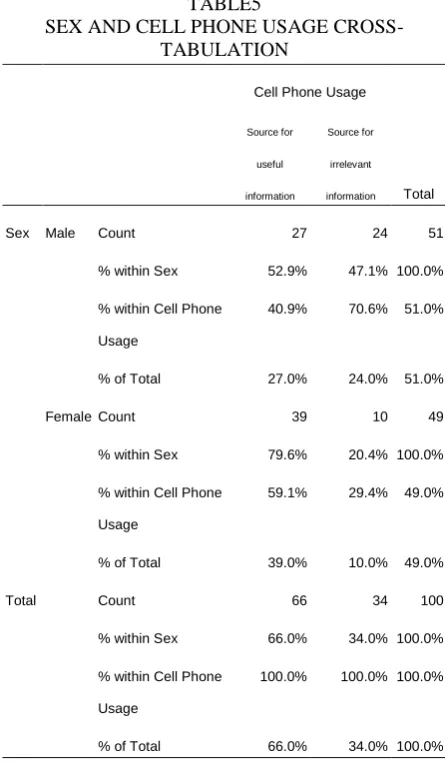
TABLE5
SEX AND CELL PHONE USAGE CROSS-TABULATION
Cell Phone Usage
Total
Source for
useful
information
Source for
irrelevant
information
Sex Male Count 27 24 51
% within Sex 52.9% 47.1% 100.0%
% within Cell Phone
Usage
40.9% 70.6% 51.0%
% of Total 27.0% 24.0% 51.0%
Female Count 39 10 49
% within Sex 79.6% 20.4% 100.0%
% within Cell Phone
Usage
59.1% 29.4% 49.0%
% of Total 39.0% 10.0% 49.0%
Total Count 66 34 100
% within Sex 66.0% 34.0% 100.0%
% within Cell Phone
Usage
100.0% 100.0% 100.0%
% of Total 66.0% 34.0% 100.0%
sourcing for irrelevant information with respect to sex. Male students have a count of 27 (52.9% within sex and 40.9% within cell phone usage) for sourcing useful information and a count of 24 (77.1% within sex and 70.6% within cell phone usage) for sourcing irrelevant information while female students have a count of 39 (79.6% within sex and 59.1% within cell phone usage) for sourcing useful information and a count of 10 (20.4% within sex and 29.4% within cell phone usage) for sourcing irrelevant information. A total count of 66 (66.0% within sex and 100% within cell phone usage) were sourced for useful information against a total count of 34 (43.0% within sex and 100.0% within cell phone usage) that soured for irrelevant information.
TABLE6
LEVEL AND CELL PHONE USAGE CROSS-TABULATION
Cell Phone Usage
Total
Source for useful information
Source for irrelevant information
Level 100 Level
Count 31 17 48
% within Level 64.6% 35.4% 100.0%
% within Cell Phone Usage
47.0% 50.0% 48.0%
% of Total 31.0% 17.0% 48.0%
200 Level
Count 35 17 52
% within Level 67.3% 32.7% 100.0%
% within Cell Phone Usage
53.0% 50.0% 52.0%
% of Total 35.0% 17.0% 52.0%
Total Count 66 34 100
% within Level 66.0% 34.0% 100.0%
% within Cell Phone Usage
100.0% 100.0% 100.0%
% of Total 66.0% 34.0% 100.0%
Table 6 shows cross-tabulation between two levels of students sourcing for useful information and those sourcing for irrelevant information. 100 level students have a count of 31 (64.6% within level and 647.0% within cell phone usage) for sourcing useful information and a count of 17 (35.4% within level and 50.0% within cell phone usage) for sourcing irrelevant information while 200 level students have a count of 35 (67.3% within level and 53.0% within cell phone usage) for sourcing useful information and a count of 17 (32.7% within level and 50.0% within cell phone usage) for sourcing irrelevant information. A total count of 66 (66.0% within level and 100% within cell phone usage) were sourced for useful information against a total count of 34 (43.0% within level and 100.0% within cell phone usage) that sourced for irrelevant information.
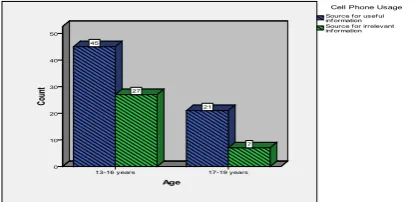
Fig.1 Showing Age of Students using Cell Phone
The fig.1 shows pictorial information of students in items of age brackets: 13-16 years and 17-19 years respectively. The figure shows clearly that more students were within 13-16 years of age compare to 17-19 years of age bracket. Also, there was a crystal difference between those student sourcing for useful information (66) and those sourcing for irrelevant information (34) respectively.
Fig.2 Showing Gender Difference of Students using Cell Phone
The fig.2 depicts information of students on gender difference. The figure shows no much difference between male (51) and female students (49). In contrary, 66 students (both male and female sourced for useful information using cell phone while only 34 student(male and female) sourced for irrelevant information via cell phone usage.
Fig.3 Showing Level of Students using Cell Phone
IV.
D
ISCUSSION OFF
INDINGSThe analysis presented in table 1 and 5 together with fig.2 answer the first research question raised for this study. The results show that there was a significant difference between male and female students using cell phones for sourcing useful information and those sourcing for irrelevant information. Table 5 specifically anchored it clearly that female students do source for useful information than the male counterparts. Male students used cell phones to source for irrelevant information more than female. The findings against [8] when he describes female style as ―person oriented‖, he went further that gossip is often a word used to describe behavior of female respondents. For a telephone, women use it more than men [9] and their motive for using it is primarily intrinsic or social one. ([9], [10]; [11], [12]). They keep close personal relationship and set up their relationship with others who are at a distance. [3] observed that men tend to use mobile phone as an instrument to do business while women tend to make social calls.
The second research question was answered using table 2 and 4 also with figure 2. From the results, age of the students has no significant influence on whether students are using their cell phones for sourcing useful or irrelevant information. Though results presented in table 2 made it clear that there was no significant influence of age on the cell phone usage, still, it was clearly shown in table 4 that students within the age of 13-16 years used their cell phones mostly in sourcing useful information as well as irrelevant information than those within the ages of 17-19 years. Studying those who are engaged in useful usage of cell phones within the age ranges of 17-19 years, their involvement in using their cell phones in useful information is far better than using it to source irrelevant information, it could be that many of them have attained higher age or most of them are engaged in academic assignments than those within 13-16 years of age. This findings partially in support of the report of [1] when he said that Norway has 3 percent of 13 years old had cell phones in 1997, while this percentage has risen to 50% in November 1999 and to over 80% in 2001. For 16 years old, the percentage was less than 20 in 1997, but about 80% in 1999 and almost 100% in 2001 [6]. This means that age range of respondents may not be significant to cell phone usage, because its usage varies from age to age and increases from time to time based on technological awareness and value.
Research question ―Does level of students in school determine the kind of information such students will source for via cell phone?‖ was analyzed in table 3 and 6, also depicted in figure 3 respectively. Table 3 shows that level of students in school is not a factor to determine the kind of information such students will source. In the same vein, table 6 reveals that 200 level students source for useful information more than 100 level students while their sources for irrelevant information remain the same. The high percentages of 200 levels sourcing for useful information than 100 levels could be as a result of their experience in the school system compared to 100 level students who have just come into the system newly. The figure 3 clearly depicted the same information as contained in cross-tabulation (table 6) better shown in a graphical view.
REFERENCES
[1] R.Ling Adolescent Girls and young adult men; Two Subculture of the mobile telephone kjeller, Telenor Research and Development R&D Report 34,2001
[2] H. Geser. Are girls (even) more addicted? Some gender patterns of cell phone usage. Retrieved on the 7th June, 2013 from www.socio-ch/mobile/t_geser3-pdf, 2006
[3] L. Leung and R. Wei. More than just Talk on the move: Uses and Gratifications of the Cellular Phone. Journalism and Mass Communication Quarterly. Vol 77, No 2, 2000. [4] J. H. Bae. Generation Effect on Gratification Obtained from
Mobil Phone and Perception as Interpersonal Communiation Medium in Korean Journal of Journalism Studies. Vol 45(4) 18, 160-168, 2001
[5] D.K. Heim. Socialization functions of the mobil phone. In D. sweet/A. Schliennger/D. Kunz home/ M. Basaler/s. Bphl/D. fresh farmhand (Eds), Young person and media (pp. 77-106), 2003
[6] International Telecommunication Union. Social and Human Considerations for more mobile World Background paper on the 7June 2013 from www.itu.int/osg/spun/in/futuremobile, 2004.
[7] E. A Mante and P. Doris. SMS use by young people in the Netherlands,2002. Retrieved on the June 17, 2013 from www.mtas.es/injuve.pdf
[8] E. M. Lohan. Men, Masculinity and the Domestic Telephone. A Theoretical Framework for studing Gender and
Technology, 1997. URL
http//dcu.ie/communication/iegis/Marial2.htm, retrieved on April 27,2010.
[9] G. Claisse and F. Rowe. The Telephone in Question: Question on Communication. Communication Research, Vol.19,485-503, 1987.
[10] J. W. Dimmick , J. Sikand, and S. J. Patterson. The Gratifictions of the Household. Dordrecht, Netherland: Kluwer Academic Publishers, 1994.
[11] A.Moyal. The Gendered use of the telephone. Media, Culture and society, Vol.14,51-72, 1992