The novel technique for the detection and
removal of dust patterns from the image in
source camera identification
Manpreet Kaur#¹, Reecha Sharma*²
#Student, Department of electronics and communication
,
Punjabi University, Patiala, India *Assistant Professor, Department of electronics and communication, Punjabi University, Patiala, IndiaAbstract--The source camera identification is the technique to identify all the information related to the camera through which the picture is clicked. The quality of the picture depends upon the camera lens and the color combinations. This issue can be seen in the image forensics. The quality of the image gets reduced when noise get raised on the image. The noise on the image gets raised when dust particles are there on the camera lens. In this work, algorithm is proposed which helps to detect the dust patterns from the image. The proposed algorithm will generate patterns from the detected dust particles and simulation is performed in MATLAB and results show the proposed technique performance well in terms of PSNR and MSE.
Keywords: Source camera identification, Dust
patterns, Itti Koch, PSNR, MSE
I. INTRODUCTION
Image Processing is a process of converting an image into the digital form and perform some operations to get an modified image and extracting the useful information from it. Image processing comprises of various techniques. Image representation defines the layout or display format of an image. Image preprocessing is a common name for operations with images at the lowest levels of abstraction both input and outputs are intensity images. In image enhancement the goal is to observe the certain image features for subsequent analysis or for image display. Contrast and edge enhancement are its examples. Image Restoration concerned with filtering the observed image to minimize the effect of degradations. Image Analysis is concerned with the quantity measurement of the image to make it perfect and noise free [1]. Image Data Compression is concerned with minimizing the no of bits required to represent an image.
To detect dust from the natural images scenes is very important step of computer for computer vision applications. Therefore, the computerized aid for visually impaired, automatic decoding of businesses
and robotic navigation in urban environments is important. Wide variety of vision tasks is available for both indoor and outdoor environment to retrieve text. There are two types of detection [2]. The bottom-up methods do not relay on where text is. Images are directly segmented into regions and after that group characters region into word. Region grows and spilt merge methods are used for segmentation. Heuristic top-down methods first detect text blocks in images using heuristic filters and then segment them into text and background regions. In training based top-down methods the text detection step is based on filters that are trained using machine learning tools [3].
Text detection is used in automatic signboard recognition. Text detection approaches can be categorized into four categories. CC-Based Methods use bottom up approach by grouping small components into larger components successively until all the regions in an image is identified. Edge Based Methods focuses on the high contrast between the text and the background. Texture Based Methods are based on the textural properties of text. Stroke Based Methods separate text from other elements of scene [4].
nearby pixels in a manner very similar to the Gaussian Filter. The difference is that the bilateral filter takes into account the difference in value with the neighbors to preserve edges while smoothing [6].
II. LITERATURE REVIEW
Sandeep Sharma et al in this paper explained that one needs to identify the text images correctly to avoid wrong identifications which can cause further problems. To provide the correct input the recognition result should be fast, efficient and robust. This will feed an OCR classifier [7]. One can also say that the actual text must relate to the segmented regions. Here is a profound method to improve the text detection mechanism. The automatic detection of the text from the images their localization and extracting horizontally aligned text in images which have harsh backgrounds is also give. The information available is difficult to be saved but the image text can help in bringing out the detailed information easily. The information is divided into segments and is easily studied upon.
Prof. N.N. Khalsa et al in this paper discussed the properties of text and many other differences have caused problems for detecting text. Such issues need to be handled for there are many cases where such variations can be easily found. Various steps are undertaken to detect the text. The first step is the initialization step. This step extracts of gathers the particular character or to gather the text from the video or the image given. This is done by edge detection. The next step holds description of features [8]. The description is only about the area that holds the text. The variations such as geometric of text, its motion and edge, and also the color are helpful factors.
Mona Saudagar et al in this paper explained that every text holds different variations of font, size, and other factors. The parameters like automatic annotation and image indexing are held as the very important features [9]. The challenging parts are the variety of fonts and there alignments. This article gives a special method of identifying the image even though it contains different fonts and much more multi-oriented text. The similar problems are grouped and only then they are solved. They are easy to be solved when groped and solutions are provided easily. The differently recognized problem is not much easy to solve due to its unrecognized solutions. The study is made much more extending.
Shashi Kant et al in this paper discussed that the two mains problems that are faced in detection of text are
the variation of text and the background of the image. This article highlights a segmentation based text recognition method. It recognizes tests with a lot of variations much faster [10]. End-to-end text recognition and segmentations have been performed on such texts to identify the images. Although there are many such techniques also, but this method proposes a result which has high precision as compared to others. Not only the efficiency results but also there are an advantage of saving time, as it provides much less computational time for the user. So with this advantage it is useful to carry on with such method.
Xiangui Kang et al in this paper explained that Camera Source Identification (CSI) can be done through sensor pattern noise and can also be helpful for the verification of image source. But it is not always necessary to have correct information within the image details. The edges are not easily separated and studied [11]. An eight-neighbor context-adaptive interpolation algorithm is written for CSI. It has profound results than the rest of the techniques. The Receiver Operating Characteristic performance increases. This method has been producing the best results of ROC than all the other methods. When the false-positive rate is low the performance resists. The images provided are used to gather parameters that can further help in knowing the source of the image.
M. Prabaharan1 et al in this paper explained that it is not an easy task to extract the text information from the image especially when there is a difference in the size, text, orientation and alignment [12]. The images which have such complex information are much likely to have wrong results when processed. Here the method is to extract the information and convert it into audio results. The output results have been much more prominent through this system and the text extraction has proven to be easy through the availability of such technique. Algorithms for scene text detection and recognition were also combined in this method for enhancing the results of this method.
III. ITTI KOCH METHOD
bits of the watermark where the original image is more inconspicuous.
In this way the Watermarked image is acquired. Saliency map of the original image is delivered and hiding limit estimation of the original image is done as it was done in the encoding process.
On the premise of original image and hiding limit in the original image, LSB is extracted from the pixels of the watermarked image. Versatile symmetry of the bits of the same request, extracted from various regions of the watermarked image got from saliency, is processed to retrieve the binary watermark.
IV. PROPOSED METHODOLOGY
In this work, technique will be proposed in which dust patterns will be detected from the captured image. When the dust patterns are detected from the captured image and it will be removed from the image with the filter technique.
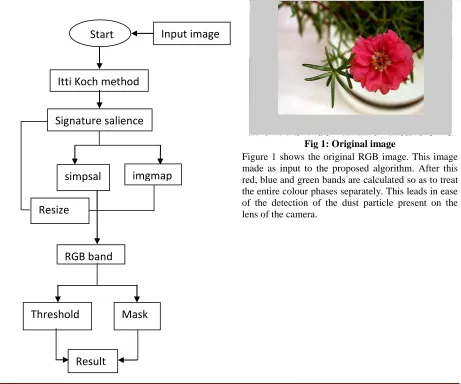
Fig 1: Flowchart of Proposed Technique
V. IMPLEMENTATION
The following are the implementation results which shows the dust pattern on the image and then filtering be applied on the respective image. Filtering of the image results in the increase in the quality of image.
Fig 1: Original image
Figure 1 shows the original RGB image. This image made as input to the proposed algorithm. After this red, blue and green bands are calculated so as to treat the entire colour phases separately. This leads in ease of the detection of the dust particle present on the lens of the camera.
Start
Input image
Itti Koch method
Signature salience
simpsal
imgmap
Resize
RGB band
Threshold
Mask
Result
Bilateral filtering
Figure 2: Red, blue and green band Figure 2 shows the calculation of red, blue and green band of the input image. This has to be done because of taking the genuine results after separating the colour phases of the whole image.
Fig 3: Masking of red, blue and green band
As shown in figure 3, the image which is taken as input for dust detection, RGB bands are calculated and each band in the image is masked and as shown in this figure, red, blue and green bands are masked.
Fig 4: Dust particles in RGB image
As shown in figure 4, the image which is taken as input, dust particles are shown on that image. In this image the detected dust particles are shown with the small dots. Also color intensity is shown with mesh graphs.
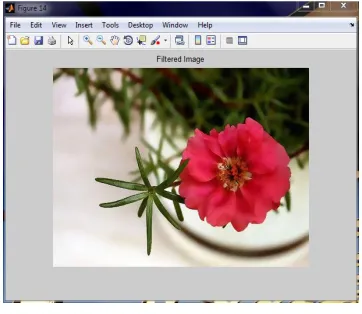
Fig 5: Filtered image
Figure 5 shows the bilateral filtration of the input image. As filtering is done to remove the noise, so this leads in improvement of the quality of the image.
1. Results
Parameter Previous
results
Itti Koch method
PSNR 17.53625 17.53177
MSE 1156.919 1155.725
Fault rate dust detection
0.15797 0.10566
VI. CONCLUSION
In this paper, it is been concluded that proposed ITTI KOCH algorithm performs well in terms of dust pattern detection from picture. The noise is raised on the picture which is clicked by the camera on which dust is there on the lens.
The Itti Koch algorithm will mark dust particles on the picture and it directly leads to reduce fault detection rate and increase accuracy. Filtering is done to improve the quality of the image. In future, proposed algorithm will further improved to remove detected dust particles.
References
[1] Boris Epshtein, E. O, "Detecting Text in Natural Scenes with Stroke Width Transform", IEEE Conference, 2963-2970, 2010
[2] Chong yu, y. S., "Text detection and recoginition in natural scene with edge analysis", IET Computer Vision , 9 (4), 2015
[3] Gaurav Jaswal , Amit Kaul ,” Content Based Image
Retrieval – A Literature Review”, 2009 NCCC
[4] Honggang Zhang, K. Z.-Z. , " Text extraction from natural
scene image: A survey", Neurocomputing , 310-323.
[5] Honggang Zhang, Kaili Zhao, Yi-Zhe Song, Jun Guo,”
Text extraction from natural scene image: A survey”, 2013 NEUCOM13479
[6] Huizhong Chen, S. S., "Robust Text Detection in Natural images With Edge Enhanced maximally Stable Extremal regions", 18th IEEE International Conference (pp. 2609-2612) Image Processing (ICIP), 2011
[7] Sandeep Sharma and Jai Prakash, “A Survey of Image to
Text Detection Methodology”, 1998
[8] Prof. N.N. Khalsa1, Prof. S.G. Kavitkar,
Nagendra.G.Kushwaha, “A Literature Review on Variation in Text and Different methods for Text Detection in Images and Videos”, 2015 IJIRCCE
[9] Mona Saudagar1, S. V. Jain,” A study of multi-oriented
text recognition in natural scene images”, 2014 IJARCCE
[10] Shashi Kant, Sini Shibu,” Segmentation Framework for
Multi-Oriented Text Detection and Recognition“, 2015 IJEDR
[11] Xiangui Kang, Jiansheng Chen, Kerui Lin and Peng
Anjie,” A context-adaptive SPN predictor for trustworthy source camera identification”, 2014 EURASIP Journal on Image and Video Processing
[12] M. Prabaharan1, K. Radha,” Text Extraction from Natural