CODEN (USA): IAJPBB ISSN: 2349-7750
I
I
N
N
D
D
O
O
A
A
M
M
E
E
R
R
I
I
C
C
A
A
N
N
J
J
O
O
U
U
R
R
N
N
A
A
L
L
O
O
F
F
P
P
H
H
A
A
R
R
M
M
A
A
C
C
E
E
U
U
T
T
I
I
C
C
A
A
L
L
S
S
C
C
I
I
E
E
N
N
C
C
E
E
S
S
Available online at:
http://www.iajps.com
Research Article
DISSOLUTION METHOD DEVELOPMENT AND
VALIDATION OF ACAMPROSATE CALCIUM TABLETS BY
UV SPECTROPHOTOMETRY
K. Akshay Kumar, Md. Abdul Avez, A. Ashok Kumar*
Department of Pharmaceutical analysis and Quality Assurance
Vijaya College of Pharmacy, Munaganur (Village), Hayathnagar (Mandal),
Ranga reddy (District), Hyderabad, Telangana (State) – 501511, India.
Abstract:The article aims at developing simple dissolution method for Acamprosate calcium immediate enteric coated tablets by UV spectroscopy and validate as per ICH guidelines. The optimized dissolution method includes stage 1 as 0.1N HCl as dissolution media, apparatus: USP Type 2 Paddle, rpm: 100, temperature of dissolution media: 37±0.5ºC, dissolution volume: 900ml, dissolution time point: 2 hours and stage 2 as dissolution media: water, apparatus: USP Type 2 Paddle, rpm: 100, temperature of dissolution media: 37±0.5ºC, dissolution volume: 900ml, dissolution time point: 2 hours and working concentration of standard and sample as 100µg/ml at a detection wavelength of 210nm.The developed method resulted in Acamprosate calcium exhibiting linearity in the range 25-200μg/ml. System precision and intra-day precision are exemplified by relative standard deviation of 1.197% and 3.37% respectively. Method was found to be rugged/inter day precise as %RSD was found to be 3.75%. Percentage Mean recovery was found to be in the range of 90-110 % by absolute method during accuracy studies. The limit of detection (LOD) was found to be 10 µg/mL for Acamprosate calcium and limit of quantitation (LOQ) was found to be 31 µg/mL for Acamprosate calcium. Hence it can be concluded that effective dissolution method by UV spectroscopy is developed and validated as per ICH guidelines which can be applicable in various pharmaceutical industries.
Keywords: Acamprosate calcium, Dissolution method, UV, Validation
Corresponding author:
A. Ashok Kumar,
Professor and HOD
Department of Pharmaceutical analysis and Quality Assurance,
Vijaya College of Pharmacy,
Munaganur (Village), Hayathnagar (Mandal),
Ranga reddy (District), Hyderabad,
Telangana (State) – 501511, India.
Email: [email protected]
Please cite this article in press as Ashok Kumar et al, Dissolution Method Development and Validation of
Acamprosate Calcium Tablets by UV Spectrophotometry, Indo Am. J. Pharm. Sci, 2016; 3(5).
INTRODUCTION:
The rate and extent at which the amount of drug substance is dissolved over a period of time is called dissolution. It is expressed as percentage release of drug substances present in dosage forms such as tablets, capsules, oral suspensions, transdermal patches, suppositories, semi-solid topical preparations and ointments. It describes about manufacturing reproducibility, product performance similarity and biological availability of drug from its formulation. Therefore, it is considered as one of the most quality control test of solid pharmaceutical dosage forms.
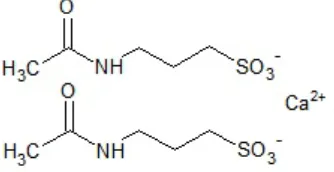
Acamprosate calcium (Figure 1, calcium 3-acetamidopropane-1-sulfonate) is the calcium salt of acetylhomotaurine used in the treatment of alcohol dependence. It is believed to act by blocking glutaminergic N-methyl-D-aspartate receptors and activation of gamma-aminobutyric acid (GABA) type A receptors [1-3]. It is an antidipsotropic agent that was approved by the US Food and Drug Administration (FDA) in 2004 for use in alcoholic individuals to decrease alcohol hankering after alcohol detoxification [4]. Acamprosate has been commercially available since 1989, in 333 mg tablet strength [5]. Acamprosate calcium is a white, odorless or nearly odorless powder. It is freely soluble in water and practically insoluble in absolute ethanol and dichloromethane. Its chemical formula is C
10H20N2O8S2 Ca and molecular weight is 400.48. A detailed literature survey reveals capillary zone electrophoresis methods [6-7], bioanalytical methods for the analysis of Acamprosate calcium using LCMS [8-16], LC-fluorometric and electrochemical detection [8] in human plasma, dog plasma and urine and overall only one UV method has been reported for the quantitative estimation of Acamprosate calcium in tablets [17]. We here first report a new, precise, accurate and linear UV dissolution method for the quantitative estimation of Acamprosate calcium in ACAMPRAL enteric coated tablets and validate as per ICH guidelines.
Fig. 1: Structure of Acamprosate calcium
MATERIALS AND METHODS:
Materials Instrument
A double beam UV-visible spectrophotometer (Shimadzu, model UV-1800) having two matched quartz cells with 1 cm light path and loaded with
UV probe software (version 2.41) was used for recording of spectra and measuring absorbance. Dissolution studies were performed on USP Dissolution apparatus (Electrolab, Model: TDT-08L). An electronic analytical weighing balance (0.1 mg sensitivity, Shimadzu AY 220), digital pH meter (DELUX model 101), a sonicator (sonica, model 2200 MH) were used in the study.
Chemicals and Reagents
Analytically pure sample of Acamprosate calcium with purities greater than 99% was obtained as gift sample from Chandra labs, Hyderabad, India and enteric coated tablets formulation[ACAMPROL] was procured from Apollo pharmacy, Hyderabad, India with label claim of 333mg. Concentrated HCl was obtained from SD Fine chemicals (Hyderabad, India). 0.22μm nylon membrane filters were purchased from Spincotech Private Limited, Hyderabad, India.
Method
Preliminary solubility studies: Solubility studies were explored for Acamprosate calcium in various solvents ranging pH of 1 to 7.5.
1. Distilled water: 1mg of drug was added to 10ml of distilled water and found to be freely soluble. Similar solubility procedure was followed using other solvents.
2. Preparation of pH 6.8 buffer as per USP: To 50ml of mono basic potassium phosphate solution (0.2M, 22.7g/L) in a 200ml volumetric flask, was added 22.4ml of 0.2M NaOH solution and later made up to the volume with distilled water, whose pH was checked. If desired pH was not achieved, solution was adjusted to desired pH using dilute phosphoric acid and sodium hydroxide solutions. 3. Preparation of pH 4.5 buffer as per USP: 2.99gm of sodium acetate in 1000ml volumetric flask was taken and then was added 14 ml 2N acetic acid solution which was finally made to the volume using water, whose pH was checked. If desired pH was not achieved, solution was adjusted to desired pH using dilute acetic acid and sodium hydroxide solutions.
4. Preparation of pH 7.5 buffer as per USP: To 50ml of mono basic potassium phosphate solution (0.2M, 22.7g/L) in a 200ml volumetric flask, was added 37ml of 0.2M NaOH solution and made up the volume using distilled water, whose pH was checked. If desired pH was not achieved, solution was adjusted to desired pH using dilute phosphoric acid and sodium hydroxide solutions.
5. 0.1N HCl: 8.35 ml of concentrated HCl was made up to 1000ml using distilled water.
Dissolution method development: The optimized dissolution method for enteric coated tablets keeping the acceptance criteria for % drug release (Q value) not more than 10% at 120min under stage 1, dissolution media : 0.1N HCl, dissolution volume: 900ml and greater than 85% at dissolution sampling point (Q point) under stage 2, dissolution media as water, 900mL. Dissolution media volume was considered based on sink conditions where in dissolution media volume should be at least 3 times of saturation volume of the dose in the formulation. Keeping the dissolution media under stage 1 as 0.1N HCl (900ml) constant, dissolution media under stage 2 has been explored using various solvents such as water, pH 4.5 buffer, pH 6.8 buffer and pH 7.5 buffer as per the procedures given above in the method section. The enteric coated tablet did not disintegrate at all up to 3 hours using the above solvents except water even though dissolution volume was taken as 900ml in all cases. In case of water as dissolution media, 900ml, % drug release was greater than 85% at 2 hours as Q point and hence considered this solvent as best solvent under stage 2. The optimized dissolution conditions are given below.
Stage 1: ACIDIC STAGE Rpm : 100
Dissolution medium: 0.1N HCl Dissolution media volume: 900mL Apparatus: USP Type 2 (Paddle) Sampling time point (Q point): 120 min Sampling volume: 10ml
Temperature: 37±0.5ºC
Working concentration of standard: 100µg/ml Working concentration of sample: 100µg/ml Detection wavelength: 210nm
Stage 2: WATER STAGE Rpm : 100
Dissolution medium: Water Dissolution media volume: 900mL Apparatus: USP Type 2 (Paddle) Sampling time point (Q point): 120 min Sampling volume: 10ml
Temperature: 37±0.5ºC
Working concentration of standard: 100µg/ml Working concentration of sample: 100µg/ml Detection wavelength: 210nm
Preparation of Working Standard Solution for Acidic Stage (stage 1)
10mg of Acamprosate calcium was accurately weighed and taken in 100ml clean and dry volumetric flask containing 80ml of solvent (0.1NHCl)and then the solution was made up to the mark using the solvent. This is considered as working standard solution (100g/ml), for which UV spectrum was recorded.
Preparation of Working Standard Solution for Water Stage (stage 2)
10mg of Acamprosate calcium was accurately weighed and taken in 100ml clean and dry volumetric flask containing 80ml of solvent (water)and then the solution was made up to the mark using the solvent. This is considered as working standard solution (100g/ml), for which UV spectrum was recorded.
Preparation of Stock and Working Sample Solution for Stages 1 and 2
One tablet (dose:333mg) was studied under above dissolution conditions for 120 minutes and dissolution sample volume of 10ml was sampled out and later filtered through 0.22µm nylon filter. First few ml of the filtrate was discarded and then from the filtrate (stock solution of sample), 2.7ml was pipetted out and made up to 10ml using 0.1NHCl, to get working sample solution concentration equivalent to 100µg/ml, 100% target concentration as that of standard. UV spectrum of this solution was recorded and then % drug release was calculated by comparing the UV spectrum with the working standard solution using 0.1NHCl solvent.
The total dissolution media was decanted carefully and to the tablet in the dissolution jar, 900ml water was added which was equilibrated to 37 ±0.5ºC. Later once the temperature was reached, dissolution was per formed for 120 minutes as per the above method. 10ml was sampled out and later filtered through 0.22µm nylon filter. First few ml of the filtrate was discarded and then from the filtrate (stock solution of sample), 2.7ml was pipetted out and made up to 10ml using water, to get working sample solution concentration equivalent to 100µg/ml, 100% target concentration as that of standard. UV spectrum of this solution was recorded and then % drug release was calculated.
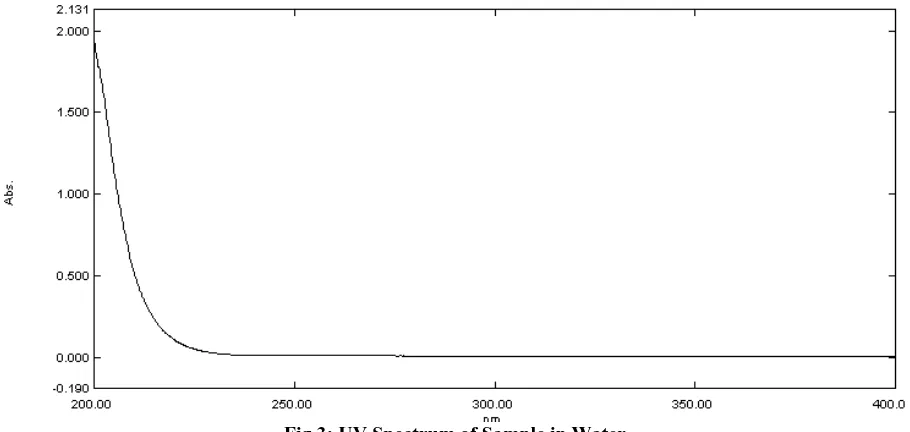
Fig.3: UV Spectrum of Sample in Water
Selection of Wavelength
Suitable wavelength for the analysis was determined by recording UV spectrum in the range of 200-400 nm for 100µg/ml of Acamprosate calcium standard as above and 210nm was chosen for the analysis.
% Drug release (Q value) was calculated using the formula as below:
Absorbance of sample x Concentration of standard X 100 Average absorbance of standard x Concentration of sample
Method Validation:
Validation of the analytical method is the process that establishes by laboratory studies in which the performance characteristics of the method meet the requirements for the intended analytical application [18]. UV spectrophotometric dissolution method developed was validated according to International Conference on Harmonization (ICH) guidelines. The method was validated for the parameters like specificity, sensitivity, linearity, accuracy, system precision, intra-day precision, inter-day precision / intermediate precision/ruggedness and robustness.
Precision System Precision
Six replicate recording of absorbance at 210nm of standard solution in water at working concentration showed % RSD (Relative Standard Deviation) less than 2, which indicates method is system precise. System precision results are tabulated below (Table 1).
Table 1: System Precision Results of Acamprosate Calcium in Water
n Absorbance
1 0.429
2 0.436
3 0.43
4 0.431
5 0.443
6 0.434
Average 0.433833
SD 0.005193
%RSD 1.196991
Method Precision
Method precision was determined by performing dissolution studies of sample under the test of (i) Repeatability (Intraday precision) and (ii) Intermediate precision (Inter day precision or ruggedness) performed during 2 consecutive days by two different analysts at working concentration.
Repeatability (Intraday precision)
Table 2: Intraday Precision Results of Acamprosate calcium
n % Drug release
1 101.88
2 100.14
3 102.81
4 109.65
5 106.89
6 99.82
Average 103.53
SD 3.93
% RSD 3.79
Intermediate precision (Inter day precision/Ruggedness)
Dissolution studies were performed on six tablets by different analysts on two consecutive days and
% RSD of percentage drug release was calculated and was found to be less than 5, which indicate the method developed is inter day precise/rugged (Table 3).
Table 3: Intermediate Precision / Ruggedness Results of Acamprosate calcium
n Day 1 % Drug release
Day 2 % Drug release
1 101.88 107.28
2 100.14 106.74
3 102.81 104.51
4 109.65 109.69
5 106.89 108.17
6 99.82 106.2
Average 103.53 107.09
SD 3.93 1.76
% RSD 3.79 1.64
Linearity
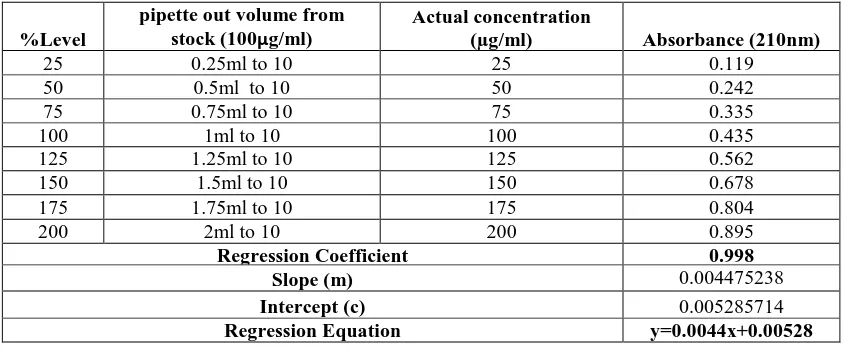
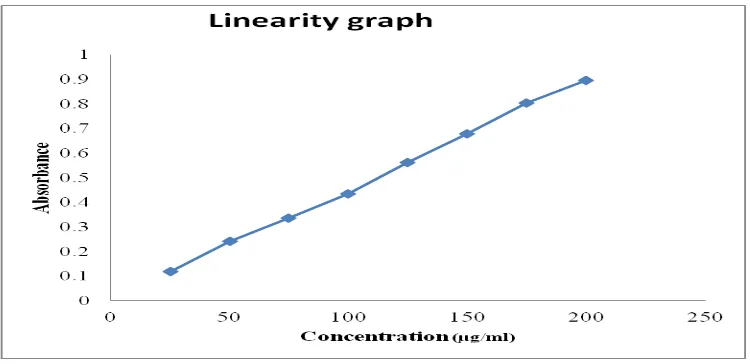
Standard solutions of Acamprosate calcium at different concentrations level (25%, 50%, 75%, 100%, 125%, 150%, 175% and 200%) were prepared. Calibration curve (Figure 4) was constructed by plotting the concentration of drug
versus absorbance at 210nm. The results show an excellent linear relationship between absorbance and concentration of drug within the concentration range of 25-200µg/ml (Table 4). The correlation coefficient was found to be 0.998, which meet the method validation acceptance criteria and hence the method is said to be linear in the range of 25-200µg/ml.
Accuracy
Accuracy was determined by means of recovery experiments by the determination of % mean recovery of dissolution sample by absolute method at three different levels 50, 100% and 150%. At each level, three determinations were performed. Table 5 represents percent % mean recovery. Individual recovery and % mean recovery was found to be greater than 85% at 120 minutes, which indicates good recovery values and hence the accuracy of the method developed. Table 6 summarizes the validation parameters about the developed dissolution method.
Table 4: Calibration Data for Acamprosate calcium
%Level
pipette out volume from stock (100µg/ml)
Actual concentration
(µg/ml) Absorbance (210nm)
25 0.25ml to 10 25 0.119
50 0.5ml to 10 50 0.242
75 0.75ml to 10 75 0.335
100 1ml to 10 100 0.435
125 1.25ml to 10 125 0.562
150 1.5ml to 10 150 0.678
175 1.75ml to 10 175 0.804
200 2ml to 10 200 0.895
Regression Coefficient 0.998
Slope (m) 0.004475238
Intercept (c) 0.005285714
Fig.4: Calibration of Acamprosate calcium
Table 5: Results of Accuracy Studies for Acamprosate calcium
% Level % Recovery % Mean Recovery
50 109.8539
104.0223
50 101.1065
50 101.1065
100 108.0039
108.0691
100 107.2211
100 108.9824
150 107.8664
105.7996
150 103.8706
150 105.6618
Specificity
Blank (water) had zero absorbance at all wavelengths from 200-400nm while standard solution exhibited UV spectrum, hence the method is said to be specific for the analyte of interest.
Sensitivity
Sensitivity of the method was determined by linearity data by the calculation of limit of detection) (LOD) and limit of quantitiation (LOQ). LOQ and LOD were calculated by the use of the equations LOD = 3.3/S and LOQ = 10/S where is the standard deviation of intercepts and S is the average of the slopes from the three different sets of linearity data generated. The limit of detection (LOD) and limit of quantitiation (LOQ) for Acamprosate calcium were found to be 10.26µg/ml and 31.09µg/ml respectively.
CONCLUSION:
A simple dissolution method by UV spectrophotometry method was developed and validated for the estimation of Acamprosate calcium in enteric coated tablets as per ICH guidelines. The developed dissolution method by UV
spectrophotometry is specific, sensitive, simple, accurate, precise, linear and rugged and therefore the method can be employed for the routine dissolution analysis of Acamprosate calcium in enteric coated tablets in various pharmaceutical industries.
ACKNOWLEDGEMENT:
The authors thank the management of Vijaya College of pharmacy (VJYH), Hyderabad, for providing the necessary facilities to carry out of this research work. The authors are grateful to Chandra labs, Hyderabad for providing drug in form of giftsample.
REFERENCES:
1.Zornoza T, Cano MJ, Polache A, Granero L. Pharmacology of acamprosate:an overview. J CNS Drug Rev 2003;9(4):359-74.
2. Saivin S, Hulot T, Chabac S, Potgieter A, Durbin P, Houin G. Clinical pharmacokinetics of acamprosate. J Clin Pharmacokinet 1998;35(5):331-45.
between in vitro and in vivo release behaviors of acamprosate from enteric-coated tablets. J Arch Pharm Res 2008;31(6):798-804.
4. Espino D, Cruz MP. Acamprosate calcium (Campral®):An effective treatment for maintaining abstinence in alcohol-dependent patients in combination with psychosocial support. J Pharmacy Therapeutics 2005;30:497-505.
5. Lipha Pharmaceuticals Inc. Briefing Document for Acamprosate 333 mg Tablets. J Food and Drug Administration:Washington, DC, US;2002:1-311. 6. Blanchin MD, Baalbak B, Bosc N, Fabre H. Short-end injection technique in capillary electrophoresis for dissolution testing of tablets. J Anal Chim Acta 2000;415:67-73.
7. Fabre H, Perrin C, Bosc N. Determination of homotaurine as impurity in calcium acamprosate by capillary zone electrophoresis. J Chromatogr A 1999;853:421-430.
8. Chabenat C, Ladure P, Blanc-Continsouza D, Boismare F, Boucly P. Determination of calcium acetylhomotaurinate by liquid chromatography with fluorimetric and electrochemical detection. J Chromatogr B Biomed Sci Appl 1987;414:417-22. 9. Chabenat C, Ladure P, Moore N, Boucly P, Boismare F. Application of an analytical method to calcium acetylhomotaurinate determination in urine. J Arzneimittelforschung 1989;39:1413-4. 10. Girault J, Gobin P, Fourtillan JB. Determination of calcium acetylhomotaurinate in human plasma and urine by combined gas chromatography-negative-ion chemical ionization mass spectrometry. J Chromatogr 1990, 530:295-305.
11. Rhee YS, Park JH, Park S, Park CW, Ha JM, Jeong KW, Lee DS, Park ES. Analysis of Acamprosate in Beagle Dog Plasma by LC-MS-MS. J Arch Pharm Res 2008;31:1035-39.
12. Xu F, Quing Y, Shang B, Liang M, Zou Y, Xu G. Pharmacokinetics of Acamprosate Calcium in Healthy Chinese Subjects after Oral Administration of Three Dosage Levels. J Arzneimittelforschung 2009;59:631-4.
13. Ghosh C, Jha V, Shinde CP, Chakraborty BS. A LC-MS analysis of acamprosate from human plasma:pharmacokinetic application. J DrugTest Anal 2011;3(10):735-42.
14. Hammarberg A, Beck O, Eksborg S, Jayaram-Lindström N, Lindefeldt A, Andersson M, Brundin L, Reid MS, Franck J. Acamprosate determinations in plasma and cerebrospinal fluid after multiple dosing measured by liquid chromatography-mass spectroscopy:a pharmacokinetic study in healthy volunteers. J Ther Drug Monit 2010;32(4):489-96. 15. Rhee YS, Park JH, Park S, Park CW, Ha JM, Jeong KW, et al. Analysis of acamprosate in beagle dog plasma by LC-MS-MS. J Arch Pharm Res 2008;31(8):1035-9.
16. Kanchana Mala K, Babu Rao C, Nagiat TH, Mukkanti K, Prakash K, Challa BR. Quantification
of Acamprosate in human plasma by LC-ESIMS/ MS with solid phase extraction:Application to a bioequivalence study. J Pharm Res 2013;7:389-96. 17.Kirankumar A, Mamatha B, Sasikala M, Monika S, Ranganayakulu D. UV spectrophotometric method development and stability studies of acamprosate calcium in bulk and tablet dosage form. Int J of Pharm Tech Res 2013;5(3):1241-6.