! REVIEWS !
Biolinguistics 10: 001–005, 2016 ISSN 1450–3417 http://www.biolinguistics.eu
Challenges to the What, When, and Why?
Berwick, Robert C. & Noam Chomsky. 2016. Why Only Us: Language and Evolution. Cambridge, MA: MIT Press.
by Marc D. Hauser
Why Only Us (WOU) is a wonderful, slim, engaging, and clearly written book by Robert C. Berwick and Noam Chomsky (B&C). From the authors’ perspective, it is a book about language and evolution. And of course it is. However, I think it is actually about something much bigger. It is an argument about the evolution of thought itself, with language being not only one form of thought, but a domain that can impact thought itself, in ways that are truly unique in the animal king-dom. Seen in this light, WOU provides a framework for thinking about the evo-lution of thought and a challenge to Darwin’s claim that the human mind is only quantitatively different from other animals. Since this is an idea that I have cham-pioned (Hauser 2009), I am of course a bit partial. Let me unpack all of this by working through B&C’s arguments, especially those where we don’t quite agree.
One caveat up front: As I have written before, including with B&C (Hauser et al. 2014), I am not convinced that the ideas put forward here or in WOU are testable: Animal capacities are far too impoverished to shed any comparative light on the evolution of human language, and the hominid fossil record is either silent or too recent to be of interest. My goal here, therefore, is to focus on the fascinating ideas raised in WOU, leaving to the side how or whether such ideas might be confronted by significant empirical tests.
One of the essential moves in WOU is to argue that Merge—the simplest recursive operation—is the bedrock of our capacity for infinite expression by finite means, one that generates hierarchical structure. Because no other animal has Merge, and because Merge is simple and the essence of language, the evolu-tionary process may well have occurred rapidly, appearing suddenly in only one species: modern humans or Homo sapiens sapiens (Hss). To accept this argument, you have to accept at least five premises:
(1) Merge is the essence of language. (2) No other animal has Merge. (3) No other hominid has Merge.
(4) Due to the simplicity of Merge, it could evolve quickly, perhaps due to mutation.
(5) Because you either have or don’t have Merge (there is no demi-Merge), there is no option for proto-language.
Biolinguistics ! Reviews !
2
I accept (2) because the comparative literature shows nothing remotely like Merge. Whether one looks at data from natural communication, artificial lang-uage learning experiments, or animal training studies with human langlang-uage or language-like tokens, there is simply no evidence of anything remotely recursive. As B&C note, the closest one gets is the combinatoric gymnastics observed in bird-song, but these are neither recursive nor do they generate hierarchical structures that shape or generate the variety of meaningful expressions observed in all hu-man languages.
I also accept (3), though here we don’t really have the evidence to say one way or the other, and even if we did, and it turned out that say Neanderthals had Merge, it wouldn’t really make much of a difference to the argument. That is, the fossil record for Neanderthal, though richer than we once thought, says nothing about recursive operations, and nor for that matter does the fossil record for Hss. Both records show interesting signs of creative thought—a topic to which I return —but nothing that would indicate recursive thought or expression. If evidence emerges that Neanderthals had Merge, that would simply push back the date of origin for B&C’s evolutionary account, without changing the core details.
Let’s turn to (1), (4), and (5) then. What is interesting about the core argu-ment in WOU is that, although B&C place significant emphasis on Merge, they fully acknowledge that the recursive machinery must interface with the Conceptual-Intentional system (CI) on the one hand, and with the Sensory-Motor system (SM) on the other. However, once one acknowledges the non-trivial roles of CI, SM, and the interfaces, while also recognizing the unique properties of each of these systems, it is no longer possible to accept premise (4), and challenges arise for premise (5). This analysis lays open the door to some fascinating possibilities, many of which might be explored empirically. I consider a few next.
Biolinguistics ! Reviews ! 3
songbirds, dolphins, or non-human primates, an individual born deaf does not emerge with a comparably expressive visual system of communication. The systems of communicative expression are intimately tied to the modality, such that if one modality is damaged, other modalities are incapable of picking up the tab. The fact that our language, and even more broadly, our thoughts, are de-tached from modality, suggests a fundamental reorganization in our represen-tations and compurepresen-tations. This takes us to CI, SM, and the interfaces—and Merge.
Given the modularity of the songbird system, and the lack of imitative capacities in non-human primates, we also need an account of how a motor system capable of imitating sounds and actions evolved. This is an account of how SM evolved, but also about how and when SM interfaced with CI and Merge. There is virtually no evidence on offer, and it is hard to imagine what kind of evidence could emerge. For example, the suggestion that Neanderthals had a hyoid bone like Hss is interesting, but doesn’t tell us what they were doing with it, whether it was capable of being deployed in vocal imitation, and thus, of building up the lexicon. And of course, we don’t know whether or how it was connected to CI or Merge. But whatever we discover about this account, it show-cases the importance of understanding the evolution of at least one unique property of SM.
When we turn to CI, and in particular, lexical or conceptual atoms, we know extremely little about them, even in fully linguistics human adults. Needless to say, this makes comparative and developmental work difficult. But one observation seems fairly uncontroversial: Many of our concepts are completely detached from sensory experiences, and thus can’t be defined by them. If we take this as a starting point, we can ask: Do animals have anything remotely like this? On one reading of Randy Gallistel’s elegant work, the answer is “Yes” (e.g., Gallistel 1990). All of the empirical work on number, time, and space in animals suggests that such concepts are either not linked to or defined by a particular modality, or minimally, can be expressed in multiple modalities. Similarly, there is evidence that animals are capable of representing some sense of identity or sameness that is not tied to a modality. If this is right, and even if these concepts are not as abstract as ours, they suggest a potential comparative approach that at this point, seems closed off for our recursive capacity. Having a comparative evolutionary landscape of inquiry not only aids in our analyses, it also raises a challenge to premises (4) and (5), as well as to Richard Lewontin’s comment (supported by B&C) that we can’t study or understand the evolution of cognition (Lewontin 1990). Let me take a small detour to describe a gorgeous series of studies on the evolution of cognition to show what can and has been done, and then return to premises (4) and (5).
Biolinguistics ! Reviews !
4
related polygynous vole species. Using a maze running task to test for spatial capacity, results provided strong support for the prediction. Further, the size of the hippocampus—an area of the brain known to play an important role in spatial navigation—was significantly larger in males of the polygynous species when contrasted with females, whereas no sex differences were found for the monogamous species. This, and several other examples, reveal how one can in fact study the evolution of cognition. Lewontin is, I believe, flatly wrong.
Back to premises (4) and (5). If nonhuman animals have abstract, amodal concepts—as some authors suggest—then we have a significant line of empirical inquiry into the evolution of this system. If our concepts are unique—as authors such as B&C believe—then there may not be that many empirical options. Per-haps Neanderthals have such concepts, perPer-haps not. Either way, the evolutionary timescale is short, and the evidence thus far, relatively thin. On either account, however, there is the pressing need to understand the nature of such concepts as they bear on what I believe is the most interesting side effect of this discussion, and the issues raised in WOU. In brief, if one concedes that what is unique about language, and thus, its evolutionary history, is Merge, CI, SM, and the interfaces, then a different issue emerges: Are these four ingredients unique to language or part of all aspects of human thought? Said differently, perhaps WOU is really an account of how our uniquely human system of thought evolved, with language being only one domain in terms of its internal and external systems of expression. B&C often refer to our Language of Thought, as the core of language, and what is our most dominant use of language: internal thought. On this view, external-ization of this system in expressed language is not at the core of the evolutionary account. On the one hand, I agree. On the other hand, I think the use of the term of ‘Language of Thought’ or LOT has confused the issue because of the multiple uses of the word ‘language’. If the essence of the argument in WOU is about the computations and representations of thought, with linguistic thought being one flavor, then I would suggest we call this system the Logic of Thought. I suggest this substitution of L-words for two reasons. Language of Thought implies that the system is explicitly linguistic, and I don’t believe it is. Further, I think Logic of Thought better captures the abstract nature of the ingredients, including both the recursive operations, concepts, motor routines, and interfaces.
Biolinguistics ! Reviews ! 5
reveal deficits in multiple domains. The second option suggests that damage to the Merge circuit in one domain would only reveal deficits in this domain. To my knowledge, there is no evidence of neuropsychological deficits or imaging studies that point to the nature or distribution of such recursive circuitry.
In sum, WOU is really a terrific book. It is thought provoking and clear. What more could you want? My central challenge is that it paints an evolutionary account that can only work if the essence of language is simple, restricted to Merge. But language is much more than this. As such, there has to be more to the evolutionary process. By raising these issues, I believe B&C have challenged us to think about another option, one that preserves their title, but focuses on the logic of thought. Why only us? Much to think about.
References
Gallistel, C. Randy. 1990. The Organization of Learning. Cambridge, MA: MIT Press.
Gaulin, Steven J.C. & Matt S. Wartell. 1990. Effects of experience and motivation on symmetrical-maze performance in the prairie vole (Microtus ochro-gaster). Journal of Comparative Psychology 104, 183–189.
Hauser, Marc D. 2009. The possibility of impossible cultures. Nature 460, 190–196. Hauser, Marc D., Charles Yang, Robert C. Berwick, Ian Tattersall, Michael J.
Ryan, Jeffrey Watumull, Noam Chomsky & Richard C. Lewontin. 2014. The mystery of language evolution. Frontiers in Psychology 5, 401.
Jacobs, Lucia F., Steven J.C. Gaulin, David F. Sherry & Gloria E. Hoffman. 1990. Evolution of spatial cognition: Sex-specific patterns of spatial behavior pre-dict hippocampal size. Proceedings of the National Academy of Sciences 87, 6349–6352.
Lewontin, Richard C. 1990. The evolution of cognition: Questions we will never answer. In Daniel N. Osherson & Edward E. Smith (eds.), Thinking, vol. 3, 229–246. Cambridge, MA: MIT Press.
Puts, David Andrew, Steven J.C. Gaulin & S. Marc Breedlove. 2007. Sex differ-ences in spatial ability: Evolution, hormones and the brain. In Steven M. Platek, Julian Paul Keenan & Todd K. Shackelford (eds.), Evolutionary Cog-nitive Neuroscience, 329–379. Cambridge, MA: MIT Press.
Marc D. Hauser Risk-Eraser PO Box 376
West Falmouth, MA 02574 USA
! FORUM !
Biolinguistics 10: 006–020, 2016 ISSN 1450–3417 http://www.biolinguistics.eu
The Human Oscillome and
Its Explanatory Potential
Elliot Murphy
My intention in this piece is to briefly outline a novel hypothesis regarding the neurobiological implementation of set binding, the labeling of feature-sets, and the resolution of linguistic dependencies arising from the cyclic combi-nation of these labeled objects. One of the numerous motivations for this was reading Robert C. Berwick & Noam Chomsky’s (B&C) recent book Why Only Us: Language and Evolution (Berwick & Chomsky 2016; henceforth WOU), which struck me as moderately comprehensive in its interdisciplinary scope (including good critical commentary on recent work in comparative neuroprimatology and theoretical biology) but severely impoverished in its range of linking hypotheses between these disciplines.
While the authors are correct to point out that the Strong Minimalist Thesis follows the ‘divide-and-conquer’ approach which helps narrow the gap between disciplines, their actual implementation of this approach is fairly mild and uninstructive. There is lots of talk about how language is “an ‘organ of the body’, more or less on a par with the visual or digestive or immune system” and how it is “a subcomponent of a complex organism” (p. 56), accompanied by the usual discussion of the Newtonian dispelling of the mind–body problem
—
all of which is true, unequivocal, undeniable, but directionless and intensely vague. B&C discuss Lenneberg’s early work on language evolution, deeming it “a model of nuanced evolutionary thinking” (p. 5), but as Lenneberg (1964: 76) himself noted, “[n]othing is gained by labeling the propensity for language as biological unless we can use this insight for new research directions—
unless more specific corre-lates can be uncovered”. The absence of concrete linking hypotheses between the domains of the life, cognitive, and biological sciences in WOU, and its concern with isolated and disparate sources of evidence which lend support to an emer-gentist model of language evolution, whatever its merits, does not promote this kind of cross-disciplinary collaboration. I think that from the perspective of brain dynamics, what the authors call the “Basic Property” (Merge) can be explored in a number of interesting and fruitful ways, promoting further interdisciplinary work and relying on a neurolinguistic perspective which, unlike WOU, goes bey-ond the cortex and examines the important role of subcortical structures like the thalamus and basal ganglia.To set the scene for what follows, it is useful to consider the framework in Boeckx & Theofanopolou (2015), which highlights the inadequacy of standard
Biolinguistics ! Forum ! 7
cladistic thinking so prevalent in much of contemporary biolinguistics (most notably in the FLN–FLB distinction, under which the ‘Basic Property’ was simply added ‘on top’ of faculties shared with other species, as if no reciprocal causation had occurred). Boeckx & Theofanopoulou “very much doubt that cognition can be studied independently of the basic neurophysiological principles that produce it”, going against the many ‘Marr Misreaders’, as I term them in Murphy (forth-coming), who claim that the three Marrian levels need to be studied in a segre-gated fashion, privileging the computational level.1 For instance, while compu-tationally distinct, music and language share a number of important algorithmic properties such as prediction, synchronization, turn-taking, and oscillatory entrainment (Doelling & Poeppel 2015). This seems to emerge from cell assembly specializations and distinct rhythmic profiles; language and music have different hierarchical processing networks but shared working memory and cognitive control systems (Rogalsky et al. 2011).
Much work in contemporary neurolinguistics appears instead to be effect-ively crypto-creationist in its monolithic approach to language implementation and evolution, discussing it in terms of ‘syntax’, ‘phonology’, and other complex categories
—
similar to an ophthalmologist speculating about the evolution of ‘red’ and ‘green’. Top-down perspectives, of the kind proposed in WOU, are useful up until the point that sufficiently decomposed and generic sub-operations and processes have been discovered. But insisting on a top-down perspective ‘all the way down’ is inconsistent with both Darwinian and Thompsonian thinking. Indeed, the importance of domestication and cultural evolution for language is also often overlooked, despite it being known that domestication can directly impact computational competence and trigger previously dormant operations (Okanoya 2012; Murphy 2015a).The lexicalist framework of WOU, and much recent work in linguistics (see Boeckx 2014 and Murphy 2015c for critiques), presents a number of obstacles for evolutionary theses. Most notably, contemporary neurobiology is far from achieving an understanding of representations, and I think focus should instead be placed on investigating operations, with set-formation and labeling (a composite of object permanence and property attribution) having a much greater potential to be grounded in (oscillatory) processes than roots and intransitive verbs. Studies of particular oscillations are increasingly being linked to gene sets via their neurochemical implementation, and if cognitive capacities like language can be causally derived from oscillatory factors then this would serve as an important step in narrowing the bridge between cognition and neurobiology.
Biolinguistics ! Forum ! 8
The neurolinguistic approach in WOU relies on outdated assumptions, sticking purely to localization issues and answering the ‘How’ question of lang-uage evolution by just pointing to good old BA44 and 45. “Our general problem”, B&C write, “is that we understand very little about how even the most basic computational operations might be carried out in the neural ‘wetware’” (p. 50); however, a number of recent proposals have attempted to establish intriguing relations between brain function and language comprehension (Lewis et al. 2015; Lewis & Bastiaansen 2015, among many others). These considerations embrace how the brain actually operates (via oscillations and their various coupling operations). B&C additionally “(speculatively) posit that the word-like elements, or at least their features as used by Merge, are somehow stored in the middle temporal cortex as the ‘lexicon’” (p. 159). This ignores well-accepted findings that conceptual representations are widely distributed across several regions, even if the middle temporal cortex acts as a store for many core representations and a crucial memory buffer in phrase structure building (just as how Broca’s area is most likely a similar kind of buffer in syntactic computation, and not the “seat of syntax” as Angela Friederici has often claimed; see Blank et al. 2016 for evidence of distributed syntactic processing).
B&C’s middle temporal cortex hypothesis relies solely on imaging studies which point to regional specialization for particular language tasks, but this methodological cut-off point, while typically acknowledged by fMRI experiment-alists (who can now achieve voxels of 0.8mm3), is side-stepped by B&C, who ignore the important language-related activation in non-specialized voxels. No-one would claim that the responses to tactile sensation in non-selective regions are somehow not part of the story of how we become acquainted with surfaces, and so a laser-like focus on middle temporal cortex amounts to a severely run-down neurolinguistic model. When limited to such a narrow view of functional (not to mention dynamic) brain activity, it is almost inevitable that one would be forced to arrive at bizarre and outmoded models of language localization.
It is widely assumed that human and animal concepts are composed of necessary and sufficient features surrounded by a periphery of ancillary but re-lated features used to ‘point’ the comprehender in the right conceptual direction (grey feathers may be suggestive of a bird, for instance, but are not necessarily part of one), and any neurolinguistic models informed purely by imaging studies will likely reflect only the implementational regions (and not the neurobiological mechanisms) responsible for these peripheral features. I think this point is crucial and to my knowledge has not been recognized by the neurolinguistics commu-nity.
Biolinguistics ! Forum ! 9
for interpreting word movement” (as is often done) is hellaciously bad biology, and only serves to give credit to a syntactic/processing theory rather than contri-bute to an understanding of brain and language function.2 We spend our time well when we reconsider the conclusions of Ojemann (1990), who showed that while distinct features of language propagation are strictly localized, such loci are temporary and display great individual variability, with the neuronal functions changing over time, and so we can only ever conclude from neuroimaging expe-riments that cell assemblies are active in particular tasks at time T, under condition P, and can at best be specified for particular functions.
The most advanced experimental evidence B&C put forth is Musso et al.’s (2003) seminal work on nonsense languages obeying UG principles, which they say “elicit normal activation in the language areas of the brain” (p. 106). The mis-leading term “language areas of the brain” reflects the general level of disengage-ment the authors adopt towards all the “important biological questions” (p. 1) which “arise” from an exploration of the Basic Principle’s implementation in the brain. It is certainly odd that B&C can write that “some small rewiring of the brain provided the core element of the Basic Property” (p. 107)
—
without even attempting in chapter 4 (putatively focused on brain structure) to cash this out in implementational terms. Pointing to a relatively dense, large regional structure like the middle temporal cortex and stating that it is where “the lexicon” is housed is similar to if Stephen Hawking sat under a dark star-filled night sky, pointed very roughly somewhere up at space, and claimed, “There’s a black hole over there somewhere”—
a statement which tells us nothing about black holes nor anything about space. In fact, Hawking would be on much firmer ground than B&C, since at least he can provide a theory of his object of study which can be embedded within a larger framework of quantum effects.The strikingly basic neurobiology and cortico-centrism presented in much neurolinguistic work is incompatible with what is known about the brain and its principal dynamics. As a novel approach, from the perspective of brain dynamics what B&C call “some algorithm” responsible for labeling becomes capable of being explored in a number of interesting ways. Neural oscillations might be a suitable way of exploring mesoscopic computations across a number of cognitive faculties, as is already being done in domains outside of language like working memory. Consider a relatively simple example. The model of linguistic computation in Murphy (2015d) invokes a number of cross-frequency coupling operations, and in Benítez-Burraco & Murphy (2016) current knowledge of the linguistic and ‘oscillopathic’ profile of individuals with autism was used to empirically test it. It is additionally of interest, for instance, that schizophrenic
Biolinguistics ! Forum ! 10
patients showed higher α–γ cross-frequency coupling in Popov & Popova’s (2015) recent study of general cognitive performance, despite this co-varying with poorer attention and working memory capacities. This is surprising given that most studies show reduced left frontal γ in schizophrenia. The reason for this may be that the increased phase-amplitude-locking likely results in smaller ‘gamma pockets’ of working memory items (as Korotkova et al. 2010 argue on independent grounds) and hence low total γ power. In this instance, the size and order of working memory sequences outputted by the conceptual system is not optimally compatible with the oscillopathic profile, leading to greater rhythmic excitability and yet inhibited linguistic functionality. Global rhythmicity is consequently disrupted due to unusually strong fronto-parietal interconnectivity. This may represent a genuine neural mechanism of an ‘interface’ between syntactically generated conceptual representations and external (memory) systems; a significant finding, if corroborated by further experimental work. Importing standard assumptions from syntax, we can think of the computational system as imposing its own conditions on the interfaces. The shift in perspective to oscillatory terms allows us to reformulate this such that the neural ensembles responsible for storing representations used to construct phrases require particular phase-amplitude-locking levels in order for the interconnected regions coupled with them to ‘read off’ their content. Studying what we could call the human ‘oscillome’ may provide an excellent way of experimentally investigating what kind of features can ‘pass through’ the interfaces, and because each rhythm plays numerous, non-overlapping roles, it is crucial for these oscillopathic studies to be accompanied by biophysical modeling and computationally explicit meso-scopic frameworks of regionally localized cross-frequency coupling functionality.
Over the past couple of years, the oscillation literature has shown great promise in exploring some major topics in linguistics (Ramírez 2015). Recent studies of α have shown that listeners who show better attention-to-memory capacities show more flexible α power allocation, leading to the suggestion that “selective attention to a specific object in auditory memory does benefit human performance not by simply reducing memory load, but by actively engaging complementary neural resources to sharpen the precision of the task-relevant object in memory” (Lim et al. 2015: 16094). Just as John O’Keefe and colleagues have shown that fast γ rhythms can compute vectors in the mouse hippocampus for spatial navigation (Chen et al. 2013), it may be that this generic oscillatory mechanism is employed in the service of constructing language-relevant feature-sets. The absence of a complete dorsal-ventral stream ‘loop’ in the macaque brain (Frey et al. 2014) appears to be only the briefest sketch of the real underlying puzzle, and could be incorporated well into a larger oscillomic system invoking, among other things, human-specific myelination rates as a way of directly modulating the phase and power of oscillations (Pajevic et al. 2014).
Biolinguistics ! Forum ! 11
discussion about the actual implications of this study for cognitive and linguistic architectures more generally. Following other seminal work by David Poeppel’s group on the dynamics of phonological computation (e.g. Giraud & Poeppel 2012) and Lisman & Jensen’s (2013) hypothesis that items from working memory are extracted via θ–γ embedding (which dates to the mid-1990s), we could draw up an ‘oscillomic’ hypothesis for the construction of linguistic feature-sets (Figure 1) which would directly enrich B&C’s cartographic perspective.
Figure 1: An idealized model for feature-set retrieval. ‘Q’ denotes Q-feature, ‘T’ denotes Tense feature, ‘C’ denotes Case feature, and ‘φ’ refers to φ-features (Person, Number, Gender).
In Figure 1, after inhibition reduces over the θ cycle, the most excitable representation would be itemized through low-middle γ, followed sequentially by the other, less excitable clusters. This would determine feature-set composi-tion, completed after the θ phase resets. The ‘lexicon’ may amount to stored time-frequency profiles, with each item being composed of particular, sequentially excited and ‘binded’ feature-sets (although see below for a qualification of this term). Recent work (Chomsky 2015) has also argued that linguistic structures can be labeled not only by standard categorial labels, but also by φ-features, as in [φ …α…[γ …β…]], expanding the oscillomic search range. Derivational feature-checking (e.g. φ-feature agreement followed by Q-feature agreement within the same phase) may arise from the particular sequence of items extracted within a given oscillatory cycle. The set of feedforward γ rhythms employed in this model would be mostly generated in supragranular cortical layers (L2/3) (Maier et al. 2010), while hippocampal θ would be generated via slow pulses of GABAergic inhibition as a result of medial septum input, part of a brainstem-diencephalo-septohippocampal θ-generating system (Vertes & Kocsis 1997). The interactions between the hippocampus and medial prefrontal cortex necessary to focus attention on language-relevant features (considering the conclusions of Lara & Wallis 2015 on the role of prefrontal cortex in working memory, which stressed the centrality of attention rather than storage) may be mediated through an in-direct pathway passing through midline thalamic nucleus reuniens (Jin & Maren 2016).
Biolinguistics ! Forum ! 12
across multiple, distant areas is difficult due to conduction delays, mediated by myelin thickness and nodal structure. For instance, a conduction delay of only 5ms could change the interactions of coupled γ oscillators from constructive to deconstructive interference (Pajevic et al. 2014); see also Nevins (2016) for related discussion of feature composition and motivations for assuming that Number and Person features do not combine via symmetric conjunction but rather through specific orders, possibly grounded in the above oscillomic mechanisms. Finally, while Ding et al. (2016) explored the rhythms responsible for ‘packaging’ particular constructions, their top-down experimental approach has its limita-tions, since the functional role of these rhythms in cognition more generally needs to be explored alongside broader research into the oscillatory nature of working memory, attention, and other domains necessary for language compre-hension.
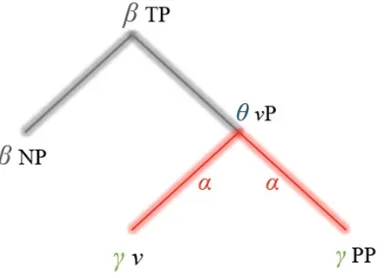
This idea could be developed through the construction of an ‘oscillomic tree’, in contrast to standard linguistic tree structures (Figure 2).
Figure 2: An oscillomic tree representing the putative rhythms responsible for particular lexical and phrasal structures according to Murphy (2015d). ‘TP’ denotes Tense Phrase, ‘vP’ denotes Verb Phrase (e.g. ‘swam in the river’), ‘NP’ denotes Noun Phrase (e.g. ‘The man’, ‘John’), and ‘PP’ denotes Preposition Phrase (e.g. ‘in the river’).
Biolinguistics ! Forum ! 13
filler (since dependents share a sub-set of their features). Because γ is modulated by cloze probability (Wang et al. 2012), β–γ synchronization may be the central mechanism of feature-set binding within phrase structures, with γ being respons-ible for semantic prediction and feature-binding (compositional meaning) and β being responsible for syntactic feature-binding and object maintenance (mono-tonic labeling).
Human-specific diverse phase relations (Maris et al. 2016) would also per-mit a greater degree of featural ‘size’ via the range of cross-coupling information gating, and may also permit different φ-features to ‘probe’ in unison (van Urk 2015). Similar approaches (accompanied by hodological research into the pathways responsible for a given cross-frequency coupling relation) could be taken to the various monkey oscillomes, attributing distinct rhythms and phase-locking patterns to particular call sequences (Murphy forthcoming). B&C’s observation that syntax appears to operate via structural and not linear distance when constructing dependencies may also emerge from temporally distant cross-frequency couplings, such that an ensemble storing a given representation may be more closely coupled (via ‘cycle skipping’, controlling the activation of particular cell assemblies; Brandon et al. 2013) to a rhythm activating temporally distant ensemble X and not the rhythm responsible for the temporally closer ensemble Y.
In the above model, bottom-up γ would rapidly shift the ongoing set of featural representations through a standard feedforward mechanism, updating hippocampal θ and the widely distributed inter-areal β. The responsibility for linking distinct cortical areas into NeuroCognitive Networks (NCNs; Bressler & Richter 2015), or large-scale, self-organizing cortical networks, likely falls to β. Bressler & Richter claim that this rhythm plays dual roles, being implicated in NCN maintenance and transferring top-down signals to lower levels in the cortical hierarchy (e.g. the γ range). This model is compatible with the need for phrases to be labeled via two (domain-general) sub-processes: object mainten-ance (keeping the constructed set in memory) and property attribution (affording the set an independent computational identity), since β would be able to simul-taneously maintain an object as a cognitive set (via its steady or increasing ampli-tude) and attribute a specific representational property to it (via top-down feed-back and transferring prediction signals).
Biolinguistics ! Forum ! 14
oscillomic phase hierarchies may support the extraction of morphological repre-sentations (see Leong & Goswami 2015 for related discussion).
In modern humans, there is increased fronto-cortical connectivity and a more developed role for the subplate in achieving this, which likely altered the structural and functional role of cortical γ oscillations. The evolution of the sub-plate additionally aids language network inter-connectedness, which relies not only on axon pathways but on the synchronous firing of cortical cell assemblies transmitting information between each other (although in what format this ‘information’ is stored remains unclear). This gives rise to γ, essential for higher cognition. Relatedly, fast-spiking interneurons such as chandelier cells play an enhanced role in humans relative to other species, aiding the cortex in transmitting longer sequences of information (Molnár et al. 2008). Different interneurons can compete to generate the same γ rhythm, as Clowry (2014: 227) summarizes:
The degree of involvement of each cell type dictates the frequency of the network rhythm within the gamma band. This ability to switch between frequencies opens up the possibility for a group of neurons to bind with different neuronal assemblies depending on which frequency channel was in operation. Potentially, the greater the repertoire of interneurons present, the greater is the potential number of channels of communication.
There is a dense literature, then, on the functional role of brain rhythms in a number of cognitive domains, and which could inform major debates in the field. For instance, Jensen et al.’s (2012) approach to the visual system’s prioritization of salient unattended stimuli claims that γ rhythms phase-lock to posterior α- and β-oscillating regions to form a clocking mechanism sequentially activating particular visual representations, such that object X in a given scene is interpreted before object Y, imposing general cognitive set-constructing rules of efficiency. If similar oscillomic mechanisms are responsible for linguistic feature-set com-position, then this could potentially provide a way of neurobiologically ground-ing the principles of Relevance Theory, through which particular representations are claimed to be triggered before others due to their ‘cognitive relevance’. Cross-frequency coupling may consequently be able to connect segmentation/parsing with representation decoding/interpretation, with oscillations (implementation) being the mechanism to address segmentation (computation) via a phase-re-setting (algorithm).3 Instead of coming up with new names for the ‘Language/ Logic of Thought’ (à la Hauser 2016) or tweaking and re-re-revising the odd model of the Italian left periphery and addressing other computational concerns, it may be more beneficial (both to linguistics and the brain sciences) if efforts were instead made to discard as much of the “attendant logico-philosophico-mathematical baggage” (Tomalin 2006: 188) carried by modern linguistics and re-translating or re-embedding only the bare minimum required for hierarchical phrase structure building into the rest of the biological and neurophysiological sciences.
Biolinguistics ! Forum ! 15
This will also undoubtedly ‘free’ linguists from investigating the compu-tational system from such a narrow perspective. For instance, given the mini-malist framework provided to him, van Urk (2015) sensibly eliminates the A/A’ position distinction and replaces it with obligatory A-features (φ-features) and optional A’-features (Wh, Top, Rel, and so forth). But where does this A/A’-feature distinction come from (a question which seems to me just as problematic as how A/A’-positions emerge)? Examining the oscillomic nature of these features would deliver a ‘bottom-up’ account of how they emerge and what their limits of interaction and generation are. Computational studies can undoubtedly (though only partly) direct oscillomic hypothesis formation, but I hope by now it should be clear that sticking purely to recycling and refining feature-based models of Merge-based grammars will not result in an adequate theory of linguistic competence: Syntacticians will simply never be able to know whether a given input–output derivational system properly characterizes the human lang-uage faculty until they explore its hardware.
Oscillation-based linking hypotheses might also provide a substantive response to Revonsuo’s (2001: 51) comment that in contemporary neuroscience, “the main efforts are concentrated on the description and systemization of data and the utilization of the data for clinical purposes. No radically new theoretical purposes, comparable to the neuron doctrine, have emerged from this enterprise as yet”. As Snyder (2015) reviews, oscillations are increasingly being shown to play a causal, and not correlational role in the perceptual segregation of sound patterns (though it should be stressed, as Snyder does not, that numerous other oscillatory mechanisms likely do not play a causal-functional role in cognition).
The unfortunate influence of Marr Misreaders has discouraged linguists from engaging with this literature, with cognitive neuroscience oscillation research perhaps being initiated properly over a quarter of a century ago by Gray & Singer (1989), who discovered that, when multiple features of a visual scene were interpreted by an individual as belonging to the same object, the neuronal temporal impulses were synchronized in the regions assumed to subserve each featural component. I think the potential for these mechanisms to explore, and perhaps even constitute part of, the language faculty is substantial; indeed, Gray & Singer were surprised by oscillatory coupling at neuronal groups 7mm apart, but by now it has been well established that coupling can occur at much greater distances, and so the potential explanatory scope of the oscillome has dramatically increased over recent years.
Biolinguistics ! Forum ! 16
see/excite these features in synchrony. Similarly, to know a language is not to ‘combine’ language-relevant features triggered by some modality, it is rather to sequentially excite them, yielding a conscious representation which we may, for convenience, term a ‘binded’ one.
Finally, studies of the human oscillome could provide an elegant way of grounding some recent proposals about ‘third factors’ in language design. Using Laplacian Eingenmodes to analyze MRI and DTI data, Atasoy et al. (2016) demonstrate that resting brain function is related to brain shape. They argue that “the critical relation between the neural field patterns and the delicate excitation– inhibition balance fits the neurophysiological changes observed during the loss and recovery of consciousness”. The eigendecomposition of the Laplace operator may provide fundamental principles permitting a direct macroscopic description of collective cortico-cortical and thalamo-cortical dynamics. The spatial harmonic waves they observed seem to predict resting state networks and obey the same physical principles as other self-organizing phenomena (such as tiger and zebra stripes or the patterns of vibrating sand), lending support to Descartes’s original intuition that the brain is organized through principles of “efficient causation”, and not being incompatible with recent work in generative grammar suggesting that syntactic computation operates via principles of efficient computation (Narita 2014).
While most of the topics of language evolution (like language use) do indeed remain in the dark, I hope to have shown that some
—
given the right multidisciplinary perspective—
are becoming increasingly tractable. If feature-set binding, object maintenance, property attribution, featural comparisons, and cross-modular searches are experimentally found to be implemented via generic oscillomic sub-routines and various cross-frequency coupling relations, this would be a substantial step towards understanding the biological basis of lang-uage. Research into the human oscillome’s neurochemical and genetic basis is rapidly expanding, widening the scope for interdisciplinary investigations into its lower-level implementation and origins. Although this work is not formally described as ‘language evolution’ literature, given the promising directions open to oscillomic experimental and theoretical work it may not be all that long until studies of thalamic α and frontal γ are considered contributions to the implemen-tational basis of phrase structure building. An underlying impetus for this bur-geoning language evolution literature was touched on by Gérard Wajcman, who as a Lacanian scholar and a figure far from evolutionary biology consequently serves as an appropriately disconnected departure from an analysis of a (current-ly) disconnected oscillome:We are animals sick with language. And how sometimes we long for a cure. But just shutting up won’t do it. You can’t just wish your way into animality. So it is then, as a matter of consolation, that we watch the animal channels and marvel at a world untamed by language. The animals get us to hear a voice of pure silence. Nostalgia for the fish life […] We record whales singing their whale songs capable of transmitting messages to other whales thousands of kilometers away, but in truth, brandishing our microphones, we only aspire to one thing—that those whales would sing us a song.
Biolinguistics ! Forum ! 17
References
Atasoy, Selen, Isaac Donnelly & Joel Pearson. 2016. Human brain networks function in connectome-specific harmonic waves. Nature Communications 7: 10340.
Bechtel, William. 1994. Levels of description and explanation in cognitive science. Minds and Machines 4, 1–25.
Benítez-Burraco, Antonio & Elliot Murphy. 2016. The oscillopathic nature of language deficits in autism: From genes to language evolution. Frontiers in Human Neuroscience 10: 120.
Berwick, Robert C. & Noam Chomsky. 2016. Why Only Us: Language and Evo-lution. Cambridge, MA: MIT Press.
Blank, Idan, Zuzanna Balewski, Kyle Mahowald & Evelina Fedorenko. 2016. Syntactic processing is distributed across the language system. NeuroImage 127, 307–323.
Boeckx, Cedric. 2014. Elementary Syntactic Structures: Prospects of a Feature-Free Syntax. Cambridge: Cambridge University Press.
Boeckx, Cedric & Constantina Theofanopoulou. 2015. Cognitive phylogenies, the Darwinian logic of descent, and the inadequacy of cladistic thinking. Fron-tiers in Cell and Developmental Biology 3: 64.
Brandon, Mark P., Andrew R. Bogaard, Nathan W. Schultheiss & Michael E. Hasselmo. 2013. Segregation of cortical head direction cell assemblies on alternating θ cycles. Nature Neuroscience 16, 739–748.
Bressler, Steven L. & Craig G. Richter. 2015. Interareal oscillatory synchronization in top-down neocortical processing. Current Opinion in Neurobiology 31, 62– 66.
Chen, Guifen, John A. King, Neil Burgess & John O’Keefe. 2013. How vision and movement combine in the hippocampal place code. Proceedings of the National Academy of Sciences USA 110(1), 378–383.
Chomsky, Noam. 2015. Problems of projection: Extensions. In Elisa Di Domenico, Cornelia Hamann & Simona Matteini (eds.), Structures, Strategies and Bey-ond: Studies in Honour of Adriana Belletti, 1–16. Amsterdam: John Benjamins. Clowry, Gavin J. 2014. Seeking clues in brain development to explain the
extraordinary evolution of language in humans. Language Sciences 46, 220– 231.
Crandall, Shane R., Scott J. Cruikshank & Barry W. Connors. 2015. A cortico-thalamic switch: Controlling the thalamus with dynamic synapses. Neuron 86, 768–782.
Ding, Nai, Lucia Melloni, Hang Zhang, Xing Tian & David Poeppel. 2016. Cortical tracking of hierarchical linguistic structures in connected speech. Natural Neuroscience 19, 158–164.
Doelling, Keith B. & David Poeppel. 2015 Cortical entrainment to music and its modulation by expertise. Proceedings of the National Academy of Sciences USA 112(45), E6233–6242.
Engel, Andreas K. & Pascal Fries. 2010. Beta-band oscillations: Signalling the status quo? Current Opinion in Neurobiology 20(2), 156–165.
Biolinguistics ! Forum ! 18
Fitch, W. Tecumseh. 2014. Attending to the forest and the trees — Reply to comments on “Toward a computational framework for cognitive biology: Unifying approaches from cognitive neuroscience and comparative cognition”. Physics of Life Reviews 11, 391–399.
Frey, Stephen, Scott Mackey & Michael Petrides. 2014. Cortico-cortical connections of areas 44 and 45b in the macaque monkey. Brain & Language 131, 36–55.
Gallistel, Charles Randy & Louis D. Matzel. 2015. The neuroscience of learning: beyond the Hebbian synapse. Annual Review of Psychology 64, 169–200. Gazzaniga, Michael S. (ed.). 1995. The Cognitive Neurosciences. Cambridge, MA:
MIT Press.
Giraud, Anne-Lise & David Poeppel. 2012. Cortical oscillations and speech pro-cessing: Emerging computational principles and operations. Nature Neuro-science 15(4), 511–517.
Gray, Charles M. & Wolf Singer. 1989. Stimulus-specific neuronal oscillations in orientation columns of at visual cortex. Proceedings of the National Academy of Sciences USA 86, 1698–1702.
Hauser, Marc. 2016. Challenges to the what, when, and why? Biolinguistics 10, 1– 6.
Jensen, Ole, Mathilde Bonnefond & Rufin VanRullen. 2012. An oscillatory mecha-nism for prioritizing salient unattended stimuli. Trends in Cognitive Sciences 16(4), 200–206.
Jin, Jingji & Stephen Maren. 2015. Prefrontal-hippocampal interactions in memory and emotion. Frontiers in Systems Neuroscience 9: 170.
Korotkova, Tatiana, Elke C. Fuchs, Alexey Ponomarenko, Jacob von Engelhardt & Hannah Monyer. 2010. NMDA receptor ablation on parvalbumin-positive interneurons impairs hippocampal synchrony, spatial represen-tations, and working memory. Neuron 68, 557–569.
Lara, Antonio H. & Jonathan D. Wallis. 2015. The role of prefrontal cortex in working memory: A mini review. Frontiers in Systems Neuroscience 9: 173. Lenneberg, Eric H. 1964. A biological perspective of language. In Eric H.
Lenne-berg (ed.), New Directions in the Study of Language, 65–88. Cambridge, MA: MIT Press.
Leong, Victoria & Usha Goswami. 2015. Acoustic-emergent phonology in the amplitude envelope of child-directed speech. PLoS ONE 10(12), 1–37. Lewis, Ashley Glen & Marcel Bastiaansen. 2015. A predictive coding framework
for rapid neural dynamics during sentence-level language comprehension. Cortex 68, 155–168.
Lewis, Ashley Glen, Lin Wang & Marcel Bastiaansen. 2015. Fast oscillatory dyna-mics during language comprehension: Unification versus maintenance and prediction? Brain & Language 148, 51–63.
Lim, Sung-Joo, Malte Wöstmann & Jonas Obleser. 2015. Selective attention to auditory memory neurally enhances perceptual precision. Journal of Neuro-science 35(49), 16094–16104.
Biolinguistics ! Forum ! 19
Maier, Alexander, Geoffrey K. Adams, Christopher Aura & David A. Leopold. 2010. Distinct superficial and deep laminar domains of activity in the visual cortex during rest and stimulation. Frontiers in Systems Neuroscience 4: 31. Maris, Eric, Pascal Fries & Freek van Ede. 2016. Diverse phase relations among
neuronal rhythms and their potential function. Trends in Neurosciences 39(2), 86–99.
Meyer, Lars, Jonas Obleser & Angela Friederici. 2013. Left parietal alpha en-hancement during working memory-intensive sentence processing. Cortex 49(3), 711–721.
Molnár, Gábor, Szabolcs Oláh, Gergely Komlósi, Miklós Füle, János Szabadics, Csaba Varga, Pál Barzó, & Gábor Tamás. 2008. Complex events initiated by individual spikes in the human cerebral cortex. PLoS Biology 6(9): e222. Murphy, Elliot. 2015a. Labels, cognomes and cyclic computation: An ethological
perspective. Frontiers in Psychology 6: 715.
Murphy, Elliot. 2015b. Reference, phases and individuation: topics at the labeling-interpretive interface. Opticon 17, 1–13.
Murphy, Elliot. 2015c. Review of Elementary Syntactic Structures: Prospects of a Feature-Free Syntax by Cedric Boeckx. Journal of Linguistics 51(3), 682–685. Murphy, Elliot. 2015d. The brain dynamics of linguistic computation. Frontiers in
Psychology 6: 1515.
Murphy, Elliot. Forthcoming. Evolutionary monkey oscillomics: Generating linking hypotheses from preserved brain rhythms. Theoretical Linguistics. Musso, Mariacristina, Andrea Moro, Volkmar Glauche, Michel Rijntjes, Jürgen
Reichenback, Christian Büchel & Cornelius Weiller. 2003. Broca’s area and the language instinct. Nature Neuroscience 6, 774–781.
Narita, Hiroki. 2014. Endocentric Structuring of Projection-Free Syntax. Amsterdam: John Benjamins.
Nevins, Andrew, 2016. Lectures on postsyntactic morphology. Ms., University College London.
O’Meara, Dominic J. (ed.). Neoplatonism and Christian Thought. Albany, NY: State University of New York Press.
Ojemann, George A. 1990. Organization of language cortex derived from investigations during neurosurgery. Seminars in Neuroscience 2, 297–306. Okanoya, Kazuo. 2012. Behavioural factors governing song complexity in
Bengal-ese finches. International Journal of Comparative Psychology 25, 44–59.
Pajevic Sinisa, Peter J. Basser Richard D Fields. 2014. Role of myelin plasticity in oscillations and synchrony of neuronal activity. Neuroscience 276, 135–147. Popov, Tzveten & Petia Popova. 2015. Same clock, different time read-out:
Spontaneous brain oscillations and their relationship to deficient coding of cognitive content. NeuroImage 119, 316–324.
Ramírez, Javier. 2015. Locality in language and locality in brain oscillatory structures. Biolinguistics 9, 74–95.
Ray, Supratim & John H.R. Maunsell. 2015. Do gamma oscillations play a role in cerebral cortex? Trends in Cognitive Sciences 19(2), 78–85.
Biolinguistics ! Forum ! 20
Rogalsky, Corianne, Feng Rong, Kourosh Saberi & Gregory Hickok. 2011. Func-tional anatomy of language and music perception: Temporal and structural factors investigated using fMRI. Journal of Neuroscience 31(10), 3843–3852. Schneider, Julie M., Alyson D. Abel, Diane A. Ogiela, Anna E. Middleton &
Man-dy J. Maguire. 2016. Developmental differences in beta and theta power during sentence processing. Developmental Cognitive Neuroscience 19, 19–30. Snyder, Joel S. 2015. Sound perception: Rhythmic brain activity really is
import-ant for auditory segregation. Current Biology 25, R1166–R1185. Szathmáry, Eörs. 1996. From RNA to language. Current Biology 6(7), 764.
Tattersall, Ian. 2014. An evolutionary context for the emergence of language. Language Sciences 46, 199–206.
Tomalin, Marcus. 2006. Linguistics and the Formal Sciences: The Origins of Generative Grammar. Cambridge: Cambridge University Press.
Urk, Coppe van. 2015. A uniform syntax for phrasal movement. Cambridge, MA: MIT dissertation.
Vertes, Robert P. & Bernat Kocsis. 1997 Brainstem-diencephalo-septohippo-campal systems controlling the theta rhythm of the hippocampus. Neuro-science 81, 893–926.
Wajcman, Gérard. 2009. The animals that treat us badly. Lacanian Ink 33: 7.
Wang, Lin, Zude Zhu & Marcel Bastiaansen. 2012. Integration or predictability? A further specification of the functional role of gamma oscillations in language comprehension. Frontiers in Psychology 3: 187.
Elliot Murphy
University College London
Division of Psychology and Language Sciences Chandler House
2 Wakefield St. London WC1N 1PF United Kingdom
Biolinguistics 10: 021–050, 2016
ISSN 1450–3417 http://www.biolinguistics.eu
Phasal Eliminativism, Anti-Lexicalism,
and the Status of the Unarticulated
Elliot Murphy
This paper explores the prospect that grammatical expressions are propo-sitionally whole and psychologically plausible, leading to the explanatory burden being placed on syntax rather than pragmatic processes, with the latter crucially bearing the feature of optionality. When supposedly unarti-culated constituents are added, expressions which are propositionally dist-inct, and not simply more specific, arise. The ad hoc nature of a number of pragmatic processes carry with them the additional problem of effectively acting as barriers to implementing language in the brain. The advantages of an anti-lexicalist biolinguistic methodology are discussed, and a bi-phasal model of linguistic interpretation is proposed, Phasal Eliminativism, carved by syntactic phases and (optionally) enriched by a restricted number of pragmatic processes. In addition, it is shown that the syntactic operation of labeling (departing from standard Merge-centric evolutionary hypotheses) is responsible for a range of semantic and pragmatic phenomena, rendering core aspects of syntax and lexical pragmatics commensurable.
Keywords: concepts; contextualism; labeling effects; phasal eliminativism
1. Introduction
The distinction between the uttered and the meant dates back at least to the 4th
century rhetoricians Servius and Donatus (Horn 2004: 3). More recently, divisions between linguistic form and semantic content have been proposed from a number of perspectives, invoking unarticulated constituents and ‘completion processes’ such as free enrichment to derive and fully specify the supposedly underdetermined conceptual representations delivered by syntax (Carston 2007, 2009, 2012; Fodor 2008). In this paper, the status of unarticulated constituents in pragmatics is claimed to have a more much limited role in linguistic inter-pretation than standardly assumed, and what the computational system delivers is shown to be propositionally sufficient and psychologically plausible enough to eliminate certain pragmatic operations from the Conceptual-Intentional (CI) system (Chomsky 1995, 2014). The problem of biological adequacy is also
Elliot Murphy 22
sed in relation to the syntax–pragmatics division of labour, and new directions are suggested for how the study of the computational system and pragmatic competence can embrace the plurality characteristic of the life sciences.
2. Lexicocentrism and the Structure of CI
This first section will present a basic overview of some standard cases discussed in the pragmatics literature, setting up the main focus of the paper in section 3, which explores how syntax delivers propositionally whole structures and that pragmatics can only enrich, and not alter, such structures. It is shown that in cases of complex polysemy, nominal reference, and even Case assignment, mean-ing is determined grammatically, not pragmatically.
2.1. Polysemy
To begin, I will assume that questions of meaning and reference should be ex-plored at the grammatical, and not purely lexical, level. This ‘internalist’ (Hinzen 2006, 2007) perspective can be explored through classic pragmatic thought ex-periments. For instance, if we take Travis’s (1997: 90) sentence “The leaf is green” when spoken by either a child or a botanist, the former would be accessing a
representation from the INTUITIVE BIOLOGY core knowledge system (CKS for
short; Spelke 2010), while the latter would be using the “science forming faculty”
(Chomsky 1975).1 We could notate these meanings as LEAFi and LEAFs for intuitive
concept and (natural) science concept. The meaning of leaf would still be atomic, but speakers could employ the respective representations based on appropriateness (Ludlow 2014: 132).
Is there a need, then, to appeal to pragmatic processes in this case? I think not. As with complex nominals like book, city, person, appointment, or construction, the word leaf can bear the above multiple senses not because it is an indexical (shifting its meaning based on context) or because its meanings are coerced or
because of pragmatic processes, but simply because it is polysemous.2 As Frisson
(2009) and Vicente (2015) demonstrate, variations in the truth conditions of a number of standardly explored utterances like “The leaf is green” or “The book was brilliant but weighed a ton” can be systematically explained if we assume
the existence of semantic operations forming complex types like book(INFOR
-MATION•PHYSICAL_OBJECT) and school(BUILDING•INSTITUTION).3 A similar
1 Perhaps a clearer example would be a generic statement like “A leaf is green”, since Travis’s case refers to a token leaf (at least, on the most natural reading).
2 As Vicente (2015: 54) points out, “[p]olysemy seems to be a relatively neglected phenom-enon within philosophy of language as well as in many quarters in linguistic semantics. Part of this neglect is due to the fact that philosophical and a good part of linguistics semantics have been focused on sentential, truth-conditional, meaning, instead of on lexical meaning for a long time. But another part has to do with […] the idea that, barring homonymy, each word-type has a unique simple denotation”.
Phasal Eliminativism, Anti-Lexicalism, and the Status of the Unarticulated 23
ation arises in blue ink due to the polysemous status of the noun: When we apply
the concept BLUE to INK we can do so either by modifying what Pustejovsky
(1995) terms its ‘formal’ aspect (which defines the ink as a liquid) or its ‘telic’ aspect (which defines the ink as a device for writing). This yields the apparent
flexibility in describing ink as either appearing blue or being able to write in blue.
The topic of co-predication is particularly relevant here. This is the phe-nomenon of two apparently incompatible properties being attributed to a single object (Murphy 2015b). In (1a), informational and physical predicates apply to
book, while in (1b) the bill is simultaneously an abstract monetary amount and a
slip of paper:
(1) a. The book was brilliant but weighed a ton.
b. He paid the bill and threw it away.
Philosophers of language and pragmaticists have typically sidelined the
importance and intricacy of complex dotted types (Pustejovsky 1995) of the kind
found in co-predication (see Carston 2012: 616, 2002: 362f., 374f.). Following proposals from Gotham (2012, 2015) and Bosch (2007), treating the meaning of
nominals like book and city as reflections of conceptual, and not lexical semantic,
complexity, allows us to deal with apparent paradoxes which force the
multi-plication of semantic senses. Consequently, novel simultaneously possesses
ab-stract and concrete conceptual features, a form of productivity which allows it to extend its meaning from a material text to a piece of electronic information on a
memory stick, and beyond, licensing different CI representations: (i) ∀x (BOOK1(x)
PRINTED TEXT(x)…), (ii) ∀x (BOOK2(x) INFORMATION(x)…).4 It follows that our
knowledge of novels being prose “is not lexical knowledge, but literary theory”
(Bosch 2014: 45, emphasis his). The NOVEL concepts seen in co-predication are
what Bosch terms “contextual”/unsaturated concepts which are enriched by sub-categorization and predication information, along with discourse data. This
allows us to relocate polysemy—including the verbal-nominal cases of cut and
stop discussed by Searle (1980) and Rayo (2013)—to the CI-system.5 These results
4 Co-predication appears to have a number of grammatical and semantic constraints which have not been noticed in the literature (including Gotham 2015 and Chomsky 2000), which remain to be accounted for in model-theoretic or syntactic terms and which suggest that the qualia and argument structure relations of words like book and newspaper are much more intricate than Pustejovsky originally assumed. Dot-type nominals like translation can refer to a process or a physical text, but while (i) is well-formed, (ii), which reverses the sense order, is not. While the physical and informational senses of newspaper can appear together, as in (iii), adding the institutional sense leads to a licensing failure in (iv)—but not when placed in a modificational structure, as in (v), and (vi) even points to the existence of three-way co-predication (see Murphy 2015b for discussion):
(i) The translation that lies on the table was difficult. (ii) ?The translation was difficult and lies on the table. (iii) John held the reactionary and large newspaper.
(iv) *That newspaper is owned by a trust and is covered with coffee.
(v) The most provocative newspaper of the year has been sued by the government. (vi) The well-written newspaper that I held this morning has been sued by the government.
Elliot Murphy 24
also depart from Fodor’s (2008) view that words express Fregean ‘senses’, or modes of presentation (MOPs), being representations of some mind-external entity ‘out there’, invoking an indefensible mind-world dualism (see Collins 2015 for related discussion).6
There have been attempts, however, to explain co-predication on pragmatic grounds, which I think can be shown to be empirically inadequate. For instance, Brandtner (2009) proposes that the co-predication yielded by German deverbal
–ung nominalization cannot be addressed by compositional operations alone, but
additionally require pragmatic processes. In the case of Übersetzung ‘translation’,
the selectional restrictions of two conflicting interpretations simultaneously ap-ply to one token of the nominal, where ‘tedious’ and ‘easy’ refer both to the act of translation and more difficult translations are assumed to have a higher ‘pay-off’ (an event, EV, and result, RE):
(2) German
Die [langwierige]EV Übersetzung [verkaufte sich millionenfach]RE.
the tedious translation sold itself million-fold ‘The tedious translation sold million-fold.’
Certain cases bar co-predication licensing, as in (3):
(3) German
?Die [einfache]EV Übersetzung [verkaufte sich millionenfach]RE.
the easy translation sold itself million-fold ‘The easy translation sold million-fold.’
If co-predication with event and result readings is only possible if there is a salient relation between the two, then co-predication, Brandtner argues, cannot be reduced to semantic principles. He points to ‘general ontological constraints’ on type combinations, such that we cannot conceive of a firm’s management as being simultaneously an event (an act of managing) and an agent (a manager),
even though management can independently be either an individual (or
individu-als) and an event (where AG denotes AGENT):
(4) German
??Die Leitung der Anwaltskanzlei ist [schwierig]EV und hat [angerufen]AG.
the management the.GEN law-firm is difficult and has called ‘The management of the law firm is difficult and has called.’
relatively small compared to the extremely vast number of situations we may encounter and ideas we can entertain about them” (Bouchard 2013: 49).
Phasal Eliminativism, Anti-Lexicalism, and the Status of the Unarticulated 25
With derived nominals, event and object readings can be licensed if a causal or salient reading obtains, as in (2), with the difficult translation paying off with higher sales. But in ‘The easy translation sold million-fold’, Brandtner claims that since expectations (of easy translations selling poorly) have not been, the unexpected reading must be licensed by local discourse markers, as in the case in which an easy translation is made known to nevertheless sell well:
(5) German
Die einfache Übersetzung verkaufte sich dennoch millionenfach.
the easy translation sold itself still million-fold ‘The easy translation still sold million fold.’
But we do not need to say that pragmatic processes ‘save’ the co-predication interpretation from crashing, since ‘The easy translation sold million fold’ is se-mantically unexpected but still able to constitute a complex type. Co-predication is licensed in the same way it is in unexpected cases like ‘The brilliant newspaper I held this morning has been sued’. Even if Brandtner’s pragmatics-based theory was accurate, we would only need to invoke world knowledge to yield the sup-posedly poor judgment in (3), and the processes of pragmatics and dot-type
gen-eration need not interact or influence each other.7
2.2. The Philosophy of Case
While the word-world relation is gradually being severed through the work of such semantic internalism, or ‘I-Semantics’ (Pietroski 2005, Hinzen 2007), the word–concept relation, used to defend the existence of pragmatic unarticulated constituents, remains strong and well accepted—for dubious reasons. Nouns, for instance, “need not denote objects either when they are used as predicates or parts of predicates” (Hinzen & Sheehan 2013: 73). For instance, ‘This is the building’ is referential when asserted, but when functioning as an argument (‘believed [this is the building]’) it is a predicate to a mental event. It may be possible to go so far as to argue that propositional forms of reference are not ‘semantic’ or ‘pragmatic’ but are rather grammar-dependent, relying on relations typically designated as structural cases (nominative and accusative). For instance, by showing that such Case cannot be reduced to thematic structure, Person, Tense, or Agreement, Hinzen (2014) argues that Case can receive a rationalization through its role of marking cross-phasal word movement, rather than simply reflecting formal licensing constraints on nominal arguments. Case has also been assigned no philosophical significance (troubling no theorists of denotation or reference), and is seen as a peculiar, even quirky ‘syntactic’ feature of gramma-tical structure. Since language is often thought of as merely a mode of expressing
thought, and not organizing it, Case has unsurprisingly been sidelined. But if it