Jovana Rakićević*, Maja Levi Jakšić, Milica Jovanović University of Belgrade, Faculty of Organizational Sciences, Serbia
Measuring the Potential for Technology
Entrepreneurship Development: Serbian Case
DOI: 10.7595/management.fon.2018.00091. Introduction
It is generally recognized and accepted that technology development, innovation, and sustainability are the most important forces influencing business success and economic development of nations. Entrepreneurs are change agents seen as those who could change the overall living standards and work conditions. Apart from creating wealth from their entrepreneurial ventures both for themselves and their country, they also create jobs and represent the main “force” acting against unemployment. Simply put, entrepreneurs are a necessary ingredient in building a prosperous society (Stenholm, Acs & Wuebker, 2013; Brown & Mason, 2014; Ratinho, Harms & Walsh, 2015). Combining these views on the contemporary business, sustainable technology entrepreneurship stands out as a modern concept contributing to actual practice and develop-ment. The adoption of environmentally and socially responsible business practices open up a wide range of opportunities for entrepreneurs, starting from the development of new products and services, to the re-examination and reconfiguration of business models and practices (Schaper, 2016).
* Corresponding author: Jovana Rakićević, e-mail: [email protected]
Abstract: Research Question: This paper explores the potential for technology entrepreneurship development at the country level through the creation of a new composite index. Motivation:Motivation for this paper arises from the fact there is a lack of the composite indices used exclusively for technology management as identified by Jovanovic et al. (2017). Technology indices are mostly used as important components of other composite indices used for tracking a country per-formance from the perspective of other global phenomena (e.g., competitiveness and innovativeness). The novelty of this paper is reflected in the proposed Technology Entrepreneurship Development Potential (TED-pot) index which has multi-ple significances. It could serve as a help for policy makers in creating national policies; for other companies and coun-tries looking for an adequate environment to invest in technology entrepreneurship projects; for academics who benefit from a new country-level view on technology entrepreneurship, especially ICT entrepreneurship. Idea:The idea of the paper was to create the TED-pot index to enable the cross-countries comparisons and examine whether the potential of Serbia lies in its entrepreneurial ICT sector. Data:Four indicators included in the created index are measured by the World Bank. The index is applied on six ex-Yugoslav countries and the EU for the period 2009-2014. All the data are collected from the World Bank database. Tools:The final index value is obtained by using the simple weighted function with equal weights. The overall TED-pot has been built upon the equal weighting of the two created pillars: ICT potential (ICT-pot) and Entre-preneurial potential (E-pot). The values for each pillar are calculated by the same procedure, through the simple mean of certain indicators. Findings: According to the calculated TED-pot values, Serbia stands out as a country with the great-est potential for technology entrepreneurship development in the region. Analysing individual pillars, ICT-pot indicates Serbia has a very strong ICT sector, far ahead of other countries in the region, while the E-pot values show there is a space for administration to ease and speed up the process of starting new businesses in Serbia. This is a pilot research and the first presentation of the created index, which calls for further investigation. Contribution:This paper expands the exiting research related to the country-level measurement in the field of technology management and entrepreneurship, especially focusing on ICT entrepreneurship development.
Keywords: technology, ICT, entrepreneurship, development, index, measure, country level.
An indisputable priority is strengthening and linking the available potentials in the country, and focusing them on establishing the conditions for creating an environment for a stronger link between science, know-ledge, innovation, and creativity with the aim to realize new, innovative ventures and companies as well as incentives for existing organizations to turn to innovation and technological entrepreneurship. There is a need to analyze all the key factors analytically and thoroughly and to determine the existing conditions and specificities related to the concrete national environment as well as to establish the development priorities. Technological entrepreneurship becomes one of the main catalysts of a country’s development and atten-tion is increasingly directed towards creating the condiatten-tions for successful technological entrepreneurship. It is necessary that not only the activities of entrepreneurs themselves should be monitored but also those actors that are part of the national ecosystem that influence, enable and support entrepreneurial activities. Isenberg (2011) summed up the domain of the entrepreneurial ecosystem to the following elements: mar-ket, human capital, support, culture, financial marmar-ket, and politics. Some of the actors and domains are di-rect participants in entrepreneurial activities such as the market and human capital, while the financial market and other elements support and facilitate further development of entrepreneurial activities. In Serbia, the development of entrepreneurial ecosystems has been steady in recent years with the number of partici-pants increasing year by year, but the activities are still underdeveloped and lack a higher degree of sup-port and organization (Levi Jaksic et al., 2018, p. 70).
As elaborated in the publication“Entrepreneurship in Serbia – A Necessity or an Opportunity?”(CEVES, 2014), Serbia is a country where foreign direct investments cannot replace the creativity and energy of thou-sands of people driven by entrepreneurial ventures and ideas. Entrepreneurship should not be ‘second-rate’ here because the country is an economy of small and medium-sized enterprises (SMEs) that are actually entrepreneurial ventures. SMEs and entrepreneurs represent a significant segment of the Serbian economy, making 99.8% of the total active enterprises, employing almost 2/3 of employees in the nonfi-nancial sector and making 32% of the Serbian GDP (ME, 2016a). The Serbian government highlights the de-velopment of the economy which builds its long-term competitiveness on a private entrepreneurial initiative, knowledge, application of new technologies and innovativeness as a precondition for the overall socio-eco-nomic development of Serbia. The government has created and adopted the Strategy of supporting the de-velopment of small and medium-sized enterprises, entrepreneurship and competitiveness for the period 2015 to 2020(ME, 2016b); it represents the continuation of the policy of full appreciation and application of all doc-uments defining the EU policy in the field of entrepreneurship and competitiveness, primarily the Europe 2020 Strategy (European Commission, 2010) and The Small Business Act for Europe (European Commis-sion, 2008). It sets six main strategic goals related to (1) improving business environment, (2) improving ac-cess to funding sources, (3) continuous human resource development, (4) strengthening sustainability and competitiveness of SMEs, (5) improving access to new markets, and (6) developing and promoting entre-preneurial spirit and encouraging women’s, youth and social entrepreneurship. The year 2016 was declared the Year of Entrepreneurship in Serbia proving that the market is practically moving towards entrepreneur-ial activities (see: godinapreduzetnistva.rs).
Additionally, if one assumes that technology is fundamental to continuous growth and the development of organizations and an important source of competitive advantage, seeing the ICT as the backbone of tech-nology today, one comes to the conclusion that the potential for countries’ development lies in the entre-preneurial ICT sector. SIEPA (2015) published a brochure on the Serbian ICT sector, pointing out that computer software is one of Serbia’s main export products. Serbia is globally acclaimed for being the largest exporter of raspberries, but the value of exported software and services is almost twice as big as the export of raspberries. In 2013, the Serbian ICT industry was ranked 40thglobally when it comes to the value of ex-ported software. This made the ICT branch one of the most successful and export-oriented industries in Serbia. The sector’s export is on the constant rise especially when it comes to the export of computer and information services, i.e., software development. In 2007 the value of exported ICT services was $890 mil-lion, and by 2015 it reached as much as $1.74 billion (WITS, 2017), which is a great increase. The Serbian IT market was worth around €410 million in 2013, which is still far less than before the global financial crisis outbreak in 2008 when it was worth €550 million. The potential for reaching and exceeding that result is ev-ident (SIEPA, 2015). The Strategy for scientific and technological development of the Republic of Serbia for the period 2016-2020(MESTD, 2016) considers ICT as a priority sector for the country.
trends of technological changes are imposed as a priority. Technology entrepreneurship in the wide context of knowledge entrepreneurship is oriented at competitiveness based on strong links between scientific re-sults, new technologies and a new value created for the customers in the form of advanced products and services (Etlie, 2000). The United Nations (2012) claim that enterprises activated based on R&D are be-coming the essence of the knowledge-based economy. In order to overpass the communication problem between industry and science, there is a need for developing technology entrepreneurship (Levi Jaksic, Marinkovic & Kojic, 2014).
In the effort to create integrated performance measures based on indicators and composite indices, differ-ent methodologies are developed and differdiffer-ent institutions are involved (Adams, Bessant & Phelps, 2006; Bandura, 2008; 2011). Measurement results and values obtained through data collection both from institu-tional sources and surveys involving different actors are precious in managing performance, leading to bet-ter policies and strategies at various levels of the economy. Jovanovic et al. (2017) identified the lack of the composite indices used exclusively for technology management. Technology Achievement Index (Desai et al., 2001), ArCo Technology Index (Archibugi and Coco, 2004), GloCap index (Filippetti & Peyrache, 2011) and Technology creation index (Khayyat & Lee, 2015) were created for measuring countries’ technological capabilities. However, they were created for scientific purposes only, and were not accepted widely as im-portant performance measures. Levi Jaksic, Jovanovic and Petkovic (2015), used the Triple Helix Model as a conceptual framework to analyse the performance of different actors in accomplishing the activities of technology innovation management and entrepreneurship, but implementation of the concept has not been performed. Although the World Economic Forum has measured the Network Readiness Index (WEF, 2016) since 2001, technology performance indicators are mostly included as important components of other com-posite indices used for country performance measurement from the perspective of other global phenomena such as competitiveness and innovativeness. The relevance of this research arises from the discrepancy be-tween the broad awareness in theory and practice of the significance of technology management and en-trepreneurship for the development and the lack of indicators designed for deeper analysis and comparisons in the field. The ultimate goal would be the use of such indicators in improving our understanding of the po-sition a country has attained in specific areas of technological entrepreneurship and leading to concrete ac-tions for fostering the advantages and overcoming the obstacles. The main research results of this paper are viewed in the development of the index TED-pot, followed by a comparative analysis which encompasses six ex-Yugoslav countries and the EU with the special emphasis given to comparing Serbia to the average of the EU and with the other countries in the region. The analysis covers the period 2009-2014.
The rest of the paper is organized as follows. Section 2 defines the technology entrepreneurship concept and highlights the importance technology-based firms and technology start-ups have in contemporary busi-ness. Section 3 presents and explains in detail the created index of Technology Entrepreneurship Develop-ment Potential (TED-pot). Section 4 presents the comparative analysis based on the TED-pot values, results, and discussion. Section 5 shows the limitations of this study, future work directions, and concludes the paper.
2. Technology entrepreneurship: theory behind it
Sobel and Clark (2017) argue that even though the technology entrepreneurship is widely recognized as a driver of economic growth, a unified framework for understanding technology entrepreneurship and as-sessing its value does not exist. Dealing with another topic, one group of studies examine the compatibility between the nature of technology firms and the public sector technology policies designed to support them and find the inconsistency. In that sense, Brown and Mason (2014) offer suggestions how a policy can be recalibrated to better reflect the requirements of local entrepreneurial actors. Despite the affirmed impor-tance of technology policy in the policy making circles, it is open to criticism in that it remains too simple, too narrow and insufficiently based on detailed evidence of firm-level innovation process (Groen, Cook & Van der Sijde, 2015).
In the early 1990s, Zahra (1993) wrote about technological entrepreneurship considering it as one of inno-vative aspects of production organizations. Nowadays, several authors define technology entrepreneurship as an interface of two well-established, but related fields - entrepreneurship and technological innovation (Beckman et al., 2012). In his work, Bailetti (2012) defines technology entrepreneurship as “an investment in a project that assembles and deploys specialized individuals and heterogeneous assets which are intri-cately related to advances in scientific and technological knowledge for the purpose of creating and capturing value for a firm”. Technology entrepreneurs have a task to bring together the technical world and the busi-ness world in a profitable way (Byers, Dorf & Nelson, 2011). It is for this reason that technology entrepre-neurship can be observed as a link between science and technology and the practical new value created for the customers, upgrading their living conditions and standards, contributing to the overall welfare of the economy and society (Etlie, 2000).
Levi Jaksic, Marinkovic & Rakicevic (2010) suggest a technology entrepreneurship cycle model focusing on new technology as an opportunity. They emphasize that it differs from the technology push model which is based on new technological innovation being “pushed” through the business operations with a “hope” that sustainable business strategies will be found and enable the success of the venture. This technology en-trepreneurship model is initialized by opportunity – recognized or created as technological innovation; it has organization-wide context and entrepreneurial perspective. These technological opportunities can be recognized and exploited by individuals through starting new ventures, but could equally be pursued through technology intrapreneurship, by individuals or groups within existing public or private organizations (Clarysse, Mosey, & Lambrecht, ; Parker, ). Clearly, technology entrepreneurship is a multidimensional con-cept that includes a variety of actors at different levels of analysis (Garud & Karnøe, 2003). The complex change in an organization, caused by the projects of research and development, procurement and imple-mentation of new technologies is initialized by strategic management, realized through operational man-agement and it involves all organizational segments (Levi Jaksic, Marinkovic & Rakicevic, 2014).
It is interesting to notice that Pathak, Xavier-Oliveira and Laplume (2013) find out that high levels of foreign direct investments per capita combined with strong IPR protection decrease the likelihood of individuals’ entry into technology entrepreneurship, while low barriers to technological adoption increase this likelihood. Colovic and Lamotte (2015) show the positive relationship between R&D investment at the country level and the likelihood of technology entrepreneurship, and also between the access to the ICT infrastructure and the likelihood of technology entrepreneurship. An opportunity is recognized here for further investigation which will be pursued later on in this paper.
To conclude, fostering technology entrepreneurship is understood as a means to release currently unex-ploited opportunities hidden in individuals, shelved technologies and resource combinations (Gilsing, Van Burg & Romme, 2010). Innovation is a precondition for success, but being innovative does not automatically mean new value for the customer and competitiveness. This is where technology entrepreneurship has a vital role, pushing the innovations to the market. Additionally, sustainability is the key new dimension crucial for modern business development and achievement of long-term competitiveness (Levi Jaksic, Marinkovic, & Rakicevic, 2014). In the future, technology entrepreneurs, especially sustainably-oriented, are asked to re-spond to the major challenges of today’s world (Thukral et al., 2008; Groen & Walsh, 2013).
3. Index of Technology Entrepreneurship Development Potential (TED-pot)
Understanding the importance of technology entrepreneurship today, we created a measure of the poten-tial for technology entrepreneurship development. We observe the potenpoten-tial as a measure of a country’s ca-pacity, which can further be used for understanding the future development directions of a country.
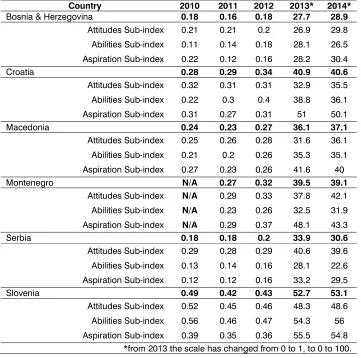
GEDI until 2017). This global index is calculated as an average of three sub-indices: Entrepreneurial Attitudes, Entrepreneurial Abilities, and Entrepreneurial Aspiration. It is compounded of 14 pillars: Opportunity Per-ception, Start-up Skills, Risk Acceptance, Networking, Cultural Support, Opportunity Start-up, Technology Absorption, Human Capital, Competition, Product Innovation, Process Innovation, High Growth, Interna-tionalization, and Risk Capital. However, in spite of its comprehensiveness it doesn’t focus on measuring po-tential for entrepreneurial development. To examine the methodology and provide better insights and justification for this research, we collected the data for the Ex-Yu countries for the period observed in this re-search (Table 1). The GEDI results show the entrepreneurial level of the country, emphasizing which area is the most developed within a country (Entrepreneurial Attitudes, Entrepreneurial Abilities, or Entrepreneurial Aspiration). However, it does not help us identify which area of entrepreneurship has the largest potential to be beneficial for the observed country. Thus, we constructed an index which focuses on determination of specific capacities for further country development.
Table 1:GE(D)I results for Ex-Yu countries 2010-2014
OECD & EC-JRC (2008) published the Handbook on Constructing Composite Indicators – Methodology and User Guide, which provides help in creating indices. The Handbook aims to contribute to a better under-standing of the complexity of composite indicators and to an improvement in the techniques currently used to build them.
The following general steps were followed in creating TED-pot: 1. Selecting the indicators to be included in the final index, 2. Finding the right sources for collecting the data, 3. Normalizing the data, and
4. Finding the method for weighting and aggregating the selected indicators.
!
"
! ! ! ! !
! ! !
! # !
$%
! !
!! !
# !
$
!! !#
! ! !
!# !!
!
!
!!
!
# !
! ! !
&'( ! ) % ) %) '( *
Steps 1 and 2: Selection of indicators and finding the right source for data collection
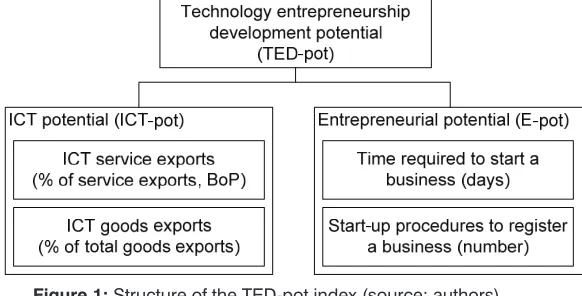
When deciding which indicators TED-pot should include, it was obvious that two variables must be included: one which indicates the level of the ICT potential of countries, and the other, which refers to the entrepre-neurial potential. Analyzing the indicators measured by the World Bank, six potential indicators were in-cluded: ICT service exports (% of service exports, BoP), ICT goods exports (% of total goods exports, BoP), High-technology exports (% of manufactured exports), Time required to start a business (days), Start-up procedures to register a business (number), and Number of new businesses registered (number).
Upon collecting the data from the World Bankdatabase, the indicator on high-technology exports was ex-cluded because of a large amount of the missing values. The number of new businesses registered turned out to show the result and not the entrepreneurial potential, so it was excluded and observed as a control indicator. We remained with four indicators (World Bank, 2016a; 2016b; 2016c; 2016d) grouped into two pillars (variables):
1. ICT potential (ICT-pot), and 2. Entrepreneurial potential (E-pot).
Figure 1 presents the structure of the TED-pot index, which consists of two pillars, and four indicators – two for each pillar.
Figure 1:Structure of the TED-pot index (source: authors)
Step 3: Normalization (rescaling) of data
Having decided which indicators to include and having collected the data, we need to re-scale the values of indicators to be suitable for aggregation. In the case of the TED-pot, we observe the variables (and pil-lars) with different natures. This means that the higher value of ICT service/goods exports, the better, but not in the case of the variables of Entrepreneurial potential where lower values show better results (it is better to have fewer procedures and less time needed for starting a business). This is why we needed to perform different re-scaling procedures for the two observed indicators, to make the values of indicators and the final index value positively correlated (when the values of indicators grow, so does the final index value).
Table 2 presents the method for preparing the data for aggregation.
Table 2:Transformation of original data (normalization and data preparation)
Table 1 shows that the max-normalization was used for normalization, which means that we divided the val-ues of an indicator by the highest value for the observed year. Additionally, for the indicators of E-pot, we needed to perform one more action – subtracting the obtained value from 1 in order to make a positive
relation with the final index value. To clarify, all indicators values are now scaled from 0 to 1, where 1 is the highest value.
Step 4: Weighting and aggregation
For obtaining the final index value, the simple weighted function with equal weights was used. The overall TED-pot has been built upon the equal weighting of the two mentioned pillars (ICT-pot, and E-pot), using the following formula:
where Pirepresents the two pillars of each country and αiis the constant of ½.
The value for each pillar is calculated by the same procedure used for the overall index, which is through a simple mean of certain indicators. In total, four basic indicators were considered: two for one pillar, and two for the other. The final TED-pot values, as well as the values for either pillar, are bounded from 0 to 1.
3. Study on the potential for the development of technology entrepreneurship:
results and discussion
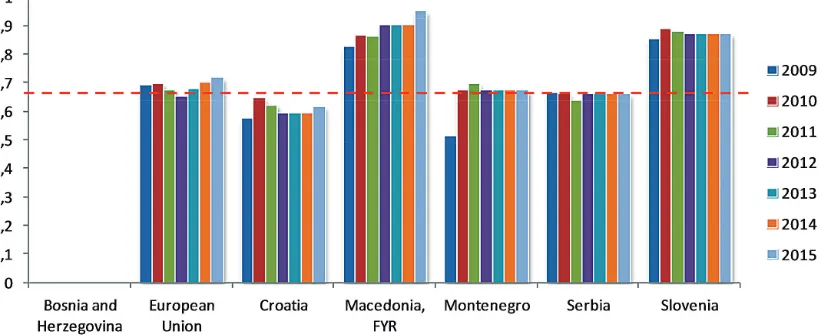
With the aim to determine whether a Serbian development potential lies in the entrepreneurial IT sector a comparative analysis was performed which encompasses six ex-Yugoslav countries and the EU. The TED-pot index as well as the ICT-TED-pot and E-TED-pot partially are calculated for each country for the period 2009-2014. Figures 2 and 3 present the results for the two pillars – ICT-pot and E-pot, respectively. The red dotted line shows the Serbian best value for the observed period.
Figure 2:ICT potential (ICT-pot): Ex-Yu countries and the EU comparisons, period 2009-2014 (source: authors)
Figure 3: Entrepreneurial potential (E-pot): Ex-Yu countries and the EU comparisons, 2009-2014 (source: authors)
Figure 3 shows different results for the E-pot pillar. The EU does not have the best results. Macedonia and Slovenia, with the best (fastest) procedures for starting business, are ranked at the top. Both the number of procedures and the time required to start business are the fewest and least in Slovenia and Macedonia. Bosnia and Herzegovina is positioned very low, with the values 0 for the whole period, e.g., throughout the observed time, due to the following observed values: 99 to 67 days for starting business, and around 13 start-up procedures. In comparison with Macedonia, where the time required to start a business is around 2-3 days, with 2-3 procedures, it is clear why Bosnia and Herzegovina has scored 0 for this pillar. Serbia, Mon-tenegro, and Croatia have scored similar results regarding the E-pot.
Finally, the aggregated TED-pot values which indicate the potential for technology entrepreneurship devel-opment of the observed countries are presented in Figure 4. The values closer to 1 indicate better results. Figure 4 clearly shows that Serbia is very near the EU average, with the highest potential for technology en-trepreneurship development, far ahead of the other ex-Yugoslav countries. Serbia is followed by Macedonia, Montenegro, Slovenia and Croatia which show similar final values. Bosnia and Herzegovina lags behind, with the final value of around 0.35 (value for Serbia in 2012 is around 0.8 on the scale 0 to 1). The values for the EU are slightly above 0.8 throughout the whole period (except 2009).
Figure 4:Technology Entrepreneurship Development Potential (TED-pot): Comparisons between ex-Yu countries and the EU, 2009-2014
(source: authors)
It is encouraging that the Strategy for scientific and technological development of the Republic of Serbia for the period 2016-2020(MESTD, 2016) predicts that the total investments in science, technological develop-ment, and innovation in Serbia will reach the level of 1.5% in total (of which 0.6% from of the budget). In the EU it is predicted to reach a value of around 3% (1% of which comes from public sources, i.e., budget). However, it is not important just to observe the value of investment itself, but also the structure of the in-vestment. Observing the sources of investment, Serbia significantly lags behind regarding the investment of the business sector in R&D (Eurostat, 2017). For that reason, the Strategy for scientific and technological development of the Republic of Serbia for the period 2016-2020(MESTD, 2016) sets the encouragement of the business sector to invest in R&D as one of its main goals. The second dimension of the investment struc-ture relates to the type of research being funded. Here one must notice the dramatic difference between Ser-bia and the developed world. While the most funded research in SerSer-bia is fundamental, the developed world funds the applied research (OECD, 2017; SORS, 2016)
Serbia, which shows remarkable results in the ICT exports, is currently investing only €60 per capita into the development of the ICT industry. It is by far less than the EU average which is €800 (SIEPA, 2015). Since ICT is considered to be a priority sector for the Government (MESTD, 2016), they should increase the support for this sector over the years, especially since the sector gives strong results in attracting investors and pro-moting employment. The thing that proves Serbia is on the right track is the opening of the following cen-tres (Vukanovic, Andric & Nesic, 2016): (1) ICT hub (www.icthub.rs) for technology entrepreneurship development in the Science Park Zvezdara (in 2014). In less than three years, over 40 technological start-ups have gone through the ICT Hub Education Programs; (2) Startit (www.startit.rs) centres for technology entrepreneurship development in Belgrade, Indjija, Novi Sad, Vrsac, Majdanpek, Zrenjanin, Valjevo, and Subotica. Since the launch of the Startit Center in Belgrade in late 2015, it has become the place where the local ICT community gathers; (3) the well-known Business Technology Incubator of Technical Sciences (BITF) which offers support in the early stage of business development. It already fosters 70 start-ups which developed 45 innovations, among which 10 are patented (www.bitf.rs); (4) StartLabs (www.startlabs.co) – an investment fund that invests in early stages of development of start-ups from the Western Balkans; (5) Ser-bian Venture Network SeVeN(www.seven.rs) – an association dedicated to the development of start-up and entrepreneurial ecosystems in Serbia and Southeast Europe.
The main objective of this paper was to analyse the critical factors influencing the potential for the development of tech-nology entrepreneurship at the country’s level and to establish an index that would enable measuring and comparisons between countries. From a holistic point of view, entrepreneurship, especially technology entrepreneurship is one of the impetuses of national economies. Thus, it is important to identify and find the concrete measures of its potential. These measures enable the identification and improvement of critical success factors and corrective measures of national strate-gies. Consequently, the paper was aimed at determining whether technology entrepreneurship is the focal development strategy for Serbia. For that purpose, we developed an index of Technology Entrepreneurship Development Potential (TED-pot) which has two pillars: ICT-potential (ICT-(TED-pot) and Entrepreneurial potential (E-(TED-pot). These pillars include two indica-tors each: ICT goods and ICT service exports (for the first pillar), and Time required to start a business and Start-up procedures (for the second). All the data are collected from the World Bankdatabase. The methodology for the con-struction of TED-pot is explained in Section 3. The index was applied to a set of six ex-Yugoslav countries and the EU for the period 2009-2014. The detailed results and discussion are presented in Section 4. To summarize, the calculated val-ues show that Serbia has the best potential for technology entrepreneurship development in the region, being closely be-hind the EU (e.g., the value of TED-pot for Serbia in 2012 is 0.808, while for the EU this value equals 0.835; scale 0 to 1). Although Serbia does not have the best E-pot value in the region (procedures and time required to start a business are not fewest and least), it still has a highly fertile ICT sector which compensates the slightly lower E-pot value. It is in the best tradition of the history of technology in Serbia since the first digital computer in the Central Europe was manufactured in Serbia back in 1960. At the time, Serbia was also one of the six countries in the world with the capability and know-how needed to do that (SIEPA, 2015). Summing up the results of the TED-pot index, we could conclude that Serbian potential is in the development of technology entrepreneurship and technology start-ups which could further grow and become the backbone of the Serbian economy.
To our knowledge, this is the first attempt of measuring the potential for the development of technology entrepreneurship at the country level which shows there are at least three obvious limitations of this paper to be discussed. The first is the selection of indicators which are included in the TED-pot index. The second is the methodology used for constructing the TED-pot (normalization of data, weighting and aggregation scheme). The third limitation is the narrow analysis, since it in-cluded only six ex-Yugoslav countries and the EU average; it should be broadened to a larger set of countries in order to validate the index results by comparing and connecting the TED-pot values with the established values such as Ease of
REFERENCES
[1] Acs, Z. J., & Szerb, L. (2011). Global Entrepreneurship and Development Index 2011. Cheltenham, UK: Edward Elgar. DOI:10.4337/9780857935540
[2] Acs, Z. J., & Szerb, L. (2012). Global Entrepreneurship and Development Index 2012. Cheltenham, United Kingdom: Edward Elgar. DOI:10.4337/9781781001158
[3] Acs, Z. J., Szerb, L., & Autio, E. (2013). Global Entrepreneurship and Development Index 2013. Chel-tenham, United Kingdom: Edward Elgar. DOI:10.4337/9781782540427
[4] Acs, Z. J., Szerb, L., & Autio, E. (2014). Global Entrepreneurship and Development Index 2014. Chel-tenham: Springer. DOI:10.1007/978-3-319-14932-5
[5] Acs, Z. J., Szerb, L., & Autio, E. (2015). Global Entrepreneurship Index 2015. Springer. DOI:10.1007/978-3-319-26730-2
[6] Adams, R., Bessant, J., & Phelps, R. (2006). Innovation management measurement: A review. Interna-tional Journal of Management Reviews, 8(1), 21-47.DOI: 10.1111/j.1468-2370.2006.00119.x
[7] Archibugi, D., & Coco, A. (2004). A new indicator of technological capabilities for developed and de-veloping countries (ArCo). World Development,32(4), 629-654. DOI: 10.1016/j.worlddev.2003.10.008 [8] Bailetti, T. (2012). Technology entrepreneurship: overview, definition, and distinctive aspects.
Technol-ogy Innovation Management Review, 2(2),5.DOI: 10.1007/s10961-015-9462-3
[9] Bandura, R. (2008). A survey of composite indices measuring country performance: 2008 update. New York: United Nations Development Programme, Office of Development Studies (UNDP/ODS Working Paper). Retrieved from:http://old.usc.ac.ir/IPPWebV1C035/ TemplateFileFolder/10-8-2013/OriginalFolder/0a6e29c4-1fa6-4496-a362-000f0851d4fc_indices_2008_bandura.pdf
[10] Bandura, R. (2011). Composite Indicators and Rankings: Inventory 2011. New York: United Nations De-velopment Programme, Office of DeDe-velopment Studies (UNDP/ODS Working Paper).
[11] Beckman, C. M., Eisenhardt, K., Kotha, S., Meyer, A., & Rajagopalan, N. (2012). The role of the entre-preneur in technology entreentre-preneurship. Strategic Entrepreneurship Journal, 6(3), 203–206 DOI: 10.1002/sej.1136
[12] Brown, R., & Mason, C. (2014). Inside the high-tech black box: a critique of technology entrepreneur-ship policy.Technovation,34(12),773-784.DOI: 10.1016/j.technovation.2014.07.013
[13] Byers, T.H., Dorf, R.C., & Nelson., A.J. (2011). Technology Ventures: From Idea to Enterprise, 3rd Ed., International Ed., McGraw Hill.
[14] CEVES - Centar za Visoke Ekonomske Studije (2014). Entrepreneurship in Serbia – A Necessity or an Opportunity?, CEVES, Belgrade. Retrieved from:
http://ceves.org.rs/wp-content/uploads/2014/02/Preduzetnistvo-u-Srbiji.pdf
[15] Clarysse, B., Mosey, S., & Lambrecht, I. (2009). New trends in technology management education: A view from Europe.Academy of Management Learning and Education, 8(3),427.
DOI: 10.5465/AMLE.2009.44287941
[16] Colovic, A., & Lamotte, O. (2015). Technological Environment and Technology Entrepreneurship: A Cross-Country Analysis.Creativity and Innovation Management,24(4), 617-628.
DOI: 10.1111/caim.12133
[17] Desai, M., Fukuda-Parr, S., Johansson, C., & Sagasti, F. (2002). Measuring the technology achievement of nations and the capacity to participate in the network age. Journal of Human Development, 3(1), 95-122. DOI:10.1080/14649880120105399
Doing Business, ICT Development Index, Technology Readiness, Global Entrepreneurship Index, Global Failure Index etc. The results could be validated only on a larger sample of countries. The future research directions are found to be: (1) re-vising of included indicators (considering including a larger set of indicators) since at this point the TED-pot index is fo-cused only on one side of the overall research phenomenon, neglecting other important issues; (2) revising of the methodology used for obtaining the final value (considering different normalization techniques, as well as weighting and aggregation schemes); (3) broadening the analysis worldwide and enabling the global cross-country comparison; (4) cor-relating with existing indexes to verify results; and finally (5) including the third pillar - sustainability, with the aim to create a measure of the potential for sustainable technology entrepreneurship development.
Acknowledgements
[18] Etlie, J. E. (2000). Managing Technological Innovation, John Wiley&Sons.
[19] Etzkowitz, H., & Leydesdorff, L. (1995). The Triple Helix - University-Industry-Government: A Laboratory for Knowledge-Based Economic Development. EASST Review, 14, 14-19. Retrieved from: https://ssrn.com/abstract=2480085
[20] European Commission. (2008). The Small Business Act for Europe. European Commission, Brussels. Available at: https://ec.europa.eu/growth/smes/business-friendly-environment/small-business-act_en [21] European Commission. (2010). Europe 2020 - A European strategy for smart, sustainable and inclusive
rowth. European Commission, Brussels. Available at: https://ec.europa.eu/info/business-economyeuro/ economic-and-fiscal-policy-coordination/eu-economic-governance-monitoring-preventioncorrection/ european-semester/framework/europe-2020-strategy_en
[22] Eurostat. (2017). Retrieved 27 8, 2017, sa Research and development expenditure, by sectors of performance (% of GDP):
http://ec.europa.eu/eurostat/tgm/download.do?tab=table&plugin=1&language=en&pcode=tsc00001 [23] Filippetti, A., & Peyrache, A. (2011). The patterns of technological capabilities of countries: a dual
ap-proach using composite indicators and data envelopment analysis. World Development,39(7), 1108-1121. DOI: 10.1016/j.worlddev.2010.12.009
[24] Garud, R., & Karnøe, P. (2003). Bricolage versus breakthrough: Distributed and embedded agency in technology entrepreneurship.Research Policy, 32(2),277–300.DOI: 10.1016/S0048-7333(02)00100-2 [25] Gilsing, V. A., Van Burg, E., & Romme, A. G. L. (2010). Policy principles for the creation and success of
corporate and academic spin-offs. Technovation, 30(1),12-23. DOI: 10.1016/j.technovation.2009.07.004 [26] Groen, A., Cook, G., & Van der Sijde, P. (2015).New technology-based firms in the new millennium.
Emerald Group Publishing.
[27] Groen, A.J., & Walsh, S.T. (2013) Introduction to the Field of Creative Enterprise. Technological Fore-casting and Social Change, 80, 187–90.DOI: 10.1016/j.techfore.2012.10.011
[28] Harms, R., & Walsh, S. T. (2015). An Introduction to the Field of Technology Entrepreneurship: Editorial to the Special Issue.Creativity and Innovation Management,24(4),552-557.DOI: 10.1111/caim.12159 [29] Isenberg, D. (2011). The entrepreneurship ecosystem strategy as a new paradigm for economic policy:
Principles for cultivating entrepreneurship. Presentation at the Institute of International and European Affairs. Available at: http://entrepreneurial-revolution.com/2011/12/09/the-entrepreneurship-ecosystemstrategy-as-a-new-paradigm-for-economic-development-principles-for-cultivating-entrepreneurship/
[30] Jovanovic, M., Rakicevic, J., Levi Jaksic, M., Petkovic, J., & Marinkovic, S. (2017). Composite Indices in Technology Management: A Critical Approach. In V. Jeremic, Z. Radojicic, & M. Dobrota (Eds.) Emerg-ing Trends in the Development and Application of Composite Indicators(pp. 38-71). Hershey, PA: IGI Global. DOI:10.4018/978-1-5225-0714-7.ch003
[31] Khayyat, N. T., & Lee, J. D. (2015). A measure of technological capabilities for developing countries. Technological Forecasting and Social Change, 92, 210-223. DOI: 10.1016/j.techfore.2014.09.003 [32] Kirchhoff, B. A., Linton, J. D., & Walsh, S. T. (2013). Neo-Marshellian Equilibrium versus
Schumpeter-ian Creative Destruction: Its Impact on Business Research and Economic Policy.Journal of Small Busi-ness Management,51(2), 159-166.DOI: 10.1111/jsbm.12018
[33] Levi Jaksic, M., Marinkovic, S., & Kojic, J. (2014). Technology and Innovation Management Education in Serbia, in Levi Jaksic, M., Barjaktarovic Rakocevic, S., Martic, M., ed. Innovative Management and Firm Performance, Palgrave, McMillan, London, pp 57-63. DOI: 10.1057/9781137402226_2
[34] Levi Jaksic M., Jovanovic, M.,& Petkovic J. (2015). Technology Entrepreneurship in the Changing Business Environment – A Triple Helix Performance Model, Amfiteatru Economic,38(1), 422-440. Retrieved from: http://www.amfiteatrueconomic.ro/temp/ Article_2395.pdf
[35] Levi Jaksic, M., Marinkovic, S., & Petkovic, J. (2010, June). Managing technology entrepreneurship competences. Proceedings of international symposium SymOrg 2010 – “Organizational Sciences and Knowledge Management“, FOS, Belgrade.
[36] Levi Jaksic, M., Marinkovic, S., & Rakicevic, J. (2014). Sustainable Technology Entrepreneurship and Development – the Case of Serbia. Management: Journal of Sustainable Business and Management Solutions in Emerging Economies, 70, 65-73. DOI: 10.7595/management.fon.2014.0004
[37] Levi Jaksic, M., Marinkovic, S., Petkovic, J., Rakicevic, J.,& Jovanovic, M. (2018). Technology Entre-preneurship. Belgrade: Faculty of Organizational Sciences (in Serbian).
[38] ME - Ministry of Economy (2016a). Report on Small and Medium-Sized Enterprises and Entrepreneur-ship for 2015.Government of Republic of Serbia. Retrieved from:
http://www.pks.rs/SADRZAJ/Files/Izvestaj%20za%20MSP%202015(1).pdf
[40] MESTD - Ministry of Education, Science and Technological Development (2016). Strategy for scientific and technological development of the republic of Serbia for the period 2016-2020 – “Research for in-novation”, Government of the Republic of Serbia. Retrieved from: http://www.mpn.gov.rs/wp-con-tent/uploads/2015/08/STRATEGIJA-naucnog-i-tehnoloskog-razvoja-RS-za-period-2016-2020..pdf [41] Mosey, S., Guerrero, M., & Greenman, A. (2017). Technology entrepreneurship research opportunities:
insights from across Europe. The Journal of Technology Transfer, 42(1),1-9.DOI: 10.1007/s10961-015-9462-3
[42] Muegge, S. (2013). Platforms, communities, and business ecosystems: Lessons learned about tech-nology entrepreneurship in an interconnected world.Technology Innovation Management Review,3(2), 5-15. Retrieved from: https://timreview.ca/article/655
[43] OECD, &EC-JRC (European Commission-Joint Research Centre). (2008). Handbook on constructing composite indicators: Methodology and User guide. OECD publishing.
[44] OECD. (2017). Retrieved 28 8, 2017, from R-D expenditure by sector of performance and type of R-D: https://stats.oecd.org/Index.aspx?DataSetCode=GERD_COST
[45] Parker, S. C. (2011). Intrapreneurship or entrepreneurship?Journal of Business Venturing, 26(1),19– 34.DOI: 10.1016/j.jbusvent.2009.07.003
[46] Pathak, S., Xavier-Oliveira, E., & Laplume, A. O. (2013). Influence of intellectual property, foreign in-vestment, and technological adoption on technology entrepreneurship. Journal of Business Re-search,66(10),2090-2101.DOI: 10.1016/j.jbusres.2013.02.035
[47] Ratinho, T., Harms, R., & Walsh, S. (2015). Structuring the technology entrepreneurship publication landscape: Making sense out of chaos.Technological forecasting and social change,100, 168-175.DOI: 10.1016/j.techfore.2015.05.004
[48] Schaper, M. (2016).Making ecopreneurs: developing sustainable entrepreneurship. Routledge, New York.
[49] SIEPA - Serbian Investment and Export Promotion Agency (2015). Serbia Smart Solutions – ICT Sector. SIEPA, Belgrade. Retrieved from: http://ras.gov.rs/uploads/2016/02/ict-industry-in-serbia.pdf
[50] Sobel, R. S., & Clark, J. R. (2017). The use of knowledge in technology entrepreneurship: A theoretical foundation.The Review of Austrian Economics, Online first article.DOI: 10.1007/s11138-017-0380-5 [51] Stenholm, P., Acs, Z. J., & Wuebker, R. (2013). Exploring country-level institutional arrangements on
the rate and type of entrepreneurial activity. Journal of Business Venturing, 28(1), 176-193.DOI: 10.1016/j.jbusvent.2011.11.002
[52] SORS - Statistical Office of the Republic of Serbia. (2016). Statistical Yearbook of the Republic of Serbia 2016, Statistical Office of the Republic of Serbia, Belgrade. Retrieved from: http://www.stat.gov.rs/ [53] Thukral, I. S., Von Ehr, J., Walsh, S., Groen, A. J., Van Der Sijde, P., & Akmaliah Adham, K. (2008).
En-trepreneurship, emerging technologies, emerging markets.International Small Business Journal,26(1), 101-116. doi: 10.1177/0266242607084656
[54] United Nations. (2012). Fostering innovative entrepreneurship: challenges and policy options / United Nations Economic Commission for Europe. Geneva: United Nations New York. Available at: https://www.loc.gov/item/2011502373/
[55] Vukanovic, D., Andric, K., & Nesic, S. (2016). How to start a technological start-up in Serbia - A manual for starting your own business in the field of technological entrepreneurship in the ICT sector.ICT-Hub, Science technology park, Belgrade. Retrieved from: http://www.novipocetak.rs/wp-content/uploads/2015/10/Kako-pokrenuti-tehnolo%C5 %A1ki-start-up-u-Srbiji.pdf
[56] WITS - World Integrated Trade Solutions (2017).Retrieved 9 9, 2017, from ICT service exports BoP, current US$:
http://wits.worldbank.org/CountryProfile/en/country/by-country/startyear/LTST/endyear/LTST/indicator/BX-GSR-CCIS-CD#
[57] World Bank.(2016a). Retrieved 6 9, 2017, from ICT service exports (% of service exports, BoP): http://data.worldbank.org/indicator/BX.GSR.CCIS.ZS
[58] World Bank. (2016b). Retrieved 6 9, 2017, from ICT goods exports (% of total goods exports): http://data.worldbank.org/indicator/TX.VAL.ICTG.ZS.UN
[59] World Bank (2016c). Retrieved 6 9, 2017, from Time required to start a business (days): http://data.world-bank.org/indicator/IC.REG.DURS
[60] World Bank (2016d). Retrieved 6 9, 2017, from Start-up procedures to register a business (number): http://data.worldbank.org/indicator/IC.REG.PROC
[61] WEF - World Economic Forum. (2016). The Global Information Technology Report 2016. Innovating in the Digital Economy. Retrieved from: http://www3.weforum.org/docs/ GITR2016/WEF_GITR_Full_Re-port.pdf
[62] Zahra, S. A. (1993). Environment, corporate entrepreneurship, and financial performance: a taxonomic approach. Journal of Business Venturing 8 (4), 319–340.DOI: 10.1016/0883-9026(93)90003-N
About the Author
Jovana Rakićević University of Belgrade, Faculty of Organizational Sciences, Serbia [email protected]
Jovana Rakicević, MSc, works as a teaching assistant at the University of Belgrade, Faculty of Organizational Sciences, Department for management of technology, innovation, and development. She is currently enrolled in PhD studies – Information Systems and Management. She is author and co-author of about 30 scientific research papers and three book chapters. Her research and teaching area of interest include technology and innovation management, performance measurement, sustainable SMEs development, sustainable development, and technology entrepreneurship.
Maja Levi Jaksić University of Belgrade, Faculty of Organizational Sciences, Serbia [email protected]
Maja Levi Jaksić, PhD, is a full professor at the University of Belgrade, Faculty of Organizational Sciences, and Head of Department for management of technology, innovation and development management. Prof Levi Jaksic has published more than 200 works, among which more than 20 books and monographs and had been engaged in fundamental and applied research projects. She has been teaching as visiting professor at universities in Greece, United Kingdom, Japan, and France and is the programme leader of the dual diploma Academic Master program in International Business and Management, organized with the Middlesex University from London. She is a member of Editorial Board of Technovation.
Milica Jovanović University of Belgrade, Faculty of Organizational Sciences, Serbia [email protected]