* MA, Ishik University, Erbil, Iraq.
The Effect of Project–Based Learning on Undergraduate
EFL Students’ Reading Comprehension Ability
Aziza KAVLU *
Abstract
Globalization in the 21st century and rapid strides in technology have increased the need for communication in English as is has become a
lingua franca. English is also needed as a tool to assist academic advancement, career promotion and information-seeking in general. Hence, good English reading comprehension ability and a sufficien vocabulary range are both vital for university students for these purposes. There-fore, educators have to take into consideration these improvements and attempt to apply various innovative approaches during the education process. Project–Based Learning (PBL) is an approved method that equips learners not only with the 21st century skills (critical-thinking, problem-solving, life–long learning skills, creativity, innovation, collaboration, real-life- setting communication skills), but also has remarkable effects on enhancing learners’ English language skills. The main purpose of this paper is to explore the relationship between the implemen-tation of PBL and elementary level EFL learners’ reading comprehension ability. The present study investigates whether learners’ reading comprehension ability and vocabulary skills improve with the application of PBL. Forty-five first year Faculty of Education students at Ishik University (Iraq, Erbil) participated in the study, in which the experimental group was taught reading comprehension using PBL methods, while the control group – without PBL. The results confirm that the measured variables (reading and vocabulary skills) showed a significant positive progress in the experimental group. The researcher indicates that reading and acquiring required vocabulary become more efficien and enjoy-able for students, when PBL is implemented.
Keywords: English as a foreign language, project–Based Learning, reading comprehension, vocabulary
Introduction
Nowadays, due to the rapid development of technology, young people have become the “visual generation” prefer-ring pictures to reading, so students’ reading habits have de-creased. In 2004, the National Endowment for the Arts (2007, p. 7), for example, published Reading at Risk: A Survey of Lit-erary Reading in America. The study showed that “Americans in almost every demographic group were reading fiction, po-etry, and drama - and books in general - at significantly lower rates than 10 or 20 years earlier. The declines were steepest among young adults”.
However, getting accomplishment in university academic life is directly and closely connected with students’ reading habits and reading comprehension level. The problem be-comes more serious, when education requires reading in a foreign language. In our case the foreign language is English. Students’ education at Ishik University (Iraq, Erbil) is com-pletely in English. Hence, to be able to read and understand English written material is significant for students not only academically, but also for personal advancements. Therefore,
various teaching approaches are being used to enhance stu-dents’ reading comprehension level. Project–Based Learning is one of teaching approaches that enables to integrate the 21st technological age skills with improvement of learners’
reading comprehension and vocabulary knowledge in Eng-lish as a Foreign Language context (EFL). It helps to create an interactive student/s – student/s and teacher – student/s atmosphere.
Theoretical background
are able to use the target language and have a purposeful communication with peers, teachers, and experts in order to accomplish the tasks (Eguchi & Eguchi, 2006).
For many years rote memorization was dominant in Iraqi educational system (Eldakak, 2010; Kavlu, 2015; Massialas & Jarrar, 1987), so PBL assists EFL learners to shift from some meaningless drilling, grammar rules memorization and indi-vidual work to more real–life-connected language learning in a more collaborative and cooperative atmosphere. According to Richards and Renandya (2002), PBL should be accepted as a multipronged approach for thoroughly integrated guage, it enables language teachers to work in different lan-guage educational settings such as: GE – General English, EAP – English for Academic Purposes, ESP – English for Specific Purposes, EOP - English for Occupational Purposes, also viable for pre–service and teacher training programs. Haines (1989) advocated that PBL is an approach that is ap-propriate to be implemented with almost all language levels, abilities and ages of students.
The application of PBL in an EFL context started 3 dec-ades ago as a vehicle of student–centered learning principles (Hedge, 1993). Eyring (2001) asserted that early researches’ reports in Second Language Acquisition (SLA) field generally emphasized that PBL gives language learners opportunities to have a comprehensible input and to be able to generate a comprehensible output. Furthermore, PBL projects assist learner to develop analytical skills, time management and sense of responsibility. Moreover, PBL is based on group investigating, team working, peer assessment and feed-back, which improve leaners’ interpersonal skills, sense of community and cooperation (Lou & Kim MacGregor, 2004; Railsback, 2002). All mentioned skills are crucial and indis-pensable in the rapidly progressing 21st century (Ananiadou & Claro, 2009; Saavedra & Opfer, 2012), because English solely is not enough for students to be competent in tech-nological high competitive digital age. The other virtual sides of PBL in an EFL context are being process- and product-oriented (Stoller, 1997) in real-life settings. Therefore, learn-ers improve their language skills in an authentic environment, implement their life and hands-on experiences and content knowledge as well as acquire problem-solving and higher–or-der thinking skills and creativity (Brunetti, Petrell, & Sawada, 2003; Poonpon, 2011; Solomon, 2003). Furthermore, projects enhance learners’ public speaking, presenting, contemplation and information elaborating skills and assists learners to build up confidence and self-esteem
The importance of Reading for EFL students
The importance of reading either in L1 or L2 and foreign lan-guage acquisition is incontrovertible. Reading is a source of information, clarifying vague points, solution of problems, and it is a target of language acquisition, vocabulary enrichment, culture awareness and academic success. Research has shown that students who read in English a lot get a better English proficiency than students who do not (Floris & Divina, 2015; Hayashi, 1999; Krashen,1993; McQuillan, 1994).People naturally start listening to speech around them, then it stimulates their speaking, but generally it is not easy to start reading without being taught. Undergraduate EFL students normally somehow can read, but their most vulner-able points are the comprehension of printed material and students’ vocabulary knowledge. When students’ education takes place in English, unless students can understand, syn-thesize, interpret, and paraphrase the texts encountered in
academic settings, unless their vocabulary is rich enough, they experience great problems in academic life (Chen, 2014) and further careers. Therefore, undergraduate students’ abil-ity to understand course books written in English influence students’ course achievement.
The majority of EFL learners hardly ever have the op-portunity to speak with native speakers (Rivers, 1981), on the other hand, they have an easy access and great exposure to material printed and written in English. Therefore, in an EFL situation, when foreign language input is limited, reading plays an active and vital role in foreign language acquisition (Gorsuch & Taguchi, 2008).
In language teaching reading is viewed as one of the four essential skills (Grabe & Stoller, 2002), at the same time read-ing integrates and combines many skills. Writread-ing, vocabulary, speaking, grammar, and spelling can be taught through read-ing (Al-Mansour & Al-Shorman, 2011; Harmer, 2007; Pourkal-hor & Kohan, 2013).
The simple explanation of reading comprehension is be-ing able to understand what we read. Proficiency in readbe-ing, effective learning and ability to conceptualize are acquired by reading comprehension skills. Richards (1976) noted, that reading comprehension is the only and substantial skill required in order to get access to professional data and in-formation in different subject fields. The significance of good reading comprehension skills for university EFL and ESL students has been emphasized by scholars (Beasley, 1990; Rezaei, Rahimi, & Talepasan, 2012). Johns and Dudley-Evans (1991), Jordan (1997) and Hudson (1991) even ex-pressed an idea that because of the principal importance of reading in myriad EFL settings it is a single skill in ESP’s prac-tical purpose.
In spite of such prominence of reading comprehension, most EFL students suffer from incompetence’s in compre-hending printed material (Suknantapong, Karnchanathat, & Kannaovakun, 2002).
Aim of the Study
The research aims to find effects of PBL on undergraduate students’ reading comprehension.
Research Question
Does PBL implementation enhance students’ reading com-prehension skills?
Methodology
Participants
The study participants were 42 – the first-year elementary level students of a private University in Erbil, Iraq. The study was held during January and February 2015. The age range of the study participants was from 18 to 24, including both females and males. The participants were voluntary and their selection and placement to groups was random. 21 student was assigned to the control group and 21 – to the experimen-tal group.
Kurdish, 10 students – Arabic and 3 students – Turkish.
Procedure
In the beginning of the academic year, in order to indicate learners’ English level and to generate more or less homoge-neous classes, the University implemented the high reliability “Cambridge Placement Test”. The participants, according to placement test’s results, were assigned in two elementary classes, the control one, where no PBL was applied, and the experimental one, where PBL was applied. Otherwise the teaching was in maximally equal conditions – same teacher, same materials, same time dedicating to learning in class, and same teaching methods. The Dean of Faculty and Head of Department were officiall informed and the researcher before conducting experiment obtained department’s permis-sion. It was an intensive course - 10 hours of English each week, out of which reading was taught for 2 hours.
Instruments
Three types of tests were used in this study:
a. Cambridge Placement Test – which was administrated in order to assign the students to groups of proper level.
b. Reading pre-test from course Teacher’s Book Unit tests. Tests are designed by Oxford publishing on a high pro-fessional level. Pre-test was implemented in the end of the first month of the first semester. The reading comprehension test included multiple-choice, true – false, and open-ended questions.
c. Reading post-test from course Teacher’s Book Unit tests, it was implemented in the end of the second month of the first semeste
Both pre- and post–tests were administrated in order to check the changes in reading comprehension. Researcher’s in-class observation was also applied.
Materials
As a course book – Oxford Elementary level books (Hancock and McDonald, 2013) set were used. PBL projects were as-signed correspondingly to books’ topics. Projects were de-signed in order to enhance reading skills. One of the projects was making up a short video and another - a poster. PBL characteristics, project generation steps and procedures were explained in detail with prepared specimens.
Data Collection and Analysis
Quantitative data collection was utilized in order to assess learners’ reading comprehension achievement across control and experimental groups at the beginning and in the end of the study. Quantitative method of data analysis was employed for the evaluation of the gained pre and post–experimental data. Statistical Package for Social Sciences (SPSS) 17 was used to collect data, independent and paired sample t- tests were run to analyze the data.
Findings and Discussions
Table 1: Paired Samples Statistics of Students’ Reading Compre-hension pre- and post-test results (experimental group)
A paired samples t-test was utilized to summarize the mean and Standard Deviation of experimental group reading comprehension pre and posttests. The Experimental group pre–test mean result was 77.5 and post–test results -87.6. Table 1 reveals that PBL had a positive effect and Experimen-tal group’s reading comprehension results show an increase from 77.5 to 87.6.
Table 2: Paired Samples Statistics of Students’ Reading Compre-hension pre- and post-test results (control group)
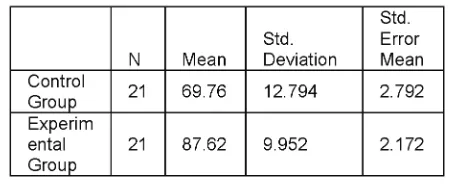
Table 2, on the other hand, reveals that the results in the control group, where no PBL was applied, ptest mean re-sult was 77.9 and post-test mean rere-sult - 69.76. Traditional teaching of reading comprehension not only did not yield a positive effect, but also demonstrated a decrease in reading skills level.
Table 3: Control and Experimental groups’ Reading comprehension post–test statistics
deterioration of test results, but also, having an almost identic with the experimental group ptest results, its students re-ceived a worse result than in the experimental group.
To find out whether this trend is significant, the research-er worked out the data in Independent t-test.
Table 4 indicates experimental and control group read-ing comprehension pre–test results Sig. (2-tailed) are 0.921 - greater than 0.05. So this statistical test confirmed that ex-perimental and control group pre-test mean differences were statistically non–significant, which shows that groups’ initial level was quite equal. The purpose of pre-test was to obtain the data with which the post–test results could be compared.
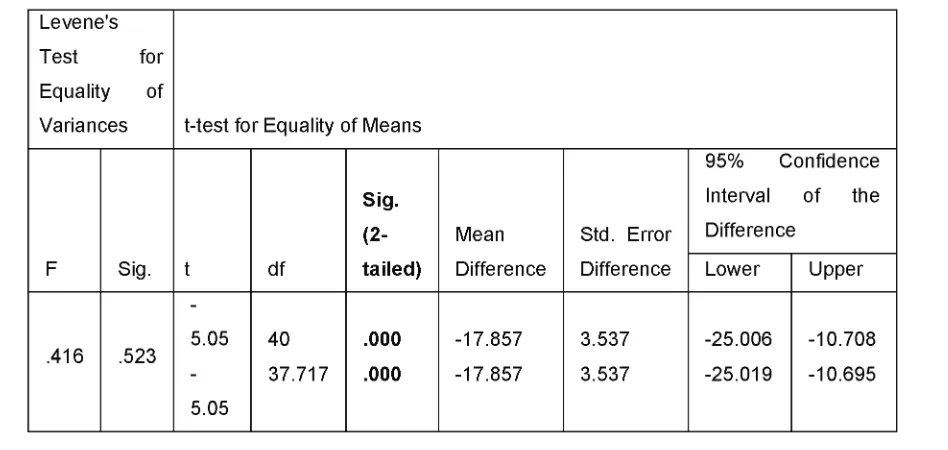
Table 5 shows the experimental and control group Reading Comprehension post–test results, the value of Sig. (2-tailed) is .000 which is smaller than 0.05, so, it can be in-ferred that the difference between pre and post–tests of the PBL-implemented group and the control group was statically significant. It confirmed that PBL had a significant positive ef-fect on learners’ reading comprehension.
Conclusion
The main purpose of the study was to explore the relation-ship between the PBL implementation and lack of such an ap-proach, while teaching reading. The analyzed data revealed that there is a positive link between the application of PBL and students’ level of reading comprehension skills. The re-sults of paired sample T-test revealed that at the beginning the control and experimental groups’ reading comprehen-sion pre-test scores are close to each other (Table 3). On the other hand, the control group’s post-test mean is 69,7 (Ta-ble 4), which presented a decline, as control group’ pre-test mean was 77.9. The reason for this downtrend is the lack of motivation (without PBL students were quite bored with reading). The difficult level of the texts was increasing, but the students did not make an extra effort. The researcher’s personal observation while implementing research was that students generally do not like reading, as they need to work hard, finding the meanings of unfamiliar words, memorizing them and also trying to keep in mind comprehension ques-tions. The grammatical structure of the text is more important for them and students’ general perception is that reading does not need any strategies or extra time to study. Moreover, Al– Shorman and Bataineh (2004) have remarked that Gulf stu-dents set reading aside and for them the developing of other language skills is much more important than reading. With respect to Grabe (2009), their sole concern is to form func-tional language skills - grammar and vocabulary. Most likely, the experimental group students had had the same consid-eration as the control group students before the experiment, but doing projects, which they were assigned, helped them to naturally improve their reading comprehension, because to fulfill the required projects, the students needed to read the same text more than 2-3 times, to gain a clear understand-ing. Besides, they discussed the topic, the unfamiliar words and general context of reading with their group members and also tried to work up a possible solution to the stated problem. On the other hand, in the control group, where conventional teaching was implemented, the students were supposed to read and answer the reading comprehension questions indi-vidually, orally or in written.
The findings of this study were consistent with resent
researches, such as Soleimani, Rahimi and Sadeghi (2015), who tested and proved statistically the positive effect of PBL not only on intermediate level EFL students’ reading compre-hension, but also ascertained that well–designed PBL pro-jects foster learners’ short and long-term vocabulary recall achievement. Shirazi and Larsari (2014) held a detailed study with two experimental and one control EFL leaners’ groups, which revealed that, irrespective of the type and nature of the PBL project (one of experimental group’s projects was mak-ing up magazines, another dealt with wall newspapers), the experimental group’s reading comprehension skills’ level far outweighed that of the control group, although both groups were taught by the CLT approach.
Suggestions
United Nations recent report (2008) (as cited in Khreisat & Sarjit, 2014, p. 18) indicated that American and British people read for leisure eleven and eight books a year, respectively, which is insufficient However, Gulf region people (Arab World people) on average read for leisure only 4 pages a year, ir-respective the literacy level of over 90% in some countries, such as Kuwait and Jordan. Therefore, as educators, who not only assist learners to acquire language skills, but also cultivate learners’ humanistic ethics, should have as one of their aims to make their learners avid readers, because read-ing is the passkey in each step of educational and personal life. Especially as language teachers we should seek for new educational approaches which will help our learners to con-struct good reading habits. Project-based learning is one of the possible effective solutions of the problem of enhance-ment of reading skills.
Acknowledgments
sustainability: Team project-based learning enhances aware-ness of sustainability at the University of British Columbia, Canada. International Journal of Sustainability in Higher Edu-cation, 4(3), p. 210-217
Chen, K. Y. (2014). Vocabulary, syntactic knowledge and reading comprehension: The perspective of college EFL stu-dents. An Interdisciplinary Journal, 66, p. 39-52
Eguchi, M., & Eguchi, K. (2006). The limited effect of PBL on EFL learners: A case study of English magazine projects. Asian EFL Journal, 8(3), p. 207-225
Eldakak, S. (2010). The Modern Effects of Teacher Education on the Arab World. Retrieved September 10, 2015 from http:// files.eric.ed.gov/fulltext/ED510606.pd
Eyring, J. L. (2001). Experiential and negotiated language learning. In Celce-Murcia, M. Teaching English as a
Sec-Table 4: Reading Comprehension Pre–test significance - t-test result
Table 5: Reading Comprehension Post–test Significance table of t-test resul
References
Al-Mansour, N. S., & Al-Shorman, R. E. A. (2011). The effec of teacher’s storytelling aloud on the reading comprehension of Saudi elementary stage students. Journal of King Saud University-Languages and Translation, 23(2), p. 69-76
Ananiadou, K., & Claro, M. (2009). 21st century skills and competences for new millennium learners in OECD coun-tries. OECD Working Papers, 41. Retrieved September 10, 2015 from http://www.keepeek.com/Digital-Asset- Management/oecd/education/21st-century-skills-and- competences-for-new-millennium-learners-in-oecd-countries_218525261154#page2
Beasley, C. (1990). Content-based language instruction: Helping ESL/EFL students with language and study skills at tertiary level. TESOL in Context, 1(1), p. 10-14
Hankock, M. & McDonald, A. English Result Elementary. Ox-ford: Oxford University Press
Harmer, J. (2007). How to teach English. Longman London, UK
Hayashi, K. (1999). Reading strategies and extensive reading in EFL classes. RELC Journal, 30(2), p. 114-132
Hedge, T. (1993). Key concepts in ELT. ELT Journal, 47(3), p-. 275-277
Hudson, T. (1991). A content comprehension approach to reading English for science and technology. TESOL Quar-terly, 25(1), p. 77-104
Johns, A. M., & Dudley-Evans, T. (1991). English for specifi purposes: International in scope, specific in purpose. TESOL Quarterly, 25, 2, p. 297-314
Jordan, R. R. (1997). English for Academic Purposes: A Guide and Resource Book for Teachers. Cambridge Univer-sity Press: Cambridge
Kavlu, A. (2015). Implementation of project-based learning (PBL) in EFL (English as a Foreign Language) classrooms in Fezalar Education Institutions (IRAQ). Paper presented at the The Fifth International Research Conference on Education, English Language Teaching, English Language and Litera-tures in English, Tbilisi, Georgia, p. 206-221
Khreisat, M. K. & Sarjit, K. (2014). English recreational read-ing habits of Arab Jordanian EFL tertiary students. Education, Business and Society: Contemporary Middle Eastern Issues, 7(1), p. 17-32
Krashen, S. D. (1993). The Power of Reading. Englewood, CO: Libraries Unlimited
Lou, Y., & Kim MacGregor, S. (2004). Enhancing project-based learning through online between-group collaboration. Educational Research and Evaluation, 10(4-6), p. 419-440
Massialas, B. G., & Jarrar, S. A. (1987). Conflicts in educa-tion in the Arab world: The present challenge. Arab Studies Quarterly, 9, p. 35-52
McQuillan, J. (1994). Reading versus grammar: What stu-dents think Is pleasurable and beneficial for language acqui-sition. Applied Language Learning, 5(2), p. 95-100
National Endowment for the Arts. (2007). To Read or Not To Read: A Question of National Consequence. Washington, D.C.
Poonpon, K. (2011). Enhancing English skills through project based learning. The English Teacher, 40, p. 1-10
Pourkalhor, O., & Kohan, N. (2013). Teaching reading com-prehension through short stories in advanced classes. Asian Journal of Social Sciences & Humanities, 2(2), p. 52-60
Railsback, J. (2002). Project-Based Instruction: Creating Ex-citement for Learning. Portland: Northwest Regional Educa-tional Laboratory
Rezaei, A., Rahimi, M. A., & Talepasan, S. (2012). Exploring EFL learners’ reading comprehension problems in reading ESP texts. Sino-US English Teaching, 9(3), p. 982-987
Richards, J. C. (1976). Teaching English for science and tech-nology. Singapore University Press: Singapore
Richards, J. C., & Renandya, W. A. (2002). Methodology in Language Teaching: An Anthology of Current Practice: Cam-bridge University Press
Rivers, W. M. (1981). Teaching Foreign-language Skills. Uni-versity of Chicago Press: Chicago
Saavedra, A. R., & Opfer, V. D. (2012). Teaching and Learn-ing 21st Century Skills. Asia Society. Retrieved September 10, 2015 from http://asiasociety.org/files/rand-1012report.pd
Shiraz, M. P., & Larsari, E. E. (2014). The Effect of Project-Based Activities on Intermediate EFL Students’ Reading Comprehension Ability. The Journal of Effective Teaching, 14, 3, p. 38-54
Soleimani, H., Rahimi, Z., & Sadeghi, H. (2015). Project-based learning and its positive effects on Iranian intermadiate EFL learners’ reading ability and vocabulary Achievement. In-ternational Journal of English Language and Literature Stud-ies, 4(1), p. 1-9
Solomon, G. (2003). Project-based learning: A primer. Tech-nology and Learning. 23(6), 20-26.
Stoller, F. L. (1997). Project work: A means to promote lan-guage content. English Teaching Forum, 35(4), p. 2-9, 37
Suknantapong, W., Karnchanathat, N., & Kannaovakun, P. (2002). An analytical study of humanities and social sciences students’ problems in reading English. Songklanakarin Jour-nal of Social Sciences & Humanities, 8(2), p. 121-132 ond or Foreign Language, p. 333-344. Boston, US: Heinle
& Heinle
Floris, F. D., & Divina, M. (2015). A Study on the reading bskills of EFL university students. TEFLIN Journal, 20(1), p. 37-47
Gorsuch, G., & Taguchi, E. (2008). Repeated reading for de-veloping reading fluency and reading comprehension: The case of EFL learners in Vietnam. System, 36(2), p. 253-278
Grabe, W. (2009). Reading in a Second Language: Moving from Theory to Practice: Cambridge University Press
Grabe, W., & Stoller, F. L. (2002). Teaching and Researching Reading. Longman:London