SHARED WATERS:
CATALYST FOR COOPERATION
Vahid Alavian
Rankin International, Inc.
ABSTRACT
Water is a unique resource. It is critical to the functioning of human society and ecosystems, and there are no substitutes. As the demand for water has begun to outstrip the available supply, competition for this limited resource has intensified. When faced with scarcity, nations experience real limits to their growth, declines in their human health, and degradation of their resource base - all destabilizing factors in international relations. This situation can become particularly acute, and has the potential to become explosive when nations compete for water resources. Meanwhile, some countries have begun to realize the benefits of cooperatively developing their shared transboundary water resources. Even in highly contentious areas, cooperation on water issues can lay the foundation for broader based peace, security, and prosperity. This paper provides a review of the water resources as a security issue and discusses the elements critical to the development of a unifying framework for management of water resources.
INTRODUCTION
Water is our most precious resource. Society requires water to grow food, provide energy, run industries, and sustain human health. Ecosystems require water for existence. Yet, increasingly, fresh water is being recognized as a scarce and limited resource. Supplying water at an affordable cost and acceptable quality is difficult in many parts of the world. At the same time, the demand for water has increased due to the growth in population, urbanization, industrialization, and agriculture. Rising standards of living and water allocations for environmental purposes have placed additional demands on water. Consequently, competition among water uses and users has intensified (Gleick, 1998-99; World Resources, 1998-1998-99; Postel, 1992).
water resources can become fierce where water is scarce, water demands are rapidly growing, and geo-political relations are tense for other reasons. Currently, water disputes are most serious in the basins in the Middle East (Nile, Jordan, and Euphrates basins) and parts of Asia (Indus, Ganges, and Brahmaputra basins). Although less volatile, conflicts over water have also been the focus of international negotiations in the Americas (Colorado, Rio Grande, and Paraná basins), Asia (Aral Sea and Han basins), and parts of Europe. History is replete of examples where water has been a source of strategic rivalry, a goal of military action, and has been used as a target and tool of war (Gleick, 1998-99).
As the demand for clean water begins to outstrip the available supply, conflicts over water, particularly waters flowing among nations, have the potential to significantly intensify. At the same time, there are countries that have begun to realize the benefits of cooperatively developing shared water resources, as illustrated by current multinational development efforts in the Mekong and Zambezi River Basins in Asia and Southern Africa, respectively. Even in highly contentious areas, such as the Jordan and the Tigris-Euphrates Rivers in the Middle East, it has been recognized that cooperation on water issues can lay the foundation for broader based peace efforts (Lowi and Rothman, 1993). It has been argued that "Water can unite or divide the region. It can be a catalyst for cooperation and peace or for conflict" (Moffett, 1990). It is the intention of this paper to review the role of water as a potential source of conflict and to prove that water can be used as a viable unifying catalysis for achieving peace and prosperity at local and international levels.
competition and tensions among nations and groups. Furthermore, national and international instability, arising from a combination of environmental, resource, and political factors, may escalate to the international level and may become violent. This concept is particularly relevant to society's most basic resource -- water. While most water disputes are settled through negotiations or discussions and few lead to violent confrontation, several trends are converging which have the potential to intensify conflicts over water and destabilize international relations. The vulnerability of nations to water-related conflicts is related to the degree of scarcity, the extent to which water resources are shared, and the relative strength of the riparian countries involved.
Scarcity
Water is increasingly being recognized as a scarce and limited resource. Growth in population, urbanization, industrialization, agriculture, and rising living standards have increased the demand for clean water. Water demand is estimated to increase at three to five times the rate of population growth (Falkenmark and Lundqvist, 1996). At the same time, available supplies are fixed, too costly to develop, or rendered unusable due to degraded water quality. Gleick (1993) estimates that there are currently 21 countries whose current water demand exceeds their renewable water supply by more than one-third. By the year 2025, Serageldin (1995) estimates that
as many as 52 countries with over three billion inhabitants will be plagued by water stress or chronic water shortages. Most of these people reside in poor countries with high population growth: Africa, the Middle East, central Asia, and parts of China, India, and South America. Even where water is available, the majority of poor people are without safe drinking water and adequate sanitation. In the early 1990's, 1 billion people lacked access to safe drinking water and 1.7 billion lacked adequate sanitation, resulting in some two billion people contracting water-related diseases (Briscoe, 1993). As the demand for clean water continues to outstrip the available supplies, countries will experience real limits to their growth and development, see declines in human health, and witness continued environmental degradation of their resource base - all destabilizing factors in international relations.
Shared River Basins
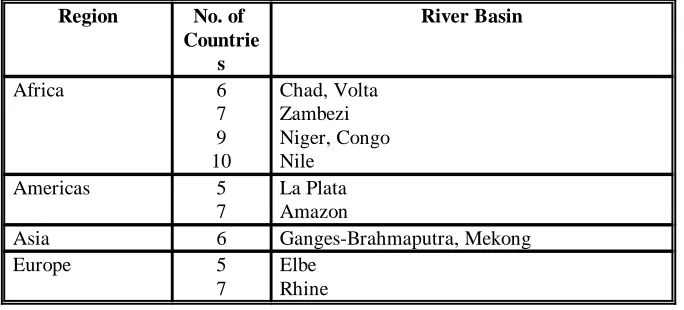
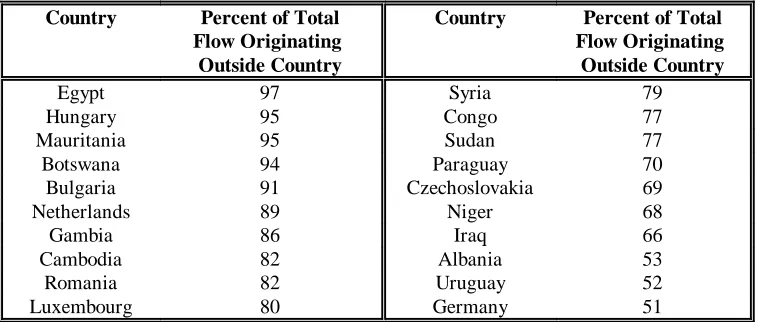
The extent to which river basins are shared by two or more countries determines the potential for international water conflicts. It is estimated that more than 40 percent of the world's population lives in the more than 200 international river basins. While most basins are shared by only two countries, there are 13 major rivers with 5 or more riparian countries, as depicted by Table 1. (Barrett, 1994). The degree of water interdependence among various countries is illustrated in Table 2.
Table 1. River Basins Shared by Five or More Countries (after Barrett, 1994)
Region No. of
Countrie s
River Basin
Africa 6 7 9 10
Chad, Volta Zambezi Niger, Congo Nile
Americas 5 7
La Plata Amazon
Asia 6 Ganges-Brahmaputra, Mekong Europe 5
7
Table 2. Dependence on Imported Surface Water (source: Gleick, 1993)
Country Percent of Total
Flow Originating Outside Country
Country Percent of Total Flow Originating
Outside Country
Egypt 97 Syria 79
Hungary 95 Congo 77
Mauritania 95 Sudan 77
Botswana 94 Paraguay 70 Bulgaria 91 Czechoslovakia 69 Netherlands 89 Niger 68
Gambia 86 Iraq 66
Cambodia 82 Albania 53
Romania 82 Uruguay 52
Luxembourg 80 Germany 51
There are 20 countries that import more than 50 percent of their surface water from outside their borders. Nations such as Egypt, Hungary, and Mauritania depend on other countries to satisfy as much as 95 percent of their water needs. In the highly volatile Jordan River Basin, approximately 40 percent of Israel's groundwater supply and 33 percent of its total sustainable water yield originates in the occupied or contested territories (Lonergan and Brooks, 1994).
Riparian Relations
International tensions related to water are influenced by the relative strength and position of the countries involved and the aggressiveness of their development plans. Classic examples of these factors are illustrated by Egypt and the other riparian countries of the Nile River Basin and by the current conflict over the Tigris-Euphrates River Basin between Turkey, Syria, and Iraq.
The Nile – The Nile River runs through ten riparian countries in northern and eastern Africa: Burundi, Egypt, Eritrea, Ethiopia, Kenya, Rwanda, Sudan, Tanzania, Uganda, and Zaire. Egypt, the downstream riparian country, is the primary beneficiary of the Nile and is totally dependent upon its waters. It is expected that due to Egypt's high population growth, increased irrigation activity, and worsening water quality, the country will not
countries (Smith and Al-Rawahy, 1990).
As upland countries have begun to demand their share of the Nile's waters, the potential for conflict - and the need for cooperation - have intensified. Until recently, upstream countries have been too poor, distracted by civil war, or dominated by Egypt to focus on water resources development. However, several upstream countries now have plans for water projects which will alter the flow to Egypt. Furthermore, proposed schemes to increase the flow to Egypt involve storage of Nile waters in upland countries where evaporation rates are lower. Although the 1959 Niles Waters Agreement includes procedures to settle claims of upstream riparian states through equal flow reductions to Sudan and Egypt, no formal claims have yet been made and these procedures have not yet been tested (Kirmani and Rangeley, 1994). Egypt has traditionally utilized the lion's share of the Nile River waters, but as upland countries have begun to develop, the potential for conflict has escalated, giving rise to the recently initiated cooperative framework described later.
international debate. Syria and Iraq, the downstream riparians, fear loss of as much as 40 percent and 60 percent of their share of the Euphrates, respectively, and are concerned about the quality of the remaining water (Economist, 1996). Their fears were further fueled when Turkey interrupted the flow of the Euphrates for one month to partially fill the Ataturk Reservoir.
The disagreement centers around different interpretations of international law. Syria and Iraq consider the Tigris-Euphrates as international waters and demand they be shared accordingly. Conversely, Turkey alludes to the "transboundary" nature of the water (i.e., crossing common borders) and plans what it considers to be "rational and optimal utilization" of the water. Turkey regards the Tigris-Euphrates as the foundation for cooperation and prosperity for all three countries and has proposed: unified data collection and management; rehabilitation of existing projects; agricultural joint ventures; a Peace Water Pipeline to provide water to Syria, Iraq, Jordan, and Saudi Arabia; sale of electricity to Syria and Iraq; environmental impact studies; and construction of canals to supplement flows in the Euphrates with water from the Tigris. However, as Turkey controls and has self-financed the GAP project, Syria and Iraq fear that their downstream rights are not adequately protected. Intense negotiations continue today.
A UNIFYING FRAMEWORK
Conflicts over water have the potential to threaten international security, either directly or by exacerbating geo-political relations which may be tense for other reasons. Some predict that the "next wars will be over water - not oil or politics" (World Press Review, 1995). Cooperation on water issues, however, can also serve to lay the foundation for broader based peace and cooperation efforts. Water is a unique resource in that it is critical to the functioning of human society and natural ecosystems and there are not substitutes. Shared waters, therefore, can be used as an instrument for cooperation, peace, and prosperity.
The majority of published work on transboundary or international waters either defines the problem or analyzes a specific conflict or region of conflict. Some focus on particular aspects of the problem, such as water resources management, the legal framework, institutional and economic issues, or means of negotiation and conflict resolution. Although the opportunity to use water as a unifying instrument is often mentioned in passing, this concept has not been explored in depth as a central theme in an integrated fashion. Yet, experience has shown that where riparian countries have been able to establish
cooperative arrangements and treaties for sharing water, more or less successful and sustainable development programs have followed. Examples include the Indus Waters Treaty between India and Pakistan (1960), the Paraná agreement between Brazil and Paraguay (1966), the Senegal River agreement between Maili, Mauritania, and Senegal (1972) except for the recent external concern over the plans to add hydro power generation to the dam's function, and the agreements between South Africa and Mozambique on the development of the Komati Basin (1991) (Kirmani and Rangley, 1994).
Perhaps the most recent and far reaching in implication is the Nile Basin Initiative. The ten riparian countries of the Nile have agreed to a transitional, institutional set of guidelines to pursue cooperative development while they continue to work out long term institutional and legal framework for sharing the waters of the Nile. This process is being shepherded by the World Bank. The degree to which this approach will be successful remains to be seen. However, the fact that this many countries with very different economic, political, and development objectives and positions have recognized that there is more to be gained by cooperation than conflict, with water as the catalyst, is a major step forward in the appropriate and responsible social and economic development.
To develop a framework for water as a unifying instrument among nations sharing water resources and as an essential foundation for peace and prosperity, four key issues must be explored and integrated:
Institutional, Legal, and Decisionmaking Framework
Although there are no generalized procedures or institutional mechanisms for settling international water disputes, a considerable body of international law and custom has evolved over the years. An important distinguishing aspect of international law is that it generally cannot be enforced by a third party and must rely upon self-enforcement and world opinion. None-the-less, observance of international law is generally in the self interest of the involved countries and most states adhere to their obligations under the law. International law relating to water is generally derived from two main sources: treaties and international custom.
need for development of globally accepted legal and institutional instruments for cooperative use of international waters.
A Shared Vision and Common Goals for Development
Traditionally, national wealth has been measured in terms of gross domestic products (GDP) and the goal of economic development policies has been to increase physical capital (machines, factories, buildings, and infrastructure). At the local level, development policies have aimed at increasing personal accumulation of or access to material goods. Development is largely viewed through the eyes of the economist, where growth and efficiency are the primary economic objectives. If social and ecological objectives are at all considered, they are generally viewed in terms of inequality, poverty reduction, and natural resource management (Passell, 1995; Serageldin and Steer, 1994).
Recently, the concept of sustainable development has forced a change in thinking regarding the measurement of wealth and the goals of development. Institutions such as the World Bank have broadened their definition of wealth to include not only physical capital, but also natural capital (land, fossil-fuel deposits, mineral wealth, clean water); human capital (investments in education, health, and nutrition of individuals); and social capital (the institutional and cultural bases for a society to function) (Serageldin and Steer, 1994). This broadened definition incorporates the concept of "saving" for future generations. It recognizes that preserving the integrity of ecological subsystems is critical to the overall stability of the global ecosystem and that human capacity is key to devising and sustaining effective development programs. The goals of development become ones of realizing human capacity, increasing opportunities, improving livelihoods, and reducing risk of disease or impoverishment. Social objectives, such as empowerment, participation, social cohesion, cultural identity, and institutional development are valued as an integral component of prosperity. Similarly, ecological objectives such as maintaining ecosystem integrity and biodiversity are seen as contributing to the long-term wealth of the society. A shared vision of development must be created among riparian countries as an integral part of cooperative development efforts.
the operation and management of natural resources systems and in design and implementation of programs and policies. Even though the process of developing a water resources strategy is relatively well established (World Bank, 1993, Le Moigne and Subramanian, 1994), a comprehensive process for integrated water resources management does not exist. None-the-less, the concept of integrated water resources management is becoming the standard for water development, endorsed by countries, donors, non-governmental organizations, and even private investors.
Existing river basin planning, development, and management systems around the world provide valuable lessons in designing the process and procedures for implementation of integrated water resources management. However, their mainly traditional command and control approach and structural solutions limit their applicability to the IWRM process. The Tennessee Valley Authority (TVA), which is responsible for a broad range of resource management, power production, and social and economic development programs in the Tennessee River Basin in the southeastern United States, constitutes one of the oldest and most successful attempts at comprehensive river basin development (Miller and Reidinger, 1998). More recent examples include the Murray-Darling Basin Authority in Australia, the Ruhrverband (Ruhu Basin Water Association) in Germany, and the "French Model" which has been implemented in several developing countries.
Key elements that would contribute to the successful implementation of the integrated water resources management process are:
• Sound water policies
• Well-defined legal, institutional, and regulatory framework
• Institutional and human capacity building • Management on a watershed or ecosystem basis • Stakeholder participation
• Cost recovery and economic incentives
• Sound scientific and technical approach combined with data/information system
development must include methods for equitable sharing of the costs, the benefits, and the risks. Financial mechanism for joint ownership of assets must be developed. When nations share water resources, the marshalling of financial resources by third party international organizations has often been a key to the successful settlement of international water disputes. Organizations such as the World Bank or the United Nations (which command international respect, possess recognized expertise in the development field, and have the ability to harness financial resources) are becoming increasingly involved in transboundary water resources development and management. The ongoing Nile Basin Initiative program at the World Bank, serves as a good example of third party involvement. The initiative is designed to provide all ten riparian countries with technical, institutional, and financial assistance within the framework of integrated development of the Nile Basin.
CLOSING REMARKS
Water has emerged on the global agenda as a critical issue to be addressed in the coming century. As initially articulated in the 1992 Dublin Principles and further developed in Agenda 21 and UN conventions, global consensus calls for a participatory, cooperative approach to water and water resources development. Countries sharing water bodies or experiencing water stress are beginning to realize that there is more to be gained from cooperation rather than conflict in terms of achieving their national social and economic development goals. One of the challenges of the water resources community is to translate the guidelines and principles of water management into pragmatic solutions and implementation methodologies applicable to complex transboundary water issues. A unifying legal, institutional, and technical framework must be developed for equitable sharing of international water resources driven by a strong commitment to cooperation and prosperity of those affected.
REFERENCES
Barrett, S. 1994. "Conflict and Cooperation in Managing International Water Resources." Policy Research Working Paper No. 1303. The World Bank, Washington, D.C.
Briscoe, J. 1993. "When the Cup is Half Full." Environment: 35:4:7-37.
Economist. 1996. "Water in the Middle East: As Thick as Blood." Jan. 5th, 1996.
Gleick, P.H. (ed). 1993. "Water in Crisis: A Guide to the World's Fresh Water Resources." Pacific Institute and Stockholm Environmental Institute. Oxford University Press, New York.
Gleick, P.H. (ed). 1998-99. "The World's Water: The Biennial Report on Freshwater Resources." Pacific Institute for Studies in Development, Environment, and Security. Island Press, Washington, D.C.
Falkenmark, M. and J. Lundqvist, 1996 (draft) "Comprehensive Water Resources Assessment." Chapter 1 in UN Comprehensive Assessment of the
Freshwater Resources of the World. Stockholm Environment Institute. Stockholm Center.
Kirmani, S. and R. Rangeley. 1994. "International Inland Waters: Concepts for a More Active
World Bank Role." Technical Paper No. 239. The World Bank, Washington, D.C.
Le Moigne, G. and A. Subrananian, 1994. "A Guide to the Formulation of Water Resources Strategy." The World Bank. Washington, D.C.
Lonergan, S.C. and D.B. Brooks. 1994. "Watershed: The Role of Fresh Water in the Israeli-Palestinian Conflict." International Development Research Center. Ottawa. 310 pp.
Lowi, M. and J. Rothman. 1993. "Arabs and Israelis: The Jordan River." In Culture and Negotiation. G.O. Faure and J. Z. Rubin (ed). Sage Publications. London. Pp. 156-175.
McCaffrey, S.C. 1993. "Water, Politics, and International Law" In Water in Crisis: A Guide to the World's Fresh Water Resources." P.H. Gleick (ed). Pacific Institute and Stockholm Environmental Institute. Oxford University Press, New York.
Miller, B.A. and R.B. Reidinger 1998. "Comprehensive River Basin Development: The Tennessee Valley Authority." The World Bank. Washington, D.C.
Moffett, G.D. 1990, March 13. "Downstream Fears Feed Tensions." Christian Science Monitor. P. 4. Passell, P. 1995. "The Wealth of Nations: A 'Greener'
Approach Turns List Upside Down." New York Times. Sept. 19, 1995.
Serageldin, I. 1995. "Toward Sustainable Management of Water Resources." The World Bank. Washington, D.C.
Serageldin, I. and A. Steer (eds). 1994. "Making Development Sustainable: From Concepts to Action." Environmentally Sustainable Development Occasional Paper Series No. 2. The World Bank, Washington, D.C.
Smith, S.E. and H.M. Al-Rawahy. "The Blue Nile: Potential for Conflict and Alternatives for Meeting Future Demands." Water International, 15.
World Press Review. 1995. "Next Wars Over Water ?" Nov.
World Bank. 1993. "Water Resources Management: A World Bank Policy Paper." The World Bank, Washington, D.C.
World Resources. 1998-99. "A Guide to Global Environment." The World Resources Institute, The United Nations Environment Programme, The United
Nations Development Program, The World Bank. Oxford university Press, New York.