Volume 03, No. 07, July 2017
P
age
1
Smart Channel Assignment in Mobile Communication Systems
Mohamed Abdelghader Morsi*, Dr. Amin Babkir A.Alnabi**, Dr. Ashraf
Gasim Alsid*** & Khalid Qasem Mohamed Alborahy****
*P.G. Student, Department of Communication Engineering, Engineering College, El. Neelain University and Spectrum Engineer at National Telecommunication Corporation (NTC), Planning & Research &studies
Department, Head of Future Trends, Khartoum, Sudan.
**Assocaite Professor, Alneelain University, Faculty of Engineering, Khartoum, Sudan.
***School of Electronic Engineering, College of Engineering, Sudan University of Science & Technology, Khartoum, Sudan.
****Department of electrical and electronic engineering, University of Khartoum, Khartoum, Sudan.
ABSTRACT
This Paper deals with the handover & blocking probability minimization in mobile communication system. In this paper a new algorithm was proposed for channel Assignment. This proposed algorithm is a Smart one, which use Smart Channel Assignment (SCA) and it utilize the information from the MCS regarding the traffic load. If the load is very high the algorithm increase the common channels and if the traffic load decrease the algorithm reduce the common channels within the cluster. The algorithm was tested using MATLAB program. The simulation model was build based on a geographical and call generation model. The simulation result shows a good performance of the Smart Channel Assignment (SCA) algorithm.
1. INTRODUCTION
Volume 03, No. 07, July 2017
P
age
2
available cells on the cluster and the remaining part are left on the pool, through this type of assignment we can achieve better spectrum utilization with lower computational load.
2. APPROACH
In this paper the existing channel assignment algorithms will be reviewed. The main aim of this revision is to examine the advantages of that algorithm. The analysis of mobility and traffic parameters variation on the network performance is examined by a simulation program written using MATLAB Editor. The simulation process using MATLAB will start with modeling this include Physical model (Geographical area is part of Khartoum city to simulate traffic), Mathematical model, Simulation scenario. The simulation results used to develop the HCA Smart algorithm, which can be developed farther to run in the MSC switch and improve the handover process. The smart algorithm is proposed also to enhance the performance of the network and utilize the advantages of existing algorithms in one adaptive algorithm.
3.
SIMULATION SCENARIO
Volume 03, No. 07, July 2017
P
age
3
Start
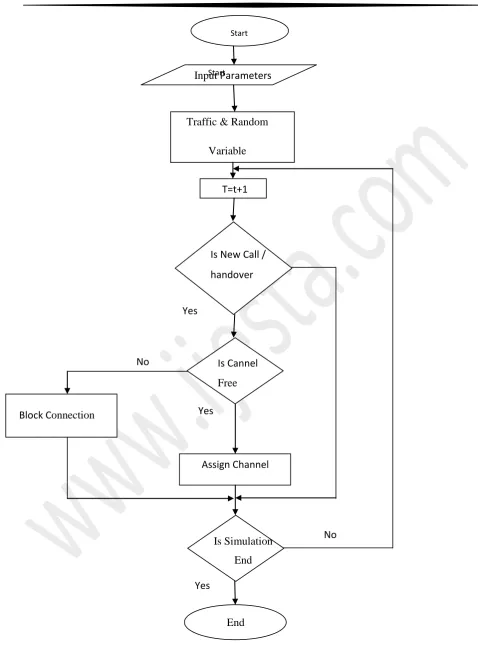
Figure (4.1): Flow chart of the first simulation
Start
Input Parameters
Traffic & Random
Variable
T=t+1
Is New Call / handover
Is Cannel Free
Assign Channel
Is Simulation
End
End
Block Connection
No
No Yes
Volume 03, No. 07, July 2017
P
age
4
Figure (4.2): Flow Chart of Second Simulation
Scenario
Start
Input Parameter
Traffic & Random Variable Generation And Traffic
Classification T=t+1
New Call Arrive / Handover
Is Channel Free?
Assign Channel
Is Simulation End
End Delay
Is Channel free
Is Delay ≥ Delay th
Block Connection Modification
No
Yes
Yes No
No
No
No Yes
Volume 03, No. 07, July 2017
P
age
5
4. SIMULATOR RESULTS VALIDATION
The random generators have been tested and the graphical results indicated its performance. The mobile position generated according to non uniform distribution in which the cell in middle has a very large number of mobiles as in figure (3) from the simulation output. This done to create asymmetric traffic load.
Figure (3): non uniform distribution of the mobile position
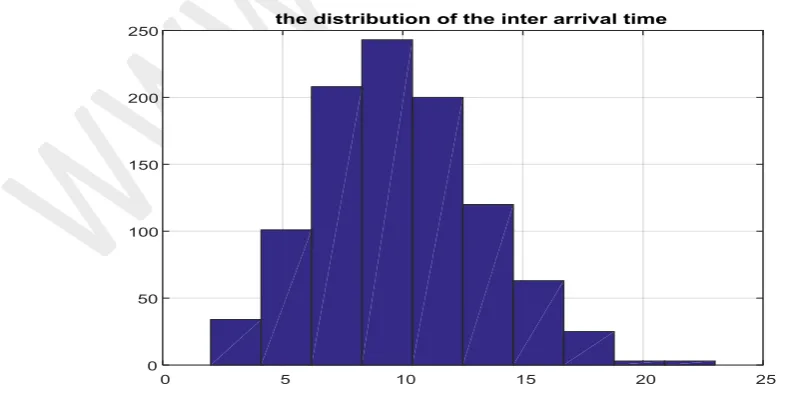
The traffic generator is tested and the result indicates its efficiency. That generator includes the call interarrival and call duration as in figure (4) and (5). The call interarrival is Poisson random distribution. The call duration has a uniform distribution
Volume 03, No. 07, July 2017
P
age
6
Figure (5): call duration
5. THE EFFECT OF THE MOBILITY AND TRAFFIC VARIATION
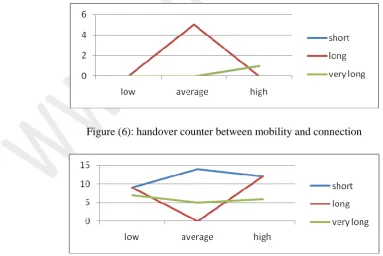
The handover counter or handover request for 1000 users with very long and short connection is proportional to mobility. In long connection the average mobility has a higher handover request. The results also show that the handover increase due to high mobility, as in figure (6). In the average the handover request increase with the mobility. The handover request was identical in the results of the two simulation scenario. Figure (7) shows the new call block and it’s identical in the two simulation scenario. The handover counter or handover request for 500 users is also has a similar pattern to the 1000 users.
Figure (6): handover counter between mobility and connection
Volume 03, No. 07, July 2017
P
age
7
6. PERFORMANCE ENHANCEMENT IN THE PROPOSED HANDOVER ALGORITHM
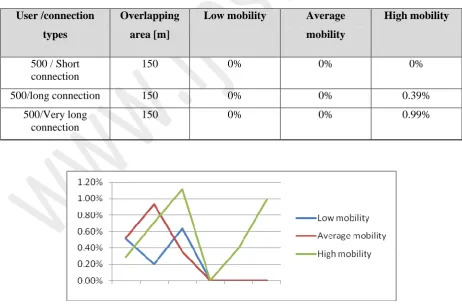
Table 1 and 2 shows the enhancement percentage for the proposed handover algorithm. Figure 8 shows the general performance and enhancement in the handover failure. The proposed algorithm has better performance in high mobility. The performance for low and average mobility is better for large number of user 1000 user however there is no enhancement for low number of users 500 user.
Table 1 Connection blockimprovement percentage for 1000 users
User /connection
types
Overlapping
area [m]
Low mobility Average
mobility
High mobility
1000 / Short connection
150 0.51% 0.52% 0.29%
1000/long connection 150 0.20% 0.93% 0.71%
1000/Very long connection
150 0.64% 0.35% 1.12%
Table 2 Connection blockimprovement percentage for 500 users
User /connection
types
Overlapping
area [m]
Low mobility Average
mobility
High mobility
500 / Short connection
150 0% 0% 0%
500/long connection 150 0% 0% 0.39%
500/Very long connection
150 0% 0% 0.99%
Volume 03, No. 07, July 2017
P
age
8
7. CONCLUSION
There are problems of a new call blocking in the mobile network. These problems occur due to the demand of the channel and lack of channel resources. The fixed and dynamic assignment has its disadvantages. The HCA was proposed to over comes those disadvantages because it contains fixed channel for each cell and other shared channels for the entire cell in the cluster. However the HCA algorithm in the mobile switching center is not adaptive because the percentage of shared and fixed channels is not varying according to the traffic. This might cause a handover blocking problem especially if the traffic load is asymmetric. Another important factor in channel allocation is the new calls vs. handoff calls. From a customer point of view it is much less desire able to drop a call in the middle of the connection because of lack of channels in the cell the customer is moving into rather than to be denied admission of his service request at all Virtually all channel assignment protocols give priority to handoff calls over new calls.
In this studies identify the effect of the mobility on the new call blocking and handover failure, determine the effect of the cell overlapping and traffic load variation on the new call blocking and handover failure and Develop a smart adaptive channel assignment algorithm, with the possibility of varying the percentages of shared and fixed channels according to the traffic load distribution with a consideration of the handover.
The proposed algorithm shows unique solution to enhance the mobile network performance. This work estimates the full network capacity with the available channels, and with various mobility patterns.
REFERENCE
i. 3GPP TS 23.107 V6.3.0. 3rd Generation Partnership Project, “Technical Specification Group Services and System Aspects; Quality of Service (QoS) Concepts and Architecture”, June 2005.
ii. Anjlica Malla, Mona El-Kadi, Stephan Olariu and Petia Todorova, “A fair resource allocation protocol for multimedia wireless networks”, IEEE Transactions on Parallel and Sánchez Soriano, “User QoS-based multi-channel assignment schemes under multimedia traffic conditions”, in Proc. of IEEE ISWCS, pp. 113-117,2007.
iii. P.M.Papazoglou1, D.A.Karras2, R.C.Papademetriou” Improved Integral Channel
Allocation Algorithms in Cellular Communication Systems Enabling Multimedia QoS Services". Issue 10, Volume 7, October 2008.
iv. Rincy George, Jude Hemanth, Karunya University, Coimbatore. "Application of an Optimization Algorithm for Channel Assignment in Mobile Communication" DIA, 2011.
v. M.P. Mishra, P. C. Saxena.“Survey of Channel Allocation Algorithms Research for Cellular Systems” International Journal of Networks and communication.2012, 2(5).
vi. P.Ravi, P.Jesu Jayarin,“Optimal Channel Allocation Mechanism to Improve the QoS
Volume 03, No. 07, July 2017
P
age
9
vii. Swati Sonavane1 and Dr. R. R. Sedamkar," Improved Channel Assignment Scheme in Cellular Mobile Communication”. International journal of Emerging Trends & Technology in computer science (IJETTCS). Volume 1, Issue 3, September – October 2012.
viii. “Dynamic Channel Allocation and Revenue Based Call Admission Control Using Genetic Algorithm”. International Journal of Advanced Research in IT and Engineering.Vol. 1 .No. 5 | November 2012.
ix. Seong-Hoon Lee, Byung-Tae Chun, “An Intelligent Channel Allocation Mechanism”
SERSC 2013.
x. Zahedi Azam, Saif Mohammad Towfiqul Islam, Aktar uzzaman, “A Hybrid-FAIL
Dynamic Channel Allocation Method in GSM System”. International Journal of Science and Research (IJSR), India Online ISSN.Volume 2 Issue 1, January 2013. xi. Smriti Dubey, Sati, “Optimal Channel Allocation with Hot-Spot Technique in
Wireless Network”. International Journal of Computer Applications. Volume 61– No.10, January 2013.
xii. Arafat Abu Mallouh, Christian Bach, and Abdullah A. Abdullah., “Dynamic Channel
Allocation in Cellular Networks”. International Journal of Innovation and Applied Studies. 2013 Innovative Space of Scientific Research Journals.
xiii. G. Arul Dalton, Dr. T. Jeba Rajan, Dr. K. Siva Sankar, “An Optimized Channel Assignment Strategy for Wireless Cellular Networks”. International Journal of Engineering Research & Technology (IJERT) Vol. 2 Issue 7, July – 2013.
xiv. Zhiyuan Hu, Fei Ye, Yanggen Yuan, Xueliang Zhi , Jun Tang, “The Performance of
Virtual Mesh Network and Channel Assignment”. Journal of Computational Information Systems. August 15, 2013.
xv. R R Kar, S S Nayak, “An Efficient Adaptive Channel Allocation Scheme For Cellular
Networks” IOSR Journal of Computer Engineering (IOSR-JCE). 8727Volume 16, Issue 2, Ver. V, Mar-Apr. 2014.
xvi. Sangil Choi and Jong Hyuk Park, “Minimum Interference Channel Assignment
Algorithm for Multicast in a Wireless Mesh Network”. Academic Editors: Luis Javier Garcia Villalba, Anura P. Jayasumana and Jun Bi Received: 10 August 2016;
xvii. Mohamed Abdelghader Morsi, Ashraf Gasim Elsid Abdalla, Mohammed
Abaker,“Adaptive Hybrid Channel Assignment (AHCA) Algorithm”, International Journal of Emerging Technology & Research, Volume 2, Issue 1, Jan - Feb, 2015. xviii. Mohamed Abdelghader Morsi, Dr.Amin Babkir A.Alnabi, Dr.Ashraf Gasim Alseed,
“New Adaptive Channel Assignment scheme for Cellular Network”, International Journal of Computer Engineering and Applications, Vol IX, Issue IV, April 2015.
xix. Zhang, W.; Xing, H.; Cheng, J.; Nallanathan, A.; Leung, V.C.M. Secure Resource allocation for OFDMA two-way relay wireless sensor networks without and with cooperative jamming. IEEE Trans. Ind. Inform.2016, 12, 1714–1725.