CONTRIBUTOR'S
SECTION
T HE OBJECFIVESof pediatric training pro grams for house officers (residents) have been scrutinized by several groups in recent years,1° and the changing role of pediatricians in modern American society has evoked a great deal of discussion in medical journals.716 No clear answer is presently available as to the ultimate role pediatricians should or will have in the medical care and health supervision of chil dren and their families. Proponents of all shades of opinion are heard, from those who advocate a purely hospital consultant position for the pediatrician to that of a family medical practitioner.
The Children's Medical Center in Bos ton, likeother departments of pediatrics throughoutthe country,has been gradually changing itsresidencyprogram in an effort to meet some of these challenges. In plan ning for such changes, it seemed essential to ascertainfrom previoushouse officers the nature of their careers subsequent to leaving the hospitaland to obtain their opinions on the merits and deficiencies of their own training program in the light of their ensuing experiences. It is recognized that each traininghospitalwillhave cer tain unique features which may require a somewhat differentresidency program. Nevertheless,itisbelievedthatthe results of a questionnaire type of survey of the physicians who served as house officers in this hospital from 1946 through 1957 will be interesting to others. Perhaps this will stimulate studies from other institutions, which will together provide a more com prehensive view of these problems.
Supported by grants from the Commonwealth Fund.
ADDRESS: (R.J.H.) 300 Longwood Avenue, Boston 15, Massachusetts.
Pxnwnucs, November 1960 858
EDUCATION
EVALUATION OF A PEDIATRIC HOUSE OFFICER PROGRAM
Robert J. Haggerty, M.D., and Charles A. Janeway, M.D.
Department of Pediatrics, Harvard Medical School, and the Children's Medical Center, Boston
THE SURVEY
Questionnaires were sent to the 171 physi cians who had served on the regular house staff during the 12-year period since World War II; 152 (89%) were returned. The 11%who did not return the questionnaire are known to be corn parable to the respondents in type of present career. The data collected represent a large majority and should be a fair sample of the opinion among the former house officers queried.
Certain vital statistics were collected, such as sex, age, place of obtaining medical degree, and present residence. These are not pertinent to thisreport.
The present type of career was determined from the replies by arbitrarily assigning to each category those persons who spent 75% or more of their time in either pediatric practice or academic and research careers. A small number stated that they were primarily in practice, but spentonly50 to75% oftheirtimeinthisarea. Thesewere added to thepracticegroup.
RESULTS
CareerNumberPer Cent1.Full-time practice (75% ormore7148.92.Mainly practice (50—75%)106.93.Research-teaching4833.14.Left pediatrics1611.014599.9Still in training7Total152
Percent of TimeHealth
SupervisionAcute illnessChronic illnessNo. %No. %No.Under25% 26—50% 51—75% 75%ormore Totals*11 21.6 18 85.2 19 87.8 8 5.910 17.5 17 29.8 20 85.2 10 17.537 80.4 5 10.9 1 2.2 3 6.551
100.057 100.046 100.0
EDUCATION
were noted in the replies to the question naire; but most were generally pleased with their work. In reply to the open-ended question : “¿Whatwas the most valuable as pect of your residency training?―, the great majority listed extensive experience with a wide variety of seriously ill children, con tact with stimulating teachers, and the crit ical approach to diagnosis and therapy of medical problems.
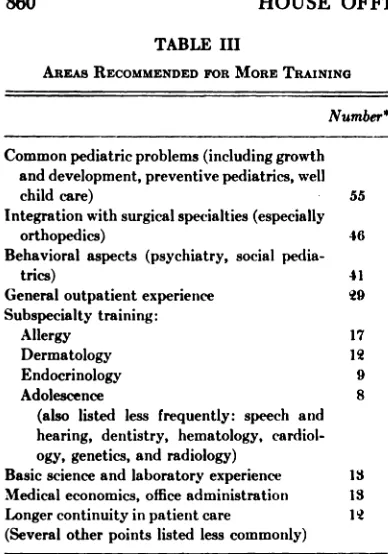
Perhaps most important, in view of our wish to determine which aspects of the training program needed to be improved, were answers to the question : “¿Inwhat areas do you feel house officers should have more training to be best prepared for pe diatrics in the future?― With this type of open-ended question many replies were naturally difficult to categorize, but broad groupings have been listed in Table III. Especially significant were the large num ber who prefaced all their remarks by stat ing that more of this or that subject was not what was needed, but that exposure to stimulating teachers who taught by pre cept, or who were available to discuss prob lems as they arose in clinical material, was most important. With these reservations it is apparent from Table III that many in both the fields of practice and of teaching felt a need for more emphasis on under standing and management of common pe diatric problems, preventive pediatrics, out patient or ambulatory care, and the be havioral aspects of pediatrics. However,
TABLE II TABLE I
PRESENT CAREERS OF FORMER HOUSE OFFICERS
shown to be the case for the United States in 1949.'@
pediatricians in
It has been stated that as many as one third of practicing pediatricians are dis satisfied with their careers.7 While many of this group of former house officers have only recently started on their careers, and the number who become disenchanted with practice may increase with time, at present only seven have left pediatric practice. Some have gone into academic work and a few to other fields, while five have in the same time left an academic or research ca reer for practice. Of the 16 who have left pediatric medicine since residency, 8 have gone into pediatric psychiatry as they had planned, and 2 each have gone into in ternal medicine, public health, anesthesia or surgery. Frustrations and drawbacks in all present careers, including those of profes sors as well as of those in private practice,
TIME SPENT IN VARIOUS ASPECTS OF PRACTICE BY GROUPS 1 AND 2 OF TABLE I
860 HOUSE OFFICER PROGRAM
TABLE III
AraAS RECOMMENDED FOR MORE TRAINING
monly listed area of need was that of ex perience in the preventive and behavioral aspects of pediatrics. While some indicated
Number8 that this could be learned quickly once in
—¿__— practice, most believed they needed some
contact with these problems while in train
55 ing, when the same critical approach, in
cluding a review of the literature and dis
46 cussions, could be applied to these fields
as is now the custom with the serious, rare
::@disease
states
often
seen
onthe
inpatient
services. It is evident that many believe that17 being of “¿goodwill― and having an interest 12 @nthese areas of preventive pediatrics is
:
not
enough
toenable
aphysician
todoa
good job and that careful training under guidance is just as important here as in any other field of medicine.13
@ seems apparent that the future will
@:continue
tobring
about
changes
inpediat
rics as in every other field. Pediatric education and training will be forced to adapt it self to meet these changes. The complexity of the problems and uncertainty of the fu ture should not alter attempts to provide more individualized training programs de signed to add some of these newer dimen sions, while at the same time keeping the virtues of sound training in the traditional inpatient pediatric setting.
REFERENCES
1. American Academy of Pediatrics: Report
on Regional Conferences of Pediatric
Educators,Committeeforthe Improve ment of Child Health. PEDIATRICS,9: Suppl. to May issue, 1952.
2. Richmond, J. B.: Some observations on the sociology of pediatric education and practice. PEDIATRICS,23:1175, 1959. 3. Wilson,J.L.:Letterto ContributingEdi
tor.PEDIATRICS,17:111,1956. 4. Deisher, R. W.: Pediatric residency pro
gram. PEDIATRICS, 16:541, 1955.
5. Green, M., and Stark, M. A.: Postgraduate program for the longitudinal health supervision of infants. PEDIATRICS, 19:
499,1957.
6. Powers, G.: American pediatrics—the com ing years.PEDIATRICS,16:688,1955. 7. Tabrah, F. L.: The pediatrician's role in
society(LettertotheEditors).J.Pediat.,
51:745, 1957.
Common pediatric problems (including growth and development, preventive pediatrics, well child care)
Integration with surgical specialties (especially
orthopedics)
Behavioral aspects (psychiatry, social pedia
trics)
General outpatient experience
Subspecialty training: Allergy
Dermatology Endocrinology
Adolescence
(also listed less frequently: speech and
hearing, dentistry, hematology, cardiol ogy, genetics, and radiology)
Basic science and laboratory experience Medical economics, office administration
Longer continuity in patient care
(Several other points listed less commonly)
* Since several gave more than one answer and some
no answers, the totals are not listed.
none stated that this should be at the ex pense of the time spent in the care of seri ously ill inpatients. At the Children's Medi cal Center, a general hospital for infants, childrenand adolescents,what iscommonly calledpediatricsisorganizedas the Medi cal Servicewhich has generalservicesand several special divisions (cardiology, neu rology, tumor clinic). Pediatric surgery, or thopedic surgery, neurosurgery and otolar yngology have separate services. Many re plies indicated that more integration with these services, especially outpatient ortho pedics and general surgery, were necessary to prepare a pediatricianfor practice,and several indicated a need for more experi ence in the medical sub-specialties, espe cially in allergy and dermatology.
EDUCATION 861
8. Parmalee, A. H.: Pediatric rewards. J. Pediat., 51:752, 1957.
9. Hill, L. W.: Letter to the Editor. J. Pediat., 52:490, 1958.
10. Editor's Column: Pediatric practice and its
rewards. J. Pediat., 52:769, 1958.
11. Crook, W. G., Harrison, W. W., and Craw ford, S. E.: Pediatric practice can be re warding. J. Pediat., 52:115, 1958. 12. White, P. J.: New pediatricians: new pe
diatrics. PEDIATRICS, 16:537, 1955. 13. May, C. D.: Can the new pediatrics be
practiced? (Editorial.) PEDIATRICS,23:
253, 1959.
14. Ibid.: On the teaching and practice of the new pediatrics. PEDIATRICS, 23:1038, 1959.
15. Letters to the Editor. PEDIATRICS,23:812, 1005,1199,1959.
16.Harned,H. S.:A challengetopractitioners
(Letter to the Editor). PEDIATRICS, 24: 859, 1959.
17. American Academy of Pediatrics: Child Health Services and Pediatric Educa tion. New York, Commonwealth Fund, 1949.
VIRAL INFECTIONS OF INFANCY AND CHILD
HOOD, Harry M. Rose, M.D. New York,
Paul B. Hoeber, Inc., 1960; Number 10, Symposium of the Section on Microbi ology, The New York Academy of Medi cine, 244 pp., $8.00.
Viral Infections of Infancy and Childhood
is a collection of papers presented at a sym
posium at The New York Academy of Medi cine in March 1958. The authors are well known virologists or pediatricians from various
parts of the United States, England and Eu
rope. The topics were obviously selected for their special interest and timeliness; some pre sent new concepts and others are devoted to a much needed review of present-day develop ments in special areas. Where necessary the papers have been brought up-to-date by foot notes and addenda.
The papers were written for the practicing pediatrician by experts in the field. For the entirely clinically oriented, the bulk of the book presents papers on topics such as “¿TheRole of Echo Viruses in Human Disease―by Sabin, and “¿CoxsackieVirus Infections of Children―by Hodes, or infiuenzae vaccination by Curnen and Davenport and Hennessy. Then there are a few more theoretical papers like those of Alexander and Colter on infectivity of viral ribonucleic acid, and that of Isaacs on inter feron.
Most of the papers are excellent reviews of
their subject and have selective bibliographies. Further, there is an index with useful cross references. Almost anyone interested in viral infections will find this little book easy to use, pleasant to read, up-to-date and informative.
1960;26;858
Pediatrics
Robert J. Haggerty and Charles A. Janeway
EVALUATION OF A PEDIATRIC HOUSE OFFICER PROGRAM
Services
Updated Information &
http://pediatrics.aappublications.org/content/26/5/858
including high resolution figures, can be found at:
Permissions & Licensing
http://www.aappublications.org/site/misc/Permissions.xhtml
entirety can be found online at:
Information about reproducing this article in parts (figures, tables) or in its
Reprints
http://www.aappublications.org/site/misc/reprints.xhtml
1960;26;858
Pediatrics
Robert J. Haggerty and Charles A. Janeway
EVALUATION OF A PEDIATRIC HOUSE OFFICER PROGRAM
http://pediatrics.aappublications.org/content/26/5/858
the World Wide Web at:
The online version of this article, along with updated information and services, is located on
American Academy of Pediatrics. All rights reserved. Print ISSN: 1073-0397.